
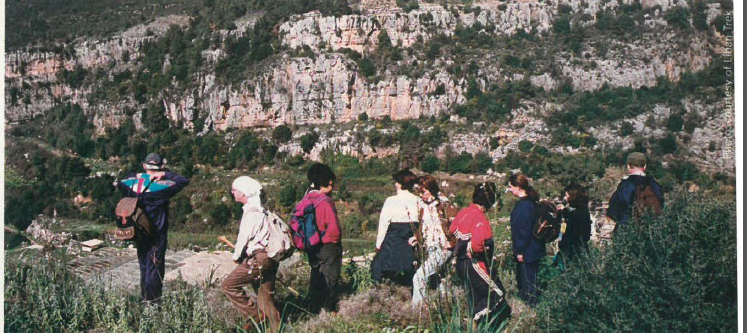
For many people, discovering Lebanon means visiting
archaeological sites and driving to remote villages to
lunch at local restaurants. That may be fine when the
grandparents are along, but for a growing number of people,
a simple trip to the mountains just doesn’t cut it. They want
more: more contact with nature, more exploring and more of the great outdoors. If
this sounds like what
you’re looking for,
now is the time to discover
trekking.
“Trekking is accessible,”
says Pierre Abi
Aoun of Wild Expeditions.
Other activities,
such as rock
climbing and rafting,
are technical and
require a certain
amount of skill, as
well as sporting
equipment. Trekking
needs no training.
“All that is needed is a
good pair of boots,”
says Michel Moufarege
of Liban Trek.
Lebanon’s mountains
and valleys
offer plenty of playgrounds for adventure. “Trekking is ecotourism par excellence,”
says Moufarege (see box). Treks often include cultural
excursions to sites where classical tours don’t go.
Besides its natural attributes, the Qadisha Valley, for example,
has a rich cultural heritage. “There are a lot of caves that
were occupied by monks and villagers during the Middle
Ages,” says Abi Aoun. “The only way to get to them is on
foot.” The Deir Es Salib cave, for example, is a site that
requires vigorous rock climbing to visit.
Trekking programs are divided according to levels of
difficulty. Liban Trek has two programs to the Horsh Ehden
nature reserves, one for beginners and one for amateurs. The
company also organizes a hike for those with an athletic aptitude
to Qornet Assawda, Lebanon’s highest peak at 3,083
meters.
Treks are led by one or more guides, who explain
the geography and history of the areas being explored.
Besides being educational, treks are socially stimulating and
a great way to meet people.
Liban Trek and Wild Expeditions provide bus transportation.
“The advantage is that we can start the hike at
point ‘A’ and finish at point ‘B’, where the bus retrieves the
group,” says Moufarege. “With cars, we would have to
make circular tours to get back to the starting point.”
If
transportation is included, costs rise to about LL 30,000 per
person. Lebanese Adventure doesn’t offer transportation,
so its treks cost about LL 15,000 per person. Prices are
determined based on the distance to destinations and on
entrance fees for reserves. Participants should bring a
simple picnic lunch, except when itineraries include lunch
at a local restaurant.
Down with five-star hotels
There’s historical Lebanon, with its Phoenician and
Roman sites. There’s leisure Lebanon, with its
beaches and ski resorts. And there’s carnal Lebanon,
with its nightlife, casinos and shopping galore. These
assets, which attracted tourists by the millions during
the country’s heyday, won’t be enough to entice a new type
of traveler that has since emerged – ecotourists.
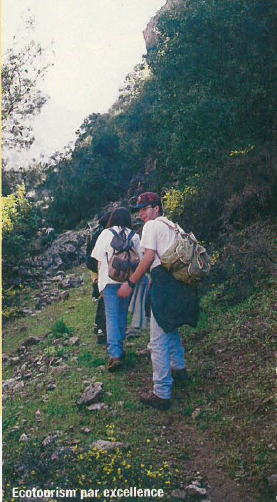
These
modern-day adventurers are into nature trails and prefer
to explore countries while doing outdoor activities such as
trekking, cross-country skiing, caving, birdwatching and
camping.
“Ecotourism is the fastest-growing segment of
tourism,” says Felix Tohme of TLB.
Realizing this, the Ministry of Tourism recently formed a committee
to promote Lebanon as an ecotourism destination.
Some local tour operators are already trying to capitalize on
the growing demand for ecotours. TLB offers off-road
adventures that incorporate ecotourism. For example, it
offers a 16-day journey through Lebanon, Jordan and Syria.
Participants travel in 4×4 vehicles and stop to explore valleys,
mountains, deserts, towns and archaeological sites.
TLB also offers a number of nine-day package trips
through Lebanon, including a cross-country ski trip.
“Lebanon has natural assets that neighboring countries
don’t have,” says Tohme. “It’s easy to spend a couple of weeks
in the mountains.”
Some nights the participants camp out. On
other nights, they stay at mountain lodges or family homes in
remote villages. Because travelers visit out-of-the-way
places, ecotourism helps develop rural areas.
To have a successful ecotourism sector, preserving the
environment is a must. “If we don’t have a healthy and beautiful environment we can’t play a role in the ecotourism field,”
says Andre Bechara of Lebanese Adventure, which is
responsible for all outdoor activities in the Chouf nature
reserve.
“Lebanon’s nature is deteriorating fast,” says
Michel Moufarege of Liban Trek. Laws exist, but they often
aren’t enforced. For example, there’s a law that forbids bird
hunting, but it is largely ignored. Similarly, regulations exist
regarding quarrying, but the practice continues
unchecked.
“The best way to safeguard the environment
is to make big natural
reserves – protected
areas,” says Bechara.
Ecotourism requires
its own infrastructure,
including first aid facilities,
helicopters for
mountain rescues, forest
rangers, standardized
signs and up-to-date
maps.
A stable political environment
is needed to capture
more tourists. Liban
Trek was established in
1997, “on the eve of what
we thought was peace,”
says Moufarege. “We
expected more incoming
tours.” In the interim, Liban
Trek, like most companies,
concentrates on the
local market.
