
With the principles of Zen Buddhism governing
all aspects of life in Japan of old, it’s no wonder
that many practices from this rich civilization
evolved from meditative study. Take Ikebana, the
ancient art of flower arranging that has an entire philosophy
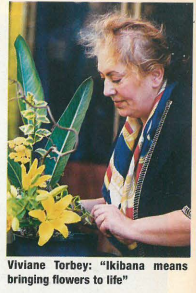
built around it. “Ikebana means ‘bringing flowers to life’,”
says Viviane Torbey, a pupil of the Ohara school of Ikebana.
The three leading schools Ikenobo, Ohara and Sogetsu
prescribe different styles, but all adhere to the same basic
principles. “The basics are very simple: heaven, man and earth
should be represented in flower arrangements,” says Torbey.
Occidental flower arrangements display man’s control over nature.
Ikebana arrangements depict life, in which man represents
one part of the overall design.
For this reason, the seasons of the year influence what
materials should be used. Whereas occidental arrangements
might use roses all year round, Ikebana arrangements are seasonal.
“You must study nature well,” says Arsho Tutungian,
a pupil of the Sogetsu School. “In the middle of spring you
cannot use autumnal things.”
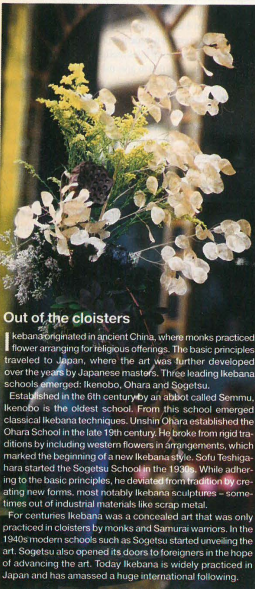
Everything in nature can be put to use, from blooming
flowers to bare branches and stones. Every element conveys
a meaning. Driftwood symbolizes the past, branches the present
and twigs the future. Likewise, every phase of a flower’s life is symbolic:
buds represent the future, blossoms the present and pods the
past. And every type of flower has its meaning. For example, irises symbolize
man and lotuses, sacredness. By combining
materials, one can express ideas.
“If you know your materials, with a few
branches and a few flowers, you can
create a universe,” says Tutungian.
Heaven is usually represented with a
main branch. For emphasis, smaller auxiliary
branches can be added. The same
concept applies to materials representing
man and earth. Ikebana arrangements can consist of as little as two flowers.
Double arrangements, two separate arrangements of similar themes, are
linked together by branches or other materials. Sculptures of
up to 20 feet are also possible. “This is when you reach the top
when you are a master,” says Torbey.
Flowers may be thrown loosely in a vase. With this style,
which is called Nageire, the flowers rest freely and create
their own harmony. However, ordinarily Ikebana arrangements
are affixed to pin holders, which can be difficult to
work with. Thus, Ikebana teaches self-discipline and optimism.
It also teaches concentration and meditation.
Whereas in occidental arrangements flowers are continuously
added, in Ikebana space is very important. “By taking
your time and studying each material well, Ikebana transfers
you to a completely different world you feel yourself
at one with nature,” says Tutungian.
Ikebana philosophy says that nature may be used, but it must
not be exploited. As a student, Torbey said she was forbidden
to buy flowers from florists. “Because we had to learn how to
cut.” Branches must be cut so as not to bruise the veins, which
absorb water, allowing flowers to live longer. When cutting
flowers, it is important to cut in between the leaves and the stems
must remain in the soil so that plants can regenerate.
Prior to the war Tutungian, who has a master’s degree in Ikebana,
gave classes at the Japanese embassy. They ran at full
capacity. “The Lebanese loved Ikebana before the war,” she
says. “But now they like more elaborate and decorative
arrangements not the poetic Japanese Ikebana.” Today interest
in the art has all but disappeared in Lebanon. Classes are
no longer available, and there’s little chance of finding Ikebana
arrangements at flower shops. Tutungian and Torbey can
accommodate custom orders. Tutungian now works as a floral
designer and wedding planner, and Torbey creates dry
flower arrangements at her shop Style & Nature. Fortunately,
both women are also skilled in occidental flower arranging.
Both women recently gave Ikebana presentations at a flower
show organized by the YWCA and are happy that more people
are expressing an interest in Ikebana. Both talk of starting
courses, in the hope of reviving the art in Lebanon.
