
Hand-woven carpets are likened to works of art. Collectors
will pay large sums of money to own valuable
antique pieces. None are more desired than
Persian and Caucasian carpets.
Persian carpets are identified by their floral designs. But
there are countless types, such as Isfahan, Kashan and
Nain, which are named after the villages where they were
made. They are made of silk, wool or a combination of the
two and are based on either cotton or silk. The tribal rugs
have busy geometrical designs and are made of wool. The
finer the knot, the greater the value. “Whenever it’s a fine
knot, you get a very clear design on the back side,” says Heydar
Maktabi of Hassan Maktabi & Sons. He retrieves a finely
knotted 2m x 1.5m carpet made of wool and based on silk.
It is priced at $10,000.
What determines the value? “For old carpets it’s the rarity
of the piece,” says Maktabi. He reveals a prized antique
carpet, a Kirman Lavar that is over 200 years old and in perfect
condition. The 2m x 3m carpet, which bears two
stamps, has an interesting history. An Iranian governor commissioned
the piece, which has a twin located in the Iranian
museum. Maktabi is asking $250,000.
While antique Persian carpets are valuable, the 20-year US
embargo on Iran crippled demand. Prices are low because
of the devaluation of the Iranian currency. “It’s a very
good time for people to buy carpets,” says Maktabi. Many
can be found for under $2,000.
Caucasian carpets, identified by their bold geometrical
designs, are more in fashion than their Persian counterparts.
This is partly because the designs suit a wide variety of
decors. Today Caucasian carpets are made of synthetic
wool and chemical dyes, mechanically woven and are
priced as low as $200. Since hand-weaving techniques
have all but disappeared, old Caucasian carpets command
high prices. No two carpets are identical. Additionally, old
carpets are made from organic dyes and handspun wool.
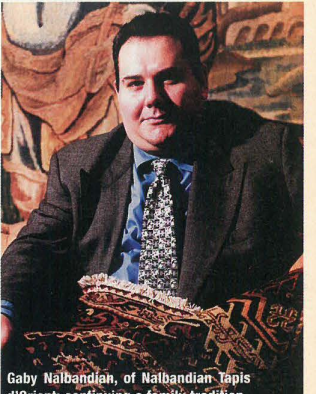
Nalbandian Tapis d’Orient has an inventory of about
9,000 old Caucasian carpets. “All the old pieces were collected
by my father and grandfather 35 to 40 years ago,” says
Serge Nalbandian, one of the fifth-generation team now at
the helm of the business. “They used to buy the carpets for $5
and $10 a piece.” Today they are worth $5,000 to $10,000.
There are four main types named after the region where they
are made: Kazak, Karabajh, Chirvan, and Kuba. How is a carpet’s
value determined? “By its age, the rarity of the design,
and the condition of the carpet,” says Nalbandian. He displays
a yellow 140cm x 120cm carpet that is over 100 years old and
priced at $7,000. “For a worthy piece, the average price for an old Caucasian is about $3,000 to $3,500,” he says.
The Nalbandian family reintroduced the tradition to
Armenia two years ago to
attract buyers that cannot
afford such prices and to
revive the hand-weaving
technique. Production is
small, at about 40 to 50
pieces a month. Most are
marketed in the US, but
some are available here.
He displays one that is 2m
x 1m and sells for $1,500.
Its antique counterpart
sells for about $7,000.
While Persian carpets
are valued by the fineness
of the weave, Caucasian
carpets aren’t. “You should
look at their beauty,” says
Nalbandian. His family
heirloom is an antique
worth about $250,000.
Called a ‘Star Kazak’, only
13 exist in the world. “The rarity of ours is that it has all the colors
used in Caucasian carpets in one piece.”
So French
Buying antique tapestries is like
buying paintings by great artists.
Collectors pay up to $250,000 for masterpieces. The tapestry business flourished in France
between the 17th and early 20th century. What determines
a treasure? According to Hratch Nalbandian, it’s a combination
of things. “If the painter
and weaver are known and the
subject is unique, then it’s an
interesting tapestry.”
Tapestries were based on oil
paintings. Aubussun was one
area in France that was famous for
its tapestries. Other notable mills
were located in Gobelins, Felletin,
and Beauvais. Nalbandian’s shop,
Loutfik Nalbandian & Fils, has an
impressive selection of antique
tapestries. He unfolds an 18th
century piece, based on a painting
by Boucher and retrieves a book
detailing its history. The artist’s
series ‘Italian Village Scenes’ was
reproduced into tapestries a number
of times. “But no two pieces are
the same,” says Nalbandian. His
piece was based on a painting,
‘The Gypsy Fortune-teller’. Thirteen tapestries were produced based
on this painting, five of which are
known to be in museums. “And one is in my shop,” says Nalbandian. Once the piece is fully
repaired, his asking price will be about $140,000.

With tapestries, there’s no graspable range for prices:
19th century tapestries cost
$8,500 to $60,000, 18th century
ones go for $10,000 to
$150,000, while those dating
from the 17th century run at
$70,000 to $250,000. The art is
still alive and well, but many
mills relocated to the Far East,
because of the high production
costs in France. Nalbandian
advises first-time buyers
against purchasing at auctions,
because good deals are
usually for damaged tapestries.
Restoration work isn’t
cheap and can cost more than
the purchased price. Nalbandian
has a small workshop
where three women sit
painstakingly mending tapestries.
“You have to appreciate
the art to recreate it again.”
