
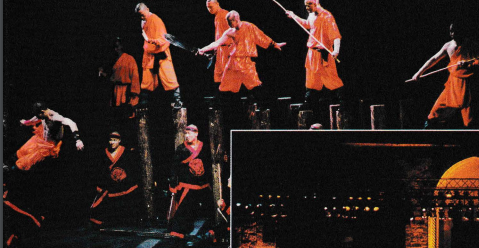
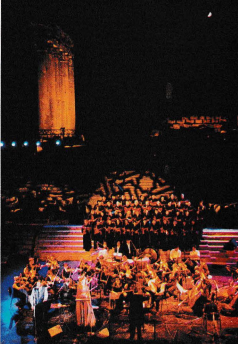
Accompanied by the Budapest Concert Orchestra, Dame Kiri Te Kanawa launched this year’s festival season on July 1. The celebrated soprano’s captivating performance at Beiteddine proved a good indicator of things to come. Spectacular open-air performances, at the ancient sites of Beiteddine and Baalbeck, have once again placed Lebanon’s two festivals among internationally renowned cultural events.
At Beiteddine the reigning king of flamenco, Spaniard Joaquin Cortes, gave a spirited dance performance accompanied by his troupe of 12 dancers and 20 musicians. The Shaolin Monks from China presented ‘Wheel of Life’, a display of martial arts dexterity with a dance-like choreography. Moroccan singer Hassan Hakmoun had the crowd on their feet. At the time of going to press, the artists scheduled to perform were rock legend Joe Cocker and celebrated vocalist Jessye Norman.
For its grand finale, Beiteddine will feature Lebanon’s legendary diva, Fairouz, in a concert directed by Ziad Rahbani. She is scheduled to perform on August 4 and 5, and tickets are selling fast.
Baalbeck’s opening performance on July 7 was an Oriental production called Anachid, at the Temple of Jupiter. The two-part show featured musical renditions of old texts and love poems. Fadia Tomb El Hage and Abdelkarim Chaar sang in Arabic to contemporary classical music composed by Marcel Khalife and Zad Moultaka. Accompanying them was the Boulogne-Billancourt Orchestra and the Louaize University Choir.
Unfortunately, an excerpt from the Old Testament’s love poem, Song of Solomon, sparked a controversy. A few unenlightened members of parliament claimed that references to Israel ‘glorified’ that country and undermined ‘national achievements’. For security reasons, composer Moultaka removed the ‘offensive’ passage from the second night’s performance. Besides infringing on freedom of artistic expression, such dim-witted commentary from politicians hurt efforts to reestablish Lebanon’s cultural heritage on the world stage.
Next up was the Merce Cunningham Dance Company, in a modern production called ‘Event’. The act scheduled to follow was African Rhythms and Jazz. The three-part show “was a crescendo,” says committee member Wafa Saab. Tunisian Anouar Brahem and an acoustic trio started the act with a temperate beat. French violinist Jean Luc Ponty, accompanied by an African quartet, raised the tempo with an ethnic jazz arrangement. Finally, Papa Wemba heated things up with Zairian rumba.
The next event is for lovers of classical music: The Franz Liszt Chamber Orchestra will present ‘A Tribute to Bach’, in commemoration of the 250th anniversary of the composer’s death.
If you missed the July events, there are still four shows taking place at Baalbeck. Puccini’s opera ‘Tosca’ is to be presented by an ensemble of distinguished artists, including tenor Jose Cura, soprano Tiziana Fabbricini and Paolo Pecchioli. Accompanying them is the Philharmonic Orchestra from Italy, conducted by Maestro Piergiorgio Morandi.
“This is a big event; the costumes will be lent to us by the Theatre La Scala of Milano,” says Saab. She says that ‘Tosca’ is the costliest production in this year’s lineup, and that Argentinean Cura is of Lebanese origin. His performance at Baalbeck marks his first visit to Lebanon.
Not to be missed is the Buena Vista Social Club. The famed Cuban band, accompanied by 92-year-old singer Compay Segundo, will conclude its world tour at Baalbeck with a single performance. “Whenever you get the chance to have Compay Segundo, you just grab it,” says Saab. As an opening act, Orquesta Aragon will play music that combines Cuban rhythms and African instruments.
Next up are singer Wadih Es Safi and the Fahd Abdallah Folklore Troupe, in collaboration with Rafic Ali Ahmad and Siham Es Safi. They will give a performance celebrating traditional Lebanese songs and dance.
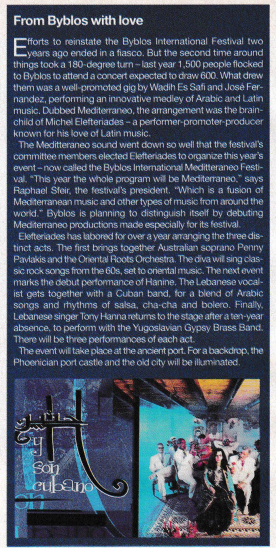
For the final presentation, Frenchman Julien Jalal Eddine Weiss, virtuoso of the zither and founder of the Al-Kindi Ensemble, directs a repertoire that brings together the ‘Grand Voices of Arabian Classic’ singing—namely Syrians Sheikh Hamza Chakour, Sabri Moudallal and Omar Sarmini.
Beyond Hollywood
Independent films are attracting a loyal following
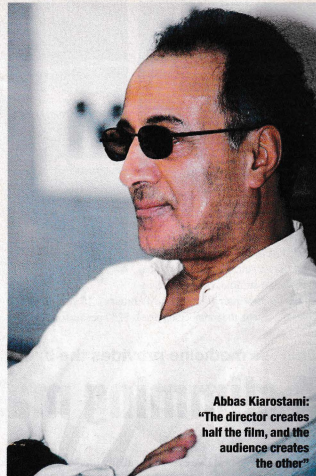
Iranian filmmaker Abbas Kiarostami said he was surprised to discover, during a promotional tour in Lebanon, that many people here know his films. Kiarostami attributes their notoriety to the international awards he’s won. They’ve been many—starting with the Golden Palm at Cannes International Film Festival (1997) to the Akira Kurosawa Award for Lifetime Achievement (April 2000), presented to him by the San Francisco International Film Festival.
“It’s the responsibility of film festivals to promote this kind of cinema,” Kiarostami said during an open-floor discussion at Monot Theater. Film festivals advance low-budget independent films—which are challenging the dominance of big-budget Hollywood films, according to Kiarostami. “Cinema is moving in the direction of simplicity.” He adds that this trend “is good news for third-world countries,” where filmmakers don’t have access to high technology and bloated budgets.
Moviegoers are still hooked to blockbusters, but artistic independent films are appealing to larger audiences. This was apparent last month at a ‘Tribute to Abbas Kiarostami’, presented by the Beirut Film Festival. The one-week event at Empire Sodeco Square presented five of the director’s films: The Traveler, The Wind Will Carry Us, Close-Up, And Life Goes On, and Where Is My Friend’s Home?
This reporter went to a screening of And Life Goes On, which recounts a real-life experience Kiarostami had. The film is about a father and son’s journey to northern Iran, a few days after the 1970 earthquake that devastated many poor villages there. They hope to find out about the fates of the two young boys who acted in the film Where Is My Friend’s Home?
The long and difficult trip proves to be a journey into the human spirit—it explores mankind’s ability to endure grave adversity and muster the resolve to continue. From the rubble, the victims pick up the pieces and start rebuilding their simple lives. The thought-provoking film leaves the audience to draw conclusions.
Herein lies the difference: melodramatic and action-packed films usually just spell things out. “The director creates half the film, and the audience creates the other half,” says Kiarostami.
Another constant theme in his films is children. “I started my career with children, without knowing children,” says Kiarostami, who established the Institute for the Intellectual Development of Children and Young Adults in 1970. Four movies later, he came to the opinion that children are the wise ones.
“They know how to enjoy life more than grown-ups,” says Kiarostami. “It would be nice if we could learn from them, instead of teaching them.”
Constrained by Iranian censors, Kiarostami’s films often make use of metaphors. It took some negotiations to get The Taste of Cherry, which confronts the issue of suicide, passed the guardians of morality.
During his public appearances at Sodeco Square and Monot Theatre, Kiarostami captivated audiences with his quiet charm and quick wit. On July 19, he was presented with two lifetime achievement awards by the Ministry of Culture and the Beirut Film Festival.
Wind surfing offers an exhilarating rush
Off with the wind
“It’s an adrenaline rush,” says Tanja Roy of windsurfing. The commercial attaché for the German embassy discovered windsurfing four years ago during her first posting to Egypt, and maintains her hobby here, at Pearl Beach in Batroun. Pearl Beach is a windsurfing club that was set up four years ago by Pierre Tannous. Small clubs like Pearl Beach have helped raise the momentum for the sport in Lebanon, but its following is still limited to a small group of devotees.
“I love the combination of sea, sun and wind,” says Roy. “And the excitement of the speed caused by the force of wind.” As with every sport, windsurfing has its jargon. Enthusiasts are always waiting for a 5-Beaufort—the perfect wind speed. ‘Rigging the sail’ translates into preparing equipment. Once launched, windsurfers ‘hook in the harness’, ‘get in the foot straps’ and start ‘planing’—that is, gliding on water.

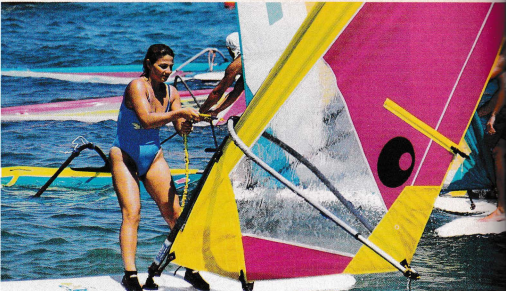
If it’s windy and windsurfing boards are moving fast, hitting waves propel jumps. This exhilarating experience is called ‘getting air’. But if the jump was too high, panicky windsurfers might ‘bail out’—that is, fall into the water from a jump.
Pearl Beach offers lessons at $20 an hour. The club has 2 windsurfs, which it will rent at $10 an hour. If you own equipment and want to store it at Pearl Beach, the membership fee is $150 per season. There are two seasons a year: summer (March to September) and winter (October to February). If you don’t have equipment, the membership fee is $250 per season. The unpretentious atmosphere at Pearl Beach has made the club a popular haven during weekends.
Chinese medicine provides the basis for losing weight
A slimming massage
“This is the best I’ve ever felt in all my life,” says 44-year-old Lillian, who had a weight problem all her life and tried just about every diet. Four years ago she lost 30 kilos over a year’s period—and kept them off. What was the miracle diet? Well, massage, actually. But that’s simplifying things. “What we do here is a cure,” says Iman Tabbara Itani, the owner of Aliman weight loss clinic.
It’s a two-part process: an eating formula and a massage treatment. The eating formula consists mainly of vegetables, fruits and proteins. “I insist on three meals a day with snacks in between… you can eat and still lose weight,” says Itani.
The massage is a French technique based on Chinese acupuncture—but without the needles. According to the principles of traditional Chinese medicine, health comes from the flow of energy, via 14 meridians in the body. These are associated with specific internal organs, and any imbalance in the flow of energy results in diseases. To remove blockages, needles are inserted into the acupoints along the meridians.
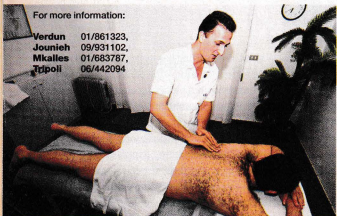
“First we massage along these meridians to circulate the energy in the body,” says Iman Tabbara Itani. “This helps sluggish metabolisms get back on track. Then we massage the pressure points.” There are points to remove stress, to eliminate excess water and to curb the appetite. “A person will be losing weight and not be feeling tired or hungry,” she says.
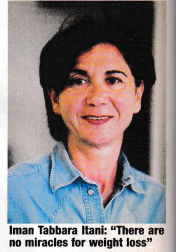
Every day, from Monday to Friday, clients are massaged for 45 minutes. The treatment runs between four to nine weeks. The average weight loss for a four-week treatment is six to eight kilos for women and eight to ten kilos for men. The cost is $200 a week.
Once the treatment is over, there is a three-week period of stabilization, which costs $200. During this time the frequency of the massage decreases and food intake increases. Afterwards, clients can eat what they like—within moderation. “There is no miracle for weight loss—if you don’t watch out, whatever goes in has to go somewhere.”
If a kilo or two creeps back on, Itani suggests that clients return for checkups. Lillian maintains her weight-loss with a weekly massage.
