
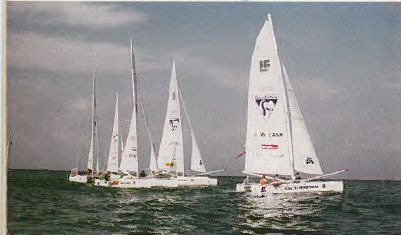
Centuries ago, Phoenicians set sail from these shores
for destinations as far away as the Atlantic coast of
Africa or even, some speculate, America. Today,
despite formidable obstacles, a small group of Lebanese
sailors are struggling to keep this sea-faring tradition alive.
Just four years ago, the Lebanese Yachting Federation was
reestablished after a long absence during the war. Its first
mission was to select athletes to represent Lebanon at the Pan
Arab Games, held in Lebanon in 1997. With a $50,000 grant
secured from the ministry of youth and sports, the federation
was able to buy 12 laserboats and 12 international class
mistrals (sailboards).
The Lebanese team’s performance was hardly noteworthy,
but the event marked the rebirth of competitive sailing in
Lebanon. Today, a small but proud group of passionate enthusiasts
is taking to the water in search of that elusive feeling of
freedom that can only be found on the sea.
“You must always have a strategy and expect the unexpected,”
says Eddy Nehme of Laser sailing. “You have to use your
head and angle the boat to get the most from the wind and the
water. It’s fun – the sensation of contact with water and wind.”
Besides selecting teams to compete in international competitions,
the federation organizes a regular program of about
12 regattas every year. But in its drive to advance the sport, the
federation has encountered a number of obstacles.
The federation only owns the boats it purchased for the Pan
Arab Games and one Optimist boat, donated by the Kuwaiti
sailing team. Since the federation’s boats are strictly reserved for competitions, sailors must rely on sailing
clubs to provide them with boats they need for
training. But there is only a limited number of
clubs in Lebanon and most do not have sufficient
funds to buy new boats, which cost
from $2,000 for a Mistral up to $5,000 for a
Laser. This means that only a limited number
of people can participate in the sport. “We
need new clubs,” says Joe Salame, a sailing
buff and owner of Windriders, the exclusive
distributor of Dart and Laser boats.
But huge barriers faced Salame when he
tried to set up a club. First he had to sign an
official contract with the owner of a beach
property. But the properties had to be legally
owned, which is rarely the case in
Lebanon. At the same time, the law prevents
the legitimate owners of beach properties
from subletting. “If they give a concession,
they will lose theirs,” says Salame.
The more popular clubs are private and usually
charge steep annual membership or entry
fees. “We need affordable access to the sea, so
that people can learn to sail,” says Salame.
At the same time, a lack of funds and little
sponsorship means that members of the federation
must donate money in order to keep
activities going.
“The annual budget should be $100,000 to
have a proper and professional federation,”
says Nehme. The actual budget is between
$5,000 and $10,000.
With such modest financing, there’s little
hope of finding a Lebanese sailing team at the
Olympics anytime soon.
There is some local talent around, but no
funds to nurture it. “We don’t have the budget
to qualify for the Olympics,” says Nehme,
adding that it would cost between $20,000 to
$25,000 annually to prepare just one athlete
for the Olympics
