Remember all the glowing clichés you’ve heard about
Lebanon? A bastion of capitalism within a sea of controlled
economies, a regional hub, the Switzerland of the Middle
East. With relatively low tax rates and banking secrecy, Lebanon
must be one of the freer economies in the Middle East, if not the
world, right? Think again.
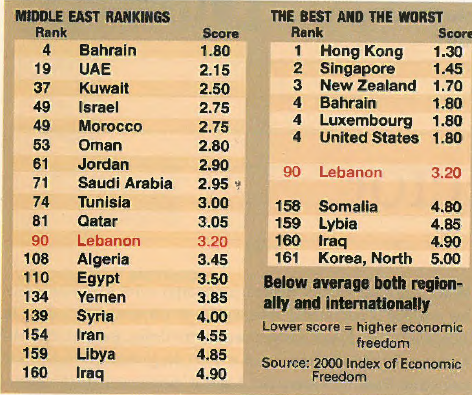
The Heritage Foundation and The Wall Street Journal, in their
recently released 2000 Index of Economic Freedom, ranked
Lebanon as number 90 among 160 countries (see chart), placing
it in the “mostly unfree category.” Lebanon found itself even
with such countries as Guyana, Madagascar and Moldova. Even
worse, it scored one point below Mongolia and three points below
Guinea and Ghana, while Fiji, Nigeria and Papua New Guinea
ranked just below Lebanon, tied at number 94. (Ratings are based
on 1998 statistics.)
Conducted annually since 1995, the survey has become something
of a benchmark for measuring the ease of doing business
in a country. Rankings are based on ten
broad factors of economic freedom: trade
policy, the fiscal burden of government,
government intervention in the economy,
monetary policy, capital flows
and foreign investment, banking,
wages and prices, property
rights, regulation and the
black market. Each factor is
scored from one to five and
averaged to determine the final grade. The
higher the score, the greater the government
interference in the economy and the lower the economic
freedom. Hong Kong topped the list of “free”
economies with a score of 1.3. Trailing the pack are repressed
economies like North Korea, which scored five. Lebanon’s score
was 3.2, below average, not only by world standards, but also by
regional standards. Among 17 countries in the Middle East,
Lebanon ranked 11th.
The study showed a direct correlation between the per capita GDP
and the level of economic freedom. “Countries with greater economic
freedom have a faster rate of economic growth and a higher
standard of living,” says Nassib Ghobril, an analyst at Lebanon
Invest. “The study is used by policy makers and investors to
assess the investment climate in a country. If a company were to
set up an office here, obviously it would want more business-friendly
policies. It’s not the country of choice. Why not set up in
Jordan, or the UAE, which is second only to Bahrain?”
Why did Lebanon score so poorly? Ghobril points to three important factors.
First, Lebanon scored a maximum of five on trade policies. High
tariffs and surcharges on imports are the main culprits.
According to IMF statistics, trade taxes account for more than
70% of the total taxes collected by the government. In an attempt
to control the high deficit, the government has increased tariffs over
the past several years. This will make the country’s hopes of joining
the WTO and the Euro-Med agreement difficult, as both deals
would require a general phasing out of trade barriers.
Lebanon has signed free trade agreements with Syria, Egypt and
Kuwait as well as the Arab common market agreement. “But still
overall the tariffs are considered very high,” says Ghobril.
Lebanon also scored five in the “black market” category, largely on
account of its rather porous border with Syria and its thriving
business in unauthorized cable television and pirated software.
Lebanon’s score was also disappointing
– 3.5 – on the fiscal burden of government, which includes income and corporate
taxation plus government expenditures. With a top income
tax rate in 1998 of 10%, Lebanon received a two for taxation. But
that was averaged with a score of five for expenditures, which were
almost 44% of GDP in 1998. Even in some areas where Lebanon
prides itself on openness, the results were disappointing. The
country received a three, “moderate barriers,” for capital flows and
foreign investment. According to the US Department of Commerce,
“Lebanon offers the most liberal investment climate in the Middle
East, with no significant restrictions on foreign investment.” The
report disagrees: “It restricts the amount of real estate a foreigner
may own and needs an efficient investment approval regime.”
It was not all bad news, however. Because of a “low level of
restrictions,” Lebanon received a two for its banking sector and on
prices and wages. As another bright spot, the index showed a modest
improvement from last year, when Lebanon scored 3.25. But
the score for 2000 is still far below its 1997 score of 2.95. And not
everyone agrees with the index’s rating. Kamal Hamdan, an economist
with the Consultation and Research Institute, feels that
Lebanon was under-rated in a number of areas. Trade barriers may
be high by international standards but by regional standards they
are not unusual, he argues. Hamdan also questioned how Lebanon
scored a five for black market, while Nigeria, which he believes has
a far worse problem, scored a three. The five for government expenditures
is also unfair, he says, because the survey calculates the
money spent on debt servicing. “I think Lebanon should be among
the top 30 to 50 countries,” he says. Marwan Iskandar, head of MI
Associates, agrees: “I think that these measures are rather arbitrary.
I would not give much credence to a study like this.”
There are reasons for hope and despair for next year. The “black market”
rating may improve if the new intellectual property rights law,
passed by parliament last spring, is enforced. On the down side, corporate
tax was raised from 10% to 15%, while the top income tax bracket
was increased from 10% to 21%. That could affect next year’s score.
OK, so Lebanon might not be a bastion of capitalism, but at least
it’s a nice place to live, right? Well, actually no, according to another
survey by international consulting firm William M. Mercer. It
ranked Beirut 168th out of 218 cities based on quality of living. The
survey was based on 39 standards including political, economic and
environmental factors, personal safety and health, education, transport
and other public services. Among the notable cities that beat
Beirut were Medellin, Colombia, the cocaine capital of the world,
and Cairo, Egypt, where the smog is so bad that a walk on the Nile
can cause lead poisoning. At the top of the list were Vancouver,
Canada and Zurich, Switzerland. At the bottom: Brazzaville and
Pointe Noire, Congo and Khartoum, Sudan. Well, at least in
Lebanon, we can ski in the morning and swim in the afternoon. Then
again, who would bother?