
Steady streams of unmistakable yellow cabs snaking through
the streets of Manhattan dominate the view of New York from
atop the Empire State building. Beirut might be just as saturated
with taxis, but the sight is somewhat less organized.
One company is trying to change that image. In a market seemingly
overrun with taxis, newcomer Allo Taxi entered the fray at the
end of June with an investment of $500,000 and a fleet of 25 cars.
“People generally talk of the taxi business in Lebanon as lousy,
the uneven prices, bad cars. The idea is to change the mentality about
taxis,” says Raja Kurban, chairman of Allo Transport. He represents
the majority shareholder Kurban Holding, the local Avis agent. The
other major shareholder is vice president Tarek Boubess, whose
Premiere Leisure Holding owns the Commodore Hotel, La Piazza,
and L’Entrecote among others.
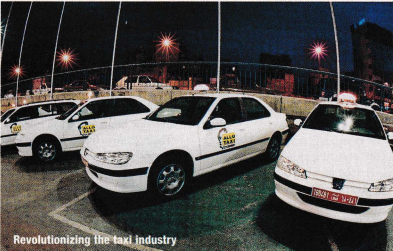
Theirs is the only cab company in Lebanon whose drivers are uniformed
(although the editors at EXECUTIVE have noticed that the drivers
sometimes prefer their own apparel) and whose vehicles are identical
and equipped with taximeters. That is all part and parcel of the
image of a professional company that Allo Taxi hopes to portray.
But Beirut is not New York, London or Paris. Will a western-style
taxi service work here? Privately, some of the other taxi companies
tell you that it won’t, and that neither will the taxi meter, because
the Lebanese don’t trust them. Meters are not yet required under
law and Allo Taxi gives the client the choice to use the meter or set
price. Results of a test done by EXECUTIVE showed that a trip from
Achrafieh to our office in Hazmieh cost LL10,000 by the set
price and LL12,500 using the meter.
Allo Taxi will find tough competition in outfits like Safe
Taxi, whose philosophy is that a higher turnover of clients with lower
prices is better than a
smaller client base that
pays more. Its cheapest
rate is LL4,000, while a
ride from Beirut to the
airport costs LL10,000.
That compares to
LL5,000 and LL15,000
with Allo Taxi, or
LL10,000 and LL25,000
from Hamra or LL30,000
from Achrafieh with
Lebanon Taxi.
Despite its different
approach, Safe Taxi has
aggressively gone after
clients since it began just
over a year ago. It has expanded from seven drivers to 22, each of whom
owns his own car. The drivers contribute $20 a month to cover the office
rental and the dispatcher’s salary, pocketing the rest for expenses and earnings. Allo Taxi charges its drivers a $300 weekly rental fee; the rest
goes to the driver, who pays for his own petrol.
As Lebanon opens up more to how business is done elsewhere,
there’s little reason why the type of taxi company that works in most
places won’t work here too. The question is when. Allo Taxi has figured
three years into the equation before it starts to make money.
Kurban employed a smart technique to get into the market: go out
and get the customers rather than waiting for them to come to you. Allo
Taxi has been targeting individual companies as well as hotels, restaurants
and bars to get its cars stationed outside. These include the
Commodore, La Cigale, Sports Cafe and recent exhibitions at the Beirut
Hall and Beirut Forum. The captive market provided by Avis clients
and the business of associates hasn’t hurt. But Kurban claims that now
makes up just 20% of business. In the first few months of operation,
hotels accounted for about 70% of business, but the problem is hotels
charge a commission. The goal is to generate most business from individual
clients, which now make up about 50%.
Planet Hollywood is one of the restaurants that Allo Taxi
approached and now has one car stationed outside on most nights.
“Before we had regular taxis that would drive around, but foreigners
sometimes get taken advantage of,” says Habib Jabr, general manager of
Planet Hollywood. “These guys give the same price to everyone
and their cars are brand-new and clean.” Allo Taxi has so far spent $30,000 on advertising. Although still
a small figure, it’s a different tactic than that used by companies such
as Safe Taxi and Lebanon Taxi. While the latter has not spent anything
on advertising in the past six months, preferring barter deals
and its web site to do the job, the former did a lot of knocking on
doors to distribute price lists. These and Lebanon’s other taxi
offices are precisely
where Kurban plans to
compete for market
share, rather than the
service-taxis. Kurban
estimates that of all the
taxi offices, just 15 could
be considered major
ones.
With a fleet of 25 cabs,
Lebanon Taxi concentrates
on a select client
base, whose primary
concern is not price.
Nsouli, whose family
company was established
in 1955, says the
newcomer hasn’t made an impact on his business. “I know all my
clients,” says Mohammed Nsouli, manager of Lebanon Taxi. “We
haven’t lost any business to Allo Taxi.”
