


Karim Habib (not his real name) is a young
and bright financial analyst. Four years ago
he was employed with one of the biggest
investment firms in the United States, where
he had a promising career ahead of him. But
the post-war feeling that Beirut would reemerge
as the Middle East’s financial center
inspired Habib to return to his homeland,
where he was offered a position with a newly
established investment company. His enthusiasm
has since waned. “What I came back
for is proving to be an empty shell,” he says.
Now intent on returning to the US, Habib will
be among the thousands of educated
Lebanese that emigrate each year.
Lebanon has long been a major exporter of human resources
(see box), but the civil war pushed unprecedented numbers
of people to emigrate. From 1975 until the end of 1993,
729,000 people emigrated – 19.9% of the net population at that time,
according to a study by statistician Anis Abi Farah. Displacement is
common during wartime, but what is uncommon is that the exodus
didn’t subside when the hostilities ended. By 1996 that number had
increased to 950,000. In other words, between 1994 and 1996 – years
of relative stability – another 221,000 people emigrated, a further
increase of 30.3%.
Should emigration be condemned entirely? “Emigration has
always been a major element of strength for Lebanon, because emigrants
transfer quite a lot of money to their relatives and also capital
savings,” says economist Marwan Iskandar of MI Associates.
“Whenever we achieved a surplus – except in ’96 and ’97 which was
due to borrowing – it was due to transfers from Lebanese.”
However, transfers cannot compensate for the losses due to emigration
of educated people. University graduates accounted for 32%
of emigrants between 1975 and 1996, reducing those within the resident
population to 22.4%. “We lost 300,000 university graduates in
that period. It cost us $30 billion to prepare them,” says Abi Farah, referring
to public and private investments in education. “Have we been reimbursed
$30 billion by them leaving?” Indeed not.
For example, a Lebanese working abroad as an electronics engineer
produces ‘X’ amount of value – let’s say $100,000 annually. He
might transfer $10,000 of his salary to his family in Lebanon. “If this
person was able to be productive here, we would get ten times more
benefit,” says Paul Salem, a political and development analyst.
“Obviously it’s a bad deal, but that’s what is happening because our
productive sectors aren’t able to absorb this amount of skilled labor.”
So the greater value is forfeited to the host countries, most of which
have developed economies. Abi Farah’s study shows that of the emigrant
university graduates, 23.9% went to the United States, 20.1% to
France and 13.4% to Canada.
Iskandar presents yet another, more recent study. “41% of all people
between 20 and 30 years are applying to emigrate – whether they
succeed or not, the desire is there,” he says. Lack of economic opportunity
is identified as the fundamental reason young people emigrate.
For those with jobs, incomes are low (Lebanon’s per capita income is
$3,000 to $3,500 annually) while the cost of living is high. And for thousands
of young graduates entering the job market every year, most cannot
find employment. No statistics are available on job creation.
Considering the economic stagnation of 1996 to 1999, job creation was
probably negligible, while there was possibly even job loss.
The government hasn’t traditionally taken a leadership role in the
economy. “But now, I believe the government should begin to take a
lead in certain areas where Lebanon has a comparative advantage,” says
Salem. Identifying potential sectors is one thing, taking action is
quite another. For example, the government has identified the technology
sector as strategic. “They have been talking about it for the last
year, but I haven’t seen any laws or regulations pass that would help
develop it,” says Habib. For this sector to develop, the government must
give tax breaks, create an information free zone and support specialized
institutes, such as training centers. It must also invest in upgrading
the school curriculums. In 1998 parliament endorsed a new curriculum
to improve the current system, which hasn’t been changed in
about 30 years. However, it was never implemented. The allocation
for the training of teachers was $13 million a year for three years. “We
put the new program on hold to save $13 million, but the returns of education
are enormous,” says Iskandar. If the trend of emigration continues,
“in the coming five years we will lose a further 500,000 people,
of whom 150,000 would be university graduates,” he adds.
Lebanon cannot sustain such losses and expect to achieve growth
via a ‘knowledge-based economy’.
Habib returned to Lebanon “with big plans to modernize and earn
a good living.” But his aspirations have been shattered by harsh realities. He cites nepotism, rampant corruption, bureaucracy, red
tape and wastefulness along with shortsightedness on the part of
the government. There is hope that the peace process will bring foreign
investment to Lebanon. But, according to Habib, “if there is
still chaos in the government, other countries will benefit from the
peace, not us.”
Global networking
The claim is true: The number of Lebanese people throughout the world
far exceeds those that reside within its borders. The first exodus started
in the middle of the 19th century because of economic hardship and
political instability. Since then the flow of emigrants has been steady, but
three periods of war commencing in 1860, 1914 (punctuated by
famine), and 1975, pushed unprecedented numbers to emigrate.
Today it’s impossible to compile accurate statistics on the size of the
expatriate community (including descendants). And the said population
of Lebanon is only an estimate. In the absence of statistics, a simulation
model is the best means to assess such data. Statistician Anis Abi Farah
has developed a software program called nasripop, which can produce
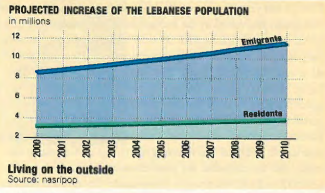
data on the Lebanese population. The program calculated that in 1999
Lebanon’s population was 3.2 million, while the number of Lebanese emigrants
(including descendants) was 8.3 million. According to nasripop’s
projection (see chart), the expatriate community is growing at a
faster rate than the resident population, so that in 2010 there will be 3.9
million residents and 11.6 million emigrants.
“Lebanon stands out as one of the few countries in the world with a
larger expatriate community compared to its own,” says Paul Salem, a
political and development analyst who sees a positive side to this.
“Lebanon needs to recognize that we are – and will always be – a global
country.” Israel is probably the only other “global country” in the world.
It has always recognized this and includes the diaspora in its national
affairs, an approach that has proved beneficial to economic development.
Many expats have achieved success, and Lebanon could gain by similarly
involving them in state affairs. “A lot of them are wealthy, influential
and have global connections,” says Salem. “Have them represented
in parliament, let them have a say in economic policy – involve them
in the country.” Now might just be the time, as Lebanon embarks in the
global economy. “Global trade requires a global network, and our allies
around the world are the Lebanese around the world,” says Salem. “They
are a great resource.”
Salem is a progressive thinker. But personal experience of Lebanese
communities in the United States, South America and the Caribbean
leaves this writer doubtful that such solidarity is possible. True to form,
division and discord characterize Lebanese emigrant communities. It
would take charismatic, dedicated leaders to lobby the Lebanese
worldwide to join hands and contribute to the greater good of Lebanon.
