
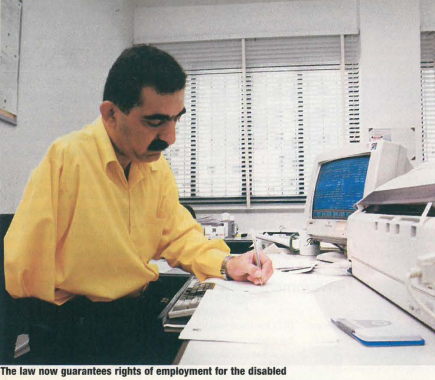
With political and economic issues heading the government’s
agenda, it’s hardly surprising that the rights of
the disabled were put on the back burner. Following
concerted efforts by advocates, the most that law 243 of 1993 stipulated
was that disabled people “have the right to be employed,”
says Jerius Khouri, vice-president of the national association for
the rights of the disabled. “But it didn’t require companies to hire
a certain percentage of the disabled or fine them for not obeying the
law.” The law didn’t even eradicate an antiquated and discriminatory
Turkish law that actually denied handicapped people
access to public jobs.
All that was changed when parliament approved a new anti-discriminatory
law in March. “It cancels or amends unfair texts, clarifies
unclear texts and adds new texts,” says Rita Saba, head of
human resources at the rights and access program of the ministry
of social affairs. On employment, the law guarantees equal opportunity
for individuals with disabilities. It stipulates that disabled people
will represent 3% of public jobs in all categories.
Private companies with more than 60 employees must reserve 3%
of positions for those with disabilities. For companies with 30 to
60 employees that figure is 1%. Failing to comply will result in a
fine, but the amount has yet to be disclosed. Companies with a staff of less than 30 are not bound by the law to employ disabled people,
but doing so will procure tax exemptions.
“The purpose of the law is to ensure the rights of the disabled on
a long-term basis,” says Saba. It’s an important step towards moving
the status of the handicapped in society from marginalization
to total integration. But the law must still be enforced. “We have to
turn it into applied rules,” says Khouri, who is blind and works as
a freelance journalist and translator. That will require coordination
between the ministries. “Coordination committees must be formed
within each ministry,” says Saba. “Without them we will not be able
to apply anything concerning the law.”
The law also specifies that all public buildings must be accessible
to people with disabilities. “But the criteria still have to be set in
the implementation stage,” says Saba. Adapting the workplace will
be an important component. “As far as I know, most workplaces are
not accessible for the physically disabled,” says Khouri. That
includes making toilets and elevators accessible to wheelchairs.
Solidere showed vision by building in accordance with international
standards that allow for accessibility, but it will be a while before
building specifications become obligatory by law. When they
do, owners of buildings under construction that fail to abide by
specifications will be fined. Tax exemptions will be given to
property owners who restructure existing buildings.
No statistics are available, but it’s safe to say that the number of handicapped
people presently employed is negligible. The Dr.
Mohammed Khaled Social Foundation cares for the physically
handicapped, for whom it provides training in carpentry and sewing. The foundation employs 12
physically handicapped people,
mostly paraplegics.
“They can’t move their legs,
but they can move their
hands. They have brains and
are intelligent,” says Abdul
Hafiz Elladki, the foundation’s
general director.
One barrier to employment
is that just a small percentage of the handicapped population is educated, according to Raif Shwayri, the director of
the Al-Kafaat Foundation.
Before the 1993 law, handicapped
people had no access to
public schooling. Though the ban was lifted, schools are still not accessible to the disabled.
Additionally, no public transportation is available for the handicapped,
making it difficult to get to work or school. Al-Kafaat is a specialized
organization that caters to socially and physically disadvantaged
people. The organization provides daily transportation for its
4,500 beneficiaries, 2,000 of whom are physically impaired. The government
needs specialized buses for the physically handicapped.
“To integrate the handicapped in society, society must be equipped to
receive them,” says Shwayri.
Compiling the cases
Exactly what percentage of
Lebanon’s population is disabled?
Two studies have been
done: one by the ministry of social
affairs in cooperation with the
United Nations population fund
(December 1995 to May 1996) and
the other by the Central
Administration for Statistics
(1997). The studies put the figure at
1% and 1.5% respectively.
According to a source at ESCWA,
“the figure is way too low.”
Recently the ministry of social
affairs began issuing identity cards
for disabled citizens who meet the
classifications set by the ministry.
“Certain health problems are not
classified, such as extreme cases
requiring medical equipment that
we cannot provide and minor
ones,” says Rita Saba of the ministry’s
rights and access program.
The card is required for disabled
people wanting access to services
provided by the ministry, such as
technical aid. To date 24,493 cards have been
issued, indicating 24,763 disabilities
(some have multiple disabilities).
Of these 6.79% are visually
impaired, 11% hearing impaired,
38.7% mentally disabled and
52.2% are physically disabled.
While many people are reached
through ‘outreach services’ provided
by collaborating NGOs,
such as Arc en Ciel, most people must apply for the cards in person at
the ministry’s offices. For this reason, the figure isn’t a good indicator of the real number of the disabled,
which likely stands at 6% to
7% of the population.
