
In the eyes of most spectators, the row has
turned into a complete fiasco for the government
and has been sorely mishandled
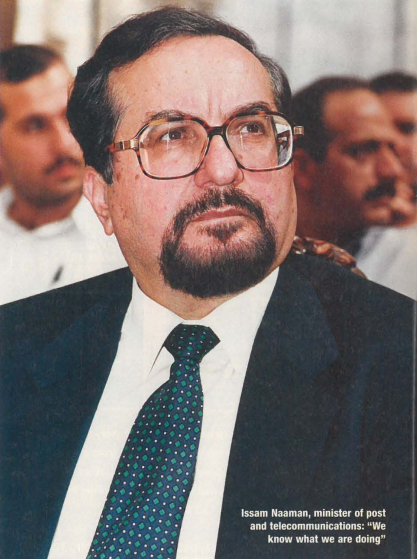
by Issam Naaman, the minister of post and
telecommunications. International rating
agency Standard & Poor’s (S&P) recently
included the government’s inability to find a
solution to the cellular issue by October in a list
of factors that could lead to a possible sovereign
downgrade for Lebanon. In a telephone interview
with EXECUTIVE, the minister brushed
aside S&P’s warning: “Let them go to hell. We
know what we’re doing.”
But the view from the sidelines tells a different
story. “This could have been resolved
quickly, privately and profitably for the government had they been more
politically astute,” says one analyst. And so the dispute has dragged
on. Many point to the vested interests at play as the major culprit: the
politically powerful hoping to get their fingers in the pie and push forward
companies with which they have or hope to form alliances.
Kamal Shehadi, a consultant on telecom privatizations in the
region, points to the government’s failure to adopt a consistent telecom
policy and law in keeping with the information age (see pp.
27-29). “Other reasons, such as the myopic approach to telecoms as
the cash cow for public finances, at the cost of encouraging
growth and investment in the sector and Lebanon catching up with
the information revolution, must have played a big role,” he adds.
And with elections just around the corner, a solution is probably
not in the cards anytime soon.
Naaman is still hunting down that elusive $300 million in fines
for each LibanCell and Cellis. But neither has received a detailed
explanation of that figure. The minister even threatened that the government
could break the build-operate-transfer (BOT) contracts and seize the two companies’ assets if an agreement is not reached
through talks. But negotiations are made difficult when the two
sides are virtually on non-speaking terms. This does not bode well
for possible future investment. “No investor will invest in a country
where governments decide to shut down a business simply
because it is more profitable than its original business plan had predicted,”
says Shehadi.
Both cellular operators have submitted requests for arbitration to the International Chamber of
Commerce in Paris. “We maintain that we have not
violated our contract and that arbitration is the best
path to resolve the different interpretations of the contract,”
says Hussein Rifai, chairman of LibanCell.
Recently, Naaman has been touting a ‘much better offer’ from Vodafone than what Lebanon’s two cellular
companies are willing to pay for their contracts
to be converted into licenses. The UK-based company
has apparently expressed its readiness to pay $1.5 billion for a license. Contacted by EXECUTIVE,
Vodafone denied making any such offer, oral or written, to the Lebanese government, even insisting that
there are no negotiations between the two parties. “If that’s true, it means
they are not telling the truth. I have all the evidence,” says Naaman,
refusing to elaborate. According to the minister, he is conducting meetings
with representatives of three mobile phone companies that are
interested in investing in Lebanon. “Vodafone for me is a ghost,” says
Sima Hafez, marketing director of Cellis, which submitted an offer in
writing. “He said Vodafone’s offer is better than ours. What are the conditions
of Vodafone’s offer? Nobody knows.”
All this comes in the wake of offers by LibanCell and Cellis to
pay $1.35 billion each for licenses that were snuffed out by the government.
Of that amount, $900 million would be paid upfront with
the rest coming in over the 20-year life of the license that would
allow competition. “Our offer was more than fair and exceeds any
price paid until now for a GSM license,” says Rifai. Indeed, in a
study prepared for the Lebanese government in September 1999,
Booz, Allen & Hamilton assessed the price of a license at between
$800 million and $950 million, based on four different scenarios.
While LibanCell points to the unprecedented high price per population
of the offer, that is the proper index for startups, according
to Shehadi, not going concerns. Nonetheless, the price is fair on a
per subscriber basis, he says: “It compares favorably with prices paid for going telecom concerns in
Europe, where the revenue per subscriber and per
capita income are higher.”
At the council of ministers, sentiment was split. The
nay camp included Naaman and Michel Murr, the
interior minister. Naaman listed his reasons for rejecting the offers at a recent press conference: the
initial installment is too low, the length of the license
too long and the right of first refusal for UMTS, the
third generation of mobile phone systems, should not
be included. Those in favor included Georges Corm,
the finance minister and Nasser Saidi, the minister of economy and trade. “I proposed transforming the
BOT contracts into licenses in December ’98, so I believe it should
have been done then,” says Saidi, adding other issues like competition
and new technologies need to be considered.
The matter appears to be shelved for the time being as the government’s
decision was, er, not to make a decision. Instead the unresolved
dispute was passed onto the auditing department’s lap, with
the operators’ offer not accepted, but not officially refused either, and
it was announced that a law would be drafted to allow a UMTS tender.
“The government should not have accepted the operators’ offer
without making modifications that would ensure a fair and level playing
field for LibanTelecom, the state-owned operator, and other
new entrants to the market,” says Shehadi. “However, that does not
justify the decision reached.”
