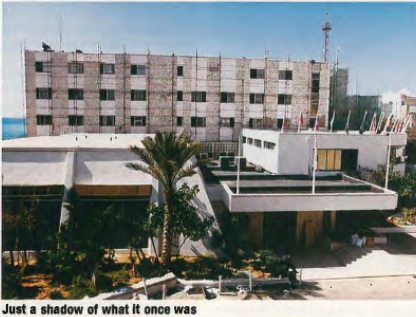
The 36-year-old Coral Beach Hotel, once a summer playground
for Gulf princes, European holiday seekers and
Beirut’s elite, has closed its doors. After suffering three consecutive
losing years, Izzat Kaddoura, the owner, is calling it
quits and pulling out of Lebanon. The empty shell of the once-thriving
resort that employed
over 170 people is up for
sale at a price that has not
yet been disclosed.
Kaddoura blames the
recession, an unstable political
environment and a business-
unfriendly government
for the hotel’s failure. In
1997, Coral Beach had over
2,600 members and received
1,000 guests. Last year, the
hotel saw less than half those
numbers. Occupancy
declined from 60% to less
than 25% during the same
period. But Coral Beach is
not alone. Across the country
hotels are suffering.
An independent survey
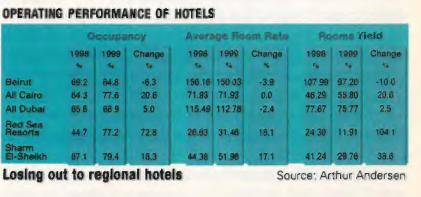
done by Arthur Andersen of six leading hotels in Beirut showed that
the average price for a room has declined from $156.16 in 1998 to
$150.03 last year. The survey also showed that the yield for rooms
(occupancy multiplied by the average room rate) declined by 10%
in that same period, from $107.99 to $97.20. “We used to get company
representatives attending conventions as well as tourists from
all around the world. Today these same people go to the Gulf,
Egypt, Morocco, Tunisia, Turkey or Greece,” says Kaddoura. He estimates
that Rhodes alone attracts 1.3 million tourists annually, compared
to the 670,000 tourists who visited Lebanon last year.
Kaddoura complains that the cost of maintaining the Coral Beach also
took its toll. The hotel was spending nearly $300,000 a year on electricity
and the corrosive sea front climate cost the club another
$300,000 to $350,000 in yearly maintenance. Government policies
toward the struggling hotel sector haven’t helped. Two years ago, a
5% tax was imposed on hotel revenues but the struggling tourism sector
has received little support in return. “The government makes us
pay taxes, social security, transportation, schooling for our employees’
children as well as fees for street and sidewalk maintenance and trash
removal, which we do ourselves,” says Kaddoura.
The ministry of tourism, which plays a central role in promotion,
receives minimal funding. Its budget for this year was a mere $4.5
million, less than one-tenth of a percent of the total budget allocated
to all ministries (see “Switzerland of the Middle East No longer”,
March 2000). “We keep
hearing speeches from the
government that don’t
translate into action, they
simply don’t have a plan of
action and lack vision,”
says Nizar Alouf, managing
partner of the Riviera
Hotel. Last year, the
Riviera underwent a complete
rehabilitation. “The
commercial loan here is
higher than any other
country,” says Alouf,
adding that at best a five-year
loan carries an 11%
interest rate. In the Gulf,
the interest on a 15-year
loan is as low as 6%.
Meanwhile, as hotels suffer,
government officials and some within the industry continue to
act as though everything is fine. Last June, after the Israeli air
strikes, a letter was sent to members of the hotel owners’ syndicate.
It said that the syndicate and ‘responsible’ officials had devised a
plan to use the media to create an image of normalcy. The letter
urged all hotel owners, when speaking to the press, not to mention
any cancellations as a result of the bombings.
Kaddoura has grown tired of the rhetoric. He is investing elsewhere.
Six months ago, construction started on a $42-million residential project
in Conakry, in the Republic of Guinea, which he and seven other
shareholders are financing. The facility will include furnished apartments,
a beach and recreational facilities, supermarkets, restaurants and
hotels. The government gave the investors the 250,000 m² of land for
free as well as a seven-year tax exemption and a free license to build.
Kaddoura also plans to invest $7 million to open a company there that
will export fish to Europe. As for Lebanon, he warns the government
that if it wants to attract tourists it should take a lesson from countries
that have been successful and lay down the proper legal and regulatory
framework where hotels can prosper.