
The recession is making itself felt in the number of new businesses starting
up and capital investments. According to the latest statistics published
by the ministry of industry, the number of newly established industrial
firms by the start of August this year totaled 276. That’s down 17%
from the 333 firms that were started up during the same period of 1999.
Capital investments declined by 16.5% from $63.5 million during the first
seven months of last year to $53 million during the same period of 2000.
“Considering the discouraging recession Lebanon is facing, a lot of
entrepreneurs and businesses hesitate before investing and setting up ventures
locally,” says Nassib Ghobril, analyst at Lebanon Invest.

Signing on

A Canadian delegation
that was
in Beirut during the
first week of October
signed agreements worth$ I 0.5 million. The
objective of the visit was to
boost trade links between
Lebanon and Quebec, where an estimated
100,000 Lebanese reside. One of the deals, worth $10 million, consists
of building and equipping a research center for cancer, which
will employ up to 50 people in Lebanon. The delegation was headed
by Guy Julien, Quebec’s minister of industry and commerce, and
included representatives from 22 businesses. Several Quebec based
companies are already present in Lebanon, including the
National Bank of Canada and Techni-Serv. And Liban Post is two thirds
owned by a Canadian consortium that includes SNC-Lavalin
and Canada Post Systems Management. During 1998 and 1999,
annual exports from Quebec to Lebanon totaled $16.7 million, of
which pharmaceutical products and automobiles accounted for
20%. Exports from Lebanon to Quebec were just $6.7 million, half
of which was accounted for by cement.
Southern discomfort
The International Labor Organization (ILO) has earmarked over
$16 million in aid for the former occupied zone and plans to
start work in the region immediately. Few other donor agencies have
sent any kind of assistance to the South, an area that is facing its
worst financial crisis ever. The international donor conference for
the South that was scheduled to take place in October was postponed
due to a lack of interest on the part of donor nations, who wanted
first to see Lebanon send its army to secure the border with Israel.
The Lebanese government has since turned to non-governmental
organizations in search of financial aid. ZeinaAli-Ahmad, from the
United Nations Development Program (UNDP), says that so far, $2
million has been sent to the South. This sum, which was sent by the
UNDP and the council for development and reconstruction
(CDR), was mostly for the execution of small projects, job training
and local mobilization. Ali-Ahmad says that additional aid from
the Kuwaiti Fund and the Islamic Fund is on the way.
A boost for Bekaa
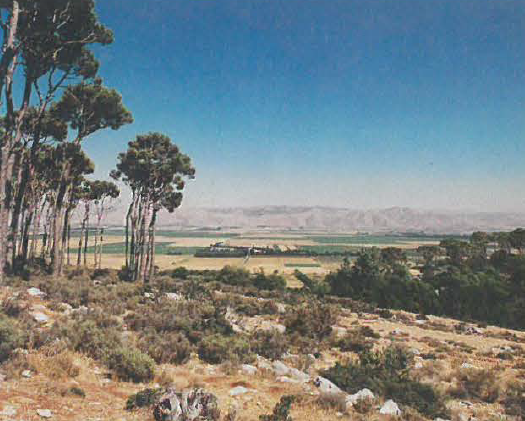
A $300 million agro-industrial project has been announced for the
Bekaa. Financed by the Egypt-based Arab Brothers Group, the venture
will include a flourmill, a sugar production plant, a sunflower and soybean
oil press, a water-bottling plant and a pasta plant and will take four years
to complete. Middle East Food Industries, which will be in charge of
implementing and managing the project, plans to build a warehouse with
a 50,000-ton capacity and a cargo dock at Tripoli port that can handle 20,000
tons a day. While 20% of production will meet Lebanon’s need, about 80%
will be exported to the Arab world.
But the local milling industry view the development as a threat to their
operations. “Investing in a sector that is already so saturated will eventually
cause the project to fail, pulling other milling industries down with
them,” predicts Arslan Sinno, CEO of Dora Flour Mills, adding: “They’re
here to take advantage of the subsidy system.”
Oil from Saddam
Lebanon is exploring future possibilities of oil cooperation with
Iraq, according to the ministry of hydroelectric resources. The
sanction-riddled nation has a similar agreement with Jordan, whereby
Iraq provides the Hashemite kingdom with oil and oil byproducts
in return for concessions that ease Iraq’s crippling debt. Samih al Rayess,
general director of oil at the ministry, says that although the
agreement is still pending, there is great probability that Lebanon will
adopt a policy that closely resembles Jordan’s. “Oil will be imported
from Iraq,” he says, “and either used for domestic consumption or
exported to other nations, using the Port of Tripoli as a transit point.”
Iraq has been under UN sanctions since it invaded Kuwait in I 990.
Taxi on the runway
S yria’s official news agency SANA reported that Syria and
Lebanon are working on a joint airline to service cities in both
nations and in neighboring countries. Called Air Taxi, the company
will operate much like a cab service, flying businesspeople from
Beirut, Damascus and other cities to such destinations as Amman,
Limassol, Larnaca and Cairo or to virtually anywhere requested by
potential customers. Air Taxi will consist of several modem business
jets and has a reported capital base of $80 million. Arab businessman
Yassin Doghmosh is the company’s major shareholder.
High hub hopes
Can Beirut become a transport hub for the region? A task force created
by the Beirut international shipping chamber, Trans
Mediterranean Airways (TMA) and the syndicate of Lebanese ship
owners certainly hopes so. “We are trying to form a working group
to tackle issues such as multimodal transport,” says Roula Hamadeh,
TMA’s marketing manager. “We are cooperating with other representatives
of the sea and land transport sectors in order to establish an
integrated transport network to, from and through Lebanon.”
The goal is to facilitate and coordinate air, land and sea shipping to bring cost
and time savings to companies. The group also plans to work with government
authorities to amend laws and create strategies to help
Lebanon regain its role as a regional transit hub. That won’t be an easy
task considering Lebanon’s cumbersome bureaucracy – and most
notably the outdated and snail-paced customs procedures.
Dial away
The ministry of post and telecommunications is offering new fixed
line services to Lebanese consumers. Khaled Ghazal, from
Ogero (the phone company operating under the ministry’s umbrella),
explains that a variety of services are now available, including
call forwarding, wake-up calls, and conference calls. Each option costs
LL25,000 for the first month; subsequently the price drops to
LL5,000 a month per service. Ogero is also offering two new hotlines
for both customer service and repairs, and will soon have a website
to provide users with phone bill information. These options are expected
to help the MPT better compete with the cell phone industry.
Deal, what deal?

Minister of information Anwar Khalil recently
announced that the government had sold 49% of
Tele Liban to Arab Radio and
Television (ART), which is
owned by a Saudi company.
Although Tele-Liban’s president
of the board Ibrahim
Khoury refused to comment
about the sale, sources close to
him have revealed that the
shares were sold for about $7
million – an extremely low figure,
since the station is worth an
estimated $50 million. The
government and ART have also
supposedly agreed to lay off all
station employees and to limit
the government’s share of airtime
to a maximum of 30 hours
a week. Elias Abu Rizk, head
of the General Labor
Confederation, denied any
knowledge about the deal, saying that the news was nothing
more than unfounded rumors and that the government hadn’t
concluded a signed agreement with ART or any other company.
Workers of Bata unite
The closure of Bata’s shoe factory in Dekwaneh has created a flurry
of controversy and negotiations over the 120 employees who
lost their jobs. Bata officials claim to have offered its former long-term
employees generous severance packages that go beyond its legal obligations.
But after workers staged protests in front of store outlets,
demanding their jobs back or better compensation, Bata revised its offer.
The new package included a month’s payment for each year
worked plus an extra four months paid notice, five months for those
who worked for the company for 20 years and six months for those who
have worked longer. But that still wasn’t good enough for laid-off workers,
who found support from the ministry of labor in their demands for
double the original compensation package. Bata accepted to pay in
installments but is still being pressured to pay the full amount upfront.
Although taking the matter to court may be financially better for
Bata, the company says it hopes not to use that option. “Most of the
employees have been working with us for years, and we prefer to
solve the problem in a reasonable manner,” claims Rafic Saloum,
industrial manager at Bata, adding: “We are close to reaching an
agreement on the matter.”
Both the retail and manufacturing division of Bata have been present
in Lebanon, and the former will continue its operations.
Bata’s local manufacturing division was shut down due to an
accumulation of $10 million in debt.
