Bartering in Lebanon is nothing new (see ‘Barter frenzy’,
October 1999). In fact, it is common in construction,
advertising and insurance, where goods and services are
traded in a cashless transaction. For example, advertising is traded
in exchange for furniture or computers,
supplies of construction materials are
traded for a flat or condominium. So far,
such activities have accounted for less
than 1% of total GDP. Bartercard
Lebanon plans to change that.
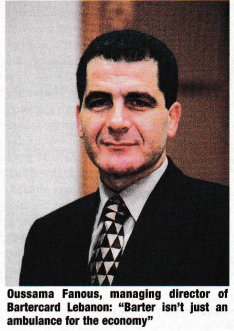
In mid-August, Lebanon became the
ninth country that Bartercard International
(BI) operates in. BI is an Australian-based
company that was launched in February
1991, with operations in New Zealand, Sri
Lanka, the United Kingdom, Hong Kong,
Thailand, Malaysia, Canada and most
recently Lebanon. “After three months of
operation, we had enlisted 325 member
companies, a record-breaking number for
any trade exchange company in the
world,” says Oussama Fanous, managing
director and the person responsible for
bringing Bartercard here. The company
now employs 23 trade consultants and is
confident that in the first year of operations at least 1,500 companies will join the network linking them to BI’s
30,000 members. BI has ties with other trade exchange networks that
connect more than 100,000 businesses.
The enthusiasm Lebanese companies are showing towards barter
can be attributed to the state of the economy, where there is little liquidity
and cheques have a tendency to bounce. Barter helps secure
trading and preserve cash. “Barter is good for the economy in two
ways: when cash is tight and when it accelerates the trade process
between two or more businesses,” says Joe Issa Khoury, an investment
banker and chairman of Investment House.
So does barter only work during times of recession and in emerging
markets? Surprisingly, in the United States alone over 500 trade
exchanges and 900,000 businesses generated a turnover of $12 billion
in barter in 1998, according to a survey by the International
Reciprocal Trade Association, the governing body for barter companies.
Putting that figure in perspective, the US economy was worth
some $8.8 trillion in 1998, while Microsoft alone generated revenues
of $19.7 billion for the year ending June 30, 1999.
Nonetheless, barter is enjoying a certain revival at a time when the
US economy is arguably in its healthiest state ever. “Barter isn’t just
an ambulance for the economy,” says Fanous. “It cannot replace a cash economy but it can help a business increase market share, boost a company’s
turnover by 5-10% and increase its bottom-line profit.”
Bartercard is designed for small to medium-sized businesses that
trade anywhere from $10,000 to a couple of million dollars annually.
For a fixed fee, the company does
marketing on behalf of its members,
holds functions to encourage exchanges
and helps businesses jump-start their trade by
opening a line of credit. Purchases and
sales are recorded as debits and credits
which become part of the international network
and can be accessed by anyone within
the organization and its affiliated associations.
The card can also be used to travel
with member airlines and to member
hotels, restaurants, shops, and resorts, of
course within the line of credit. Sounds
wonderful, but is it all good?
“Barter is bad for the economy,” says Rafi
Semergian, an economist and general manager
of Customer Success Progress Middle
East. “It means people are afraid of something,
or that they can’t control their
future.” He refers to a book entitled
Organizational Society that calls the barter
phenomenon uncertainty avoidance.
Semergian argues that in a cash economy money travels through
the different layers with a profit margin on each transaction which
can then be reinvested or consumed. “With barter, it’s a cashless
transaction and with an economy already short on liquidity, this
process will slow the economy even further,” he says.
For Khoury, the problem with bartering is that it eliminates jobs.
In effect, barter helps companies bypass the bank. For example,
when Michael Milken created junk bonds in the United States, customers
went directly to companies that gave them a 10-11%
return on deposits. He circumvented the usual process of customers
going through a bank to get a 5-6% return on deposits, which the
bank then invests in those same companies for a return of 10-11%.
Cutting links in the chain is an effective tool for businesses to
increase profits and sell a product at a more competitive price.
However, the practice usually comes at the expense of someone’s
job, and at a time when job creation is a necessity, barter might make
a bad situation worse.
Everyone, including Fanous, agrees that the continuing success
of bartering suggests a struggling economy. But it seems to be an
effective tool for businesses to move products and services in times
when no one has the liquidity to do that.