For sale: one national airline carrier that has lost $360 million
in the last four years. Doesn’t make for a very appealing
advert. Could there possibly be any takers if Middle East
Airlines (MEA) isn’t first whipped into shape?
The International Finance Corporation (IFC) is the latest organization
to be contracted by the Lebanese government to assess the air
carrier and devise an action plan for the sell-off. Oddly enough the
central bank owns 99.37% of MEA; it would like nothing better than
to get rid of such a burden. Last July the bank signed a $1.3 million
agreement with IFC to help it do just that.
Reports have indicated that the study
would take 17 months to complete. But the
financing arm of the World Bank told
Executive that the report could be finished
much sooner. The plan seeks to find a
suitable partner for the carrier and to save
it from the political tug-of-war that has
turned the airline into an albatross.
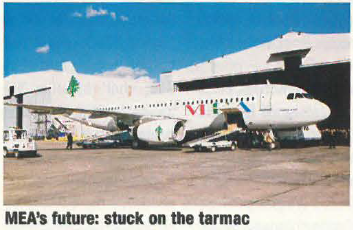
Despite its worldwide experience in privatizations,
IFC faces a monumental task of convincing the government to take action. And, according to an official
at MEA, this is just the latest in a series of studies that have been
commissioned with the appointment of each new chairman. Since
1997, at least four foreign companies have performed a similar study.
But despite the wealth of reports, no decisions have ever been made.
The eternal question at MEA is the employee issue. Because of politically
appointed personnel, the airline has a staff of 4,500 to operate
a fleet of just nine planes. That carries a monthly cost of $5.5 million.
MEA’s employee-to-plane ratio is about 380 more than required to run
an efficient and profitable airline, according to international standards.
The employees’ union of MEA has claimed that the staff is just 2,700,
while some three to four contractors each with about 200
employees are hired on a contractual basis. Regardless, that would still
put the number of employees at 180 more per plane than required.
Administrative reform of state-owned enterprises faces strong political
resistance because of the layoffs that would involve. The IFC is
expected to extend a 20-year loan of $40-$60 million to Lebanon for
end-of-service indemnities as a result of privatization. But because
politicians would interfere to protect their fiefdoms, it’s questionable
whether that money could ever be put to use.
Questions are also being raised about management
decisions in running the airline’s
operations. MEA doesn’t own any planes;
instead it pays about $250,000 per plane a
month in leasing fees. Although the price of
planes can range from about $70 million to
$180 million, few carriers choose to lease
when they can own the airplanes and pay the
same monthly installments over 20 or 30
years. MEA sold its three jumbos for a total
of $60 million in 1997, a deal that included $18 million worth of spare parts. That’s way below the estimated value
of$60 million each. The decision resulted in lost market share for MEA
as the jumbos had a capacity of 428 passengers compared to 186 for
the largest plane in its current fleet. ‘These decisions are part of years
of corruption and abuse that still contribute to the airline’s annual losses,”
says the MEA official.
Corruption and a lack of vision have brought the company to its current
situation, robbing the treasury of much-needed funds. Will the government
make the necessary decisions and implement the IFC’s recommendations
or will this report end up with the previous ones?