
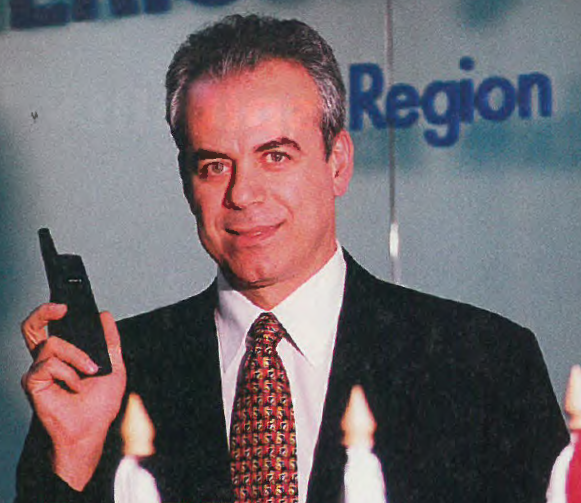
The opening of Ericsson’s regional office in Beirut is a rare and
welcome development, since pessimism clouds Lebanon’s outlook.
Nael Salah, vice president and general manager of
Ericsson Middle East, talks to EXECUTIVE about the future
prospects for Lebanon and the region, liberalization and the
company’s strategies. Salah’s office is responsible for 12
countries in the Middle East. Last year turnover for the region
was about $600 million, with infrastructure accounting for
about 70%. Annual growth in the past three years has been
30%, and Salah expects that trend to continue in the coming
years. The company has about 40% of the mobile phone
market in Lebanon and 35% for the region, with Nokia as its
biggest competitor for handsets.
Ericsson has just opened its regional office here.
Why Beirut?
SALAH When we decided to open a regional office in the Middle
East, we looked at a number of countries. Very quickly we shortened
the list and one of them was Lebanon. I would probably guess
that the most important factor is that in Lebanon there are many people
with a very high level of education, so we can recruit locally.
That means we have continuity in our work. There are other factors
as well, such as the geographic location of Lebanon between
Europe and the rest of the Middle East.
But many business people complain about the high
level of corruption, customs and bureaucracy here,
and most prefer Dubai.
SALAH Many of those things, if they exist, are not valid for us really.
Because we are a regional office we support Ericsson companies
in the Middle East. So our business is not with the society; it’s
more with the Ericsson companies of the area. Things like dealing
with authorities can be improved and simplified in terms of, for
example, getting work permits or establishing companies. But we
don’t feel this is a major obstacle.
Do you believe Beirut still has the potential to be
some sort of hub? Some have pretty much written it off
as a financial or transport hub.
SALAH We believe that there is very good potential for Lebanon
to play a major part in the business sector of the Middle East, but
there are a number of things that have to change. We believe that
there will sooner or later be a peace settlement and there will be
stability in the region. And we believe that the authorities in
Lebanon are serious about improving the infrastructure and that they
have an important objective to reestablish Lebanon as a hub for
many companies. So if we have stability, and if the authorities make
establishing Lebanon as a hub a major objective, I don’t really see
a problem in the future.
How can Lebanon convince other companies to set up
their regional bases here?
SALAH Foreign companies would like to hear the authorities
declare the establishment of Lebanon as a hub for the Middle East.
And number two would be to have additional development of the
infrastructure. You could make telecommunications more cost
effective; compared to Europe or the United States, it’s expensive
here. Transportation in terms of the airport and roads can be
improved. Then of course I would say all those formalities — registering
companies, issuing work permits, visas — these things can
be simplified.
What are Ericsson’s strategies for increasing business
in the region?
SALAH The Middle East is a traditional Ericsson market. So we
have established relations with people in the Middle East and we
have a good understanding of how people do business here. That
helps us today, and it will help us in the future. One of the major
strategies that we have is to be near our customers, so we have offices
in many countries in the region. We don’t want to be a competitor
to our customers; Ericsson’s strategy is to be a supplier of products
and services and not to compete in the operators’ business.
We have experienced liberalization in many countries before. This
has been happening for two or three years in the Middle East, and
it will continue. We have experience in that and can give support
to our customers to help them in a changing environment.
Are there specific countries in this region where you
see particular potential for growth and in what side of
your business will the real growth happen?
SALAH We believe there will be much growth in most of the countries
in the Middle East. Of course there are many countries which
have huge potential for growth, like Saudi Arabia, Iran, United Arab
Emirates, Syria, Lebanon, Jordan, Yemen. Other smaller countries
have a big growth rate as well, such as Bahrain, Kuwait, Qatar and
so on. We believe that the business will grow very much in cellular
infrastructure, cellular consumer products and in Internet systems
and services, so we target those areas.
What effect will privatizing part of the MPT (Ministry of
Post and Telecommunications) have on your business?
SALAH Today we are one of the major suppliers to the MPT. So I
think what we should talk about are the general advantages of having
privatization rather than having a monopoly. When we have privatization
and we have liberalization there are very obvious advantages.
Of course the market itself will expand a lot. And I believe that
we will gain from both of those things. Although we have a major share
of the business, I think the cake will be bigger. Even if we maintain
the same market share, the absolute volume of business will expand.
I’m convinced that this is very good for Lebanon in all aspects.
So we expect to see privatization within a short time.
Is a 25% stake enough to attract international investors?
SALAH My opinion is that many of the global operators are more
interested not in how much share they have in the company, but
more in what sort of business that company will be doing. I
believe that if cellular is part of that business then that would be
much more attractive.
They are on the right track. To establish a company and to sell 25%
is the first step. This 25% will increase and become a majority in the
future, or the total. In other countries in the Middle East, such as Jordan,
for example, they have sold a 40% stake to a strategic partner. In
Saudi Arabia they also have plans to privatize; they have already made
a company out of the telecommunications part of the ministry. In Oman
they have already formed a company and they are looking to privatize.
In Yemen this is also the case; they are giving two licenses for cellular.
Bahrain has already been privatized to a large extent for a long time.
In Kuwait there are two cellular companies — one was private from the
beginning and the other one started out government-owned and was
then partially sold off. There are many examples of liberalization in
the Middle East and these will increase in the future.
Is one of the biggest frustrations for Ericsson that the
cell phone companies are limited in the number of subscribers
they can have?
SALAH Of course it affects our business, so it will be positive for
us and for the telecommunications sector in general if this dispute
(between the MPT and cell phone companies) is out of the picture
as soon as possible.
What will most affect Ericsson’s business now or in the
future? Is it developments with the Internet?
SALAH Very shortly the industry will develop wireless data, which
is combining Internet and cellular telephony together. That will have
a major effect on our business. The third generation system will give
very high bandwidth between the telephone and the network for data.
Today the bandwidth is 9.6 kb/s, and that will increase very soon to
115 kb/s. With the third generation system, we’re talking about 384
kb/s. So this will give us very large bandwidth to data which means
that mobiles will be used for connecting to the Internet.
There are so many advances with cell phones, palm organizers,
laptops, getting Internet on the TV. Does this risk
a certain degree of confusion?
SALAH I don’t think it’s confusion. What is happening is that there
are many different industries which are converging together; this
is really the most important trend that will continue to develop in
the coming years. The computer industry, the communications
industry and the media or content will converge. It may be confusing
for some people, but I think it will mean simplification as well. You
will have things that have many different purposes; for example,
something like a PC will be a phone as well as a videoconference;
it’s your door to get information.
How far away is that?
SALAH I think that within about two to three years these things
will be happening on a large scale. We are already developing
the products.
Top of Form
