
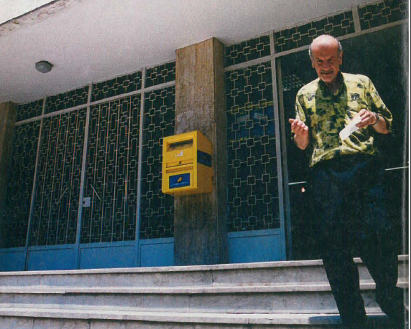
While some point the finger at the Canadian-run consortium,
which took charge in October 1998, Fakhoury, like
most, does not. The contract stipulates that all MPT
employees should be able to join LibanPost, based on an assessment
of skills. Some did choose not to transfer. But employees insist that
this was due to the lack of regulation to protect them once transferred,
that the selection process favored youth, and that political pressures
played a role in appointments. (Issam Naaman, the minister responsible,
declined repeated requests for an interview.)
“What is the future
of those who are taken by LibanPost when the contract ends?” asks
Boutros Harb, a lawyer and member of parliament. “Nothing was
stipulated, nothing at all; and I think the government was irresponsible
in this case.”
Part of the problem was trying to get the accord of the Civil Service
Board to allow MPT employees out ‘on loan’ to LibanPost.
“But this is an internal government matter,” says Nassib Husseini,
chairman of LibanPost. “The priority has always been for MPT
employees. But would you, as a customer or citizen, expect us to wait
another five years to settle this issue?”
Further, there were some
205 ‘untouchables’ that the minister retained to form a regulatory
body, and many of these are the most qualified. Almost 400 didn’t
make it through the selection process, says Husseini.
“We did
put on the table a firm 250 written job offers, and 71 of them accepted,”
he says. The current LibanPost staff totals 450.
But with the employee issue brewing, LibanPost could soon find
itself the receiver of an MPT special delivery: the matter may be headed
to the Council of Ministers.
“LibanPost will have to agree to modify
the contract,” says an MPT official.
Having a regulatory framework
in place, he argues, might sidestep the employee imbroglio and
other problems.
At the same time, MP Georges Kassarcji wants to have
the 12-year build-operate-transfer contract brought back to parliament:
“As soon as we finish with the cellular issue, I want the LibanPost file
put back on the table.”
The debate centers on the constitutionality of the contract. Harb
insists the contract contravenes Article 89 of the Constitution,
while others point to Article One of Decree 126 (see box), which governs
the former Directorate of Post, Telephone, and Telegraph.
An
independent lawyer consulted on the matter said that the decree only
touches on distribution, not running the entire concession, and
that the Constitution takes precedence.
This is not the first time such a debate has erupted. It’s an issue
that just doesn’t seem to die for LibanPost — one that threatens to
be continually questioned by MPs or with each new government
that comes into power.
“Whatever the decision of the government,
we will respect it. But we feel we have a solid contract; so if it is
challenged, there’s compensation linked to that,” says Husseini.
“Our
objective is not to kill the guardian of the vineyard; our objective
is to eat the fruits, which is a project that is good for both parties.”
There’s also the matter of the international couriers (see “Down and
Out in Beirut,” January 2000). The amendments to the contract gave
LibanPost the right to collect, as part of its revenues, what is essentially
a tax on private courier companies.
When the tax was
increased last June from $6 per kilo on inbound documents only to
$12 per kilo on both inbound and outbound,
the couriers cried foul and have
refused to pay. The outstanding tax bill
will reach about $9 million by June.
According to the MPT official, this part
of the contract will also have to be amended.
“I hope that it’s changed too. Why?
Because I am looking for a healthy
environment,” says Husseini. “I think
we share that goal with both the government
and the courier industry.”
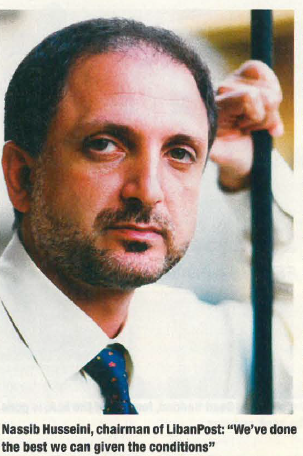
If the MPT employees and others
have complaints, it hasn’t been smooth
sailing for LibanPost either. Husseini’s
worry? That LibanPost is working with
a fixed revenue-sharing formula and a
fixed tariff scale, as well as delivering in
villages at a loss.
“How can we compete
with someone who works without a
license and charges local tariffs that are
lower than the government’s?”
The company also suffers from the same bureaucracy that inflicts
most businesses. One problem, which has
slowed down the process of renovating post offices, has
been getting permits. It’s no secret that the municipality
isn’t exactly quick on its feet in that arena.
Some offices
have yet to be passed from MPT control to LibanPost. Bureaucracy
has also impeded the launching of new products. And red tape at
customs undoubtedly makes Lebanese hesitant to send or receive
more than letters internationally.
On the upside, items up to LL 1–2 million in value should be delivered
without going through customs very soon.
Nonetheless, LibanPost is reassessing its expectations of breaking
even by year three. Husseini declined to reveal how much the company
is losing, saying only that this is a time of investment.
While the
volume of mail more than doubled in the last year, it’s still low compared
to levels in the West.
“Unfortunately, the win-win conditions we
were hoping for didn’t materialize, and we are at a turning point,” he
says. “We should make a decision on whether the conditions are now
there to invest more.”
LibanPost has invested
$20 million so far and is committed to
investing at least $50 million over the life
of the project.
While some say the
Canadian team has threatened to leave,
Husseini refutes that claim. The coordination
committee hasn’t met in over a
year and a half — that’s a pretty clear indication
of how poor relations are between
LibanPost and the MPT.
LibanPost is two-thirds owned by Canada
Post Systems Management together with
Profac, a joint venture between Canadian
firms Bracknell and SNC-Lavalin.
The
remaining third is held by Qantara
Holdings, a Lebanese company that
Husseini set up for the project.
“We’ve
done the best we can given the conditions,”
says Husseini. There is still room for
improvement, however (see box).
So are the Canadians
worried by the cellular war?
“What we care for is to be assured
that a written contract is respected
and that arbitration clauses are respected,”
says Husseini.
