Welcome to Lebanon -the land that has forgotten its role as
the region’s free economy, where levying taxes has
become the national sport and stupid government decisions
run free. The latest doozy was a gift from sports minister Mohammed
Youssef Beydoun. He decided to tax visitors $IO for each night spent
at any hotel during the Asian Cup and for the entire month of October,
claiming it w~ the best way to recover costs for the three new stadiums.
That’s on top of the current 5% tax on transactions at hotels, restaurants
and tourist attractions. The only people exempt from the new tax
were the football players participating in the Asian Cup.

The hotel industry cried foul – and rightfully so. Pierre Achkar, president
of the association of Lebanese hotel owners, resigned from his
post last month in protest. Josianne Chaccour, sales and marketing executive
at Palm Beach Sofitel, was appalled by the new tax. “We’ve had
many groups cancel their bookings,” she says. “The government
thinks that it’s going to make more money, but in fact it’s going to lose
money in the end.” Viviane Sarkis, public relations manager at Le
Bristol, also reports cancellations as a result of the tax.
But if the hotels are livid, those forced to pay the extra money aren’t
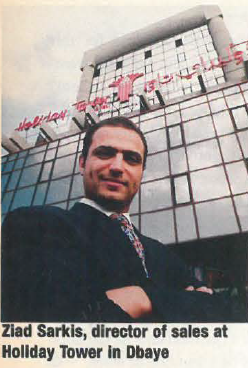
any happier. “Many visitors are outraged at the $10 tax,” says Ziad
Sarkis, director of sales at Holiday Tower in Dbaye, “because they are
not even here to view the sports matches. But they have to pay the exorbitant
tax anyway.” Tanios Kassis, development manager for Choice
Hotels, says that many visitors come to Lebanon as part of a package
deal and pay an average of $30 a night for hotel accommodations. “For
these visitors, the $10 tax translates into a 33% cost increase,” he says.
Noha Saliba, public relations manager at Phoenicia Intercontinental,
sounded the one positive note. ‘The tax is not a problem,”
she says, “because those who want to attend the Asian Cup will not be deterred by an extra$10.”
But its effects are mostly
felt by the smaller hotels,
not big outfits like
Phoenicia, according to
Enrique Byrom, CEO of
the Asian Cup accommodation
bureau: “If you’re
paying $200 a night and
you have to pay an extra
$10, that’s just a 5%
increase. But if you’re
paying $40 a night, that’s a
25% increase.” Clearly, if
a new tax was indeed needed, a flat $1 0 fee for all hotels was an irresponsible
decision, a half-baked idea at best.
A total of 26,000 reserved hotel nights were cancelled as a result of
the tax, according to Achkar. And of the 25,000 visitors expected to
come to Lebanon for the Asian Cup, just 2,000 actually showed up.
Kassis adds that the maximum amount that the government will raise
through the tax is $ I million (not nearly enough to cover the cost of the
stadiums), while it is estimated that the cancellations have resulted in
multimillion-dollar losses for Lebanon. The cancellations have been
particularly distressing for Choice Hotels, which has just opened a
Quality Inn hotel in Tripoli in honor of the Asian Cup.
While many point to the $10 tax as the main culprit behind
October’s mass cancellations, border tensions were also responsible for scaring away visitors. Just
before the Asian Cup’s official start,
Hizbollah captured three Israeli soldiers.
In response, Israel threatened
to bomb Beirut. While the Lebanese
may have become blase about
Israeli strikes, the same cannot be
said of the majority of tourists.
Byrom believes that the political situation
was the major reason for the
cancellations – more so than the $10
tax. “Lebanon’s problems are
always political,” Achkar concurs, but he’s also quick to single out the government as the party responsible
for the Asian Cup fiasco. ‘The ministry of tourism didn’t even
promote the Asian Cup outside Lebanon,” adds Kassis.
And herein lies the real problem: an inefficient and bloated government
that never accomplishes anything. ‘The ministry of tourism
should have top professionals,” believes Francesco Borrello,
Starwood Hotels and Resorts area manager for Lebanon and Syria,
“and it should play the most important role in the country’s government.
Instead, it’s doing absolutely nothing for Lebanon.”
The only thing it’s accomplishing is dreaming up new forms of taxation.
The result is that the government is making Lebanon too
expensive and thereby discouraging visitors from coming here.