
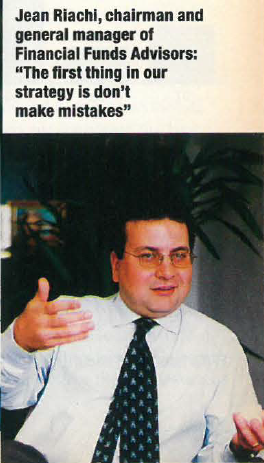
The first time EXECUTIVE met Jean Riachi, chairman and general
manager of Financial Funds Advisors (FFA), was in the
summer of 1998 at the head office of Bou Khalil Markets
in Baabda. The meeting centered around Riachi and Walid El Khalil,
then the head of special projects at Banque Libanaise pour
le Commerce**’s** capital markets division, who were taking Bou
Khalil public.
Even though the private placement and moving
Lebanon’s biggest supermarket chain onto the Beirut Stock
Exchange (BSE) was a success, it was the last time Riachi was
involved in investment banking activities.
“We would like to be investment bankers, but we’re realistic,”
says Riachi. “We know that it’s not possible right now; there is no
market for this in Lebanon.”
Instead, Riachi has kept FFA focused
strictly on brokerage activities and asset management, which has
paid off. It got its license from the central bank in 1996 and was up
and running in 1997, the year that trading on the Lebanese equity
markets was in vogue. FFA capitalized on investors’ interests:
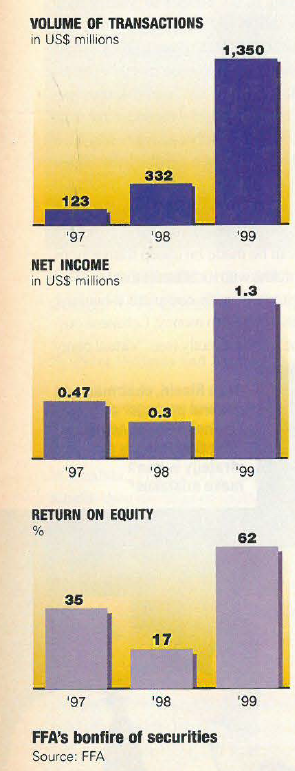
Eighty percent of its transactions were on the local markets, and it
pulled in $470,000 in earnings during its first full year of operations.
But the “bull run” was short-lived. Trading volume on the BSE
dropped to $330 million in 1998 from $639 million one year earlier,
and FFA went with it. Profits sank 36% to $300,000.
The logical step? Go where the action is. That’s where Riachi and
his clients headed. Last year, over 90% of FFA’s trading deals were on
international markets, which pushed its trading volume up from $332
million to $1.4 billion. Profits climbed 333%, up to $1.3 million.
Those
who trade only on the local markets sat idling. Banque Audi’s capital
markets division, for example, watched its trade in equity on the BSE
drop from $384 million in 1997 to $39 million last year.
Avoiding full-fledged investment banking, which includes corporate
finance and advisory services, makes sense. Investment
bankers complain that family-run businesses are afraid to lose control
and are not transparent.
They also claim that local companies
are not familiar with investment banks, don’t understand how they
can benefit from such services, and are reluctant to pay fees even
once they are aware of what they can get in return.
If an investment
bank does take in a company, the chances are high that it will be
working with a wily client, according to Nicolas Photiades,
senior vice president at Thomson Financial Bank Watch, a former investment
banker. “It’s too much effort,” he scoffs. “There is not a lot
of cooperation from the client and there’s a lack of transparency,
professionalism and organization.”
Photiades argues that with the amount of time spent working with
a client to finish a deal, the returns are not worth it. “A deal that
would take you a month or two in the West would take you a year
or two here,” he says. “One of my deals took me
two years, which was for no more than $1 million in fees.
If I had done it in London, it would have
taken three months, max.”
To compound the
problem, even if companies want to work with
investment banks and go public, the BSE being in
intensive care is pushing them away.
Lebanon Invest and Middle East Capital Group,
two prominent local investment banks that started
making deals in 1995, have had difficulties facing this
unruly business community. Their solution? Move
their services into the region where more deals can
be made. “With so many problems in Lebanon, you end up
with overheads and might end up with losses,” argues Fouad
Trad, general manager at Credit Agricole Indosuez Liban. “You have
two options: go into regional business or create a regular source of
income, which is asset management and brokerage activities.”
FFA focusing on foreign markets — especially the US — was the
major catalyst in creating growth. But it is not alone. Many investment
houses have caught the wave in equities abroad.
Across town
is Fidus, which has built up a solid client base over the years: It does
at least 97% of trading on foreign markets. Société Générale
Libano-Europeenne de Banque bought a 51% stake in the investment
firm at the beginning of 1999.
“Because Société Générale is an
international name, present in the
US, European, Asian and Middle
East markets, it has added credibility
and confidence to Fidus,” says
Nabil Aoun, who sold his shares but
still runs the firm.
Fidus also benefits
from Société Générale’s client base and through technical assistance from the bank. According to
Ort, Misri & Associates, Fidus carries out at least $6 million worth
of transactions a day.
Local banks have flooded the market by setting up capital market
divisions. Byblos Bank’s brokerage arm is averaging about $5 million
a day in trading volume.
Banque d’ Affaires du Liban et d’Outre-Mer
(BALOM), a subsidiary of Banque du Liban et d’Outre-Mer, has also
been caught up in the rush, watching trading volume
jump 143% and net commissions on share trading
shoot up 135% from the first quarter of 1999 to the
same period this year.
Plus, big foreign firms are present.
Merrill Lynch, the world leader with $35 billion
in total revenues in 1999, has an active branch
in Beirut, while CCF Finance Moyen Orient
moved in a few years back.
Credit Agricole last year
doubled its trading volume, reaching around $2 billion.
“If there is peace, more big foreign institutions
will come into the market,” says Riachi. “It’s a permanent
fight to improve your people, technology and services.”
That’s exactly what FFA is trying to do. Similar to what Merrill
Lynch and Arab Finance Corporation (AFC) provide, FFA just
launched an up-to-date online account.
That gives clients access
through the Internet to their immediate portfolio summary, holdings,
statements, profits and losses, recent transactions and risk management.
FFA also has plans to set up online trading by the end of the year.
AFC has launched “online trading” but is merely passing orders from
clients to brokers to execute. FFA will take on Merrill Lynch, which
already has online trading.
Even though entering cyber trading is considered a must for the
future by many investment firms, there’s hesitation. First, firms are
uncertain about how much money can be made on cheap transactions
online.
Brokerage houses are also in line with local banks that are moving
slowly to accommodate customers with complete e-banking
services.
The general belief: When it comes to money, Lebanese customers
still want to interact with the banker directly (see “Virtual piggy
bank,” February 2000).
“Online trading will eventually come, but it
will be difficult to compete,” says Fadi Osseiran, general manager at
BALOM, which is thinking about offering online trading next year.
“Eventually you give access to clients with virtually zero income on
transactions. But if someone trades online and makes mistakes, he
can’t talk to the computer. He still needs to talk to a person.”
Osseiran anticipates customers using a portion of their money to trade
online, leaving a larger sum in the hands of asset management.
Although FFA has doubts, now might be the time. Some large US
investment firms, like Merrill Lynch, got left behind when online trading
caught on and had to scramble to catch up to retain customers. FFA’s
chief local rival, Fidus, also has plans to launch online trading this year.
Even though FFA is exploring the new world of technology, Riachi
stresses the tight control of its operations.
“When it comes to taking
on new clients, if I feel I cannot handle that many, I stop. I drop clients
that can be a problem; ‘terrorist clients’, which is risky business. We
don’t want risky business,” says Riachi.
FFA also pays close attention
to risk management. By monitoring clients’ investments, it tries to trim
down exposure to risk. “When Nasdaq crashed in April, we didn’t feel
the pain. We have clients that lost money but within an acceptable range,” says Riachi.
Other brokers felt pain with their clients.
“Some bought at the top and
believed that prices would
continue to rise,” says Tarek
El-Ahdab, vice president of
asset management at AFC.
“For some people trading on
leverage, the consequences
were very harsh.”
Brokers at
FFA didn’t have to make any
margin calls during the turbulent
times in the US markets.
Was FFA’s spectacular jump
in earnings last year a fluke?
It might be difficult to repeat,
and Riachi aims at consistent
growth.
“We’ll have growth
unless we make mistakes,”
he says. “The first thing in
our strategy is don’t make
mistakes; make sure things
are operating well before
taking the next step.”
A hint at
FFA’s results in 2000: In the
first quarter, transactions
were $450 million and earnings
came out as $450,000. If
it keeps up the pace, FFA’s
profits will increase about
38%. Not as sensational as last year, but for any investor
or broker, something to
smile about.

