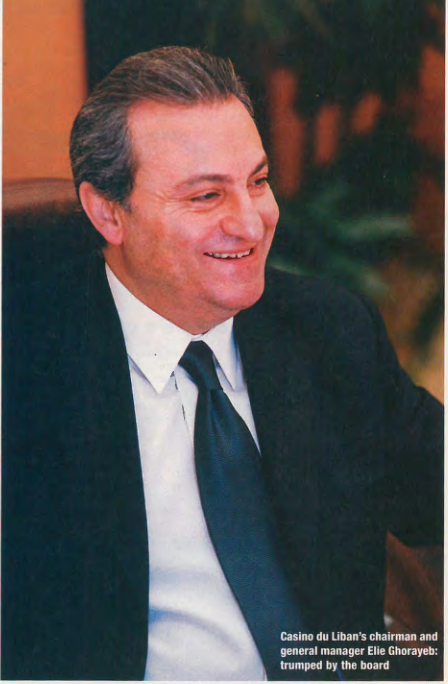
“It was a real mess,” describes Elie
Ghorayeb on what he saw when he
first came in as Casino du Liban’s
chairman and general manager in March
1999. His objective: do a clean-up job. He
concentrated heavily on cost cutting that
included reducing the casino’s bloated
workforce to 1,270, laying off 65 employees.
He also took a look at a number of contracts,
dealing with services such as cleaning
and maintenance, renegotiating seven and
canceling three. It is estimated that changing
the contract structure will help the casino save
about $3.5 million every year, with the overall
spending cuts adding up to savings
between $5 million and $6 million annually.
Ghorayeb acted quickly on the gambling
parlor’s debt as well. Two-and-a-half years
before the deadline, the casino paid back
$15 million, the remainder of a $50 million
syndicated loan used to rebuild the casino
after the war, which left the institution in the
clear. Ghorayeb was also wary of some of
the staff’s behavior. He implemented a
strict policy to make sure everybody
showed up for work, threatening to let go of
those not following through, and helped
the government uncover five employees
involved in embezzling funds.
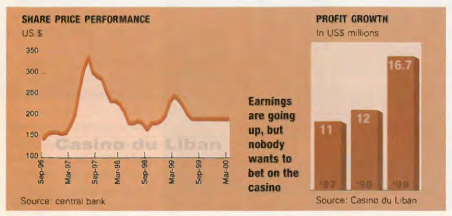
The casino’s earnings last year were
impressive. Pre-tax profits jumped 50%,
from $13 million in 1998 to $19.5 million.
The casino estimates net income at $16.7
million, close to a 40% increase from $12
million the year before. Not a bad job,
right? Wrong, according to the board of
directors. Early last month, the board threw
a punch and knocked down the chairman’s
powers. He can no longer sign or tamper
with contracts or recruit new employees
without the board’s approval.
According to board members, it’s not
exactly what the chairman did, but more the
way he did it. They complain that
Ghorayeb was operating as a loner, keeping
a distance from the board and leaving them
out in the cold as to where he was heading.
“At the beginning we delegated some powers
to the chairman, but after one year we
discovered things that were not properly
administered in a diplomatic way,” says
Majid Joumblatt, a board member. “The
board does support reducing costs where
feasible. He reduced contracts but changed
them without consulting the members of the
board. He would only tell us something
very briefly during our meetings and didn’t
give any information whatsoever, only bits
and pieces. The information was not systematic,
informative or documented.”
Some at the casino see what prompted the
board to jump on Ghorayeb differently.
One source claims that at the start the
chairman was given the right to make decisions
and implement them on his own. “He
was supposed to present his plans broadly,
not specifically. Now they want to get into
every detail.”
Sources at the casino believe that some of
Ghorayeb’s moves irritated members on the
board. They suggest that some board members
may have had ties with those involved with
the contracts that were renegotiated or canceled
and that Ghorayeb stripped several members of
their second jobs working for the casino,
which is not allowed.
It is also believed that what brought the
struggle between the alienated parties to a
head was a particular contract that
Ghorayeb really wants to change. Abela
Tourism Development Company (ATDC),
a joint venture between Abela Group and
London Clubs International, was brought in
for technical management when the casino
was back in operation a little over three
years ago. Within the ten-year contract,
ATDC is responsible for looking over a full
range of activities, including gaming, theaters
and restaurants.
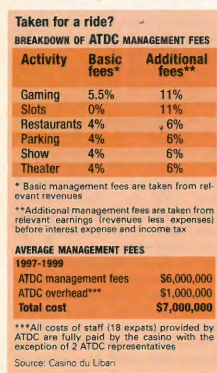
The payment structure for ATDC (percentages
of different revenues and earnings before interest expenses
and income tax) has been calculated as a
yearly average of $6 million (see table).
The casino also pays $1 million each year for
18 employees working for ATDC.
“It’s a big problem paying $6–7 million for
a counterpart doing I don’t know what,”
says Ghorayeb. A major beef, according to
one official, is that ATDC is not providing
enough services for the amount paid. He
cites only two employees working under
ATDC, outside the 18 on the casino’s payroll.
London Clubs is not being aggressive in
bringing in big foreign players and ATDC is
only giving advice that doesn’t offer
enough support.
Ghorayeb’s target is to bring ATDC’s income
down to reasonable terms. Including the $1
million payroll, it should be reduced to
between $1.5 million and $2 million,
allowing the casino to save around $5
million a year.
But some argue that, even though the
price looks high, it’s hard to estimate what
it should be. Abela Group is well known as
a multi-purpose contract company, especially
in working with restaurants and
catering. It has 33,000 employees in 40
different countries, covering territories
from North America to Southeast Asia. As
for London Clubs, it is famous internationally
for running gaming. According to a
financial analyst, whether it’s doing the best
job or not, it’s important just having the
name attached to the casino. “The casino
can’t lose London Clubs.”
Hacham Tabbara, another board member
and a regional manager for Abela Group,
goes further. He claims that Ghorayeb
doesn’t listen to suggestions given by ATDC.
“We submitted to him a written study that
ATDC is able to increase turnover by 20%
in 2000, with an additional cost of $1
million for renovations, such as tables,
increasing surface for slot machines, and
so forth,” he says.
It is estimated that revenue decreased
slightly from 1998 to 1999, which should
give credit to cost reductions increasing
earnings. Increasing turnover coupled with cost control
could push profits higher. “But he
refused,” says Tabbara. “He wouldn’t even
discuss it.”
From one source at the casino, Ghorayeb
will not let up; he plans to go on pressing the
issue to renegotiate the ATDC contract.
Talks between Ghorayeb and Abela are far
from inviting. And if there is no agreement,
Ghorayeb could take the case to an arbitrator,
which would take years and be costly.
Along with infighting, intrigue and uncertainties
(sex, lies and videotape extraordinaire),
there is also an ongoing question
about whether the casino can do better.
It’s obviously a money machine but has potential
to be a booming cash cow.
To help feed its revenue stream, the government gave the
casino a monopoly on gambling until 2026 in
return for 30% of gaming revenue (excluding
slot machines) in the first ten years, 40% in the
next ten years and up to 50% for the last ten.
It has little competition in the region — one in
Palestine and clubs in Egyptian hotels are the
best-known competitors.
But it has obstacles. Auditing firm
Deloitte & Touche estimates that the casino
can run on 1,150 employees, still 120 less
than what it has. Although Ghorayeb
claims that there has been no political pressure
preventing him from cutting the workforce,
the previous chairman, Habib
Letayf, once confessed that he was forced
to hire up to 300 employees.
In 1998 the ex-chairman was beaten up by armed marauders,
assumed to be operating for a political
power group, forcing the hiring of its own
people. This year Ghorayeb is considering a 5% reduction in staff.
But even then, the number of employees will be above
Deloitte & Touche’s benchmark.
Another weakness is its marketing campaign.
Thirty percent of the customers are
foreigners, but with little competition in the
region, the casino could push foreign
clients higher. This brings infighting back
into play.
The board claims that it established
a committee to study marketing
abroad four or five months ago. “I don’t
think Ghorayeb was able to listen at all. He
neglected everything,” says one board
member. “We could be involved in promotions
overseas much more and raise foreign customers much higher than 30%.
This is one of the most important tourist
institutions in Lebanon.”
But some argue that there’s a risk factor
attached to attracting tourists to a land still
at war. “It’s not easy to promote tourism
with no peace,” says Ghassan Matar, once
an independent consultant for the ministry
of tourism. “Israeli planes still provide fear
and you can lose tourists.”
On the service side, others argue that the
casino is hindering its progress by not following
the Las Vegas model. The key is that
non-gaming revenue is not where money is
made (about 95% of the casino’s revenue
comes from gaming); it’s only to attract customers
to gamble their money away.
“A hotel, a helicopter taking a gambler from the
airport to the hotel, cheap dinners, free
drinks — all this is crucial for the casino,”
says Nicolas Sawan, head of trading at
Lebanon Invest.
Some say that due to its monopoly and lack
of competition, the casino can get away
without pampering clients with food and
drink, but they are adamant that a hotel is
essential. In its contract with the government,
it’s supposed to build a hotel by 2001.
The casino hasn’t taken one step in that direction.
For the sake of survival (the casino would
have to pay hefty penalties and eventually
lose the contract), the ministry of finance
granted the institution a two-year extension,
according to Tabbara. Yet, putting together
any plans is still on the back burner.
Even though the casino is making
money, financial analysts don’t want to
come near its shares traded on the over-the-counter
market (and most don’t want to be
quoted directly, since it is considered a
political animal). One analyst estimates
that its earnings could have easily doubled
by now if it had put in the proper facilities,
moved heavily into marketing and reduced
costs even further.
The Financial Funds Advisers (FFA) report
published in July 1998 projected net income
to reach $29 million in 1999.
Another complaint is that the casino is not
transparent enough. “The way the balance
sheet is constructed raises a few questions,”
says one analyst. “The problem is
that the casino is not open to answering
questions. Detailed information on financials,
operations and management structure
are not readily available.”
More caution comes from the casino being
tied to political meddling. “A lot of politicians
have their fingers in it,” claims an analyst.
Better yet: “Everybody knows the casino is
corrupt,” says one broker.
Its shares reached a high point in July
1997 at $340 (from its starting point at
$148 in September 1996), but worked
their way down to $195 in mid-summer last
year and haven’t moved since. Now that its
debt is paid off, there’s a chance that the
gambling house will dish out dividend
payments in the future.
Could this create movement on the shares?
“It would please the shareholders but not much movement of the shares, because of lack of transparency
and not being as profitable as it
should be,” suggests an analyst.
The unanimous recommendation among analysts
questioned: gamble at the casino, but
don’t bet on it.
It’s also difficult to bet on
who is going to win in the
boxing arena. Many were
surprised that Ghorayeb
didn’t resign when the
board took away some of
his authority. But as one
analyst says, “He is clean
and he did a good job by
reducing costs, paying off
the debt and bringing up
profits.”
Ghorayeb faced a
mess when he first arrived, but
he has a bigger mess to
deal with now.