
Picture this. Mohammed and Mahmoud are good friends. The former is married to the latter’s maternal cousin, and most evenings after work are spent together around the dinner table followed by a session of backgammon and nargileh sipping. Jokes, exaggerated
tales and laughs are mixed with political
chit-chat and complaints about the state of
the Lebanese economy. Shop talk doesn’t
enter into the conversation much, but when
it does, Mahmoud’s $75,000 in outstanding
debts to his friend never does. Even in a
work environment, Mohammed finds it
difficult to press the matter for fear of
upsetting their close relationship.
Though these characters are fictitious and
any resemblance to real persons is purely
coincidental, it’s not a difficult scenario to
imagine in Lebanon, where it can be difficult
to separate personal from business relations.
While some may consider that to be a hindrance,
factoring firm Ipso Facto sees it as an
open invitation for its line of business. “A
client [of Ipso Facto] doesn’t have to jeopardize
his relationship with his buyers, pushing
them to pay, because it’s not his worry anymore,”
says Bassem Yammine, head of corporate
finance at Lebanon Invest.
But there are other advantages to using the services of Ipso Facto on top of safeguarding relationships. Factoring involves a
number of services that revolve around the
management of receivables, including collection,
credit insurance against bad debt
and financing. Ipso Facto receives a fee of
0.5% to 1.5% for its services as well as interest
on the financing it provides to clients
against their receivables. Ipso Facto has so
far concentrated largely on recourse factoring; if a client’s buyer doesn’t pay up,
Ipso Facto has recourse to the client.
Since its inception in 1997, Ipso Facto has
broken even, with losses last year canceling
out the previous year’s profits. But earnings
should be just around the corner as the
company expects profits of about
$250,000 this year. With about 35 clients last
year, Ipso Facto managed about $22 million
in receivables, about the same as it did in
1998. The company needed to increase its
capital and lay the groundwork before
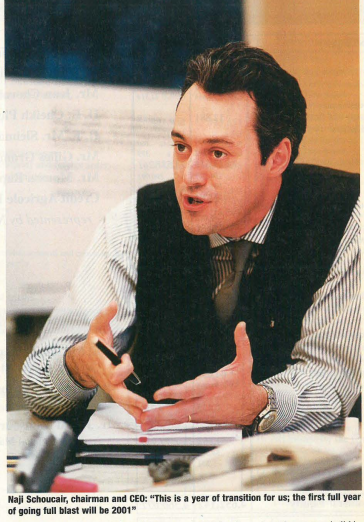
being able to factor more, says Nagi
Schoucair, chairman and CEO, explaining
why business was flat in 1999.
As the first factoring firm in Lebanon,
Ipso Facto has doubled its human resources
since it began and invested about $500,000 in information technology last year. The
investment includes FactoLine, the firm’s
online service for clients to check up on their
accounts. The company has been given a
helping hand through its alliance with
Societe Française de Factoring (SFF),
France’s second largest factoring firm,
which has provided know-how and served
as a partner in international factoring for
trade between Lebanon and other countries.
“The last two-and-a-half years Ipso
Facto has basically been running like a lab:
testing, modifying, improving, testing,
modifying, improving,” says Yammine.
“Definitely, it has a two- to three-year lead
over any potential competitor; it would be
very difficult for someone to duplicate
what they have in a very short time.”
The next big push will come with the
planned capital increase from $2 million to
$8.75 million in May through Lebanon
Invest. This will bring a new shareholder
base into the company, which is 90%
owned by Schoucair and 10% by Rami
Nimr. At that level, Schoucair expects to be
able to handle about $70 million to $80
million in receivables in a full year of operations.
“This is a year of transition,” he
says. “For us, the first full year of going full
blast will be 2001.” The cash injection will
also give Ipso Facto the opportunity to dip
its toes into the regional pool of factoring,
where competition is scarce. Oman,
Tunisia and Morocco are the only countries
in the Middle East and North Africa that
have factoring firms.
SFF sees good potential in the region,
especially in Egypt. “The idea is for Ipso
Facto to be a partner that we’ll go with
into the region,” says Jean Gartner, international
director for SFF. “Now is the time
to go down to these regions, not when
everyone else is already set up there.” And
go they will, starting with Egypt and
Jordan. While SFF already holds a 5%
stake in Morocco Factoring and 10% in
Tunis Factoring, there are no plans to do the
same with Ipso Facto for the moment.
The plan is for Ipso Facto to form joint ventures
with local companies, which will bring
the knowledge of the market and put up the
capital. In its turn Ipso Facto will provide the
know-how and tools, using SFF again as its
partner in international factoring, which they plan to begin this year. Domestic factoring
will come at a later date in Egypt and
Jordan. With margins as slim as 2%, going
regional will help increase volume.
“Lebanon is a small market, so you can only
think of it as a lab to test concepts and see
how you can take it further,” says Yammine.
But what’s the benefit of paying money for
a third party to collect payments, when it can
be done in-house? Outsourcing the management of receivables allows a company to
eliminate related expenses and concentrate
on its core business. According to
Schoucair, factoring firms generally have
a collection rate that is 10% to 15% better
than when the clients do it themselves.
More importantly, financing allows a firm to
turn outstanding receivables into working
capital. Interest rates are 12% to 14%.
Clients include Sony, Megacom, Nike and
Playtime. “One of the major reasons we
decided to go to Ipso Facto is that it’s the only
company willing to offer this service on the
market,” says Mohit Parasher, branch manager
of Sony Lebanon.
Ipso Facto has been creating a sort of credit
bureau, called Ipso Credit Watch (ICW), in
the absence of such information on the market.
ICW has created a system of standardization
for industries similar to those codes
that operate in the US and EU. There are some
170,000 companies in the ICW database,
albeit with varying levels of financial information.
Based on balance sheets representing
about 15% of the companies in a given
industry, ICW can assess others with limited
information by using ratios such as turnover
per employee. “Based on this, we can
rebuild a balance sheet, figure out the assets
and so on,” says Schoucair. “But the condition
to do this is to have a proper sector study.”
Schoucair admits the method is not 100%
foolproof. In fact, the results are only accurate
to within a 20% to 25% variable by his
estimates. Come again. A 20% to 25% variable?
While that may be good for the prevailing
conditions in Lebanon, it still leaves
a huge margin for error. Schoucair has a few
other uphill battles to face, not the least of
which are the lack of transparency and culture
on the Lebanese market. “Take for
example securitization. It’s very simple, but
nobody understands it, nobody accepts it,”
says Nicholas Photiades, senior vice president
of Thomson Financial Bank Watch in
Beirut. “The legal structure is not there to
facilitate it. It’s still early, early days.”
Another analyst points to the inefficient
judicial system in Lebanon: “The banks
take the good debtors, so you’re left with bad
debtors and no courts.” While Schoucair
acknowledges the problem of the slow
legal system, he says the more important
legal issue is the invoice’s weak status in
comparison with the promissory note.
Another factor that the company will
have to prepare for is the inevitability of a
tougher market. Ipso Facto may soon find
that it doesn’t have the run of the place.
Commercial banks could become direct
competitors in the factoring business following
the recent central bank circular that
laid the ground rules. Schoucair, however,
has a plan to cut them off at the pass: Facto
Bank. “We’ll operate the factoring completely
from A to Z, and the bank just puts
its logo on it,” he says. “Or we can train
them, give them the tools and procedures to
enable them to do this.” Knowing the Alfa
banks will be tough to convince, Schoucair
plans to target the medium-sized banks.
Ipso Facto expects 2000 to be a very difficult
year. “1999 was a tough year, but most
companies had reserves,” says Schoucair.
“They’ve used them, so now a lot of companies
are on the edge.” He believes that this
year will bring a surge of bankruptcies. All
that and Ipso Facto is in the process of
switching its clients to non-recourse, meaning
if debts can’t be collected, Ipso Facto
swallows the loss. In the face of so many
obstacles, Schoucair has his work cut out
for him. The next couple of years will reveal
whether he can manage to pull it off. Either
way, at least he has the guts to try.

