
In the second half of 2000, big-name US industries listed on the New York Stock Exchange and Nasdaq are releasing this year’s second-quarter earnings. In Lebanon, cement industries that have shares traded on the local capital markets are also making their figures public. Unfortunately, last year’s results. Notorious for their lack of transparency, this time around they can almost be forgiven.
Ciments Blancs, a white cement producer, lost $372,543. On the Portland front, even though Sibline hasn’t opened its books yet, one official says losses were at least $200,000. But Société des Ciments Libanais (SCL), the largest cement industry in Lebanon, stole the show: It came out with a mind-boggling $19.3 million in losses, down from $1.1 million in the red the year before.
When an economy tanks, cement producers get waxed. It’s estimated that last year’s GDP growth rate was between -1% and -1.5%. The real estate sector is barely hanging on. According to M.I. Associates, there are about 140,000 empty residential units in Lebanon. Solidere, which is responsible for rebuilding the Beirut Central District, is losing a war with the government. Building and occupancy permits are rarely approved, holding back hundreds of millions of dollars’ worth of projects.
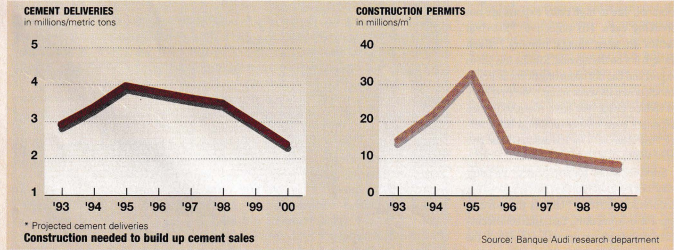
The construction sector is near its deathbed: Permits dropped from 33.1 million in 1995 to 8.4 million in 1999, a 75% free fall. Not one public project has been launched since 1998, which has erased 20% of cement consumption, according to Marwan Iskandar, an economist.
In return, there is little need for the basic commodity. Five years ago, 4 million tons of cement was delivered; last year, only 3 million, down nearly 16% between 1998 and 1999.
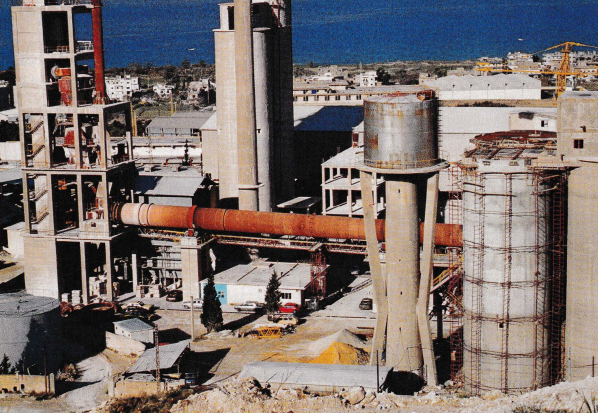
Cement industries have also hurt themselves. Assuming the boom in the mid-’90s would continue, the three Portland makers (SCL, Sibline and Cimenterie Nationale) pumped in over $300 million to expand production, reaching 5.4 million tons.
This year is even worse. Compared to the same period last year, cement consumption in the first half of 2000 fell 22%. Pierre Doumet, CEO of Cimenterie Nationale, expects cement deliveries to come out at just 2.4 million tons by year-end. That’s 40% less than 1995, and that will leave the industry as a whole 56% below production capacity.
But the crisis has just begun. Something else might cripple the sector even further. Seament was given the right to be the sole cement importer during the robust years of construction, taking up a 10% market share. But in September 1999 the government banned imports.
Protectionism at a time when Lebanon needs to prepare itself to join Euro-Med and the World Trade Organization could have been a strong argument for Seament while it was being cast out. But the company bought Cimenterie du Moyen-Orient (CMO), which was on the verge of collapse. Once a producer of white cement, CMO lost a price war with its arch-rival Ciments Blancs. This helped Ciments Blancs’ losses decrease in 1999, half of what they were the year before.
It’s also a lucky break: Seament is converting the plant to produce gray cement, so Ciments Blancs will be the only local producer of white cement. Seament has invested $25 million to convert the plant, which will be operational later this year.
Undoubtedly, bringing in a new production line has generated fear and loathing in the cement sector.
“I’m not glad they’re here. There’s no rationale behind it,” says Nicolas Nahas, general manager of Sibline. “The market is going down and is already harmed. It will damage the cement industries more, bringing down production for each plant.”
Seament is no rookie dealing with cement. It belongs to Seament Group, which has numerous vessels and terminals and has specialized in shipping, handling and trading cement worldwide for over four decades. It is now serving 20 countries, including Denmark, the UK, Turkey and Egypt, delivering up to 5 million tons a year.
In the last few years, it branched into cement production. It bought two factories in Albania and is working on acquiring plants in Africa and the Far East.
Seament says it’s no death squad in the local market.
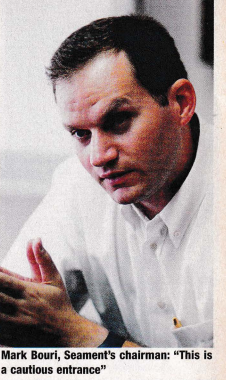
“We were supplying around 10% of the market with imports, which is the level we want to supply by the end of the year,” says 30-year-old chairman Mark Bouri.
Initially, the company will have the capacity to produce only 200,000 tons; by 2002 it will expand to produce twice the amount.
“This is a cautious entrance,” says Bouri. “Coming into the market will not destabilize the market, because we’ll represent a small share initially, which could take only 3% from each existing plant. People will hardly notice.”
Hard to believe. Any slight disruption can cause damage to a patient in intensive care.
The only good news for the cement industries’ shareholders is that the companies are concentrating on survival. (The shares are cheap but off limits to the faint of heart.)
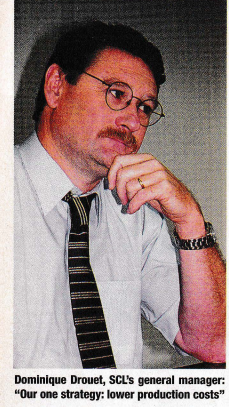
SCL is the best example. According to its new general manager Dominique Drouet, besides a drop in sales and being saddled with debt from its recent expansion, some of SCL’s deep losses are attributed to repairing its books.
“Our objective was to clean our accounts,” says Drouet. “What was needed was to start with a clean slate, start over again.”
It wrote off $8.5 million in receivables and $1.8 million for ailing subsidiaries. With only one out of four kilns operating, SCL put in $4.6 million for provisions for excess spare parts.
To help reduce costs, it laid off over 40% of its work force (300 employees), which cost the company $10.2 million in severance pay.
Attempting to break even this year, Drouet is focusing on exports. Having started in May, he’s expecting 20% of production to sell elsewhere by year-end. But Drouet knows this is a problem: Production costs in Lebanon are too high to have competitive prices internationally.
“Our one strategy: lower production costs,” says Drouet. “We have to be competitive worldwide or we’ll have to close the company—or set up in another country.”
More layoffs are on the way. Fifty more will be deleted from the payroll, bringing it down to 346 by the end of 2000. But it might not stop there.
“A factory our size in Europe has only 80 workers,” emphasizes Drouet. “That’s the key; we have no choices.”
Cimenterie Nationale jumped on exporting cement and clinker last year, taking up 23% of sales. This year it’s on a rampage: 50% of sales are abroad. But according to Doumet, due to high costs, exports are not breaking even.
His objective: “Survival tactics to keep things running.”
Even though it’s on the agenda, Sibline has yet to export and has not taken drastic measures to knock down its workforce.
“We first have to reduce costs. We have room to reduce expenses even further on things like energy,” says Nahas. “Our last resort will be layoffs. We’ll do it if we end up there.”
Survival skills for the cement industry may not be enough. One thing it needs is economic recovery.
“Unless the government does something fast, like sell licenses to mobile phone operators to reduce the deficit and give the economy some breathing space, there will be negative growth this year,” says Iskandar. “But because of the elections, it’s probably too late.”
What’s going to happen next year is pure speculation. But economic growth is not really the answer. Drouet reasons that Lebanon’s cement consumption per capita is outrageously high. Yearly consumption per capita is estimated at 500-600 kilos, compared to the worldwide average of 350-400.
He concludes that the burst in cement consumption in the mid-’90s was an off-chance bubble. He considers sales of 2.4 million tons as normal and 3 million as a maximum.
What really shows on the pain index is that the industries didn’t see this when they expanded production at the same time. With excess capacity lingering, the only way out is to export. But if costs aren’t drastically reduced, there may be a time when one or more companies head for the boneyard.
“Cement producers are in danger,” muses Iskandar. “It’s likely that we’ll end up with two companies. I don’t know when exactly, but there’s a good chance it will happen.”
Whatever it takes
Ceramic tile industries are in the same boat with cement producers: sales are cyclical, following the economic tide. Uniceramic, a local tile manufacturer listed on the Beirut Stock Exchange (BSE), avoided a drop in earnings last year when sales dropped by restructuring (see “Streamline to the bottom line,” April 2000). But this year has been tougher.
In the first half of 2000, turnover from local sales fell 12%, from $7 million in the same period last year to $6.2 million. The stagnant economy has been the main culprit. But the government doesn’t wet-nurse Uniceramic or its local rival Lecico like it does the cement industries. There is a complete blackout on cement imports, but tiles are allowed in, with 20% customs duties. Imports are creeping up: 55% market share in the first six months of 1999 to 58% this year.
Uniceramic doesn’t give up without a fight.
“We’ve lowered our prices on commercial products, trying to stop the invasion of foreign tiles,” says Nabil Ghorra, assistant general manager. Lecico has also lowered prices on commercial items to fend off foreigners. Still enhancing the quality of tiles, Uniceramic’s prices for value-added products targeting consumers remain on the high end.
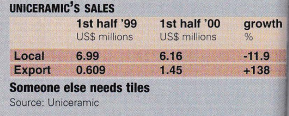
While having problems selling at home, Uniceramic will go where the money is. It’s increasing exports by entering new markets, like the US and Canada. After tiles were finally included in the Lebanese-Syrian free trade agreement earlier this year, Uniceramic’s trucks have been rolling across the border. It has already signed a $5 million contract with Iraq and is waiting for approval by the UN, which might happen this year.
At the end of June, exports increased from 12% at the beginning of the year to 20.5%. Revenues in the first half of 1999 were $600,000; this year it pulled in $1.5 million. The increase in exports has helped push production up from 70% to 95% of capacity.
“This will cover our costs, and we’ll end up with profits at the end of the year,” says Ghorra.
Uniceramic also finds it time to diversify. Lecico dominates the sanitary ware market with a 55% market share and almost $12 million in revenues, while imports account for the rest. Uniceramic signed with Vitra, a large sanitary ware manufacturer in Turkey, to be the local distributor of high-end products. Sales should begin in August, with the aim to account for 5% of sales this year and 10% by next summer.
Lecico is not concerned.
“It will probably not have a big impact on the market,” says Georges Ghorayeb, general manager. “They’re not the first to enter the market. There are over 50 importers.”
Uniceramic’s shares are rarely traded on the stagnant BSE. In late June, its A shares got a jolt out of the blue: Prices fell 19% in one day.
But one thing is clear. To handle Lebanon’s ailing economy, Uniceramic will try whatever it takes to make money.
