
Not a bad start.
Only two
years after the
central bank let Credit
Libanais loose in the
market – followed by a
complete restructuring
program (see “Back to
life,” December 1999)it
outshone the leading
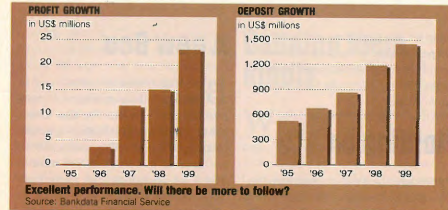
banks. Net income
jumped 52.5%, from
$15.l million in 1998
to $23.1 million last
year, while average
profits of the top-tier
banks dropped 3.7%
(Bankdata Financial
Services). Bank of
Beirut came in second,
up 27.6%. Credit
Libanais’ strategy is to
become a strong retail
bank, and results are
coming through. It led
its competitors in
deposit growth and non-interest income increased over 10%,
above the two leaders in retail banking,
Banque Audi and Byblos Bank.
But questions are beginning to surface. Is
Credit Lihanais a threat to the top retai I
banks? Leaping into the market with a
splash soon after Saudi entrepreneur
Khaled Ben Mahfouz bought the bank is
one thing; maintaining healthy returns in the
years to come is another. “The test is not
today,” says Ziad Maalouf, vice president at Middle East Capital Group. “The test is
this year and the next few years to come.”
According to Spiro Youakirn, senior
manager of corporate and project finance at
Schroders, Credit Libanais is well positioned
to compete in retail business. It has
a far-reaching branch network with 49
outlets and is highly liquid – 69% of liquid
assets to total assets. Youakim argue~ that
in the long term, “Retail banking revolves around retail lending, and once economic
conditions improve, Credit Libanais will be
able to he a major lender.”
Credit Libanais has already taken a step
forward in lending. Last year its loan portfolio
shot up 43%, “Most of our loan
growth has been in small consumer lending,”
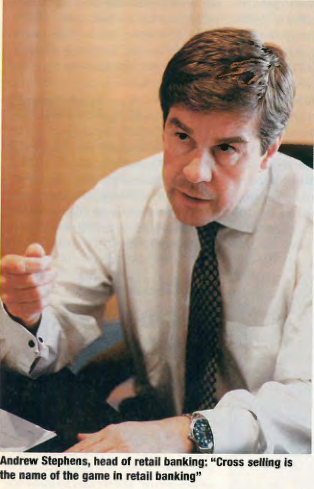
says Andrew Stephens, head of retail
banking. “What we tried to do is speed up
the decision process so the customers enjoy coming to us,
rather than taking a
week or more to get a
loan. For small loans,
we can virtually agree
on the spot.” It also
cleaned up the faulty
loan portfolio inherited
from other banks it
acquired under the central
bank’s control. By
collecting $4.3 million
and writing off bad
loans, its non-performing
loans to gross loans
dropped from 26% in
1998 to 11.8% last
year, which is around
the average for the
leading banks.
Audi is still considered
the leader in producing
products and services:
“It always pays for
Audi to be the innovator
and to be the first in the
market,” says one analyst.
But Credit
Libanais is not far
behind, having already developed insurance,
leasing, phone banking, free Internet and ecommerce
facilities. Already the leader in
credit cards, its number of cards issued and
points of sale through businesses increased
20% last year.
Will it whip out more products this year?
“Enough is enough for now,” says
Stephens. “Customers can only take so
much. They mostly want fast, efficient and
value for money services. They don’t like you to mess around with their money too
much.” Instead, the bank will focus mostly
on cross selling existing products, which
fits in with its restructuring program to be
more sales oriented, turning its outlets into
points of sale.
Credit Libanais is also looking into
acquiring the American Express outlet in
Lebanon, which has over $80 million in
assets, within the next few months. “It’s a
good small bank that has a small portfolio
with prime, high net worth customers,”
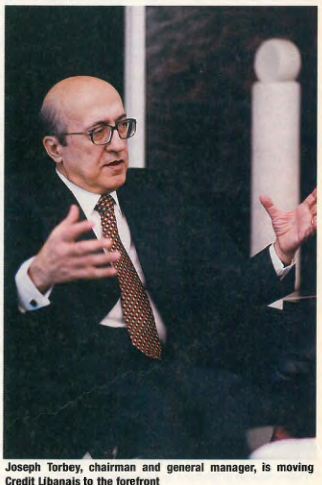
says Credit Libanais’ chairman and general
manager Joseph Torbey. The bank knows
American Express well: It has an exclusive
partnership with the American bank as the
service provider for it~ cards, accepted only
through Credit Libanais’ network.
But some analysts see a weakness Credit
Libanais bas to work on to be a real competitor
in retailing and maintaining steady
growth. “The new upper management that
was acquired recently is high caliber, but
human resources and services at the outlets
have to improve,” says one analyst. “If you
want to establish yourself as a retail bank, it’s
the service and the quality of staff behind it.
Credit Libanais is slower in tenns of training
and improving the quality of service,
especially compared to Banque Audi.”
Stephens replies: “We’ve recognized it and
we’re doing something about it. Training
began 12 months ago, and it will go on and
on.” Another issue is cost control. Its costto-
income ratio came out at 60.5% in 1999,
higher than Banque du Liban et d’Outre-Mer
(44.3%), Byblos (52.8%) and Audi
(56.2%). But with increasing efficiency
being a part of the restructuring program,
Credit Libanais’ cost-to-income dropped
7 .2 % from 1998, the largest decrease
among the top-tier banks.
After an initial burst of growth, it will be
interesting to watch how Credit Libanais
does from here on out. But the bank has an
idea of where it is heading. “What Credit
Libanais started two years ago was a statement
that we’re open for business,” says
Stephens. “We’ve put the building blocks in
place and we’ve done some good business.
We’re going to build on those building
blocks, and I see no reason why we can’t
sustain steady growth and be prepared to
take on opposition.”
