It’s funny how a passing comment can send gyrations across an entire nation. Mustapha Miro, Syria’s prime minister, made a curious remark while casting his vote at the recent referendum to confirm Bashar Al-Assad as the new president last month. He announced that foreign banks were invited to set up shop in Syria, implying that a nearly four-decade-old ban on private banking either had been, or was about to be, lifted.
Lebanon’s financial community pricked up its ears. Nearly devoid of modern financial services, such as credit cards, ATMs and loans, and with a population over four times the size of Lebanon’s, Syria is a wide-open frontier for Lebanese banks to explore.
For more than a decade, unfounded rumors that Syria was about to do everything from loosening its airtight import restrictions to opening a stock market have circulated. This might explain why some Lebanese bankers were taken aback by Miro’s comments.
“When I read what Miro said, I had to read it several times to understand what he meant,” says Makram Sader, president of the Association of Banks.
This time it could be for real, however. The new Syrian leader is facing the task of pulling the state-controlled economy out of a recession and pleasing a constituency eager for change. The Economist Intelligence Unit estimates that Syria’s GDP growth rate in the last two years was at -1.5%.
Recently, a number of reforms have been launched. Foreign banks are now allowed to operate in free zones, but only to serve the limited number of businesses working in those areas. Banque du Liban et d’Outre-Mer (BLOM), Lebanon’s largest bank, is considering entering the free zones, but general manager Samer Azhari expects any returns to be modest at this stage.
Syria also overturned a law that restricted the importation of cars to the government and a few individuals. Although tariffs on imported cars remain as high as 235%, the increased competition is beginning to show results.
“Cars have been trading for prices between 30% to 50% less than before,” says Bashir Mansour, director of foreign relations at the Damascus Chamber of Commerce.
More changes are expected.
“Bashar needs time to assume tasks in a proper manner. The general trend is towards opening up,” says Mansour.
The Syrian prime minister’s press office has confirmed that, indeed, a draft law has been drawn up that will allow foreign banks to operate in Syria, as long as they have a Syrian partner. The bill is now before parliament. The draft law also contains provisions to regulate the banking sector, and it is fully supported by the president, according to the press office.
But most likely Syria will not be hasty. Although the country has received assistance from the European Union to modernize its state-run banks, it still lacks the know-how and expertise to set up and regulate a modern private banking system.
“This can’t be done in one go. It’s too dangerous,” says Nicolas Photiades, vice president at Thomson Financial BankWatch. “The Russians opened up immediately, which created a disaster. Syria should not copy them; it must do it step-by-step. Opening the free zones was a good start.”
Lebanese banks will likely be among the first to step in once Syria does open its doors. BLOM and Banque Européenne pour le Moyen-Orient are already run by families of Syrian origin and have a large Syrian customer base.
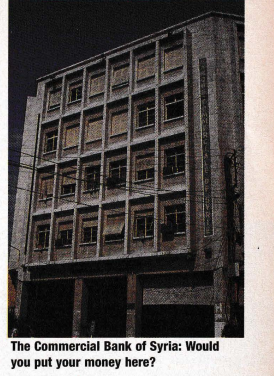
But development will undoubtedly take time. Syrians are not accustomed to using modern banks.
“It’s a great opportunity on the retail side for Lebanese banks,” says Photiades, “but it will take a long time for the Syrians to learn and trust banks. They don’t trust credit cards, technology and so forth, because they’re not sophisticated and are conservative. The foreign banks will have to start with basic retail banking.”
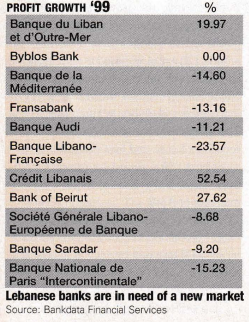
The Lebanese banking sector is in need of a new market. After years of tremendous growth (it’s estimated that total deposits in Syria in 1999 were around $5.5 billion, whereas deposits in Lebanon are over $35 billion today), the recession has taken a toll on the industry’s profit growth.
Estimated earnings for the top 15 banks in 1999 fell 3.7%, according to Bankdata Financial Services (see table). Moreover, the country is saturated with some 65 banks, and some are beginning to fail.
Miro’s comment could not have come at a better time. If only establishing a private banking sector was as easy as dropping a ballot in a voting box.