
Remember the hazards
of the Asian
crisis? Confidence
plummeting and hot money
flying out of emerging markets
were major causes that
brought a number of countries
to their knees. But it
turned out to be one of the
best times for Lebanon’s T-bill
market. “The secondary
market boomed then,” says
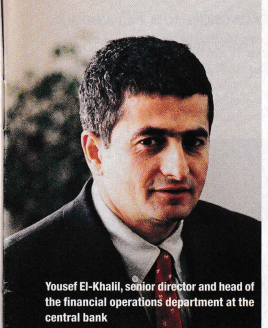
Yousef El-Khalil, senior
director and head of the
financial operations department
at the central bank.
“Foreign investors in T-bills
wanted to get out of emerging
markets, but local
investors did not. Sellers could sell and buyers could buy at
relatively cheap prices.”
That was the time of the two-way market. Unfortunately,
most of the time the T-bill secondary market is just a one-way
market. “Because of the uncertainties surrounding
Lebanon, everybody is optimistic and wants to buy and there
are no sellers, or everybody is pessimistic and wants to sell
but there are no buyers,” says El-Khalil.
There are other reasons why the secondary market is not an
active bond market. Over 75% of T-bills are held by banks. In
the middle of a recession, financial institutions find lending to
the private sector and consumers risky. In this predicament, the
banks generally buy and hold government paper, which offers
healthy returns, over 14% for two-year T-bills. Being the major
players on the market and wishing to hold paper to maturity,
it’s clear why there is little motivation to trade.
Another reason is how often the central bank issues T-bills.
Weekly auctions on the primary market are too frequent
because an investor can simply wait until the next auction
rather than search for a seller on the secondary market.
Repos are discouraged by the central bank. The repo rate for
banks and the discount rate for individual investors are both
25%. And some point to the lack of official market makers,
which would act as intermediaries. “The market makers or
primary dealers would buy at the auction and sell to other traders,” says Nabil Chaya, head of treasury at Banque Audi
- known by many as the leading T-bill dealer. “That would
help develop the secondary market.” But he does not consider
it to be a critical change. “Some banks have earned a
reputation as market makers,” he says. “They have
been there on a regular basis and local and foreign
investors know which banks to call.”
But the way the central bank runs the primary market
might be the real culprit. And the bank knows it. “We know
very well that the auctions we hold are not up to international
standards,” says El-Khalil. For example, the central
bank will often announce how much paper it will issue then
adjust its T-bill allocation on the day they are issued for
monetary purposes. “If we had a real auction, where the
amounts of T-bills sold were predetermined, then banks
would get allocated paper according to their bids,” says
Chaya. “This means that depending on how aggressive their
bids were, some will get more, others less, and some
might get none. Inevitably, those who got more than they
need might have an interest in selling the excess, whereas those
that didn’t get enough or any will be keen to buy. These
transactions would take place.” This would be a step
towards a two-way market.
Chaya also maintains that since the central bank is very
open about when it will raise or lower interest rates, investors
know when to grab more paper and when to sell. “Lebanon
is predictable as they come,” he says. “If we know exactly
what the rate is going to be, why would we need to resort
to the secondary market? There are very few reasons to go
to the secondary market when the rates on the primary market
are predictable.”
But the real question is why the central bank and ministry
of finance won’t change the policies to allow the secondary
market to become more active. The answer is loud and clear.
The priorities are to maintain currency stability and keep
inflation under control, and the central bank’s control over
the T-bills is where the bank has its say on interest rates.
The bank needs to change course and keep an eye on fiscal
and administrative reform, says El-Khalil. “Both would generate
confidence in the Lebanese pound. When a fiscal deficit
is contained further, a regular auction and the development of
the secondary market would be very interesting to undertake.”
If you’re hoping for the secondary market to develop into
a real market, don’t hold your breath.

