
Expectations for most industries are
fairly routine. When sales sink in
the middle of an economic slowdown,
earnings should follow suit. Not so
at Uniceramic, Lebanon’s leading ceramic
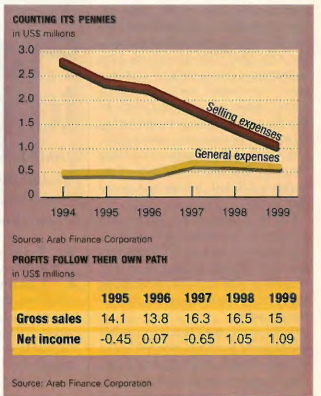
tile manufacturer, whose sales dropped 9%
in 1999. Surprisingly, its sour sales performance
did not drag down profit growth;
instead, net income inched up 4.3%, from
$1.05 million in 1998 to $1.09 million.
Uniceramic’s formula was simple. With
revenue boxed in, the manufacturer has
been going through a major overhaul to
reduce costs across the board. A restructuring
program began in 1998 with the help of
Consulting & Development Services
(working with other big names, such as
Société Nationale d’Assurances and Obegi
Consumer Products) and Dr Christoph
Ackermann, a German expert who has 40
years of experience in tile manufacturing
and now sits on the board of directors. The
program pinpoints every aspect of the
company’s activities to raise efficiency and
enhance productivity (see “Back in the
black,” May 1999).
The results of the makeover have come
through. Cost of goods sold per m²
dropped from $3.65 in 1997 to $3.32 last
year, while general expenses declined from
$744,000 in 1998 to $689,000, down
7.4%. On the selling side, Uniceramic
changed its strategy from being mostly an
exporter in the early 90s to focusing on the
domestic market. In 1994, business abroad
took up 70% of sales. Last year local sales
accounted for 88%, which helped decrease
cost of sales by 24.6%. Its workforce was
also streamlined, down from 340 to 300.
“Sales going down and profits on the rise is
a rare occurrence,” says Fadlo Choueiri,
Arab Finance Corporation’s (AFC) project
officer. “Sales in tiles are directly correlated
with the performance of construction and
real estate. It’s cyclical. Had Uniceramic not
implemented a restructuring program, it
would have really suffered. But since they
did it, they have performed well, working
against the tide.”
What will Uniceramic do to continue
improving as Lebanon moves into another
year with little sign of economic recovery?
For one, the restructuring program isn’t
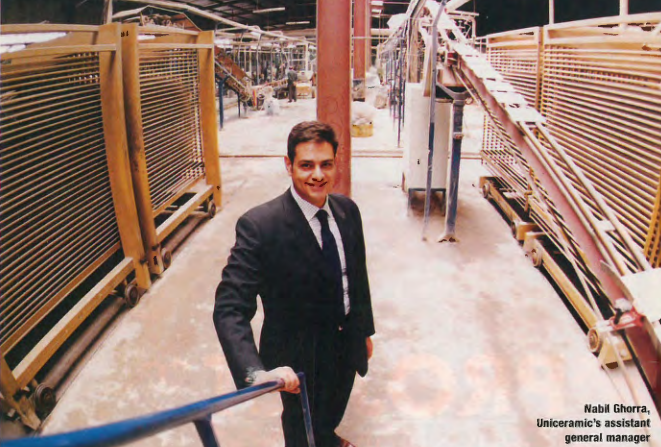
finished, according to Nabil Ghorra,
Uniceramic’s assistant general manager.
“Thirty percent of restructuring will be
implemented this year,” he says. This will
include additional cost reduction in
administration, financing and production.
“We haven’t seen all the benefits yet,”
adds Ghorra.
On the sales side, with costs down, some
prices will be lowered. But one objective has
been to take advantage of better quality and
more variety in tiles. With a broader range
of value-added products coming out,
Uniceramic will slap on a higher price tag,
increasing its margins. AFC predicts that the
firm’s average selling price will move up
from $5.78 per m² to
$6.1 per m² this year.
In the bigger scheme of things, trouble-shooting
to enhance efficiency and production
will be a never-ending process. (More proof
of Uniceramic’s drive to improve: To
interview Ghorra, EXECUTIVE had to call
him in Fontainebleau, France, where he is in
an international executive program at
INSEAD, a famous business school.)
To buffer itself against the difficulties of
the local market, Uniceramic is looking
abroad again. Its goal: move exports up
50% in 2000, from 12% to 18% of total
sales, aiming to reach 30% by the end of
2001. It plans to increase sales in markets it’s
familiar with, like Saudi Arabia and France,
and move into the US market for the first
time. Uniceramic is also working with the
United Nations to finalize a deal to export to
Iraq this year.
In the short term, exporting will not be a
tool to generate far greater earnings. With
higher cost of sales and stiff price
competition overseas, exporting goods will
put a squeeze on margins, and as Ghorra
says, exports will initially break even.
Uniceramic’s strategy is to increase its
presence in other markets and help offset the
chance of a further downturn in the local
market, keeping production at current levels
or increasing (cost savings by economies of
scale) and selling off excess inventory.
News announced last month could give a
boost to exports. Tiles were left out of the
Lebanese-Syrian free trade agreement when
it went into effect on Jan. 1, 1999. This left
Uniceramic and Lecico to face 130% tariffs
in moving their products next door. The two
countries agreed in mid-March to make up
lost ground on reducing tariffs 25% each
year applied to other products. Custom
duties were dropped 50% and will reach
zero in 2002.
Although Uniceramic has been waiting for
this, it will take time to see real results. The
tax on tiles this year is still a hefty 65%.
Even though Uniceramic’s quality should
stand out in the Syrian market, it will be
asking for a premium. It’s estimated that its
prices will be 15% higher than tiles produced
in Syria, and Syrians are notorious for being
price-sensitive consumers. Nonetheless,
Uniceramic does see Syria as a market full of
potential. In about four years, “The Syrian
market could absorb 25% to 30% of our
maximum production,” says Ghorra.
Uniceramic has weathered the storm, but
it has other challenges to face. It’s no
longer alone in making changes to deal
with harsh conditions. Lebanon’s only
other tile maker, Lecico, invested nearly
$900,000 in new modern equipment last
year (see “The right flush?” February
2000). Also a producer of sanitary ware,
Lecico holds about 15% of the tile market
compared to Uniceramic’s 33%. Georges
Ghorayeb, Lecico’s general manager,
predicts that the investment will reduce
costs in manufacturing tiles around 18% to
20% this year.
But Uniceramic appears to have the
upper hand. It has a wider range of tile
designs and sizes and it began focusing on
efficiency earlier than Lecico. Ghorayeb
says that tile sales showed losses last year.
(Lecico broke even on overall sales, of
which sanitary ware accounts for 70%.)
“Uniceramic was really smart in having
planned ahead of time to better reshape its
position in the economy,” says Choueiri.
“We can see what happened to Lecico –
losing money on tiles because it waited to
start making changes in 1999 with a
chance to see improvements in 2000.”
Ghorayeb is expecting tiles to break
even or see a glimpse of positive returns this
year. But he admits it will not come from
grabbing a larger market share. “With a
reduction in costs making the business
more efficient, we will be more profitable,”
says Ghorayeb. “We used to produce
1 million m² of tiles and we’ll still
make 1 million m² this year.”
More important than Uniceramic’s local
rival is foreign competition. The company
had set a goal of capturing some of the
market from foreign heavies to increase its
share from 30% in 1998 to 50% in 1999.
But products from European manufacturers,
especially in Spain and Italy, are still
Lebanon’s favorite, not to mention an
increase of tile imports from Jordan and
Saudi Arabia. The market share for imports
squeaked down slightly from 1998 to 1999,
while Uniceramic’s moved up to just 33%.
One of the reasons the local manufacturer
had problems capturing more of the market
was keeping its prices constant, according to
Ghorra. Its plan to move some prices lower
and beef up value-added products may make
a difference, aided by a more aggressive
marketing campaign. The goal to take 50%
of the market is still there, but has been
moved back to 2002.
AFC firmly believes that Uniceramic’s
restructuring will allow it to show steady
earnings growth this year. AFC’s projection
is a 16% increase, up to $1.3 million.
“Regardless of the economic conditions, we
anticipate a constant growth in profits,”
says Choueiri.
He also stresses that if there’s an economic
upswing in the near future, there will be a lot
of room to grow. Not only would construction
pick up, but also 50% of the estimated
200,000 unoccupied apartments still
require tiling. Increased sales coupled with
streamlined business would push profits
up considerably.
Investors have shown little interest in
Uniceramic’s stocks, even though it has
braced itself well for the construction market
hitting the dirt. With the Beirut Stock
Exchange dead and attention focused on
Solidere and the banks, Uniceramic’s
shares haven’t budged since July 1999.
Uniceramic cleared its debt with IFC last
year (a $6 million loan issued in 1993),
which will allow the manufacturer to pay
dividends in the future.
Its P/E ratio is on the high side at 19.2, but
is forecast to drop to 16 on AFC’s projected
earnings, based on the current share
price of $1.91. One positive note:
Uniceramic is one of the most transparent
non-bank companies on the BSE. (It
reported last year’s earnings at virtually
the same time as the banks, while the others
take their sweet time.)
It’s anyone’s guess when the economy
will recover to help boost Uniceramic’s
sales. But one thing is certain: Uniceramic
has shown that revamping operations and
cutting costs can lead to selling less and
making more.
Top of Form
