Rasamny-Younis Motor Company
(Rymco) is still holding on to the
number one position in car sales in
the local market with a 14.4% share so far
this year. That’s good news for the only car
dealer that has shares traded on the Beirut
Stock Exchange (BSE). Unfortunately, the
rest of the news is not so bright. Recently
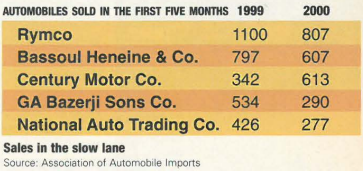
Rymco released its 1999 figures: Sales
dropped 30% and earnings fell 49%, from
$9.3 million in 1998 to $4.7 million. In the
first five months this year, units sold
decreased to 807 from 1,100 in the same
period the year before.
What is hurting Lebanon’s leading car
dealer? First and foremost, the economic
slowdown has caught up with the car market.
While economic growth started to drift
lower in 1996, car sales remained robust
through 1998, climbing 26%. “Car sales in
a normal market would have gone down
earlier,” says Gerard Rizk, senior analyst at
Banque d’Affaires du Liban et d’Outre-Mer.
“The car market was underdeveloped
in methods of financing. Two years ago
credit facilities were offered by banks and
consumers took advantage of that.”
But with the economy now at a standstill,
access to car loans can no longer encourage
customers to buy. “People are holding on to
their money to see what will happen. They
are waiting,” says Rania Fathallah, senior
associate at Middle East Capital Group
(MECG). “Someone buying a car today is
a person who needs a car, the old one is
falling apart and needs to be replaced.
Those with reliable cars will not buy now.”
Lebanon’s recession finally put a stranglehold
on the dealers last year. In 1999 total
car sales dropped about 17%, and so far this
year sales have fallen 21%, according to the
Association of Automobile Imports. Among the top car dealers, the crunch is
becoming obvious. Rymco’s main power
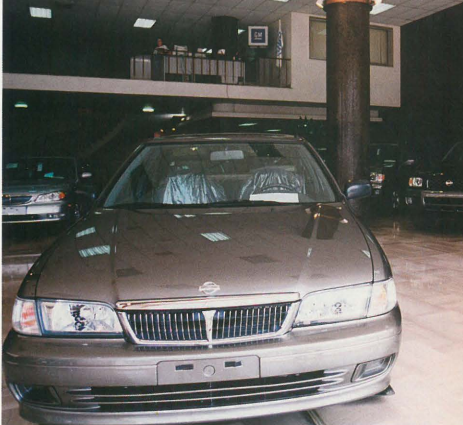
drive in sales comes from its Japanese
import, Nissan (93% of its units sold this
year), with Sunny being its leader in passenger
cars and Pathfinder its 4×4. G.A.
Bazerji & Sons, selling a full range of
Suzukis, has been ripping through the
Lebanese market in the last few years. Its
4×4 Grand Vitara has been its best seller. A
small to medium sized off-road vehicle
compared to the large Pathfinder has a
much cheaper price tag: Grand Vitara is selling
fully loaded for $14,900 to $15,900,
while the Pathfinder stripped down with no
extras goes for $28,250 to $30,500.
Bazerji’s Baleno, its best-selling passenger
car, sells at $7,900, while Rymco’s Sunny
is priced at $13,950 to $19,750. Bazerji’s
sales growth nearly tripled between 1997
and 1999 and moved up in ranking from 15 in 1997 into the top five in sales last year.
But this year, Bazerji’s momentum has hit
a brick wall: sales have dropped 46%.
Bassoul Heneine & Co., selling leading
European brands like BMW and Renault,
was able to move up from the third position
to the number two slot in sales in 1999. But
that wasn’t the result of increasing sales.
Cars rolling off the lot dipped slightly,
propped up by a weak euro that has
brought Heneine’s prices down with it.
Instead, the company that was right behind
Rymco, Century Motor, has had problems
selling its Korean brand, Hyundai. Century
Motor came out with a bang
bringing Hyundais to the market
in 1994: In 1996 the dealer led
the market in sales. But since
then, sales have deteriorated
dramatically. Sales in 1996 hit
3,372 last year units sold totaled
only 1,490. According to
Fathallah, consumer interest in
Hyundais worldwide has fizzled
out in recent years, partly as a
result of their quicker depreciation
and less reliability in the eyes of
the consumer.
Heneine has something new that
might help sales. For the first
time it will carry 4x4s, both
from BMW, for $56,000 and up,
and Renault, fully loaded and
similar in size to the Grand
Vitara at $22,000. “Four-by-fours
are very important,” says
Pierre Heneine, Bassoul
Heneine’s general manager for
financial activities. “Four-by-fours
take up at least 25% of the
market, and we have been out of
that part of the market completely.” He predicts that 4x4s will push up
sales this year by 5% to 10%. “We hope to
be number one in sales by the end of the
year, if not in 2001,” says Heneine. That’s
a decent goal, but the new 4x4s will have to
take up the slack. So far this year, Bassoul
Heneine has seen its sales drop by 24%.
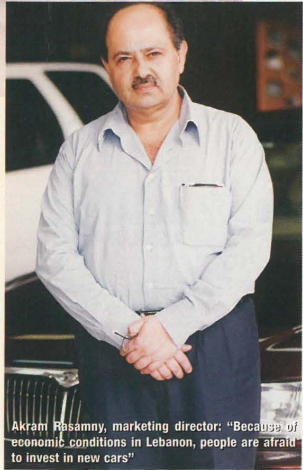
Rymco has taken steps to help handle the
harsh economic conditions. “We reduced our
costs in many areas,” says Akram Rasamny,
Rymco’s marketing director. Total operating
expenses dropped 16% in 1999, including a
decline in salaries and wages. Rymco has
also focused energy on diversifying products
and services. Last year it moved into the
boat market. “We plan to be very active in the
marine department,” says Rasamny.
The company has gone outside of retailing
by investing in Capital Finance Corporation
(CFC), which is waiting for approval by the
central bank. The financial institution, with
a total of $30 million including partners
such as Credit Libanais, MECG, Century
Motor and Standard Motors, is geared
towards offering consumer loans in
Lebanon and the region. In 1998 Rymco opened its “megastore” to push sales in used
cars. But in 1999 used cars only took up 7%
of net income. It also had plans to start a car
rental agency and to team up with an insurance
agency to cover automobiles. But
these have been put on hold.
With the economy in a black hole and the
BSE in paralysis, it’s difficult to get investors
interested in any listed company except
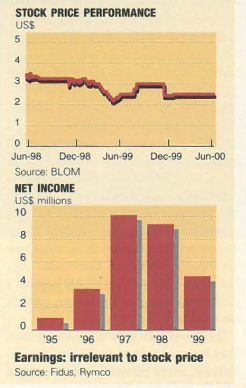
Solidere (see box). Rymco’s share prices
rarely move up or down, regardless of its
performance (see graph). It remains consistent
with its dividend payout, even though earnings
have decreased, a 53% dividend payment
ratio in 1999 compared to 54% in 1998, coming
out as $0.1 per share off of last year’s profits. Its P/E ratio is
within a reasonable
level, around 13 for
1999 earnings.
But until the BSE
is reactivated
Rymco’s shares will
get little attention.
And with the car market now caught on
the negative side of the economic
cycle, things don’t look good. “This could
be the worst year for car sales to decline
since the war, unless there’s a major
improvement in the economy,” says
Fathallah. But an upturn doesn’t look
likely in the short term. “If the private
sector, the main drive of the Lebanese
economy, suffers one more year, Lebanon
could go bankrupt,” says Nabil Bazerji,
G.A. Bazerji & Sons managing director. “If
it is not relieved by important changes, don’t
expect better income among businesses in
Lebanon.” This is something Rymco will
have to worry about, this year and probably
the next.
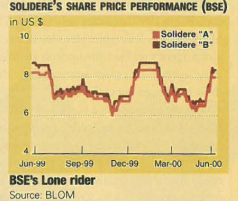
The one and only stock
With the Beirut Stock Exchange
(BSE) still in intensive care, there’s
only one stock that is able to move.
Solidere, which at $1.32 billion accounts
for 73% of the BSE’s market cap, was the
only company that showed a significant
jump after the Israeli pullout. In a few
weeks, Solidere’s shares on the BSE
jumped over 20%, while its GDR shares
increased over 10%. The two banks that
get most attention, Banque du Liban et
d’Outre-Mer (BLOM) and Banque Audi,
were lagging. BLOM’s GDRs went up
around 5%, while Audi’s GDRs barely
moved. Audi’s shares on the BSE, which
started the year at $28.13, continued to
fall, dropping 19% since the pullout, to
end up at $20.75.
In 1999 Solidere had a dismal year.
Sales plummeted and profits crashed
93%, from $54.2 million in 1998 to $3.7
million. The general consensus among
analysts is that if there is a peace
agreement coupled with an economic
recovery, Solidere’s growth will be re-
energized. But it’s hard to predict when
that could happen. HSBC and Middle
East Capital Group’s recent reports
offer a “hold” recommendation for the
long haul. But Société Générale just
released its analysis and suggested a
long-term buy. According to Hani
Shammah, senior regional analyst at
Société Générale, the prospects for a
comprehensive peace agreement are
improving and the Lebanese government
is looking more sympathetic
towards the real estate giant.
“Compared to 1999, it doesn’t take
much for the future of Solidere to look
brighter,” says Shammah.
But still, the government needs to be a
friend to Solidere (see “Can’t get no sat-
isfaction,” May 2000). Permits are still
trickling through: When Executive went to
print, there were 24 construction per-
mits and 29 occupancy permits pending.
The souqs are a prime area that will help
Solidere move forward. A decree that
gives a green light to the souqs has been
sitting with the council of ministers for
three months. If there is a historical
breakthrough for peace in the region,
everyone knows that players in the mar-
kets can make a quick buck as
Solidere’s share prices will soar. But it’s up
to the government to let Lebanon’s
biggest business operate as it should in
order to grow in the future.