
What is undeniably the most coveted
industry in Lebanon? It’s
obvious. Since the end of the
war, local banks have been sucking in a
handsome flow of deposits (189% of GDP
at the end of 1998) and turned the money
into profits that other businesses dream of.
In 1994 and 1995 the sector’s average profit
growth jumped 94% and 102%. When the
economy started its steady slowdown in
1995 and other businesses started feeling the
sting, the financial money makers were
immune: averaging 32.5% profit growth
between 1996 and 1998.
During the period of economic stagnation,
anybody in trade, service,
tourism or industries must have wanted to own a bank – or at least felt
a little jealous.
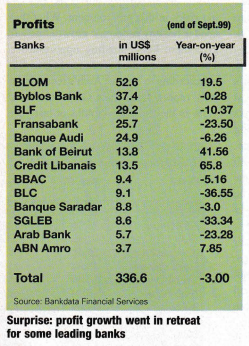
But judging from last year’s performance, it
looks like the banks may just be joining the
crowd. For thirteen top banks, the average
profit performance in the first three quarters of
1999 dropped 3% year-on-year (Bankdata
Financial Services). “We’re used to vertical
growth year after year,” says Bassam
Yammine, senior manager for corporate
finance at Lebanon Invest. “But what has
happened over the last six years has been
crazy. There is no way you can sustain such
growth, and we’re not used to growth of earnings
flattening out.”
There were some leading banks that still
showed a healthy profit performance and others
with their earnings leveling off. But others
did not see earnings “flattening out” – their
profits plummeted. (see table)
Why the fall-off? The most obvious culprit
is the tightening of the banks’ spreads.
According to Moody’s Investors Service,
33% of the banks’ assets are in treasury bills
(75% of all T-bills are held by banks). In
recent years, T-bill rates have been drifting
lower, settling in at around 14%.
(According to the Association of Banks, the
average lending rate in Lebanese lira and
foreign currency has also decreased, from
20.02% to 19.11% and 11.28% to 10.99%
respectively from October 1998 to October
1999.) To help maintain a good margin,
banks could have continued lowering their
Lebanese lira deposit rates. But that has not
been the case.
Between 1993 and 1997, the average rate of
growth for customer deposits was 24%. But in
1998 it slowed down to 20%, and in the first ten
months last year it increased only 12.8%. Add
the oversaturated nature of the banking sector
(approximately 65 banks in a very small market)
to the slowing deposit growth and the
result has been fierce competition
between banks to
draw customers, which has kept deposit rates high.
At the end of September, the average
Lebanese lira deposit rate stood at 12.3%
(5.57% in foreign currency) and according to
one banker, the rates increased further to
attract deposits at the end of the year to beef up
balance sheets. “The country is overbanked
and they were all getting free money from T-bills
with high rates of return,” says senior associate
at Middle East Capital Group Talal
Ghali. “The key to the sector is deposits, but the
rate of growth has slowed down dramatically.
They now have to fight it out to get deposits.”
Another factor is that even though banks
are not heavily involved on the lending
side, doubtful loans are on the rise, which
have to be covered by provisions that take
a bite out of the bottom line. “It’s getting
scary with non-performing loans,” says
Societe Generale Libano Europeenne de
Banque’s (SGLEB) head of management
control Georges Saghbini. “There may be a
dramatic increase that will hurt profits after
provisioning.” Although there is little data available, it is reported that allocations
to loan loss provisions
jumped 105% at Banque
Libanaise pour le Commerce,
43.6% at Crédit Libanais and
31% at Banque Libano-Française
in the first three quarters of 1999.
This, among other things, puts
banks in a bind. Commercial and
retail lending, instead of taking
care of the government’s debt, is
where money could be made.
“Credit is the real issue. What
really brings revenue to banks in
Lebanon is lending,” says Semaan
Bassil, vice chairman at Byblos
Bank, seen as the leader in retail
lending since it was the first to bring it to the market in the early
nineties. “But the problem is that
the market is dead. How are you
going to lend?”
In the middle of a recession, banks are
becoming more uncertain that payments
will be made, so they’re digging in. The sector’s
loan book, which is small by international
standards, barely increased (from
33.86% in 1997 to 33.95% in 1998) and in
the first nine months of 1999, the average
loan-to-deposit ratio for the top-tier banks
dropped by 0.69% year-on-year.
If lending is not the solution right now,
what about developing retail banking services?
They generate more fees and commissions,
offering an alternative income
stream. A number of leading banks have
already been working on their non-interest
income, pulling out new products and services
such as insurance, debit and credit
cards, portfolio management, investment
banking and far-out products like free
internet. But increasing non-interest
income is a slow mover. For one, letters of
credit and letters of guarantee, major
sources of fee-based income, have been on
the decline due to the deteriorating economy.
And getting a substantial income from
new products and services takes time. “If
you want to sell products, you have to sell
high volume to add to your profitability,”
says Bassil. “It does not pay off immediately.
It is a long, step-by-step process to
develop retail banking to get good
returns.” Plus, up until this point there have
only been around a half dozen banks that
have gone forward in retail banking with full
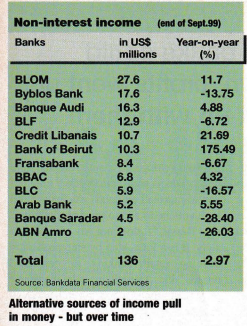
force. The end result: Non-interest income
average for twelve banks in the alpha
group in the first three quarters this year
slumped by nearly 3% year-on-year.
“Under these conditions, reducing costs
and becoming more efficient is the way
for banks to go forward and improve on
their profitability,” stresses Yammine.
“This is the area in which they have the most
control, have the most say and it’s under
their grip.” But even here there is an obstacle.
Although a number of financial institutions
have gradually reduced their staff in
recent years, the political and social pressure
in Lebanon inhibits banks from significantly
cutting costs by laying off a substantial
portion of their employees. “I know of several
large banks that could easily reduce
their workforce by as much as 20% to
25%,” claims senior vice president at
Thomson Financial BankWatch Nicolas
Photiades.
But there are other methods of cost control
available. Banque Audi, which is
rapidly expanding its branch network, has
been moving part of its existing staff into
new branches rather than hiring. Banque du
Liban et d’Outre-Mer (BLOM), the top
bank in assets, customer deposits and profit
growth, and Crédit Libanais, one of the top
ten banks that is on the rise in each of the
three categories, brought in foreign consultancy
firms to restructure their operations
for efficiency and productivity. New information
technology in the sector, along with
electronic banking, such as ATMs, phone banking and internet banking, should also
help create more efficiency.
With banks facing stiff competition in an
overcrowded market and their profits now
under pressure, this could be the time to
start looking global. Leading banks, like
BLOM, Banque Libanaise pour le
Commerce (recently acquired by United
Bank of Lebanon) and Audi, have overseas
outlets to cater to Lebanese expatriates.
They may give more attention to targeting
the diaspora, but banks might make an
attempt to focus on local clientele in foreign
markets.
But are the local banks up to the task? “It
won’t be easy,” says Yammine. “There are
huge multinationals that have done it, and
they have been around for years. People
have tremendous trust in them, a great reputation,
and you cannot compare them to the
Lebanese banks.” But according to
Photiades, “Now is the time for Lebanese
banks who have the resources to become
more global.” He adds that, although it is
expected for the banks to become global at
a slow pace, he believes that the Lebanese
banks are notorious for changing their
strategies overnight. “A few years ago,
who would have thought that there would
have been retail banking? Internet services?
Banks issuing GDRs and
eurobonds? Mergers? And who would
have thought a month ago that a bank
[Banque Audi] would buy back its shares?
Next week we may hear that Byblos or Fransabank will buy a bank in
Egypt or Europe.” And one has
already taken a step forward: SGLEB just recently acquired a
35% stake in a bank in Jordan.
On the domestic side, there has
been a lot of talk in the last year
about mergers and acquisitions
picking up speed in the near future
(see “Merger-mania,” June, 1999).
The new earnings crunch may trigger
what many have been waiting
for. Eighty percent of the sector’s
assets are with the 19 largest
banks, and some of the top banks
are the ones that are developing
alternative sources of income.
Small and medium-size banks will
be most vulnerable to the new
harsh conditions and may be willing to be
gobbled up by those in the top-tier or
merge with those of similar size.
But it is well known that owners hold their
banks dearly and do not want to let go.
Plus, haggling over prices may also limit
progress in consolidation. “A lot of small
banks may think that they are worth more
than the actual value,” says Photiades.
“They need to recognize that the value is
built on core and recurrent revenues as
well as a solid business franchise, which is
not the case for small banks as most rely on
T-bills for their revenue.” Another concern
is that mergers aren’t easy. Even in the
West, the majority of mergers fail; big egos
are involved, the mixing of two corporate
cultures is troublesome and the benefits,
such as taking advantage of economies of
scale, can be hard to realize. And in our own
backyard, the badly planned Byblos-BLC
merger highlighted the lack of professionalism
associated with family control of
Lebanese business.
Yet, if earnings in the sector continue to
deteriorate, the small and medium-size
victims may be out calling for buyers.
“There will be a point when it hits the
small banks,” says Yammine, “and if the
owners have to reach into their pockets
and put money into their bank, they’ll
think twice. When the pressure is on,
you’ll see quite a few of them respond. I predict
there will be five to seven banks disappear
in 2000.”
But in the overall picture, there is an
inescapable problem for banks. The recession
has caught up with the banks, and it is
beginning to look like they now depend
on economic growth. Ghali puts it simply:
“The best alternative for the banks after
the T-bill rates have dropped is to lend to the
consumers and the private sector. But it is
too risky in this environment. What they
need is healthy economic growth that will
give them better lending opportunities.
They are now linked to economic growth.”
According to Banque Audi’s recent quarterly
report, Lebanon’s GDP contracted
1.5% in the first nine months of last year.
And in the first ten months of 1999, the budget
deficit rose to 44.8% compared to
41.2% in 1998, which suggests that the
government will miss its target at the end of
1999 (41%). There is now doubt as to
whether the government will make necessary
adjustments as it promised, which
makes it difficult to predict when there will
be economic recovery.
If banks are tied to the ups and downs of
the economy, it is the first time that the
sector’s profit growth is something to
worry about. “Profit growth was an easy
task before, but it has turned into a difficult
chore now,” says Photiades. “Welcome to
the real world.”
