• Donate
  • Our Purpose
  • Contact Us
Executive Magazine
  • ISSUES
    • Current Issue
    • Past issues
  • BUSINESS
  • ECONOMICS & POLICY
  • OPINION
  • SPECIAL REPORTS
  • EXECUTIVE TALKS
  • MOVEMENTS
    • Change the image
    • Cannes lions
    • Transparency & accountability
    • ECONOMIC ROADMAP
    • Say No to Corruption
    • The Lebanon media development initiative
    • LPSN Policy Asks
    • Advocating the preservation of deposits
  • JOIN US
    • Join our movement
    • Attend our events
    • Receive updates
    • Connect with us
  • DONATE
Oil & GasOverviewSpecial Report

Into the blue

by Matt Nash May 11, 2017
written by Matt Nash

Potential is the most important word to keep in mind when thinking about a future Lebanese oil and gas industry. In November (provided there’s a functioning government at the time), the country is scheduled to begin offshore exploration, which could provide a revenue stream flowing decades into the future and kickstart a local industry services sector. Fifty-one mostly foreign companies have pre-qualified to get in on the action (see list below), and despite  weaker prices per barrel than Big Oil would like, there is clearly appetite for investment in east Mediterranean acreage – industry slang meaning, in this case, drilling and production rights in blocks of a country’s Exclusive Economic Zone (EEZ). Evidence, from both drilling in the neighborhood and abundant subsea survey data covering nearly all of offshore Lebanon, suggests there could be good news in the country’s near future. That said, detailed predictions about what to expect (which companies will bid to win a contract, how much gas or oil will be found, how much it will be worth) remain as useless today as they have been previously. What is undeniable, however, is that Lebanon’s slice of the gas-rich East Med is on radars near and far.

Terms and conditions

Some four years behind schedule, in September Lebanon will accept bids from oil and gas companies keen to explore its offshore. The rules say each bid must come from a consortium of prequalified companies (one operator, the company actually overseeing the complicated work of drilling hundreds of meters into the seabed, and at least two non-operators). Bids will be based on a model exploration and production sharing contract with a potential lifespan stretching more than 30 years. Certain technical and financial provisions in these contracts have been left undefined, and filling in these blanks is the heart of the bidding process.

The financial offer is the more important of the two in terms of bid evaluation (i.e., on a 100-point scale, it is worth 70 points). Lebanon’s plan for an oil and gas fiscal system (i.e., how the state captures rent from potential resources) has been loudly maligned, but not very well understood. There are certain fixed revenue mechanisms in the contracts, the most talked-about being a 4 percent royalty on natural gas, and a sliding royalty on oil ranging from 5 to 12 percent, based on volumes. Were these royalties Lebanon’s only straw for syphoning revenues from the sector, they would be laughably low, and the critics of this one component of the overall fiscal system would be correct to complain. However, royalties are only part of the story. In addition to paying Lebanon’s corporate income tax (currently set at 15 percent but expected to rise to 20 should Parliament approve a long-promised new oil and gas tax law), companies will bid on the parameters of further revenue sharing with the state based on the volumes of resources (if any) found. The details are complicated (and covered by Executive in the past), but in essence, no matter what exact numbers companies put in their bids, if enough oil and/or gas is found to justify extracting it, the state will begin sharing profits from resource sales immediately, with the state’s share growing over time. Not every country uses the same model, but it is common and – as a system – perfectly capable of maximizing the state’s take from the sector. This is all to say that there’s no way to predict what revenues Lebanon can expect at this point, but the system in place has been proven in other markets and attacks against it are likely to be driven by alterior motives.

The technical bids are arguably more exciting. Evidence from both drilling in the neighborhood and abundant subsea survey data, which today covers nearly all of offshore Lebanon, suggests there could be good news in the country’s near future – and that is not hyperbole. The aforementioned delay, abundant data and regional evidence have pushed Lebanon to be more ambitious than one would expect of a country that has never drilled an offshore well (a frontier area, in industry parlance). If contracts are signed in November, winners will be committed to drilling at least one well (if not more) in the first three years (as opposed to after 7-10 years, which can be the case in other frontier areas). What many people fail to realize is the value drilling offers in terms of useful information that itself can be of greater value in the future. For all the large natural gas discoveries nearby and talk about Lebanon’s potential, we actually know nothing about Lebanon’s offshore. Absolutely nothing. Drilling will change that, even if no discoveries are made. One arguably learns as much from “failure” (a dry well) as from success. The truth is out there, and the first real answers on Lebanon’s potential will come relatively quickly after contracts are signed.

Slow and steady wins the race

Oil and gas is a long game. The contracts Lebanon hopes to sign soon will last more than 30 years, provided a discovery is made (if companies do not find anything in Lebanon’s offshore, the sector could well be very short-lived, although all available indications suggest this will not be the case). A big discovery will no doubt intensify interest in Lebanon’s offshore in the same way large gas fields in Israeli, Egyptian and (to a lesser extent) Cypriot waters make the whole East Med an exciting exploration area. With this in mind, the Lebanese Petroleum Administration (LPA), the sector’s not fully independent regulator, pushed long and hard for gradual licensing (i.e., offering chunks of offshore acreage over time instead of signing contracts covering the entire offshore all at once). From a strategic point of view, gradual licensing allows Lebanon to leverage knowledge gained from drilling to get better terms in the future and also potentially expand the timeframe over which revenues from the sector pour into state coffers. At one point in the past four years, some politicians were against gradual licensing. Ultimately, however, the LPA won. Of the 10 blocks into which Lebanon’s offshore is divided, five are on offer in the first round, with no obligation for how many contracts the government must sign.

Managing expectations

If the deadline is respected, Lebanon will be doing more than signing contracts in November; it will be establishing a potentially valuable new sector. However, even if all goes as well as possible, oil and gas will not transform Lebanon’s economy. In the first few years, most Lebanese likely will not notice a difference. Even 30 years from now, if Lebanon is a regional gas powerhouse, the oil and gas sector will not be an economic pillar the way banking and tourism are. While there will be direct job creation, exact numbers are hard to predict, but thousands and thousands of jobs is an unrealistic expectation. The industry will need services (from housing and transportation to catering and local legal advice), and many local companies may find new opportunities, but again, not in a volume to actually re-configure the economy. In fact, one risk the LPA is actively trying to avoid is known as Dutch Disease, or the rapid refocus of an economy on one sector to the detriment of all others.

The $1,000,000 Question

As noted, it is far too early to guess what revenues Lebanon can expect from potential oil and/or gas finds. It is also a bit too early to say for certain how those potential revenues will be managed. A 2010 law governing offshore exploration and production calls for all state earnings to be deposited in a sovereign wealth fund. The law gives the fund a dual, and potentially contradictory, mandate: save some, spend some. Writing a separate law fleshing out the sovereign wealth fund will function as the sector’s next political priority after contracts are signed. The success of drilling will determine just how quickly the sovereign wealth law needs to be written.

May 11, 2017 1 comment
0 FacebookTwitterPinterestEmail
Economics & PolicyEnergy

Full of gas

by Jeremy Arbid May 11, 2017
written by Jeremy Arbid

Lebanon will finally be rescued from the electricity cuts it has long suffered from, or so says the government as it trumpets its latest plan for the sector. Eight years ago, Electricité du Liban (EDL) supplied, on average, only 18 hours of electricity per day, and an ambitious plan from 2010 did not accomplish much in terms of reducing the country’s shortfall in generated electricity. It did employ short-term measures, like leasing electricity barges, refurbishing existing power plants, and constructing small-scale renewables, all of which slightly boosted the electricity supply. The latest proposal looks like it will, again, emphasize short-term measures, but the government has so far avoided detailing the plan to the public.

At the end of March, Cabinet heard the electricity plan. According to minutes from a meeting that took place, Lebanon’s Minister of Energy and Water Cesar Abi Khalil presented the plan to the cabinet, which agreed to it in principle, permitting him to publicly announce the plan the following week in early April.

But Melhem Riachy, the Minister of Information, told reporters after the March cabinet meeting that ministers had made many comments on the plan, which would  be kept secret, and that the plan would be implemented in a completely transparent way after it was ratified.

Executive requested an interview with the Ministry of Energy and Water (MoEW)  but did not receive a response. A source at the ministry, who did not want to be named, wrote to Executive in an email at the beginning of April that details of the plan could not be discussed because there were several issues yet to be resolved. The source would not explain what those issues were and  could not give a timeframe for the finalizing of the plan’s details.

The plan, in general, calls for measures to bridge the gap between the supply of electricity and consumption, according to a draft that a separate ministry source, who also did not want to be named, confirmed to Executive as authentic but outdated (it was dated March 24, 2017). In the short-term, the plan will call for new generation capacity by leasing new barges. Over the long-term, the focus will shift toward constructing new power plants, and a switch from fuel oil to natural gas for power generation.

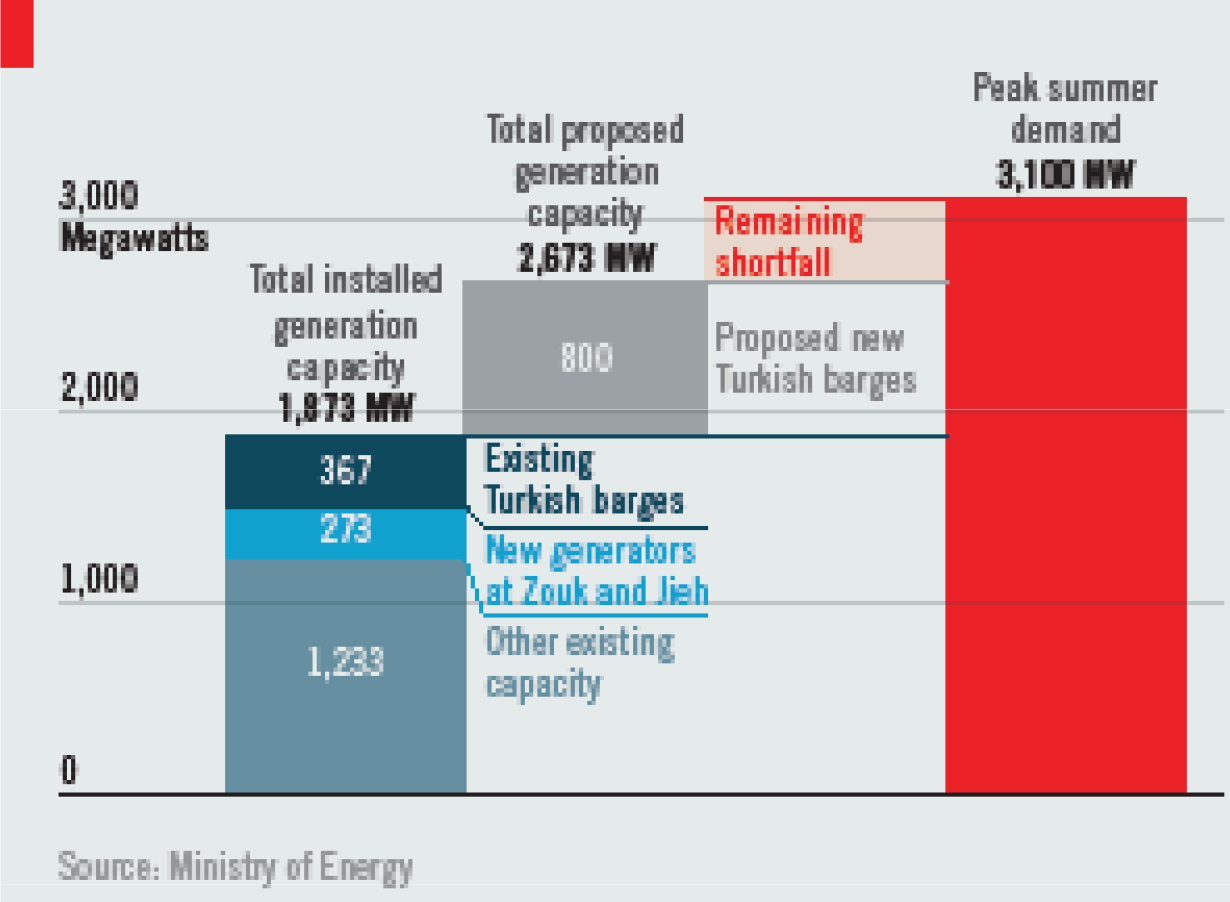
Electricity generation capacity VS demand, 2016

Short-term measures

Lebanon, by the end of 2016, had a total generating capacity of 1,873 megawatts (MW). The figure includes megawatts from two Turkish barges that connected to Lebanon’s electricity grid in 2013, and from new reciprocating generators installed at the Jiyeh and Zouk power plants in 2016.

Last summer, peak demand reached 3,100 MW. The government wants to increase the supply of electricity by leasing new barges, according to the draft plan, as a short-term measure to meet this summer’s electricity needs.

In early April, the ministry did publish a tender for two new electricity barges that would generate between 800 to 1000 MW, but bidding was postponed, according to a report in Al Akhbar.

Long-term measures

The new electricity barges that the government might rent are meant as short-term measures that could turn into long-term. The government wants to lease those barges to meet Lebanon’s electricity demands, while it builds new power plants that it hopes to power with natural gas or renewables. 

According to the draft plan, the government wants to partner with the private sector to build new power plants through a modality known as Independent Power Producers (IPP), where companies would own the power plant and sell the generated electricity to the public or Lebanon’s utility, Electricité du Liban.

Worst ranking countries for power cuts and reliance on electricity generators

The government wants to set up solar power infrastructure that would generate 1,000 MW and is now readying to tender 120 MW of solar generated electricity after receiving 265 expressions of interest at the end of March, according to a list of applicants published on the website of the Lebanese Center for Energy Conservation (a government agency tied to the MoEW). The plan also calls on the private sector to build a 1000 MW plant at Solata to be powered by natural gas. Electricity Law 462, ratified in 2002, stipulated that a regulator would be the authority to license new power plants, but the government never got around to appointing that body. Parliament, instead, passed legislation in 2014 and 2015 to get around that roadblock by allowing cabinet, on the recommendations of the MoEW and the Ministry of Finance, to decide when the private sector can build power plants.

The government is again looking to shift from burning fuel oil to generate electricity at most of Lebanon’s power plants to using natural gas. The country’s newest power plants at Deir Ammar and Zahrani, built in the 1990s, were meant to use gas but were never supplied. Gas burns cleaner and would help Lebanon reach its climate change commitments, and gas imports would be cheaper and more predictable than fuel oil. It is also possible that Lebanon might find offshore gas fields as companies are now preparing to bid for exploration, with licensing expected in November this year. However, finding gas and extracting it is a possibility that is several years down the road at the earliest.

Rise in electricity generation capacity and demand

For now, if the government’s plan is to use gas to generate electricity, then Lebanon will have to import that gas. In 2009, the Lebanese government inked a deal to import gas from Egypt via Syria using the Arab Gas Pipeline (AGP). Media reports point to dozens of attacks damaging sections of the pipeline in the Sinai Peninsula since 2011, hampering gas supplies to Jordan and Israel, and it is not clear whether the sections of the pipe snaking through war-torn Syria are functional. Even if the AGP was fully operational, the problem has been that there was never enough gas to supply Lebanon. Egypt is currently a net importer of gas to meet its own consumption needs. Its 2015 discovery of the Zohr gas field offshore might change that, but the first gas is expected from Zohr in 2018, and it is not clear where that gas will be allocated, domestically in Egypt or for export.

[pullquote] The plan forecasts the construction of the pipeline at just under $200 million [/pullquote]

In any case, the AGP only connects Lebanon in the north, at Tripoli. Lebanon would have to import Liquified Natural Gas (LNG) from a supplier abroad to feed the country’s other power plants, and it would need to build a pipeline to connect them. The plan calls for a pipeline that would extend from Solata, the proposed 1000 MW power plant in the north, to Tyre in south Lebanon. The plan forecasts the construction of the pipeline at just under $200 million, but does not acknowledge that much of its proposed pathway cuts through urban areas. The government would have to clear land, including part of the Palestinian refugee camp Ain al-Hilweh, to construct the proposed pipeline, and its proposal does not mention the costs of doing so.

The plan suggests the alternative of contracting three floating storage regasification units (FSRUs) to import the needed gas. A FSRU takes LNG and converts the liquid gas back into its gaseous form for power plants to burn and generate electricity. FSRUs come in different capacities, but three FSRUs would be unnecessary if Lebanon’s power plants were connected by pipeline. If the government does end up with plans to tender three FSRUs, then it is tacitly acknowledging that a coastal pipeline connecting Lebanon’s power plants is not possible.

The MoEW did not want to discuss the proposed electricity plan with Executive and has kept its public comments on the plan to a minimum. One of the ministry officials that Executive spoke with on condition of anonymity described many of the items in the plan as too far-fetched and politically motivated. In the end, the government is proposing a plan in the same way it has operated the electricity sector, and we are all still living in the dark.

May 11, 2017 0 comments
0 FacebookTwitterPinterestEmail
Economics & PolicyTelecom

Unleash the speed

by Matt Nash May 11, 2017
written by Matt Nash

During five days in April, Lebanese internet users were given proof that their notoriously terrible connections have been kept that way on purpose. Lebanon had become a laughing stock. Back when Ookla – the US-based operator of the ubiquitous speedtest.net – offered public rankings of average internet download speeds by country, Lebanon was always near the very bottom of the list. With the rankings no longer public, it is hard to reliably say where we stand today, but we do not really need an official ranking to know typical Lebanese download speeds of 1 to 2 megabits per second (mbps) are pathetic.

Last month, the publicly owned gatekeeper of Lebanon’s internet – Ogero – conducted five days of speed tests in different parts of the country. The results were jaw-dropping. The company’s new director general (appointed by the cabinet in January) claimed on Twitter that some users reached download speeds of 27 mbps, a 1,250 percent increase from the 2 mbps standard of the past few years. The majority of speedtest.net results tweeted at Ogero showed speeds around 16 mbps. And this without any intensive infrastructure projects. It was programmable.

“We’ve been saying for years that a simple administrative decision would improve the internet by at least 30 percent in terms of bandwidth, in terms of speed,” explains Maroun Chammas, CEO of IDM, a local internet service provider (ISP).

The bad old days

The Ministry of Telecommunications (MoT) is the sector’s steward. In addition to devising and implementing policy, it owns nearly all the infrastructure (fiber, copper and mobile-phone base stations). On the MoT’s recommendation, the government decrees the price of every phone call (mobile and landline), and the ministry’s hand is heavy on the internet. Competition in this segment is permitted, though in recent years it arguably has not been encouraged. In 2007, the steward oversaw a transformation in the market. At long last, the dial-up connection (complete with screeching modem) was replaced with a digital subscriber line (DSL) service. The future. Lebanon was a last adopter of this technology. Local rollout was slow, and download speeds are, a decade later, still abysmal.

To make a long and technical story short, the MoT and Ogero, a state-owned enterprise working as a ministry contractor, have considerable power over the internet market. With control of most of the infrastructure that allows someone in Lebanon to check their email, competition in the market can be easily hobbled. Private companies are allowed to use some of their own equipment to serve customers, but Ogero is in charge of the links that move customer traffic from one piece of equipment to another, before actually moving that traffic on to the information superhighway (via cables Ogero manages all access to). In other words, Ogero is the one closing lanes on access roads and opening only two tollbooths onto the highway during rush hour. Except it is at all hours. Every day. Whenever an unhappy customer – or a curious reporter – would ask a private provider why the internet was so bad, there was always one answer, however diplomatically delivered: Ogero, specifically in the person of its former director general. This has been true for 10 full years. It almost seemed like a convenient excuse (“Abdel Moneim Youssef ate my homework”) until the internet magically got better. Much better. Just like that.

The grey market

There used to be informal advertisements all around Beirut (which, when Executive decided to photograph one in April, were surprisingly very hard to find). An A4 piece of paper adorned with a few words in black ink, slapped up on a wall: “Wireless Internet Free for one month [local mobile number].” Some included monthly prices, some did not. This is the grey market. You pay a guy. He brings a wire to your house, sells you a router, and you have internet as fast as the two lowest-priced DSL packages, which an estimated 90 percent of legal users opt for, according to interviews with private players and an Ogero official that Executive conducted in 2014. Until recently, these illegal providers would get international bandwidth (actual internet access) in one of two ways: 1) by redistributing several legal connections to multiple users (small fry, and as best Executive can ascertain, the smaller part of the grey market segment) or 2) by bringing it in from abroad. As noted, Ogero controls the cables connecting Lebanon to the actual internet, but international capacity (as that on-ramp to the highway is called) can be secured via satellite or microwave. Many grey market providers were avoiding Ogero (and associated costs) all together.

[pullquote]

Ogero used to view the private sector as the enemy

[/pullquote]

Anywhere in the world, an ISP is that link to the highway. They buy access to the internet (bandwidth) and sell it to users at a higher price. The price at which Ogero buys bandwidth and from which provider has not been made public, but market estimates of around $4 per E1 line (2 mbps of bandwidth) seem reasonable based on internet research into the topic. ISPs in Lebanon currently pay Ogero $250 per E1 line (reduced from over $1,000 in 2014). Grey market providers buying bandwidth abroad no doubt pay more than Ogero (having at least a satellite link provider between themselves and an actual internet seller), but almost certainly less than local ISPs pay Ogero. And the advantage is not only on international bandwidth. ISPs must deposit  a $1,000 letter of guarantee on every E1 line they get from Ogero, according to both IDM’s Chammas and an ISP owner who spoke on condition of anonymity. Also, ISPs can only offer DSL on an Ogero cable. The grey market providers just add another wire to the tapestry slowly being weaved from building to building across Lebanon and hook users up the next day.

Between 2014 and 2015, the grey market got a bit whiter. Chammas as well as one private-sector and one publice-sector source told Executive that around 120 grey market ISPs were semi-legalized during that time period. Details are unclear, but what Executive can confirm is that companies formerly buying international bandwidth from abroad were sold bandwidth by Ogero – at a time when previously licensed ISPs were asking for bandwidth and not receiving it – but continued to be exempt from providing letters of guarantee and respecting distribution rules. Shortly after this apparent attempt at better regulating the market – which disrupted a supply chain at least 10 years old – corruption charges against then-Ogero Director General Abdel Moneim Youssef began to fly.

A new era?

Ogero’s director general is one of three directors general at the MoT. As such, the company’s head is an integral part of devising the ministry’s strategy for developing the country’s telecom sector. Ogero implements whatever strategy it helps write. The three-seat power structure gives the MoT’s Director General of Maintenance and Operation power to oversee Ogero’s work, and act as a check and balance, as Imad Kreidieh, the new head of Ogero, explains it. Until January, Abdel Moneim Youssef was both Ogero’s DG and the DG of maintenance and operation, “judge and jury,” Kriedieh says. That situation has now been resolved. Youssef is currently being scrutinized by the judiciary and is out of, well, two jobs. Kreidieh replaced him at Ogero, and Bassil Ayoubi is now in Youssef’s other former leadership spot at the MoT.

Market reaction to the change – only around 12 weeks old when Executive made the rounds – was cautiously optimistic. Communication between the private sector and both Ogero and the MoT is significantly improved, and Kreidieh speaks to Executive like a penitent. He admits that, prior to assuming his post in January, for Ogero, “the private sector used to be seen as the enemy.” He insists, however, “my role is not to consolidate a monopolistic position, but to offer the infrastructure for anyone who has a license, the technology, and the content to deliver it.”

Offering the infrastructure he reportedly is. On April 11, 13, 15, 27 and 29, Ogero quite simply unleashed the speed, to borrow the company’s hashtag. The tests lasted only a few hours, and were conducted in a handful of areas on each day. However, according to Habib Torbey and Patrick Farajian, heads of the data service providers Globalcom Data Service and Sodetel, respectively, the private sector has been able to keep the speed unleashed in the spots Ogero tested, as the lines between privately owned equipment are no longer congested.

Kriedieh has repeatedly said in public (both in March at ArabNet and during April on Twitter) that a new internet pricing decree will be presented by the MoT to the cabinet sometime soon, never committing to a precise deadline. While in the mobile phone segment, such a decree sets the price of all phone calls in the country (and out of it, which is why voice over IP services, like Skype, are still technically banned). In the internet segment, such a decree only sets internet package prices for Ogero. Private sector ISPs can charge customers whatever they choose (although most stick close to the decree to remain competitive), but the price of internet access (an E1 line) they pay Ogero is set by the decree. In the past, the price of internet packages for end users has been based on two factors: the speed of the connection and the monthly cap on download capacity. The decree will remove speed as a factor, Kriedieh explained, meaning users will be given the fastest speed their connections can deliver. Word on the street is that Ogero’s speed test days will become market realities after the decree. Executive interviewed Kreidieh before the tests, and he was unavailable for comment after.

Remaining constraints and the road ahead

This is not to say it is internet Christmas eve for every last one of us. Congestion is only one part of a series of problems. Individual internet users in Lebanon connect to central offices (COs), which then connect them to the internet, with copper cables. This is an old technology, with speed transfer limits and a serious problem transferring data quickly over a distance more than one kilometer. Fiber optic cables are now industry standard, and Lebanon has fiber in many places where it is needed (the country has 6,000 kilometers deployed, Kriedieh says). With a new government taking office in January came a new policy for the sector, Kreidieh explains. He describes the new strategy as “not politicized, user-centric and time-bound,” adding that “by the end of 2018, things will be much, much better.” Four projects are currently in motion, he says, the centerpiece of which is a long-discussed fiber-to-the-cabinet project (a cabinet being a piece of telecom equipment placed between users and a central office, not to be confused with the Council of Ministers). The project involves connecting individual users via copper wires to nearby cabinets –  which would themselves be connected by fiber to COs, meaning only a few cabinets and fiber cables would need to be installed to provide a multitude of users fast connections instead of fiber from the CO to each individual home. The project should begin in September and take 18 months to complete, Kriedieh says. He promises download speeds of “over 100 mbps without fiber” to the home (a technological breakthrough circa 2010).  [Editor’s note: Fiber to the cabinet was phase two of the now-fully-abandoned MoT national strategy launched in 2015. It was supposed to be nearly completed by now.]

[pullquote]

Congestion is only one part of a series of problems

[/pullquote]

The elephants in the room

Kreidieh claims not to see himself at the helm of a purely profit-driven commercial enterprise. At one point during the interview, he describes Ogero as a regulator. What he promises to deliver is a nationwide telecom network capable of providing all users with voice, data and streaming video services on the same cable. Triple-play, as it is called in the industry. Yes, a better network will benefit Ogero and help expand its market share (which he pegs at 290,000 of 700,000 legal subscribers, or 41 percent, admitting, however, that there are “leakages” that make the true number of subscribers unknown). Kreidieh, however, insists strengthening Ogero’s market position is not his goal. With a network capable of modern offerings, he says that he wants the private sector to flourish. The private sector, meanwhile, seems to want the access it has long been denied and a level playing field (meaning either fully licensing the 120 or so providers semi-legalized two years ago or forcing them out of business). Many estimate these semi-licensed providers have a significant customer base, although the numbers are very fuzzy.

Lebanon’s reported total number of fixed-line broadband (DSL) connections stands at slightly over 1.2 million, according to MoT data supplied to the International Telecommunications Union. If both that number and Ogero’s figure of 700,000 fully legal connections are correct, the formerly grey market would service over 500,000 customers. Ignoring the fact that 1.2 million fixed connections would mean Lebanon’s estimated 900,000 households are all wired, with some households actually having two or more DSL lines, it is safe to assume that there are at least some potential market share gains for fully-licensed ISPs if some providers leave the market when the rules apply equally to everyone.

Kreidieh offers no detail on how to deal with the 120 or so semi-legalized ISPs aside from suggesting that when the service offered by Ogero and fully licensed private ISPs is significantly improved the market will correct itself. If these providers are allowed to continue buying bandwidth from Ogero while being allowed to ignore the rest of the rules, however, it is hard to see how they will be pushed out of the market completely. Fully licensed ISPs may have more services to offer in the not-too-distant future (i.e., streaming, high-definition video and TV over the internet), but the market overwhelmingly demands a cheap connection, and is conditioned to accept vastly inferior services.

May 11, 2017 2 comments
0 FacebookTwitterPinterestEmail
Hospitality & TourismQ&A

Le Gray Grows

by Executive Staff May 10, 2017
written by Executive Staff

Situated across from Martyr’s Square with a view of the mountains over the Mediterranean, Le Gray hotel has been a prominent structure in downtown Beirut’s landscape since it was founded in October 2009.

Operated by Campbell Gray Hotels and a member of the Leading Hotels of the World, Le Gray Beirut is a luxury five star property with 87 rooms, six F&B outlets and a spa. As such, Le Gray is positioned as a high end boutique hotel with an emphasis on accommodation and food and beverages.

This positioning has served the hotel well in its eight years of operation in Beirut but, since the property didn’t have a banquet hall or large meeting rooms, certain market segments were harder to access- namely the Meetings, Incentives, Conferences and Exhibitions (MICE) and the wedding segments.

While the presidential suites on the hotel’s top floor were often used for small meetings or receptions, this was not enough to usher through the large volume generated by MICE and wedding segments.

The expansion the hotel is undergoing is meant to rectify this and allow the property to tap into these markets.

Executive sat with the hotel’s General Manager George Ojeil to learn of the expansion’s details and its impact on Le Gray.

E What does the expansion entail?

We have finalized three floors in the building. The basement, ground floor and first floor.

The basement includes a ballroom which can accommodate up to 350 people for a seated meal.

E So you’re targeting the weddings market with that ballroom?

Yeah weddings, social events, conferences… It’s a beautiful ballroom with state of the art equipment and decoration.

And then we are going to have a screening room; the only one in Beirut within a hotel. It’s like an amphitheater or small auditorium with the latest technology in audiovisuals, Dolby surround system etc… it can accommodate 53 people.

E What do you see people using the screening room for?

It could be used for product launching such as car launching which needs special effects and advanced audiovisuals; it can be used for a movie presentation or an afternoon kids’ birthday party with animation.

We also added a multipurpose or news room that can be used as a conference room and can accommodate up to 60 people depending on the setup.

Finally we have a board room that can accommodate up to 26 people in a boardroom set up.

This boardroom will have a virtual screen and we will be the first venue in Beirut to have that.

E Are these spaces going to be rented per hour or how does it work?

If any conference is followed by a meal, the conference room will be granted on complimentary basis. However, if there won’t be any meal (and just a coffee break) there will be a rental fee depending on the length of stay per day and on the room. For example, booking the smaller boardroom has a different fee than the conference which is of bigger size and capacity. It also depends on the demand.

E How often do people attending conferences in Lebanon book a hotel room as well?

Demand for residential seminars is on the increase again with the lift of the travel ban and the safety and security we’ve been witnessing at the local level.

Before the lift of the ban, these seminars had been deviated to Jordan and the Gulf (mainly Dubai and Abu Dhabi) so we have been witnessing increasing demand and this should support occupancy in the hotel as well because previously we were perceived as a boutique luxury hotel which offers accommodation simply and I would say luxury or highly developed services in food and beverages. But now I can say that we will be in a position to host residential conferences.

We are also adding more rooms and will have 103 rooms. This usually supports those kinds of seminars because typically when they meet in Beirut they would need up to forty rooms and when we had only 87 rooms, we couldn’t allow ourselves to book half of the hotel for a seminar and anyhow we didn’t have any conference facilities to offer them.

E Is this a rule that you cannot book half the rooms in a hotel for one event?

We prefer to avoid such scenarios especially in boutique hotels. We are a hotel that is known for repeated business and so we cannot book half of the hotel for a single event because it will put us in a situation where we might have to turn down repeaters.

E How does Le Gray still fit into the boutique hotel feel with 103 rooms?

Usually the number of rooms is below 100 and guests are more than just a number.

You have more of anticipating guests’ needs, more of a personalized service, attention to details…

It’s different than a big box and more complicated. We accommodate high end frequent international travelers with sophisticated demands and that’s why they look for such type of hotels. We know their needs from their previous visit and accommodate for them.

E How many new people are you hiring with this expansion?

27 head counts.

We are going to have a new lobby lounge so we will have more wait colleagues for that, banquet sales, banquet operational people, additional colleagues for housekeeping and a few additional colleagues in areas of support (administrative, sales and marketing) and in the kitchen we will have three additional chefs for that.

E With all these new additions, it seems you want to compete in the MICE category knowing that this space is almost saturated with the existing banquet halls and conference rooms?

There will always be other banquet halls or conference rooms and that is why we have a solid differentiation strategy for positioning our product.

Our wish is to position ourselves as the unique destination in downtown Beirut in terms of conferences and events. We have the best location in Beirut -although in politicized area-but when things are calm the location is strategic in being central with easy access.

We are determined on delivering the same quality of service in our banquets that we do in our restaurants and rooms. It’s going to be very personalized: the choice of menu will be meticulously done, the way the food will be set and the displays is going to be different and innovative with elaborated food stations, carvings….

E You are emphasizing your F&B offerings in your reply. Do you consider F&B to be your strength as a hotel ?

We are an F&B hotel.

We have six outlets for F&B and the banqueting in a 103 rooms hotels with each outlet being unique. Our wish now is to take it the higher level and we recruited a new British chef few months ago.

E Why did you choose to undergo the facilities additions when you did considering the situation the country was in then?

I think they took the right decision investing in tough times back in October 2015. Now, we will be inaugurating the project in perfect timing for the summer season.

E How much did you invest into the expansion?

It could reach $13 million. The furniture, choice of fabric, the artwork… we’ve been meticulous about this and it will pay back.

E Who are you targeting with the additional facilities and the expansion?

The conference and events market is flourishing in Beirut regardless of the situation so this will support the hotel during tough times when Beirut is not a destination for international travelers. Lebanese will always spend like crazy on their weddings.

Now we will have an addition which will allow us to penetrate a new market which we did not benefit from at the time and which affected us.

Despite this we have to point out that we were number one in the market in terms of occupancy.

May 10, 2017 0 comments
0 FacebookTwitterPinterestEmail
LeadersOpinion

Don’t sweat the details

by Executive Editors May 10, 2017
written by Executive Editors

After a rocky start that saw a several-year delay of the sector’s development as a result of political squabbling, in late April the Lebanese Ministry of Energy and Water (MoEW) announced the oil and gas companies that will be eligible to bid for offshore exploration licenses in late. Executive lauds this milestone and hopes the government adheres to the ministry’s step-by-step plan to get contracts signed in November.

Parliament must immediately ratify a newly produced draft transparency law to oversee the country’s hoped-for oil and gas sector. The law codifies the publication of information, like payments from companies to the government, and criminalizes illicit behavior. Its ratification would send a positive signal to the companies and professionals looking to do business in the country on a level playing field. It would also show the public that the government’s management of the sector will be open.

Lebanon needs this law because, as experience shows, we cannot rely on the good faith that the MoEW, and the rest of the government, says it is bringing to the oil and gas sector. We need strong legislation to hold them to account as they manage an industry that is notoriously dirty the world over.

The ministry says it wants to manage oil and gas in an efficient and transparent manner, its track record in other industries, however, sometimes shows it doing the opposite. While it has articulated its near-term plan for oil and gas, and shown its willingness to engage the public, it has not done so for its other major portfolio – electricity. Lebanon was not able to complete the implementation of its 2010 electricity plan; and the ministry has never explained why it failed.

With regards to the the latest plan for electricity, dubbed the “plan to rescue the sector,” the government has given the ministry a carte blanche in filling out the particulars, and the ministry has avoided sharing the details with the public. The last cabinet meeting to discuss the electricity plan took place at the end of March, but what has happened since then, and how will Lebanon secure both its short and long-term electricity needs?

Do not worry about it, the Minister of Energy and Water wrote on Twitter, as Executive went to print. The message was, as long as there is an electricity boost in the summer, do not sweat the details and trust us. Trust a ruling class whose governments have successively failed since the 1990s to provide cheap and reliable electricity? That, in that same time, drained tens of billions of dollars from the public treasury to subsidize Electricité du Liban – a failing public institution that the 2010 electricity plan admits is vastly overstaffed with unqualified political appointees? No, thank you.

The electricity plan needs to be scrutinized, but first, it needs to be detailed. We have no idea, beyond some high level bullet points, of what its measures will cost or how they align with Lebanon’s climate change commitments. We do want 24-hour electricity, but are not willing to write a blank check to get it.

Lebanon’s potential gas resources might be used to generate electricity down the road, linking these two issues, and the ministry is at a crossroads regarding the intersection of these two portfolios. The path taken could lead us miles forward, or in the other direction. Unfortunately, any confidence that could be inspired in the transparent planning of oil and gas is immediately shaken by the opacity with which electricity is handled.

May 10, 2017 0 comments
0 FacebookTwitterPinterestEmail
LeadersOpinion

Self absorbed

by Executive Editors May 9, 2017
written by Executive Editors

Donkeys deserve more respect than they get. For some 5,000 years, humans have been using them as strong, reliable beasts of burden. We’ve made progress on the backs of these noble creatures, yet denounce them for a strength of will we praise in ourselves. Intransigence is in the eye of the taskmaster, it seems. Donkeys aren’t stubborn because they’re lazy. A donkey’s stubbornness actually belies its intelligence. While humans can poke and prod horses to do nearly anything, if a donkey senses it is being pushed to act against its self-interest, it won’t budge. Hardly ideal for a work animal, but a respectable trait nonetheless. That said, a donkey will never win the Triple Crown. For both strength and speed, the more malleable horse is a far better bet. Lebanon’s economy needs a horse. The donkey we’ve been riding is old, tired and clearly not up to meeting new challenges with anything that resembles swiftness.

Our system is our donkey. Not parliament, cabinet or the presidency as such, but the whole confessional, consensual system. The so-called 1 percent have a disproportionate amount of power the world over, but Lebanon’s elite have their status further protected because each is a guardian of a self-absorbed community worried about its own interests and protection rather than the creation of a strong and functioning state that could benefit all citizens. Our donkey is at once the people in power, but also, the unwritten compromise that keeps them there and paralyzes decision making in this country.

While the donkey has overseen some decent economic times in the past 25 years, recent times have proven just how useless our donkey has become. While the Great Recession did little damage to the Lebanese economy, fallout from the civil war in Syria has been devastating. As growth fell from 8 percent in 2010 to 2 percent in 2011, as per World Bank figures, the donkey didn’t budge. And it has only barely moved since. This stands in stark contrast to Banque du Liban, Lebanon’s central bank, which has proven to be a thoroughbred, albeit one still confined to the paddock. Boosting growth is not BDL’s job, yet the institution has been doing all it can in this regard as the donkey munches grass, neither inspired to follow suit, nor willing to lend a hoof. In the past five years, BDL used subsidies and circulars in an effort to prop up the so-called pillars of Lebanon’s economy, real estate, tourism and banking. The hardest hit – real estate – has received the most help, and BDL still claims responsibility for 50 percent of growth since 2012, which Executive is unable to verify. The donkey makes no such boasts.

[pullquote] Our system is our donkey. Not parliament, cabinet or the presidency as such, but the whole confessional, consensual system [/pullquote]

This is infuriating. In the pages that follow, the donkey’s dereliction of duty is well documented. Seven years after a plan for fixing the electricity sector won the donkey’s support, nothing has changed. In fact, the donkey is still munching on the same plan it approved but never implemented. Two electricity bills drain households of disposable income and restrict the regional competitiveness of local industry. Twenty-four hours of state-supplied electricity by 2015, as the donkey promised in 2010, would have had a cumulative impact by now.

For its handling of telecommunications – particularly the quality of internet service in the country – the donkey deserves a beating. Download speeds in Lebanon have been kept very slow on purpose in recent years. While blame for this is often laid at the feet of one man, the donkey kept that man in place. A World Bank study from 2009 found that a 10 percent increase in access to fast internet gives GDP growth a recurring 1.3 percent boost in developing countries. Again, widespread, faster internet was possible years ago and our economy would be stronger today had the donkey but moved.

The donkey also delayed the launch of Lebanon’s oil and gas sector, and could yet stand in the way once again. To explore the country’s offshore potential, wells must be drilled. That won’t happen without contracts between the government and companies qualified to do that drilling. Contracts were supposed to be signed back in 2013, but the donkey failed to pass two needed decrees. While the donkey passed the decrees in January, we need a donkey to sign contracts in November, but might not have one, as the donkey’s plans for long-overdue parliamentary elections are anything but clear. The donkey’s refusal to choose an electoral law adds an unnecessary and unwelcome element of uncertainty onto an already disastrous economic situation.

The donkey is a losing bet. We’ve done all we can to push it into action over the years, with little to show for our efforts. It’s time to ditch the donkey and start betting on a horse.

May 9, 2017 0 comments
0 FacebookTwitterPinterestEmail
EditorialOpinion

The donkey strategy

by Yasser Akkaoui May 9, 2017
written by Yasser Akkaoui

A scantily clad singer belts out another frivolous song, and not only does her video clip get banned, she has her travel privileges revoked. A university blogger dares to criticize the system only to find himself officially ostracized and harassed.

As this is taking place, a former head of Lebanon’s telecommunications company, himself under investigation for corruption, can be found in an expensive downtown restaurant publicly relishing his surroundings without a care in the world. Can this possibly be real? Is it acceptable by any standards?

For years, the Lebanese have been clamoring for faster internet services – their right. Practically immediately after the disgraced telecoms chief was fired, the company he was heading proved that fast download speeds were achievable with the flip of a switch. The word suspicious is too weak here. This could not have been a coincidence. The refusal to deliver optimum internet speed was obviously a deliberate choice by corrupt individuals to sabotage the delivery of fast internet service to the country to suit their twisted personal interests. All this at the expense of millions of resigned Lebanese who are guiltless bystanders.

In a democracy, the government is assumed to work for the people. Its purpose is to serve its citizens and facilitate their transition between stages of their personal and professional lives. This is what a horse does. A horse responds to its rider. A horse meets needs with speed and loyalty.

In our beloved Lebanon, does our system of governance remotely resemble the values embodied in a horse? The answer is a resounding NO! Instead, it is a donkey, moving at its own pace, stopping, drifting aimlessly through life, taking inane steps along the way, with only its own interests in mind, oblivious to the world around him.

Our donkey delayed oil and gas exploration for no justifiable reason – giving our neighbors a head start. Our donkey could neither manage waste management in the country nor pass a much-needed electoral law, even though it had ample time and no shortage of reasonable proposals for both. Our donkey simply waits. And eats. And waits. Our donkey does not care where we need to go. It is completely self-absorbed, self-centered, self-indulgent. Pure and simple.   

Don’t be fooled! Our donkey is not foolish. It knows exactly what it is doing. It is playing the waiting game and it knows that time is on its side. As for us, the riders, we sit defenseless, watching the race pass us by, despite being reconciled not to win. We have been denied participation, let alone victory. Wherever I look, I find that the Lebanese have abandoned their rightful aspirations and no longer attempt to even nudge the donkey. We all know that stubbornness is the donkey’s strength. Once again, the creature has outwitted us.

I, for one, refuse to be cowed. I no longer expect anything of the donkey. It is time to find a horse.

May 9, 2017 4 comments
0 FacebookTwitterPinterestEmail
Hospitality & TourismMinistry of Food

Of burgers and pizzas

by Nabila Rahhal April 28, 2017
written by Nabila Rahhal

It all started in 2010 with a small shop flipping burgers in a mainly residential area of Achrafieh facing Sodeco Square. Seven years later, Ministry of Food – the hospitality management company that owns the restaurant brands Classic Burger Joint (CBJ) and Tomatomatic – boasts a total of 30 CBJs and five Tomatomatics (with a sixth on its way in Hazmieh), and its growth and expansion targets don’t end there.

According to Angela Sawan, franchise manager at Ministry of Food, the company aims to have 100 outlets – including the two brands both locally and regionally – by 2020; an ambitious figure for a company that only began to aggressively franchise in 2016.

A solid foundation

From the start, CBJ resonated positively, particularly with young Lebanese, who were drawn to its trendy branding and modern vibes. Karl Ghorra, the company’s CFO, says that despite local instability, the numbers have been growing since day one, with a steady year-on-year increase. “Last year the increase was perhaps not as strong as before due to the economic situation in Lebanon and the region, but we managed to maintain profitability and even increase it despite a slower increase in sales,” explains Ghorra.

In terms of an increase in sales, store-to-store comparisons both locally and regionally have yielded very good results in the last few years, according to Ghorra. He adds that this is despite the heavy cannibalism in 2016 brought on by many CBJs and Tomatomatics opening in the same year. For full-fledged year round stores in solid locations, Ministry of Food aims to have an annual turnover of close to $1 million per year, per store – another ambitious estimate – with a profit margin of 25 to 30 percent.

The faces of the Ministry

Sawan attributes the success of Ministry of Food to its founders, whom she says are all active partners and come from diverse backgrounds that provide unique strengths to the company. Donald Battal, whom Sawan calls the “guru in F&B,” uses his expertise in the hospitality sector to drive innovation, research and development, and the vital expansion strategy.

Brothers Boudy and Walid Nasrallah are the founders of the design company Wonder Eight and are behind the branding and marketing strategy of both CBJ and Tomatomatic. Sawan says that although Wonder Eight is a separate company, and Ministry of Food has their own internal marketing department, there is a lot of synergy between the two.

Also among the partners is chef Ahmad el-Chami, who developed the menus, and Maroun Chammas, a financial entrepreneur who supported the formation of Berytech and the Beirut Digital District, he brings expertise in economic development and public relations.

[pullquote]

The company observed that sales from their pizza delivery far outweighed dine-in sales, and decided to reconceptualize Tomatomatic as quick service and delivery

[/pullquote]

Burger beginnings

While plenty of diners have been serving burgers in Lebanon since the 1990s (examples include Roadster Diner and Crepaway), Sawan argues that CBJ was the first to pioneer dedicated burger joints in Lebanon. The “burgers only” concept was already a big trend in the USA and Europe in 2009, when Ministry of Food decided to adapt it to the Lebanese market, attracted by the idea of a single-item operation. “Burgers were a trend outside of Lebanon, and so, we thought of being entrepreneurs, in a sense, and bringing the trend to Lebanon. It was in the vision of the founders of the company to create single-itemed stores where the focus is really on perfecting this item,” says Sawan, explaining that operating such a model is easier because one can control costs better and focus on innovating the main menu item.

CBJ expanded fast, and following their first outlet in Sodeco, they opened a branch in Jal el-Dib that Sawan describes as a strategic location, which allowed them to serve a larger consumer base. The Jal el-Dib store was followed by joints in Uruguay Street, Zaitunay Bay, Hamra, and Le Mall Dbayeh.

Time for pizza

A year after the launch of the first CBJ, and fueled by its success as a single-item F&B concept, Ministry of Food’s partners introduced Tomatomatic, which operates in the same model as CBJ, only here the focus is pizza. The first Tomatomatic was launched in 2011 as a casual dine-in concept located in the same Sodeco building that housed CBJ.

However, the company observed that sales from their pizza delivery far outweighed dine-in sales, and decided to reconceptualize Tomatomatic as quick service and delivery only. Sawan argues that the American-style pizza they bake is inherently better suited for delivery, and illustrates her point by giving the example of Pizza Hut rebranding itself from a dine-in concept to PHD, a delivery only model.

Tomatomatic relocated its operations to Geitawi, where Sawan says they have lower visibility than in Sodeco but are more central, and thus, able to deliver to a wider area. Other benefits from the change to the quick service model include lower rent and lower expenses when compared to a dine-in concept.

CBJ’s franchising presence

Sawan says that Ministry of Food’s main goal from the start was to grow their brands through franchising. “We wanted to expand the footprint of [CBJ], and we wanted to franchise the concept,” says Sawan.

Internationally, CBJ has franchise outlets in the UAE (Dubai), Kuwait and Cyprus, with plans for an expansion to Iraq also in the pipeline.

While at first the company was directly operating its stores in Lebanon, it began franchising domestically in 2016, the “year of the franchise” for CBJ. “The big leap for franchise was in 2016, when we started franchising locally, and therefore doubled our store number. We also had multiple franchisees abroad, and each one worked on a parallel development project. So, in Kuwait we opened four stores, in Dubai two … There was one opening every five weeks in the last 18 months,” says Ghorra.

The first three franchised branches of CBJ in Lebanon are fully operational year-round and are located in Mansourieh, ABC Achrafieh and Jounieh. They now include the franchise in North Lebanon, where the franchisee for the region has opened a shop in a food court in Zgharta, as well as seasonal kiosks in Balamand, Cedars, Ehden and Batroun.

According to Ghorra, each store opening takes between four to six weeks for logistics such as marketing, training and identity development, and utilizes all the company’s operations staff (16 to 20 people in the head office, plus the team of Wonder Eight who have implants in the company to support franchise expansion).

[pullquote]

The franchisee territory for Tomatomatic outlets is divided into zones – each of which has between 50,000 to 100,000 potential customers

[/pullquote]

More pizzas in the oven

Growth for Tomatomatic has been slower, and only two franchises were granted in 2016. “For Tomatomatic, we are now focusing on growing the brand locally like we did with CBJ. We tested the franchise model by operating the store ourselves, and then by franchising locally. So, we are ready to go regionally when the time is right,” says Sawan, explaining that they plan to have 10 Tomatomatics in Lebanon and one franchise in Iraq by the end of 2017.

Sawan enthusiastically explains that Ministry of Food’s aim is to grow Tomatomatic into multiple stores that act as a network. “It is a brand that lives and feeds on outdoor marketing campaigns, so what we do is take a chunk of the marketing money we make from each store and invest it into that campaign. The more branches we have for Tomatomatic, the more we can afford to spend on outdoor marketing, and the more clients we get,” she elaborates.

To ensure that oversaturation does not occur, says Sawan, the franchisee territory for Tomatomatic outlets is divided into zones – each of which has between 50,000 to 100,000 potential customers – and is delineated by a 15-minute drive by a motorcycle at a speed of 40 kilometers per hour.

All delivery calls are directed to a unified call center, which dispatches the order to the assigned territory. Sawan says they invested over $50,000 in the modern hardware and software for the call center, which is shared with CBJ. It was established a year and a half ago, and Ministry of Food sell its services to their franchisees. “This allows us to control and streamline the service, and at the same time reduce our overhead cost.”

Franchising the brand

Ministry of Food has a well-defined franchising model in place to ensure that everything runs smoothly. Domestically, Sawan says they mainly sell single-unit franchise licenses, but they have given multi-unit franchises in certain areas such as north Lebanon. “In multi-unit franchises, the franchisee takes over the territory and is in charge of expanding the brand there,” explains Sawan, adding that the opportunity exists in south Lebanon for a similar model.

According to Sawan, the profile of a local CBJ operator is an entrepreneur with a senior or management post in an F&B operation “who shares the same culture and values of the company and appreciates our brand.”

However, the profile differs regionally as franchises are given to very large territories, so seasoned F&B developers or corporations are required, explains Sawan. “To qualify, these operators should have had success in managing brands that are similar to CBJ in that they are casual. For example, our franchisee in Kuwait is the development agent of Subway, and in Dubai he is the franchisee of [Kahwet] Leila,” she says.

Meanwhile, Tomatomatic is described by Ghorra as having a “low barrier to entry” business model. “It is much easier to get a franchise for Tomatomatic, at least financially and training-wise. You can also be a non-F&B person and get it,” he says.

The money trail

As for franchising fees, Sawan explains that there are two main expenses: an area development fee and a unit franchise or license fee, which is related to a single location. Additionally, there are ongoing royalty fees and marketing contributions.

The area development fee differs from one country to another, according to Sawan, while the license fee is based on the number of branches. The more outlets the developer adopts, the cheaper this fee becomes.

Ghorra explains that the initial fee is related to the number of branches a franchisee will take on in a country or area, and the monthly fee is a fixed percentage of turnover. All in all, he estimates that it costs $120,000 to start your own Tomatomatic, while it would cost three times more for a CBJ.

Grilling for growth

As Ministry of Food grew its number of franchisees and developers, it had to become vertically integrated to be efficient and competitive. The company originally had a central kitchen in Lebanon, but when planning for franchising, they decided to close it in favor of having their suppliers produce the company’s proprietary ingredient using its recipes.

Although these suppliers have an exclusive contract with Ministry of Food in Lebanon, this is not the case regionally, as Sawan explains. “Outside of Lebanon we changed this because franchisees were asking for facilities closer to their territories to cut down on shipping expenses. So, we started to approve factories in the GCC region, and we added a factory in KSA to our portfolio. This factory will help our Kuwaiti and Dubai franchisees when they want to import and also help us when we expand to KSA,” explains Sawan.

When it comes to Tomatomatic, Ministry of Food is more lenient on ingredients, and while some items are integrated into the supply chain, the majority can be locally sourced according to certain specifications. “The only two ingredients which must be used like us are the Italian tomato sauce brand that we use and our secret spices recipe,” says Sawan.

[pullquote]

The profile of a local CBJ operator, according to Sawan, is an entrepreneur with a senior or management post in an F&B operation “who shares the same culture and values of the company and appreciates our brand”

[/pullquote]

A new marketing approach

Marketing and promotion was another area that Ministry of Food had to rethink in order to facilitate their brand expansion. Sawan explains that at the beginning, franchisees would come up with marketing ideas or promotional campaigns based on their outlets’ needs or performance, and Ministry of Food, through Wonder Eight, would do the production and send them the materials to use.

However, with the increasing store count, this strategy was no longer viable. “We decided to elect local marketing agencies wherever franchisees are to drive the brand. So, we asked regional agencies to pitch for the brand, and we selected the best agency to present our brand there,” says Sawan, insisting that they will still feed the agencies a brand level strategy to use, which will be “strictly followed up on and supported by the head office in Beirut.”

Facing the competition

In a landscape covered with international and Lebanese franchises, such as the Gulf, it is hard to stand out from the crowd. Sawan sees several areas where their brands have a competitive edge for their brands over American or European franchises. One of them is market adaptation and cultural literacy, whereby they adapt their marketing strategy based on each country.

Examples include the Kuwaiti burger (a best seller produced only for Kuwait, which includes flavors that nationals appreciate), the soup and dates served during the holy month of Ramadan, and the fish or mozzarella burgers they add to the menu during Lent. “Cultural literacy is high in our brand identity, and this is what the international brands might miss. For us, it’s easy to cater to such requests since we have less bureaucracy, are fast and supportive in that area, and are only a short plane ride away,” Sawan explains.

In countries where there is a large Lebanese presence, Sawan sees brand loyalty playing a role in sales. “Up to 30 percent of our clientele in Dubai are Lebanese, and in a market as competitive as Dubai, loyalty really makes a difference,” says Sawan.

Only time will tell

“Our vision and our aim is franchising,” repeats Sawan emphatically, and indeed, it is clear that all of the company’s energy has been poured into this goal.

Sawan sees the region becoming increasingly competitive, and with the struggling GCC economy, they are now shifting their franchise focus to emerging markets with  high population densities and improving economic situations, such as Egypt or Turkey.

It is still too soon to tell if Ministry of Food will hit the 100 store mark by 2020. Many Lebanese-grown concepts before them have tried to expand this way, only time will tell if Ministry of Food holds the keys to franchising success.

April 28, 2017 0 comments
0 FacebookTwitterPinterestEmail
EntrepreneurshipGaming

Bolstering Lebanon’s game development

by Executive Editors April 27, 2017
written by Executive Editors

With a touch of the screen, fat bunny bounces his way up the vibrantly colored mountain terrain, munching on the occasional carrot. Press too long or too little, however, and splat goes bunny into the mountainside – game over.

Like many mobile games, Fat Bunny’s concept is simple, yet its gameplay addictive. It was launched in its beta version on March 20, the first offering of Lebanese game studio Groovy Antoid, who, along with another Lebanese newcomer, Van Ahmar, were selected as part of a piloted partnership between the startup accelerator Speed@BDD and Arab Arcade, a self-described community initiative.

Game development is not new to Lebanon. Local game studios began appearing 2008-2012, boosted by investment from the likes of Middle East Venture Partners (MEVP), Berytech and Resource Group Holding. But this last year has seen a sudden surge in activity and a more concentrated effort to grow the game development community in Lebanon –  at the heart of which lies Arab Arcade.

Creating a community

The initiative has been operating since January 2016 with a stated mission “to grow and bolster the game development community in Lebanon and connect aspiring game creators across the region.”

The last six months have seen a flurry of activity. Arab Arcade organized the Beirut Games Festival back in January at the Beirut Digital District (BDD), alongside a range of other events such as Games Jams (48-hour-long marathons where teams compete to create a game) and Fuck-Up Nights (where enthusiasts gather to learn from each other’s mistakes) – all seeking to foster ties between those who are passionate about games and those who are experienced in game development.

It also launched an incubation program for game studio startups that provides everything from office space at BDD, to mentorship, help finding investment, and business and PR support. Groovy Antoid was the first team taken under their wing, and slots are open for the next to apply.

It seems as though the Lebanese game development scene has been touched by an angel; indeed the investors behind Arab Arcade have a particular love for the local industry. “Our angel investors see great potential for gaming in the Middle East,” explains Arab Arcade’s CEO and co-founder Raja Riachi, who declined to name the investors or the amounts they’ve invested. “And on a personal level, they are passionate gamers who want to see more and more games coming out of Lebanon.”

Passion aside, there is also money to be made. The game industry brought in close to $100 billion globally in 2016, and Arab Arcade takes either equity or revenue share from teams they incubate – they took equity from both teams in Speed’s accelerator. They also arrived on the scene at a particularly prescient moment, with Speed CEO Sami Abou Saab stating that the generalist accelerator has reached a point of maturity, and they are now keen to move into niche markets.

When Arab Arcade approached him about using Speed’s space at BDD for their events, a deeper partnership evolved. “Gaming is pretty interesting, since the teams draw technical co-founders on board, which is very important for Speed,” he says, explaining what made the case for focusing on gaming startups.

[pullquote]

We’ve got a huge pool of talent adjacent to what a game designer or developer would need

[/pullquote]

Arab Arcade and Speed officially launched their partnership on March 15, alongside Speed’s Cycle IV acceleration program. The two game studios will receive the usual support from Speed, in addition to in-kind gaming-specific mentoring from Arab Arcade.  If the pilot scheme proves successful, it could lead to an acceleration program aimed specifically at gaming startups, according to Abou Saab. “We are looking to get the feedback of the startups after the acceleration [program] and how this joint effort helped them build their studios. The traction and end-user engagement with their games is one of the criteria for success that we’re looking at,” he says.

Yet, there are still obstacles to be overcome before Lebanon can claim a place as a regional hub for game development, namely the lack of funding, resources, and specific talent.

Investment remains challenging for game developers in Lebanon, where there is no venture capital fund specialized in gaming. According to several game developers Executive spoke with, there is talk of, but no viable university level degree capable of producing graduates with the necessary skills to transition into the field.

Instead, there is passion and talent on the peripheries of game design. “I think we’ve got a huge pool of talent adjacent to what a game designer or developer would need,” explains Riachi.  “Translating that talent shouldn’t take too much; we are trying to set up the infrastructure that would make that transition easier.”

Encouraging investment

The majority of game studios in Lebanon are focused on mobile gaming, seen by some as a high risk/high reward venture. However, Abou Saab explains that investors are only willing to back gaming startups if they have a vision for more than one game. “If they have a plan about how they are going to do it – and also a conception of how they are going to monetize in the future – then the investors are interested.”

The numbers alone show why investment in Lebanese game development, financial and otherwise, could prove a smart move. Globally, the games industry rakes in billions of dollars annually and is on a path to eclipse other entertainment mediums. “In 2020 it’s going to overtake all other entertainment industries; I’m talking movies and music combined,” says co-founder of game developer Wixel Studios, Ziad Feghali. Such claims are not so hyperbolic when you consider that the global movie production and distribution market generated $95 billion last year, according to IBISWorld’s Global Movie Production & Distribution: Market Research Report, compared to the global games industry’s $99.6 billion in revenue – a year-on-year increase of 8.5 percent – according to Newzoo’s 2016 Global Games Market Report.

The future may well lie outside the big screen, as the smallest screen is the segment showing the greatest increase. Mobile gaming accounted for 27 percent of the global games market last year, generating $36.9 billion, up from $30.4 billion in 2015. This trend is showing no sign of abating, with the mobile games segment set to rise each year to a predicted 34 percent market share and revenues of $52.5 billion by 2019, according to Newzoo.

While MENA is by no means the largest market – Asia-Pacific accounts 47 percent of the global market, compared to MENA and Europe’s combined 24 percent – the potential for investors is still there. “The growth of smartphone adoption in MENA, paired with an increasingly younger population – 50 percent of current MENA population [is] below 24 years of age – support further growth of mobile games in the region,” explained MEVP’s Wajdi Ghoussoub via email. MENA was also the fastest growing gaming region last year, with a year-on-year growth rate of 26.2 percent from 2015 to 2016, and revenues of $3.2 billion.

When asked what criteria MEVP would look for when deciding to invest in a gaming startup, Ghoussoub identified three key areas: a team that is experienced, can execute their company’s strategy and adapt to an ever-changing environment (for example, the growth of mobile games and virtual reality); the business model of the company, whether they are a developer, publisher or both, and how they spend their resources; and return on investment, evaluating user economics and engagement to establish growth trajectory.

In agreement with Abou Saab, Ghoussoub says that while investors would love to come across the next Pokémon Go, sustainable growth is what attracts them. “In theory, we are always looking for a company with the next big game, but that does not mean that anything short of global dominance is a failure. Having a strong portfolio of games and a pipeline for new ones is critical, as it allows the company to diversify its risk and keep on bringing to the market new and engaging games after some might sunset,” he explains.

MEVP brought a gaming studio into its portfolio with an investment into Falafel Games back in 2011. Falafel Games runs on what Ghoussoub says, in MEVP’s experience, is the most common business model; free-to-play with monetization from ads and/or in-app purchases. “An overabundance of mobile gaming options has forced game publishers to resort to this model as consumers have grown accustomed to a vast availability of titles free of charge,” he says.

Games with a smaller reach can still generate significant revenue provided they are able to engage a loyal fanbase, such as Falafel Games’ clientele. CEO Vincent Ghoussoub (a distant relation) says that most of the studio’s games are MMOs (massively multiplayer online games), which make on average around 40-50 cents per day per active user, with active daily users close to 10,000. The company also closed a small –  by industry standards –  but significant round of investment last October that brought in $2.6 million from MEVP and iSME Holdings, among others.

Falafel, which counts localization among their business strategies –  50 percent of their market is Saudi Arabia, where language and cultural concerns are part of doing business –  recently relocated its headquarters to Lebanon and plans to launch projects that are Lebanon specific, though Ghossoub remained coy on details.

Game Cooks is another profitable Lebanese game studio, counting their daily active users at around 30-40,000, though they are focused on the American market. A year ago they also had an in-app purchases business model, but have recently changed their focus from mobile games to virtual reality (VR), a potentially risky move given the projected growth of mobile gaming and industry skepticism about the longevity of VR.

“VR is not a platform you do a lot of in-app purchases in, it’s particularly for premium users,” explains CEO Lebnan Nader. The company’s first VR game was launched on Samsung Gear at $2, and their latest will be at a higher price on the HTC Vive.

Nader acknowledges that there is no way of knowing yet if VR is a fad – the equipment itself is an expensive investment for the user, with good VR kit costing between $500-800 and requiring a top-of-the-line PC. Yet, he was convinced that it was the right direction after seeing both the interest of investors in VR at the Game Developer Conference in San Francisco and experiencing the “unbelievable immersion” of VR games first hand.

[pullquote]

Mobile gaming accounted for 27 percent of the global games market last year, generating $36.9 billion up from $30.4 billion in 2015

[/pullquote]

Building from the ground up

While established gaming studios have managed to find funding, monetize and expand, there are still barriers to creating a vibrant Lebanese game development community.

“One of the major problems we have is that, although we have a lot of gamers, we don’t have the suitable belief from universities that this can actually be a career,” says Feghali.

Feghali knows this firsthand, as he and Wixel co-founder Reine Abbas teach courses for a Masters degree in Game Design and Development at the Lebanese University, one of the few games-specific courses in the country. They argue that without the foundation of a BA program, this can never be fully fledged. “Developing games is a mindset,” Feghali explains,  a multifaceted discipline that needs a dedicated program.

With Lebanon and the region woefully behind in gaming education, he and his wife Abbas took matters into their own hands in 2014, launching the Spica Tech academy, which teaches children ages five and above about game development.

“We are shifting these kids from dumb digital consumers to smart digital producers,” explains Abbas. The courses, which are always free for girls – part of Abbas’ desire to see more women in gaming – run across Lebanon, with an online platform under construction to launch the academy globally.

Wixel Studios was founded back in 2008 by the couple and Karim Abi Saleh, and has always had a social tint to its games. Their latest, Antura and the Letters –  a partnership between Wixel, Cologne Game Lab and Video Games Without Borders –  was selected in March 2017 as one of the winners of the Education App for Syria competition.

Wixel is further evidence that game development is viable in Lebanon, staying profitable through creating advertisement games for clients and also receiving funding from Berytech back in 2013.

What they and other successful entrepreneurs agree on is the need to redirect talent into game development. “I think, if one or two big universities in Lebanon open up a game development course, that it would be a very good start,” says Nader.  “People can learn how to think about a game, how to take it from idea to development to execution – and obviously how to market it.”

For the Game Cooks CEO, the biggest challenges faced in Lebanon – other than the usual annoyances of infrastructure – are putting a team together, and finding funding in a landscape wary of games.

All also agree that Arab Arcade’s push to create a game development community that is business literate about the is a good first step. “There are finite cases of experienced people who don’t talk to each other. So the Game Festival and Arab Arcade in general foster a liquidity of experience,” says Falafel’s Ghoussoub.

There is still much work to be done if Lebanon is to become a regional hub for game development. It remains to be seen if Speed and Arab Arcade’s partnership will prove successful and, if so,  become the model of how to support a new generation of Lebanese game developers.

April 27, 2017 0 comments
0 FacebookTwitterPinterestEmail
Economics & Policy

Far off the target

by Gaelle Kibranian Zavzavadjian, Stephanie Nakhel & Gebran Azar April 26, 2017
written by Gaelle Kibranian Zavzavadjian, Stephanie Nakhel & Gebran Azar

In the first of a twelve-month series investigating Lebanon’s capacity to reach the UN’s Sustainable Development Goals (SDGs), Gaelle Kibranian Zavzavadjian, Stephanie Nakhel and Gebran Azar take a look at Goal 6: Clean Water and Sanitation.

The Lebanese are blessed with favorable amounts of precipitation, with the highest average rainfall of any country in the Middle East, according to the UN’s Food and Agriculture Organization (FAO). The government estimates that there is between 2,000-2,700 million cubic meters of total available water per year in Lebanon, exceeding the country’s projected water demand of 1,802 million  cubic meters in 2035. 

However, water supply shortages are still a major problem in the country. Most of the population faces severe water shortages, leading households to rely on unlicensed private wells, overpriced tanker trucks, and purchasing bottled drinking water to meet daily needs. Among an estimated 80,500 private wells in the country, only 20,529 are officially licensed, accordingly to a 2014 study conducted by the United Nations Developement Programme (UNDP) with the Ministry of Energy and Water (MoEW). This is execerbated by widespread pollution and substandard water infrastructure that restricts the government’s ability to meet the demand for water now and in the future. Among the major issues that need to be addressed are poor water storage, deficiency in water quantity, deficiency in the quality of water supply networks, an increase in demand, unsustainable water management practices and an increase in the salinity of groundwater.

To date, Lebanon is capable of storing only 6 percent of its total water resources, making it the country with the least storage capacity in the MENA region. As such, international organizations such as the World Bank expect Lebanon to face chronic water shortages as soon as 2020.

In the wastewater sector Lebanon faces major obstacles, such as insufficient sewerage networks and wastewater treatment plants. Furthermore, constructed plants are still not operational, leading to the unsanitary discharge of wastewater.

The influx of Syrian refugees since 2011 has intensified the problem, leading to additional stress on water resources and wastewater infrastructure. Across the country, particularly in regions playing host to large refugee populations, there has been an increase in demand for water and sanitation provisions.

To better address these challenges, in 2012 the MoEW launched the National Water Sector Strategy (NWSS), a detailed road map for improving water conditions and service delivery in the country. The strategy addressed infrastructural concerns relating to distribution and wastewater treatment, as well as management issues related to institutional, financial, legal and environmental concerns. It also presented a projection of how planned resource augmentation will meet future demand and identified $7.7 billion worth of capital investment opportunities for reshaping the water sector.

The NWSS provides a framework for Lebanon to achieve the sixth UN Sustainable Development Goal of ensuring the availability and sustainable management of water and sanitation for all. The national targets included maximizing the potential and improving the quality of surface water resources, improving the management and protection of groundwater resources, ensuring proper and continuous access to a high quality water supply, and increasing coverage of wastewater collection networks and treatment capacities.

The MoEW, in partnership with UN agencies, international donors and others, is working on several initiatives in line with the NWSS objectives and responding to water issues that were exacerbated by the Syrian crisis. 

However, to fully achieve the goal of providing clean and safe water to all, the Lebanese government needs to reform or repeal legislation that still impedes the full implementation of the water strategy, increase public awareness of the 2030 target for the SDGs, and seek funding from internal and external sources to implement the projects  in the water and wastewater sectors.

April 26, 2017 0 comments
0 FacebookTwitterPinterestEmail
  • 1
  • …
  • 105
  • 106
  • 107
  • 108
  • 109
  • …
  • 685

Latest Cover

About us

Since its first edition emerged on the newsstands in 1999, Executive Magazine has been dedicated to providing its readers with the most up-to-date local and regional business news. Executive is a monthly business magazine that offers readers in-depth analyses on the Lebanese world of commerce, covering all the major sectors – from banking, finance, and insurance to technology, tourism, hospitality, media, and retail.

  • Donate
  • Our Purpose
  • Contact Us

Sign up for our newsletter

[contact-form-7 id=”27812″ title=”FooterSubscription”]

  • Facebook
  • Twitter
  • Instagram
  • Linkedin
  • Youtube
Executive Magazine
  • ISSUES
    • Current Issue
    • Past issues
  • BUSINESS
  • ECONOMICS & POLICY
  • OPINION
  • SPECIAL REPORTS
  • EXECUTIVE TALKS
  • MOVEMENTS
    • Change the image
    • Cannes lions
    • Transparency & accountability
    • ECONOMIC ROADMAP
    • Say No to Corruption
    • The Lebanon media development initiative
    • LPSN Policy Asks
    • Advocating the preservation of deposits
  • JOIN US
    • Join our movement
    • Attend our events
    • Receive updates
    • Connect with us
  • DONATE