• Donate
  • Our Purpose
  • Contact Us
Executive Magazine
  • ISSUES
    • Current Issue
    • Past issues
  • BUSINESS
  • ECONOMICS & POLICY
  • OPINION
  • SPECIAL REPORTS
  • EXECUTIVE TALKS
  • MOVEMENTS
    • Change the image
    • Cannes lions
    • Transparency & accountability
    • ECONOMIC ROADMAP
    • Say No to Corruption
    • The Lebanon media development initiative
    • LPSN Policy Asks
    • Advocating the preservation of deposits
  • JOIN US
    • Join our movement
    • Attend our events
    • Receive updates
    • Connect with us
  • DONATE
Celebrating 200 issuesSpecial Report

Intelligent designs

by Matt Nash March 17, 2016
written by Matt Nash

Regular readers of the magazine will notice something’s different. Cleaner. Crisper. We’ve tweaked our layout, and matte paper is back for the first time since 2004. It’s a slightly new look, but we’re keeping some basic elements that define our identity. We’re a business publication. And a serious one. We write three-course meals, not light snacks. That means text. And lots of it.

“It’s easier,” Executive’s design guru Tanya Salem says of moving mountains of words around. “But I don’t like it.” Salem’s creative expression is limited to finding dignified ways to “break up the text to be easier to read,” she adds.

That’s not to say there’s no fun to be had. If page layout is our identity, covers are that identity dressed up to make the best impression. And who doesn’t love picking out clothes? Covers have static elements, and we’ve tinkered a bit, making our logo smaller and sliding it up into the left-hand corner of the page, for example. The change is not merely aesthetic. We’re freeing up real estate for the most important cover element: our message.

While people were common cover art in 1999 and 2001, we’ve never had a hard rule on what covers should look like. Rather, the results of whatever investigation we’ve undertaken that month drive our cover design choices. “What are we trying to say?” is how nearly every cover design meeting begins. Once the message is chosen, there are no restraints on the ways to represent it. We’ve done plain text. We’ve staged photos, such as when we put a colleague in a gas mask for our August 2002 cover story on environmental damage. We’ve used illustrations. We’ve used stellar work from our talented in-house photographers. We’ve even left the cover blank in a poorly organized and executed effort to encourage readers to draw their own covers. If you’re a fan of our past work, be reassured there’s plenty more to come on the design front.

Re-design is part of Executive’s visual evolution. This isn’t the first and won’t be the last. Our mission, however, remains the same.
March 17, 2016 0 comments
0 FacebookTwitterPinterestEmail
AdvertisingSpecial Report

Seeking scale in difficult times

by Thomas Schellen March 17, 2016
written by Thomas Schellen

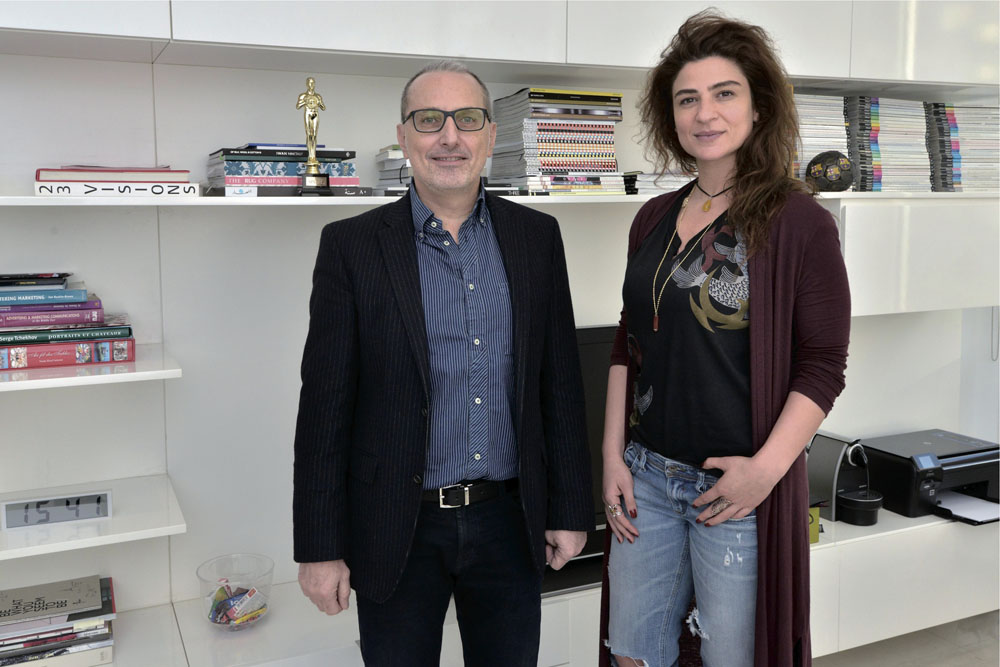
The times are not easy, concede advertising industry members Jihane Nasrallah and Hani Haddad. But whereas growth in the Lebanese advertising market has been elusive for about three years, and while Haddad’s agency had a rare year of seeing turnover drop in 2015, the two are joining forces in a merger. The merger process formally commenced last month with the relocation of Nasrallah’s agency, Inhouse Communications, into the offices of Haddad’s Spirit.

The integration of the two businesses is currently in phase one, entailing evaluation of the team and new human capital needs. There were some redundancies or departures of staff members who did not see themselves fitting into the new organization, but, according to Haddad, these represented a small portion of the new combined team of 35 individuals. “There was some [employee] turnover but we are also recruiting and will have some vacancies that need to be filled as we are restructuring,” he says.

A common vision

A key element in their corporate plan is to use economies of scale for improved profitability and stronger positioning in regional markets. “The interesting part of the merger is not turnover but profit,” Nasrallah explains. Efficiency gains from joining their forces entail lower office costs and reduction of overheads, she adds.

The owners of 11-year-old Spirit and six-year-old Inhouse Communications say they share a history of collaboration going back almost 10 years when Haddad interacted with Nasrallah as a client of his marketing services. Discussions on joining forces evolved in 2015 at a time when Nasrallah was a nominee for an entrepreneurship woman of the year award and received coaching on ways to grow her business by regional expansion or merger.

[pullquote]Both agree that having the right chemistry is crucial for a successful business partnership[/pullquote]

The newly minted business partners tell Executive that they share the same vision of running an advertising business. Each of the two firms has been operating as an independent agency offering the full range of media planning, public relations and advertising services. As a merged entity, they will operate on the basis of the very same formula. “Both of us were working the same way, which is different from the market, and have the same vision, which is being a full-service agency. We are focused on proximity to local clients,” Nasrallah says.

Merging two local advertising companies into a larger independent agency is an alternative path to the advertising industry’s prevalent business development route, which is alignment with regional groups and, ultimately, with one of the multinational conglomerates. As shown by numerous cases in the recent and not-so-recent past, local Lebanese agencies using the latter route have found their final homes as fully-owned and controlled units of global marketing powerhouses.   

For Haddad, who started his career in the advertising and marketing communications industry more than 20 years ago, aligning his first agency with a multinational group back in 2000 was a disappointment and he reversed out of the relationship by setting up Spirit in 2004. Given that advertising talent moves easily from local agencies to multinational ones and vice versa, he says the difference is not in human capital but in the rigid corporate cultures and bylaws of the multinational organizations by which they oblige local clients to commit to a certain way of doing things. An independent agency can be more flexible in responding to client needs. “This is added value and this is what clients are telling us when they say they are comfortable working with us,” Haddad claims.   

According to him, the addressable market for independent agencies is getting larger because more Lebanese companies are expanding abroad. By Haddad’s own assessment, Spirit is the largest independent agency based in the country. He declines to say how much Nasrallah and he are expecting from the merger in terms of margin improvements but admits that growth of profitability should be double digit. 

Moving forward

The only number he is willing to disclose is also by self-assessment. Following the merger, Spirit is now a $30 million company when all assets and the Dubai office that serves Gulf clients are taken into account, he says.

[pullquote]A key element in their corporate plan is to use economies of scale for improved profitability and stronger positioning in regional markets[/pullquote]

The company will invest into capacity building, job training and business development, including travel, to explore and develop new markets in the region, but budgets have not been finalized. “We have drafted a plan but we are still testing it as we are now in phase one of the merger,” Nasrallah says.

The merger was done by exchange of ownership shares and did not involve a capital increase. Haddad refuses to say how the ownership stakes are now distributed. However, his position of chairman and chief executive of the company, and Nasrallah’s position as managing director of new business give an indication. According to Haddad, Spirit operated in the past with a perfunctory board and is now advancing to a three-member board as the strategic decision platform. Board members are Haddad, Nasrallah, and Spirit’s Regional Creative Director Maya Saab, who are all shareholders in the company.

Both agree that having the right chemistry is crucial for a successful business partnership. While sharing the same basic approach to the business is essential, “there should always be areas where one complements the other,” Haddad opines and Nasrallah notes, “That is why we are now putting proper structures in place and defining responsibilities.” She adds that the merger of cultures between the two organizations still has a lot of ground to cover, saying half jokingly, “I am realizing this today from your interview. I moved [into the Spirit office] three or four days ago, so we are still in the honeymoon phase.”

March 17, 2016 0 comments
0 FacebookTwitterPinterestEmail
Celebrating 200 issuesSpecial Report

“The new Arab World”

by Spencer Osberg March 16, 2016
written by Spencer Osberg

“There is no going back,” began the cover story for Executive’s March 2011 issue. “Recent months have severed the future from past precedent and brought about a fundamental shift in the Arab paradigm.”

When we published those words, uprisings had just begun to sweep country after country across the Arab World. In response, global media outlets rushed in to broadcast “the story” to the masses around the planet – but that was never our game. From our seventh floor office near Beirut’s Adlieh roundabout, we produced coverage for the discerning reader. Our lens on the upheaval was economic. Our analysis followed the money and within our niche we were unrivaled.

For the March 2011 magazine, issue #140, we interviewed an economist at the University of Tunis El Manar, who told us that Tunisian youth – who were again marching in the streets after having driven President Zine el-Abidine Ben Ali into exile just a month and a half before – would have to wait years for the inequities they rose up against to be righted.

Libya was then newly divided between the country’s east, which a rag-tag rebel movement had newly liberated, and a west where Colonel Muammar Qaddafi still held sway. Global oil prices had surged past $100 per barrel as a result and our editorial team brought to the fore how the Libyan government’s fortune – tallying in the hundreds of billions of dollars and stashed in investments in more than 130 countries around the world – would be up for grabs if Qaddafi’s 42-year-reign were brought down.

As for Egypt, we reported on how regional banks were shrugging off the potential for short-term loan defaults post-revolution in anticipation of the massive financing needs the new government would have, while Egyptians – who our team had been with in Tahrir Square when millions demonstrated to end the 30-year dictatorship of Hosni Mubarak – were debating the future of their country and feverishly building new political parties to elect into the parliament.

In Morocco, Algeria, Jordan, Iraq, Bahrain, Yemen and Oman, the people had taken to the streets and squares of cities and towns, demanding just governance and a new social contract. Yet, even as the Arab world seemed alight from end-to-end when Executive hit Lebanese newsstands March 1, just a two-and-a-half hour drive away in Damascus, calm prevailed. Syria was different. The regime’s power seemed absolute. An uprising there was impossible. Until it happened.

A Damascene shopkeeper – speaking to our reporter who went in the next month to covertly cover the unrest – made it a point to remind us that Syria was still different.

“They will kill millions to hold onto power. Millions,” he said. “This is not Egypt.”

We documented how the rural areas in Syria that first rose up were the same ones that had been the worst affected by the government’s repeal of farm subsidies, or where small-scale artisans had been driven out of business en masse by trade liberalization with Turkey. As protests against the regime of President Bashar al-Assad spread across the country we followed how the economy retreated, unemployment surged and the Syrian Central Bank began burning through its foreign currency reserves to prop up the sinking Syrian pound.

[pullquote]Our lens on the upheaval was economic. Our analysis followed the money and within our niche we were unrivaled[/pullquote]

The more viciously and violently the regime tried to quash the peaceful protest movement, the bigger the demonstrations became. Within months media around the world began to speculate about the imminent collapse of the regime. But it withstood, and as the opposition tired of being butchered in the streets, at Executive we traced the rising price of weapons on Lebanon’s black market, fueled by groups in Syria who were rallying to arms.

In contrast to Libya – where western countries quickly secured a United Nations Security Council resolution for a “no-fly zone” and then bombed Qaddafi’s ground forces to make way for a rebel advance – the West “has generally limited its stance to the unrest in Syria with repeated calls for Assad to reform or face losing his legitimacy,” one of our comment writers noted in Executive’s August 2011 issue. “We don’t want to go for the option of an armed struggle against the regime,” the same writer quoted a Syrian activist as saying in our October 2011 issue, “but if the international community does not step in, we are afraid that it will lead to civil war.”

Five years later I look back at the words we published in March 2011, and they now echo hauntingly: “What was the status quo is now dead, trampled beneath the feet of millions marching through the streets. And while it is yet far from certain that freedom and democracy await them at the end of this road, what is assured is that where they are going is radically different from the place they left. Welcome to the new Arab World.”

Spencer Osberg was editor of Executive from 2009 to 2013

March 16, 2016 0 comments
0 FacebookTwitterPinterestEmail
AdvertisingSpecial Report

Activating the creative gene

by Thomas Schellen March 16, 2016
written by Thomas Schellen

Early in 2016 was once again the perfect moment for a comparison check on the strength of the Lebanese advertising market: the Super Bowl. As the primary sports spectacle in the United States was celebrated on February 7 with national pride (anthem sung by Lady Gaga), superbly choreographed spectacle (halftime show with Coldplay, Bruno Mars and Beyonce) and inevitable circumstance of glorious competition (throwing, running and catching of a ball by the country’s most talented sportsmen in this specialty endeavor), it would have been a fantastic chance to promote Lebanese exports to over 110 million US viewers with a creative commercial.

Super Bowl advertising spots are the real-life Olympics of marketing, far beyond the live TV audience; they are watched, evaluated, talked about and shared online by millions, long after game day. Talk about quick and viral? More like the grail of engagement. And it was not only local beer and foreign car makers that entertained with commercials during Super Bowl 50. Mexican avocado exporters advertised this year (again) and got global attention for their produce. Judging from their commercials and those of the competition, Lebanese agencies would certainly have the creative potential to produce a spot that could compete in the Super Bowl.

However, here is where the dichotomy shows: a spot in the event sets the advertiser back by about $5 million – per 30 seconds. According to industry publication Advertising Age, the 2016 Super Bowl ad sales revenue amounted to an estimated $377 million, a new record in a long line of rising marketing investments at the event. The total advertising investments in the Lebanese market in 2015, $190 million by the most optimistic assessments, consequently would hardly be enough to book the spots in the Super Bowl’s first half.

[pullquote]Judging from their commercials…Lebanese agencies would certainly have the creative potential to produce a spot that could compete in the Super Bowl[/pullquote]

While such comparison is just a mental exercise, it illustrates a big tear in the fabric of the Lebanese advertising industry. The local market is small and stagnant to the point of going into an advertising recession. Regional markets are not looking good because of the oil price slide or are, in the case of Syria, completely paralyzed. Lebanese creative agencies, however, are reaping accolades for their productions and have been ramping up their reputation for more years than the market has been slumping.

Case in point, last month saw several agencies awarded high rankings in several ad industry introspections, such as the Big Won Report, the Gunn Report and the annual listing of “brave” agencies by trade magazine Contagious. The biggest winner from Lebanon was agency Leo Burnett Beirut, a member of the Publicis conglomerate. It tied in Contagious’ list of global standard setters with another Arab agency, Menacom’s FP7 Dubai, in tenth place worldwide.

That’s not all. From their fairly modest offices – even by regional standards – on ever-busy Charles Malek Avenue in Achrafieh, Leo Burnett Beirut swept awards for top creative productions with commercials such as the keep the flame alive campaign of Diageo’s Johnnie Walker whisky brand (a Lebanese national confidence booster) and two civil society messages – Sakker el dekkene’s Lebanon4Sale, an anti-corruption campaign, and vote for us; we’ll vote for you, the women’s legal rights campaign for Kafa.

According to Nada Abi Saleh, managing director at Leo Burnett Beirut, these three campaigns were in the top ten globally in one or more categories which the Big Won Report computed from compiling information on 3,406 pieces of advertising work which in 2015 had won nearly 7,200 awards in 32 awards shows around the world. Additionally, Leo Burnett Beirut was lauded as one of the top 20 creative agencies in the Gunn Report.

This needs to be put into context. First, advertising awards are a marketing genre in itself. What else would one expect? While best-in awards and recognitions have become frequent in activities from banking to horticulture, the advertising industry has a larger propensity than most to assess its own products and advertise outstanding performances. Dubai Lynx, a regional chip off the old Cannes Lions block, and MENA Cristals, an ad feast that was staged on an annual basis in Kfardebian until it moved to Dubai last year, are regional specimens of the advertising awards genre. This notwithstanding, advertising industry award news are not mandatory reading for either advertisers or business reporters. It’s fine if you never looked at the Big Won Report, Contagious Communications or the Gunn Report.

Secondly, advertising industry leaders often speak dismissively of award shows when they are not at the events to sit on juries, deliver speeches or receive trophies. Time and again, agency owners and decision makers across the region have told Executive in interviews that awards are good for the morale of their teams and help talented individuals to get ahead in their careers. But that’s it. When it comes to the bottom line, multinational clients don’t assign big accounts on the basis of the number of awards won by an agency.

A narrative of inspiration by adversity

Yet, once the hype and marketing praise is stripped from the narrative, there is an admirable core. According to Abi Saleh and Kamil Kuran, the agency’s managing director for the Levant, the story took off a few years ago with the Leo Burnett Beirut office’s first successful grab at quality international attention when the team, in Kuran’s words, “cracked Cannes” with Khede Kasra, a women’s empowerment campaign for the Hariri Foundation.

[pullquote]Lebanese creative agencies are reaping accolades for their productions and have been ramping up their reputation for more years than the market has been slumping[/pullquote]

Winning a Gold Lion in the public relations category in 2009 ignited curiosity about who these people from an out-of-the-way agency were, Kuran explains. “I think credit of course goes to the entire team but under the leadership of Nada [Abi Saleh] at the time. The thing is, it’s so hard and you work so hard to crack something, but once you crack it, you become more confident and you start to know what it takes [to create prize worthy campaigns],” he says.

Abi Saleh interjects that the roots of the Beirut agency’s increased creativity became visible several years earlier in 2005 and 2006 during a period when the Lebanese people were eager and then desperate to see change. The agency at the time started infusing encouraging messages into ads for local retailers and banks. “We wanted our brands to not be distant from our Lebanese reality. We wanted them to be parts of the people’s mind and affection and emotions,” she explains. This marked a shift in thinking that was not planned, she adds: “I would love to say that we started with a vision, but this is not the entire truth. I think we started doing it very intuitively and thanks to the culture that some key people at this agency wanted to establish.”

The momentum was kept and in 2012, the agency was acknowledged as the world’s number 6 in creativity in the Big Won Report. According to Kuran, the dynamics in the interaction between the agency’s individuals, its collective team identity, and its simultaneously diverse and adverse Lebanese environment provided the factors that kept the creative juices flowing and coalescing in the successful campaigns seen since.

“The beauty of it is the dynamics of all of those together. Communication and advertising and all that are a form of learning and a form of culture. [If you] try to instill change, try to combat all this complacency and the spirit of giving up within our population, you’re always trying to push the envelope,” he says. When the mindset of wanting to give the message that Lebanon can achieve collides with the defeatist sentiments found in large parts of society, this frustration creates “fertile ground” for causes and for coming up “with campaigns that touch the hearts of people,” he elaborates further.

[pullquote]Frustration creates “fertile ground” for causes and for coming up with “campaigns that touch the hearts of people.”[/pullquote]

Campaigns designed with the objective of promoting needed change then were driven by “a hunger to prove ourselves and demonstrate that in such a small country we can make a difference that is 100 percent made in Lebanon. I don’t think anywhere in the world there exists a country like this where people keep beating you down and you keep resisting and wanting to instigate change,” Kuran goes on.

It was a progress along the same mental road that led Leo Burnett Beirut to its latest award winning campaigns. As Abi Saleh and Kuran tell it, the Johnnie Walker keep the flame alive campaign was the result of intense brainstorming and teamwork on how to make the long-running commercial more relevant to Lebanon. Seeds for the production had been secured when the agency got approval to acculturate the brand’s keep walking theme to Lebanon, engaging local celebrities to star in spots and using images such as walking across bridges that had been destroyed in the conflict of 2006. When conceived and realized in 2014, the ‘keep the flame alive’ commercials were informed by the resilience of Lebanese people and their affirmations of determination and overcoming in the face of the hardships.

In the greater context of changing attitudes in the communication with customers, Abi Saleh and Kuran say the winning Leo Burnett Beirut campaigns are part of a wider flow toward people-centric thinking and to developing the why of brands instead of emphasizing only the what. When it comes to the fact that a comparatively small office with relatively few staff now rates far above international expectations in its creativity, Kuran conjures an image of a different kind. “Imagine you are watching a tribe of lions which are all roaring. Suddenly you notice this small Chihuahua which shows up in the tribal meeting and instead of barking, that Chihuahua roars, and it roars louder than the lions. It gets your attention.”

We all agree that in the lions’ dens of global advertising, the Lebanese currently stand out as the roaring Chihuahua.

March 16, 2016 0 comments
0 FacebookTwitterPinterestEmail
AdvertisingSpecial Report

Battle for the ad dollar

by Thomas Schellen March 14, 2016
written by Thomas Schellen

Remember the one from Brooklyn-born designer Kenneth Cole? “Millions are in uproar in #Cairo,” he tweeted in early February 2011. True. Because they allegedly had heard about his fashion company’s “new spring collection”, the gifted marketer blared on. Triple ouch.

Every year, there are some advertising campaigns that backfire badly. Most can be attributed to cultural ignorance/insensitivity in combination with stupid timing. Cole’s was in that class, although a few grades below Coca-Cola’s epic miscalculation of first Israeli and then Arab sensitivities that led to the brand’s 23-year Arab boycott from 1968 until 1991. As far as marketing communications blunders that hurt foreign brands in the Middle East and North Africa, one cannot assess if and how much Cole’s tweet damaged Kenneth Cole Productions beyond the large immediate outcry that it generated in 2011, since the company delisted in September 2012 and henceforth had no obligation to publish results.  

Some marketing mistakes are clearly costlier than others but in general, these blunders come and go and do surprisingly little damage to the advertising industry’s profitability. The profession has become more accountable – even if that is mainly due to scandals, litigation, bad press and the arrival of digital consumer power, it also seems rooted in the will to improve. Lying to the educated consumer is the big no-no of today. Cigarettes don’t improve your health, shampoo doesn’t make you irresistible, wearing sports shoes does not make you lose weight, food is just food and there is no one drug that cures all cancers. Moreover, marketing success doesn’t grow on trees. Therefore agencies have learned to steer away from lying to the customer and from deceiving the advertising client.

Grand ideas

At the same time, however, the advertising industry has an existential need to tell stories that are bigger than life. That’s why the right deodorant and the even more flavorful toothpaste get you your dream partner, why every detergent, mobile phone and breakfast cereal is far superior to last year’s version, why every hamburger looks much better in the ad, et cetera. The knowledge that people will respond positively to embellished tales of beauty, goodness and well-being is deeply engrained in the ad industry’s DNA. Advertisers on their end always want more return for every dollar they spend on campaigns. The problem for the marketing communications profession is that the two mandates of not telling a lie and delivering a great, funny, enchanting and profitable narrative are contradictory.

[pullquote]The smallness of the revenue pie sheds harsh light on the economic viability of even prominent audiovisual networks and practically all print media[/pullquote]

Agencies seem to have embraced life within this contradiction so thoroughly that they often perceive and describe matters in their own industry through bifocal lenses with very different focuses. Like now. Judging by the numbers, the Lebanese advertising market is drifting in very dangerous currents.

This danger is not prima facie because of the mind blowing discrepancies between billings according to rate cards and estimates of real advertising sales revenues achieved by local audiovisual, print, outdoor and digital media suppliers. This gap is so customary and currently so accepted that regional ad market researchers Ipsos Media CT in their report on Lebanon, published last month in trade magazine Arab Ad, just specify what they assume to be the correct inflator for each advertising medium. It is apparently useless to fuss about the fact that these inflators range from 50 percent in the cinema category to almost 1,600 percent in television, meaning that 2015 rate-card billings of $1.62 billion in Lebanon must be revised lower, much lower – namely to an estimated $190 million.

That amount is equivalent to not more than 0.4 percent of Lebanon’s Gross Domestic Product which has been estimated at $47 billion in 2015. In the context of the country’s fragmented media landscape, with many outlets that each cater to very partisan target groups, the smallness of the revenue pie sheds harsh light on the economic viability of even prominent audiovisual networks and practically all print media.      

The danger hidden beneath the disinflated ad spend figures is that this estimate contains too much ambiguity for making a proper assessment of the industry’s health or sickness. Real advertising purchases in 2014 and 2015 could have been even lower than the Ipsos Media CT estimates of $188 million and $190 million. Directors of media planning agencies – the experts in assessing the advertising clients’ demand and purchases of media supply – work with the numbers but cannot actually confirm their accuracy.

Cloudy outlook

At Mindshare, a media planning agency that is part of WPP, the world’s top marketing communications conglomerate by annual revenues ($19 billion in 2015), the Lebanese market is judged to have been below published estimates in the past two years. Ghada Hmedeh, who manages a portfolio of luxury business from the Beirut office, tells Executive that by Mindshare’s assessment, Lebanese ad spend in 2014 was similar to 2013 and reached about $180 million in each year. “We have estimated a decrease of about 20 percent and I would say from looking at all the numbers that 2015 was closed at around $150 million,” she says.

[pullquote]Lying to the educated consumer is the big no-no of today[/pullquote]

Wilson Issa, the managing director for the Levant at market-leading planning agency VivaKi, part of the global Publicis conglomerate, gives an opinion when asked if he considers the $190 million figure for 2015 to be the real one. “Let’s put it this way: if [advertising spend] is flat, that means it is shrinking. Even if spend remained the same in 2015 versus 2014, it means that efficiencies have shrunk,” he says.

According to Issa, it is not a good signal if overall spending on advertisements is stable, because it coincides with shifts into digital marketing and this investment then necessarily is at the expense of traditional media, such as print. He observes, “Media owners were tremendously challenged in 2015. Overall budgets are more or less the same [in 2016 to date], but in a scenario where you know that you need to increase your efforts on digital, this is bad news for certain media owners.”

Beyond being worrisome for traditional media, stagnancy of advertising markets is not sustainable for the entire industry if it goes on for extended periods. “Absence of increase for one or two years is understandable, but if the lack of growth goes on longer, it is alarming,” he says.

This, however, makes 2016 something of a year on the edge. Advertising budgets of multinational clients are not something that the Lebanese media planners can bank on, because the national market is part of their regional planning and a small one at that. Given that regional economic growth outlooks are subdued and Lebanon is steeped in uncertainties, local spending by multinational clients might be at levels unchanged from previous years but increases are unlikely.

Expanded spending from regional and local clients is not much of a prospect either, given absent or minimal domestic GDP growth expectations and necessary adjustments to lower oil revenues in energy exporting countries. The advertising industry numbers of 2015 show that most Arab advertising markets reflected the tighter economic realities with drops in spending.

[pullquote]The advertising industry numbers of 2015 show that most Arab advertising markets reflected the tighter economic realities with drops in spending[/pullquote]

The outlook of further drops in regional ad budgets is therefore very concrete, even if such a downturn at this time does not directly translate into contractions of the Lebanese market, as it did in the 2008/9 burst of the real estate bubble and crisis of financial markets in the Gulf Cooperation Council (GCC). In terms of impact, the prospect of another year of no advertising growth in Lebanon is something that large and well-positioned media agencies will be able to weather but this may not be the case for everyone, says Carole Hayek, the Lebanon general manager of planning agency Optimedia, which she established in 2004 under the Publicis umbrella from Beirut.

Hope for the future?

“The problems will be affecting mainly small and medium advertising agencies, independent ones. Lebanese agencies can easily survive another difficult year but I am not so sure about small agencies,” explains Hayek, who is also vice-president of the Lebanese Advertising Association. Moreover, the resilience is limited, she admits. A lack of growth beyond 2016 would be hard to stomach. In that case, “I personally think that there will be a difficult moment for the entire industry,” she says.

The best-case scenario for the local market, in the view of Mindshare’s Hmedeh, would be a boost from a new Lebanese president. A successful election in the near future would cause a number of local advertising clients to activate campaigns in response to the upswing in national sentiment over an end to the presidential crisis, she says, but even in that scenario, her best-case expectation is for a stable market. “If we can have elections, we can optimistically look to a similar performance as last year; otherwise we might be facing another drop [of the same magnitude as in 2015],” she says.  As to markets where Beirut-based agencies could become newly active, she sees Iran as a tentative potential, based on research undertaken there by companies in the Lebanese marketing communications industry.

[pullquote]The stagnancy of the Lebanese market is not helping with the recruitment problem but the market will remain on the maps of multinational clients[/pullquote]

For Hayek, the industry’s current problem is exemplified in a lack of agency recruitment that makes local doors hard to enter for new Lebanese talent. In terms of improvement options, she sees the potential as dependent on factors in the Near East region. The stagnancy of the Lebanese market is not helping with the recruitment problem but the market will remain on the maps of multinational clients, she says: “Improvement is not on the near horizon but things cannot continue like this. This market has good potential and I am optimistic that things will change. Once there is political stability in countries around Lebanon, things will change drastically.”

In Issa’s view, the market will sustain itself because some advertisers always see an opportunity to invest into more marketing and improve their positions when competitors react to an economic trough by lowering their marketing budgets. In this sense, his worst-case scenario for 2016 is for overall budgets to remain at the level of 2015, as he expects withdrawals by the cautious type of client to be balanced by the expansionary minded ones. He says, “This is why I am telling you that advertising in a way regulates itself. Both breeds of clients, however, want more [return] for the same [marketing investment] or more for less. That is the challenge for the advertising agencies and the media suppliers as a whole.” That now seems to be the optimistic view.

March 14, 2016 0 comments
0 FacebookTwitterPinterestEmail
LeadersOpinion

Improving the economies of words

by Executive Editors March 14, 2016
written by Executive Editors

In the beginning of human expression, technically speaking, there was the pictogram. The marriage of image and meaning, irrespective of the degree of abstraction involved, is how communication can be kept “on record”. Where glances and body language cannot be preserved without comparatively extensive technology, words and pictures codify human history.

In this sense, it is indeed appropriate that the 200th issue of Executive magazine entails a section on advertising. The endeavors of content communications and marketing communications are semantically subsumed under a shared term – media. Being both part of media, the economic relationship of marketing glorifications and critical reviews of the same stuff – products, news, opinions et cetera – is a perennial competition. 

The truth of this competition is that media will have a prosperous future only if we can, on both sides, understand and practice our opposing approaches as a non-zero-sum game. Non-zero-sumness, as defined by American thinker Robert Wright, is the development scenario where competing interests overlap positively and an optimum outcome can be produced that brings more advantages to the interested parties than a zero-sum, or win-lose, solution. Walking a mile in the shoes of Adam Smith, one might perceive the logic of non-zero as an evolution of the “invisible hand”, which the philosopher-father of economics did not actually elaborate on.

According to Wright, non-zero-sumness requires advances in communication, technology and information processing, factors that are central pistons of the global economic machine. But it also needs something called “moral imagination”, which enables us to envision life as being at the same time ethical and successful, or what for Smith might have been captured in the “impartial spectator” concept; a humanly inherent ability to assess our own actions from another person’s perspective.

Applying such assessment techniques to the situation of Lebanese media at the current juncture, Executive editors see it as prudent to call for more interaction of journalistic – in the real sense – and responsible advertising media. This interaction is needed to address the questions of media ethics that in the digital age can no longer be answered in the ways in which answers were constructed a hundred years ago. 

The economic survival of both marketing and journalistic media depends on the ability to tell better stories, all the time. If the Lebanese advertising market is suffering, we are both as fishers in two tiny vessels that are shaken by the same gales and battered by the same breakers. Telling stories better requires talent which we are happy to ascertain for the Lebanese creative advertising community and, with a modicum of humility, ascribe to our track record of 200 issues and almost 500 contributors.

Also required for production of better narratives are competency in the digital sphere and diversity. In the first regard we have much to learn at Executive. Thus, our note to the editorial self and call for action are to improve our digital capabilities and their applicability in all parts of our enterprise, and then embark on a new life in the avant-garde of business publications. If top standard setters of 20th century journalism could start their careers in 19th century places such as Boonville, Missouri, and St. Louis, Missouri, we see no reason why the next impulses for top business journalism should not germinate in our inspired environs of Achrafieh, Beirut. 

In parallel, we urge the entire Lebanese marketing communications community to invest in their digital capabilities. As evidenced by a contribution of only five percent to advertising spend, Lebanon is still a laggard when it comes to digital practices, and we hear from leaders in the media planning industry that many agencies have yet to invest into and develop convincing digital offerings, as well as initiate measures to increase awareness within the local advertiser community. We call for more such outreach from marketing communications players.

We further reiterate the call to collaborate on codes of conduct and standards of ethics for the entirety of Lebanese media enterprises on both the marketing and journalism sides. All players need to devise and agree on a code that gives audiences confidence that outlets understand and respect the country in its specificities, and that incorporates ethical accountability in media behavior.

And last, on the topic of diversity and leadership, we – all in the Executive editorial team but especially its male members – offer our masculine curtsies and tip our feminine hats to the leadership evolution of local marketing communications companies, where an impressive number of agencies have achieved parity of women and men in managing director positions. Thank you for setting examples for us to learn from.

March 14, 2016 0 comments
0 FacebookTwitterPinterestEmail
Economics & Policy

Still sanctioned

by Jeremy Arbid March 9, 2016
written by Jeremy Arbid

Merhi Abou Merhi, a Lebanese business tycoon and former board member of IBL Bank, has not been acquitted by federal prosecutors, sources at the United States Department of Justice and the Department of Treasury told Executive March 8. A report carried by Lebanon’s state-run National News Agency (NNA) on March 7 claimed that Abou Merhi, family members and their companies had been acquitted of charges of facilitating a narcotics and money laundering ring overseen by the Joumaa Criminal Organization.

The Treasury Department says that the report is false and that sanctions are still in place for the Abou Merhis and 11 companies. “They all remain designated. Claims that Mr. Merhi has been “found innocent of the claims by OFAC” are inaccurate and there has been no action regarding Mr. Merhi that would change his status as a Specially Designated National and Blocked Person,” says Betsy Bourassa, spokeswoman for Terrorism and Financial Intelligence at Treasury.

Treasury’s Office of Foreign Assets Control (OFAC) had sanctioned Abou Merhi, alongside three family members that held management positions in eleven designated companies, in October 2015 for alleged business dealings with members of the Joumaa network that had previously been sanctioned by OFAC. Acting Director of OFAC, John Smith, said in a statement announcing the sanctions that, “Merhi Ali Abou Merhi operates an extensive maritime shipping business that enables the Joumaa network’s illicit money laundering activity and widespread narcotics trafficking. The Joumaa criminal network is a multi-national money laundering ring whose money laundering activities have benefited Hizballah.”

Treasury sanctioned Abou Merhi pursuant to the Kingpin Act and added him and the family members to the OFAC’s Specially Designated Nationals (SDN) list. A listing on the SDN freezes the financial assets of the Abou Merhis and eleven companies held in banks under US jurisdiction and blocks them from accessing the international financial system. Getting off the OFAC list is an arduous process requiring those listed to sever business and personal relationships and provide financial records. Gary Hufbauer, a senior fellow at the Peterson Institute for International Economics and former deputy assistant secretary at the Treasury Department, has previously told Executive that it is an expensive and timely process that places the burden of proof on the designated entities. Designation under the Kingpin Act also carries possible fines of up to $5 million and criminal penalties of up to 30 years in prison for each listed individual. The designated companies could each be fined up to $10 million.

When the NNA broke the news that a US court had acquitted the Abou Merhis of any alleged wrongdoing Executive was skeptical. The timing of the report is peculiar in that only 6 months have passed since the sanctions were announced, a very short period of time considering the allegations they face.

According to the NNA, the US Attorney’s Office for the Eastern District of Virginia (EDVA) has dropped the case against Abou Merhi, his family and the companies. But Joshua Stueve, a Justice Department spokesman for the EDVA, told Executive that “The reports are false.” Stueve did not elaborate and did not respond to follow-up questions sent by email.

The NNA says the statement was issued by the EDVA and reported by its correspondent in the United States. Executive reached the NNA’s director, Laure Saab, by telephone and was told that all pertinent information regarding the source of the statement and any other details could be found in the Arabic version of its article published Monday, March 7. But the article neither indicates whether the NNA correspondent actually spoke with the prosecutor’s office or with the Abou Merhis’ legal counsel.

According to the statement obtained by the NNA, “the United States has conducted a lengthy and broad investigation into the allegations against Merhi Abou Merhi, his family and companies. It turned out that the allegations made void of any party, but the prosecutor’s office in the United States has taken the decision to close this case and has informed OFAC of the innocence of Abou Merhi, his family and companies and there is no need to carry the investigation any further.” The NNA stands by its report that the statement acquitting the Abou Merhis came from the EDVA.

The fact that the NNA does not clearly identify and attribute sources, even anonymous ones, is an alert to the need of higher reporting standards when tackling such issues that have implications for the Lebanese–American relationship, Lebanon’s financial system and the business community at large. These stakeholders need to have reliable information because any type of business relationship with a sanctioned entity can raise red flags with Treasury.

March 9, 2016 0 comments
0 FacebookTwitterPinterestEmail
Celebrating 200 issuesSpecial Report

Steering through stormy times

by Michael Karam March 9, 2016
written by Michael Karam

I was appointed Editor of Executive in the late summer of 2002. I’d been a freelancer with the magazine for just over six months, but had been out of journalism for nearly two years. My metaphorical footprints in the sand were in danger of being washed away and I needed to get back into a managerial editing job.

Then, in August 2002, the editor very publicly resigned. It was a week before going to print. I was in the office and heard it all. I waited for the dust to settle before popping my head around Yasser Akkaoui’s door and telling him I was willing to help bring out the issue. He agreed. I stayed for five years.

And what a five years they were, capturing arguably the most amazing (and often sad) period in Lebanon’s short history. They were five years of hope, dismay, more hope, unbounded joy, fear and eventually solidarity as we reported on an economy hamstrung by occupation; driven by reconstruction, defined by prosperity, terror, revolution, assassination, war and even more reconstruction.

But back in 2002, the Downtown, Solidere, Beirut Central District – we never quite knew what to call it – had just opened up for business and it appeared that Prime Minister Rafik Hariri’s “build-it-and-they-will-come” dream just might morph into a money-spinning reality. The fallout from 9/11 meant that Beirut was once more the darling of the Arab World and we truly felt that the soul of the city had returned.

And even though Syria ran the show (and regularly arched an eyebrow at our content, some of which sailed very close to the Baathist wind) there was a feeling that economically Lebanon was back in the saddle. Hariri and his Trade and Economy Minister Basil Fuleihan organized a second Paris donor conference in November 2002, while other money (clean or otherwise) was flowing in, be it tourist dollars, remittances or from growth in banking, real estate, hospitality and retail. Hotel chains inked deals, international brands arrived and life was good.

But we forgot, or chose to forget, or figured we couldn’t do anything about, the fact that Syria was in charge and, on Valentine’s Day 2005, things changed forever. Hariri, the man who had single handedly gripped Lebanon by the scruff of its neck and convinced us we could get back on our feet, and Basil Fuleihan, the poster boy for a postwar generation who wanted to give back to its country, were murdered along with 20 other innocent passersby in front of the St. Georges Hotel. We realized then that we could no longer turn a blind eye. The whole office, like a quarter of the country, descended on Martyr’s Square on March 14 to demand that Syria leave. And when Syria did leave, we couldn’t quite believe what we had done.

In the run up to the 2005 elections in a two-part cover story, we decided to ask the parties contesting the first Syrian-free polls about their economic policies. We called Hezbollah, we called the PSP; we even called Michel Aoun in Paris. They thought we were mad; we thought they were clueless. History has proved us right.

The 2006 war nearly closed us down but the owners decided, bravely and defiantly, to reinvest and go regional. During that month long war, we didn’t miss an issue even as the Israeli Air Force rained bombs on southern Beirut and other strategic targets. We then had to contend with the occupation of the Beirut Central District by the pro-Syrian, and, it would appear, anti-business, March 8 bloc, the repercussions of which are still felt to this day.

2007 was my last year as managing editor. If I close my eyes I can still hear the daily arrival of army helicopters ferrying the wounded soldiers from the battle of Nahr el Bared onto the roof of Hotel Dieu Hospital. Lebanon was still reeling from the momentous events of 2005 and it would not be until the next summer, after a failed coup by Hezbollah and its allies and the subsequent election of a new president, that the country would once more bask in the sun of economic optimism.

Today Lebanon faces arguably greater challenges, with the fallout of the Syrian Civil War once again forcing Lebanon to adapt to the shifting tectonic plates of the region. Executive continues to hold the government to account. The private sector is the heartbeat of the country, and the political class can play regional clientelism as much as it wants as long as it lets the business class do what it has always done: keep the country working. In this way, Executive has not shirked away from its duty, be it in asking what has happened to Lebanon’s scandalously managed oil and gas files, the corruption at Electricite du Liban, or the more recent garbage crisis – an event that is a stain of shame on our entire political class.

When I was appointed full time editor in October 2002, I was determined to make the relatively young magazine a success in a cutthroat market. To do this I knew I had to defend my editorial corner, and I am grateful to have been able to work with such a wise team. We all knew that the magazine could not survive without ads, but we also recognized that our readers would desert us in a millisecond if they knew our content was just rehashed PR. We played it smart. The sales department made it clear what the commercial imperatives were if we were to stay in business and it was up to us to satisfy these without selling our editorial soul. It worked. Even the stories I’d have rather not included in the magazine were never sell-outs, and the vast majority of our content was fresh, original, dynamic, daring and, most importantly, credible. It was content that made me proud to put my name to the masthead for over 60 issues.

So, to the talented and committed people I worked with who became like a second family, and to the contributors, who I always thought would desert me from one month to the next but who always came back for more work – thanks. It was one hell of a ride.

March 9, 2016 0 comments
0 FacebookTwitterPinterestEmail
Celebrating 200 issues

Once upon a magazine

by Thomas Schellen March 9, 2016
written by Thomas Schellen

Snapshots of an environment with many wants

Looking at the world from a Lebanese vantage point, 1998 was an ominous year. Hopes for a prosperous future were still as ubiquitous as the construction cranes that dotted the Beirut cityscape. But optimism was being tested by harsh realities that had not been included in the scripts written back in 1989 – 1992 when war-ravaged Lebanon embarked on its ambitious path of reconstruction and development into the third millennium.

As the epitome of faith in a new future, the second half of the 1990s saw the Beirut Central District return in increments from a state of total physical ruin. On the outskirts of the Lebanese capital, construction highlights included road and transportation infrastructure and the Sports City Stadium, which in 1999 would be filled to capacity – a rare occurrence ever since – for a Pavarotti concert. In Beirut proper, the highlights of urban building were still mainly restorative, such as the reconstruction and enlargement of the Grand Serail in 1998 – including historic limestone cladding sliced from stones salvaged from destroyed downtown structures – and the re-erection of the American University of Beirut’s College Hall and Clock Tower, solemnly inaugurated in 1999. It was still years before anyone would start talking about the city as being defined by its skyline.

[pullquote]It was a complex time that called for the articulation of smart and authentic voices in Beirut-based (business) journalism[/pullquote]

International recognition of the country’s sovereignty was real, in theory. In all other terms, the lingering presences of two occupying neighbors were impeding the national identity and the daily lives of everyone: citizens, Palestinian residents and foreign labor of all classes. Until July 1997, United States passport holders were still in violation of US law when they traveled to Lebanon. Amid Israel’s military occupation, Syria’s armed presence and various foreign political pressures, the Lebanese vigor and spirit of the period were acknowledged in a fundraiser – the Friends of Lebanon conference in Washington in December 1996 – and a pastoral visit, the celebration of Lebanon “as a message” of coexistence in Pope John Paul II’s 48-hour visit in May 1997.

Life in Beirut was rediscovering freedom. While some visiting writers speculated glumly that the city might never return to its pre-conflict multiculturalism and relaxed intermingling of communities, Lebanese writers and thinkers told international conferences that the country had preserved its amazing character of being a mosaic of identities. Having fast food meant eating at Juicy Burger or Barbar. The young and the hip sought places to party and celebrate the now in clubs and pubs. The old cafes on Hamra Street couldn’t keep up with that. Modca faded into history. Shopping centers popped up in unsuitable indoor spaces in Verdun. Taxi drivers from the different communities learned to find routes in parts of the city that they had not navigated for 20 years and new public bus lines crisscrossed the metropolitan area, with varying degrees of success in punctuality and efficiency of service. People worshipped their cars while being oblivious to rules, and traffic lights were the rarest of street ornaments. Traffic was chaos (as if that was likely to ever change).

Phoenix moments

When compared with the political environment, the economic realm was a haven of confidence. The stability of the Lebanese Lira encouraged financial inflows into the banking system. The Beirut Stock Exchange was expected to see new listings and investment companies were hanging out their shingles. Companies in construction and development, hospitality and even waste management services were all engaged in new projects. New schools and institutions of higher education were taking shape. And perhaps most importantly, Lebanese expatriates from all continents were heeding the call to return and invest in their homeland. They arrived with the knowledge and experience of doing business in the most competitive places and were prepared to contribute to, and profit from, Lebanon’s expected rise.

In global economic affairs, the 1990s were a period of increased international integration of goods, capital and labor markets. The establishment of the World Trade Organization and of two regional trade agreements in North America and Europe enhanced globalization in conjunction with innovations in the information technology sector. Embedded in this environment, Lebanon’s post-Civil War economic aspirations shifted from the fragmented structures of the 1975-91 era of internal conflict into a desired role as a trade and services hub for economies of the Middle East and North Africa and bridge between MENA economies and markets in Europe, Africa and the Americas. As a continuation of Lebanese positions in global trade from historic and even semi-mythical perceptions, this desire was perhaps mainly intuitive and implicit in the words and actions of business leaders. It was not formulated by policy makers in the context of a national economic strategy and could not have been, given that there was no trace of any unified economic policy making.      

The quagmires of restoration

Administered by three representative stakeholders of the country’s three largest communities, efforts at social and physical reconstruction from the center out were extremely costly and required investing own, borrowed and donated resources. Paying off the huge development drive of a new downtown, new economic infrastructure and the return of the displaced required making a bet on the recovery of the once pivotal Lebanese role in regional finance and trade, combined with anticipation of a peace dividend which was expected to result in an economic boom in southern and eastern Mediterranean countries. 

[pullquote]In the 1990s, it was the waning days of what some historians had identified as the century of totalitarianism[/pullquote]

But in the second half of the 1990s, the Middle East was sliding back into a dark and stormy political night. Less than 10 years after the fall of the Berlin Wall epitomized the hopes for an end to the Cold War, United Nations-driven efforts at peacebuilding in crisis regions such as Somalia had proven ineffectual. In the Near East, the Palestinians were waiting for the state promised by the Oslo Accords under a 1999 deadline, while Israel was becoming increasingly preoccupied with national security at the expense of implementing the peace deal. In Lebanon, people were waiting for the full implementation of the Taif Accord, which had declared the end of internal violence and a reboot of the state based on a concept of national unity and the promised arrival of meritocratic politics. Regional rulers and the shakers of geopolitics, however, had other concerns than rooting for Lebanon. It was a complex time that called for the articulation of smart and authentic voices in Beirut-based (business) journalism.

In the 1990s, it was the waning days of what some historians had identified as the century of totalitarianism. The seachange of political and economic systems in favor of democratic capitalism led some other historians to talk of the end of history. Other scholars spoke of the clash of civilizations and there was much speculation on the feasibility of a new world order. The markets for explanations were brimming with ideological propositions and information markets started to see the dissolution of entrenched patterns of both media ownership and media consumption. The World Wide Web was the new kid in town and digital publishing was coming. The epic battle between propaganda and journalism was shifting from the political and ideological realm to competition over influencing the thinking of consumers.

Admission to an economic future

Within this wider context of a changing communications landscape, the media culture of the Middle East was searching for new beginnings. Newspapers and state-owned or aligned media entities were in deep need of developing their own angles and communicating the reality of Arab politics, business and social life beyond delivering propagandistic perspectives and announcement-style information on who the ruler of each realm had met or talked to on the previous day. From Qatar, the region’s most daring new media venture had just started to roll out – but as the Al Jazeera Media Network sent its marketing representatives to communication-themed trade shows in Beirut in the late 1990s, the Jazeera news brand was still unknown even among many Arabic-speaking audiences.

The stirrings of independent journalism were feeble. In countries with limited freedom, formal barriers and informal obstacles were used to keep the media controlled. Lebanon, one of the region’s historic hubs of freer expression since the Arab Awakening, saw the relaunching of its English-language print media with the return of The Daily Star and the establishment of Lebanon Opportunities as well as other, shorter-lived broadsheets and economic publications. The ticket to ride to success in any form of serious journalism was economic and business writing, albeit from within an environment where entrenched communication patterns were obstructive to analytical/critical writing and investigative reporting. Moreover, the tech was not up to speed. Internet penetration rates were minimal and there was no digital media culture worth mentioning. In Beirut, journalists at forward-thinking daily or periodical publications would typically have a dial-up connection to ultra-slow internet service at a rate of one per newsroom.

It was into this environment where two twenty-something Lebanese, banker-to-be Antoun Sehnaoui and entrepreneur Dany Rizk, returned from their university studies in California. Having been inspired by mature US business periodicals and brands such as Forbes and Fortune, they carried with them the idea of creating an independent business magazine for Lebanon. Throughout 1998, they set up the framework for creating Executive, the Lebanese business magazine. Working from a not quite purpose-built newsroom in the Brazilia district in Hazmieh, they contacted prospective editors and journalists. Rizk, wearing the hat of editor-in-chief noted in one conversation with a freelance contributor that neither his partner nor he had any experience in journalism or publishing. “But we don’t believe this to be a detriment,” he said.

It was probably better to not be too aware of the demands involved in developing an independent professional publication in the Lebanese setting and it was almost certainly an even bigger advantage not to know what challenges and costs the coming years would throw in the way of this venture. We have come a long way since those early days. The rest of the story is in the timeline.

March 9, 2016 0 comments
0 FacebookTwitterPinterestEmail
LeadersOpinion

A magazine to be proud of

by Executive Editors March 8, 2016
written by Executive Editors

There’s plenty we’re proud of after 200 issues of publication. We’ve worked with hundreds of talented people and have honored a commitment made in our first editorial from September 1998 to provide high quality business reporting in Lebanon. In that editorial, we noted, “This issue is our first step in playing a part in Lebanon’s energetic and expanding business world.” Both the magazine and the country have come a long way in nearly 18 years. In this issue, you’ll find a look back at our evolution and a much-deserved thank you to all the people who have made it possible. But first, we’d like to re-commit ourselves to the promise of providing exceptional business journalism. We’re renewing our vows, if you will,  motivated not by a fear that the fire is dying, but by the happy realization that our passion for this work still burns strong.

Our content commitment

As a monthly magazine, we’re not burdened by the pressure of daily news coverage. While we often attend and ask probing questions, we don’t cover individual events or product launches as such. We may mention them to discuss trends within an industry or to exemplify a company’s strategy, but we abhor marketing speak like “iconic.” We don’t re-word press releases. We invest the time and energy to fully understand a topic so we can relay the most important information to our readers. The research and reporting that inform our journalism are conducted as impartially as possible. “Question everything” is office ethos, and we’re not afraid to challenge each other during the editing process. Have the facts been corroborated? Have assumptions or bias crept in? Have we engaged enough stakeholders to get the full picture?

While we strive for objectivity when collecting information, we don’t take everything we’re told at face value. If a company says it wants to grow 20 percent in 2016, we remember it said the same thing in 2010. We ask about the earlier projection and find out what went right or wrong to put the latest target in the proper context. Our pieces are analytical not because we want to be difficult or cynical, but because context and historical performance are key to fully understanding any issue or event. If a minister makes a promise his or her predecessors also made – and broke – several times in the past, we demand to know what has changed. Why should we believe the promise will be kept this time? If the answer is unconvincing, we don’t hesitate to point that out.

Producing quality analytical content month after month requires dedication. There’s an industry adage that goes, “A journalist is only as good as the last thing he or she published.” Whether we’re speaking of individual writers or the magazine as a whole, coasting on past success is not what Executive does. Every month is a new challenge and a new opportunity. Do we promise to continue providing in-depth, analytical business journalism? We do.

Our digital commitment

Optimizing use of the internet to reach an even wider audience has proven a challenge for Executive (see On the road to Oz). We have a web page and social media accounts, but we recognize that we lack an aggressive digital strategy. We know our website needs a better search engine and are more frustrated than anyone when we can’t find an article we know we published. That said, we’re going to approach our digital strategy prudently. We offer added value which is not available anywhere else. Marketing that value online will take planning, time and money (just as it took time to build our brand offline – see Intelligent designs). It will require identifying and working with the best talent for our purposes. We realize the future is online and we need to find our place there. Do we promise to invest more in developing our digital strategy? We do.

Our shareholders’ commitment

No Lebanese media outlet (be it a TV station, newspaper, website or magazine) is financially independent. They all have one or more wealthy sponsor. Executive is no different. While our marketing and sales teams have consistently done great work (see The business team: A question of balance) bringing in ad revenue (drawing from an ever shrinking stream – see Battle for the ad dollar), the truth is we’re not profitable and never have been. In some publications, you know the sponsor as soon as you turn the cover, because his or her face gleams from every second page. In even worse cases, the editorial content is a one-to-one reflection of the financial backers’ political views, business interests, or both. We can credit Executive’s backer for doing neither. Our sponsor does not attend editorial meetings nor demand homage paid on the pages of this magazine. The subsidy we receive each year does not come with strings attached. Our conclusions are not foregone. Our stories are not cleared before publication. We’re not told what to cover and what to ignore. We’re not told whom to speak to and whom to avoid. We’re lucky. And in debt.

What the process of reflecting on 200 issues has made clearer than ever is that we’re sitting on a gold mine. We have a strong reputation and both content assets and human capital that simply must be better monetized. The how is tricky and no doubt related to our digital strategy, but we owe it to ourselves and that special someone whose generosity through the years has made building this legacy possible to increase revenues however we can. Do we promise to look for innovative ways to reduce our financial backer’s burden? We bet’cha.

March 8, 2016 0 comments
0 FacebookTwitterPinterestEmail
  • 1
  • …
  • 128
  • 129
  • 130
  • 131
  • 132
  • …
  • 685

Latest Cover

About us

Since its first edition emerged on the newsstands in 1999, Executive Magazine has been dedicated to providing its readers with the most up-to-date local and regional business news. Executive is a monthly business magazine that offers readers in-depth analyses on the Lebanese world of commerce, covering all the major sectors – from banking, finance, and insurance to technology, tourism, hospitality, media, and retail.

  • Donate
  • Our Purpose
  • Contact Us

Sign up for our newsletter

[contact-form-7 id=”27812″ title=”FooterSubscription”]

  • Facebook
  • Twitter
  • Instagram
  • Linkedin
  • Youtube
Executive Magazine
  • ISSUES
    • Current Issue
    • Past issues
  • BUSINESS
  • ECONOMICS & POLICY
  • OPINION
  • SPECIAL REPORTS
  • EXECUTIVE TALKS
  • MOVEMENTS
    • Change the image
    • Cannes lions
    • Transparency & accountability
    • ECONOMIC ROADMAP
    • Say No to Corruption
    • The Lebanon media development initiative
    • LPSN Policy Asks
    • Advocating the preservation of deposits
  • JOIN US
    • Join our movement
    • Attend our events
    • Receive updates
    • Connect with us
  • DONATE