• Donate
  • Our Purpose
  • Contact Us
Executive Magazine
  • ISSUES
    • Current Issue
    • Past issues
  • BUSINESS
  • ECONOMICS & POLICY
  • OPINION
  • SPECIAL REPORTS
  • EXECUTIVE TALKS
  • MOVEMENTS
    • Change the image
    • Cannes lions
    • Transparency & accountability
    • ECONOMIC ROADMAP
    • Say No to Corruption
    • The Lebanon media development initiative
    • LPSN Policy Asks
    • Advocating the preservation of deposits
  • JOIN US
    • Join our movement
    • Attend our events
    • Receive updates
    • Connect with us
  • DONATE
Business

Money talk

by Natacha Tannous April 15, 2016
written by Natacha Tannous

Financial markets have rallied significantly from mid-February to mid-March, supported by several events including, but not limited to, the G20 summit, the Chinese National People’s Congress meeting, the expansion of the European Central Bank’s (ECB) quantitative easing and the Federal Open Market Committee’s March session being more dovish than expected.  So what’s next for global financial markets?

Short-to-medium term, it now seems that we are due a slowdown in the markets, given that they have already rallied from the year’s lows.

“In a context where it is difficult to imagine that there is much left in central banks’ tool box, especially the ECB, that now pushes for fiscal measures, we believe that a correction is likely as investors will focus on fundamentals,” explains Christophe Barraud, chief economist and strategist at Market Securities, who, according to Bloomberg, ranks as top forecaster of the United States and Eurozone economy in 2015.

Highs and lows

It is indeed difficult to imagine what more the ECB could do, given that Germany will likely be opposed to further easing and, as suggested by the ECB statement on March 10, it is now time for governments to implement structural reforms.

In the US, overwhelming economic pessimism is dominating the 2016 presidential campaign, whether from an economic or geopolitical standpoint, which should lead markets to come down from current highs.

Furthermore, Marc Malek, founder and portfolio manager at Conquest Capital Group, highlighted that we are now witnessing a bubble in government bonds which is “why you are seeing these desperate actions.” So it is hard to see equity markets rally sustainably, with all else remaining constant, without first seeing a market correction.

The consequences for the world economy if China starts to falter and the Chinese central bank fails to successfully intervene will cause further turmoil to the global markets, as it has in the last year.

Whether a global market slowdown or a bigger correction is imminent, it is essential to differentiate the impacts on financial markets between regions.

In fact, unlike the Eurostoxx 50 index, the Dow Jones Industrial Average finally turned positive on the year (+0.4 percent year to date, as of March 29). We’ve also seen the Standard & Poor’s index outperform in the US over its European counterparts YTD (the S&P has outperformed the Eurostoxx by 7.7 percent YTD as of March 29, with S&P -0.5 percent YTD, and Eurostoxx -8.2 percent YTD), which has been the trend in recent years. This gap might widen even further this year, given that, as Barraud maintains, “political uncertainties surrounding Spain, Ireland, Greece and Brexit will be a drag.” This is in addition to a stronger euro which will be weighing on European equities, the ECB running out of tools, and a Europe that is facing the largest migration crisis on the continent since World War II. This trend is also reflected in Bloomberg’s company earnings expectations for 2016, with S&P forecasted to outperform Stocks Europe 600 by 4.4 percent.

The ECB believes it's time for governments to implement reforms | AFP

The ECB believes it’s time for governments to implement reforms | AFP

Meanwhile, in the US, the correction might be less pronounced. It’s an election year and if Hillary Clinton becomes president, as is widely predicted, this alone should help US equities. This is because Hillary is a well-known figure worldwide with a somewhat predictable policy portfolio (despite being market negative for sectors such as healthcare and banking). Donald Trump, on the other hand, is a much more unpredictable figure who will not bode well for the markets, unless he presents a very precise and efficient economic program.

Furthermore, the Federal Reserve is turning more dovish, with only two rate hikes expected, rather than the predicted four, which should also help US equities rally.

Investment advice

So where should one invest their money today, given the pessimism in which we started the year and given that equities have already rallied from year lows? It depends on duration. Short to medium-term it seems that US equities are a safer bet than Europe for a long position, while Europe is probably a good short, or hedge to a long, as it is a good time to “sell the news”.

Going back to fundamentals, and picking cheap stocks who are disconnected from their fair value, whether buying undervalued defensive sector names (healthcare, staples) for the more conservative ones among us, or even buying the dip in cyclical names such as European banks, could make much more sense for a longer-term horizon investment. Personally, I wouldn’t buy European luxury names yet, given the sector’s exposure to and correlation with China, but note that most European luxury names have low earnings expectations for Q1 already. Nonetheless, whichever the index or sector, investors should not wait for the absolute bottom, as many have unsuccessfully been trying to do for the last three years, given that, despite the market volatility, the trend has been upwards. Moreover, momentum trading (buying when markets rally and selling when markets are going lower) has probably hurt more than it has profited investors, due to the extent of the moves and the fear to re-initiate a position too early, while the long volatility trade is most likely also over.

The best way to look at the markets and invest today is on a relative-value basis, the old adage: studying the fundamentals and buying undervalued assets and equity. In fact, Domenico de Sole, the chairman of auction house Sotheby’s, emphasized that there was a notable “slowdown in the art market today”. From speaking to art collectors, it does seem like US and European buyers are somewhat waiting for prices to stabilize, galleries to give decent discounts, and some top-level buyers are even expecting a correction in the New York May auctions. There is no better opportunity to invest than when the market slows down and asset prices have dislocated from their fair value.

April 15, 2016 0 comments
0 FacebookTwitterPinterestEmail
Economics & Policy

What lies beneath

by Roudi Baroudi April 14, 2016
written by Roudi Baroudi

Lebanon has missed several opportunities to grow its nascent oil and gas industry at an ideal pace, but now regional developments threaten not just further delays, but also permanent losses unless the country acts to protect its national interests.

The new urgency stems primarily from two principal events. The first was last summer’s discovery of the giant Zohr gas field off Egypt’s northern coast by Italy’s ENI, a find estimated by some to have doubled the North African country’s natural gas reserves overnight. It also significantly increased the likelihood of commercially viable deposits in nearby offshore acreage belonging to Cyprus, Lebanon and Israel. This has sparked renewed interest in this section of the Eastern Mediterranean basin from major international oil companies.

The second event – in part at least a consequence of the first – was the Cypriot government’s approval in late February of a two-year extension for an ENI-led consortium to conduct exploration and production in Blocks 2, 3 and 9 of Cyprus’ exclusive economic zone (EEZ), the first and third of which are adjacent to Lebanon’s EEZ. Apart from general location, these blocks also share similar geology with Zohr and other Egyptian and Israeli fields, and undersea hydrocarbon deposits obviously pay no heed to political or other borders, so it’s possible that Cyprus’ Blocks 2 and 9 have reservoirs that extend into Lebanon’s maritime area.

This prospect should be good news for all Lebanese because it offers a chance to share in any revenues derived from any reservoir that may be discovered, even if this country’s energy sector has yet to undertake any production operations of its own. It would also offer an opportunity for Lebanese individuals, companies and government departments to gain experience by cooperating with Cyprus and ENI, helping to prepare our public and private sectors alike for the day when this country starts actively exploring for its own resources. 

Friends without benefits

All it takes to start reaping the early rewards of these happy circumstances is for the Lebanese government to exercise a modicum of self-preservation through a little initiative. The only things missing are a maritime border deal with Cyprus to define the line between the two countries’ EEZs and a Framework Unitization Agreement (FUA) that would establish terms for joint development and exploitation, including the formula(s) for any revenue sharing.

Herein lies the problem; Lebanon and Cyprus enjoy friendly relations, neither has staked out an extreme position in this process, talks on an FUA have made progress and a delineation map was agreed upon way back in 2007. However, the unitization talks have been stalled since 2013, and the map has yet to be ratified. Absent of such agreements, the scope for legal disputes over potential resources will be considerable, exposing the interests of both sides to unnecessary delays, but hurting Lebanon more because it would prevent this country from assisting and learning in the process – and rob its people of revenues to which they are entitled.

No such questions hang over Egypt’s Zohr field, which lies adjacent to Cyprus’ EEZ, because the modalities of any shared reservoirs have already been set by Cairo and Nicosia. Time is running out for Beirut to protect its long-term interests with a similar agreement that would, inter alia, insulate it against any kind of “rule of capture” claim if and when Cyprus starts recovering oil and gas from areas adjacent to Lebanon’s EEZ.

The solution is clear: Lebanon needs to re-engage with Cyprus as soon as possible and, when it does, to remain focused and keep its priorities in order. If recent history is any guide, there will continue to be distractions that limit the pace of oil and gas development, including the ongoing stalemate in Lebanon’s political class and various obstacles attached to (and compounded by) the state of war that still exists between this country and Israel. To further complicate the situation, the latter is one of three regional states, along with Syria and Turkey, that have neither signed nor ratified the United Nations Convention on the Law of the Sea (UNCLOS), usually the most reliable mechanism for resolving offshore resource disputes.

No matter. None of this prevents Lebanon’s diplomats and energy officials from getting on with the business of finalizing the necessary arrangements with Cyprus. The politicians may not get around to activating Lebanon’s energy industry as a whole any time soon, but this aspect is a no-brainer: in order to ensure Lebanon receives any revenues to which it is entitled from shared reservoirs, all it has to do is reach an agreement with a friendly country. And although there is no agreement on the tripoint where the EEZs of Lebanon and Cyprus meet that of Israel – leaving an overlap between the Israeli and Lebanese claims – this has no bearing on the rest of the bilateral line between Lebanon and Cyprus, or, for good measure, on the 90 percent or more of Lebanon’s EEZ that is not in dispute with anyone.

Sharing the spoils

Lebanon and Cyprus can accelerate this process by jointly enlisting the support of the United States to help define the aforementioned southern tripoint. The Israeli failure to commit to UNCLOS is a significant obstacle, as is the absence of Lebanese-Israeli relations. At present the only country with the diplomatic heft to ford this impasse is the US, which, through separate discussions with Lebanon and Israel, has already made progress in narrowing the gap between the two sides’ respective maritime claims.

Timely cooperation with Cyprus will also preserve Lebanon’s interests by garnering fuller recognition of our EEZ. The same partnership may allow Lebanon to start collecting revenues from shared oil and gas fields even before its own production begins. Further down the road, if and when Lebanon is producing enough natural gas for export, Cyprus can be an important outlet to crucial markets in Europe and elsewhere.

Of course, it would be nice if more politicians would provide these and other negotiations with all the support and cover they deserve. Most of Lebanon’s political institutions have been hamstrung by partisan wrangling, but parliament still has considerable resources. Having the legislative branch resume its role could be pivotal on this score.

Lebanon is not the first country to face the unique challenges of developing an oil and gas industry during a prolonged period of turmoil, and luckily one of the best examples is Cyprus itself. A third of that country has been occupied by Turkey since 1974 and its political landscape is a raucous one, populated by outsized personalities with sharply different views, and with an economy that is still struggling to regain the ground it lost since the global financial crisis of 2008-2009.

Despite these handicaps, and some decidedly unsubtle Turkish threats, successive Cypriot presidents and their ministers have kept their eyes on the prize, methodically laying the groundwork for its future as a modern oil and gas producer and, quite possibly, as the region’s premier energy hub. Successes at home have been matched by effective diplomacy abroad, integrating the tiny country into an interlocking web of bi- and multilateral partnerships that give it a voice on the regional stage. In addition, far from acquiescing to the continuing division of the island nation as an insurmountable obstacle to this process, Cyprus has turned the tables by holding out future energy revenues as an incentive for reunification.

These attitudes have allowed for meaningful progress across the legislative and regulatory spectrum, encouraging investments and partnerships that even now are fleshing out the infrastructure and support systems for a thriving oil and gas sector. Even more importantly, they have demonstrated the effectiveness of dialogue and cooperation, showing a way to break the cycle of conflict and instability that has gripped much of the region for so long.

That may sound like a lot of ground for Lebanon to cover if its energy sector is ever to catch up with those of Cyprus and other neighboring countries, but the facts are not quite so bleak.

Before the current political stalemate spread into virtually every nook and cranny of the Lebanese public sector, parliament and cabinet designed and even began to install many of the necessary administrative and legal structures, including a suitably empowered Lebanese Petroleum Administration to oversee the sector. While not quite “plug and play,” most of these can start functioning as soon as the right levers are pulled and crucial pieces of enabling legislation are passed. Therefore, while it is probably too much to hope that Lebanon’s deeply divided politicians will act with unity of purpose any time soon, if and when sufficient numbers of them get serious about serving the people they are supposed to represent, the right tools for the job will be close at hand. 

Finally, Lebanon should also strongly consider joining the emerging club composed of Cyprus, Egypt, Greece and Jordan. Apart from the technical and economic advantages to be gained, the various cooperation agreements linked to this grouping give each member greater influence over how the Eastern Mediterranean’s energy resources will be developed. Signing on would radically enhance Lebanon’s standing, and while the immediate goals of such membership would be economic, the resulting relationships would do much to promote regional stability. That, at least, would offer some hope that all of the peoples in the Eastern Mediterranean might one day know both peace and prosperity.

Roudi Baroudi is CEO of Energy and Environment Holding, an independent consultancy based in Doha, Qatar.

April 14, 2016 0 comments
0 FacebookTwitterPinterestEmail
LeadersOpinion

Education is key

by Executive Editors April 13, 2016
written by Executive Editors

No woman should have to take it. Sexual harassment is one of the many prevalent issues Lebanon has yet to solve. Not only is it not reprimanded by the Penal Code, but sexual harassment is the product of socially reproduced gender discrimination indoctrinated through education or lack thereof, so much so that it has become an inevitable reality of what a woman will go through in our country. While government officials are neglecting the need to eradicate sexual harassment, it is time we become our own leaders and put an end to it.

With MP Ghassan Moukheiber’s draft law criminalizing sexual harassment still pending in Parliament (see Prosecution of sexual harassment), Executive urges economic, religious and social influencers to push for the law’s enactment and to create a well-rounded campaign that highlights the inequitable repercussions sexual harassment has on a woman. The campaign will include clauses from each think tank upholding the need to favor the law by confirming the sociological and mental effects sexual harassment can impose on a woman, which inhibit the latter from climbing the social and professional ladder.

Parliament is not our only target; we must forward the campaign to stakeholders who represent mainstream economic entities in Lebanon and invite them to join the campaign. This will help enforce sexual harassment prohibition into the code of conduct of Lebanese companies and offices to protect employees subjected to sexual harassment and discrimination in the private sector. Devising a plan to assess companies on gender-sensitive codes of conduct will also help make the workplace a safer environment. Once the assessment list is finalized, it must be publicized to inform people which companies did not instill a nondiscriminatory code of conduct and boycott it if they wish. This approach would encourage companies who do not have an inclusive approach to implement it, or least do so out of fear of reputational damages.

In 2013, a photograph portraying a woman with a bag over her head being pulled back with a belt attached to her neck was released to celebrate the collaboration of luxury handbag designer Johnny Farah and photographer Joe Kesrouani. The photograph immediately sparked outcry and women’s rights activists called for a boycott of Farah’s products. Although the designer issued a statement explaining the reason behind the photo, he ultimately changed it due to consumer pressure. 

Of course, campaigning for better protection and safety of women goes beyond the law. We must not forget that real change can only come with proper awareness. First and foremost, it is crucial to introduce gender-sensitive education in schools where activities and exercises can challenge students’ reasoning and expose them to different situations regarding issues of gender. Teaching gender equality in schools provides a base for students’ understanding which they will then carry into their lives beyond the educational system. In addition, students should be taught about the prevalence of sexual harassment against women in society, different ways to prevent it and the cruciality of consent. Secondly, Executive urges educational institutions to partner with NGOs to arrange seminars to shed light on sexual harassment from local experts’ points of view armed with real-life experiences and developed knowledge on the subject. Third, the media should grant NGOs airtime by inviting them onto primetime shows or by teaming up with ad agencies to create fairly-priced awareness ads in order to maximize their visibility and influence. We know that social efforts should not be limited to organizations because change starts with each individual. Harassers should be punished  and exposed at every level; be it through public shaming, scolding or sharing experiences on social media platforms, the word on sexual harassment should always be out in order to familiarize people with its prevalence and allow it to become a common cause. One way we can raise awareness is by creating support programs through which anyone who is harassed can share their stories as well as give and receive advice. Earlier this year a website called HarassTracker was developed to help people identify where sexual harassment occurs and to collect the received data for upcoming campaigns fighting sexual harassment. Ultimately, however, the onus is on society to educate men not to harass women.

Change in social behavior cannot happen overnight, especially not in a society that puts women in secondary societal and economic positions and portrays them as the weaker sex. Equality is at the heart of national progression, and as long as we are dealing with prejudice, women will not find their deserved place in society. Sexual harassment in Lebanon must become a thing of the past.

April 13, 2016 0 comments
0 FacebookTwitterPinterestEmail
Economics & Policy

Up to standard

by Jeremy Arbid April 11, 2016
written by Jeremy Arbid

With the mid-April implementation of the Hezbollah International Financing Prevention Act (HIFPA), signed into United States law in December 2015, Executive inquires whether Lebanese financial institutions face an increased level of American scrutiny. The new law places liability on any financial institution, not just Lebanese banks, if they were to knowingly facilitate financial transactions connected to Hezbollah. In the lead up to HIFPA’s ratification and immediately after, Lebanese banks took notice. De-risking ensued, accounts were closed and, according to local media reports, the opening of new accounts were denied for some politically exposed persons.

In the month preceding the law’s ratification, in mid-November, Lebanon was in danger of being cut off from the international financial system due to out of date anti-money laundering rules. After many months of complacency, and despite urging from Banque du Liban (BDL), Lebanon’s central bank, Lebanese politicians rushed to Parliament to pass anti-money laundering (AML) and counter terrorism financing (CTF) legislation to comply with international standards.

Within this context, Executive was in search of answers as to the impact of HIFPA, though the Americans have yet to write its implementation rules, and as to how Lebanon is complying with AML/CTF standards. Executive posed these questions to Abdul Hafez Mansour, head of the central bank’s Special Investigation Commission – the responsible authority for investigating suspicious financial transactions. To the latter the response is one of confidence – Lebanon has put in place the necessary compliance measures to shield its financial system. But to the former, in the face of American pressure, uncertainty persists as to the consequences for local banks should the Americans accuse them of servicing accounts linked to Hezbollah – the outcome of which will be answerable only through testing actual conflict scenarios, as Executive has previously reported.

E   Since the closure of the Lebanese Canadian Bank (LCB) in 2011, the United States Treasury has only targeted Lebanese nationals, not institutions, with financial sanctions. But, last year, the Treasury sanctioned two individuals for their connections to local banks. Is there again a growing concern of alleged money laundering through Lebanese financial institutions?

No, we don’t have this feeling. After the LCB case, banks heightened their awareness to the risks – whether they are local or international [banks], it is now much clearer. When I compare what [Lebanon’s] banks are doing, I think we’re doing well by regional and international standards. Our set of laws and regulations are pretty much complete now. The new laws and regulations passed last November complete our legislative [framework], and on the regulatory front the central bank has issued the necessary regulations. So what we need from the regulatory and legislative perspectives we [have], it’s quite complete and is one of the best set of [rules] in the region. I would say the situation is quite acceptable – is it perfect? No, we’re never perfect.

E   In early November, before the AML laws were passed, you said that the Financial Action Task Force (FATF) – the body coordinating standards on anti money laundering and counter terrorism financing – would not hesitate to blacklist Lebanon if its legal framework were not amended.

Yes, there was a list of 23 countries already shortlisted – they were about to go out with a report and a shortlist of the countries that are not compliant or have fundamental problems with their regulations.

E   So with those laws passed and with the rules from the central bank regulating cash transfers and requiring banks to have compliance officers, Lebanon has addressed its weaknesses and alleviated the concerns of FATF?

Essentially yes. FATF was doing a fact finding initiative on countries’ compliance with the regulations that are needed to fight terrorism. Many countries in the world, including countries in the region, did not have the chance to elaborate on existing legislations and we argued that FATF should not apply double standards – [Lebanon was one] of the countries that made the point that other countries had the chance to explain their situation, which really helped them to not be on the shortlist. So on that basis countries were given until February to have a look at the report’s findings and to come forward with comments, which [Lebanon] did. In the timeframe running from October to November we managed to have the legislation passed – [the laws] were already ready but the legislative process is quite slow in this country.

E   Were the laws ratified because of lobbying by the central bank?

Absolutely – it was public lobbying. We were out in front of the media – the governor of the central bank, myself, the bankers’ association – we were all working to raise the awareness of the possible risks of Lebanon being blacklisted and the need to comply with international standards. That helped to a good extent in putting the necessary momentum for these laws to be issued.

E   How did it go at FATF’s February plenary meeting?

It went pretty well. The new laws were reviewed and Lebanon was found to be in compliance and that there was no further action to be taken in this regard.

E   That is essentially what BDL governor Riad Salameh announced after the meeting: that the FATF asserted Lebanon was in full compliance with international standards to curb money laundering and terrorism financing, and that no further follow-up was necessary. But a FATF spokesperson told Executive following the February meeting that the FATF’s official stance was that Lebanon was not discussed and therefore the FATF could not say what Lebanon’s status is in terms of compliance. Can you clarify?

Possibly because you did not ask the right question. I said there was a special initiative that all the countries were subject to, which is on the terrorist financing legislation – it’s not a comprehensive set of reviews. This is too technical, in a short amount of time I cannot explain, but countries are subject to what they call mutual evaluation reviews – a mutual evaluation is a kind of exercise carried out periodically every four to five years.

E   Can you explain how the FATF writes the standards for anti money laundering (AML) and counter terrorism financing (CTF)?

The standards that FATF issues on AML and CTF are labeled as recommendations for countries to comply with. Countries that do not comply could be subject to public listing. This short listing is a very influential tool. A public listing of a weak system on AML would probably lead to the cutting off of [the country’s] financial system from the rest of the world. This is how it works – there are standards that are issued by the FATF, who also reviews the extent of compliance with these standards, and countries that are not compliant – there are varying degrees of compliance – could reach the status of being publicly listed as a non-compliant country or a country with substantial weaknesses in its regulations. And the international financial community would take that into consideration when dealing with a country – they could opt to not deal with the banking sector of the specific country that was labeled a weak country when it comes to the AML / CFT regulations.

E   Just to be clear, what FATF is doing in setting the standards for compliance is completely different than what the Americans are doing with their financial sanctions.

Absolutely, the FATF is a different setup. We have to distinguish between the FATF’s work and the United States’ work. The United States passes designations and enforces its own laws and regulations on US soil but sometimes these laws have long arms and are far-reaching.

E   Many officials in Lebanon seem to be very concerned by the coming implementation of the Hezbollah International Financing Prevention Act signed into US law in December 2015. Why are government and banking officials so worried?

This is a US law that [might] affect nationals in this country and now we are in a position to see what measures will be taken as a result of this law. It’s a matter of concern to them because if Lebanese banks and the banking sector want to remain part of the international financial system they need to play by the rules of the game. So if a law is passed in the United States that would prohibit US banks from dealing directly or indirectly in certain types of transactions, or with certain individuals, then Lebanese banks cannot deal with such individuals – otherwise they will expose their correspondents, themselves and the sector to the measures that may be taken. This is pretty clear. Banks have to KYC – know your client. So the correspondent banks in the United States, which deal with a large number of banks all over the world, have to know exactly how their clients, i.e. banks, in Lebanon and elsewhere operate – and what degree of compliance is observed, what is the professionalism of their compliance officers – in order to feel comfortable dealing with them. This is a connected kind of system and in this respect you have to understand this kind of relationship in order to stay in business and stay connected: first as a bank to your correspondent and second as a country to the community worldwide. A Lebanese bank should not operate as a front. When they deal recklessly with clients not observing international regulations then this is, in a way, almost fronting. And they’re saying ‘no we’re dealing with normal clients’, when in fact they’re not – this is the general case all over the world. Lebanese banks or banks anywhere in the world could be, if they don’t apply the appropriate compliance measures, in effect, covering for illegitimate clients.

April 11, 2016 0 comments
0 FacebookTwitterPinterestEmail
Special Report

Extra! Extra!

by Matt Nash April 8, 2016
written by Matt Nash

After 200 months of continuous publication, we at the Executive editorial team could fill a whole book with the stories behind our stories and with lists of our own favorite issues, articles, covers, photos and illustrations. More important than what we think, however, is what our readers think. You, after all, are the reason we try so hard. We’ll never sacrifice our identity and commitment to quality to chase more clicks or magazine sales, but we have an obligation to understand which stories reverberate with our readers. Plus, we actually like to know what you think. Therefore, we’ve dug into our physical and digital archives to see what our readers liked most (as best we could ascertain).

Top 10 Print

Lacking the means for a scientific study of what inspires and entices our readers, we had to rely on raw numbers from newsstand sales to highlight our top selling issues. Unsurprisingly, as per the global trends for media consumption, newsstand sales tended to be higher before online reading became a full partner to offline content perusal. We’re not sure what story or stories drew so many in, so we highlight our cover article for the month. This lack of specific data does not, however, prevent us from drawing some conclusions. For example, prior to the war breaking out in July, 2006 was a great year (with four of the top 10 issues). We also get the sense readers appreciate our coverage of the fundamental sectors driving Lebanon’s economy (banking, real estate and hospitality). It seems you also like our in-depth looks into the country’s shadow economy, as evidenced by two issues on the sex industry making the top-10 cut. The declining fortunes of Idarat and Synergy.

1. Is the party over? The declining fortunes of Idarat and Synergy. June 2003, Issue 50. What went wrong with two hospitality companies that very publicly flopped?


2. The development game: Executive charts the Beirut property surge. April 2006, Issue 81. Beirut’s Central District was on fire with grand plans, so we made sense of who was buying what and looked at Downtown’s potential future.

3. Adult entertainment: Lebanon’s sex industry. August 2004, Issue 63. Sex sells. We’re surprised this wasn’t number one.

4. Girls, girls, girls: The business of prostitution. August 2009, Issue 121. See number three.

5. Death traps: Is our air safety on the line? October 2005, Issue 76. An in-depth look at safety practices at Beirut’s airport.

6. Straight talking: Nasser Chamaa explains Solidere’s new strategy. July 2004, Issue 62. We asked the company’s president tough questions about new plans to boost land sales.

7. Standing tall: Banks bear fruit in the Lebanese economic wilderness. June 2006, Issue 83. It seems readers appreciate one of our strengths: the annual banking special report.

8. Urban perspectives: Lebanon’s architects talk real estate. July 2006, Issue 84. A look at the value-added local architects brought to the building boom.

9. Rulers of the night: Who’s who in clubland. September 2003, Issue 53. Competition was fierce, patrons had deep pockets and life was good for Lebanon’s party scene.

10. Getting to know Tony: Aïshti’s boss on business, brands and beauty… And why he’s totally clean. May 2006, Issue 82. We landed a one-on-one with Lebanon’s top luxury retailer and confronted money laundering rumors head on. 

Top 10 Online

Unlike print, we have more specific data from our website about what readers like, but the timespan is shorter. Our analytics for this list are based on data as of February 23, 2016 but only include visits to the re-designed version of our website launched in March 2014. All of our archives are online – which is why some pieces older than the re-designed website made the list – but they never appeared online fresh with dedicated time on the homepage. Readers could only find articles before March 2014 if they appeared as “related articles” below a newly published piece or if the articles showed up as part of a web search result (see number 6 below). The Diaspora dominates this list, but the country’s terrible Information Communication Technology (ICT) infrastructure is also clearly a topic of interest.

1. The Deepest of Ironies: Gebran Bassil is suing us, but he should be the one answering questions. March 6, 2014. Yasser Akkaoui. We asked where data revenue related to oil and gas was and the reply was a lawsuit.

2. How the Lebanese conquered Brazil: Success came through hard work. July 3, 2014. Joe Dyke. The country has drawn our talent for generations and benefited in the process.

3. Eight top Lebanese on Wall Street. April 8, 2013. Maya Soufi. A theme emerges: our readers like Diaspora stories (ahem, increase our travel budget, dear accountants).

4. Four reasons Lebanon’s internet is so slow: Broadband in Lebanon faces layers of obstacles. April 8, 2015. Livia Murray. In a nutshell, government control is killing development in ICT.

5. PayPal is not coming to Lebanon: A year on from announcement, company has ‘no plans’ for launch. February 28, 2014. Joe Dyke. Long memories are useful, and we too love a good update story.

6. Prostitution – The business of sex:  On- and off-line, sex is still a top seller. August 1, 2009. Ben Gilbert. Sadly, our analytics suggest readers weren’t looking for information when this came up in their search results.

7. Waste [mis]management: How our politicians got us into this mess and what they’re not doing to sort it out. September 1, 2015. Matt Nash. A hard look at the trash crisis and how we got there.

8. The most powerful Lebanese person alive: Brazilian Vice President Michel Temer explains how his roots allowed him to rise to the top. July 2, 2014. Joe Dyke. A profile of Brazilian Vice President Michel Temer, whose family hails from the land of the Cedars.

9. High expectations: Lebanon’s exclusive economic zone holds good prospectivity for petroleum reserves. October 8, 2014. Jeremy Arbid. The country’s search for oil and gas looks good, but only drilling can prove anything.


10. Lebanon’s grand plans for a new capital:
A new capital to invigorate the Lebanese government. 
April 1, 2015. Thomas Schellen. Timing is everything. This April Fool’s joke went viral.

April 8, 2016 0 comments
0 FacebookTwitterPinterestEmail
EditorialOpinion

The good old days

by Yasser Akkaoui April 8, 2016
written by Yasser Akkaoui

Love him or hate him, Rafik Hariri had a skill set that worked for Lebanon. He was good at amalgamating the competing interests of Lebanon’s various groups and defending this country on the international stage with a unified vision of what Lebanon was and where it was heading. He also had foreign connections he could use to help Lebanon punch above its weight when dealing with powerful players such as the Americans. He considered Lebanon a package, and he included and defended everyone. And the Americans hated him for it. Hariri would have fought an attempt to single out Hezbollah for sanctions that risked destroying our economy. He embraced our divisions and believed that the prosperity a free market economy promised for the entire country would have made them moot.

Today, we not only lack solid diplomatic representation in Washington, but we’re also speaking as a cacophony, without authority and vision. The country’s top political bosses have their own teams in DC who compete and undermine each other with no regard for the fact that they’re embarrassing this country in the process. Worse, we still haven’t figured out how to work with the American system. When Lebanese politicians go to Washington, they are far better at convincing their hotel manager to let them smoke a cigar in their room than they are at convincing American officials of anything that would benefit this country.

Our internal divisions make it easier for us to be pushed around and punished. It’s an embarrassment for which I see no easy fix. We do, however, have an opportunity to fill an empty seat in Baabda that has been vacant too long. We need someone strong who can once again speak in a united voice for Lebanon. I see no viable candidate at the moment. But nonetheless, I sincerely hope that this time next year, our economy will have survived the American onslaught and we will once again find a strong leader who has our back.

April 8, 2016 1 comment
0 FacebookTwitterPinterestEmail
LeadersOpinion

Spinning circles

by Executive Editors April 7, 2016
written by Executive Editors

Lebanon is in a sticky situation. The Hezbollah International Financing Prevention Act (HIFPA), a United States law targeting Hezbollah, places Lebanon between Hezbollah and a loaded gun. It is the latest fire encroaching on the Lebanese economic house and comes on top of domestic catastrophes, such as the garbage and political crises, as well as the turmoil roiling throughout the region. All of these are troubles that are, in theory, throwing our national economy back to the stone age that Israel wanted to send us to nearly ten years ago. The worst thing about HIFPA is that Lebanese leaders could have done much to protect the house from the political firestarters across the Atlantic.

In a roundabout way Lebanon has almost done so. The banking sector has complied with central bank regulations for anti money laundering and counter terrorism financing, and the government has adopted laws to satisfy international standards (see SIC Q&A). But that won’t be enough to completely shield the country’s financial system. The Americans look to label Hezbollah a criminal organization because of its alleged key role in international drug trafficking and money laundering networks, using local and foreign banks to move its money. American pressure aimed at Hezbollah is a warning to financial institutions not to deal with Hezbollah lest they become the focus of American investigations.

This is a problem that Lebanon should have begun dealing with when draft versions of HIFPA first surfaced in 2014. Instead, recently Lebanese government and banking officials have been rushing to the US to assess the level of damage heading its way. If Lebanon had an effective diplomatic presence in Washington then this problem could have been dealt with sooner. Lebanese officials tell Executive that the country has negligible bilateral relations with the United States and that the embassy has had virtually no role in communicating Lebanon’s concerns to the Americans regarding HIFPA (see Damage control). Yet scaling up our diplomatic presence in DC would only be treating the symptom rather than addressing the root cause of the problem.

The main reason why Lebanon has virtually no voice in Washington is because there is no common foreign policy strategy. For the last quarter century, but specifically in the period since the assassination of Rafic Hariri, there has been no common denominator strong enough to rally everyone behind a decision on what Lebanon’s foreign policy vision should be. Lebanon has not done a very good job at presenting foreign policy positions to bilateral and multilateral counterparts. In Washington, specifically, deficiencies in diplomatic representation have resulted in reactionary responses instead of strategies to proactively influence policy there.

The dilemma regarding HIFPA is the inverse of what we saw last month when Gebran Bassil, Lebanon’s minister of foreign affairs, refused to sign Gulf Cooperation Council and Arab League anti-Hezbollah statements. Bassil took a specific approach to those statements that differed from the state’s. In that instance, Lebanon was caught between the opposing interests of Hezbollah and Gulf countries, specifically Saudi Arabia.

Lebanon can begin to address its diplomatic deficiencies in the US by nominating an ambassador for cabinet to approve. More effective representation in Washington means having a stronger voice to explain what is happening and will also help safeguard Lebanon’s national interest, but doesn’t necessarily mean it will be able to push those interests onto a US agenda.

Lebanon lacks basic representation in DC because we don’t know what those interests are and because we don’t have a diplomatic identity. Taking anti-Hezbollah legislation up with US lawmakers is a particularly difficult quagmire because representing the interest of the Lebanese government – in which Hezbollah is a stakeholder – is not in the interest of the Lebanese government.

That is due to Hezbollah’s role as the Resistance – many Lebanese outside its core constituency credit Hezbollah for rooting the Israelis out of south Lebanon – and the fact that Hezbollah has been assuming quasi state functions in parts of Lebanese territory. So the idea of America treating Hezbollah as a criminal organization doesn’t sit well for Lebanon. In that context, the label of criminal organization is a matter of definition and Hezbollah, from the Lebanese perspective, cannot be declared an enemy of the state. That in turn means Lebanon has to make a choice on what is in the best interest of the Lebanese. On the one hand it is of vital Lebanese interest to have America as a friend for business and trade relations, not to mention being cut off from the international financial system led by the United States would effectively kill our economy. But on the other hand we cannot ignore Hezbollah and the Shiite constituency it in large part represents – nor can we declare them to be enemies of the state or secessionists.

While we’re capable of adapting to the challenges we face, it’s impossible to satisfy opposing interests at the same time. But we need to take care of our national interests, however difficult that may be.

April 7, 2016 0 comments
0 FacebookTwitterPinterestEmail
Economics & Policy

Damage control

by Jeremy Arbid April 7, 2016
written by Jeremy Arbid

New legislation in the United States targeting Hezbollah has Lebanese government and banking officials shuttling between Beirut and Washington, not to rush to its defense but to assess the level of damage heading this way. Remembering the forced closure of the Lebanese Canadian Bank in 2011, local officials are more than a little concerned at the prospect of not just one bank as a victim but the entire sector.

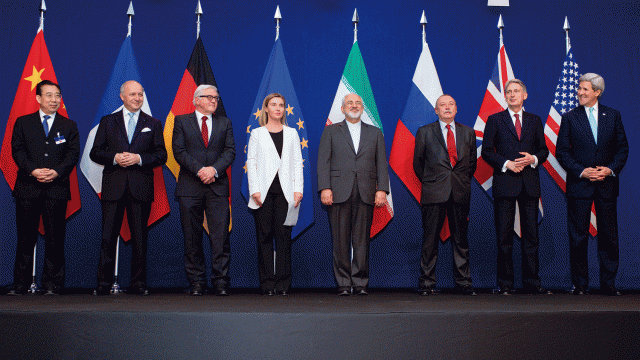
Ratified into US law in December, the Hezbollah International Financing Prevention Act (HIFPA) is a continuation of the United States’ war on terrorism, an American policy that dates back to the Bush Administration. It is also a consequence of the P5+1 nuclear agreement with Iran (the Iran deal) and the lifting of that country’s sanctions. Those opposing the Iran deal – Republicans and American allies in the Gulf and Israel – have focused their residual fury at Hezbollah. They fear that the lifting of sanctions against Iran will allow it to float more money and aid to Hezbollah and other proxies in the region.

A pawn in US domestic politics

The Americans allege Hezbollah is a key player in global narcotics trafficking and money laundering networks, using front companies to access local and international banking services to finance its military operations – charges vehemently denied in December’s “show me the evidence” speech by Hezbollah leader Hassan Nasrallah.

Cabinet officials in the Obama Administration and Congress – the Senate plus House of Representatives – both agree on the need to curtail Hezbollah’s access to Lebanese and international financial systems. But the message that the Administration has portrayed – in statements and through meetings with Lebanese government and banking officials of shielding Lebanon’s banking sector and economy does not exactly jive with that of the Congress.

There is not a discrepancy between the White House and Capitol Hill on the question of targeting Hezbollah, says Alain Aoun, a Member of Parliament representing Hezbollah’s ally, the Free Patriotic Movement. He told Executive following February meetings with representatives from both that it’s not yet clear how aggressive the implementation rules will be for the HIFPA. “It’s a question of implementation so as not to provoke any collateral damage – this was the message we [emphasized],” Aoun said.

Shielding Lebanon’s financial institutions, banking sector and economy has been the key point reiterated by Lebanese government and banking officials in trips to Washington. Amal Movement MP Yassine Jaber, another Hezbollah ally, told Executive in early March that the Americans were puzzled by all the meetings Lebanese officials were taking in DC. “Their reaction was to ask why [is Lebanon] panicking? We told them, well, the perception in Lebanon is that it’s going to be crazy,” Jaber said. Lebanese concern regarding HIFPA implementation is that the law will disrupt the country’s banking sector, blowing up the Lebanese economy in the process, with individuals and businesses that come into contact with Hezbollah, even if not facilitating financial transactions or involved in alleged illicit activities, as collateral casualties.

The Obama Administration has been quick to point out that it is only Hezbollah that the Americans are interested in. Following meetings with US officials, Jaber told Executive that “[The Americans] have no intention of neither hurting the Lebanese economy nor the Lebanese banking sector, nor of targeting any community or religious group. This is about [specific] individuals, entities and companies.” Following his mid-March visit to Washington, Minister of Finance Ali Hassan Khalil stated that Assistant Secretary for Terrorism Financing at the Treasury Department, Daniel Glaser, clearly confirmed “that the regulations will not target the Shiite community or any groups in general.”

The Obama Administration does not want to push Lebanon further toward chaos says Ibrahim Warde, an expert on terrorism financing at Tufts University. According to his reading of the situation, at least some departments in the Administration do not want to instigate a breakdown of Lebanon’s banking sector. “Certainly someone like John Kerry and the State Department institutionally, don’t want to see the collapse of the Lebanese banking sector because they are well aware of the fact that it is one of the few things left standing in Lebanon,” Warde told Executive.

Preserving the integrity of the banking sector is a point underlined by Obama’s nominee for ambassador to Lebanon, Elizabeth Richard. Richard testified to Congress in her nomination hearing in mid-March that shielding Lebanon’s banking sector and economy from Hezbollah infiltration is a top priority for the Administration. “Our goal,” she said, “is to dismantle Hizbollah’s international financial network while supporting Lebanese institutions and the Lebanese people. The success of the Lebanese banking sector, a backbone of the country’s economy, relies on upholding an already excellent reputation. Both Lebanon and the United States have an interest in ensuring Hizbollah cannot penetrate the Lebanese financial sector.”

But Congress is taking a much more hardline approach in the lead up to writing the law’s implementation rules. The case being made to Congress by partisan academic experts is that, since the signing of the Iran deal, Hezbollah’s financial latitude to purchase weapons and military technology has expanded. That is, according to testimony in front of the House of Representatives’ Foreign Affairs Middle East and North Africa subcommittee in late March by Matthew Levitt of the Washington Institute for Near East Policy, because the lifting of Iranian sanctions has “Increased Iranian spending… likely to benefit Hezbollah’s regional and international operations.”

Critics of the Iran deal have labored over the question of whether the removal of sanctions would provide more money for terrorist funding – Exhibit A being Hezbollah, Warde told Executive. From his perspective, “The way in which the Obama Administration has tried to deflect that kind of criticism was to go along with [HIFPA] in December… the [Iran deal] had been under very strong attack by the Republicans, Gulf countries and Israel.”

The advice presented to Congress during that subcommittee hearing was to go hard at Hezbollah, whatever the cost. Tony Badran of the Foundation for Defense of Democracies recommended that “Congress should push the Administration on the implementation of H.R. 2297 [HIFPA], targeting Hezbollah’s criminal and financial activities. It’s important not to be dissuaded by the argument that pushing too hard would break Lebanon’s economy.”

The subcommittee is chaired by Florida Congresswoman Ileana Ros-Lehtinen – a known hawk on Syria and self-declared supporter ‘of the state of Israel.’ She stated during the hearing that it was a near certainty the Iran deal will strengthen its regional proxies. “Hezbollah receives financial and material support from Iran and now with the regime receiving this financial windfall of over $100 billion it is not only reasonable to expect that Iran will increase its support of its proxy, but it is as near of a guarantee as one can have,” Ros-Lehtinen said.

P5+1 leaders negotiated with Iran to halt its nuclear missile program in exchange for lifting sanctions | CC 4.0

P5+1 leaders negotiated with Iran to halt its nuclear missile program in exchange for lifting sanctions | CC 4.0

Republicans, Gulf countries and Israel

Republican leaders, like Ros-Lehtinen, are pushing to target Hezbollah because the measures will serve as a counterweight to the Iran deal. Republicans as well, especially on the far right, have for a long time questioned Obama’s commitment to Israel. To many voters in the Republican primaries, Obama is considered a Muslim, and his fumbling of the America-Israel alliance, in their view, is part of an Islamic conspiracy to push Israel into the sea. The president has at times publicly feuded with his Israeli counterpart, Benjamin Netanyahu, but Obama has not veered far from US policy norms concerning issues like the Israel-Palestine peace process. Ros-Lehtinen subscribes to this critique of Obama and the narrative has played well among 2016’s Republican presidential candidates.

That HIFPA is politically driven legislation is underscored in small part by the 2016 presidential election cycle in the US. Then Republican presidential candidate Marco Rubio, a key sponsor of the bill in the Senate and one-time protégé of Ros-Lehtinen, had leveraged other important issues, such as immigration, as a way to spring up the political rungs of his career ladder. Rubio’s tendency, as a recent article pointed out in Rolling Stone, an American magazine covering music, pop culture and politics, has been to pursue issues and political alliances that best benefit his quest for power until they don’t.

America’s Arab allies fear that an Iran flush with cash will pursue regional goals more aggressively, leading one Saudi Arabian diplomat to describe the deal as “extremely dangerous,” The Washington Post reported in July 2015. Several sources tell Executive that Saudi Arabia’s decision to pull its $3 billion aid package to Lebanon’s army, the designations of Hezbollah as a terrorist group by the Gulf Cooperation Council and Arab League, as well as recent measures taken by several GCC countries to deport Lebanese nationals because of alleged ties to Hezbollah are designed to show anger over, or to blunt the impact of, sanction lifting.

Criticism by Arab governments that view Iran as competition agree that the Iran deal will enable it to give more aid to its proxies, particularly Hezbollah. More money for Hezbollah, they say, will allow it to increase military capabilities on multiple fronts in the region, strengthen Hezbollah’s alleged terrorism, narcotics and money laundering networks across the globe, and restore and expand social services to its constituency in Lebanon, allowing it to further entrench itself in domestic politics. The position Israel has taken on the Iran deal has been clear for some time: Iran represents an existential threat to the Jewish state with Hezbollah in the position to execute this threat both directly and covertly.

Partisan policy advice

The arena of power battles includes the use, by all combatants, of not only politics but also partisan think tanks. Gulf countries have bought political influence by funding think tanks in Washington. A 2014 investigation by The New York Times found that “More than a dozen prominent Washington research groups have received tens of millions of dollars from foreign governments in recent years while pushing United States government officials to adopt policies that often reflect the donors’ priorities.” The investigation linked Arab funding to several well known think tanks including the Brookings Institution, the Center for Strategic and International Studies and the Atlantic Council.

Israeli interests influence think tanks in DC too, Warde says, like the Washington Institute for Near East Policy (WINEP) and the Foundation for Defense of Democracies (FDD). “This constituency has always been quite powerful. It is especially clear whenever you have the experts testifying, it’s always the same names and affiliations – WINEP, FDD – these kinds of groups always send their ‘experts or pseudo-experts’ to just say all sorts of bad things about Hezbollah,” he tells Executive.

FDD is a think tank that describes itself as a non-partisan foreign policy and national security institute, but it does not publish its financials or donor lists. In 2011 ThinkProgress, a left-leaning policy advocacy organization, published FDD’s Form 990s, a tax document required of nonprofits by the United States Internal Revenue Service, accounting for nearly all of the organization’s funding from 2001 to 2004. ThinkProgress concluded that: “Most of the major donors are active philanthropists to ‘pro-Israel’ causes both in the US and internationally. With the disclosure of its donor rolls, it becomes increasingly apparent that FDD’s advocacy of US military intervention in the Middle East, its hawkish stance against Iran and its defense of right-wing Israeli policy is consistent with its donors’ interests in ‘pro-Israel’ advocacy.”

WINEP is the alleged policy think tank of the American Israel Public Affairs Committee (AIPAC), its critics say. In a 2010 blogpost for Foreign Policy, Stephen Walt, a professor of international affairs at the Harvard Kennedy School of Government, suggested that foreign policy officials in the White House at that time held convictions closer in line to Israeli policy than to America’s, prompting an indignant rebuttal by WINEP director Robert Satloff labeling Walt a McCarthyite, one who makes accusations of treason without evidence – an underhand way of calling Walt an anti-semite.

Israel has the added weight of supposedly non-partial academic policy organizations with that of pro-Israeli lobby groups. According to opensecrets.org, a website compiling records from the US Senate Office of Public Records, AIPAC was one of the pro-Israel organizations that paid for lobbying in 2014 and 2015 against loosely wording the text of HIFPA. Lebanon had one organization, the Association of Banks in Lebanon, that lobbied on its behalf both years. (The association declined to comment for this article). Organizations like AIPAC hold a lot of weight in Washington, and American leaders often speak in front of it to push their policy agenda or to gain support for political appointees.

In March, for example, Deputy Secretary of State Antony Blinken addressed AIPAC to garner congressional votes in favor of Obama’s nominee as the next undersecretary of the Treasury Department for Terrorism and Financial Intelligence, Adam Szubin. Blinken told AIPAC that Szubin is the right person for the job because in his sleep he dreams “about how to maintain and sustain the pressure we need on Iran” and that “every senator who has called for more sanctions should be pushing for, not delaying, his confirmation.”

Likewise, Democratic presidential candidate Hillary Clinton also addressed AIPAC in March. She told the pro-Israeli lobby group that the US “must work closely with Israel and other partners to cut off the flow of money and arms from Iran to Hezbollah.”

Underrepresented in Washington

When compared with Arab countries and Israel, Lebanon commands exceedingly insignificant influence in Washington. Diplomatic presence – the ambassador retired in December – was described to Executive as “pretty weak” and “not sufficient to do what is required.” MP Alain Aoun said that “the embassy is understaffed for such an important country like the United States. Where many decisions concerning the whole world are taken, we are so underrepresented that we are almost completely absent. One congressman is probably staffed better than our embassy.”

Compared to that of America’s Middle East allies – countries of the Gulf plus Israel – MP Yassine Jaber told Executive that, “We have really been sitting on our butts – if you compare two countries in the region, Lebanon and Jordan, we have more burden fighting terrorism, and vis-à-vis the refugees. But Jordan has a lot more attention, a lot more money, a lot more support because they’re [actively present in Washington],” adding that Lebanon has virtually “no bilateral engagement” with the United States.

The conundrum for Lebanon in all this is its perception in Washington as a problem country because of Hezbollah, an image it has little latitude to alter. Lebanon is underrepresented diplomatically and is outspent in its lobbying efforts. Ultimately, Lebanon has little ability to articulate its position, drowned out by America’s Arab allies plus Israel, on American policy in the Middle East, leaving its national concerns to go virtually unheard.

April 7, 2016 0 comments
0 FacebookTwitterPinterestEmail
Celebrating 200 issuesSpecial Report

A letter to Gracy

by Executive Editors March 29, 2016
written by Executive Editors

Dear Gracy,

Over the past few years, Executive has dedicated considerable editorial efforts to identifying entrepreneurs running young businesses that deserve attention. In particular, we have strived to highlight the exceptional but often under-appreciated work of Lebanese business women.

Finding and acknowledging these people has been one of the most rewarding tasks for us as journalists and editors. Every time we nominate a top 20 entrepreneurship listing or switch off the dictaphone after an inspiring interview, we feel confirmed in thinking that Lebanon has a future worth sticking around for. It’s a pleasure to venture across the country to find and honor inspiring people.

But all this time, a walk across the hall into the Executive business office would have provided us with an interviewee who is both an intrapreneur and a leader with a talent for helping others to be the best they can be.   

You worked full-time with Executive longer than any of us. Attracted by the content and quality that you saw in the “zero issue”, you joined the advertising sales team and very quickly became the head of our marketing department. Until a few weeks ago, you were the face of Executive for our advertisers. Year on year, despite the Lebanese market’s many limitations, you stayed true to your commitments and delivered the growth figures that you promised. Executive’s presence as the English-language magazine at the top of every media plan is your achievement, and you equally deserve credit for communicating our mission and values to all the corporate heads in the market.

In tandem with delivering economic results, you always remained cheerful and gave all your energy to maintaining the best relations with clients, whether they happened to have a budget for advertising or not. We don’t think we ever heard a single shout of anger from the business office in over 17 years. In training your team and leaving a legacy of being on top of the market, you proved yourself as a leader from whom everyone can learn.

You started exploring personal entrepreneurship six years ago, spending evenings planning an interior design venture with your sister. It was your dream and you called it Itsy Bitsy, or, in prosaic business language, “a one-stop shop that provides parents-to-be and young families with room concepts for babies and children of all ages.”

We will always be journalists, so we have to ask: Was it because you had personally chosen to merge motherhood and work life from before the births of your two children, or because of your first-hand experience of witnessing how so many colleagues were combining parenthood and careers as part of the Executive family? We know that we are the magazine with the highest share of delivering analytical insights in the national market, but we strongly suspect that we are also the team with the highest number of childbirths. In this one instance we want to forget about keeping all entrepreneurial stories at arm’s length and tell you from our perspective of being young parents: we certainly appreciate the idea of an interior design service for kids.

You said that you needed to take your business forward and that your family, which has been supporting you in your career, deserves much more attention. You also said that you hesitated to leave your Executive family but knew that the day would have to come. You used an opportune moment.

Like you, we feel that you still belong, totally, and we appreciate very much that you act as if the magazine is still a part of you. We will keep your guidance in mind and work much more on the online edition, including the commercial and marketing platform. Yasser has promised that he won’t just rush into something when he comes up with one of his many great new ideas.

You said that you have lost hope in the Lebanese government. We all have. The reason why Lebanon has a future is people like you.

A great thank you from your Executive family,

March 29, 2016 0 comments
0 FacebookTwitterPinterestEmail
Business

The real cost of regulations

by Thomas Schellen March 29, 2016
written by Thomas Schellen

In our relentless pursuit to unravel the equities markets’ mysteries of 2016, Executive sat down for a further conversation with Paul Donovan, the managing director, Global Economics at UBS Investment Bank.

E   What do you make of market behaviors in the first six weeks of 2016?

One always expects some volatility but market volatility in 2016 has been very unusual. There is no economic justification for what we are seeing. So why do we have these problems? I think it is partly because equity markets and economies are not the same thing. Equity markets are biased towards energy and manufacturing; economies are service centric. Equity markets are [populated by] large companies, while economies are small companies. Equity markets are export focused; most economies are not. If we go back 20 or 30 years, the S&P [Standard and Poor’s index] was roughly like the United States economy; today it is nothing like the US economy. I think this has surprised people and there is still a belief that equities and economies are one and the same.

E   But there surely had to be short-term factors involved in causing the amount of upheaval we have seen?

The severity of the oil price move has also been a surprise for the markets. The difficulty now is in looking at the rest of the year and asking to what extent will economies influence markets and to what extent do other factors influence markets. Things like positioning, regulations [and] political risk are of course all important factors and I think these will be the next challenges for us.

E  Can such developments still be discussed in terms of market dynamics or is everything simply human behavior?

I think there is a market issue here. [The recent period] has been the first really significant movement in markets since the crisis of 2008/9 and, perhaps more importantly, since the regulation that followed the crisis. The issue with regulation is of course that there is always some unintended consequence; this is now a world where banks provide less support to the markets than they used to do. This is because they are more regulated. I am not saying regulation is bad, but this is a consequence of where we are. So when I look at the markets, we are now perhaps seeing some of the true costs of regulation come through with this increase in market volatility. We should perhaps not be surprised. The question now is  if this is an acceptable price to pay for the benefits that regulations give us, or do we need to reconsider [this strategy].

E  Does the belated emergence of the cost of regulations explain all that we are seeing in markets?

In terms of behavioral economics, I think it is a mixture of behavioral issues, regulations and market pressures that have created this push to quite short-term investment [horizons].

One of the things in defense of markets is that economic data has become less reliable and subject to larger revisions. We saw an example just today with US retail sales in December being corrected from minus 0.2 [percent] to plus 0.3. This is not a small change, shifting from saying that consumers are not buying anything to saying they are actually buying quite a lot. Over the past six years, GDP data in the US has been revised up 74 percent of the time. Markets are dealing with less reliable data and that perhaps represents a confused picture. On the behavioral side as well, because we are in a low-return environment, I think a lot of people in markets are very nervous.

E  Do fears come out stronger in times of uncertainty?

The problem we have is that to understand what is truly happening in the economy, we need to take a very broad approach, but this requires a lot of effort, looking at lots of different data items and understanding them. What I find is that we economists are often asked to name five key economic indicators to watch for in the US or Germany. The [real] answer is you shouldn’t look at five because three of these indicators might need a revision next month and then you are looking at the wrong signal. Many people working in markets have grown up with a mindset of paying attention to certain favorite data releases. That can be a very hard habit to break. People fixate on an individual data release or several indicators rather than on the big picture and that perhaps creates the problems that we see now.

E  In your view, is it true that potentials for cascading risks, as described in the World Economic Forum’s latest Global Risks Report, are on the rise? There are potential economic impacts, even if the top perceived risks are not economic ones such as the failure to mitigate climate change or involuntary mass migrations, with the Fourth Industrial Revolution as an added factor – what do you think? As we face such complex risks and cannot accurately assess and deal with their interconnectedness, should we as humans perhaps just hand management over to robots?

The whole issue of the impact of the Fourth Industrial Revolution is going to be quite significant. We did a white paper on this for Davos in which we ranked a number of economies according to their likelihood to succeed in light of the coming changes. What this test revealed is that while many developed economies are doing very well, countries like China, Brazil and India are positioned very poorly.

[pullquote]Many people working in markets have grown up with a mindset of paying attention to certain favorite data releases. That can be a very hard habit to break.[/pullquote]

E  What are the critical factors deciding the propensity for success or failure?

The criteria for success, and this applies to countries as well as companies, are having a relatively highly skilled labor force and a flexible labor force. You have no benefit from engineers who have memorized text books – you need to train people on how to change and how to be able to adapt. Other important factors are innovation and the rule of law. In a world where I export a computer code, not a finished product, I need to be confident that you can’t steal my code and that if you do, I can sue you and get my money back.

E  Would you see any Middle Eastern economies on the “likely to succeed in the Fourth Industrial Revolution” list?

In looking at issues surrounding the Fourth Industrial Revolution we have to be honest: many Middle Eastern economies are not well positioned. [A country like] the Lebanon is perhaps better positioned to be able to adapt. The Lebanese had to adapt a great deal in the past 30 years. But when we look at some of the Gulf states, we see countries where the middle class is not getting a very flexible education enabling them to adapt. These are countries which, for the past 40 years, have remained single-commodity countries, focused on oil and petrochemicals. Despite the opportunity to change, many of these countries have remained structured around a single product.

E  Looking to developed markets, are doomsday scenarios impacting your thinking, such as predictions that United Kingdom GDP would suffer severely with a Brexit?

We have obvious tail risks in the economy. The political risk is quite prominent, I would say. We have risks in this region and from this we have the refugee crisis which has changed policies in Europe. Now we have fears that if [German] Chancellor [Angela] Merkel were to leave, this would increase uncertainties in markets, given her leadership role in Europe. There are a variety of risks and you have to assign probabilities to them. A UK exit from the European Uunion is a moderate risk in terms of both likelihood and severity; our base case is that the UK remains in. If the UK exits, then the question is what sort of exit? If the UK were to exit against our expectations, it would be what we call a soft exit; it would be negotiated so that there would not be a great deal of disruption. However, there would be consequences which would be moderately negative for the UK and negative for Europe. Without being too British about it, I think if the UK leaves it will lessen Europe.

E  Have you noticed any new questions, shifts in attitudes, any rise in fears in behavior of your Lebanese clients?

There have been some interesting issues, such as the discussion of the oil economies. In that context there has been discussion of repatriation flows from Lebanese working overseas as they are impacted by the lower oil price. But in talking with the entrepreneurs in the region, it is very interesting that many of them are saying: “While markets have been messy, we are not seeing our businesses being affected.” Demand for our products remains relatively firm from Europe and indeed from the Gulf. The Gulf has yet to cut back spending significantly, at least not on the sort of products that Lebanon has been selling in the Gulf. It is worthwhile to keep monitoring the situation very closely, but so far it seems that Lebanese entrepreneurs have been cautiously upbeat about how their companies are performing regardless of how the equity markets are performing.

March 29, 2016 0 comments
0 FacebookTwitterPinterestEmail
  • 1
  • …
  • 126
  • 127
  • 128
  • 129
  • 130
  • …
  • 686

Latest Cover

About us

Since its first edition emerged on the newsstands in 1999, Executive Magazine has been dedicated to providing its readers with the most up-to-date local and regional business news. Executive is a monthly business magazine that offers readers in-depth analyses on the Lebanese world of commerce, covering all the major sectors – from banking, finance, and insurance to technology, tourism, hospitality, media, and retail.

  • Donate
  • Our Purpose
  • Contact Us

Sign up for our newsletter

[contact-form-7 id=”27812″ title=”FooterSubscription”]

  • Facebook
  • Twitter
  • Instagram
  • Linkedin
  • Youtube
Executive Magazine
  • ISSUES
    • Current Issue
    • Past issues
  • BUSINESS
  • ECONOMICS & POLICY
  • OPINION
  • SPECIAL REPORTS
  • EXECUTIVE TALKS
  • MOVEMENTS
    • Change the image
    • Cannes lions
    • Transparency & accountability
    • ECONOMIC ROADMAP
    • Say No to Corruption
    • The Lebanon media development initiative
    • LPSN Policy Asks
    • Advocating the preservation of deposits
  • JOIN US
    • Join our movement
    • Attend our events
    • Receive updates
    • Connect with us
  • DONATE