• Donate
  • Our Purpose
  • Contact Us
Executive Magazine
  • ISSUES
    • Current Issue
    • Past issues
  • BUSINESS
  • ECONOMICS & POLICY
  • OPINION
  • SPECIAL REPORTS
  • EXECUTIVE TALKS
  • MOVEMENTS
    • Change the image
    • Cannes lions
    • Transparency & accountability
    • ECONOMIC ROADMAP
    • Say No to Corruption
    • The Lebanon media development initiative
    • LPSN Policy Asks
    • Advocating the preservation of deposits
  • JOIN US
    • Join our movement
    • Attend our events
    • Receive updates
    • Connect with us
  • DONATE
Economics & Policy

Not just a pipe dream

by Jeremy Arbid January 22, 2015
written by Jeremy Arbid

Even though Lebanon’s first offshore licensing round is on hold indefinitely, each passing month highlights the necessity for transparency and accountability in managing the country’s potential oil and gas resources. When Executive asked questions about the Lebanese firms prequalified to bid for petroleum contracts in its October 2014 issue, it found evidence that Apex Gas Limited exploited loopholes to conceal its corporate identity and that Petroleb blatantly expected government connections would result in it winning a bid.

[pullquote]Executive found that civil society, with some exceptions, is failing to hold the country’s oil and gas decisionmakers to account[/pullquote]

In conducting this investigation, Executive encountered tremendous resistance from both the government entities organizing the sector and the companies in question. Likewise, Executive found that civil society, with some exceptions, is failing to hold the country’s oil and gas decisionmakers to account, with many NGOs largely uninformed and unaware of the information relevant to transparency and, ultimately, still relatively clueless as to their role in the governance of this sector. 

On one end, the problem was, and still is, a lack of communication of information by the government to the public, breeding mistrust and discouraging confidence in the government’s ability to transparently manage this sector — all at a time when political squabbling is further complicating matters. And on the other end, another roadblock is civil society’s incompetence and general lack of interest in the subject. If civil society can overcome these obstacles, however, it may be able integrate itself into the governance of this sector — and the international Extractive Industries Transparency Initiative (EITI) is one useful tool to this end.

EITI allusions

In October, what should have been a commercial conference on Lebanon’s potential oil and gas resources was instead downgraded to a day focused on civil society’s role in governance of the nascent sector. It was, according to a post-event recap on the Lebanese Petroleum Administration’s (LPA) website, a display of “support, faith, commitment and constructive inputs provided by our decision makers, local partners, civil society and academic institutions, as well as our media.”

Though the Lebanese government has not formally announced its intention to implement EITI standards, it has alluded to this intent on several occasions. Most recently, Lebanon’s minister of energy, Arthur Nazarian, welcomed the conference audience by stating that Lebanon will “explore what implementing the EITI will mean” for the country in embarking “on such a cooperation without having discovered any oil or gas yet.”

[pullquote]The LPA had also commissioned a study on the feasibility of implementing EITI standards[/pullquote]

The LPA had also commissioned a study on the feasibility of implementing EITI standards, carried out by the Beirut office of international NGO Natural Resource Governance Institute (NRGI), but has not released comments on the findings of the study. With intent signaled by both the LPA and the Ministry of Energy, the Council of Ministers could also formalize its intentions — announcing intent is the necessary first step towards EITI implementation. 

These positive indications of implementation, and through the spirit of invitation subtlely extended during the conference, thrust civil society into a role of articulating the merits of the EITI, its applicability to the Lebanese context, and its benefits to the interest of the country at large — inclusive to government and company stakeholders.

Trust through cooperation

What the EITI provides — which has been articulated recently in contributions by Lebanese civil society leaders (here, here and here) to Executive on the subject — is not a parallel reporting mechanism but rather an outlet for disseminating information already collected, ideally, by a government. In many countries, explains Pablo Valverde, country manager for the Middle East and North Africa at the EITI Secretariat, this information doesn’t exist, so the EITI can also serve as an assessment tool for governments to see what kind of information they should be making available as well as helping make the information they already collect accessible. “As with everything else in the EITI Standard, the ideal is that you wouldn’t need a parallel reporting system like the EITI because all of this would already be available through the government,” adds Valverde.


Read also: Beyond EITI — Lebanon needs better institutions, not just greater transparency


If a government is already collecting EITI-relevant information it is therefore, by definition, not a radical concept. Likewise, those who fear the government might begin the implementation of the EITI only to stall assume that civil society or companies are not active partners in the process — though the tripartite cooperation is an absolute requirement of EITI candidacy and implementation. These notions are exactly the opposite of the governance environment the EITI fosters — transparency by building trust through cooperation.

[pullquote]The act of providing access to information is a key step towards improving transparency[/pullquote]

The act of providing access to information is a key step towards improving transparency in the governance system, says Valverde, adding that “sunlight is the best disinfectant; having the information available is the best way to limit corruption. The government can say ‘Look, this is not the way it is in this case,’ but how do you prove it? Well this is a way of proving it.”

Trust in the government is essential to the management of this industry. “It’s important because of our past experience in Lebanon and the very intimate relationship between the political and the economic elite — many times they are one and the same — whereby government contracts are actually awarded to those who are in power or close to power,” says Sami Atallah, executive director of the Lebanese Center for Policy Studies.

Much of what currently qualifies as EITI requirements includes information on the overview of payments made by companies to the government and overview of payments received by government from companies, allocation of exploration and production rights, well production data, and the social impact of the industry — to broadly name a few. Yet EITI standards form a live organism, constantly adapting to developments around the world — one such development is that of beneficial ownership.

On the horizon

The disclosure of beneficial ownership is a relatively new concept and the value of its application is not yet fully appreciated — pilot projects in EITI implementing countries are navigating the unknown path with project evaluations commencing in 2015, and plans to make beneficial ownership a reporting requirement shortly thereafter. “There’s a really good argument here in that, ‘This is coming, this will most likely be a part of the EITI Standard in the future’ — so countries that start doing it now will have a head start,” says Valverde.

Simply put, beneficial ownership refers to those controlling benefactors of a company — the individuals behind the scenes. There can be many entities with stakes in a company, so a precise definition of beneficial ownership is the prerogative of the national multistakeholder group (MSG) — a collection of representatives from local government, companies and civil society overseeing the EITI implementation process. “What the MSG would need to figure out is how far it would be logical for them to go. Is it necessary to identify each and every owner? Maybe only those that own more than a certain percentage are of any consequence?” explains Valverde.

“The international companies usually have this information in the open,” says Diana Kaissy, MENA coordinator for Publish What You Pay, and EITI standards acknowledge this. Norway’s Statoil sets an example for disclosing beneficial ownership. The company keeps track of beneficial ownership to a threshold of 5 percent, reporting on its website that only the Norwegian state surpasses this threshold — owning roughly 70 percent of the company.


Read Diana Kaissy’s article “Extracting transparency — Lebanon’s oil industry must not be shrouded in secrecy” published in this year’s January issue


“For the government of a resource rich host country it can be important to know to whom exclusive exploration and production rights to national resources are awarded. It can be considered a matter of resource management,” explains Tonje P. Gormley, a lawyer at Norwegian law firm Arntzen de Besche who specializes in international petroleum law and is a frequent speaker at Lebanese conferences. The LPA ensured just that when it required the details of partners or shareholders with an interest of more than 20 percent, as part of its prequalification application process in the country’s first offshore licensing round last year. The Lebanese government is already collecting beneficial ownership information.

[pullquote]“We want to know that company won the contract because it had a competitive bid, not because it had the connections”[/pullquote]

Close ties

In many cases throughout the global oil and gas industry those companies bidding for — and sometimes winning — petroleum contracts have close ties to the government through connections that influence the award. These companies can mask the identity of their ownership: “They’re hiding behind companies and law firms, behind shell companies or even entities that do not exist,” explains Laury Haytayan of NRGI.

It is the right of the individual, in Lebanon and elsewhere, to invest freely in the country — in its resources, its businesses and its people. But what raises concerns for civil society is when individuals leverage their connections to win contracts while hiding their complicity in doing so. As Atallah puts it, “We want to know that company won the contract because it had a competitive bid, not because it had the connections.”

“It’s especially important for state owned enterprises entering joint ventures that might not be 100 percent owned by the government … or companies that are local service providers. These are the companies — their names and owners — to be listed,” Kaissy explains. Valverde expressed a similar notion saying, “In some countries you can look at the smaller company in a joint venture and think ‘Okay, why is this company even here, what do they bring to the table?”

When Executive surveyed the companies bidding in Lebanon’s licensing round late last year, it uncovered evidence of both scenarios — the ownership identity of Apex was obscure, while Petroleb’s leadership outright proclaimed their competitive advantage to be government connections.

Preventing suspicions

Determining the application of beneficial ownership towards improving transparency is ongoing. Haytayan explains that “this is another way of building trust, rather than ownership remaining a mystery and frustrating citizens into believing that people from the government are stealing their resources.”

Yet, as a point of strength, beneficial ownership is a useful tool for all stakeholders. Where the primary goal in utilizing such a tool is in mitigating corruption, it also carries corollary value. “Some host countries prohibit certain persons — such as government officials of a certain seniority, parliamentarians or judges — to hold petroleum contracts. In such cases disclosure of beneficial ownership can ease monitoring of compliance,” Gormley explains, adding that, “Even without such prohibitions, disclosure of beneficial ownership may reveal that one or more owners of a company [are] very closely linked to the government — and this may give reason to question whether such [a] company is treated in a more preferential manner than other companies. At the same time, disclosure of beneficial ownership in combination with transparent awards of exploration and production rights may also prevent unjustified suspicions of corrupt behavior and thus contribute to building trust.”

Gormley points out that tax evasion can also be an issue. In fact, in 2013 OpenOil, an organization advocating transparency in the oil industry, evaluated the utility of disclosure of beneficial ownership using a Norway EITI country report from 2011, an ideal scenario. Data from the report broke down tax transactions to determine jurisdiction of parent companies, often the first step in uncovering the ultimate beneficial owner hidden layers below the apparent surface. The study also concluded that this information was useful for governments to determine “how much revenue fell outside double taxation treaties.”

The means to scrutinize

Accountability is only possible when actors make use of information made available through standards such as the EITI. Nongovernmental organizations will need support, including financial and technical assistance, if they are to champion transparency for this sector, not limited to the EITI requirements — but this highlights a need to further calibrate civil society’s interorganizational knowledge and capacity.

One such proposal to kick off this capacity building process could entail a roundtable or workshop for media in interpreting the information found in EITI reports. In fact, strengthening accountability and transparency will be core components of capacity building support which the Norwegian government will provide to Lebanon in 2015, targeting “the main transparency actors, such as decisionmakers, civil society organizations, the media, as well as public control institutions, including parliament,” the Norwegian Ambassador to Lebanon Svein Aass wrote in a recent contribution to Executive.

January 22, 2015 0 comments
0 FacebookTwitterPinterestEmail
Business

Positive shock

by Livia Murray January 21, 2015
written by Livia Murray

Likely due to some well publicized successes, the concept of startup acceleration has spread like wildfire over the past decade. This idea — nurturing nascent innovators for a small slice of the pie — has developed worldwide. Every cluster of startups that considers itself an ecosystem needs at least one accelerator to take itself seriously. The first Middle Eastern accelerator, Jordan’s Oasis500, saw the light of day in 2010. Lebanon’s first accelerator, Seeqnce, launched its first batch of startups in 2012 but then disbanded soon after the group graduated. Since Seeqnce was established, many calls have been made for a new accelerator as something badly needed for the entrepreneurial ecosystem. Finally, a well meaning and perhaps a little exasperated group of individuals from Bader, Berytech, Lebanon for Entrepreneurs and Middle East Venture Partners came together to create Lebanon’s second accelerator, Speed@BDD, which will launch its first round of acceleration in early 2015, according to Fadi Bizri, Speed’s CEO.

Adapting to local specificities

But the region’s relatively new accelerators couldn’t simply copy their peers elsewhere. Accelerators in the Middle East have some basic elements in common with accelerators in Europe and the United States: a business development program lasting several months, where the accelerator’s fund takes an equity stake for a cash and in-kind investment. However, accelerating in the Middle East is a different beast from operating anywhere else, and accelerators have to adapt even further to take local specificities into consideration.

Making a carbon copy of a foreign accelerator in the Middle East is perhaps among the worst ideas if one wants to be successful. “If we just tried to copy and paste [US based accelerator] Techstars’ model in Bahrain it wouldn’t have worked,” says Hasan Haider, CEO of Bahraini accelerator Tenmou. “We looked at [their] program, looked at curriculum [and] it just didn’t sit with [the] characteristics of the market. We did a lot of niche things to change the way it’s delivered. We also decided we’re not going to focus on tech, we’re not going to be a Silicon Valley, we’re going to invest in any good team,” adds Haider.

Those behind the accelerators confess that they had to adapt their programs to local specificities. Ramez Mohamed, CEO of Egyptian accelerator Flat6Labs, acknowledges that their programs have to provide more basic training, since they were seeing entrepreneurs in emerging or developing markets with little experience in business. “The format of the program kept developing cycle by cycle until we develop[ed] something fit for Egypt and the region,” he says.

MEASURING ACCELERATOR EFFECTIVENESS

In physics, when charged particles go through a cyclic accelerator, they are propelled through a circular vacuum tube by electromagnetic fields until they reach an intense energy level, at which point the beam of accelerated particles is then directed at a certain target. The radiation — fundamental particles and combinations thereof — emanating from the collision with the target are captured and recorded by sensors to draw conclusions on the nature of the universe.

In business, a startup accelerator propels startup founders through a rigorous cycle of coaching, exposes them to mentors and markets, and provides them with seed capital for a small slice of equity. The anticipated result is to accelerate the process of customer acquisition and have the business mature faster than it would outside of the acceleration process.

But measuring the success of the companies, and therefore the effectiveness of the accelerator, follows a slightly less scientific process than that of measuring radiation, despite the various metrics that have been identified to ballpark the success of the process. Some accelerator rankings have focused on the valuation of the companies that came out of different accelerators after a certain period of time, while other measurement factors taken into consideration include how much funding the companies have been able to raise post-acceleration, what percentage of the companies have been acquired and what percentage of the companies have gone out of business.

While some accelerators are highly successful, the overall performance of the industry is by no means uniformly stellar. According to a 2014 report by US academics Susan Cohen and Yael V. Hochberg, while on average each accelerator examined saw 4 percent of its own startups successfully exit via sale or initial public offering, this percentage varied between 0 and 13 percent, depending on the accelerator in question. Among different accelerators, the percentage of companies receiving financing of over $350,000 within a year after graduation ranged from 5 to 78 percent. The very wide discrepancy between the range of results is one indicator pointing to the fact that not every accelerator adds the same value, and some perhaps add close to none. It is important to remember that better known accelerators attract the best deal flow, often by virtue of having been around for the longest time — as well as having older graduates that had more time to build and sell their companies. But ultimately, the programs and resources offered by different accelerators also account for their different levels of effectiveness in advancing startups.

Those familiar with the lean startup model know that you have to keep changing, iterating and adapting your product until it fits the market. The work of those guiding an accelerator is not dissimilar to this. Over the course of several cycles, a successful accelerator adapts to the market and figures out the best way to help the startups it is supporting meet their business goals. This, perhaps more than longevity, can account for some accelerators’ successes. “Our accelerator has been developing to the needs of the market since we began in September 2010. So we’ve been very fluid [in order] to identify the most appropriate way of what works and doesn’t,” says Oasis500’s CEO, Yousef Hamidaddin.

The lineup

In this context, Executive took a look at three regional accelerators to examine the models and the value that they add to their incubated companies. While measuring the performance of accelerators is an imperfect science (see box), one ballpark metric is how well these companies are doing.

The accelerators identified were established before 2012, as it is difficult to assess the performance of companies established much later than this. We looked at Oasis500 in Jordan, Flat6Labs, which was established in May 2011, and Tenmou in Bahrain, launched in November 2010.

The first on the list and by far the most successful is Oasis500. Out of 75 startups that have graduated from it since the first quarter of 2011 when its first batch was launched, 55 are still active and nearly half have raised follow on funding with a combined total of $18 million as of Q3, according to the Oasis500 team. It is the only regional accelerator that has witnessed an exit for one of its startups. In 2013, their graduate, Run to Sport, was acquired by Jabbar Internet Group, an investment group made up of former employees of Maktoob, a Jordanian internet company acquired by Yahoo in 2009. The deal brought the Oasis500 shareholders a return of three times the original investment of $30,000 for 10 percent equity, according to Hamidaddin, meaning the company was acquired at a valuation of little under $1 million. Hamidaddin sees exits, rather than reaping dividends, as the only strategy by which the accelerator can become financially viable. Their strategy thus is to hold equity for five years and then divest in the next five.

The team states that now for a 10 percent equity slice, Oasis500 gives between $53,000 and $80,000 direct cash investment per startup, in addition to $12,000 worth of in-kind services, such as office space and internet connection. For making these investments, Oasis500 currently taps into a $6 million fund. They are also launching two more funds according to Hamidaddin, though they still have to deploy 20 percent of the first. According to Hamiddadin, the anchor investor is the King Abdullah II Fund, a non profit initiative by Jordan’s king.

 In terms of their acceleration model, Hamidaddin stresses that it is the accelerator team that adds the most value to the program. “It’s the group of people who spend hours with the startup [working] on how to develop value. We work a lot on bringing things back to the fundamentals. And the fundamentals are importance of delivering a business.” Everything else is “dressing on the salad,” he says. Even mentorship takes second stage next to the core team. “Mentors, if they are given too much high ground, distract the business,” explains Hamidaddin, cautioning against too heavy a focus on mentorship. “Mentors, because we position them as a thought leader and a reference, sometimes, or in other cases many times, cause the business to lose focus. And they do become a crutch and a handicap for some startups.”

Hamidaddin also frowns on practices that focus too much on pitch events, and claims that he only lets some of their entrepreneurs do them. “There is a buzz around startups. You push them into competitions, you push them into PR [public relations] driven activities,” says Hamidaddin.

But not all PR activities are bad PR activities, especially when it comes to attracting deal flow to the accelerator. To spread their name, Oasis500 organizes ‘bootcamps’ across the Middle East — training programs lasting several days with the chance of being accepted into the accelerator — to attract companies to their program in a region that lacks deal flow. According to Hamidaddin, they have received applications from companies from as far away as Russia, Kenya, Brazil and the US.

Flat6Labs, the Cairo based accelerator, has had comparable success having graduated 57 startups, 70 percent of which are still active, according to CEO Ramez Mohamed. Over 50 percent raised follow on funding totalling $2 million as of Q3, according to Mohamed. The accelerator takes a 10–15 percent equity slice for $15,000–$20,000 in cash investment and $15,000–$20,000 of in-kind services.

Mohamed explains that Flat6Labs has a heavy focus on mentorship. “It’s more like Techstars than Y Combinator [another US based accelerator] because we are more mentorship driven. Techstars has a huge network of mentors and support,” he says. “I think it stands for every accelerator in the world; [it’s] not just about pipeline, [but] all about [the] quality you provide, the quality of the mentors, what mentors you are engaging with,” says Mohamed.

[pullquote]In terms of a success formula, “There is no magic wand … Just put the structure for them in the environment, and it’s always up to them to drive”[/pullquote]

In terms of a success formula, “There is no magic wand,” says Mohamed. “Just put the structure for them in the environment, and it’s always up to them to drive. We buy them the car, show the road, but never drive for them. We always push the entrepreneurs in any country to have confidence to drive the team [and] talk to investors. This is one of the very basic steps that we tell them at the beginning of the cycle. It’s your business,” he explains.

Bahraini accelerator Tenmou has a different approach to supporting startups. CEO Haider says, “We try to give the startups enough money to make the cash flow break even. We try not to rely on raising money to survive.” This has proved successful thus far; of the 18 startups Tenmou has graduated, 10 are still active, according to Haider. They invest between $53,000–$80,000 for equity stakes of 20–30 percent. As of Q3, seven companies have raised follow on funding, for a total of $500,000 according to the CEO.

Haider describes Tenmou as a hybrid between an accelerator and an angel network. About $2.7 million has been invested to build the accelerator, while its shareholders consist of 14 private sector family groups and two semi-governmental entities. Tenmou’s program comprises a three month acceleration period in which the accelerator’s ‘strategic partners’ come in to provide advice on marketing, finance and PR, at the end of which they have a session with investors. Haider explains that they also organize one on one mentorship. “I think having a structured program to take the entrepreneurs from the idea stage is useful. There is a major difference in companies who have gone through accelerators.”

[pullquote]The secret to success is perhaps not just in the content of the program itself, but also in the resources at their disposal[/pullquote]

Deep pockets

But the secret to success is perhaps not just in the content of the program itself, but also in the resources at their disposal. Accelerator programs require an important upfront capital investment, since the companies do not start making returns for the shareholders in the first few years after they are created. The accelerators then need funding until they become sustainable from the returns of shares they take from their graduated companies, a situation in which no MENA accelerator is yet finding itself.

Even management fees derived from the seed investment fund would not necessarily cover any given accelerator. According to Hamidaddin, Oasis500’s functions run on a budget derived from a 3 percent management fee per year, providing them a total of $180,000 per year. While he would not specify the exact amount, Hamidaddin concedes that operating costs are more than $500,000 per year; however, considering they have a staff of around 22, these costs are likely to be much heftier.

With no immediate returns, acceleration is certainly a project for the long haul. No Middle Eastern market is alike, and accelerators will face varying degrees of success not only based on their programs and resources but also on their local business atmosphere. Accelerators in the Middle East are still quite young and it is impossible to compare them to the big players in the US and elsewhere, yet a glimpse at their performance is worthwhile to make sure they deliver tangible business goals to the companies they host, and not just glorified office space.

January 21, 2015 0 comments
0 FacebookTwitterPinterestEmail
Finance

It’s hard to enter when you can’t exit

by Livia Murray January 20, 2015
written by Livia Murray

EuroMena is a series of private equity funds managed by Capital Trust Group. The latest fund, EuroMena III, launched in June 2014 and aims to provide financing to fast growing industries in the MENA region. Executive sat down with managing director Romen Mathieu and executive director Gilles de Clerck.


Since we last spoke in June, EuroMena III has raised its first closing at $100 million. How close are you to your second closing?

RM: The objective is $200 million. $150–$200 million. At $150 million, we will be very happy. And we’re there, at $150 million. Consider it done. By February we’ll [formally] do the second closing at $150 million, then probably [we will need] another three, four [or] five months to reach the $200 million [mark]. Now if we’re lucky, we’ll reach $200 million by February or March.


Have you made any investments yet?

RM: No, not yet. We have made our first capital call, and I think the first investment or probably two investments should be made before the first quarter of 2015.


Your clients in the first two EuroMena funds include both institutional clients, such as the European Investment Bank, as well as family groups. Are their appetites changing?

RM: Look, the hardest thing you can do in our business is fundraising and exiting. In Europe it’s fundraising; exiting is easy because you have stock markets. We are in a region with no stock markets and it’s very difficult to exit. But fundraising is even more difficult. Because when you go to sell to someone and say: ‘Hi, I’m raising a private equity fund, give me your money — but you know, I don’t know when I will invest it, I don’t know when I will call it, I don’t know how much return I will get on a yearly basis, I don’t know when I will exit, and I don’t even know if I will give you the money back. And don’t ask me which companies I am going to invest in, I don’t even know that yet,’ the pitch is very difficult. The people that invest with us are the people who know us very well, who have seen us working and seen our track record. They are the ones who come and invest with us, or they’re very close to people who have already invested with us.


In terms of private equity, there are not a lot of funds based in Lebanon. Some banks have attempted it, but there are none now. Why is there so little private equity based in Lebanon?

RM: Because small is not beautiful in our business. So setting up a small fund of $10 [or] $20 million to make private equity in the region [is] not viable. The management fees won’t allow you to pay competent people to do due diligence. And for what you invest, you only get a small capital gain. You have to have a big fund. If a bank is involved in a fund, it doesn’t work. A banker is a banker, and an investor is an investor. All the funds where you had a bank involved just didn’t work out.

We’re in a region where exits aren’t easy. If you grow a company in Lebanon and you want to sell it — impossible. You don’t have stock markets here. You want to bring someone to buy a company in Lebanon today? I mean, who would come and buy a company in Lebanon today? So our secret recipe  when we invest in a company is to take it regionally, to diversify the risk.


Even in the Middle East, if you look at data from the Middle East Private Equity Association, the amount of new funds created per year and total amounts raised is decreasing. Why is this the case?

GC: The fact that there are few funds suggests you have more maturity in this industry. People now understand that it’s not a business for amateurs, and that it’s difficult. Only the good ones who were successful in the initial years were able to continue and to carve out new teams that have been able themselves to raise funds.

RM: In the whole region, as Gilles said, first time players are being wiped out. The people who have stayed are those who have really proved that they have a track record, a business model and a serious reputation, which is very important in our business.

GC: I think if you look at the percentage of private equity as a part of the GDP, in this part of the world we’re still behind Europe 20 or 30 times, and 50 times behind the US. So there is still room to develop.


Well that begs the question, where do you want to go with this? What’s after EuroMena III?

RM: One billion [dollars]. If you know to drive on the right side, you continue to drive on the right side. Why would you go over to the left side? This is our everyday job. It’s private equity. We’ll never do anything other than private equity.

January 20, 2015 0 comments
0 FacebookTwitterPinterestEmail
Business

Growth on tap

by Paul Cochrane January 19, 2015
written by Paul Cochrane

Executive met with Monisha Abraham, general manager at Brasserie Almaza, to discuss the business of beer in the country, market share, exports and plans for a new brewery.


You recently came to Beirut to manage Almaza, which is owned by Dutch group Heineken. How long have you been with the Heineken Company?

I started working at Almaza in July [2014], and before that I was in the Netherlands as the regional marketing manager for the MENA region. I’ve been with the company for nine years.


In early 2014, Almaza had 74 percent of the beer market, according to BLOM Bank data. Has your share of the market been impacted following the introduction of new brands, such as Beirut Beer and Colonel? 

It is not our policy to talk about market share, but our share was not affected by the competition that came in, in fact volumes have grown compared to 2013, and we seem to be on a winning track. 


Why have sales grown given the current local and regional situation?

The market is growing. There is excitement about beer, the new entrants and the category, and what has partly helped are our innovations, as well as more and more people reaching the legal drinking age.


Was this a reason for diversifying your offerings?

For us, innovation is key — not only in Alamza, but Heineken, to increase the global innovation rate to 6 percent by 2020, to create excitement and cater to consumer needs. Over the last three years we introduced Light, Radler and Al Rayess, and all are doing very well for us, and not cannibalizing the Almaza brand. 


Unlike many other food and beverage items, the price of a bottle of Almaza has not increased for years. How are you managing to stay so price competitive? 

We are looking at the economy and what consumers really need at this time. Al Rayess is retailing for LBP 1,000 ($0.66), and one of the reasons we introduced it was to provide consumers with a good Lebanese beer at an affordable price.


Can you give a breakdown of sales in your portfolio?

I can give an indication. The Almaza brand is about 85 percent of total volumes, and then Heineken brands about 15 percent.


Why did you decide to do special bottle packaging for Almaza at certain clubs and bars? 

It is done in other markets — and this was the first time in Lebanon — to show our partnership with an organization; it creates excitement and something that you can connect with as a consumer. It is small scale, but we [also] did it for the whole brand, as seen with the World Cup 2014 campaign. We had eight different national flags on the bottles. 


Was it a successful campaign? 

It was extremely successful, and touched on the true insight of the Lebanese, as yes, you support different countries but [you’re] still Lebanese first, just like Almaza is the number one Lebanese beer brand.


Have exports of Almaza been affected by the conflict in Syria? It was quite a good market before, I believe. 

We continue to export to Syria and it’s a well known brand, and we also sell to something like 25 to 30 markets around the world. 


Were summer sales down because of weaker tourism? Indeed, a statistic floating around is that around 70 percent of beer is consumed in the summer months.

There are two factors. Yes, tourism was affected but it did not affect [our] business too much, although we would have grown more if there had been more tourism. The seasonality of beer, indeed, is present, but you see that in many countries. What I find now, more and more, is that although the summer is related to beer, the excitement that the beer category has — and if it continues — will help reduce that seasonality to a degree.


Are you considering buying a micro brewery here? 

When [it] comes to Lebanon, no. We will focus on our portfolio, and Heineken has over 250 brands around the world, so we will dip into that pot.


Are you planning to expand your brewing facilities?

We are not going to expand this current facility, but [rather] are looking to build a new brewery in Lebanon. We started this process a few months ago, and it should come to fruition in the short to mid term. We are still looking for land.

January 19, 2015 0 comments
0 FacebookTwitterPinterestEmail
Business

Holding the middle ground

by Thomas Schellen January 19, 2015
written by Thomas Schellen

On the clouded horizon of Lebanese retail in 2015, the next quarter’s biggest bang in fashion retail may well be a new store in the, recently often maligned, Beirut Central District. Come this spring, Hamra Shopping and Trading Company (HST), best known for its retail brand Grand Stores (GS), will open a new retail space smack in the center of downtown Beirut, facing the Souks and 200 steps from the security cordon around Nejmeh Square.

With about 2,400 square meters (m2) in sales area, the new GS multibrand store will be the company’s largest. “This project consists of four floors, each comprising around 600 m2, and it will be our flagship store, taking us to the next era as a company and as retail[er] in Lebanon. We are designing and planning and working [so that] this store [can] really cement our presence in the retail market in the region,” says Jamil Rayess, current helmsman of family owned HST.

Costs for getting one of HST’s stores up and running in Lebanon, according to Rayess, range between $1,000 and $1,150 per square meter, giving the project an investment dimension in the neighborhood of $2.5 million. In the context of the HST portfolio of over 30 multi and monobrand stores between Tripoli and Saida, this new space will add about one fifth to their existing retail surface, which Rayess meticulously cites as 11,221 m2 at the end of 2014.

[pullquote]“We have never made any plan for our company based on a negative scenario for the country”[/pullquote]

Crisis of companies

Of course the new GS store in downtown, even as HST’s largest project ever, amounts to a nice, rather than overwhelming, splash in the urban storescape when compared with the tens of thousands of square meters in new fashion retail surfaces that have come to market between 2003 and 2014 in prime areas, namely in shopping malls and the Beirut Central District.

Notably however, this national expansion in gross leasable area for prime retail has not been as smooth as depicted in shopping malls’ promotional brochures or the musings of experts like Simon Thomson, founder of the London based consultancy Retail International, who 10 years ago predicted the “regeneration of Beirut as a significant international retail destination city capable of competing with the likes of Dubai.”

Especially in downtown, where fashion mongers made it their ambition to make local and visiting shoppers wear down their heels in extensive strolls around Foch-Allenby and Minet El Hosn, this expectation has faltered time and again and retailers have of late either moaned over bad business or altogether refused to discuss sales results when queried by Executive.

Asked if he wasn’t concerned about the weak economy in general and turned off by the purported anemia in the downtown retail environment, Rayess has two answers. On the economy, he says, “We have never made any plan for our company based on a negative scenario for the country, because to do so would be self defeating and mean that we would be standing still.” HST instead approaches the future by “planning on [a] day-to-day basis, hoping that things will [get] better,” he enthuses.

As for downtown’s troubles, he comments that the negative perspective “is not all true. I may not have the same presence in this area as some of my competitors in terms of size,” he continues, “but I have two retail shops in the central district. I have been in this area for 11 years now and can say that it is not all bad. There are a lot of retailers that are not satisfied but there are several retailers that are satisfied and are growing their presence in this area.”

[pullquote]HST has developed its middle of the road approach into an art form tuned to the Lebanese taste[/pullquote]

Strategic positioning

Another facet of the company’s confidence in the Lebanese market is a strategy mix that is built upon HST’s identity of being a Lebanese retailer whose source of success is the importing of well established but not extravagant foreign labels. According to Rayess, HST was established under this formula by his father 40 years ago and has developed its middle of the road approach into an art form, tuned to the Lebanese taste. It can compete with local outlets of international monobrand chains, whether they are recent arrivals to the Lebanese market, such as H&M and Marks & Spencer, or have been present for years, such as Mango and Zara.

The strategy mix involves marketing, purchasing, pricing and positioning. The fairly aggressive marketing activity entails diversified outreach activities ranging from common tools, such as discounts and seasonal campaigns, to instruments that are sparsely used in Lebanon, such as an in store magazine and a mobile app. 

Purchasing and exclusive franchise representations are the next building blocks in the business formula. This includes franchise partnerships with four brands — Timberland, Springfield, Geox and Bossini — which HST offers in monobrand stores and a much larger portfolio of about 100 brands which the company’s team of buyers obtains from foreign suppliers. Sold in GS stores, this portfolio consists of 90 percent exclusive representations, Rayess says, and 13 to 14 professional buyers in the HST team are constantly on the road to source collections from trade fairs and suppliers “all around the world.”

Although the HST product portfolio includes two house brands where items are produced by contractors in China, Turkey and Lebanon, these brands are used to fill supply gaps and their contribution to the bottom line has been shrinking to the point that they recently accounted for less than 2 percent of turnover. “We are dealing with our house brand not to maximize margins but for a different philosophy: we sometimes fall short of a specific product, an item that was en vogue but which we were unable to acquire from one of our suppliers. In such cases, we take this product and tell our contract manufacturers to produce it for us,” Rayess says.

Pricing is mainstream and conservative but orientated to match the pricing in the home markets of the manufacturers whose brands are in the portfolio. This translates into a policy of combining price comparability with limiting discounts.

[pullquote]Our company and its affiliates have been growing every single year since 1974[/pullquote]

Dedicated bargain hunters can find products such as a pair of Geox shoes at this or that Beirut retailer, but when it comes to comparing prices displayed at an HST store with those shown internationally for the same product, customers who go to the — today very small — trouble of checking those prices online will rarely encounter a significant differential in favor of buying outside. This is because Rayess tends to price a Timberland product according to the US market and a Springfield product according to the Spanish market, etc.

He says, “Let me not enter price debates with my customers, who can confront me right there in the store with what my product costs in another market. So let me price it right according to the price in the country of origin of this product. Most of the times, the country of origin is where the product is sold at its cheapest when compared with the remainder of the markets.”

This correlates with a longstanding practice to stay away from the Lebanese market’s flashiest sales methods. “In the history of HST or GS or any of my brands, we never did 70 percent discounts. I price my products so that the lowest I can go in terms of discounted prices is 50 percent,” Rayess explains. With markdowns from the regular retail price being limited in this way, the company seeks to engender customer loyalty and avoid a behavior where customers delay purchases in order to wait for the bigger discounts.

On the accounting side, the company has a policy of aiming for stable earnings before interest, taxes, depreciation and amortization (EBITDA) margins. “We are trying to work with an EBITDA of 10 percent, sometimes successfully so, sometimes less. Less successful means [achieving] EBITDA [that is] lower by half a [percentage] point,” Rayess says.

Refusing to disclose data on the turnover and bottom line of the HST retail business in Lebanon and other countries, he only volunteers the information that “our company and its affiliates have been growing every single year since 1974, with year on year growth in terms of turnover and gross profits.”

Manifest less Syria

The company has set its same-store turnover growth targets for 2015 at 6 percent, and expects new points of sale will add to overall growth in gross revenues. These new points of sale include not only the upcoming flagship facility in downtown Beirut but also new stores in Iraq, of which one is scheduled to open in June in Suleimaniya, and Jordan, where a 500 m2 store in Amman’s Abdali district is planned to launch at the end of the year.

Iraq, with five stores, and Jordan, with three stores at end of 2014, are the two regional markets where the expansion of HST has been successful. But the company is still recovering from its exposure to Syria where it began an enthusiastic rollout of stores in 2008. Opening six stores in three cities between 2008 and 2010, the decision to close all outlets and put activities on hold had to be made in 2011, the Syrian conflict thus having a “big” impact on HST, Rayess admits.

Rayess, who stepped up to the position of general manager at HST in 2010, nonetheless emphasizes that he still attributes great potential to the Syrian market. He is not deterred by the challenges of operating in a difficult and extremely complex environment and still has dreams, such as developing a fully fledged fashion brand.

[pullquote]This leaves HST looking like a firm where conservative and ambitious elements are in a balance[/pullquote]

This venture, to be created by HST with full brand philosophy, packaging and everything else, has been on the drawing board “for a good while,” according to Rayess. It has moved between pipeline and drawing board without having been scheduled for implementation due to the financial requirements of investing several million dollars and because of the even greater challenge of building a team that can develop and run such a brand.

Once the family run company establishes itself regionally, it may consider a public listing, says Rayess, noting that “We are a family business of the 21st century, so we are not looking specifically for any of our children to take over or hold the reins.”

All things considered, this leaves HST looking like a firm that is not out to reinvent fashion or overthrow the global order of retail, but a company where conservative and ambitious elements are in a balance. Their corporate passion is conveyed by Rayess as not being focused on the amount of cash that can be generated from a customer. “I never look at people this way. I always look at what they are wearing and I always feel a sense of pride if an item they are wearing was purchased from one of my stores. I don’t care whether it is a small bracelet or the most expensive suit I carry. I look at them with satisfaction because I was able to have them enter my stores and purchase a product.”

January 19, 2015 0 comments
0 FacebookTwitterPinterestEmail
Leaders

Politics and public health

by Executive Editors January 16, 2015
written by Executive Editors

Health Minister Wael Abou Faour caused quite a stir by telling the Lebanese they are eating “shit” — his word, not ours. What he failed to do, however, is give any details about the methodology and precise results of tests on food his ministry recently conducted. In short, Abou Faour spread fear, not information. He also failed to point out that testing food and water once in a blue moon does nothing to ensure that they are consistently meeting health and safety standards. Lebanon has several laws and decrees setting standards for food, water and the preparation of these two necessities; the problem — as always — is enforcing these standards and punishing those who violate them. This is especially true for unlicensed and unregulated small scale water distributors — the ‘off brands’ selling 10 liter bottles in corner shops and supermarkets as well as the neighborhood distributors who fill 18.9 liter jugs for $1 (see “A dangerous source“).

According to the most recent statistics — which of course are laughably outdated — these distributors were the most common source of drinking water for the largest number of Lebanese. While Abou Faour in late November vowed to crack down on these distributors, in reality he did nothing. Admittedly, we do not know if these gray market entrepreneurs are selling unsafe water, but there should be a system in place to monitor and organize them.

Law 210 of 2012 does this. It outlines the exact quality standards this drinking water should meet and details the sanitation standards required for the facilities in which this water is treated, stored and distributed. But because the law does not specifically say who is responsible for monitoring and implementing these standards, it is not being enforced. We don’t know for sure where these distributors get their water; we don’t know whether they store and bottle it in sanitary conditions; and we don’t know how well it has been treated before being sold. What we do know is that such a system can easily lead to public health problems. Every citizen has the right to safe drinking water, and it is clear that the state cannot yet provide that. Until it can, the very least it can do is consistently monitor this gray market so that people can drink with confidence.

Extralegal water distribution is reflective of the wider problems with Lebanon’s food and beverage sectors. Whether it is rotten meat, expired potato chips, counterfeit booze or fruits and vegetables with alarming amounts of pesticides, we know we have a serious monitoring problem. The best way to deal with all of these tainted products is to regularly and rigorously enforce health and safety standards. Launching brief campaigns every few years for unclear purposes is not helpful.

Haphazard monitoring and enforcement will generate media attention and make a politician look good. It won’t ensure health and safety standards for food and beverages are consistently applied. That is, it won’t protect the public. Only regular and robust inspections can do that.

January 16, 2015 0 comments
0 FacebookTwitterPinterestEmail
Economics & Policy

A dangerous source

by Matt Nash January 16, 2015
written by Matt Nash

In the dead of a crisp November night, the elite unit of Lebanon’s Internal Security Forces prepared to pounce. Their target? An unlicensed neighborhood water distributor at the southern edge of Beirut’s Hamra district. Acting on a tip from public health minister Wael Abou Faour, the police stormed the distributor’s ad hoc basement factory, shutting off pipes, rounding up suspects and smashing open water cooler jugs as though they were barrels of booze in Prohibition era USA. Over the next few days, this scene was repeated hundreds of times in the capital’s various neighborhoods, as well as in villages and cities across the country. The battle for safe, regularly tested drinking water had begun.

[pullquote]A significant number of Lebanese regularly drink water that has been filtered though never tested for safety[/pullquote]

Don’t remember reading about this crackdown in the news? That’s because it didn’t happen. While Abou Faour did threaten to move against what he estimates are 800 unlicensed drinking water providers throughout the country, the reality is he didn’t. Nor does he know exactly how many of them there are. In truth, no one is sure how many there are, but there are indications that a significant number of Lebanese regularly drink water that has been filtered though never tested for safety.

Water, water, everywhere

There are 38 companies licensed by the Ministry of Public Health to distribute drinking water. These companies are listed on the ministry’s website and include well known national brands such as Tannourine, Sannine and Sohat. According to the Central Administration of Statistics (CAS), 10 percent of the Lebanese relied on bottled water as their main source of drinking water in 2009, the most recently available statistics on the subject. Ihsan Atwi, head of the sanitary engineering department at the Ministry of Public Health, tells Executive that the 1983 law governing bottled water stipulates that it cannot be treated or otherwise tampered with. It’s taken straight from the ground (whether from a well or a spring) and sold to consumers. He says bottled water is tested by the Ministry of Public Health’s central office to make sure it is safe to drink when the company applies for a license. After obtaining a license, the ministry’s “decentralized services” carry out tests according to their own schedule and only report back to headquarters in Beirut “if there is a problem.” His tone and demeanor while explaining this suggest he is not sure whether testing is regular or rigorous, but he notes that some Lebanese water is exported. “Because there aren’t any complaints about our [bottled] water outside, this is an indirect indicator that our water is safe,” he offers. 

[pullquote]Because there aren’t any complaints about our [bottled] water outside, this is an indirect indicator that our water is safe[/pullquote]

What we know nothing about, Atwi says, is the quality of water sold by small scale neighborhood or village distributors in larger quantities than bottled water for a fraction of the price. These are the ‘off brands’ you might see in the corner grocery story in 10 liter plastic bottles. Small scale distributors also allow customers to refill 18.9 liter water cooler jugs for $1, according to Atwi and Executive’s own experience with such a distributor. “These are the danger,” Atwi says, in reference to the distributors, whom Abou Faour says number 800. Atwi explains that the ministry tried to count them in 2012 but the survey was “not accurate” because of difficulties in reaching all parts of the country. “In general, there are hundreds,” he says. No doubt hyperbolically, he adds that a new small scale distributor opens “every day,” as the investment cost is low but the return can be high. Executive was unable to convince a distributor to talk financials, but Atwi notes that “evidence that [this business] is worth it [from a revenue standpoint] is that it is widely spread. If it wasn’t worth it, no one would work in this field.” Expenses such as a license and bottling lines are not necessary for small scale distributors, he says. 

Atwi and Lena Dergham — director general of the Lebanese Standards Institution (LIBNOR), which sets local standards for water quality, among other things — say these small scale distributors do filter or otherwise purify the water before distribution, for example with small amounts of chlorine. The problem is that no one monitors or tests this water, so diarrhea outbreaks in a concentrated area is one of the only ways to know if there is a problem with it.

These small scale distributors provided the main source of drinking water for a plurality of the Lebanese — 36 percent — in 2009, according to the CAS survey. As for where the water comes from, Atwi says, “The well of the building [they operate in], the public networks — they steal it, for example — or they buy it [from a large truck or well owner]. They filter it and they sell it.”

[pullquote]The law is still not being enforced because it does not stipulate which ministry is responsible for actually implementing it[/pullquote]

Waiting for Godot

The existence of these unlicensed and unregulated distributors is no secret. Executive was not able to ascertain exactly when they came into existence. However, in 2012 — following media reports on unsanitary conditions in some distribution facilities — Parliament passed law 210 to regulate the quality of the water — based on standards set by LIBNOR — the methods of filtration and the conditions of the distribution facility. The law is still not being enforced because it does not stipulate which ministry is responsible for actually implementing it. Dergham explains that the government needs to pass a new decree assigning enforcement authority to a specific ministry before the law will be enforced.

Even if that happens tomorrow, however, the World Health Organization argues that Lebanon — or LIBNOR, to be more specific — must also update its drinking water quality standards, which have not been revised since 1999. In a process that has taken “a lot of time,” the WHO has been pushing Lebanon to update its standards, according to Nohal Al-Homsi, a project officer working on environmental health, food safety and community health with the WHO. Homsi would not be more specific about how long the WHO has been arguing for an update, but Dergham, from LIBNOR, says the process has taken over a year. Dergham and Homsi say new drinking water standards are being discussed by a technical committee including members of Parliament, the WHO, LIBNOR, academics, members of relevant ministries and representatives of Lebanon’s four regional water authorities, which handle treatment and distribution of state supplied drinking water. Dergham notes that while LIBNOR writes the standard, it cannot be applied — or considered mandatory — without a decree from the government codifying it into law.

The WHO last revised its own drinking water quality standards in 2011, however the UN agency notes that its standards merely serve as guidelines and do not necessarily need to be adopted as a whole. “The nature and form of drinking water standards may vary among countries and regions,” according to the WHO’s 2011 report on its update. “There is no single approach that is universally applicable.”

[pullquote]There is no single approach that is universally applicable[/pullquote]

Neither Dergham nor Homsi would be specific about what updates Lebanon’s standards need — though both argued that the standards need to be revised. Homsi offered only that Lebanon’s standard is “outdated for chemicals.” However, the WHO’s 2011 standards update notes, particularly of chemicals, it “provide[s] guideline values for many more chemical contaminants than will actually affect any particular water supply, so judicious choices for monitoring and surveillance should be made prior to” setting national standards. Dergham notes, “the new update mentions stricter limits” but, as the WHO document says, Lebanon cannot adopt all of them blindly without first studying what is most relevant for the country. “There are some specific national issues that need to be addressed, it doesn’t mean we will allow something that will have [a negative] impact on human health.”

Homsi and Dergham refused to say that regulated and licensed drinking water in Lebanon is unsafe. Homsi also refused to explain why revising the standard has taken so long, though she does indicate there is opposition to an update that she would not elaborate on. Dergham says the regional water establishments don’t have the proper lab equipment to test for new possible water contaminants even if the standards were updated, yet another roadblock to a quick revision. Dergham notes that LIBNOR has no legal authority to test water, and highlights the need for a national policy on strict testing that is actually implemented. “We will push more in order to quicken the process, but this discussion has to happen because if we have a standard that is not implemented and is not able to be implemented, this will be a problem. We need to be sure the requirements are there based on scientific data and these requirements are able to be implemented.”

January 16, 2015 0 comments
0 FacebookTwitterPinterestEmail
Comment

How to do an IPO

by Chadia El Meouchi & Carine Farran January 15, 2015
written by Chadia El Meouchi & Carine Farran

An initial public offering, or IPO, is a company’s first offering of its equity to public investors; its main objective is for the company to raise capital. It is generally an intensive process that requires a number of regulatory authorizations and processes that may be quite burdensome, as well as the necessity of obtaining professional advice and support in many areas, including legal, technical, financial and marketing.

Lebanon has one securities market, the Beirut Stock Exchange (BSE), currently the only stock exchange in the country. There are relatively few Lebanese and foreign companies currently listed on the BSE compared to other stock exchanges in the region. This situation is due to a number of reasons, ranging from political instability, the economy and a lack of incentive for companies to seek new sources of financing through IPOs.

The Lebanese Capital Markets Authority (CMA) was formed by virtue of Law 161 of August 17, 2011. Its board of directors was appointed in July 2012, but the CMA officially became active in the beginning of 2014. The CMA alone is authorized to regulate the listing and trading of securities and financial instruments on the BSE and on any other stock exchange that may eventually operate in Lebanon.

The laws and regulations applicable to public offerings are still under development by the CMA. The general requirements, however, are unlikely to change.

The basic rundown

A subscription is considered public when a company issues, sells, offers to issue or offers to sell financial instruments, including shares, to the public in Lebanon and abroad, whether directly or indirectly, within a specific time limit. The time limit, the value of the financial instruments and the definition of public are to be determined in special regulations that have not yet been issued.

To offer its shares up to public subscription, a company must obtain the prior approval of the CMA through an application process. No invitation may be addressed to potential investors for a public subscription without the CMA’s approval. The CMA has four weeks from the date of the application’s submission to give its decision. If it does not reply back as to whether the authorization is granted or not by the end of the four week window, the authorization is considered granted.

Before offering its shares up to public subscription, the issuing company must put a free prospectus at the public’s disposal. The prospectus should explicitly include the offer’s start date and its duration, the detailed contact information of the company and all information required by specialized investors and consultants so that they can undertake a serious assessment of the assets and liabilities of the company, its financial status, its profits and losses, the rights pertaining to the financial instruments offered for subscription and any other important information. A copy of the prospectus must be sent to the CMA at least 15 days before the proposed offer start date, and the CMA must approve the prospectus prior to its publication.

[pullquote]The fees associated with an IPO vary, but can become quite significant depending on the number of actors intervening in the process[/pullquote]

The issuing company, its chair and board members, may be held liable in case of missing or misleading information in the prospectus that could cause losses to any person. In addition to the prospectus, the issuing company must also submit a feasibility study of its project, endorsed by economic and financial consultants, that is preapproved by the board of the CMA.

Every company that opens its share capital for public subscription has continuing obligations of disclosure before the CMA, its shareholders and its partners, regarding information about itself and its subsidiaries, its financial status and any other facts that might affect its status. 

Furthermore, many investors take into consideration whether the company wishing to go public has good corporate governance practices, particularly regarding the composition and functioning of its board of directors, and its policies regarding disclosure of information and transparency. While this is important to consider in any company, it is even more so in the case of a company wishing to go public.

The fees associated with an IPO vary, but can become quite significant depending on the number of actors intervening in the process. Such costs include the cost of the BSE listing for the subscription application, the broker, the legal consultants, the accountants and auditors, the investment banks and so forth.

The CMA may elect to issue special implementation regulations. It will be interesting to witness the evolution of the Lebanese capital market and its regulations in the upcoming years, and the ways in which these will compare to capital markets in the region.

January 15, 2015 0 comments
0 FacebookTwitterPinterestEmail
Comment

A sea of small fish

by Camille Moussa January 15, 2015
written by Camille Moussa

Whether it is mutual funds, hedge funds, private equity funds, managed accounts, individual securities or any other alternative investment, one can safely assume that the needs of high net worth individuals are catered for by both local and international banks and financial institutions. There is a plethora of financial products and services to address the needs of these individuals, and for banks and financial institutions, it makes empirical sense to target them since they possess the largest sums of money.

But what about the individual with a couple thousand dollars who does not even qualify to buy a mutual fund at a bank because the required minimum investment is anywhere from $5,000 to $100,000? How about the individual who has zero cash saved up, but would like to start an investment plan on an ongoing basis? What saving or investment options are they left with?

Common challenges

There are two factors that impair the ability of the average person to participate in the capital markets locally. The first is a lack of education about the financial markets, and the second is the lack of products designed to meet the needs of that person. This leaves the common individual with three choices: deposit money in a bank where it waits to earn an interest rate that inflation will slowly but surely eat away at; open a leveraged trading account with the hopes of multiplying that small capital, only to see it evaporate into thin air; or buy some insurance and savings products that promise something, but only if something else happens, while never being sure of what these ‘somethings’ even are.

Today, banks and financial institutions are aggressively pursuing the creation of investment funds as they are aware of the importance of presenting their clients with an array of ways to save and invest. Since banks impose a minimum amount to be invested, certain questions arise: What happens to the person that does not have that required minimum? What if I am a person with no capital that can be invested, yet I am able to allocate a couple of hundred dollars a month? What are my choices?

At this stage, the only alternative is some sort of an insurance savings product that allows me to contribute a small amount of money on a regular basis. Not that there is anything wrong with these products, but shouldn’t there be another alternative for investors in deciding how to save? In the US, investors can buy mutual funds with as little as $100 per month — far lower than in Lebanon. This gives them the discipline to save money on a regular basis. It provides them with diversification, risk reduction and regulatory protection.

Moreover, such ‘dollar cost averaging’ allows people to invest at all levels of the markets, forces them to contribute to a mutual fund on an ongoing basis and reduces the risks of both timing the markets and of investing lump sums. It shapes the individual to adopt the mentality of a long term investor, not a short term trader, as it does not make any sense to think of dollar cost averaging for the short term. This, in turn, will hopefully reduce the gambling attitude towards the markets. People will know what they are buying as funds are regulated and transparent, and it will allow them to potentially earn higher returns than with bank deposits and insurance products.

Dollar cost averaging is vital, but more important is its implementation through mutual funds. It is an efficient method that allows people to grow their small capital into a decent amount in the future. The higher potential returns from investing in the capital markets are definitely more attractive than bank deposits or insurance products. The average rate of return on deposits is about 3–3.5 percent, compared to the historical return of roughly about 9–10 percent for equity capital markets. Thus a $250 monthly contribution will yield about $55,000 in 15 years, compared to an approximate $100,000 return generated from the capital markets.

This method of investing is ideal for those who plan to save for their retirement and their children’s education. The capital markets should not only be accessible to larger investors; smaller investors with limited funds must also be able to invest in these markets and benefit from higher returns and regulatory protection.

January 15, 2015 0 comments
0 FacebookTwitterPinterestEmail
Finance

Struggling to capitalize

by Livia Murray January 14, 2015
written by Livia Murray

While naturally there are incremental increases to any reputable Lebanese financial service business, 2014 did not see any developments out of the ordinary. The lack of real activity on the capital market front in Lebanon remains a barrier for the financial service industry to properly flourish, though the efforts of the Capital Markets Authority since 2011 to establish better regulatory oversight over markets in Lebanon brings a small degree of hope, despite the infamous slow pace of developments of the country.

A wish list for 2015 would definitely include flourishing capital markets at the very top. In our report, Chadia El Meouchi and Carine Farran from Badri and Salim el Meouchi Law Firm explain the steps a company would have to take if it were to undertake an initial public offering (IPO) — a rare instance in Lebanon, but certainly something that the Lebanese financial professional crowd hopes to see more frequently.

Another wish list item, as posited by Camille Moussa, director of Executive Education at École Supérieure des Affaires, is having a greater choice of financial products for small investors. In his comment piece, he argues that while many products exist for the high-net worth population, average people with a hankering to save are hindered when it comes to investing due to the lack of offerings to meet their investment appetite.

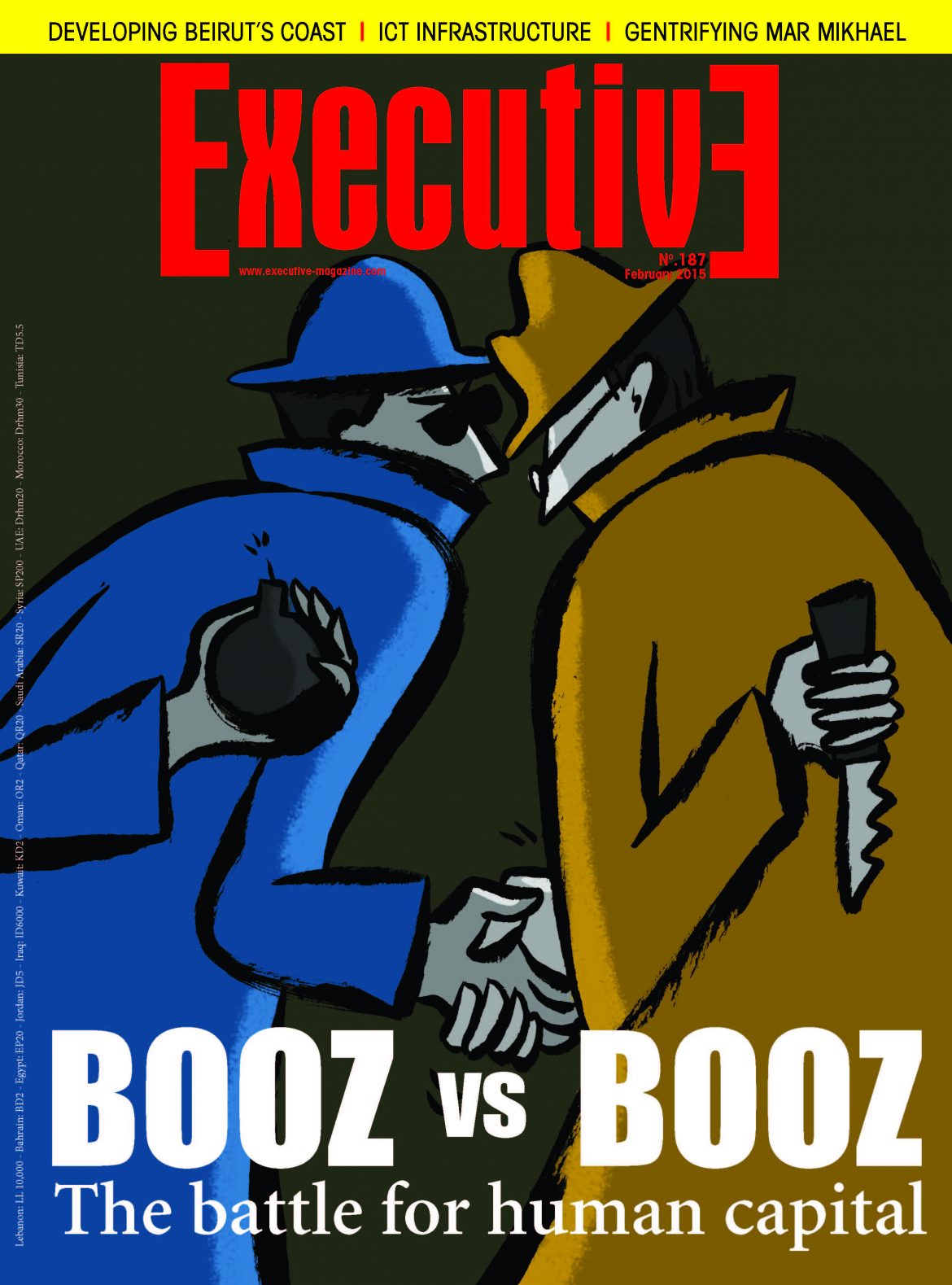
Lebanon still has a long way to go in terms of developing its financial services industry, and the picture only gets slightly better from a regional perspective. While Dubai may have a comparatively thriving stock exchange, Daniel Diemers, Abdulkader Lamaa and Jihad K. Khalil, respectively partner, principal, and senior associate at Strategy& (formerly Booz & Company), argue that the Middle East still has a lot of work to do in terms of getting its wealth management businesses up to scratch when it comes to technological savvyness.

Despite the usual suspects in terms of barriers, it is very much possible to run a serious business in the financial sector in Lebanon. In a Q&A with Romen Mathieu, managing director of the EuroMena Funds at Capital Trust Group and Gilles de Clerck, executive director of the EuroMena Funds at Capital Trust Group, the pair talk about their experience in running successive private equity funds out of Lebanon.

January 14, 2015 0 comments
0 FacebookTwitterPinterestEmail
  • 1
  • …
  • 166
  • 167
  • 168
  • 169
  • 170
  • …
  • 685

Latest Cover

About us

Since its first edition emerged on the newsstands in 1999, Executive Magazine has been dedicated to providing its readers with the most up-to-date local and regional business news. Executive is a monthly business magazine that offers readers in-depth analyses on the Lebanese world of commerce, covering all the major sectors – from banking, finance, and insurance to technology, tourism, hospitality, media, and retail.

  • Donate
  • Our Purpose
  • Contact Us

Sign up for our newsletter

[contact-form-7 id=”27812″ title=”FooterSubscription”]

  • Facebook
  • Twitter
  • Instagram
  • Linkedin
  • Youtube
Executive Magazine
  • ISSUES
    • Current Issue
    • Past issues
  • BUSINESS
  • ECONOMICS & POLICY
  • OPINION
  • SPECIAL REPORTS
  • EXECUTIVE TALKS
  • MOVEMENTS
    • Change the image
    • Cannes lions
    • Transparency & accountability
    • ECONOMIC ROADMAP
    • Say No to Corruption
    • The Lebanon media development initiative
    • LPSN Policy Asks
    • Advocating the preservation of deposits
  • JOIN US
    • Join our movement
    • Attend our events
    • Receive updates
    • Connect with us
  • DONATE