• Donate
  • Our Purpose
  • Contact Us
Executive Magazine
  • ISSUES
    • Current Issue
    • Past issues
  • BUSINESS
  • ECONOMICS & POLICY
  • OPINION
  • SPECIAL REPORTS
  • EXECUTIVE TALKS
  • MOVEMENTS
    • Change the image
    • Cannes lions
    • Transparency & accountability
    • ECONOMIC ROADMAP
    • Say No to Corruption
    • The Lebanon media development initiative
    • LPSN Policy Asks
    • Advocating the preservation of deposits
  • JOIN US
    • Join our movement
    • Attend our events
    • Receive updates
    • Connect with us
  • DONATE
10 Ways to Save LebanonComment

Repair our pensions

by Ibrahim Muhanna March 12, 2014
written by Ibrahim Muhanna

As part of Executive’s ‘10 Ways to Save Lebanon’ issue, we asked leading figures from a range of fields to put the case for one major changes for the country. In this article, pensions expert Ibrahim Muhanna argues for better care for elderly people.


The quintessential goal of social security is to protect individuals against any financial risks they face throughout their working life and retirement. While risks of impoverishment in retirement pose special dangers for earners of low and lower-middle wages, the current National Social Security Fund’s End of Service Indemnity (NSSF EOSI) system provides little or no protection against poverty and the costs of deteriorating health throughout retirement.

Over the past four decades, the Lebanese Parliament has witnessed several draft bills aimed at reforming our current system into an old age pension scheme, yet none has reached the voting stage. The majority of these reforms have aimed to combat the numerous drawbacks of the EOSI system, chief of which is the payment of benefits in one installment, rather than in a secure stream of monthly pension payments.

In order to truly mitigate the risks of life in retirement, the average Lebanese citizen is expected to have the foresight, knowledge and financial capacity to plan for old age. This involves starting their own retirement plan during their working years, choosing to use the EOSI sum to purchase a life annuity from an insurance company and making the necessary plans for post-retirement healthcare.

To illustrate the limits of the EOSI system, let us imagine that there is a Lebanese individual who joins the workforce in 1994 aged 24 and retires in 2034 having worked at the same institution for 40 years. Assuming that their monthly salary increased from $240 in 1994 to $580 in 2014 and $1,400 in 2034, their EOSI payout will be roughly equal to $42,000. If this individual chooses to use the EOSI to purchase a life annuity, they would receive around $400 per month throughout retirement. This is barely 30 percent of their monthly income before retirement and, on its own, is insufficient cover for the individual, even just for the health risks after retirement.

All is not lost…    
Among the several pension reform plans put forward to the Cabinet, the ‘Muhanna Proposal’ maps the path for a reform of the current EOSI formula into an old age pension system that provides, among other benefits, a guaranteed minimum monthly pension, and allows for the establishment of a new post-retirement healthcare fund.

The costs of this reform are manageable and would be shared by employees, employers and the government, with the migration from the old to the new system designed in such a way as to avoid bureaucratic hiccups that are common in government-run institutions.

The need for pension reform has been acknowledged by each of the cabinets in the past decade. Proposals for a new system are based on extensive actuarial studies of the prevailing situation in Lebanon and offer a practical solution and important step forward. However, the much-needed reform has yet to be realized as each change in government resulted in a shelving and re-examination of the Muhanna Proposal.
This political delay in advancing to a pensions system has put extreme burdens on individuals who have reached retirement age. If it is not implemented soon, this will cause even greater burdens on individual citizens and the state budget, due to, among others, demographic factors and the rapidly expanding cost of health care for retirees.

On the bright side — and there is a bright side — unlike the current NSSF health care system, the NSSF’s EOSI branch has a substantial surplus of funds which is not being utilized. This surplus is neither the property of the government nor the NSSF; it is the property of the thousands of Lebanese whose contributions led to its formation. Put simply, herein lies the answer to the debate on what to do with the current EOSI surplus: partially use it in the creation of a pensions system. It’s time for reform.

March 12, 2014 0 comments
0 FacebookTwitterPinterestEmail
Comment

A new strategy to defend Lebanon’s free press

by Ayman Mhanna March 12, 2014
written by Ayman Mhanna

For those who believe in a free and independent press in Lebanon, our latest report on media freedom in the country makes depressing reading. In total, in 2013 there were at least two cases a month of journalists being assaulted across the country. These abuses ranged from being shot at in Tripoli, being illegally detained by Hezbollah, Salafists and other non-state actors, to even being beaten up by security forces in Beirut.

Most worryingly, there is a growing silence following such cases, with impunity for the perpetrators all too common. Virtually none of these abuses have been prosecuted, despite seemingly unequivocal evidence in some cases. Simply put, the government is not doing enough to protect these most basic rights.

In the long run, what is needed to protect freedom of speech are changes to the country’s laws. Foremost among these is the passing of the 2009 draft law on freedom of information. This law, debated by parliament in 2012 but never passed, would give journalists new protections to question those in authority.

The second legal change that is needed is the decriminalization of libel, slander and defamation. While it is right that people should be held accountable for what they publish, these are matters that should be dealt with in a civil court. No one should ever face going to jail as this threat pushes reporters into not asking the toughest questions.

Judicial hope

Yet if we are honest, these legal changes do not look forthcoming. Lebanon’s politicians have a pretty woeful record of passing legislation at the best of times. Right now we have a parliament that last summer (arguably unconstitutionally) extended its own mandate by 17 months. Since doing so, they have passed precisely zero legislation. Simply put, the chances of getting the changes we need right now are negligible.

With the new government due to disband in only a couple of months, in the short-term the judicial system is our only fully functioning institution. As such, it is our best hope of better protecting the values we hold dear. Parts of that system have shown themselves open to defending freedom of expression. In the 1999 Marcel Khalife case, for example, the judge ruled in favor of the artist who had been sued by Dar al-Fatwa for putting a Quranic verse to music. The ruling set a major precedent for the protection of cultural expression.

This and other examples show that there is clearly a possibility that the judiciary will back liberal values. The most recent ruling by judge Najj Al-Dahdah in a LGBT case is another sign that things can move in the right direction through the judiciary.

Yet there are in fact two areas of the judiciary that deal with media freedom in Lebanon. The main judicial system, on the one hand, which would rule on cases of physical abuses, unlawful detention and death threats, and, on the other hand, the Publications Court, which deals with cases against media publications (including online) covering issues of libel, slander and defamation.

This duel system can sometimes end up with bizarre paradoxes. Al Akhbar journalist Mohammed Nazzal, for example, exposed clear corruption in the judiciary – leading directly to a judge being demoted. Yet the Publications Court declared he had brought the judiciary into disrepute, and therefore fined him. This is clearly illogical – we need protection for those exposing injustice in any form.

Taking the initiative

Going forward, therefore, it is no longer enough to merely defend journalists that are unjustly beaten up, detained or sued. We must empower those that have their rights abused – initiating action and giving them the legal support and capacity to take their cases to court. To that end, SKeyes has launched a strategic litigation program and invites journalists subjected to violations to come forward so that, with our support, they can seek justice through all available legal means.

By putting these cases directly in front of the judiciary, we increase the pressure on judges to protect freedom of speech. Key cases could be the attacks on journalists from New TV in downtown Beirut on November 26, 2013 or the attacks on bloggers and civic activists demonstrating in June 2013 against the postponement of parliamentary elections. The evidence against those that attacked them appears so compelling – there is huge amounts of video footage of the events – that if and when it eventually comes to trial, the right decision is crucial.

March 12, 2014 0 comments
0 FacebookTwitterPinterestEmail
10 Ways to Save LebanonEconomics & Policy

Revive Lebanon’s job market

by Zafiris Tzannatos March 12, 2014
written by Zafiris Tzannatos

As part of Executive’s ‘10 Ways to Save Lebanon’ issue, we asked leading figures from a range of fields to put the case for one major changes for the country. In this article, former International Labor Organization advisor Zafiris Tzannatos discusses changes to the country’s job market.


At face value, Lebanon is probably the top economic and employment performer in the Arab region. Globally, it is an upper-middle-income country, one notch below the group of high-income economies. Within the Arab region, it has the highest per capita income among non oil-producing countries. It has the lowest unemployment rate — about 9 percent — in a region with an average of nearly 14 percent. This excludes the Gulf Cooperation Council, where unemployment is almost zero by virtue of oil wealth and the government being an employer of last resort. Moreover, the Lebanese education system produces graduates who can find jobs in the most technologically advanced high-income economies.

Yet the Lebanese labor minister faces daunting challenges, since the above picture masks deep structural economic deficiencies and weaknesses in labor market governance. Meeting these challenges will require radical, rather than reformative policies at the macro level, which are beyond the ministry’s mandate. And within the labor market, Lebanon is in need of a national labor policy.

The task ahead
Consider unemployment. It is not low because the economy creates too many jobs. On the contrary, domestic employment has been increasing by only 5,000 jobs a year, with almost 20,000 new entrants into the labor market.  And the latter figure would be far higher if more women were joining the workforce.  Now consider employment.  Are those 5,000 newly-created jobs what the young and dynamic Lebanese are aspiring to? The answer is no. Most jobs are in low value or low productivity sectors that offer low wages.  For its level of development, Lebanon has an exceptionally high share of small and micro-enterprises, self-employment and family work characterized by a high degree of informality. Even if wages in the formal sector were adequate to live on in the short term, they cannot compensate for the expensive investments families make in education.

As such, market failures that saddle the competitiveness of the private sector need to be addressed. Unfortunately, they have been met only by government failures, spanning from ineffective regulations and licensing procedures to a lack of infrastructure and a segmented education system. The latter produces the best learning outcomes for some students while leaving many behind — one in four Lebanese does not complete secondary education.

When the economy does not create decent jobs, employment is unstable, there is no unemployment insurance and a lifetime of work does not end in a pension, your choice is limited to staying out of work — as many women do — or emigrating — as many men do. Lebanon has both the highest emigration rate and the highest skilled emigration rate among Arab countries, and one of the highest across the globe.

The Ministry of Labor cannot change the big picture.  This is a giant task for the Cabinet, which faces the same constraints as its predecessors, in terms of the accumulated public debt, the most recent influx of refugees, the perennially unstable regional geopolitics and fragile internal politics. However, with the aim of creating greater and more fulfilling employment, a national labor policy can be developed through the creation of a level playing field for the private sector, a reduction of red tape and a boost to investor confidence. Additionally, an increase in the transparency, effectiveness and accountability of the state in the sphere of public goods — from electricity and broader infrastructure to education and social protection — is needed to produce the required outcome.

However, for the Ministry of Labor to be able to play an effective role in the labor market, it would need to upgrade its statistical, analytical, policy, administrative, management and planning capabilities.  Moreover, the ministry is a key player in improving the dialogue among employers and workers. In this respect, reviving the role of the Economic and Social Council is a low hanging fruit that can, in turn, contribute to the development of the national labor policy.

Areas of focus, some of which have been pending parliamentary approval for years, include the revision of the archaic 1946 Labor Code, the introduction of pensions for the private sector and a reconsideration of the available employment services (the mandate of the National Employment Office). Furthermore, improvements in health and safety in the workplace, the development of an accurate price index to reduce tensions in wage negotiations, a reduction in child labor and more effective labor inspections — including the case of the thousands of domestic workers — are equally vital.

March 12, 2014 0 comments
0 FacebookTwitterPinterestEmail
Business

What a gas!

by Thomas Schellen March 12, 2014
written by Thomas Schellen

Last month, members of the national business community faced the tricky question of what to wear for the festive opening of a gas station. Total Liban, the Lebanese unit of French oil multinational Total, put the question on the agenda by inaugurating, with speeches and circumstance, a re-developed flagship station on one of Beirut’s main traffic arteries, the six-lane urban highway connecting Downtown Beirut to Dora.

Total Liban’s senior management told Executive on the sidelines of the opening party that the company achieves a daily sales volume of 20,000 liters at the outlet, dubbed Medawar Station after the surrounding neighborhood. The station generates this volume from an average of 1,500 customers a day, but Total aims to boost the station’s fuel throughput by 30 percent based on the location’s full redevelopment into a station that features eight gas pumps, an automated car wash, a modern automotive servicing area, an ATM and a convenience store with two, albeit a bit tight, aisles.

According to a press statement, the location also has a Liban Post antenna, indubitably to the delight of people who know how to use the device.

The invited guests at the opening were not only pampered with canapés and entertainment but were treated to a service station that aims to live up to a standard that is common in developed markets but still far from ubiquitous in Lebanon’s national network of gas stations.

In this context, the Medawar station opening was as much aimed at catching the attention of the motoring customer base as it was promoting the idea of a modern gas station and conveying Total’s commitment to the internal target groups of auto-industry members, distribution partners and station operators, says Reina Cullinan, Total Liban’s commercial director.

“We are striving to project a constant and uniform image throughout the market. We would like the customer to have the same experience whether they come to a Total-owned and operated service station or a dealer-owned and operated service station,” she tells Executive in a separate interview about the company’s strategy. Cullinan emphasizes the alignment of Total Liban not only with the new global branding of the multinational group, but also with the group’s worldwide-enforced policies on safety and product quality, among other standards.

Staying aggressive
According to Cullinan, Total Liban has a network of 180 branded stations. The majority of stations are dealer-owned and operated under contract while the company owns and operates 30 to 35 stations directly. In terms of fuel volume sold, Total Liban accounts for nearly 20 percent of the gasoline pumped into Lebanese vehicles, Cullinan claims, making the company the volume leader in the market.

Other large gasoline distributors and station operators include Medco, Wardieh and United, each brand comprising upward of 180 stations. Some of these networks have historic affiliations with multinationals and maintain product relations with international brands such as Caltex and Mobil, but Total Liban is the only company in Lebanon’s retail fuel sector that is fully owned by an international parent and reports to a global corporate head office.

This means that Total Liban’s results are integrated into the annual reports of the group; however, how much the activity here contributes to Total’s global bottom line is not something that Cullinan would disclose. She does reveal that Total Liban felt the impact of the depressed economy in that the size of the average customer transaction was down, saying, “we did not have negative growth in 2013 despite the situation but we did feel the impact. The growth that we saw was not as good as we would have liked it to be.”

She concedes that the growth in turnover that Total Liban achieved in 2013 was influenced by factors such as network expansion and the company’s investments to migrate 30 stations to its new global brand identity. Without those factors, she says, the year would have been “very flat.”

After 18 months in Lebanon, the native South African is nonetheless positive about the country and Total’s esteem in the market. “There are not a lot of exciting things happening in Lebanon because of the situation, but we — as Total — remain very positive about the country. We have always been here and been committed, and we want to stay committed. Our investment budgets, whose numbers we are not allowed to disclose, have not been cut back and in fact we have an aggressive investment strategy,” she says.

The strategy involves, on one hand, continued upgrades of the network by migrating another 40 stations to the new brand colors before the end of the year, along with the rollout of more large stations along major traffic arteries. Three such projects are under implementation and four more are planned for delivery in 2014.

The expansion plans and the investments they represent are not peanuts by local standards. To begin with, the acquisition of land for a station is difficult, due to the scarcity of suitable properties, and those that are available carry a high price tag. Once a property is acquired, a major station can require a further investment of between $1 million and $2 million, Cullinan explains. “Excluding the cost of land, $1.5 million is not a lot of money to pay for a flagship-size station.”

The second pillar of Total Liban’s growth strategy is diversification from pure gas sales into more retail and customer services, such as money transfer, banking services and food offerings. The convenience stores will stock more high-margin items and, for the planned expansion into roadside restaurants, the company has begun negotiations with potential partner companies that could implement family-oriented eateries or bistros at Total Liban stations, perhaps even including play areas for children.

According to Cullinan, such concepts have become possible thanks to recent legal changes allowing food preparation on commercial sites. Overall, Total Liban aims to increase the share of non-fuel items in the company’s revenue to 25 percent from the current 10 percent.

Playing a peculiar market
The low contribution of non-fuel-related products and services in the revenue streams of gas station operators is among the several peculiarities that characterize the fuel distribution industry in Lebanon. More significant discrepancies vis-à-vis global best practices relate to the fact that Lebanon has highly individualized traffic and a high number of vehicles per capita when compared with any other small country in the upper-middle income group of emerging economies.

In the economy of gas station operators and fuel distributors, this is reflected in the market presence of many stations that might be neither economically viable nor environmentally acceptable in more developed countries.

According to unofficial numbers from members of the fuel sector, Lebanon’s national fuel distribution network includes around 3,200 stations of which only about 2,200 operate under the requisite government license. Of these 2,200 legally run stations, around 2,000 are branded, estimate officials in the Association of Petroleum Importing Companies (APIC).

While the major operators and APIC itself are anything but beacons of financial transparency, it is entertaining to note that Lebanon has, by international comparison, a very high number of gas stations by pretty much any parameter one chooses.

For example, the number of all Lebanese stations (licensed and unlicensed) at 3,200 is 30 percent below South Africa, a country that also regulates its oil wholesale margins and controls pump prices at its 4,600 stations according to the South Africa Petroleum Industry Association. However, South Africa is about 20 times larger in terms of population. In terms of territorial dimensions, South Africa is roughly 120 times the size of Lebanon, which makes the Lebanese network extravagantly dense in comparison.

Using a European country for comparison that is only about eight times Lebanon’s size and while just taking licensed gas stations into account, Lebanon’s 2,200 rank not far below Austria’s 2,500. But although Austria has a higher density of gas stations per capita than France and Germany, each Austrian station has a theoretical clientele of 3,400 inhabitants. The hypothetical average operator of a licensed Lebanese service station by contrast has to make his profits on the basis of a ratio of only 2,000 inhabitants per station.

Finally, when correlating the number of stations to the length of the national road network, the Lebanese landscape mathematically spots one gas station every three road kilometers, while a South African motorist has to drive 78 and an Austrian 49 kilometers, if they happen not to like the colors of the nearest fuel vendor.

In other words, Lebanon has a higher density of gas stations than bank branches and it seems a daring feat, at least in mathematical terms, to run out of gas because of want of a pump nearby (not having a working gas gauge in the car or days of facing a supply shortage are different matters). Operators have to be very creative and hard working to succeed in a field crowded with many competitors and no opportunity for price differentiation, due to the government control of pump prices. Either that, or they have to dodge all sorts of common sense business principles, not to mention almost every operational standard that is enforced in developed economies.

Given the market’s constraints it is no wonder that Cullinan proclaims, “I am sometimes surprised when I see the deals that we are doing and deals that we have throughout the country, where volumes are very minimal — they are little, little stations.”

Being profitable and safe
Total Liban sees the threshold for a station in its network to make economic sense at a monthly sales volume of at least 300,000 liters. But as Cullinan puts it, “we are working with what we have” in the network. She explains the company’s ongoing partnerships with small operators, with the policy of being present in every corner of Lebanon. She has yet to visit several of these in person because of security-related restrictions that Total, as a multinational, places on the movement of its international employees in Lebanon.

In the area of security and compliance with group safety standards, Total Liban maintains that the trucks in its third-party owned delivery fleet comply with European standards. It also conducts annual maritime emergency drills to be prepared for the possibility of an oil spill from a vessel during delivery or at its fuel importation terminal.

Across its network of branded stations, the company has a training program for pump attendees and uses independent monitoring of product quality to be sure that only certified and compliant fuels are disbursed at the pumps. At the opening of Medawar Station, visitors could step into the van with the test laboratory that is used to monitor fuel quality at all Total Liban stations.

Operational improvements of its new stations include energy-saving lighting and water-saving car washes. But more important for environmental safety are the collectors in the ground designed to capture spills of gasoline, contaminated water and lubricants all around the station. “We collect all contaminated residue at the oil change and car wash and dispose of it responsibly. This is something that the Lebanese market as a whole may not be sensitized to but it is something that Total is very conscious about,” Cullinan explains.

When asked about the details of how the company disposes of contaminated motor oils, she says that Total Liban has an agreement with a partner, “whose name we are not allowed to mention,” and adds that this partner company uses the contaminated lubricants “in their equipment, in burners and that kind of stuff.”

While it seems doubtful that an environmental watchdog or a supervisor in a country with stringent waste treatment standards would be satisfied with incineration of contaminated oils by an unnamed industrial company as a bona fide disposal method, Cullinan makes a point in saying that Lebanon’s poor waste treatment infrastructure poses a problem and that dumping of such wastes in a landfill is not an acceptable solution. “We are trying with the very limited infrastructure in Lebanon to play our role as best as we can,” she says, and concedes, “oil companies will never be green.”

As to the question of what to wear for a gas station launch party, fashion experts on site at the opening of Medawar Station recommended casual or smart casual. Male attires at the event were dominated by suits and ties chosen to mesh with a great gas station image. But from an operational perspective, the warm reds worn as uniforms by Total Liban’s pump attendants were clearly the natural fit to both environment and occasion.

March 12, 2014 0 comments
0 FacebookTwitterPinterestEmail
Business

Semsom pursues the American dream

by Livia Murray March 11, 2014
written by Livia Murray

FFA Private Bank will present local and regional investors an opportunity to invest in the Lebanese food and beverage (F&B) industry this Thursday. Lebanese restaurant chain Semsom is seeking to raise $6 million in equity financing for the new unit, Semsom US, that will drive the chain’s expansion into the United States. The bank says it already has a quarter of their target pledged from investors, but March 13 marks the start of their formal fundraising.

Semsom US will be based in the British Crown dependency of Jersey. The company is planning on raising up to 49 percent of equity in a first round of $4 million by selling common stock shares of Semsom US, with the remainder owned by umbrella holding Treats, which also owns Green Falafel and the Lebanese franchise of Dunkin Donuts.  Treats, whose shareholder base consists of Christine Assouad Sfeir, the CEO of all three restaurant chains, and her family, will keep 51 percent equity against a cash injection and in-kind contribution that will cover the cost of franchising in the US territory, the franchising fees for each store, resources and expertise.

Semsom is anticipating opening at least 70 new restaurants by 2020 and twice that in the best-case scenario. Expansion is to be both through company-operated stores and franchised outlets, numbering 20 and 50 respectively in their conservative estimate.

Fundraising from investors is going to be split into two rounds. The first-round target is for $4 million with expectation to close this round by mid-April. Under the financing plan, the investment banking department of FFA Private Bank will handle this round and follow it up with a second round seeking to raise at least another $2 million by 2016.

The deal projects an internal rate of return (IRR) of 31 percent in a conservative scenario given an exit by year seven, and a base-case IRR of 42 percent. Acccording to its fundraising material, the venture expects a positive cash flow by 2016, all of which will be re-invested in the company to drive growth. Investors who invest in the first phase will get priority right to take part in phase two, FFA Private Bank says. They are looking for ticket sizes ranging from $100,000 to $1 million.

Land of opportunity

The plan for Semsom US is to open their first restaurant by the end of 2014. The parent company has seen regional growth since it opened its first location in 2008 in Lebanon. Under the management of Treats, the restaurant brand today operates two locations in Lebanon, two in Saudi Arabia’s Jeddah and one in Kuwait. They are planning to open in one in Oman, two in Saudi Arabia’s capital Riyadh and a third in Jeddah, and one in the UAE by the end of 2014.

According to Julien Khabbaz, senior manager and head of investment banking at FFA Private Bank, they doubled their projections for profitability in the GCC to a 35 percent EBITDA ratio (earnings before interest, taxes, depreciation and amortization).

Carine Assouad, a shareholder in Treats and the designated managing director of Semsom US, says the company has been attracted to the US market because of its size and its lack of a single dominant Lebanese food chain. Citing the food and beverage (F&B) industry’s market value of $660 billion per year, Assouad adds that Semsom is initially targeting 3 of the 10 cities that they have identified as most lucrative for F&B: New York, Boston, and Washington.

The makers of Semsom have worked for the past six months to adapt their company to consumer trends in the US market. According to Assouad, “ethnic cuisine” is booming in America – where 63 percent of Americans order it more than once a week. They are also witnessing a growing appetite for “fast casual” style food in the states: a cross between dine-in and fast food, which offers premium food and fast service. They are seeking to tap into both of these trends.

FFA is planning on staying on board long term once the funding is closed. They will take a board seat in the company to represent and protect the investors as one block. According to FFA’s Khabbaz the bank has prior experience in fundraising for F&B projects in Africa and have worked with clients in the region, but their experience in fundraising for projects in the US is limited to the film industry.

March 11, 2014 0 comments
0 FacebookTwitterPinterestEmail
10 Ways to Save LebanonComment

Public private partnerships can boost Lebanon

by Ziad Hayek March 11, 2014
written by Ziad Hayek

As part of Executive’s ‘10 Ways to Save Lebanon’ issue, we asked leading figures from a range of fields to put the case for one major changes for the country. In this article, privatization expert Ziad Hayek calls for inviting more private companies into public sector.


It is clear to any Lebanese citizen that the country is in desperate need of new public infrastructure. Its current electricity, education, health, transport and other basic networks are decaying due to the chronic inability of successive governments to manage and plan them.

Investment in new infrastructure would not just help the end users; it has also been shown to play a key role in raising national growth rates, developing the economy and ensuring sustainable growth. Such projects also help to lay the groundwork for job creation and attracting major new investments.

Right now, however, to ask the government to pay for such projects is unrealistic. The new cabinet has little to spend — the country’s national debt is climbing again and growth is minimal. As such, investments in new infrastructure would be at the cost of additional taxes or increasing the public debt — both potentially damaging for growth.

One way to develop new infrastructure without crippling the country’s economy would be through public-private partnerships (PPP) — inviting private firms to work alongside the government in developing the necessary infrastructure. Indeed just this weekend, President Michel Sleiman spoke about the importance of PPP deals for Lebanon’s growth. These deals have had a major impact in countries across the globe that, like Lebanon, were desperate for change but couldn’t afford to pay in the short-term.

But PPP deals are not just about delaying debt; they are long-term agreements between the public and private sectors focused on providing public services and building infrastructure by relying on the private sector’s financial capabilities and expertise. Such partnerships are not at the level of capital or profits, but rather a partnership of risks, whereby the public sector transfers some of the project’s risks to the private sector and retains others.  For example, the private sector could assume the risks of development, design, construction, operation, exploration, financing and inflation, while the public sector bears the environmental, regulatory, political and pricing risks.

As such, in PPP deals, the government does not buy (or bear the cost of building) the assets required to offer the public service. In the case of electricity, for example, Lebanon is desperate for new power plants but the government cannot afford to pay for them directly. Instead, it should agree a deal with private firms to set up the plants and then buy electricity from them, thereby satisfying the needs of its consumers and potentially ending the power shortages that all Lebanese endure.

The potential benefits are huge. Foremost among these is guaranteed rapid execution. In a country where public sector projects often come in years late and millions over budget, bringing in the private sector mentality  (both by transferring the design and construction obligation to the private sector and linking payments to service provision) could be a game changer.

Similarly, the government could execute numerous projects simultaneously, rather than having to wait for the funding for capital expenditures. Lebanon is clearly crying out for infrastructure investment and PPP would make a genuinely radical series of reforms possible.

Even better, in a wider sense PPP promotes decentralization as local authorities can sometimes go it alone without the central government. Redistributing power away from our central political classes can only be positive.

This is not to say there are no potential issues with PPP. While it is clear that there is local and foreign readiness to invest in PPP deals, success must be built on certain important pillars.

First among these is a modern legal and regulatory framework ensuring clarity in tender procedures, and in the relationship between the parties from the public and private sectors. In Lebanon, this is currently stalled as the public-private partnership draft law has yet to be passed by Parliament.

Secondly, it is important to represent all stakeholders in the process of awarding PPP deals. This helps avoid surprises or obstacles that result at later stages from the lack of coordination among all parties concerned. It also helps prevent the corruption that occurs when one minister may award tenders unilaterally. This should obviously go alongside a high level of transparency — something that foreign investors in particular will push for. In Lebanon this is a particular concern, as public deals are often incredibly murky.

Finally, it is important to establish an independent centralized unit composed of experts who are specialized in partnership with the private sector. This would enable them to design PPP agreements that guarantee the public interest, and respect the investors’ rights.

Lebanon’s new Cabinet should push through the PPP draft law and open up to private sector funding for state infrastructure projects. In a time of economic shortages, PPP could help boost growth and create the kind of society we want to see.

March 11, 2014 0 comments
0 FacebookTwitterPinterestEmail
10 Ways to Save LebanonComment

Time for a new national pact

by Misbah Ahdab March 11, 2014
written by Misbah Ahdab

As part of Executive’s ‘10 Ways to Save Lebanon’ issue, we asked leading figures from a range of fields to put the case for one major changes for the country. In this article, former Tripoli MP Misbah Ahdab makes the case for moving beyond the March 8 and March 14 political groupings in search of a new national pact.


The formation of a new government is cause for optimism — after nearly a year without a Cabinet the Lebanese were crying out for change. Yet sadly it was not really made in Lebanon; while the parties involved may be local, the deal struck to bring it about was not made in Beirut, but in the Gulf, Tehran and Washington.

The key moment came in January, when Hezbollah abandoned its demand for a veto block in the cabinet. This sudden shift, after months insisting that there was no room for negotiation, almost certainly came about due to Iranian repositioning in its negotiations with the US and the West.

This is emblematic of a wider trend; the country’s politics are now almost exclusively controlled by outside interests. The March 14 alliance is largely responsive to the wills of Saudi Arabia and the Gulf, while March 8 dances to Iran’s tune.

While this divide has its roots further back, it was the 2008 Doha Accords that really cemented these two foreign-backed groups in power. The deal, which saw both groups agreeing to share power, is often credited with improving the country’s short-term fortunes both politically and economically.

But what it did in the long run was squeeze the space for moderates by divvying up the key state institutions along political lines. Rather than seeking to reconcile the parties and find common ground, it embedded the divide by giving them different and competing power bases. For example, one key intelligence agency was handed over to March 8 while another was given to March 14.

The cumulative effect is that there are almost no institutions left for those Lebanese who don’t take their agendas from outside. And so we have become more than ever subject to the wills of foreign powers.

Take the new government as an example. While everyone talked extensively about which ministry each party will get, there was almost no debate about what the government should actually do. Forming a cabinet has become little more than a squabble over which side gets which slices of the pie.

But the Doha Accords were predicated on one flawed principle: that the deal would lead to a reduction of violence in the country. A loss of sovereignty, we were told, was the price of security. Six years later, we can see how wrong this was.

Take my home city of Tripoli. Since the 2009 elections, around 400 people have died in ongoing clashes, provoked, and often funded, by outside interests. In the past four years, there has been no meaningful attempt to create a genuinely unified government position on these clashes.

A fresh start

Worse still, the division of security services has actually exacerbated the crisis, with the institutions of the state no longer seen as honest brokers between warring parties. There has also been almost no support for the city’s economy, making the youth increasingly easy to radicalize; for many young men, picking up a gun is now the only way to earn a decent wage.

Tripoli is just one of dozens of examples that show that the principles of the Doha Accords are leading the country closer to a return to civil war. What is required is to turn inwards again and develop a genuine vision for Lebanon, independent of foreign meddling. This requires a deal of the magnitude of the Doha Accords, but this time brokered and designed in Lebanon, with its primary focus being to serve the Lebanese people.

There are reasons to be positive. The non-sectarian movement endures, while oil and gas wealth offers the distant possibility of economic independence. We know how to manage Lebanon better than outsiders.

To make any deal work requires compromise of a different form. Rather than agreeing to divide power, we need to share it — working together, rather than setting up parallel organizations.

Currently those in the international community who would genuinely like to support an independent local agenda in Lebanon are not able to do so, as they see little vision for a better future. We have to create this vision so that international players want to support us.

It is an immense challenge — both March 8 and March 14 are incredibly well funded and will outspend and outmuscle all rivals when it comes to elections. Similarly, convincing people to believe in an alternative when the current system is so engrained can be a challenge. But for Lebanon right now, the stakes are too high not to try.

March 11, 2014 1 comment
0 FacebookTwitterPinterestEmail
10 Ways to Save LebanonComment

Lebanon needs a new census

by Kamal Hamdan March 10, 2014
written by Kamal Hamdan

As part of Executive’s ‘10 Ways to Save Lebanon’ issue, we asked leading experts from a range of fields to put the case for one major policy for the country. In this article, pollster Kamal Hamdan puts the case for a new census.


No wonder Lebanon is falling behind. In a world racing towards greater and more accessible economic data, our country is standing idle, having firmly refused to conduct a census for 82 years. This is not just a technical issue for economists. The census is such a basic analytical tool that its absence impairs the ability to make sound, informed decisions.

Every day economists, executives and labor leaders rely on mountains of economic data to plan policies, strategies and investments. What is the optimal fiscal policy? The yearly demand and supply of labor? Which parts of the economy and the country show the best investment potential? What raises will workers need to keep up with inflation and changes in consumption?

The fundamental basis for much of this data is a full, up-to-date count of people. Unemployment rates and figures, for instance, are meaningless without knowing how large the population is to begin with. Even seemingly unrelated measures — like oft-cited GDP numbers — use population size in their calculations. For detailed surveys, researchers need a base to build representative samples and get reliable results.

Without a census, there is no comprehensive way to know for sure whether a sample is representative of the entire population. And perhaps most importantly, knowing how many people live in which locales is a sine qua non for economic planning and forecasting.

In short, the census is a very basic and necessary economic tool. But there are numerous reasons as to why there has not been a census since 1932. Within the ruling class, the balance of power depends in part on the perception of each community’s pull. A census might disrupt the status quo — a prospect that is rarely viewed favorably by the political elite.

The civil war and concomitant mass migration have created a related issue: how do you measure residency? How should expatriates be counted, especially those who left the country in the last two or three decades? Should migrants vote in their place of residency or place of registration?

While a census is necessary, it’s simply not in Lebanon’s political cards. Nothing short of revolution would make it a practical possibility.

Making do with smaller measures

Failing that, what can our new government do to make up for the lack of the most basic statistical tool in existence, the basis of all per capita indicators? While there are no direct substitutes for a census, there are smaller changes the new cabinet can make to boost Lebanon’s statistical base.

First, the government can make the Central Administration of Statistics (CAS) truly independent. Currently, the CAS, Lebanon’s official statistics body, is housed under the Prime Minister’s office. This causes problems of political interference and conflicts of interest. When official inflation numbers edged higher than 10 percent year-on-year in late 2012, then-Prime Minister Najib Mikati allegedly refused to fund data collection for five months. The CAS was forced to stop producing the headline-friendly but government-hostile numbers.

Second, the government can increase the CAS’s funding. This would allow for two major improvements to the quality of Lebanon’s statistical base: more surveys and a higher quality of staff and training. The current periodic surveys the CAS carries out could be refined, expanded and conducted more regularly.

This applies to the entire survey process: conceptual framework, sampling methodology, questionnaire design, surveyor training, and analysis and interpretation of results. You cannot expect high-caliber data if you pay the same salaries as other government ministries — instead, you need to attract a team of top-flight economists and statisticians.

Finally, the CAS can make its data more accessible and its methodologies more transparent. Earlier partial surveys have not been released in full to the public. For example, the CAS released data for its census of buildings in 2004 only at the regional level; it withheld the much richer cadastral-level data. If private institutions had access to such granular data, it would go a long way towards filling the census gap.

It is unfortunate that such a basic, necessary economic tool is outside Lebanon’s reach. But, with a little imagination and policy know-how, the incoming government can mitigate some of the effects of a lack of reliable statistics while at the same time building the institutional capacity to conduct a thorough census once political obstacles fall.

If the new government takes the economy seriously, it must take economic and demographic data seriously.

March 10, 2014 0 comments
0 FacebookTwitterPinterestEmail
Business

Simulating surgeries to save lives

by Livia Murray March 10, 2014
written by Livia Murray

Entrepreneur: Jean Nehme
Country: United Kingdom
Company: Touch Surgery
Industry: Healthcare/Tech
Founded: 2013
Funds raised in 2013: $1.5 million
Number of employees: 15

Jean Nehme, a Lebanese expat living in London, is one of a team of four who have devised an application that simulates surgeries. Nehme, Andre Chow, Advait Gandhe, and Sanjay Purkayastha developed Touch Surgery to enable surgeons and surgeons-in-training to perform operations virtually in 3D before they are faced with the real thing.

The idea, Nehme explains, came from the desire to improve surgical training and the preparedness of surgeons before they enter the operation room. “I think there’s a big misconception that we all practice on people who donate [their] bodies [to science]. You don’t always get the opportunity to practice before,” says Nehme. “Training on patients is not safe.”

Even experienced professionals can benefit from the app, he explains. Surgery being a complex and changing field, surgeons need to stay on top of medical developments to know the latest, most effective procedures and techniques or simply for the sake of refreshing their memories before performing an operation they haven’t done in a while.

Cognitive task simulation

The application breaks down complicated procedures into individual steps and stops at important decision points. The platform teaches through cognitive task simulation, which is based on the idea that an operation’s success stems from a combination of sound surgical decision-making and technical skill.

“It’s really about training your brain,” says Nehme. Decision making, he explains, is not always explicitly taught to surgeons in training, an aspect they are trying to emphasize in the app. “When you’re trying to follow a surgeon … a lot of their knowledge is so automated that they forget to express all the basic things,” says Nehme, who compares it to learning how to drive a car when a driving instructor “wouldn’t tell you how to get in the car.”

To assess the surgeon’s progress, the app collects data for every surgery undertaken. According to Nehme, they collect over a million “data events” – virtual surgical maneuvers – a week. The data can be then used to chart the surgeon’s learning curve.

Surgical heat map

The team is using a surgical heat map to identify the surgeries to develop by order of importance. This enables them to chart which surgeries are both the most common and the most vital. “While we are picking things that are common, we are trying to teach things that are really making a difference,” says Nehme.

They started with orthopedics because of its “big procedural market,” and are now moving into general surgery. They have released an operation for removing the gallbladder, a common operation,“but if it goes wrong, it can really affect the person’s life,” says Nehme. They currently have developed over twenty surgeries.

Jean Nehme is co-founder of the company

[/media-credit]Jean Nehme is co-founder of the company

Touch Surgery has partnered with many large institutions such as Duke, Stanford and New York University to design the various types of surgeries. They are currently working with surgeons at the University of Toronto and plan to work with Harvard as well.

B2B model 

Traction-wise, the app has seen 120,000 downloads, mostly in the United States. They raised $1.5 million last year in a seed round with investments from Chicago Capital Partners and European venture capital firms Ballpark Ventures and Balderton Capital. They are currently working to close a round of Series A funding.

The app is free and the team intends on keeping it free, but they are toying with various ideas for business models related to data collection. They currently envisage a business-to-business (B2B) model in the academic, medical and insurance sectors. The app has also attracted the attention of medical device companies, who are interested in having a platform that trains surgeons to use their equipment. Likewise, insurance companies could make use of the data collected to improve calculations for surgeons’ premiums.

With a few ideas for business models down the road, the team is focused first and foremost on traction. “Revenue has never been a [key performance indicator],” says Nehme. Though he admits, “we are transitioning into a company with business motives.”

March 10, 2014 0 comments
0 FacebookTwitterPinterestEmail
Finance

Arab stock markets: New bulls rising?

by Thomas Schellen March 9, 2014
written by Thomas Schellen

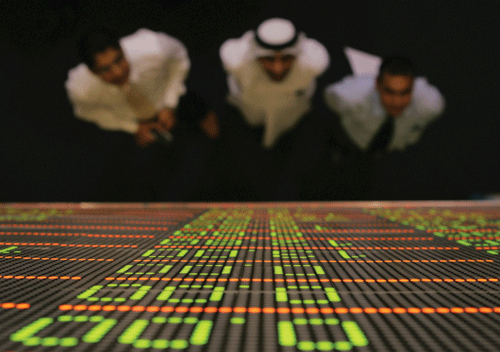
Today five years ago, spring birthed a new bull in global finance. Security market annals refer to March 9, 2009 as the point where the United States equity market bottomed out and finally started gaining. While the recession in the American economy remained, the securities markets in the developed economies have risen consistently since that point.

Observers and stock advisors on developed financial markets are using the anniversary as a chance to contemplate the unexpected strength of these markets and their chances of lasting another year. At the same time Arab stock markets, with the limited attention they get in comparison to the bulls and bears in the developed and the larger emerging markets, are quietly having their own spring of market gains.

In 2013 and the first ten weeks of 2014, it is fair to say there has been something of an Arab spring for Middle Eastern stock markets. If that is the case then the United Arab Emirate’s Dubai Financial Market (DFM) has been leading the revolt. When comparing the DFM index position of 4,154 points on March 6 at the end of the past trading week with the index opening of the first trading day back in 2013, the Dubai securities market has moved up 156 percent, to two-and-a half times the 1,622 points of back then. The corresponding year-to-date and twelve-month DFM index variations are 23.3 percent and 130.3 percent, according to Bloomberg Finance.

The Abu Dhabi Exchange (ADX) was Dubai’s sibling in growth. It broke free from a multi-year trough at the end of 2012 and has since climbed by impressive ratios – 15.3 percent in 2014 to date and 50.8 percent over the past twelve months – while it also reached a new five-year high at the end of February. Both UAE exchanges dropped about one percent in the trading week that ended last Thursday [Mar 6].

Oman showed a moderate gain in the year to date and its Muscat Securities Market reached a three-year high at the end of January. The Kuwait Securities Exchange, exhibiting a different dynamic from the UAE, had a slight drop in the year to date; it had seen a solitary period of strong gains between November 2012 and end of May 2013. But the bulls have kept roving in the first ten weeks of 2014 in Qatar and Bahrain and, most importantly, in Saudi Arabia, the largest Arab exchange. The Saudi exchange represented almost 42 percent of the MENA region’s cumulative market cap of $1.2 trillion on the first of this month.

While the year-to-date gain of the Saudi Stock Exchange are ‘only’ 8.6 percent, it led to a new index high on March 6. Notably, the SSE’s index rode to this five-year high of 9,252 points from a paltry 4130 points five years earlier in an increase that was more evenly spaced over the period when compared with the concentration of growth in 2013 and 2014 to date that occurred in the UAE equity markets.

Some meadows void of bovines

But while some bulls may be rampaging, others look a little short on grass. The Amman Stock Exchange (ASE), which had seen more down periods than up times in the past five years, had a March 6, 2014 close that was more than 400 points, or almost 16 percent, lower than on the same day five years ago. It achieved, as hint of an upswing, a year-to-date improvement of 6.25 percent as part of a six-month period of gains that added 20 percent to the March 6 ASE Index close of 2,188 points when compared with early September 2013. In Beirut, despite a brief outburst of premature spring feelings right after the announcement of the new government in mid-February, there has been no subsequent charge – with the Blom Index’s 4.11 year-to-date gain only slightly higher than the 12-month gain of 3.4 percent.

Farthest afield to the west, the MASI on the Casablanca Stock Exchange was up barely two percent last Friday when compared with the start of 2013. Its five-year performance was negative and the year-to-date and one-year gains of 4.6 and 13.3 percent, respectively, are probably not enough to inspire much confidence in the market’s predominantly local investors.

This leaves the core Arab Spring countries of Tunisia and Egypt. The smallest active exchange by market cap ($9.2 billion on March 1), the Tunis Stock Exchange ended last Friday flat from a year ago and up 5 percent since the beginning of 2014. When viewed against the economic hopes and political transitions of the past two years, not much of anything has been made visible. The Tunindex had slipped already in the last three months of 2010 and did more so throughout the Arab Spring period; its recovery in the second half of 2011 and the first seven months of 2012 was notable but not impressive when compared with the market’s strong earlier growth between March 2009 and the third quarter in 2010.

Egypt, the country with the bourse that reflected the most ups and downs of the Arab Spring, had more than a fair share of tumults in the past 10 months but nonetheless saw its EGX 30 index climb strongly, pretty much from the day that the military deposed of President Mohammed Morsi at the end of June 2013.

The bird’s eye view of the impact of the epoch of turmoil since January 25, 2011 on the stock market shows three phases: a time of deep uncertainty between the precipitous fall and temporary closure of EGX and the election of Mr. Morsi in summer of 2012; a period of indecisive index moves during his presidency, with a drop that corresponded to the growing hostility towards him in June 2013; and from July last year, a continuous rise with a two short interruptions to a new five-year high on the first trading day of March 2014.

Predictability, anywhere?

Few things in the world lend themselves as easily to aimless speculation as the numbers in our stock markets. This reading of meaning into unpredictable numbers is sophistry in the worst sense of the word.

In a demonstration that much-voiced expectations have no strong evidence of correlation with actual market events, the rise of Dubai in 2013 began well ahead of the DFM’s upgrade announcement to emerging markets status which will be implemented [when] and the rise has not slowed in any way.

From a behavioral vantage point, the index curves of Arab stock exchanges since the burst of all exuberance in 2008 give the impression of the great reluctance to enter a new relationship that follows a first broken commitment among young adults. Inexperienced, local investors were important actors on the securities scene in those years.

Their excitement and willingness to borrow money for stock purchases in the Gulf markets’ first hypes in the early 2000s were punished in two boom-and-bust periods before 2009 and so while Standard & Poor’s started to show a bull sentiment from March 9, 2009, the key Gulf markets stayed on the fence until 2012.

From the perspective of political interferences, the changes and upheavals in the Levant and North Africa impacted the non-GCC markets to the point of total disruptions in Libya and Syria and major direct disturbances in Egypt.

Morocco, Tunisia, Jordan and Lebanon were each impacted in their own ways, underscoring perhaps that the political Arab Spring and its impacts were much more nuanced and created more diverse short-term outcomes than what has so far been understood about this historic turning point.

Whether the Arab bulls of the Gulf and Egypt will keep going strong in the coming months is as challenging a question as the one how long the current bull market in developed economies will last. In the Gulf region, investor behaviors will be worth studying to see inasmuch they have become used to to the behaviors in older markets.

While emphases on protests in international reporting from Bahrain and outcries over workers’ mistreatments in Qatar did not seem to have impact validations from market trends in Doha and Manama, political impacts on the Cairo market still look like a downside risk factor. Small issues of the rule of law and implementation of political democracy may not be very influential on the market but the risk of upheaval remains based on the volatility caused by large events on the streets.

March 9, 2014 0 comments
0 FacebookTwitterPinterestEmail
  • 1
  • …
  • 210
  • 211
  • 212
  • 213
  • 214
  • …
  • 685

Latest Cover

About us

Since its first edition emerged on the newsstands in 1999, Executive Magazine has been dedicated to providing its readers with the most up-to-date local and regional business news. Executive is a monthly business magazine that offers readers in-depth analyses on the Lebanese world of commerce, covering all the major sectors – from banking, finance, and insurance to technology, tourism, hospitality, media, and retail.

  • Donate
  • Our Purpose
  • Contact Us

Sign up for our newsletter

[contact-form-7 id=”27812″ title=”FooterSubscription”]

  • Facebook
  • Twitter
  • Instagram
  • Linkedin
  • Youtube
Executive Magazine
  • ISSUES
    • Current Issue
    • Past issues
  • BUSINESS
  • ECONOMICS & POLICY
  • OPINION
  • SPECIAL REPORTS
  • EXECUTIVE TALKS
  • MOVEMENTS
    • Change the image
    • Cannes lions
    • Transparency & accountability
    • ECONOMIC ROADMAP
    • Say No to Corruption
    • The Lebanon media development initiative
    • LPSN Policy Asks
    • Advocating the preservation of deposits
  • JOIN US
    • Join our movement
    • Attend our events
    • Receive updates
    • Connect with us
  • DONATE