• Donate
  • Our Purpose
  • Contact Us
Executive Magazine
  • ISSUES
    • Current Issue
    • Past issues
  • BUSINESS
  • ECONOMICS & POLICY
  • OPINION
  • SPECIAL REPORTS
  • EXECUTIVE TALKS
  • MOVEMENTS
    • Change the image
    • Cannes lions
    • Transparency & accountability
    • ECONOMIC ROADMAP
    • Say No to Corruption
    • The Lebanon media development initiative
    • LPSN Policy Asks
    • Advocating the preservation of deposits
  • JOIN US
    • Join our movement
    • Attend our events
    • Receive updates
    • Connect with us
  • DONATE
Finance

Arab Stock Markets – Week in Review

by Thomas Schellen March 17, 2014
written by Thomas Schellen

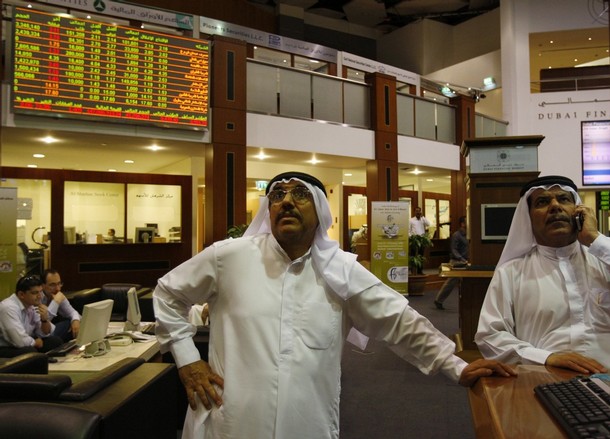
Benchmark indices of Arab stock exchanges retreated in the trading week between March 9 and March 14. Both markets in the United Arab Emirates shed around 150 points between the week’s first opening and last close, translating into a 3 percent softening for the Abu Dhabi Exchange (ADX) and around 4 percent for the Dubai Financial Market (DFM). This scaled the year-to-date gains for DFM and ADX back to 19.55 and 12 percent, respectively.

Where the ADX and DFM displayed index losses in the first part of the trading week, the Gulf Cooperation Council’s northern pair, Bourse Bahrain (BB) and Kuwait Stock Exchange (KSE), gained a bit each. The BB Index kept the pace and closed the week with a fractional gain of all of a point-and-a-half, or 0.4 percent. The KSE benchmark dropped 53 points, or 0.7 percent.

[pullquote] Saudi’s 1.5 percent gain was the best in the Gulf and also took the exchange to a new five-year high [/pullquote]

Oman’s MSM index fell 0.8 percent and Qatar’s QE index 2.1 percent, leaving it up to the GCC’s largest market to make the biggest positive impression for the week. The Saudi Stock Exchange’s TASI did so by climbing 137 points (and change) between market opening on March 9 and market close on March 13. The 1.5 percent gain was the best in the Gulf for the period and took the Saudi exchange to a new five-year high when the index peaked, intraday, above 9,400 points.

From North Africa and the Levant, the trumpets were keeping silent. Jordan’s ASE Index fell 0.3 percent while Morocco’s MASI rose 0.2 percent. Both are in 5-percentish positive territory for the year to date. So is the Tunindex which showed the Tunis Stock Exchange pass through a slight weekly dip and come out of it with a 0.2 percent drop for the March 10 to 14 period.

Even in Lebanon, where the compulsively quarreling political classes managed to produce another absurdity in the inability to draft an acceptable policy statement for the cabinet, the BLOM Stock Index stayed calm – meaning minimal trading activity and an index movement of breath-freezing 2.49 points. That represents a 0.2 percent drop, perfectly in tune with the small North African markets.

Cairo, however, played differently. The EGX 30 index of the Egyptian Stock Market was not contented with frustratingly insignificant moves but rather pushed up almost 200 points, or 1.1 percent. This resulted in a rise above 8,000 points for the Egyptian bourse and a year-to-date gain of just over 20 percent.

[pullquote] Small losses of Arab indices seem like nothing when compared with the sound of panic across the developed and the most-prominent emerging markets [/pullquote]

The double digit year-to-date gains of the EGX, DFM, ADX and TASI range between 20.08 and 10.3 percent. None of these markets made a great leap when compared with a week ago – but this rate of increase looks actually quite sweet right now in international context. That is because the mellow gains and small losses of GCC indices since March 9 seem like nothing when compared with the sudden sound of limited but contagious panic across the developed and the most-prominent emerging markets.

One of the worst hit markets this week was the Moscow Stock Exchange, owing to nervousness over the Crimean crisis and to fear of European sanctions against Russia in case of an escalating confrontation. The same crisis made bullish feelings turn to jelly beans in developed markets.

To name just two, Germany’s DAX dipped below the 9,000 points line on March 13, before rallying on Friday. And the S&P 500 in almighty New York suffered retreat from a five-year high achieved on March 7.

The downward pressure also showed in Japan, elsewhere in Asia and in Latin America. Mainland China indices in Shanghai and Shenzhen were stable for the week but the country acted as worry booster. Weak Chinese economic data and lower than expected growth targets contributed to drive global market sentiments south but better than expected labor and consumer economy data from the United States apparently did not.

Last week we discussed how long the developed markets could continue to grow, after five years of growth. Indications this week suggested perhaps not that long.

March 17, 2014 0 comments
0 FacebookTwitterPinterestEmail
Ski lift at Mzaar
The Buzz

Lebanon’s ski slopes finally open

by Nabila Rahhal March 14, 2014
written by Nabila Rahhal

As the belated four day storm hit the country this week, one thought was on the mind of many: will Lebanon’s ski slopes be open this weekend?

The answer, in brief, is yes — and excitement levels are palpable as business owners and consumers alike rush to take advantage of what might be the only ski weekend this winter.

The sudden storm caught ski resort operators by surprise, according to those Executive spoke to, and most are currently scrambling to prepare the slopes for eager skiers. Christian Rizk, director of Mzaar ski resort in Faraya, says they will be opening four slopes tomorrow — Jonction, Baby, Refuge and Renard — the first time they open for business this winter. He anticipates many will be hitting the slopes this weekend but asks that they act responsibly and stay off areas that are closed due to unsafe snow levels.   

Both Laklouk and Cedars ski resorts will be open as well with Laklouk operating all of its slopes and Cedars still deciding which to open, according to Ronald Sayegh of Ski Lebanon, an online resource for the country’s alpine community. Sayegh says there is an increased buzz of excitement from ski resort operators and downhill enthusiasts — and thus foresees a busy weekend.

The ski slopes are not the only beneficiaries of the fresh snowfall as restaurants and hotels situated close to the ski resorts also look forward to filling up their venues as well. Joost Komen, reservations manager at Mzaar Intercontinental Resort, says that while he is unable to share exact occupancy rates, there has already been a significant increase in the number of room reservations for this weekend and the following days. “We anticipate it is going to be a hectic weekend indeed,” he says.

According to the front desk manager at Shangri-La in Laklouk, reservations at their restaurant went up but room occupancy was still the same this Friday at noon probably because, in his opinion, the suddenness of the storm did not allow for people to make plans yet.

Some restaurants, such as the popular Rikky’z in Faraya, also did not report a major increase in their reservations yet but are expecting a lot of last minute diners and walk-ins eager to relax after a long day on the slopes.

Tomorrow’s weather forecast is sunny and the roads leading to the country’s ski resorts are sure to be jammed from the early hours of the morning with winter sports lovers and those who want to enjoy the snow. While this might keep those who dislike traffic and crowds away from the resorts, the lure of the season’s first snow could also prove too strong to resist. We will know soon enough.

March 14, 2014 0 comments
0 FacebookTwitterPinterestEmail
The Buzz

Lebanese politics show cut short in protest over media freedom

by Joe Dyke March 14, 2014
written by Joe Dyke

A leading Lebanese TV channel has cut short its flagship politics show over a perceived crackdown on media freedom.

LBC News cut off its normally one-hour Nharkom Saeed (meaning “Have a Good Day”) politics show after just seven minutes on Friday after the host Dima Sadek repeatedly sarcastically cautioned her guest – political analyst and blogger Imad Bazzi – that various topics were out of bounds.

Among the issues that she said they were not allowed to discuss were religious conflict in the country, the failures of the judiciary, President Michel Sleiman and Foreign Minister Gebran Bassil.

In recent weeks, following the formation of the new government, a number of media publications in Lebanon have faced increasing political pressure over their coverage of various issues. A blogger, Jean Assy, was recently sentenced to two months in jail for insulting the president on Twitter, while Bassil is currently suing this publication over allegations of malpractice. Bazzi himself recently tweeted that he had been called in for interrogation by the “cyber crimes office” over a blogpost he wrote.

I got a call from cyber crimes office requesting me for interrogation tomorrow because of a blog post I published few months ago #Lebanon

— Imad Bazzi (@TrellaLB) March 12, 2014

At one point Sadek sarcastically implores Bazzi to be a “responsible journalist” and not discuss such controversial topics. After seven minutes, Bazzi agrees that there is nothing left to discuss and the show is called to a close. The screen then reads: “This is our screen image as they like it,” with the “they like it” crossed out in red and replaced by “we reject it.”

You can watch the whole video below (in Arabic).

Related articles: Lebanese media freedom on the rack

A new way to defend Lebanon’s free press

March 14, 2014 0 comments
0 FacebookTwitterPinterestEmail
Leaders

Lebanese journalism on the rack

by Executive Editors March 14, 2014
written by Executive Editors

A belief in freedom of speech has led many good journalists to adopt as their maxim what French philosopher Voltaire once supposedly said: “I disapprove of what you say, but I will defend to the death your right to say it.”

In fact it is accepted today to be one of history’s many misattributions, but the sentiment remains a valid one. In Lebanon, the need to fight for freedom of speech is more important than ever.

The country has long had a reputation for the freest media in the Middle East. This is perhaps not the highest bar in a region where journalists are often brutally suppressed and attacked, but it is something that has helped the country develop into the most open and progressive Arab society.

In recent years this freedom of expression has been threatened as successive governments have failed to properly enforce Article 13 of the constitution – which protects freedom of the press within the framework of the law.

In 2013, according to a new report released by the pro-media freedom organization SKeyes, the deteriorating security situation has led to increasing hostility towards free media. “Media institutions and their employees were victims of multiple violations while covering explosions that rocked more than one region of the country as well as other clashes and protests,” the report said.

The watchdog organization, which is part of the Samir Kassir Foundation, gave numerous examples of journalists being detained by non-state actors, including Hezbollah and Salafist groups. To a certain extent, for investigative journalists and even paparazzi, such occurrences are an occupational hazard. What matters, therefore, is what happens afterwards, with journalists reliant on the police and security authorities to protect them in doing their  work.

It is, therefore, cause for great alarm that the security apparatuses appear to be complicit in the crackdown. Numerous times this year journalists were physically attacked by state forces, while there are other forms of intimidation by which those in power seek to quell inconvenient questions.

In recent weeks, some individuals in government positions have brought lawsuits against critical publications – including this magazine. The fact these cases are held in a criminal court, rather than a civilian one, means those journalists risk jail.

Online, too, the political classes have gone on the attack. One blogger, Jean Assy, is currently facing two months in jail for offending President Michel Sleiman with insulting comments posted on the social networking site Twitter. Clearly Assy’s comments were both crass and undignified, but we should defend to the death his right to say them freely.

Broken pens

Part of the issue is that the relationship between journalists and politicians in this country is deeply flawed. When those in power are asked a challenging question, more often than not they take it as a personal insult.

To a certain extent, this is a logical response. So much of the country’s media is owned by those either directly or indirectly tied to political parties that politicians make the assumption that every media outlet in the country is someone’s battleship, with a difficult question being a broadside. Lebanese journalists should certainly do more to draw a distinction between themselves and their organizations.

But the larger portion of the blame lies with the politicians. By feeding information only to friendly media outlets that fail to ask challenging questions, they dilute the debate in the country and allow all sides to continue to mislead the public.

If they do not trust that journalists will use information in a fair and honest way, perhaps they could go directly to the public. In 2009, MP Ghassan Moukheiber proposed a draft law on access to information that would allow citizens to request documents and data held by public bodies. It was debated in parliament in October 2012, but never passed.

Pushing this law through parliament would level the playing field for all – empowering citizens to get information about their political classes and making them genuinely accountable. Furthermore, it would contribute to a better media culture – giving no sides unfair advantages.

This must go alongside a recognition by politicians that there are journalists who want to treat them fairly. Responsible media simply seek to hold to account all those in power, irrespective of political positions. This magazine prides itself on having equal skepticism of all in positions of power – a healthy attitude in a democracy.

Lebanon’s free and independent media is deeply challenged right now. We must fight to maintain our liberty.

March 14, 2014 0 comments
0 FacebookTwitterPinterestEmail
Embracing a more eco-friendly Lebanon
Real Estate

Embracing a more eco-friendly Lebanon

by Tiziana Cauli March 14, 2014
written by Tiziana Cauli

Energy efficiency and environmental preservation are still not among the first concerns of Lebanese real estate buyers when choosing their properties. Developers, though, are increasingly aware of the requirements they need to comply with to make their assets green. Only a few finished buildings are currently certified as green in Lebanon, but several more are in the pipeline.

Based on a report by international real estate agency Jones Lang LaSalle (JLL) in June 2013, Lebanon is not among the best performing countries in the Middle East by number of green property projects. According to JLL’s “Sustainability in the MENA region” survey, only 25 of the projects certified by US green building rating system LEED (Leadership in Energy and Environmental Design) were in Lebanon, compared with 802 in the United Arab Emirates, 173 in Qatar and 145 in Saudi Arabia. None of Lebanon’s LEED certified projects was platinum rated, the highest level in the system, while a total of eight schemes achieved a platinum rating in the region, with the UAE accounting for seven of them.

Room to grow

“Lebanon and Beirut are not where they are supposed to be,” says Fadi Moussalli, the Dubai-based regional director of JLL’s International Capital Group in the MENA region. “Abu Dhabi and Doha are way ahead in this sense. There are more initiatives there and the governments are taking some concrete steps. Unfortunately, Lebanon has other priorities now,” says Moussalli, referring to the country’s political vacuum, which ended only last month when a new government was formed after nearly eleven months of deadlock.

“In Lebanon we are followers rather than leaders,” he adds. “Other countries opened the way and in Lebanon there are still very few entrepreneurs who took a gamble in this regard.”

According to Moussalli, the fact that green building is not imposed as a standard within the country’s real estate market and the fact that buyers are not sufficiently aware of the benefits of going green makes it risky for developers to invest in the sector.

“Are buyers really likely to pay a premium for green in a market with stagnation? The developments which are likely to be green are luxury ones and the luxury market is stagnant,” he says.

Drivers on the highway that runs by the southeastern Beirut suburb of Yarzé may not even notice it is there, but the green hillside overlooking the city hides a large luxury residential complex. The 1,829 square meter (sqm) high-end asset La Brocéliande was built by real estate developer Greenstone, the property subsidiary of Saade Holdings group. The complex was designed to minimize its impact on the environment and maximize the efficiency of the energy and water consumption in its residential units.

The villa-like asset in the Lebanese mountains, developed between 2009 and 2012, was the first residential project in the country to meet the requirements of the UK-based certification system for green buildings BREEAM (Building Research Establisment Environmental Assessment). Along with its US counterpart LEED, this rating system is applied internationally and largely used by developers and owners to assess the sustainability of their properties. In Lebanon, these two international certifications are used along with local rating system ARZ, which was developed by the Lebanon Green Building Council as a way to adapt international standards to the country’s environment, society and real estate industry.

Although many projects under construction are already certified with LEED and several more have registered to obtain certification with one of the three systems, the completed and operating properties already green-rated in the entire country total only five, all located in the Beirut area. Besides La Brocéliande, which achieved a rating of “very good” under BREEAM, two finished buildings have obtained a LEED certification in Beirut.  In Hamra, the International College Elementary School, which bought its premises from the American University of Beirut and renovated them to make them green, achieved a LEED gold certificate. In Hazmieh, the new 164,000 sqm Beirut City Centre shopping mall, inaugurated last year by Dubai-based Majid Al Futtaim development firm, was also rewarded with a LEED gold certificate in December. Two more completed buildings in Beirut are ARZ certified. They include an office occupied by consultancy firm Beta Engineering in the Badaro neighborhood, as well as the 3,900 sqm headquarters of the BLC bank group in the Adlieh district, which was the first to obtain an ARZ bronze certificate in 2012.

According to Greenstone’s development and operations manager Sami Andraos, going green may be easier for developers working within Beirut’s urban area, as they are operating in an environment that is already highly compromised and polluted. “Getting a certification is certainly more difficult for a project located in a green area than for one in the center of Beirut,” he says. “Based on the [BREEAM] rating system’s requirements you have to preserve the environment and we were operating in a natural area.” The visual and acoustic impact of the asset, Andraos says, had to be reduced to a minimum. “We even gave up around 28 percent of the buildable surface in order to include more gardens in the project.” The complex cost Greenstone around $3.5 million, but the firm’s development manager says it is impossible to determine how much less they would have spent on a non-green asset of the same size and nature. “We chose the location and started our project as a green one, so we knew right from the start that we would have to sustain high costs.” Insulating each apartment, as well as the entire building, both acoustically and thermally accounted for a great part of the burden the developer had to sustain in order to qualify for BREEAM. “No constructor in Lebanon implements the acoustic isolation,” Andraos says. “It is too costly. Luckily the area where La Brocéliande is located is very quiet, so we could use 28 mm double glazing.”

Whilst isolation up to this thickness can be found from local suppliers, Andraos says, anything above that is very difficult to find in Lebanon. “We have another project in Ashrafieh for which we have applied for BREEAM certification and because that area is in the middle of the city we had to use 32 mm double glazing. You can’t find that from Lebanese suppliers and we had to get it from Germany.”

The costs of being green
Whilst BREEAM adapts its requirements to the countries where projects are, some of the green features it suggests are not easy to implement in Lebanon. “They wanted us to get a composting machine for waste, but there is only one company in Lebanon that uses that system and it would have cost around $2,000 per month. Residents would have never paid that, so we decided to drop the idea.”

Whilst the costs faced by developers in order to build green may reflect on selling prices when assets are put on the market, this extra investment is, in some cases, part of the initial budget and is not transferred to buyers, according to Andraos.

“We planned to build green and part of the costs was absorbed before we sold,” he says. “Based on Lebanese laws we didn’t have to go green, but we did it anyway, although clients are not sensitive to this issue. We need to start somewhere though.”

Lebanese engineer Ali Berro, who runs his engineering consultancy business in the Beirut district of Badaro, is among the Lebanese real estate owners who developed a sensitivity to environmental issues before they started to be considered by developers and buyers in the country’s property market.

Berro’s office premises are located on the second floor of the Al Nakhil building, which is almost 50 years old. Built in 1966 by Lebanese developer Mohammad Khouri, it was renovated twice in the past 30 years. Despite the changes brought about by the two refurbishments, the last of which was completed in 2000, the mainly residential complex is still not green. The fact that the building was lacking the minimum energy and environmental sustainability requirements to seek green certification did not stop Berro — the owner of one of the building’s three office units — from making changes within his property to reduce its energy and water consumption, as well as its impact on the environment. As a result, the venues of Beta Engineering are now one of the two real estate assets to have obtained a green certificate based on the Lebanese ARZ system.
Berro’s office, as well as the other ARZ-certified operating building in Beirut, achieved a bronze rating. Whilst this level of certification is the second lowest after the mere “certified” level in the 4-degree Lebanese system, qualifying for it requires a major and continuous commitment on the part of owners and occupiers. Energy and water consumption in Berro’s office is diligently tracked, waste management is regulated, and the company’s ten employees have all embraced an environmentally friendly lifestyle, at least during their workday.

The engineer says, although he had no control over the rest of the building and he could do nothing to make it “greener”, he felt that he had to change at least his own property to make it more sustainable, especially due to the nature of his engineering consultancy.

“I have been working in the green business for ten years,” he says. “I couldn’t be a carpenter and have my own door broken.”

Berro spent $7,660 to comply with the standards required by the ARZ grading system. Most of them had to do with monitoring consumption, minimizing and recycling waste, and reducing pollution from transport by asking employees to share cars or to use buses. This last criterion is particularly crucial in Lebanon, where public transport is almost non-existent and the road system is unable to bear the traffic burden efficiently. This is partly why choosing the right location when buying or building a property is a fundamental step in determining its environmental sustainability.

“I am the only one here who has to travel as far as 15 kilometers to get to work,” says Berro, who is based in the Mount Lebanon village of Bchamoun. “Some of my employees walk to the office, three of them come together in the same car and some use buses.”

The office location also helps Berro reduce its electricity consumption for illumination and air conditioning. “My office gets a lot of sunlight during the day and we shut down at 4 pm so we don’t really need to keep the lights on all the time,” he explains. “We also get enough ventilation, so in summer we can use fans rather than air conditioning in most of the office.”

Installing a water meter was one of the first changes Berro had to make in order to obtain a green certification. “In Beirut we don’t have meters, so I had to install one in May 2012,” he says. “Now we can make readings and track our water consumption. We use 48 cubic meters of water per year, mostly for cleaning and hygienic purposes.”

Installing small solar panels in the kitchen balcony area, replacing the original fridge with a smaller one and the company’s paper registers with CDs, using low-consumption electric equipment and limiting water waste from the toilet flush by connecting it with the sink are some of the other green improvements Berro implemented in his office.

Reaping the benefits
Berro said that it took him only two weeks to make all the improvements needed to turn his office into a green asset. “No matter how small it is,” he says, “you can always make it green.”

When asked why he didn’t go for a higher rating within the ARZ system, Berro says it was due to the fact that he had to buy the asset as part of an existing building and some key changes required by the silver and gold certificate would have involved major improvements.

“A gold certificate would have cost me around $10,000 more,” he says. “For the silver I would have had to replace the existing windows with double-glazed ones and that alone would have cost me around $7,000.”

Money he saved in bills has countered renovation costs incurred to achieve a bronze certificate. “My electricity bill has dropped by 24 percent,” he says. “Compared to what I am saving, $7,000 is really nothing. We should have done this long beforehand.”

According to Gilbert Tegho, founder of green consultancy e-EcoSolutions and a board member of Lebanese Green Building Council, the cost of going green is difficult to quantify, but buyers of green assets may face a maximum increase of between 5 and 10 percent, or lower, in the price of their property, while saving up to 40 percent in bills.

“It is still not easy to quantify the cost of green certification in Lebanon, but malls and schools who decided to go for it in Beirut are paying it back in three years max,” he says. “On the residential side, there is not much Green Building certification achieved in the market. While many projects have registered, only a few pursue the certification.”

Complying with green certification requirements, Tegho says, may prove more complex than it seems, especially in a country like Lebanon.

Water consumption is usually not tracked, but the country may soon face a shortage, which will make the cost of water clearer to everyone. “We have a problem with water in both quantity and quality terms,” Tegho says. “We will face a big shortage in the summer of 2014 and everybody will start to value the cost of water. Maybe they will start to change their taps (with low-consumption ones), just like they changed to energy saving lights due to high electricity costs.”

When it comes to the view offered by a building to its occupiers, orientation is a crucial point. “In Beirut most buildings are oriented towards the sea (west), because people like a sea view, but this is wrong for energy-saving, as these buildings accumulate more heat in summer than those which are south-facing with less natural daylight time.”

Green without government
The materials used inside real estate projects are also tricky. “A lot of them are toxic,” Tegho says. “Standard paint, for instance, is very bad. When you smell fresh paint, you are basically breathing cancer. Low volatile organic compound paint is healthier but there is no mass awareness over this issue.”

Tegho admits that attention toward sustainable building has grown in recent years. “In general, green building is still seen as a marketing tool rather than a necessity,” he says. “But five years ago we still had to explain the parameters. Now many building professionals know them.”

These improvements came about with almost no support from the government, besides an incentive plan launched by Lebanon’s central bank, which subsidizes partial loans at 0% interest to the developers of energy efficient real estate projects.

“Unlike what happens in other countries, in Lebanon no law is pushing for green building to grow, and the market is relying totally on financial incentives and whether the real estate market is up or down, which means that the green part is always the one to be put down when times are bad,” says Tegho.

March 14, 2014 0 comments
0 FacebookTwitterPinterestEmail
A woman relaxes
The Buzz

In photos: Getting beautiful for the summer

by Greg Demarque March 13, 2014
written by Greg Demarque

Ahead of the summer months, the Lebanese are again turning their thoughts to getting fit. The return of the In Shape fair to BIEL offered plenty of new ideas for getting that perfect beach physique.


Group working out
In Shape returned to Beirut this week, focusing on all things health, beauty and fitness
A woman has her hair styled
Much of the conference focused on beauty, with numerous hair salons setting up bases
A cosmetics lab
Those who desired more than just a hairdo considered cosmetic surgery
A machine helps dry nail polish
A machine helps dry nail polish for those in a rush
Nutritional supplements
There was also an increased focus on a nutritional approach, with numerous companies selling supplements for those looking to get buff or slim down
A woman relaxes
Some forms of exercise look suspiciously similar to lounging in a hot tub


March 13, 2014 0 comments
0 FacebookTwitterPinterestEmail
10 Ways to Save LebanonComment

Hand power to regulatory authorities

by Thomas Schellen March 13, 2014
written by Thomas Schellen

As part of Executive’s ‘10 Ways to Save Lebanon’ issue, we asked leading figures from a range of fields to put the case for one major changes for the country. In this article, Executive’s MENA business editor Thomas Schellen argues for better — and more independent — regulation.

A vacuum in the wrong place causes all sorts of disturbances. In numerous segments of Lebanon’s governance system, development has been obstructed by regulatory vacuums. Instituting a culture of independent and fully accountable regulatory authorities is a way to address deep-rooted deficiencies in economic policymaking and generate positive impulses for economic well-being that far exceed the direct areas of responsibility under their control.

The benefits of proper regulation are well documented. In the 1990s, World Bank researchers found a strong causal relationship between good governance and development outcomes, such as incomes, infant mortality and literacy.

Since that time, the worldwide governance indicators (WGI) have traced the long-term performance of countries for six governance indicators, one of them regulatory quality. According to the WGI, good governance is significant for development in that each ‘notch’ of improvement in governance tends to create 2.5 to 4 notches of improvement in economic and social outcomes. Not surprisingly, Lebanon is positioned in the lower half of the WGI readings for regulatory quality and has barely improved over the past ten years.

One way to take significant steps forward would be the creation of properly empowered and independent regulatory authorities to oversee different areas of government policy.

Reforming toothless agencies

Legislative and executive branches of the government are open to regulatory authorities. The first prominent example dates back to 2002 when Law 431 laid the foundations for the establishment of the Telecommunications Regulatory Authority (TRA). Since then, the most notable new authority has been the Petroleum Administration (PA), set up in late 2012 to oversee the tapping of the country’s offshore oil and gas resources.

[pullquote]Weaning the regulatory unit out of the ministerial nest would help in securing a more consistent flow of regulatory action[/pullquote]

The authorities have two major factors in common. First, both were set up at the time when the sector concerned had the greatest potential to drive Lebanon’s economic growth. The TRA was the outcome of a period when the initial rapid growth of the mobile communications sector had led to allegations of corruption and under-representation of state interests in the awarding of contracts for two mobile networks back in 1994. It was intended to reinvigorate the communications industry, which at the time was the second largest revenue source for the Lebanese state. Likewise, the PA was launched at a time when every political party was looking to oil and gas for the country’s future.

The second unifying factor is that neither body has been fully empowered. The TRA has yet to fulfill its mission to “liberalize, regulate and develop telecommunications in Lebanon” in many important components. Specifically, the liberalization roadmap of 2008 for privatization of the mobile and landline operators was a missed opportunity. The body is now, sadly, rather toothless. The PA is still at an early stage of its life cycle but it has, as this magazine uncovered last October, been subject to significant political pressures from all sides.

To improve regulatory authorities, what is needed is competence, independence and accountability. Competence in technical issues is such an obvious need that it should prohibit any consideration of loading regulatory authorities with political appointees, or with anyone without the highest qualifications in the required area of expertise. Independence of regulators from politics is critical for their efficacy. Independent regulators are mandated to respond to long-term needs, assess the entire set of cost-benefit ratios of a development or major initiative, and follow laws and standards that have been laid out for the duration of more than one electoral period.

Regulators must be held to the highest standards of transparency and must be accountable to elected representatives. This will ward against the dangers of becoming self-absorbed technocratic entities or, worst of all, colluding with special interests.

Currently, regulatory and supervisory functions for several areas are performed by units attached to various ministries. Some of these units are better equipped than others in terms of manpower and budgets, but all ministerial units have to contend with the high frequency of politically driven changes on the respective portfolio minister’s chair. Weaning the regulatory unit out of the ministerial nest would help in securing a more consistent flow of regulatory action.

Merit-based regulatory bodies with a clearly defined mandate and the requisite authority can be of value in streamlining competencies that have been historically distributed among ministries, with various complications in decision-making. Independent regulatory authorities can better address the development needs of important social infrastructures, such as — to name just two examples — health care and education.

March 13, 2014 0 comments
0 FacebookTwitterPinterestEmail
Finance

Retail banking gains ground

by Thomas Schellen March 13, 2014
written by Thomas Schellen

To step into the workplace of the retail banking leader in Lebanon, one passes through the hallways and anterooms of a busy lender’s back office operation. With a view, albeit an unspectacular one, from the tenth floor, the corner space that BLOM Bank’s retail head Elias Aractingi commands at work is both functional, and a comfortable backdrop for a discussion of the bank’s retail performance.

The office is not located in BLOM’s gleaming banking palace in Verdun however, but a vigorous 10-minute jog away in the Hamra district. Aractingi says he frequently makes the short commute and quips that his department’s location in a secondary building was necessitated by their retail banking success of recent years, which has far exceeded expectations held in the 1990s when the headquarters building was designed.

“We are the leader in housing, car loans, personal loans and in credit cards if you look at outstanding balances,” Aractingi says confidently. In 2012, BLOM’s retail loans were worth $2.1 billion, 34.8 percent of its total $6 billion loan portfolio, according to the bank’s annual report. The latter expanded 5.3 percent to $6.3 billion by the end of 2013, according to the latest results.

It may be a stretch but the retail department’s distance from the head office illustrates the status of second fiddle that retail banking has historically played in the sector. Over on the other side of Beirut, the retail head for Byblos Bank, Gilbert Zouein, reminisces about how some competitors belittled the activity as recently as the 1990s.

“Retail banking has expanded very much since 1999, and even the mentality of the banks has changed,” Zouein tells Executive. “When we launched the first retail loans four to five years before the competition began to think about it, [other banks] said Byblos was foolish but we were really not the fools.” Unlike the vigorous double-digit growth rates of 2005 to 2011, market demand for consumer loans in 2013 was flat and as subdued as it had been in 2012, Zouain adds.

As the retail banking culture has taken hold, Zouein says Byblos has retained its edge as one of the top three banks to plough the fertile field of retail. According to Zouein, Byblos’ retail lending portfolio rose from $1.4 to $1.6 billion from 2012 to 2013. In 2013, the bank’s total net loans amounted to $4.5 billion, 9.5 percent up from a year earlier.

The Alpha lenders
Other Alpha banks (banks with deposits above $2 billion) say they have seen increases in their retail lending in 2013. Ronald Zirka, head of retail lending at Banque Libano-Francaise (BLF) says, “Last year was a good year for us in retail banking; we achieved an increase of more than 30 percent in BLF’s retail lending portfolio in 2013. We had not been expecting such numbers for 2013 because 2012 was not a very good year.” According to him, the lender, whose assets stood at $10.4 billion in mid 2013, saw growth of 15 to 20 percent in demand for car loans, and did 40 to 45 percent more business in housing loans.

For slightly larger peer Bank of Beirut (BoB), 2013 was also an “excellent year” in retail lending and similar in growth to 2011 and 2012, says Georges Aouad, the head of retail banking at BoB, adding that the bank’s retail portfolio grew from a very small volume of  $30 million in 2005 to around $1 billion at the end of 2013. “The bank’s main driver of business and profits is still the corporate line, but we are growing on the retail side, and our retail banking contributes a share to the bank’s profits that is growing year after year,” he says, adding that the bank’s strong overall performance was reflected in profit growth from $117 million in 2012 to $147 million in 2013.

Opportunities in retail are also at the center of attention for Alpha group member Bank of Beirut and the Arab Countries (BBAC) and Bank Misr Liban (BML), a bank with a strong position in the Beta group. Both are among the numerous Lebanese lenders who have taken strides in developing their retail operations fairly recently.

BBAC’s head of retail, Camille Moujaes, explains that the bank’s top management is convinced of the potential of consumer banking and has committed to a sizeable investment into the retail side in order to reach asignificant share of profits from the activity. “In our loans-to-deposit ratios, retail lending represents 12 to 13 percent of total deposits while commercial and corporate loans represent around 30 percent,” he says. “In all our retail lending we are searching for new markets for purposes of diversification and that is why in 2014 we will focus on increasing our credit card base, which is still relatively small.”

According to Bassem Hassan, the assistant general manager in charge of retail at BML, the bank has awoken from a period of unremarkable performance after a management change at the end of 2007. Its growth rates in the past few years reflect the commitment to reposition the bank, and retail played an important role in that effort.  Retail is a major growth driver for BML, he explains “because we need to regain market share.”  He says BML reinvented itself over the past five years by renovating its branch network and expanding from 14 to 18 outlets, rejuvenating its human capital and developing retail products that had been wholly absent. “We moved from zero retail in 2008 to $110 million today and have 60 percent retail, and 40 percent corporate in our lending portfolio. [Within the retail portfolio] personal loans account for about 40 percent, car loans for around 10 percent and housing loans for another 40. The remaining 10 percent are divided between tuition loans, credit cards and other small products.”

Housing loans dominant
The growth of retail banking across the sector was strongly correlated to the expansion of the real estate market. This was on the one hand characterized by a surge in unit prices, and on the other hand aided by a spectrum of loan subsidies ranging from offers to low-to-average income earners under the scheme developed by the Public Corporation of Housing, to several rounds of subsidies for medium to medium-high earners which the Banque du Liban (BDL), Lebanon’s central bank, initiated in 2010.

At BLF, housing loans constitute 60 percent of the retail portfolio, Zirka explains, attributing the excellent growth the lender achieved in this segment last year to their “strategy to follow the biggest developments [and developers] in Lebanon such as Beit Misk, Waterfront City, Sayfco and Zardman.”

BBAC’s Moujaes puts demand for home loans in the context of the economic situation. “Concerning housing loans, it was a relatively good year considering all the challenges that the country is facing.”
“The demand for housing loans is thriving,” agrees Zouein, specifying that the share of housing loans in the Byblos Bank retail portfolio is around 47 percent.

Personal loans
The marketing of personal loans is a business where Lebanese bankers are facing perhaps not so much shifts in customer preferences but a certain price inelasticity of demand. Even though interest rates on personal loans easily reach 16 percent per year when all costs associated with borrowing are taken into account, the bankers say they didn’t notice a drop in the appetite for personal loans.

Customers who are looking to borrow “are not influenced by the [interest] costs as much as they are influenced by whether they can afford the payment,” explains Byblos’ Zouein. Thus, although BDL has mandated all banks to display the full costs of their loans in both their contracts and all communications, such as billboards and magazine advertisements in form of an annual percentage rate, or APR, he has not seen a great impact on inquires. “We have not received any comments from customers on the APR,” he says.

Under BDL’s directive, banks have started representing the cost of loans in a more comparable way than in the early days of Lebanese retail banking when loan conditions were often shown as flat — and thus deceivingly low — interest rates or where offers were directly misleading by advertising ultra-low interest but carrying exorbitant one-time fees or file charges.

According to BLF’s Zirka, the mandate to display the APR was phased in last year and the information is to the benefit of what he calls “good customers,” meaning those folks who have regular incomes and sound financialprofiles. “Good customers are sensitive on interest rates, sensitive on the monthly payments and on the costs related to insurance such as life or fire policies that are required as part of the loan,” he says.

There are other customers, of course, and specifically those for whom “there is a risk in the current economic situation to take out a loan at any cost because they are desperate,” acknowledges BLOM’s Aractingi. But as he sees it, these people are often all too aware that their loans carry a very dear cost. “For many of the people for whom you are probably concerned that they should understand [APR], I can tell you that they might understand it but they don’t care so much about it.”

He claims that the high interest on personal loans is furthermore not too much of a consideration if the borrowed amount is limited to a few thousand dollars. “It depends on the loan. For most of the small loans, what the customer cares about is the availability of credit and not the cost of credit.”

For the bankers, the art is to service demand and make profits. In the experience of BML, the main demand points in 2013 were in personal loans where people needed to borrow for consumption; as Hassan notes, this demand is to be considered with scrutiny. “There are people who will accept any terms but those are the people to whom you should not lend,” he says; as such, BML does not give out loans just on request. “If a person has a good employment record and his salary comes into the bank, then we can lend to them.”

Cautious is my middle name
Across the banks that discussed their retail universe with Executive last month, conservative was a shared word of emphasis.

Despite calculating substantial risk premiums into their personal loans and unsecured credit offerings, and despite confessions of aggressive retail strategies by several lenders, all the bankers we spoke to emphasized their institutions’ high scrutiny of applications from retail borrowers. They also emphasized, without exception, that retail loan defaults in their portfolios are low.

“We, as Bank of Beirut, have a very strict and very conservative lending policy, and we don’t look at booking high sales volumes; we are looking at how the money that we are lending today will come back to us, because this money is not ours, it belongs to the depositors,” explains Aouad.

BBAC’s Moujaes says, “We apply a conservative policy which has proven beneficial for the bank; that is why our ratios of non-settled loans are very low, at one to two percent in the retail portfolio, even though retail requires mass production.”

BLF’s Zirka says, “because we are a conservative bank, our strategy did not change since we launched our retail activity in 2005. Our default portfolio is very small, less than one percent, which is nothing when compared with retail business worldwide where banks have between 7 and 11 percent defaults.”

Lebanese banks are counting on political improvement and the improving consumer confidence going into 2014.  Growth of retail lending is a complex proposition however, not only because of the economic climate, but also due to the intense competition in a country where the number of branches is approaching 1,000, and where the number of ATMs has more than doubled in the past ten years, reaching 1,435 in the beginning of 2013 according to BDL’s records.

Smart Branches
New distribution channels are being developed and implemented, including ‘smart branches’ where the customer can interact with an agent by video conference. Bank of Beirut’s Smart Branch in Downtown is the latest example and, according to Aouad, it even facilitates the opening of an account in as little as ten minutes.

Progressing into 2014, retail bankers in this eager environment will be pushing new products, new channels, and plenty of marketing buttons. Most of all, they express optimism that the Lebanese retail banking market is today on a strong path to full maturity even as question marks linger.

“We did not stop developing new retail products in the past year and we expect to have better demand in 2014 after some political indicators are improving,” says Zouein. But he is sober in his expectations, adding, “However, we have to wait. What we felt in the market in January and the first two weeks of February was still very slow work and below the equivalent period in 2013.”

March 13, 2014 0 comments
0 FacebookTwitterPinterestEmail
Business

Beesline: The new buzz around town

by Livia Murray March 13, 2014
written by Livia Murray

Maha Arayssi Rifai and Mohamad Arayssi were recently selected to join Endeavor’s network at the non-profit’s latest International Selection Panel in Dubai. The brother-sister duo founded the personal-care products company Beesline with siblings Roula Arayssi Chehab and May Arayssi Baba in 1993. Their admission into Endeavor is exciting news for all parties, as they are the first family business to enter the Lebanon network.

“We’re quite excited about it because we would like to take on more family businesses that fit our criteria,” said Tarek Sadi, managing director of Endeavor Lebanon. “I think they represent a lot of what Lebanon has to offer.”

Endeavor is an international nonprofit organization, headquartered in New York, that helps emerging economies develop by offering advice, mentorship and access to markets. Companies that join Endeavor’s network have to go through a rigorous selection process and open themselves up to the organization’s suggestions.

According to Sadi, out of the 350 companies that they looked at in Lebanon over the past three years, only 11 companies were chosen to join the network.

The early days

In 1993, Rifai, a pharmacist, and her brother Arayssi, a chemist, were experimenting from a small room in their family’s house with different beauty creams and concoctions on a Bunsen burner. Rifai carried out research on natural extracts, while her brother worked on stabilizing the formulas. They now hold the titles of vice president and CEO, respectively.

Since the early days, Beesline and the other brands from the Natural company have expanded to regional and international markets: Saudi Arabia, Kuwait, Iraq, Jordan, the Emirates, Oman, Yemen, Morocco, France and the US. Some of these were ‘white labeling’ — where they made custom products that would appear under another company’s logo.

Their impressive growth was one of the reasons Endeavor selected them to join the network . “Having a production of that caliber in Lebanon selling to the region is not something that we see every day, having that kind of growth,” says Sadi.

They base their products on the science of apitherapy, which uses materials derived from natural bee products. They are certified by the International Standardization Organization and are in the process of obtaining the Good Manufacturing Practice certificate. They do not currently have an organic certificate, which Rifai attributed to the high yearly fees involved in such a certification as well as disagreement within certification bodies over what is organic.

Maha Arayssi Rifai Maha Arayssi Rifai

They currently have six chemists working in the research and development lab just on formulas. “We are always trying to get better and safer formulas,” says Rifai.

Charting a new course
Since they entered Endeavor’s network, Beesline has begun to chart a new course in its strategy.

Formerly offering diverse lines of products, many of which were custom-made, they will be closing some operations to hone in on others. Based on recommendations from Endeavor, they will be focusing on their whitening line. “It’s a trend and we have to open new markets in the eastern region such as Pakistan, a Muslim country. Our product is halal. It doesn’t contain any animal-origin products,” says Rifai.

Halal personal care products are less common, since most products use alcohol or animal ingredients where the animal has not been slaughtered in a halal way. “We are free from animal ingredients,” says Rifai, adding as a disclaimer that vegans consider beeswax an animal derivative, but it is still considered halal.

Specializing in products with the most potential will allow them to automate some of their lines of production. They currently have a factory in Bchamoun and will be opening another one with automatic machinery. For this, they took a $4 million bank loan over seven years to purchase the machines.

Sadi foresees that the new factory will increase their workforce in manufacturing by 20 to 30 percent as they expand geographically.

Beesline currently has 180 employees, all based in Lebanon. They’re hoping that they can avoid downsizing even as they automate production. “Maybe they will stay but we will not grow bigger. We will re-assign the jobs,” says Rifai. “We planned to make the company have a lot of employees but it doesn’t give back much money to develop more or to grow bigger.”

They made around $7.5 million in sales in 2013, with profits at $3 million, according to the team.

They will also be closing their retail store in Hamra in the next month, since it is no longer profitable. Rifai cited not enough marketing, “and we have to concentrate on our main business which is the production.”
Another suggestion from Endeavor was to increase marketing efforts. “We faced [this issue] during the international selection panel. Everyone said we have a great product and great business, but we didn’t focus on the marketing.” One advisor who offered his assistance was Roy Haddad, who had previously done a study on marketing in Islamic countries.

Before they joined Endeavor’s network, the company did not attribute time or budget toward marketing. The expansion of their products happened organically through word of mouth.
letting go

Beesline has already recruited some new managers, a sign that they are slowly relinquishing the reigns on the company and opening it up to outside expertise.

They hired a marketing manager who had previously worked for L’Oreal for 12 years along with financial and human resource professionals.

When asked whether the family was taking a step back, Rifai said, “Yes, because managing the business is one thing, and working at developing formulas is another.”

“We had a local panel [hosted by Endeavor], and they told us that if we wanted to go global, we have to forget about the family and to become like an institution,” she said. “We were okay with that and they said you have to be open to all suggestions, have to accept change. We are no longer involved in every small detail.”

Although they are bringing in professionals from outside the company, they are also thinking of bringing in May Arayssi Baba’s son as the new CEO. He holds an MBA from the US and has experience working at Paypal and the Boston Consulting Group.

“In general, it’s about the best person for the job,” says Sadi. “Whether that person is from within or outside family, it doesn’t matter.”

Although they are no longer in charge of every decision, the four founding family members are still the only shareholders on the board. The management team and the CEO still report to them, so they still exert some control over operations. “It’s about layering — keeping control through shareholder structure,” explains Sadi.

They have not yet opened up their equity, but this might be something they will consider further down the road. They already had two propositions — one from Abraaj Capital, who offered them a deal for a slice of equity, and another from a Saudi businessman who works for prominent Saudi family the bin Ladens but who made the deal of his own accord. They declined both offers because they were not happy with the terms.

Working with a family
Family businesses in Lebanon have garnered a reputation for lacking in efficiency and transparency. According to Sadi this is not the case for all.

“It depends on the family in question and how proactive the family is in terms of organizing the business and professionalizing the business. You have great examples in Lebanon of companies that are very professionally run who brought in outside talent. They realize they have to be structured and need to institutionalize the business,” he says.

Sadi claims that the only real difference in approach they have undertaken for dealing with a family business was an attempt to engage the rest of the family co-founders. Only two of the four sibling co-founders were selected as Endeavor entrepreneurs because they were the most active.

With guidance from Endeavor, Beesline’s team hopes to see the company grow rapidly over the next five years. Sadi is also enthusiastic about the company’s potential: “a business like that — with the right strategy, with the right support — I wouldn’t be surprised if in 10 years time they become a $100 million business. They play in a niche market, but it’s a growing niche.”

March 13, 2014 0 comments
0 FacebookTwitterPinterestEmail
O1NE's graffiti façade
Society

O1NE Beirut: Sky high and bass down low

by Nabila Rahhal March 13, 2014
written by Nabila Rahhal

After almost ten years’ absence, Sky Management, the team behind SKYBAR— Beirut’s first and most iconic rooftop nightclub — has come back with a blast, bringing O1NE to posh Beirut partiers in December of last year.

Admitting a rotation of around 2,500 clubbers every Friday and Saturday night and fully booked — with a long waiting list — until it closes for the summer in May, O1NE seems to have been worth the wait.

“For us, O1NE personifies the ultimate clubbing experience in many ways. O1NE is an architectural landmark, a technological breakthrough and an entertainment haven,” says Abraham Helal, business development and marketing manager for Sky Management.

[pullquote]”The future of clubbing is the visual”[/pullquote]

The original purpose behind launching O1NE was to expand Sky Management’s business by offering a winter venue to complement SKYBAR, which only operates in the summer. “This is the grain of the idea, but O1NE became more than that; we used the experience accumulated in SKYBAR to correct mistakes, perfect the good things and implement everything inside this new space,” says Helal.

A total of $10 million was invested in O1NE, an amount the company claim was the most spent on a club in Lebanon to date. In a period when other clubs are moving abroad, Helal says the investment was partly of the company’s faith in the country. “History has shown us that Beirut always triumphs and while rough times are rough times, there is a prominent Lebanese clubbing society that is our customers,” he says.

O1Ne’s location, on Beirut’s Waterfront, was chosen following the team’s positive experience with nearby SKYBAR — in an area with vast, empty space for parking, minimal neighborhood disturbance and proximity to both the city and its eastern suburbs.

For the club’s design, Sky CEO Chafic El Khazen was inspired by Rome’s Colosseum — which he considers one of the most notorious entertainment venues in history. O1NE’s circular layout, designed by Chafic’s brother and architect Sari El Khazen, is a tribute to the famous landmark.

O1NE's light show

Driving up to the venue, one is greeted by a larger-than-life graffiti wall — covering the front of the cylindrical club — depicting people dancing and singing. The 3,500 square meter façade is the work of 16 international graffiti artists and is being considered for inclusion in the Guinness World Records as the biggest privately owned graffiti canvas in the world.

The 1,000 square meter interior is 18 meters high — equivalent to a five story building.

Technologically it has both three dimensional projections and 360 degree mapping which allow for a full, unobstructed view of images. “The future of clubbing is working on the visual and complementing the music and atmosphere with something the eye can enjoy, which is motion graphics. Today if a club has no visuals you feel something is missing,” says Helal.

To clubbers, the combination of 3D mapping and 360 degree projections means that they can feel they are dancing the night away in Moulin Rouge one night and underwater the next.

Music wise, O1NE is relying on resident DJs due to the difficulty of attracting international talent amid Lebanon’s tense security situation.

Still, the club is performing better than expected, achieving the same numbers in winter months that they have reached with SKYBAR in the height of summer when tourists are more plentiful.  The Sky Management team, on the back of the club’s success in both Beirut and Abu Dhabi, is also planning to take the concept beyond the region to Europe or the United States.

And locally, Sky Management is moving into the food and beverage industry with the management of Liza, a Lebanese restaurant in Paris they’ve licensed to replicate in Beirut, and the renovation of La Crêperie in Jounieh.

March 13, 2014 0 comments
0 FacebookTwitterPinterestEmail
  • 1
  • …
  • 209
  • 210
  • 211
  • 212
  • 213
  • …
  • 685

Latest Cover

About us

Since its first edition emerged on the newsstands in 1999, Executive Magazine has been dedicated to providing its readers with the most up-to-date local and regional business news. Executive is a monthly business magazine that offers readers in-depth analyses on the Lebanese world of commerce, covering all the major sectors – from banking, finance, and insurance to technology, tourism, hospitality, media, and retail.

  • Donate
  • Our Purpose
  • Contact Us

Sign up for our newsletter

[contact-form-7 id=”27812″ title=”FooterSubscription”]

  • Facebook
  • Twitter
  • Instagram
  • Linkedin
  • Youtube
Executive Magazine
  • ISSUES
    • Current Issue
    • Past issues
  • BUSINESS
  • ECONOMICS & POLICY
  • OPINION
  • SPECIAL REPORTS
  • EXECUTIVE TALKS
  • MOVEMENTS
    • Change the image
    • Cannes lions
    • Transparency & accountability
    • ECONOMIC ROADMAP
    • Say No to Corruption
    • The Lebanon media development initiative
    • LPSN Policy Asks
    • Advocating the preservation of deposits
  • JOIN US
    • Join our movement
    • Attend our events
    • Receive updates
    • Connect with us
  • DONATE