• Donate
  • Our Purpose
  • Contact Us
Executive Magazine
  • ISSUES
    • Current Issue
    • Past issues
  • BUSINESS
  • ECONOMICS & POLICY
  • OPINION
  • SPECIAL REPORTS
  • EXECUTIVE TALKS
  • MOVEMENTS
    • Change the image
    • Cannes lions
    • Transparency & accountability
    • ECONOMIC ROADMAP
    • Say No to Corruption
    • The Lebanon media development initiative
    • LPSN Policy Asks
    • Advocating the preservation of deposits
  • JOIN US
    • Join our movement
    • Attend our events
    • Receive updates
    • Connect with us
  • DONATE
Finance

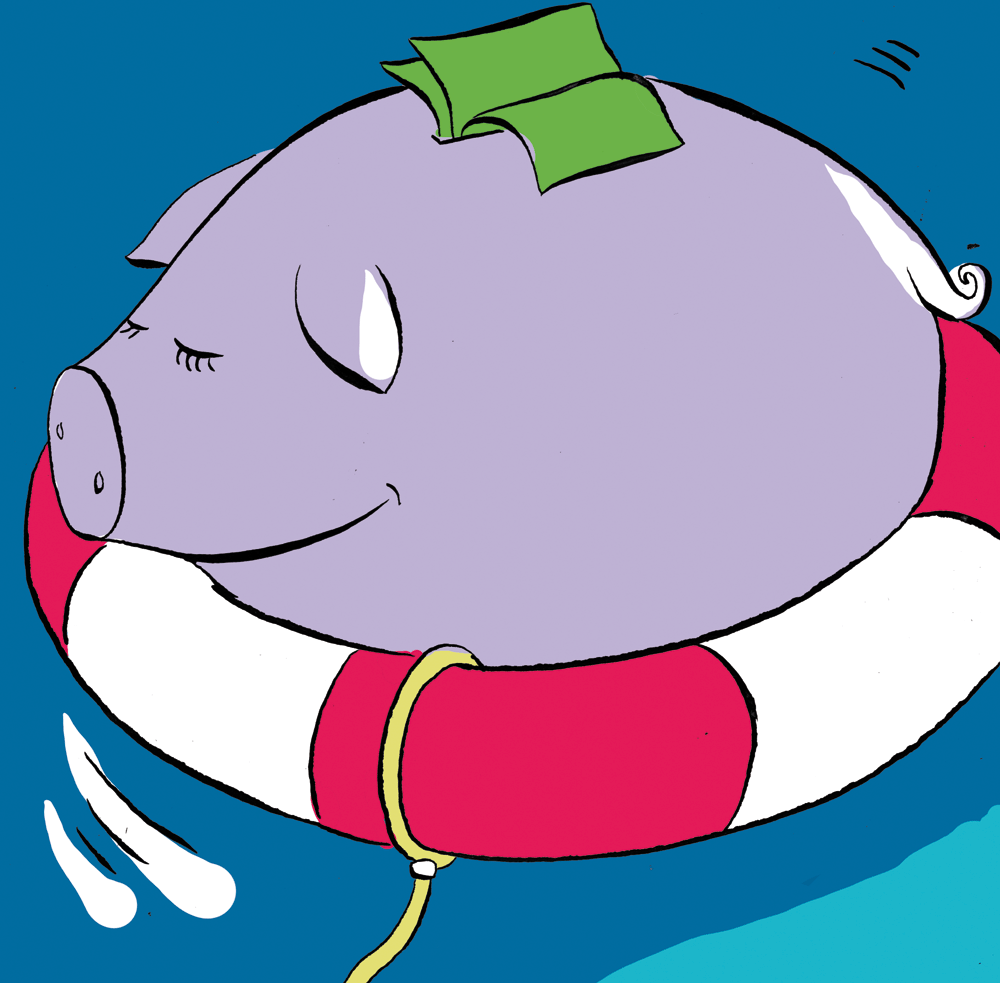
Bridging troubled waters

by Maya Sioufi December 11, 2013
written by Maya Sioufi

All seems relatively quiet in the Lebanese banking world, for now. Lebanon’s banks are still growing. They are still making money, too. While their profits are not swelling at the same double-digit rates as in the past, the fact that they are still in the black is welcome news given the fatigued economy and appalling regional circumstances.  And the banks are still funding the needs of the people and the government without jeopardizing their liquidity.  They are able to do so because of a still steady growth in deposits, the key health indicator for Lebanon’s banking sector.

Deposits still flowing in

Behind the scenes, CEOs and their senior managers are no doubt rolling up their sleeves and working day and night to overcome yet another crisis, one that has lasted longer than expected and with no end in sight. The total size of the sector stood at $159 billion as of the end of September, up 5 percent since the beginning of the year. Customer deposits grew by $6.6 billion in the first nine months of the year — a 5 percent growth rate over last year — with the bulk coming from residents. Chief economists seem relaxed and are not sounding the alarm yet. Bank Audi’s Senior Manager Marwan Barakat estimates that deposits need to grow by 5 percent annually in order for the banking sector to continue meeting the needs of consumers, corporates and especially the greedy sovereign. Nassib Ghobril, head of economic research at Byblos Bank, is satisfied with the average $800 million a month of deposits seen in 2013, but warns that $2 billion flew into banks’ coffers this year following the Cypriot economic crisis as Lebanese brought back home the dough they had parked in the neighboring island. “If you remove that amount, the monthly average would be lower, but we will take it,” says Ghobril.  

The stimulus boost

With deposits still growing, the banks are extending their lending arm and still maintaining their liquidity, a much-needed feature in an unstable environment. The private sector owes banks a total of $46 billion as of the end of September, with banks handing out an additional $2.4 billion in loans in the first three quarters of the year, $500 million less than was handed out last year. That’s despite the boost from the country’s central bank, Banque du Liban (BDL). In January of this year, BDL oversaw a stimulus package of $1.46 billion, and provided the country’s commercial banks with low interest rate loans, at 1 percent, to support certain sectors. Over half of those loans were addressed to the stagnant housing sector. “Without the stimulus, we could have had a contraction in the economy,” says Marwan Mikhael, head of research at Blom Bank.

For next year, BDL’s governor Riad Salameh has plans for another stimulus package but of a smaller size at $800 million. “The first and second stimulus, especially the second one, can have a positive psychological effect,” says Ghobril. With the economy forecast to grow by just 0.7 percent this year according to the London-based Institute of International Finance (IIF), the first stimulus was a critical shot in the arm. As for next year, the IIF forecasts growth to pick up to 2.7 percent if a solution is found to the crisis in Syria; a big if. “I don’t see any factors helping the economy grow faster next year than this year. This year was disastrous. I don’t think it will be worse. I hope. 2014 is so foggy. I refuse to give an outlook,” adds Ghobril.

Give me more

As for the government, its continuous need for capital has been significantly exacerbated this year as the country has borne the cost of the ongoing war in Syria, estimated at a staggering $7.5 billion by the World Bank. The sovereign sucked up 16 percent more loans from the country’s banks in the first nine months of the year, bringing the total amount to $36 billion.

And its reliance on the banks to continue fuelling its rising expenses is unlikely to abate anytime soon, given the World Bank prediction that the majority of the war’s burden — around $4 billion — will be inflicted on the country next year, largely due to the influx of Syrian refugees, currently around 1 million and rising.
 
Replacing provisions

When it comes to the banking sector’s exposure to the fallout from Syria, all the provisions for bad loans have been accounted for: a total of $450 million. “We might have additional income when things improve” says Barakat, but it’s still too early to estimate when that will happen. Now banks are taking provisions for the domestic economy but there are no red alerts as the percentage of loans that are in default, or close to default, relative to total loans — otherwise known as the non-performing loan (NPL) ratio — stands at an acceptable 3.3 percent as of the end of September. “We have been hovering in the 3.3 to 3.5 percent range in the past couple of years so the ratio is maintained within acceptable limits” adds Barakat.

To make up for the strain on their income, banks have had to optimize costs. From freezing recruitment, to holding off on certain branch openings, to revisiting expansion plans, all the options have been put on the table of board meetings. There are currently just over 21 thousand employees in the country’s banking sector. The annual growth rate in the number of employees floated around 6 percent between 2007 and 2010 before dropping to 1 percent in 2011, the year the neighboring turmoil started, and went back to 4 percent in 2012. For this year, Barakat expects another drop in the growth of recruitment of employees. “Banks have become more careful; there is an increase in awareness of the cost factors,” adds Ghobril.

Finding profits

In the midst of these rough waters, the alpha banks — those with deposits over $2 billion — still managed to increase their profits by 1.2 percent in the first nine months of the year, generating a total of $1.3 billion. The losses of the five banks listed on the Beirut Stock Exchange — with profits down 4 percent over the same period — were not linked to activity in Lebanon. Bank Audi saw a 15.5 percent drop thanks to the costs of its expansion in Turkey, dragging down the average of the listed banks. The double-digit profit growth rates enjoyed in the years prior to the turmoil seem long gone for now. With over 85 percent of their profits generated in Lebanon, banks’ profits are unlikely to be stellar until the economy picks up again.

And so the fight for market share continues yet again this year. With the pie not getting much bigger, banks are wrestling for each other’s slices. Smaller banks are competing by offering higher deposit rates according to economists. Last year, the medium-sized banks — those with assets between $200 million and $500 million — grew the most, with a 15 percent growth in their asset base relative to 8 percent for the entire sector, a trend that is likely to continue this year given the ongoing competition. In the midst of this heightened competition, good news and support comes from the Lebanese expatriates who are still sending remittances home. These are expected to reach $7.6 billion in 2013 — or 17.5 percent of the country’s economy — up from $7.3 billion in the previous two years.

A fragile boost

An attempt by the central bank this year to support the startup sector is unlikely to fatten the banking sector’s profits anytime soon. BDL amended a circular in August of this year in an attempt to boost the startup industry by extending interest free loans to commercial banks to the tune of 3 percent of their deposit base — around $400 million — provided the banks invest an equal amount in technology startups, accelerators and incubators. The central bank shares 50 percent of profits generated from the sale of a startup and guarantees 75 percent of the investment. According to Ghobril, this is because the central bank knows that the banks have no appetite for this type of investment. Startup investment “requires specific skills and experiences that the banking sector does not have; venture capital and private equity funds complement commercial banks and don’t replace them, so banks need time to get used to this,” adds Ghobril.

As for those banks that have set their sights beyond the country for lucrative returns, most have planted seeds in countries that have turned sour — Syria, Egypt, Jordan and Sudan for instance — and have had to put their expansion plans to bed. Their managers are in a wait-and-see investment approach for calmer days. Only a select few have ventured beyond the region in recent years, mainly Turkey for BankMed and Bank Audi, and Australia for Bank of Beirut. But so far these expansions still account for just 20 percent of the sector’s overall assets and 15 percent of their profits. Bank performance ultimately comes down to what happens at home. With foreign direct investments expected to drop by 21 percent this year, from $3.8 billion last year according to the Investment Development Authority of Lebanon (IDAL), growth opportunities in the country are getting more and more scarce.

Syria is the cloud that hangs over the banking sector. When that finally clears, the economy and the country’s banking sector will be presented with more favourable conditions to grow. Until then, banking CEOs and their boards are going to have to continue scratching their heads to find breaks in new markets in the quest for higher returns.

December 11, 2013 0 comments
0 FacebookTwitterPinterestEmail
The Buzz

Business briefing: 9 Dec 2013

by Executive Staff December 9, 2013
written by Executive Staff

Economics and Policy

Hundreds of Egyptian police rallied on Sunday to demand higher wages, in a rare act of defiance of a new protest law which they themselves have been enforcing to quell unrest on the streets.

More from Reuters


Qatar’s diversifying economy is set to reap rewards with the non-hydrocarbon sector predicted to be worth more than half of the country's GDP by 2015, according to the country’s biggest bank.

More from Arabian Business


Lebanon has launched a tender to import liquefied natural gas in a bid to cut the country’s energy costs by $2 billion per year, the caretaker energy and water minister has said.

More from The Daily Star


Companies and Business

Middle East carriers witnessed a stellar 14 per cent year-on-year growth in passenger traffic in October, much higher than the global average of 6.9 per cent, according to the latest report released by the International Air Transport Association.

More from Gulf Business


Football fans in the Gulf will be able to get a glimpse of the FIFA World Cup trophy when its official global tour stops off in the region this month.

More from Arabian Business

December 9, 2013 0 comments
0 FacebookTwitterPinterestEmail
The Buzz

Business briefing: 5 Dec 2013

by Executive Staff December 5, 2013
written by Executive Staff

Economics and Policy

UAE president Sheikh Khalifa bin Zayed Al Nahyan has accepted an invitation from Iranian president Hassan Rouhani to visit Tehran.

More from Arabian Business


Caretaker Energy and Water Minister Gebran Bassil has urged politicians to end a dispute that has blocked the passage of key oil and gas legislation, while reiterating that he would not change the January 10 date for the offshore gas auction.

More from The Daily Star


The confidence of Lebanese consumers plunged further this year as the political standoff wreaked more damage to the economy, a new survey showed Wednesday.

More from The Daily Star


Saudi Arabia needs to strengthen its private sector to satisfy demand for jobs by its young population and reduce its dependence on oil exports, a senior International Monetary Fund official has warned.

More from Reuters


Companies and Business

Saudi Arabian banks are scaling back lending as the withdrawal of domestic stimulus has slowed economic growth.

More from Bloomberg


Dubai builder Arabtec Construction was part of a consortium awarded a $1.2bn contract for a hospital in Abu Dhabi.

More from Arabian Business


Hill International has announced that it has received a contract from Real Estate Services Group to provide project management services for the design and construction of two mixed-use tower projects in the Lusail District of Doha, Qatar.

More from Arabian Business

December 5, 2013 0 comments
0 FacebookTwitterPinterestEmail
The Buzz

Business briefing: 2 Dec 2013

by Executive Staff December 2, 2013
written by Executive Staff

Economics and Policy

Lebanon continues to battle with US sanctions on banking secrecy.

More from The Daily Star


The absence of Arab tourists and investors is weighing heavily on the Lebanese economy, said Mohammad Choukeir, president of the Chamber of Commerce and Industry of Beirut.

More from The Daily Star


Iran has said it wants stronger cooperation with U.S. ally Saudi Arabia, as it seeks to ease concerns among Gulf Arab neighbours about a potential resurgence in its influence following a nuclear deal with world powers.

More from Reuters


UAE President Sheikh Khalifa bin Zayed Al Nahyan has announced the allocation of $5.44bn for funding social and economic projects.

More from Arabian Business


Companies and Business

Kuwaiti telecom operator Zain wants to retain majority control of its Bahraini subsidiary after the unit’s initial public offering, but has yet to agree the exact terms of the share sale.

More from Reuters


The chief financial officer of Saudi Prince Alwaleed bin Talal’s investment vehicle, Kingdom Holding, is to leave the firm.

More from Reuters

December 2, 2013 0 comments
0 FacebookTwitterPinterestEmail
Editorial

Rising above the gloom

by Yasser Akkaoui December 1, 2013
written by Yasser Akkaoui

For Middle East watchers, 2013 was a schizophrenic year politically. As the months went by, all the supposed truths about the region after the ‘Arab Spring’ uprisings were contradicted, leaving us deeply confused.

Back in January, there was a democratically elected Muslim Brotherhood government in Egypt, Israel was pushing for an attack on Iran and commentators were still betting on the fall of Bashar al-Assad in Syria. Eleven months later and the military have returned to power in Egypt, Salafists and fundamentalists are growing across the region, Assad looks undefeatable and Iran’s new president is exchanging hugs with Western leaders. In the midst of all this, Lebanon has ground to a depressingly familiar halt. What can we make of it all?

Chaos, clearly, but if there is a lesson to be drawn from the year it is that those, like myself, who believe in liberalism and focusing on economic development have been increasingly sidelined.

The ideals of the Arab uprisings have given way to the return of backroom deals and the principle that might makes right. Those with the guns rule and human rights mean little — we have learned the hard way that the people still don’t have much of a say.

So as we look forward to 2014, perhaps the most depressing lesson for the people of the Arab world is to ignore their politicians. Until geostrategic deals are made and global alliances settle, those in Washington, Moscow, Beijing and elsewhere care little about economic growth. In the face of such insecurity, the only way forward is on your own.

The Lebanese realized this long ago and have given up hope in their inept, corrupt political class. Instead they have gone it alone and faced with seemingly insurmountable challenges time and again they have clutched success out of the jaws of defeat.

This is evident in the few areas of resilience in the economy — banks continue to grow, exports remain stable and exciting new entrepreneurs are emerging. Those that predicted doomsday for Lebanon in 2013 have been proved wrong, and there is little reason to expect a full collapse next year.

Obviously, we wish the circumstances were better — that there was political stability that could lead to another boom. But it was ever thus in this country, and increasingly this region. Stability will remain elusive and the search for opportunities will be more challenging, but we will persevere and succeed. Here’s to 2014.

December 1, 2013 0 comments
0 FacebookTwitterPinterestEmail
The Buzz

Business briefing: 29 Nov 2013

by Executive Staff November 29, 2013
written by Executive Staff

Economics and Policy

Dubai’s prolific win to host Expo 2020 will fast-track infrastructure developments such as rail projects and ramp up logistics facilities that are worth billions of dollars.

More from Gulf Business


Dubai’s measure hits a five-year closing high after the emirate was chosen to host World Expo 2020, although the benchmark gives back more than half of its intraday gains.

More from Reuters


A decrease in imports reduced Lebanon’s trade deficit in the first 10 months of 2013 by about $2.8 billion compared to the same period of 2012.

More from The Daily Star


Lebanon could face further power cuts if the outstanding dues to Electricite du Liban are not paid soon, caretaker Energy and Water Minister Gebran Bassil has warned.

More from The Daily Star


Turkey and Iraqi Kurdistan have signed a package of landmark contracts that will see the semi-autonomous region's oil and gas shipped to international markets via pipelines through Turkey.

More from Reuters

November 29, 2013 0 comments
0 FacebookTwitterPinterestEmail
The Buzz

Business briefing: 27 Nov 2013

by Executive Staff November 27, 2013
written by Executive Staff

Economics and Policy

Most foreign oil firms are still keen to operate in Lebanon despite the delay in launching the offshore gas auction.

More from The Daily Star

FIFA president Sepp Blatter on Tuesday defended under-fire 2022 World Cup hosts Qatar over what he called “unfair” European media attacks.

More from Reuters


The UAE government is to spend $1.36bn building new homes for 10,000 Emiratis.

More from Arabian Business


Companies and Business

Saudi state oil company Saudi Aramco said on Tuesday it had shut some of its computers for an upgrade and denied it had suffered a cyber attack similar to one it experienced last year.

More from Reuters


Qatari telecommunications firm Ooredoo has launched a $1.25 billion, five-year sukuk, the firm's first Islamic bond.

More from Reuters


Dubai-based property firm Damac Real Estate has extended roadshows on a London IPO by four days because the verdict on Dubai's bid to host World Expo 2020.

More from Reuters


General Electric Co said on Tuesday it signed a nearly $700 million deal with Saudi Electricity Co to supply natural gas turbine generators.

More from Reuters


November 27, 2013 0 comments
0 FacebookTwitterPinterestEmail
Business

Raising standards

by Thomas Schellen November 26, 2013
written by Thomas Schellen

The Syndicate of Safety and Security Professionals in Lebanon (SSSPL) and its member companies address two market needs. Fire prevention, detection and response systems are one central need; the other is for security systems such as intrusion alarms and access control and monitoring systems including Closed Circuit Television (CCTV).

According to Riccardo Hosri, the current SSSPL president, the syndicate’s main concern is “to become a label of quality” that will allow member companies to differentiate themselves as reliable providers of safety and security systems.

To achieve this, the organization has revamped its bylaws and is currently implementing a set of standards that member companies have to adhere to in their commercial, financial and administrative practices.

These standards oblige member companies adopt ethical practices, such as recycling, but they also include provisions against offering kickbacks or gifts in order to win contracts. The process of drafting and agreeing to the standards among all 28 member companies took two-and-a-half years as the firms are all in competition with one another, Hosri told Executive. “We are trying to work against human nature and put limitations on ourselves. But if we don’t do this, we don’t have credibility.”

When SSSPL was established in 1999, the organization had what appeared to be a defensive character. Globalization and the arrival of manufacturers from the emerging Far East in international markets meant that competition heated up, as opportunistic importers offered low-cost systems to the local market. Faced with the intrusion of what the founding members considered to be substandard quality, Hosri said they “came together to set some market standards and try to maintain a minimum quality in the sector.”

Educating the market

Efforts were poured into educating  the target market, which according to Hosri initially greatly lacked awareness of the value of security systems so that it took months to complete a sale. This has changed and the market has become driven by demand, but competition from what they perceive as unqualified or unproven vendors is still a big issue for the SSSPL members.

To ensure that the market can distinguish competent local vendors from unprofessional operators, the SSSPL devised a process of accession and certification. To obtain a to-be-coveted “professional installer certification”, or PIC, a company has to first be a full member of the syndicate. Before granting this status, SSSPL requires that a new applicant has been operating in Lebanon for one year. The applicant can then progress to full membership in a process taking a minimum of another two years as a guest and associate member.     

So many companies are interested in joining SSSPL that the organization’s ranks could increase by more than half. Hosri added that the syndicate is now preparing to admit new corporate members after the revision of its bylaws won ministerial approval in August. According to the revised bylaws membership will be opened to individuals, such as consultants and installers, and to companies with other security specializations, such as guard services.

That complex accession rules of organizations can turn into entry barriers is evidenced by the World Trade Organization’s recent history of what is euphemistically still called the Doha Round. However, there is an argument for a restrictive and perhaps even protectionist procedure given that the Lebanese state and its administrative organs have not installed any regulations and governance processes to supervise the quality of private safety and security. Since the security services and systems have touch points with sovereign responsibilities, the real aspiration of the SSSPL is to operate under a framework where a qualified public sector authority properly regulates, licenses and supervises the companies in this sensitive realm.

November 26, 2013 0 comments
0 FacebookTwitterPinterestEmail
Comment

Erbil booms despite blasts

by Riad Al-Khouri November 26, 2013
written by Riad Al-Khouri

Iraqi Kurdistan was tense end-September with the announcement of somewhat contentious election results, and the staging of a rare terrorist attack. Inevitably, the overall effect was to dampen business confidence. However, are these mere pinpricks, or more ominous signs?

Erbil doesn’t yet have that most accurate of all measures of business confidence, a sophisticated, broad-based, and large stock market. In most other places, it’s simple to gauge the state of the economy, just by looking at the bourse. Yet this will also be the case in Kurdistan next year with the announcement in October that NASDAQ is helping to set up a trading system for the Erbil Stock Exchange to start operating in June. Along with existing firms, the Kurdistan Regional Government (KRG) plans to trade shares on the bourse of new joint ventures with private partners in agriculture, tourism and industry. Estimates in Kurdish investor circles are that trading will begin with a daily volume of $4 to 5 million, and that around 25 companies will list shares on the Erbil exchange by the end of 2014. Of course that is tiny compared to other exchanges, but the prospects are good, thanks to massive amounts of oil on which Kurdish prosperity is based.

The Kurds estimate their crude reserves at 45 billion barrels, and are building an oil pipeline as a step toward economic self-sufficiency. Based on such wealth, coupled with stability, consumer confidence is much higher in Kurdistan than in Baghdad or the northern non-Kurdish governorates, according to TNS MENA, a market research organization that recently unveiled a study of the country.

Of the two parts of Kurdistan’s winning combination — oil and a stable political environment — the former is underpinned by continuing growth of production. The latest example came in October when a multinational consortium received approval from the KRG for the first phase in the development of the Atrush block, located 85 kilometers northwest of Erbil; this is expected to initially produce approximately 30,000 barrels per day (bpd) with the first output due by early 2015. Discovered in 2011, the block is operated by TAQA Atrush, a subsidiary of the Abu Dhabi National Energy Company, which holds a working interest in the block along with the US company Marathon Oil, and others.

Approval by the KRG gives TAQA and its partners 25 years to recover resources. The group plans to invest more than $300 million during the first phase of the work, including drilling three production wells and constructing a central processing facility, while preparing to drill a fourth well. Subject to appraisal and KRG approval, Phase 2 development is expected to include another 30,000 bpd of production, while TAQA and its partners will also evaluate the feasibility of producing associated natural gas.

As for stability, the September explosions in Erbil — apparently the work of Islamist extremists — were the exception that proved the rule: since 1991, when the Kurds achieved autonomy, the region has been peaceful compared to the rest of Iraq. As such, the recent terrorist attack is seen as an isolated incident, not the beginning of major instability.

Meanwhile, the election for the regional parliament, which took place a week before the explosions, called attention to public frustration over alleged corruption by politicians in a healthy democratic way. The Kurdistan Democratic Party (KDP) secured 38 seats in September’s vote for the 111-seat regional parliament, having previously held 30. The main opposition party Gorran (Kurdish for “change”) won 24 seats (compared to 25 last time) and the Patriotic Union of Kurdistan, which ran in coalition with the KDP in the last election but on its own this time, won only 18 seats, sharply down from last time’s 29. The results do not upend the domination of the KDP and its leader, KRG President Barzani, who is seen as having brought prosperity to the region. He has also been skillful in managing disputes with the government in Baghdad over territory, natural resources, and power sharing. Keeping this friction under control, and eventually resolving differences with Iraq’s central government, remain challenges for the KRG, but ones that can be addressed. In the meantime prosperity will continue.
 

Riad al Khouri is senior consultant at the Institute for Democracy and Election Studies (IDES) at the University of Jordan, Amman

November 26, 2013 0 comments
0 FacebookTwitterPinterestEmail
Business

Celebrity endorsement – a brand’s boon or bane?

by Line Tabet, Zeina Loutfi & Ramsay G. Najjar November 26, 2013
written by Line Tabet, Zeina Loutfi & Ramsay G. Najjar

Those of us living in Lebanon can’t but notice the recent profusion of ads featuring celebrities promoting different causes: actors and athletes encouraging people to drive carefully, well-known female figures supporting breast cancer awareness month and singers vowing to protect the environment. More recently, local corporate brands seem to have jumped on the bandwagon, with a partnership between a financial institution and a leading TV talk show host.

Celebrity endorsement has become a common communication practice: Every week we hear about a new deal, sometimes rumored to be in the seven figures, and the consumer landscape is now filled with celebrities plastered on billboards, magazines, TV ads and on our daily news feed on social media. The point is: celebrity sells.

Throughout the years, evidence has shown that celebrities sponsoring products is beneficial, especially in cluttered markets, to generate buzz and get people talking. However, as many brands have learned, connecting their image to that of a person can sometimes go horribly wrong.

Win-win

Celebrity endorsement is first and foremost a marketing tool used by companies to enhance their brand equity and increase their name recognition. Let’s take the example of Nike, an iconic brand famous for its consistent use of celebrities to endorse its wide range of products.

When Nike sponsored Michael Jordan in 1984 and Tiger Woods in 1996, the brand was still known primarily for sponsoring tennis and track athletes. By partnering with the world’s top basketball player and golfer, Nike succeeded in expanding into new markets. It created the subsidiary company “Air Jordan” in the first case and in the second, changed the perception of golf from that of an elitist game to one appreciated by and accessible to all.

As mentioned earlier, celebrity endorsement sells. In fact, from a pure marketing and sales perspective, associating a brand with a celebrity greatly influences consumers’ purchases. It is no secret that people look up to celebrities and do their best to imitate them, and one of the easiest ways to do so is by buying the products they seem to prefer. We all remember the buzz that surrounded the ad campaign for men’s underwear featuring David Beckham, which reportedly even caused traffic jams. More than just a pretty face, sales for H&M’s Bodywear line went up 28 percent after Beckham’s campaign this year, according to Selfridges, one of the UK’s leading retailers.

“Because I’m worth it” has become an instantly recognizable tagline, thanks to L’Oréal’s ads featuring a stream of celebrities endorsing each product. There may well be better products on the market, but who wouldn’t want to have the perfect complexion of Aishwarya Rai or the glossy hair of Eva Longoria? In fact, a celebrity testimony adds credibility to the product and ultimately increases sales and revenues.

Away from its mercantile dimension, when celebrities support causes through public service announcements, they succeed in drawing the public’s attention and raising awareness around important social issues. In the United States, the renowned “Got Milk” campaign, famous for its white moustache, featured athletes, musicians, actors and politicians, among others, all pitching in to shed light on the importance of living a healthy lifestyle. In Lebanon, a leading NGO focusing on road safety launched an awareness campaign by featuring local celebrities including dancers, actors and media figures.

Potential drawbacks

That said, and despite all these advantages, celebrity endorsement can certainly go wrong, bringing significant harm to the brand’s image.

Let’s talk about Credit Suisse, Rolex, Wilson, Nike, Mercedes Benz, Jura, Moet & Chandon, Lindt, Gillette and Nationale Suisse. While this might seem like a random listing of brands, they do have a common denominator: the endorsement of Roger Federer. From here comes a major drawback of celebrity affiliation: overexposure. As the popular saying goes, “less is more”. In fact, when a celebrity is involved with a large number of brands, his or her credibility might suffer, which then reflects on the brands themselves. Consumers feel that the endorser is motivated by financial remuneration rather than promoting a product he or she truly believes in, which will in turn dilute the message the brand wants to convey.

Another problem is one of human nature. Image changes, celebrities lose their fame, people make mistakes and celebrities can go off script. When they do, it takes a toll on the brand. A brand can be seriously damaged because of an image gone bad: Nike had to deal with the Lance Armstrong and Tiger Woods scandals, and recently that of Oscar Pistorius, the South African Paralympic champion charged with murdering his girlfriend.

Another risk a brand faces when using a celebrity is that the consumer might focus on the endorser rather than the product itself. This is especially true when the brand and its recognition are not yet mature or well-established in consumers’ minds. This creates an overshadowing effect whereby consumers remember the celebrity and not the brand. Case in point: Very few consumers in the US and elsewhere seem to recall the 2005 partnership between St John, the luxury brand apparel, and Angelina Jolie, which lasted three consecutive years.

Getting it right  

For many companies, celebrity endorsement seems to be the perfect communication initiative that can propel the product and the brand. However, given the risks and the price brands will have to pay in case of failure, companies should look into many parameters prior to investing in a multi-million dollar deal.

Is celebrity endorsement right for the brand? The first question to answer is whether celebrity endorsement is the right strategy to follow. Has the brand been established and rooted long and well enough in consumer minds that it would not risk being overshadowed by a celebrity? As an example, at a certain point, Rolex had endorsement deals with 24 golf players, seven tennis professionals, four equestrians, three yachtsmen, two race car drivers, a skier and a polo player. Never once has that eclipsed the recognition of this mature brand.

How to ensure the success of the partnership? If the answer to the first question is yes, then the company needs to set the right key performance indicators to measure the effectiveness of the partnership: What are the objectives the brand is trying to achieve by the association? What are the right measurement tools to assess the effectiveness of the endorsement in achieving its objectives?

How to select the right celebrity for the brand? At this point, selecting the right celebrity to become the spokesperson for the brand becomes critical.

Profile: Companies need to ensure that the celebrity is attractive enough to create a positive association with the product or service. Moreover, the image of the celebrity needs to be consistent and in line with that of the brand to successfully establish a strong personality and identity for both. Most of us fell for the obvious charm of George Clooney walking into a Nespresso shop to buy a machine and have his daily espresso. Yet beyond the seduction and wit of the ads, George Clooney also perfectly represented the image Nestle wanted to convey about this new product: dark, rich, refined and mature.

Relevance: When famous weight loss programs decided to team up with celebrities to endorse their products, they chose those who struggled with weight loss and who achieved their goals by resorting to the dieting plans offered by them. From here we see the importance of showing a clear relevance and association between the celebrity and the product and/or service.

Credibility: Selecting a global ambassador should be a smooth transaction, whereby the celebrity should not come across as selling the product but rather endorsing it for the various benefits and advantages it brings to his or her lifestyle. Indeed, many celebrities were the laughing stock of consumers when it was clear that their association with a brand was more of a business transaction. Drinking Coca Cola while endorsing Pepsi, using an Apple product when sponsoring Samsung, or even driving a Bentley when endorsing a Volkswagen are common missteps that negatively affect the brand and harm its credibility.

Opting for celebrity endorsement when the brand is just not ready or spending money on the wrong person can be detrimental to a brand. Not setting the right objectives and tools to measure success is another mistake when embarking on an expensive celebrity relationship. It is therefore essential that brands develop a well-thought out strategy before striking a deal, as the rumored seven figure numbers we hear about can become painfully real when brands have to pay the price for an endorsement gone wrong.


Line Tabet, Zeina Loutf and Ramsay Najjar work for communication firm S2C

November 26, 2013 0 comments
0 FacebookTwitterPinterestEmail
  • 1
  • …
  • 224
  • 225
  • 226
  • 227
  • 228
  • …
  • 697

Latest Cover

About us

Since its first edition emerged on the newsstands in 1999, Executive Magazine has been dedicated to providing its readers with the most up-to-date local and regional business news. Executive is a monthly business magazine that offers readers in-depth analyses on the Lebanese world of commerce, covering all the major sectors – from banking, finance, and insurance to technology, tourism, hospitality, media, and retail.

  • Donate
  • Our Purpose
  • Contact Us

Sign up for our newsletter

    • Facebook
    • Twitter
    • Instagram
    • Linkedin
    • Youtube
    Executive Magazine
    • ISSUES
      • Current Issue
      • Past issues
    • BUSINESS
    • ECONOMICS & POLICY
    • OPINION
    • SPECIAL REPORTS
    • EXECUTIVE TALKS
    • MOVEMENTS
      • Change the image
      • Cannes lions
      • Transparency & accountability
      • ECONOMIC ROADMAP
      • Say No to Corruption
      • The Lebanon media development initiative
      • LPSN Policy Asks
      • Advocating the preservation of deposits
    • JOIN US
      • Join our movement
      • Attend our events
      • Receive updates
      • Connect with us
    • DONATE