• Donate
  • Our Purpose
  • Contact Us
Executive Magazine
  • ISSUES
    • Current Issue
    • Past issues
  • BUSINESS
  • ECONOMICS & POLICY
  • OPINION
  • SPECIAL REPORTS
  • EXECUTIVE TALKS
  • MOVEMENTS
    • Change the image
    • Cannes lions
    • Transparency & accountability
    • ECONOMIC ROADMAP
    • Say No to Corruption
    • The Lebanon media development initiative
    • LPSN Policy Asks
    • Advocating the preservation of deposits
  • JOIN US
    • Join our movement
    • Attend our events
    • Receive updates
    • Connect with us
  • DONATE
The Buzz

Morning briefing: 21 Mar 2013

by Executive Staff March 21, 2013
written by Executive Staff

Economics and Policy

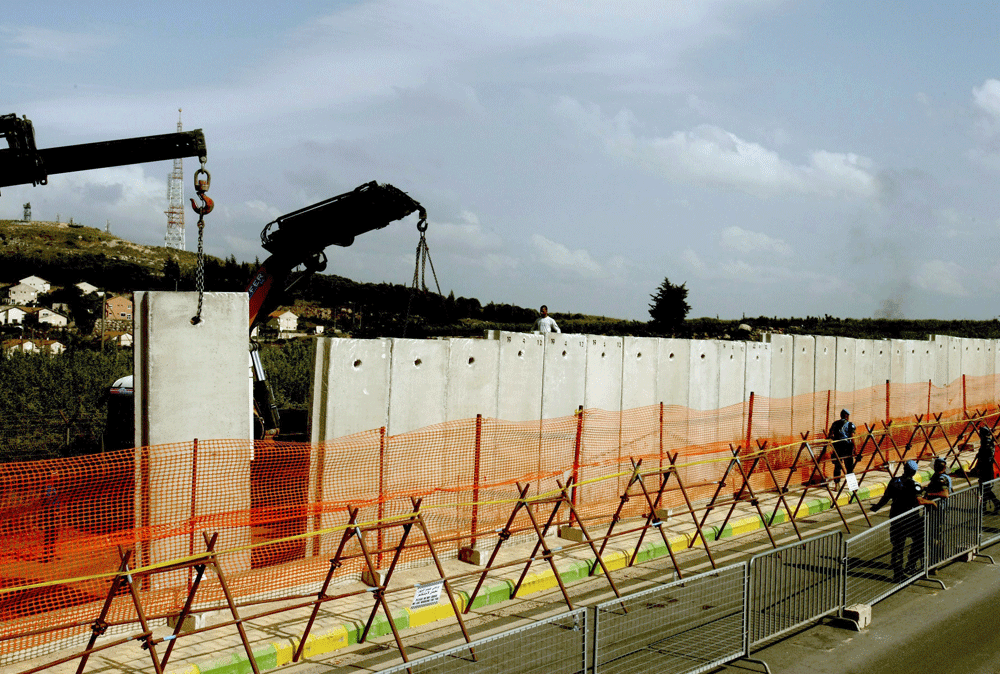
Cyprus has turned to Russia for emergency help to avert a financial meltdown.

More from The National


Fitch has affirmed Saudi Arabia's AA-minus rating but said the country could see an upgrade in coming months because of progress in handling social stressors and strengthened budget buffers.

More from Reuters


When it raises tolls in May, Egypt's Suez Canal Authority will know that fuel costs rule out alternative routes, but some in the shipping industry say the calculation could reach a tipping point if the risk of delays from unrest increases.

More from Reuters


Companies and Business

An Egyptian court overturned on Wednesday a public prosecutor's decision to freeze the assets of 23 investors and officials, including several from the Gulf, who are under investigation for alleged stock market manipulation.

More from Reuters


Qatari shipbuilder Nakilat Damen Shipyards Qatar (NDSQ) has signed a contract for the construction of a 69m-long fast luxury vessel, to be built entirely in the Gulf state.

More from Arabian Business


Kuwait plans to cut the number of foreign workers by 100,000 every year for the next decade, reducing its expatriate population by more than half.

More from The National


Dubai-based DP World, the world’s third largest ports company, has announced record profits of $555 million in 2012, up 21 per cent compared with $459 million in 2011, helped by the sales of several of the firm’s assets.

More from Khaleej Times


Emirates, the world’s biggest airline by international passenger traffic, said it needs about $5 billion in the year starting April to pay for planes.

More from Bloomberg

March 21, 2013 0 comments
0 FacebookTwitterPinterestEmail
Finance

Wall Street’s Lebanese connection

by Maya Sioufi March 21, 2013
written by Maya Sioufi

Executive is in New York. As we embark on our 2013 mission to engage the successful and influential Lebanese diaspora in order to relay their stories, inspire hope and propose solutions to the country’s numerous challenges, we are meeting with some of the biggest Lebanese names in global finance for a special feature in April’s magazine. 

Running up and down Madison and Park Avenue, we are engaging Lebanese financial executives in debates to understand how they made it to the Big Apple and what advice they have to Lebanese graduates kicking off their careers.

See also: The Lebanese Empire

How Lebanon could raise $1 billion a year

“I would love to see Lebanon becoming a center for capital markets in the Middle East. You have all the ingredients in place except for the political and regulatory landscape,” says Beirut-born Anwar Zakkour, vice chairman of JP Morgan investment banking, as he explains what he would like to see from his home country. “There are lots of expatriates who would love to see it happen and who would love to invest in something like this but for some reason or another, we never see it flourish.”

With roots in Bcharre, Habib Kairouz, managing partner at venture capital firm Rho Capital Partners, says convincing talented young Lebanese not to emigrate is key to the country’s development. “I don’t want to encourage people to follow my path as I want people to stay in Lebanon. Through every organization I am involved with, such as Endeavor [a non-profit nongovernmental organization that supports high-impact entrepreneurs in emerging markets] and LIFE [Lebanese International Financial Executives], I work to convince people to stay,” he says. “But if my son was graduating from a college in Lebanon today, could I consciously tell him to put his career path in Lebanon? It’s a tough one.”  

We are also aiming to address what the expatriate community want to see in terms of reforms before they would consider returning and deploying further capital in their home country. “Lebanon is in dire need of public service and of people giving back to make their country a better place. But look at the confessional system, we still have to appoint each person based on their sect,” says Marc Malek, founder of alternative asset management firm Conquest Capital. “If I decide tomorrow I want to shut everything I have here, go back and live in Lebanon, dedicate my life to public service and do it for free, I won’t be allowed because I am from a minority Christian sect, Syriac orthodox.”

As we reach out to the expatriate community, we strive to contribute to the advancement of the country by inspiring the Lebanese youth, putting forward alternative solutions critical to Lebanon’s current investment climate and reviving faith that a better future is possible.

March 21, 2013 0 comments
0 FacebookTwitterPinterestEmail
Economics & PolicyLebanon's oil and gas

Plan ahead to protect the environment

by Ricardo Khoury March 20, 2013
written by Ricardo Khoury

Lebanon’s progress to cultivate wealth from its offshore oil and gas resources has left us with more questions than answers. While the country will not extract any resources for at least five years, the agreements being negotiated in the next 12 months will determine whether Lebanon gets a good deal or not.

Over the course of five days, seven leading thinkers will discuss different aspects of the resources — from avoiding environmental destruction to how to spend the new wealth — each with the aim of helping provoke awareness about what is going on in this crucial period.

For our fourth segment, Ricardo Khoury argues early planning can protect Lebanon from environment catastophe. 

See also: Lebanon's Petroleum Administration makes a positive start

Avoiding a regional war over hydrocarbons


The launching of the prequalification process for Lebanon’s first oil and gas licensing round is a significant step towards the development of hydrocarbon resources in the country. But while many topics are being discussed related to the offshore finds, little is being spoken about the potential environmental impacts of the sector.

A lack of planning could lead to severe environmental and social impacts.  While most people are concerned with the risks of major oil spills that could have devastating impacts on our shorelines — although our neighbors are probably more at risk than we are because currents will mostly drive spills towards the north — there are many other issues to be dealt with and that are more certain to occur in the event of major hydrocarbon finds.

So far although a strategic environmental assessment (SEA) study has been prepared, as required in Lebanon’s Offshore Petroleum Law as an environmental planning instrument, it has not yet been disclosed to the public. Not much is known about the results of the study and whether it has provided strategic inputs to guide environmental decisions early on in the sector’s development process.

The SEA could help, for example, to guide the Petroleum Administration in designing the licensing bid and providing guidance to developing sound environmental policies for the sector. Environmental criteria could, for example, be used when deciding on the number and the geographical location of the blocks under the first licensing round.

The scale and significance of environmental impacts associated with the exploration and production of petroleum resources in Lebanon are intrinsically related to outcomes of the exploration phase of the first awarded block(s). For instance while the impacts associated with exploration activities — which may include some additional seismic surveys, drilling of exploratory wells, and establishment of on-shore support facilities — may not be significant, impacts in the case of multiple production areas (in which exploration activities revealed commercial findings of gas) could cause significant pressure on the Lebanese environment. The potential for routine and accidental damage are even higher if both gas and crude oil commercial findings are revealed.

Not quite so offshore

If commercial findings are made, the infrastructure required to transport, process, store and offload hydrocarbon finds range from ultra-deep water subsea installations and pipelines to relatively large on-shore supply bases which support the offshore installations. What some people may not realize is that while the production facilities are off-shore, most of the significant impacts may actually occur on-shore or near-shore.

Relatively large areas (possibly in the order of hundreds of thousands of square meters) will be required for hydrocarbons processing, storage and further delivery for use. This will undoubtedly impact on land-use (in an already densely populated coastal area), air emissions (mainly associated with flaring and further increasing Lebanon’s carbon footprint), noise, pressure on transportation infrastructure, and waste generation.

Furthermore in the case of gas, once processed, it would need to be transported to the local power plants (if priority is first given to domestic use). Current plans are to convey gas along an on-shore coastal pipeline running across the entire coastline.

The environmental impacts of such a plan need to be more carefully studied bearing in mind the various crossing of the pipeline with surface water bodies and other land-uses. Such detailed studies would be needed to ascertain that safety zones can be secured along the densely populated littoral. This is where not only environmental, but a more holistic health, safety and environmental assessment of such projects become instrumental planning tools to be used by regulators and planners.

Furthermore, while economic analyses may indicate that an onshore pipeline is more cost-effective than an offshore one, if resettlement of those people living in affected areas is required to meet safety standards then associated costs would rise significantly.

The recently established Petroleum Administration (PA) has the challenging job of understanding the potentially significant negative environmental impacts early on in the process and designing mitigation strategies and policies that will avoid them.

Early planning will lead to savings in the long term, both financially and environmentally. For example given the very limited availability of space onshore, the PA may encourage the adoption of off-shore floating solutions such as FPSO (floating, production, storage and offloading vessel). Such an option, although expensive, would not only relieve the coastal area from significant pressure, but may also protect marine habitats as lengthy pipelines bringing hydrocarbons onshore would not be needed. Such solutions also provide flexibility in the long-term, as they can be moved to another location once fields are exhausted, and do not require the decommissioning of extensive areas onshore.

There are other areas where the PA should provide policy directions as early as possible, such as in the areas of flaring (by promoting the adoption of zero-flaring philosophies in design) and waste management (will drill cuttings be allowed to be disposed in the sea or need to be sent for treatment and disposal offsite?).

Given the limited waste infrastructure, the PA could promote treatment of wastes in common offshore facilities to be established (introducing the concept of shared off-shore infrastructure facilities among the different fields and operators) or even promote transboundary cooperation (notably with Cyprus).

These are just a few of the myriad issues to be considered if Lebanon is to successfully extract oil and gas without causing irrevocable damage to the environment. They can only be dealt with if the government and the PA take a proactive approach to addressing a lack of health and safety legislation related to oil and gas, the lack of a national contingency plan (current plan considers only the case of natural disasters and foreign invasion, but not the case of large scale oil spills), data deficiency, and a lack of waste management infrastructure.

Development of the Lebanese hydrocarbon resources will not come without environmental impacts, however these can surely be controlled with sound environmental planning. The earlier such planning is integrated in the government’s activities, the better it will be for our environment’s and people’s welfare.


Ricardo Khoury is a senior environmental engineer and managing partner at ELARD, a regional consulting firm providing specialist services to the oil and gas sector. He consults for major international oil companies, government bodies, engineering firms and contractors operating in the sector, with a particular focus on the Middle-East and GCC region.

March 20, 2013 0 comments
0 FacebookTwitterPinterestEmail
Economics & PolicyLebanon's oil and gas

Transparency is not enough

by Zara Rahman March 20, 2013
written by Zara Rahman

Lebanon’s progress to cultivate wealth from its offshore oil and gas resources has left us with more questions than answers. While the country will not extract any resources for at least five years, the agreements being negotiated in the next 12 months will determine whether Lebanon gets a good deal or not.

Over the course of five days, seven leading thinkers will discuss different aspects of the resources — from avoiding environmental destruction to how to spend the new wealth — each with the aim of helping provoke awareness about what is going on in this crucial period.

For our third segment, OpenOil's Zara Rahman discusses how to push the government to be transparent.

See also: Lebanon's Petroleum Administration makes a positive start

Avoiding a regional war over hydrocarbons


Transparency has become something of a buzzword for Lebanese politicians, most recently former Prime Minister Fouad Siniora, as they suggest ways to avoid corrupt practices and bad governance in the country's nascent gas industry. But publishing information and signing up to transparency initiatives is not enough; this transparency needs to be coupled with information accessibility in order for the information provided to bring actual value to the process, and it needs the Lebanese people to stay involved and interested in what the government is doing with their natural resources.

One way of understanding transparency in the extractive industries can be as making information public about what is going on, at every stage of the value chain. To prevent hidden favors, governments should be publishing contracts, releasing procurement tenders online and announcing licensing rounds and bidding rules to the wider public at the same time.

But the problem with this type of transparency, at least in the extractive industries, is that often the information released cannot be understood by the vast majority of the population. As such its value is lost, simply because it is not coupled with the tools needed to understand and use that information. The fact that a government is putting information online – often without advertising how to find it or putting in a format easily read and understood – does not necessarily contribute in concrete terms towards making it a 'transparent' government.

Take, for example, the Kurdistan Regional Government, which has published their signed contracts online. This step was welcomed as a clear sign of their commitment towards a transparent and open extractives sector, and rightly so, but the fact that the contracts are available only in Adobe Flash format has a huge effect on the way they can be understood. This format means that only one page can be viewed at a time from the KRG website, and also that only one page can be printed at a time. Without being overly critical – because their very decision to put the contracts online has been a great step in the right direction – the format they chose (whether this was a conscious decision or not) hindered the accessibility of the information.

Other countries have released statements saying that they have decided to put their contracts online; but a search for them comes up with nothing. Whether that means that they then decided to take them down, that they put them online on an obscure URL where people are unlikely to find them, or whether they were simply lying in the first place is not clear. What is clear, though, is that statements of transparency effectively mean very little unless a government takes the extra time to ensure sure that people can easily access that information.

Furthermore, we need to help people get past the legal jargon as oil contracts are often seemingly impenetrable to the untrained eye. To an oil and gas contract lawyer, these contracts can reveal huge amounts of information about what was focused upon in the negotiating room, what was conceded by the company and the government, and who is getting the 'best' deal out of the contracts. But to anyone else, reading the contract from scratch can be a thankless task; like reading a foreign language without a dictionary.

International organizations are taking steps now to make these contracts accessible: including (disclaimer: a project the author was involved in) OpenOil, which produced the first non-specialist guide to understanding contracts last November, released under the Creative Commons license. This book was designed to be a guidebook to allow citizens to really understand the issues covered in oil contracts, in order for them to act as an effective and real watchdog upon both their government and companies.

Other tools are also available, in the form of training courses around contracts and policy issues, and internet-based resources such GOXI – the social network which brings together experts working on governance of the extractive industries worldwide.

So let's say, in theory, that the Lebanese government really commits to transparency, and provides a single resource center where information on the process can be found – including any contracts the government may sign with international companies and clear announcements for calls to tender. The next crucial step is finding people within Lebanon to take that information and use those tools to really get inside the process and understand what is going on.

This group of people does not, necessarily, have to be civil society; it could also be people from the local private sector, who want to ensure that they have the best possible chance of gaining business from the deals their government is making with international oil companies. Or it could be engineering students who want to be sure that they are getting the opportunity to be trained to international standards by the companies – in contract speak, that there is a strong “local content” clause. Or, even better, a mixture of many different groups – the more people involved in really understanding that information and making well informed decisions on what should or should not be happening, the better.

These people need to take the tools available now, and begin to really understand what can, or should, be going on in the industry. This group of people, however small, can then disseminate the information to the wider public in more comprehensible terms; essentially democratizing the whole process and allowing the highest number of people possible to really have a handle on what is going on with their oil and gas industry.

In order for Lebanon to have the best chance of a corruption free and responsibly managed oil and gas sector, the commitment towards transparency needs to come from all levels of society. The government cannot do this alone; it needs citizens to act as a watchdog, both for the government itself and on the companies it is doing business with. These citizens must make sure that every party involved is acting in an economically and socially responsible way. Knowledge is power; and this power should belong to the Lebanese people, just as the natural resources do.


Zara Rahman is a Research Associate at Berlin-based transparency organization and publishing house, OpenOil

March 20, 2013 0 comments
0 FacebookTwitterPinterestEmail
The Buzz

Morning briefing: 20 Mar 2013

by Executive Staff March 20, 2013
written by Executive Staff

Economics and Policy

Brent crude rose toward $108 a barrel on Wednesday, recovering from a three-month low hit in the previous session, on hopes that a deal to bail out Cyprus could be reached although the uncertainty kept a lid on prices.

More from Reuters


Gold held steady on Wednesday, close to a three-week high as Cyprus's rejection of bailout terms triggered worries about a default and underpinned safe haven demand in gold.

More from Reuters


Lebanon’s long-awaited new salary scale draft law will be tied to an increase in working hours of civil servants and a tax hike on luxury goods, State Minister Marwan Kheiireddine has said.

More from The Daily Star


Depositors will rush to withdraw their money from Lebanese and foreign banks operating in Cyprus unless the EU abandons its demand to tax all deposits in the island, bankers have said.

More from The Daily Star


Rising oil trade between Iraqi Kurdistan and Turkey threatens to split Iraq in two, a senior Iraqi official said, as the autonomous region ignores Baghdad's threats of tough action against what it terms illegal exports.

More from Reuters


Business and Companies

Saudi Arabia’s attempts to reform its expatriate-heavy labor market have put more than 600,000 locals into jobs at private companies, a senior official said on Tuesday, a sharp increase over previous rates.

More from Reuters


The Middle Eastern owner of Leeds United has signalled that it is in talks to sell the former English Premier League soccer club it bought only in December.

More from Gulf Business

March 20, 2013 0 comments
0 FacebookTwitterPinterestEmail
The Buzz

Running the Code Marathon

by Joe Dyke & Robert Biddle March 20, 2013
written by Joe Dyke & Robert Biddle

It was not until the can-can came on that Firas finally lost it. The tall, bearded man rushed to the sound system, cranked it up to full volume, raised his hands and wiggled his body – somewhere between a dabke and the Harlem Shake, but definitely nothing like the can-can. The moves failed to illicit much of a response; the half dozen men around him briefly looked up before returning to their computer screens. But that was 2:00 am on Sunday morning — hour 34 — and a lot had already happened by then.


Developing developers

Hackathons — where developers are given a finite amount of time to design and build a particular product — are relatively common in the West. But this is not Silicon Valley or London, but Beirut. While Lebanon’s Internet is among the slowest in the world, the last two years have seen rapid improvements, and a development community is, well, developing.

For this event, created, and initiated by Lebanon’s leading telecoms operator Touch, the crème de la crème of the country’s developers turned up at AltCity, an alternative space for techies in the Hamra district.

The basic principle is simple: teams are given 48 hours to create a workable model of a mobile app using Touch’s new Touch Cloud, which provides simple back-end services for app development. The winning team receives $1,000 cash, a Samsung smartphone for each member and an assortment of other prizes that help the team further develop their app.

While it is a competition, teams are encouraged to collaborate, especially when it comes to figuring out how to use the unfamiliar back-end. Experts from Touch and other organizations such as the Cisco Entrepreneur Institute and the Ministry of Telecoms, who sponsored the event, were available all weekend to give advice to the participants.

Executive decided to check out the scene and see if the competitors and their apps were up to the task.


Friday 6:00pm – Hour 0

60 people are squeezed into a small room, chatting. In front of them, 17 are lined up in branded white t-shirts supplied by the competition staff, like a bad television commercial. Each waits for their chance in the pulpit, with 60 seconds to explain why their app can solve Lebanese technology needs of the 21st century.

After the last one announces his pitch, the frantic process of forming alliances begins. Theoretically, each team should have at least a designer, developer and businessperson, though a number merge the roles.

At the end of the night, the participants are given a crash course into how to use the new Touch Cloud. While it is a race, the first night starts with more a canter than a sprint and Altcity is closed, giving the impression that we would have to wait until morning to see some real action.


Saturday, 10:02 am — Hour 16

If there is a sense of urgency, a sunny morning seems to have dampened it somewhat. On arrival, around 20 of the 60-odd participants are spread out over the room. In the next hour, a few dozen wander in, grab a coffee, make idle chitchat and consider starting work.

One sign, however, that being an ‘early bird’ is worthwhile is found at the breakfast table. The tasty doughnuts and fresh manaeesh are long gone, with the latecomers faced with a choice between fruit or nothing. Many go hungry.

In a corner, Firas Wazneh and Hassan Kanj are plugging numbers onto their computer and setting up a business model for their MenaVersity app. It aims to provide an online connection between teachers and students, as well as offering video courses in Arabic in “everything.”

While they may be a team of two, they are planning on tapping the expertise of their extended families. “For now, we are going to count on our connections, our friends who are willing to record for free,” Firas says.

Other teams are less organized. Aida, a developer, and one of the few women participating in the event, is working with two teams, but mainly because one has not yet shown up. She is currently helping out the Bala 3aj2a team, designing an app that seeks to solve Beirut’s traffic congestion through car-pooling, but is visibly frustrated that her other team are late. The temptation to ask whether they are stuck in traffic is resisted.


Saturday 19:20 – Hour 25

“Ah, you need to put a slash,” Majed Traboulsi snaps at Mohamed el-Amine as they stare at near endless lines of code. “Then it will work, I reckon,” the longhaired developer adds.

The two men have sequestered themselves, capturing a room off the main space in which they are plotting their path to victory. Outside, a buzz has steadily been growing about their app and their isolation only intensifies the rumors, with rivals increasingly worried they are competing against the new Facebook.

Inside, the two are relaxed about their favorites tag. Their app — La2ta, meaning ‘bargain’ – already looks smooth. It has the same basic principles as GroupOn and other social buying websites but with several differentiating factors. Most importantly, while readers can ‘grab’ coupons for free, it is only by going to the store or restaurant that they can claim them. There are a finite number of ‘La2tas’ and when someone uses that coupon in-store the number online automatically ticks down one closer to zero, thus encouraging buyers to rush to claim their deal.

“It’s the thing that makes us different really,” Traboulsi says. “You can be walking past a shop and then your phone will give you a push notification reminding you that you have a voucher there and there are only a few deals left.”

All of the apps have to be designed using Touch’s new backend-as-a-service system. This, for non-developers, will mean little. But the unique benefit, for the Lebanese market at least, is that these apps could allow user billing, meaning, for example, that you could pay for your food online and it would be charged to your phone bill. This circumvents one of the major issues in online payment, that customers are unwilling to enter their credit card details to sites they don’t trust. The La2ta team are hoping their plans to implement the billing system will tip the balance with the judges.

In the general hall, Ayssar Arida is at the other end of the organized scale. In the initial round he found no developers for his proposal, which involves making users move the phone in the air in a certain pattern before being able to read a message. But he has not allowed himself to be defeated and is attempting desperately to teach himself mobile app development in 48 hours. “I don’t know if I will have anything to show tomorrow, honestly,” he admits.


Sunday 1:48am – Hour 31

The room is sparse, with a hardy gang of some dozen remaining. Like Darwin in reverse, developers squat in varying stages of decay. One stares blankly at a screen, another slumps on beanbags, while a third has passed out on a vaguely flat surface.

Firas has long since stopped being productive but can’t bring himself to give up and go home. His sleep-deprived mind has lost some of its linearity; in response to one question about MenaVersity he pontificates about developing an app to record the sound of a gun and know exactly what type of weapon is being used. “Useful in Beirut,” he jokes. Then, in a flash, he is gone — off to the sound system to crank up the can-can, shortly followed by Leanne Rhymes.

“That’s it, we are locked in,” an excitable AltCity staff member shouts shortly after 2 am. No one bats an eyelid; they have long since consigned themselves to a sleepless night.


Sunday, 11:26 am — Hour 41

Angst and stress have settled nicely between the now cluttered tables, as teams frantically try to meet the deadline. “I tried calling my partner, but he didn’t answer. I don’t know where he is,” says a member of one team designing an app aimed at the Lebanese Red Cross. While the app supplies a “panic button” to shorten the response time for emergencies, it sounds like he has already pressed his.

Other teams are applying the finishing touches. La2ta are nearly finished with their demo and are beginning work on the presentation. “Some things, such as getting the user back from Touch’s payment page to the app, were really difficult, we had to stay up all night to figure that out,” says Majed, trying to hide his exhaustion with a smile.


Sunday, 4:45 – Hour 47

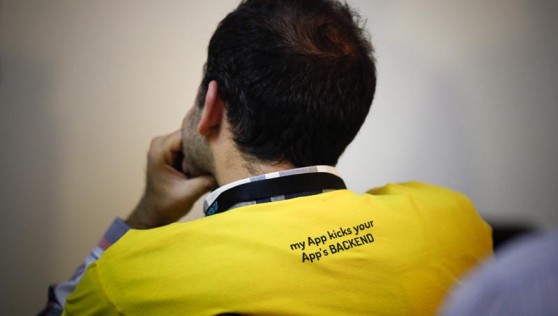
Entering from the street outside, the room has taken on a unique aroma born of a combination of unwashed bodies and energy drinks. Perhaps in a back room the event organizers are discussing whether white was the correct color for the t-shirts, as many have taken on a yellowish hue.

Some competitors, including both La2ta and MenaVersity, are ready to go, enjoying a few minutes of downtime before the deadline. Others, such as Ayssar, are still huddled over their computers.  “Are you ready?” Executive asks. He shrugs in a way that doesn’t invite further questions.


Sunday, 5:00 – Hour 48

There is no big countdown, no bell, no presenter announcing: “ladies and gentlemen, please put down your computers.” In a style many Lebanese will recognize all too well, the five o’clock deadline ends up being a bit more like five fifteen, which then drags on to around five thirty. For those, like Ayssar, who are still adding the final touches, the tardiness could hardly be more welcome.

Eventually the six judges, including representatives from Apstrata, Touch, AltCity and the Ministry of Telecoms, are introduced and the teams begin to present their ideas to be picked apart. Both MenaVersity and La2ta give good presentations, tightening the race between the two.


Sunday, 19:50 – Hour 50

The six judges, and an unidentified child, retire to behind a glass wall to debate their decision. Nervous contestants mull around the food table, eating and drinking their way around the fruit.


Sunday 21:10 – Hour 51

The judges return and the results begin. Three honorable mentions are handed out, then the Bala 3aj2a team are awarded third place. Silence descends.

“The winning team has a team member called Mohamed,” the presenter says jokingly, knowing that it doesn’t rule out many of the remaining teams. “And the winning team also has a member called Majed,” he announces, bringing the La2ta team to their feet. MenaVersity have to settle for second.

“We were confident but there were some other teams with really good ideas,” an ecstatic Majed says. The app, they hope, will be ready in a few months. “We want to improve our skills on mobile, we cannot count only on web applications. We are going to take it to the next level, we are going to think big,” Mohamed adds. Even for those not recognized, the experience has been valuable. “I made something basically in a day, and it’s a good idea,” Ayssar says.

Lebanon’s mobile application sector is still in its infancy and many ideas will be tried in the coming years. Many, as is so common in the technology sector, will fail. Yet the space for these developers to grow is important and will help hungry young coders like the La2ta team to stand out from the pack.

The La2ta team Mohamed el-Amine and Majed Traboulsi

March 20, 2013 0 comments
0 FacebookTwitterPinterestEmail
Economics & PolicyLebanon's oil and gas

Avoiding a regional war over hydrocarbons

by Georges Pierre Sassine March 19, 2013
written by Georges Pierre Sassine

Lebanon’s progress to cultivate wealth from its offshore oil and gas resources has left us with more questions than answers. While the country will not extract any resources for at least five years, the agreements being negotiated in the next 12 months will determine whether Lebanon gets a good deal or not.

Over the course of five days, seven leading thinkers will discuss different aspects of the resources — from avoiding environmental destruction to how to spend the new wealth — each with the aim of helping provoke awareness about what is going on in this crucial period.

For our second segment, Georges Pierre Sassine discusses the how to avoid conflict in the region over the resources.

See also: Lebanon's Petroleum Administration makes a positive start


Lebanon is making progress in developing its oil and gas resources. Offshore seismic surveys are completed, the Petroleum Administration is finally formed and the licensing round for oil companies to bid on offshore exploration has been launched.

The Lebanese government is rightly focusing on developing petroleum resources in its direct waters. However, Lebanon has yet to fully demarcate its maritime borders with Cyprus, Syria and Israel. Petroleum discovered in contested areas could prevent Lebanon from extracting parts of its resources and risk to pose a serious security threat.

The focus so far has been on the border dispute with Israel. Traditional resolution strategies of maritime border disputes are not easily applicable to the Lebanese-Israeli case.

Direct negotiations between the two countries or joint development agreements – where Israel and Lebanon cooperate to access hydrocarbons instead of dividing the territory – are not applicable. The countries are at war and will not negotiate face to face.

Another option is to resolve the dispute through formal legal proceedings. The International Court of Justice, the International Tribunal for the Law of the Sea and the Permanent Court of Arbitration are all different platforms that could resolve the dispute.

However, Israel has not signed or ratified the United Nations Convention on the Law of the Sea (UNCLOS), which means that Lebanon cannot force Israel to court. Lebanon could pursue an international media and diplomatic campaign to get Israel to sign the UNCLOS, enabling Beirut to bring Tel Aviv before a binding judicial tribunal or panel of arbitrators. But this remains a challenging path to undertake given that Lebanon does not acknowledge the existence of the state of Israel, and political resistance is to be expected as part of Lebanese public opinion perceives international courts to be biased towards Israel.

Searching for a settlement

As such, the most realistic proposal may be for some kind of indirectly negotiated settlement, though any such process will be lengthy and complex.

As exploration in the Eastern Mediterranean continues it is not unlikely that a new oil and gas field will be found in disputed Lebanese-Israeli waters while at the same time extending into Cypriot waters. Cyprus is divided into two main parts: the Republic of Cyprus – a member state of the European Union – and the Turkish controlled area in the north. This is likely to pull both the European Union and Turkey into the fray.

Lebanon could then find itself in a scenario where instead of dealing only with Israel it is drawn into a multi-stakeholder dispute directly involving Cyprus, Turkey, the EU and probably the United States as a broker.

Such a scenario has been studied by Harvard Professor, Meghan O’Sullivan, and several students from Harvard University and the Massachusetts Institute of Technology (MIT) in a Geopolitics of Energy competition. In looking for ways to avoid a conflict, two broadly different approaches have been suggested.

The first is the ‘politics before economics’ pathway, which suggests that a complete political resolution of conflicts between Lebanon and Israel on one hand, and Turkey and Cyprus on the other hand need to be resolved before the gas can be developed. The development of eastern Mediterranean gas would be included in a comprehensive regional peace initiative. Until then, petroleum resources in disputed areas would remain untapped and conflict avoided. However, immediate prospects for such a regional agreement are slim at best.

The second proposal suggests the development of disputed oil and gas fields while waiting for a final political resolution of territorial disputes. In this case, Lebanon and Israel as well as Cyprus and Turkey would agree to disagree. Each side would hold on to its claims but agree to a third party developing disputed oil resources until big political issues are resolved. Revenues could be split or frozen in foreign accounts and by the time a political resolution of disputed areas is reached revenues would then be distributed according to each country’s respective share.

Such a model has its challenges as well but nevertheless has been proven viable. In the 1940s Saudi Arabia and Kuwait both claimed a 5,770 square kilometer area along their borders and as such created a neutral zone. They shared equal rights to oil concessions until they reached an agreement to formally divide the territory in the mid-1960s. Australia and East Timor provide a similar case in 2003 as they postponed the settlement of their boundaries for 50 years and pursued the development of common resources under agreed guidelines.  

There is no doubt that potential oil and gas resources in contested waters provide serious risks to Lebanon. While the current unspoken agreement seems to be that both Lebanon and Israel will not explore in the conflict area, Lebanese remain nervous that Israel would decide to unilaterally develop these fields and provoke retaliation from the Lebanese Armed Forces or Hezbollah. Any option to avoid this issue will prove complex. This is why as the Lebanese government accelerates the exploitation of undisputed areas it should in parallel devote time and resources to manage risks on its maritime borders. A team of legal, diplomatic, military and political experts should plan and prepare for Lebanon to successfully defend its rights, develop its entitled resources and avoid conflict.


Georges Pierre Sassine holds a master’s degree in public policy from Harvard University’s John F. Kennedy School of Government. He writes about Lebanon’s public policy issues at www.georgessassine.com

 
March 19, 2013 0 comments
0 FacebookTwitterPinterestEmail
The Buzz

Morning briefing: 19 Mar 2013

by Executive Staff March 19, 2013
written by Executive Staff

Economics and policy

Foreign Direct Investment in Lebanon fell by 68 percent in 2012, down to $1.1 billion from $3.5 billion in 2011.

More from The Daily Star


Syrian rebels have told Lebanese truck drivers that the Masnaa crossing to Syria would remain closed indefinitely, the head of Lebanon’s Farmers’ Association has said.

More from The Daily Star


Saudi Arabia, the world’s largest oil exporter, will start drilling for shale gas this year, the Gulf state’s Oil Minister has said.

More from Arabian Business


Arab banks operating in Cyprus may abandon the island if the government does not revoke a proposal to impose taxes on depositors, the head of the World Union of Arab Bankers warned Monday.

More from The Daily Star


Companies and Business

Investment Corporation of Dubai (ICD)  has launched a syndication of $2 billion conventional and Islamic financing facilities to refinance a $2 billion loan due to mature in August.

More from Reuters


Contractor Drake & Scull International has been awarded contracts worth AED369m (US$100.46m) for the construction of three projects in Saudi Arabia and the United Arab Emirates.

More from Reuters


Collapsed carrier Bahrain Air has failed to honor around 22,000 customer tickets as a result of its closure.

More from Arabian Business


Abu Dhabi government-owned Al Hilal Bank plans to issue a debut Islamic bond worth $500 million in the third quarter of this year to fund growth and diversify its balance sheet.

More from Gulf Business

March 19, 2013 0 comments
0 FacebookTwitterPinterestEmail
Society

Not just your grandpa’s car

by Yasser Akkaoui March 19, 2013
written by Yasser Akkaoui

Being a lifelong fan of the European models of compact sports cars, I did not expect to be impressed by the Cadillac ATS, Cadillac’s latest luxury sports sedan. However, the ATS is giving the big boys such as the BMW 3 series or the Audi A4 a run for their money.

Cadillac is known for sensible classics such as the XTS, which attracted the older generation still fond of big cars. With the lightweight, compact ATS, they are going after a new market of young businessmen who are looking for the luxury that Cadillac offers, with the nimbleness and speed that they can now find in the ATS.

The aerodynamic and lightweight design gives the ATS’ exterior its own character and sets it aside from the competition. Its interior is classic Cadillac, luxurious and comfortable, with the technology to back it up. The Cadillac User Experience (CUE) is the interior’s highlight. The CUE is a built in entertainment system which allows you to link your smart phone to the car’s front screen. In this way, all my contacts are available to me through the futuristic front screen and I can ignore my phone while in the car.

The ATS was tested and developed on the road in the famed journey from Germany’s Nürburgring through Monaco to YAS Island, Abu Dhabi in seriously demanding road conditions. Lebanon’s roads are notoriously unforgiving and so the ultimate test of its performance was over Beirut’s potholes. Driving it through the streets of the capital, or the curves of the mountain roads, I found the ATS to be a quick, smooth and supple ride.

The ATS’ innovative ‘Safety Alert Seat’ is also a welcome feature when navigating the infamously chaotic Lebanese traffic. An advanced warning system comprising radars, cameras and ultrasonic sensors sends pulses through the drivers seat, warning of a variety of potential hazards. 

In terms of performance and design, the ATS is offering no less than what other cars in its class are. In terms of pricing, it has them beat by 15 to 20 percent. In the Lebanese market, the ATS is priced at $48,000 (VAT excluded) and comes with four years free servicing. Cadillac expects to sell seven to eight ATS models per month, a target they may very well reach.

March 19, 2013 0 comments
0 FacebookTwitterPinterestEmail
Economics & PolicyLebanese in advertising

MENA Cristal’s Christian Cappe talks revolution

by Maya Sioufi March 18, 2013
written by Maya Sioufi

I am coming home,” said Austrian skydiver Felix Baumgartner right before jumping off a balloon capsule 39 kilometers above Earth, setting a new world record. Sponsored by energy drink company Red Bull, the stunt, which took place in October of last year, was streamed live by 8 million people. It marks a new era in advertising communication. Several months later, the organizers of the eighth edition of the MENA Cristal Festival invited Felix to attend its event at the InterContinental Mzaar hotel in Faraya, from February 5 to 7. Headed by Christian Cappe, the MENA Cristal Festival brings international recognition to the advertising industry in the region through awards decided upon by juries of international professionals. Executive, present in snowy Faraya, sat with Cappe to discuss why Felix was invited, his thoughts on the evolution of the advertising industry and why MENA Cristal was held again in Lebanon.

Why did MENA Cristal decide to invite Felix to the event this year?

They say Felix did the jump. It is not just the jump. It’s the first and biggest operation of brand content done in the world because behind Baumgartner is Red Bull and behind Red Bull is video online, YouTube and the new era of communication. It is in a context of global evolution.

In your opinion, what are the best types of advertising creations?

The most importing thing is [for the creation] to touch a local target and if it is recognized internationally then that is fantastic. The recognition through festivals is done to stimulate the creation. When we are creative, we want to show our work; we want it to be recognized.

Which advertising format is going to dominate going forward?

We are in the post-digital [era] now. All communications now are through mobile. There is a multiplicity of screens, and when you search the Internet on a smartphone for information, you go directly to the information. We are no longer passive like when we read the newspaper. So for a brand to be seen, it has to be in the content either through an article or at the origin of the article, the origin of the game, the origin of the event etcetera. That’s the big evolution. The client becoming mobile, we get to the problem of managing the data. This is going to be the big challenge: associating the creation with the means of distribution.

How have revolutions in the Arab world affected the advertising industry?

It is complicated to speak of countries that are in a real crisis. Syria has no real economy and Egypt is very problematic. Today [the industry] needs to go to the countries that are moving, like Saudi Arabia and Dubai.

How financially viable is the MENA Cristal budget?

I think it won’t be possible to organize this event if MENA Cristal was the only festival that we organize. Now, we organize events all year long in this field so that we can support the industry through the events.

Why is the MENA Cristal Festival held in Lebanon and not in other countries in the region?

The Lebanese talent, hub and brilliance has to be known. [Cristal Festival] people ask to be part of the staff organizing the MENA Cristal because of the enthusiasm, entrepreneurship attitude, culture and elegance of the Lebanese. It’s quite specific to Lebanon.

Perhaps the event could be bigger in Abu Dhabi or Doha but the concept is to put together, in the same place, people that are happy to not go back to the office and have an exchange [of ideas] and so on. To organize an event [which celebrates] cultural creativity in the country that provides the most important [number] of creative people in the Middle East is quite logical. I know Saudi Arabia is the biggest country in economic terms and that the hub for many companies is in Dubai but where is the talent coming from? From Lebanon. Plus there is only one ski resort in the region that we can attend!

March 18, 2013 0 comments
0 FacebookTwitterPinterestEmail
  • 1
  • …
  • 272
  • 273
  • 274
  • 275
  • 276
  • …
  • 685

Latest Cover

About us

Since its first edition emerged on the newsstands in 1999, Executive Magazine has been dedicated to providing its readers with the most up-to-date local and regional business news. Executive is a monthly business magazine that offers readers in-depth analyses on the Lebanese world of commerce, covering all the major sectors – from banking, finance, and insurance to technology, tourism, hospitality, media, and retail.

  • Donate
  • Our Purpose
  • Contact Us

Sign up for our newsletter

[contact-form-7 id=”27812″ title=”FooterSubscription”]

  • Facebook
  • Twitter
  • Instagram
  • Linkedin
  • Youtube
Executive Magazine
  • ISSUES
    • Current Issue
    • Past issues
  • BUSINESS
  • ECONOMICS & POLICY
  • OPINION
  • SPECIAL REPORTS
  • EXECUTIVE TALKS
  • MOVEMENTS
    • Change the image
    • Cannes lions
    • Transparency & accountability
    • ECONOMIC ROADMAP
    • Say No to Corruption
    • The Lebanon media development initiative
    • LPSN Policy Asks
    • Advocating the preservation of deposits
  • JOIN US
    • Join our movement
    • Attend our events
    • Receive updates
    • Connect with us
  • DONATE