• Donate
  • Our Purpose
  • Contact Us
Executive Magazine
  • ISSUES
    • Current Issue
    • Past issues
  • BUSINESS
  • ECONOMICS & POLICY
  • OPINION
  • SPECIAL REPORTS
  • EXECUTIVE TALKS
  • MOVEMENTS
    • Change the image
    • Cannes lions
    • Transparency & accountability
    • ECONOMIC ROADMAP
    • Say No to Corruption
    • The Lebanon media development initiative
    • LPSN Policy Asks
    • Advocating the preservation of deposits
  • JOIN US
    • Join our movement
    • Attend our events
    • Receive updates
    • Connect with us
  • DONATE
Economics & Policy

World Economic Forum’s Martina Gmur

by Thomas Schellen November 7, 2012
written by Thomas Schellen

The World Economic Forum (WEF) is the preeminent organization trying its hand at the impossible game of matching business with the greater global good. The WEF global agenda councils (GAC) are an ensemble of stakeholder groups that play an increasing role in identifying and defining issues to go on the agenda of the WEF’s annual main event in Davos, as well as regional events. As the annual GAC summit is hosted in the United Arab Emirates it is also the WEF’s only top-tier event associated with the Gulf region. Executive chatted with GAC chairperson Martina Gmür. 

What issues will dominate the GAC summit this year?

We have a strong focus on the economy and on what is going to happen in Europe, but there will also be discussions on China and the other emerging markets. One of the big themes will be resource scarcity and related to that, water, food and energy. Lastly, a major issue that has been raised and is important to discuss is the digital and communications revolution.

What will be your hottest topics this year relating to the Middle East and the regional economy?

A clearly important one is youth unemployment and we will have a televised debate on this topic. The other one that we feel is very important is the whole geopolitical risk and security agenda. On this we will also have a TV debate. Those two are really important aspects.

On the larger front, [we will discuss] the role of the Middle East as it relates to Europe, and also the outcome of the elections in the United States and the implications for the region.

What does this wide spectrum of topics and current concerns demand of you as a person steering this event?

You do have to have a certain design or architecture to fit everything in. The summit is quite different from other events that we have and it is a lot more flexible and open. Not all the sessions are pre-determined. There are just the broad topics and then whatever the group decides becomes the focus. This can be influenced by recent events but also conversations with other people in the network.

How do you determine the membership in the different councils?

It is quite a lengthy process that we engage in each spring. We talk to our government constituents and [those people with whom we have]relationships — our chief executives and strategic partners — and we do our own research on who the new voices in the world are, on [a] regional and on [a] stakeholder basis. We collect all these nominations and then we do a pre-selection based on certain criteria of diversity and fit with the topic.

Is the final selection done by WEF or by a peer group?

The Forum has the ultimate decision but we will check back with the councils and the chairs. Each GAC has a chair per year and there is usually a vice-chair and 15 to 20 people in each group per year. Those people can rotate but usually 80 percent stay on for at least two or three years.

How much time would a council member have to commit to participate in a GAC over the course of two years?

It will be a minimum of one or two weeks over two years but most people actually engage more and many councils not only discuss ideas but also start implementing on their levels and that takes a lot more time. 

There is no remuneration involved in council membership?

No, none at all.

The councils are one of several new structural elements in the Forum. Where do the councils fit in with the task of shaping the future of WEF?

The essential purpose for creating them was to help us shape the agenda in a more structured way. They are very much embedded in all our activities, they participate in our initiatives, they participate in programming for our regional events; the summit is the key brainstorming event for those and for agenda-setting for the program that happens in Davos. They integrate in all [the Forum’s] communities.

Do you have measuring tools and feedback mechanisms to show how effective the different councils are in fulfilling those roles?

Yes. We ask them to produce annual reports at the end of their terms to show what they have achieved; how much they have been contributing to our activities but also to activities around the world. We have feedback rounds within the groups themselves and also with our constituents. Our strategic partners for example constantly rate how much value the councils add or don’t add.

You have quite a number of councils. How many are there in total, how many are new, and do you have a personal favorite?

This year we have 88. Of these, 16 or so are new. I could not choose a favorite. They all have their own special things that make them really interesting. There are topics that no one has done much on such as new growth models on economic thinking or the Arctic, which is really a new effort for the Forum, but there are also the long-standing ones [such as] the ones on education or health.

The whole culture of conferences, endless debates, and global recommendations or rankings has proliferated greatly in the last 20 years. Do you think that it is still meaningful today to hold global events of this type?

From our perspective, one shouldn’t underestimate the power of dialogue and bringing people together. We are putting huge emphasis on virtual engagement as well. We are balancing the physical conference, going to a more virtual… culture, or reality. I certainly think virtual [interaction] will play a big role in what we are doing and how we interact and communicate and our products will also become more and more virtual. But as I said, the dialogue itself is critical and we have seen over and over again, how useful it is to bring people together who have never spoken [before] and break some barriers.

A recent WEF report focused on the gender gap. The report seemed to indicate that there are some improvements in gender balance but it is also known to be a persistent problem in corporations and countries. One also sees many more men than women on the GAC participant lists. What is the situation within the global councils as far as gender balance?

It is one of our priorities to improve the gender balance within the councils. We have today 25 percent women across the councils, which obviously can still be improved. We started from 15 [percent] four years ago and have improved it every year. Our aim is of course to get to 50 percent in the future but we have to be realistic. There is a certain reality that Fortune 500 and political leadership around the world is not 50-50.

Do you expect that a more balanced composition of the councils could create a loop where women participants have a greater chance to take larger roles in their organizations?

Yes, one of the big points that encourages people to be in the councils is not only the contributions they can make but also the recognition of their thought-leadership.

And that could perhaps help women advance in their organizations?

Perhaps.

Is there a specific value-added that you expect from the new councils in 2012?

We emphasise greatly the economy and finance related councils in the hope that we generate new thinking on economic growth models this time around because many argue that the economy after the crisis will be different than before. We also have a number of new environmentally related councils, whether it is governance of sustainability or measuring sustainability. Then we have more innovative councils like the one on complex systems which we hope can help us to put a perspective on how our world is changing and what that means for different issues in our complex world.

November 7, 2012 0 comments
0 FacebookTwitterPinterestEmail
Economics & Policy

A promising partnership

by Karl Nader, Ramy Sfeir & Karim Abdallah November 7, 2012
written by Karl Nader, Ramy Sfeir & Karim Abdallah

There is no shortage of super-regional and regional malls in countries of the Gulf Cooperation Council (GCC). Super-regional malls, such as Dubai Mall and Mall of the Emirates in the United Arab Emirates, as well as Villagio in Qatar, are major destinations and are filled with well-known and sought-after high-end retailers. In some of these malls — which often attract thousands of visitors per day — you can shop, visit artificial ski slopes and travel on a replica gondola.
In addition to their popular leisure offerings, these malls each comprise more than 200 shops, restaurants, and entertainment venues. Similarly, regional malls, such as Muscat Grand Mall in Oman and The Avenues Mall in Kuwait, provide residents with 100 to 200 shops, dining venues, and entertainment facilities that are multi-purpose in nature.

The GCC retail boom of the past 10 to 15 years spawned these shopping centers along with developments in almost all parts of the regional property market. However, the GCC market continues to evolve and this growth is paving the way for new opportunities. In particular, cities are flourishing and communities are expanding. This means that while super-regional and regional malls serve their purpose of providing a major anchor within cities across the region, they are far from becoming convenient one-stop shopping centers for everyone, especially given their lack of proximity to housing developments and cumbersome access. Ultimately, this gap in retail coverage offers canny developers and retailers an important opportunity.

Matching brands with bread

Essentially, malls attract tourists and families, but are not practical for fulfilling the daily needs of GCC residents. This is because they are situated in busy city centers, locations that are far from housing developments, making these malls inconvenient for everyday needs such as childcare centers, gyms, grocery stores, and other miscellaneous shops. At the same time, there are more and more large, isolated residential developments that lack nearby shopping centers and convenient retail space.

The mundane needs of local communities are an opportunity for retailers and real estate developers. The attraction for retailers is expansion via new channels. For real estate developers, such ventures can reignite development plans stalled by the property bust, and provide sustainable recurrent income essential for balancing their business models.

One current trend that aims to meet market needs is a fully integrated approach among large retail conglomerates and mall developers. In this model, a developer acquires, or organically develops, capabilities in retailing (such as major brands) — or a retailer develops the capabilities needed for property development. This ensures consistency of retail and property objectives as well as maximum returns.

This fully integrated approach, however, is operationally complex and financially risky. Nonetheless, successful regional examples include Azadea’s Le Mall branches in Lebanon, which have responded to community needs by offering malls that focus on convenience and present affordable retail and dining options in smaller-sized malls. The fully integrated approach has also been employed by retailers and developers looking to create large-scale mall developments. Alshaya’s The Avenues located in Kuwait and Majid Al Futtaim’s City Center properties across the region are both prime examples of this trend.

These examples of fully integrated models also demonstrate the substantial evolution among retailers and developers. Azadea and Alshaya have established themselves as franchising specialists, yet are now developing malls that showcase their wide portfolios of brands. At the same time, Majid Al Futtaim has made a name for itself as a mall developer, but is now growing its own retail portfolio of fashion brands and grocery stores (namely Carrefour).
These malls are all driven by their corporate owners’ need to improve negotiation positions and secure their share of the attractive retail market in the region. While sometimes successful, this model requires that retailers fully build capabilities in mall development and management, and that mall developers acquire retail capabilities in order to ensure that best practices are not overlooked. Otherwise, these malls may face challenges, such as design flaws, access issues or a narrower retail offering.

A better alternative

Yet there is another, more promising approach that could enable smaller retailers and developers to compete and capture a share of the retail gap without having to develop a complete set of new capabilities. In essence, non-integrated real estate developers and retailers should form alliances to develop convenience and neighborhood shopping centers geared toward GCC residents.

This model allows successful retailers, such as Al Meera and retail cooperatives in the UAE, to capture market share without the high capital costs of building new outlets. Instead, retailers will be able to rent store units in these vibrant, growing communities. Many of these retailers have found the right formula to attract customers at home, a feat that they believe can be repeated in adjacent markets.

These retailers will still need to adapt their value proposition to the specificities of this new channel, but by partnering with real estate developers, they will overcome the biggest hurdle — large upfront costs.

For real estate developers, such partnerships can position them for the eventual recovery of the property market. Real estate players are trying not to repeat the mistakes of the past when they focused on capital gains from property sales. Instead, developers need the recurring revenues that long-term rental leases provide, income that will give their investors a constant stream of returns.

Certainly, a convenient shopping center located within a residential development would increase its value and make it more attractive to current and future residents.

Both partners have much to contribute. First, real estate developers, such as UAE-based Emaar and Saudi Arabia-based Dar Al Arkan, own the residential developments that can host the community shopping centers. Second, these developers have expertise in designing and executing commercial centers, in raising capital, and in potentially managing the properties. As for the large retailers, they can become anchor tenants, attracting customers and smaller retail tenants.

Important differences between the partnership and the fully integrated approach are the concentration of risk in the integrated approach, and the partnership model’s dual availability of critical retail and mall development and management capabilities.

A strategic alliance

The best way forward in the partnership approach is an exclusive agreement in which developers and retailers agree to build a number of neighborhood shopping centers together. Given the small investment required, lack of community shopping centers in the region and ongoing trend of large, isolated residential developments, neighborhood shopping centers are in a position to thrive.

The keys for success in this model are full agreement on the center’s positioning in the market, its offerings and its target customers. This model is good for food retailers and large residential developers, who come together in a strategic alliance that allows each partner to focus on their core capabilities. The retailer obtains a secure client base — people are housed next to the shops. The developer builds an environment that is ready for retailers to move into. Sorouh, a leading UAE developer, uses this approach with its Boutik brand. Boutik is a series of retail centers inside Sorouh’s residential communities that offer a Waitrose grocery store and an attractive mix of other retailers.

The partnership model requires careful agreement between the retail and real estate sides on the center’s positioning, its target segments, and the division of responsibilities and rewards. The rewards will be worth the effort. With GCC governments embarking on large-scale housing projects, which include a program to develop complexes of affordable housing with a total of 500,000 units across Saudi Arabia alone, there is no better time for real estate developers and retailers to join forces and provide low and high-end convenience shopping centers.

November 7, 2012 0 comments
0 FacebookTwitterPinterestEmail
The Buzz

Morning briefing: 7 Nov 2012

by Executive Staff November 7, 2012
written by Executive Staff

US Elections

US president Barack Obama said difficult compromises were needed to move the United States forward in a speech after he won a second term in the White House by beating Republican challenger Mitt Romney earlier today.

More from The National


Re-elected US President Barack Obama will take a tougher stance on the Syrian civil war during his second term and will use the US’s leverage with Gulf states to help resolve the conflict, former US Secretary of Defence William Cohen has said.

More from Arabian Business


Barack Obama tweeted “four more years” shortly after winning the state of Ohio.

More from The National


Economics

Brent futures held below US$111 per barrel on Wednesday as concerns about weak demand in a fragile economy and Greece outweighed supply disruption worries on escalating tension in the Middle East.

More from Reuters


Syrian lawmakers urged a fresh economic response from President Bashar Assad’s government after the 2013 budget revealed a more than threefold growth in the deficit amid falling revenue and rising expenditure.

More from The Daily Star


British Prime Minister David Cameron met with Saudi Arabia’s King Abdullah and other top Saudi officials in Jeddah on Tuesday following a two-day visit to the UAE, where he secured a defense partnership with the Gulf state

More from Arabian Business


Companies

Dana Gas, the first UAE company to fail to meet a bond redemption, said on Wednesday it reached an "in principle" restructuring agreement with creditors to repay the US$1bn Islamic bond, or sukuk.

More from Arabian Business


Dubai’s Emirates Airline has signed Britain’s low-cost carrier easyJet to its frequent flyer programme Skywards. The agreement will enable Emirates’ frequent flyers to redeem their Skywards miles on easyJet flights across Europe and North Africa from November 6, said the airline.

More from Arabian Business


Abu Dhabi's two biggest property developers Aldar and Sorouh have both reported big Q3 profits increases ahead of the two companies potential merger slated for later this year.

More from The National

November 7, 2012 0 comments
0 FacebookTwitterPinterestEmail
Finance

Credit Agricole Suisse plans Middle Eastern expansion

by Thomas Schellen November 7, 2012
written by Thomas Schellen


Crédit Agricole Suisse (CA Suisse) is the centerpiece of the private banking division of Crédit Agricole, France’s third-largest bank, whose interests in the Middle East include long-standing relationships with banks in Saudi Arabia and Lebanon. Executive sat down with Youssef Dib, head of private banking at CA Suisse, Pierre Masclet, newly appointed head of markets and investment solutions, and Peter Chamlian, the recently appointed chief executive of the bank’s subsidiary in Lebanon.


You are one of five entities under the umbrella of the Crédit Agricole Private Banking arm. As such, you are present in select locations, with Beirut one of three locations in the Middle East, together with Abu Dhabi and Dubai. Why is Lebanon attractive to you, rather than Doha or Riyadh?

[Dib] Lebanon is obviously not what it was 30 years ago but it is still a key market and a key presence for us, for the local market and also for the diaspora. We are very present vis-à-vis the [Lebanese] diaspora, whether in Europe, in the Middle East, or in Africa and Latin America. We know how the diaspora works and the heartbeat really comes from Beirut. We (re)opened the office [in 2006] and are committed to it despite the ups and downs.

You told me that you are adding new competencies. What is the new real estate financing capacity that you are preparing?

[Masclet] Our goal is to protect and grow the assets of our clients. We want to develop product lines that are diversified and deep. We have discretionary portfolios, management activities, advisory mandates, some structured products, private equity funds, forex of course, and so on. What we want to develop more and more to add new points to this, is our real estate offering. It will first be based on knowledge that is coming from France.

Given that regional real estate investment hotspots exist in Dubai and Beirut, will you offer your financial services for real estate in Arab markets?

[Masclet] It will be a new offering and we have to develop it step-by-step and build up a learning curve. We will begin with the main markets of the group which are France and Switzerland. We have projects to develop in other European countries and later we will see the appetite of the clients. 

Within your range of product offerings, is there any favorite asset class that you can share as being the best right now?

[Chamlian] In a nutshell, diversification is key today, whether it is asset classes or currencies. 

[Dib] On the offering side, we really insist on open architecture and what we are reinforcing is the top-down approach, which is the asset allocation approach. We are pushing more the new offerings [such as] the real estate side, tax and legal engineering, and private equity where we are adding capacity for global custody for our clients. 

Do you see a gold bubble or any other asset bubble that is shaping up in your field of vision?

[Masclet] A lot of people are speaking about bubbles today. The price of gold was pushed higher and higher during the last few years. We don’t have a feeling that there is specifically a bubble. 

[Dib] Gold continues to be supported by lack of visibility and strong demand from countries like India and finally by the fact that interest rates are so low, so the opportunity cost of investing in gold is very low. 

[Chamlian] It is exaggerated by the non-traditional monetary policy by the United States mainly, with QE 3, the unlimited [quantitative easing]. 

How much in assets does CA Suisse have under management today?

[Dib] About 45 billion Swiss francs ($48.4 billion) in Switzerland. For the overall business line of international private banking, it is close to 100 billion euros ($130.2 billion) for Crédit Agricole Private Banking, to which you can add about 30 billion euros ($39 billion) at Crédit Lyonnais Private Banking. That does not include the private banking through Crédit Agricole in France, which is in the hundreds of billions [of euros]. 

In which tier of the private banking world are you located, in terms of total assets under management?

[Dib] If we include Crédit Agricole in France, we are definitely in the top 10, but I would guess even in the top five, although this is not official because the group doesn’t consolidate the figures.

November 7, 2012 0 comments
0 FacebookTwitterPinterestEmail
The Buzz

Morning briefing: 6 Nov 2012

by Executive Staff November 6, 2012
written by Executive Staff


Economics

Gold traded little changed on Tuesday as investors awaited potential policy spinoffs from the US presidential election, while China's upcoming leadership transition and Greece's strike over a new austerity package also kept sentiment cautious.

More from Arabian Business


Qatar and the United Arab Emirates have requested the sale of up to $7.6 billion in Lockheed Martin Corp missile-defense systems to counter perceived threats and lower their dependence on U.S forces, the Pentagon has announced.

More from Gulf Business


The Lebanese public sector employees’ association said it will take part in a general strike scheduled for Thursday if the government fails to pass salary increases in its Wednesday parliamentary session.

More from The Daily Star


Companies

Dana Gas, which last week missed a $920 million Islamic bond redemption, said on Tuesday it was still negotiating a standstill agreement with a creditors’ committee.

More from Gulf Business


Ahli United Bank, Bahrain's largest lender by market value, saw its third-quarter net profit rise 11 percent, as its earnings were boosted by an increase in net interest income.

More from Arabian Business


Growth of business activity in Saudi Arabia's non-oil private sector fell slightly in October from a four-month high, a survey of over 400 private companies showed on Monday.

More from Arabian Business


Abu Dhabi's state-owned investment fund Mubadala is seeking bondholders' consent to alter certain contract terms on outstanding bonds worth about US$3.4bn.

More from Arabian Business

November 6, 2012 0 comments
0 FacebookTwitterPinterestEmail
Finance

A cyber siege on Lebanese banks

by Maya Sioufi November 5, 2012
written by Maya Sioufi

When news broke out in August that a cyber virus dubbed ‘Gauss’ attacked bank accounts in the Middle East, with the vast majority being Lebanese accounts, senior management at local banks must have said to themselves “just when you thought it couldn’t get worse.” With the banking sector’s challenges already piling up — from a war in neighboring Syria to dwindling domestic economic growth to increased international scrutiny — banks now had to add a cyber war to their lingering list of concerns. 

Kaspersky Lab, a Moscow-based information technology (IT) security vendor, discovered the Gauss virus and claimed it began operating in September 2011, attacking around 2,500 machines in the Middle East, of which 1,600 were in Lebanon. According to Kaspersky, Gauss is capable of stealing browser history, cookies, passwords and system configurations as well as accessing credentials for various online banking systems and payment methods, targeting the clients’ bank accounts and not the servers of the banks.

Kasperky claims that six Lebanese banks saw their clients’ bank accounts affected by the cyber virus: Bank of Beirut, Byblos Bank, Credit Libanais, BLOM Bank, Banque Libano-Française and Fransabank. The total number of online accounts in Lebanon is not readily available information — neither the Association of Banks in Lebanon nor Banque du Liban (BDL), Lebanon’s central bank, were able to provide this information (“Banks do not provide us with the number of online accounts, merely the total accounts,” says a spokesperson at the BDL). A chief information officer at a leading local bank however, assumes this figure does not exceed 300,000. 

In response to this cyber virus, BDL provided security recommendations to the banking sector in order to prevent future attacks and limit the spread of the virus. “For instance, if there is no need for a USB, don’t use it; if you have to use it, do a scan before opening it,” says Zeina Assi, head of the IT security division at BDL. She claims that the impact on the banks was limited but “there was theft of information of course.” The central bank cannot impose on banks which software to use; its role is merely to recommend certain security measures to the IT teams of the local banks, which are responsible for implementing the necessary measures to protect the banks and their clients.

BLOM Bank’s chief information officer Antoine Lawandos claims that their customers were not impacted by the Gauss virus because of the technology offered to their clients when they access online accounts. To login to eBlom, clients must input two factors: a password as well as a four-digit one-time-password (OTP) sent on their mobile phones via SMS — in IT security jargon, this is called “dual authentication”. “So even if the client’s PC has been infected by Gauss, his digital identity could not be intercepted,” says Lawandos. 

Credit Libanais also claims it was not affected.  “As far as we know, none of our systems were penetrated and no customer information affected,” says Najib Ghanem, head of IT at Credit Libanais. “We use Virtual Keyboard (think of the iPad’s keyboard for instance) and Volatile Matrix (meaning the numbers on the “virtual keyboard” change places after an input) technology to authenticate clients signing onto our online banking service.  These techniques ensure that hackers cannot use “keyboard sniffers” (which track keys entered on a keyboard) to record and steal passwords and PINs [personal identification numbers]”.  He adds that Credit Libanais considered adopting OTP technology but did not see the need to at this point. 

If attacks of this sort are the new face of wars in the Internet age, banks are going to need to increase investment in technology to protect themselves and their clients. “Chances are that there will always be fraudsters who will try to attack banks and financial institutions,” says Lawandos. “As an industry, we are under constant attack from many different directions and every indication is that this is likely to increase in the future,” adds Ghanem. 

Deploying appropriate and up-to-date technology to counter the likelihood of attacks means piling up more costs, which have been already mounting this year from increased regulations to wage hikes imposed by the government. With the sector suffering from falling revenues this year, bearing additional costs is unpleasant, but with more cyber attacks expected, the sector really does not have a choice.

November 5, 2012 0 comments
0 FacebookTwitterPinterestEmail
The Buzz

Morning briefing: 5 Nov 2012

by Executive Staff November 5, 2012
written by Executive Staff

Economics

US aerospace giant Boeing Company has secured a contract valued at US$4bn to modernise the Royal Saudi Arabian Air Force's fighter jet fleet, according to the Pentagon.

More from Arabian Business


Lebanon will complete linking telecom switchboards to a fiber-optics network in April 2013, paving the way for the launch of the fourth generation of mobile networks in major cities, the telecommunications minister said over the weekend.

More from The Daily Star


Almost half of all workers in the UAE claim that they are not being paid enough, according to the findings of a study published on Sunday.

According to Bayt.com’s latest Consumer Confidence Survey, 47 percent of employees in the Gulf state are dissatisfied with their current level of compensation.

More from Arabian Business


A gas pipeline feeding Yemen's only liquefied natural gas (LNG) export terminal will take around a week to be repaired following an attack on it last week, the country's oil minister was quoted as saying.

More from The Daily Star


Companies

With average UAE consumers using a massive 16 tonnes of oil per person per year, the facilities management specialist Emrill and two of the world's biggest energy efficiency companies are attempting to reduce carbon emissions from UAE buildings by 40 per cent.

More from The National


The Dubai Airport Freezone Authority, or Dafza, has entered into a memorandum of understanding with HSBC on Sunday, which will see the firms offering a range of added-value services to their customers.

More from Khaleej Times


Middle East airlines led the world in passenger traffic growth for September, the International Ait Transport Association has said.

According to Iata's global traffic returns, demand for Middle East airlines rose 13.3 per cent year-on-year compared to worldwide demand for passenger traffic of just 4.1 per cent above September 2011 levels.

More from The National


Politics

Kuwaiti security forces fired tear gas to disperse a demonstration on Sunday by thousands of opposition supporters against new voting rules for parliamentary elections on December 1.

More from Arabian Business


November 5, 2012 0 comments
0 FacebookTwitterPinterestEmail
Economics & Policy

Romney and the Middle East: Would anything change?

by Joe Dyke November 5, 2012
written by Joe Dyke

As the American people prepare to go to the polls to select their new president, incumbent Barack Obama and challenger Mitt Romney are on a desperate last minute race for votes.

But for those watching in the Middle East, unable to influence the result, the question is how a change in government would really affect the region.

Click here or on the map below for an infographic on how different Obama and Romney's policies on the Middle East are.

Also see our exclusive graphic Obama and the Middle East – did anything change?


November 5, 2012 0 comments
0 FacebookTwitterPinterestEmail
Business

Return to the chief’s chair

by Thomas Schellen November 5, 2012
written by Thomas Schellen

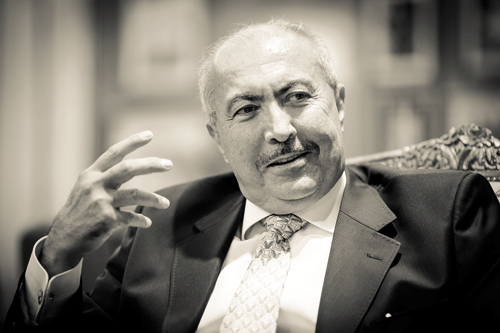
In 2002, Fouad Makhzoumi retired as chief executive of Future Pipe Industries at age 50 and handed the reins of day-to-day business to his son Rami. In April 2011, a brain aneurysm struck and Rami passed away in the middle of life. At age 33, he was father of two young children and the main decision maker in the business.

Makhzoumi says as painful as it was to lose his son, he had to quickly reassume the role of chief executive. “Then to step in and reposition, you must remember that Rami for 10 years was the only known figurehead and if I did not step in very fast, the whole thing would start shaking,” he said. “But luckily, I like to read and follow up, and Rami was copying me in on all his correspondence. He would consult with me for only one hour every day on the key issues. I was acting as a chairman, a non-executive chairman. So I was in the loop, plus this was a business that I built myself, so I could easily step in. Of course we also have a very good management that was there before Rami and is there after Rami, which means the adjustment process was not very painful.”

At the time of writing, preparations were being finalized to announce a Rami Makhzoumi chair for corporate governance at the American University of Beirut’s Olayan School of Business. Also, a global prize of jurisprudence bearing Rami’s name for outstanding scholars of law is being prepared on a level comparable to the Nobel Prize, according to his father.

Fouad Makhzoumi on…
 

…the Makhzoumis:

“We, the Makhzoumis, were in Mecca before Islam. Historically, my father, uncle, grandfather and great grandfather were part of the Ottoman Empire. We believe in the establishment of government. My generation was the first that decided to step out of government and establish our own business.”
 
…rights and their misperception in the region:

“We don’t understand freedom and don’t understand our rights. We think that if we can remove [former Egyptian President Hosni] Mubarak, we can remove anybody. The process of change is a series of education. We are not educated in this region to understand what it means to have rights. All the time we revolt against the regimes that take our rights away but guess what — we have no idea what our rights are. Look at Lebanon. We are now waiting for a bunch of yo-yos to [give] us the election law that we are pursuing in order to reproduce the same group.”

…his venture in Akkar and Lebanese industrial politics:

“At one point we had 850 employees in Akkar; it was the only investment that ever existed in Akkar. But neither were the Syrians happy for me to generate jobs nor was the Beirut government interested. Instead of trying to help, they blocked me from selling to Syria… There is no intention in this country to try and support industry. For the political regime in Lebanon it is much easier if you are a trader because your profit is a function of the political decision.”

…encounters with the Muslim Brotherhood in Egypt:

“I have a factory with 2,000 people in Egypt. Some time before the ‘Arab Spring’ started the Muslim Brotherhood came to me and said ‘you are not a true Muslim [because] you are supposed to be helping us against the Christians.’ I said, ‘I have a global company, so I have Muslims and Christians, you name it. I actually have 29 nationalities working for me and so I am sorry, I don’t play this game.’ Then, all of a sudden, we had a fire in the factory.”

…Iran:

“Elections in Iran are coming up in 2013. I believe we will come to a deal between Iran and the United States by the end of 2013. The question is what advantage we can give Iran to not put them in the same position as North Korea. They are not willing to back off, because it has become an issue of national pride at this stage. Iran is a much bigger country than Iraq, three times the size, and it will be the focal point together with Afghanistan, to have all these cross[-continental] pipelines.

It is important that we try to encourage the region to come to a deal with Iran. I know the Gulf people may not be comfortable with Iran but at the end of the day, Iran will have to deal with reality, just as we, the Arabs, will have to deal with reality. I believe that if we can do that, it will be done by this time in 2013.”   
 

November 5, 2012 0 comments
0 FacebookTwitterPinterestEmail
Society

Where luxury meets utility

by Nadim Mehanna November 5, 2012
written by Nadim Mehanna

Every time the curtain rises on a motor show these days, it seems a new luxury sports utility vehicle (SUV) is crowding the limelight. A year ago it was the Ferrari FF, four seats, four-wheel drive, a 650 horsepower “family car” targeting the snow-bound vacationer. This spring we got our first glimpse of Bentley’s XP9 concept, the “Queen’s Car” for the super-rich soccer mom, packing both a 12-cylinder engine and a built-in silver-and-Lalique crystal picnic set.

A month later, Lamborghini unveiled the Urus at the Beijing motor show, signaling its own entrance into the luxury SUV ring. Three makers, 7,500 miles apart, but as the saying goes: Once is an anomaly, twice is coincidence. But three times makes a trend.

The entrance of these ultra-luxury brands solidifies a trend started more than two decades ago. It was 25 years ago, after all, that Lamborghini sortied what many consider the first luxury SUV, the LM002 — a chiseled, muscular SUV that would have been right at home in the movie ‘Jurassic Park.’ The car, originally modeled on a military-purpose vehicle codenamed “Cheetah”, sold out almost overnight. Then, of course, there was the Cadillac Escalade — a revamped version of the GMC hauler — bombarded with derision until its sales numbers shut up the critics for good.

The real pace-setters for the modern wave of luxury SUVs came in the late 1990s, in the form of the BMW X5 and Mercedes-Benz M-Class. These “crossovers” were the first to take the concept in a truly new direction, moving away from the militaristic ruggedness of the old design toward something closer to a synthesis with the sports car model.   But what started as a trickle has since grown into a flood. Luxury SUVs are taking an increasing share of the limelight, attracting a new class of car buyer — the top-dollar family man, the ultra-rich soccer mom. And that means new business — a lot of new business.

Business is ‘bigger’

In part, the movement toward luxury SUVs has simply been a matter of market inertia. Many people outside automotive circles will tell you that the heyday of the SUV waned a decade ago; that, like the dinosaurs, the big-car movement of the 1990s tripped into a tar pit of high gas prices and drowned, succeeded by a generation of fleeter, more economical sedans. Nothing could be further from the truth. In the commercial markets, many makers are counting on big-car sales to flush out their profit margins this summer. Ford Escapes, Honda CR-Vs and the new Mazda CX-5s are selling like hot cakes, so much so that many dealerships are struggling to keep them in stock.

You can see similar patterns in the sports car markets as well, with sales of BMW’s “sports activity vehicle” segment — the X3, X5 and X6 — up more than 20 percent, and Audi’s Q5 Crossover SUV up an incredible 60.5 percent.

Porsche, one of the first makers to branch into the luxury family vehicle, saw more than half its June sales claimed by two of its break-out models, the best-selling Cayenne SUV and the Panamera four-door sedan.

For commercial and luxury markets alike, SUV sales have never been better.

Trimming down the Hummer

Some things have changed. The new genesis of utility vehicles has less and less in common with the behemoths of the 1990s, such as the Hummers and Mega Cruisers, designed for armored convoys and co-opted by suburban driveways. Sales of those hulking gas-guzzlers did, in fact, tank with the oil price spike of 2002, and today make up less than 10 percent of the big-car market.

The SUV idea has itself evolved to fit the times. The credo of “bigger is better” has been tempered by the reality of gas prices and the more carbon-conscious consumer, so that each new luxury SUV seems to compete for the mantle of greatest fuel-efficiency. Relying on clean fuels and ultra-light carbon-fiber components, the SUVs of today outdistance the Hummers of yesteryear by an order of magnitude.


Currently, the vast majority of SUVs sold are small and mid-range vehicles, defined by their high carriages and focus on front or all-wheel drive. These are family autos for the all-purpose urbanite — a synthesis of power, prestige and, of course, utility. The Bentley XP9 packs a W2 engine, 600 horsepower and enough cargo space for a family of five. The Urus’ chief designer, Filipo Perini, told Forbes Magazine that he wanted the car’s trunk low enough for the family dog to jump in the back. Size has given way to an emphasis on handling, speed and, of course, all the latest gizmos and gadgets to trick out your dashboard.

The marketing angle here is no mystery. While high-end sports cars have traditionally targeted young and middle-aged men, women make up more than half of all SUV drivers. Access to this sizable and previously untapped market segment has been largely responsible for the surge in sales that many of the early pioneers have enjoyed in recent years.

Super cars and Soccer practice

This creates a possible dilemma for the brand, of course. Not every critic out there is happy to see Lamborghini marketing family vehicles. In general, their arguments run as follows: It takes years — decades — to build a brand, to imbue it with certain qualities that go beyond carbon-fiber and chrome. For super cars, those aren’t necessarily qualities that mesh well with soccer balls and picnic baskets.

The machines that Maserati and Ferrari build are supposed to be pure experiences, works of art that sit outside the realm of the day-to-day. You wouldn’t treat them like a family minivan, the argument goes, any more than you would prop up a table with one of Michelangelo’s marble busts. The very idea of “utility” in conjunction with these brands seems heretical.

Ten years ago, just as the Cayenne was being unveiled, I posed this question to the president of Porsche. I told him I couldn’t believe that now, on some wind-blown highway outside of Dubai, I might come across a Porsche towing an Audi through the desert. He laughed, and assured me that the brand was safe. The SUV, he said, represented a new branch in the company’s activities, but not a new direction. This was hardly a step toward becoming a mass producer, and it wouldn’t shake the company’s focus on its core market — the fast, sleek sports cars that will always define the high-end auto consumer.

That much, at least, has stood the test of time.  

And despite the many hybrids and crossovers to make their way into the market, when it comes to rough terrain, many believe the originals — Nissan Patrol, Range Rover, and of course, Jeep’s many iterations — still do it best.

Because seriously, if you’re going off-roading in Iceland, are you really going to risk the fenders on a $200,000 car?

November 5, 2012 0 comments
0 FacebookTwitterPinterestEmail
  • 1
  • …
  • 303
  • 304
  • 305
  • 306
  • 307
  • …
  • 707

Latest Cover

About us

Since its first edition emerged on the newsstands in 1999, Executive Magazine has been dedicated to providing its readers with the most up-to-date local and regional business news. Executive is a monthly business magazine that offers readers in-depth analyses on the Lebanese world of commerce, covering all the major sectors – from banking, finance, and insurance to technology, tourism, hospitality, media, and retail.

  • Donate
  • Our Purpose
  • Contact Us

Sign up for our newsletter

    • Facebook
    • Twitter
    • Instagram
    • Linkedin
    • Youtube
    Executive Magazine
    • ISSUES
      • Current Issue
      • Past issues
    • BUSINESS
    • ECONOMICS & POLICY
    • OPINION
    • SPECIAL REPORTS
    • EXECUTIVE TALKS
    • MOVEMENTS
      • Change the image
      • Cannes lions
      • Transparency & accountability
      • ECONOMIC ROADMAP
      • Say No to Corruption
      • The Lebanon media development initiative
      • LPSN Policy Asks
      • Advocating the preservation of deposits
    • JOIN US
      • Join our movement
      • Attend our events
      • Receive updates
      • Connect with us
    • DONATE