• Donate
  • Our Purpose
  • Contact Us
Executive Magazine
  • ISSUES
    • Current Issue
    • Past issues
  • BUSINESS
  • ECONOMICS & POLICY
  • OPINION
  • SPECIAL REPORTS
  • EXECUTIVE TALKS
  • MOVEMENTS
    • Change the image
    • Cannes lions
    • Transparency & accountability
    • ECONOMIC ROADMAP
    • Say No to Corruption
    • The Lebanon media development initiative
    • LPSN Policy Asks
    • Advocating the preservation of deposits
  • JOIN US
    • Join our movement
    • Attend our events
    • Receive updates
    • Connect with us
  • DONATE
InsuranceSpecial Report

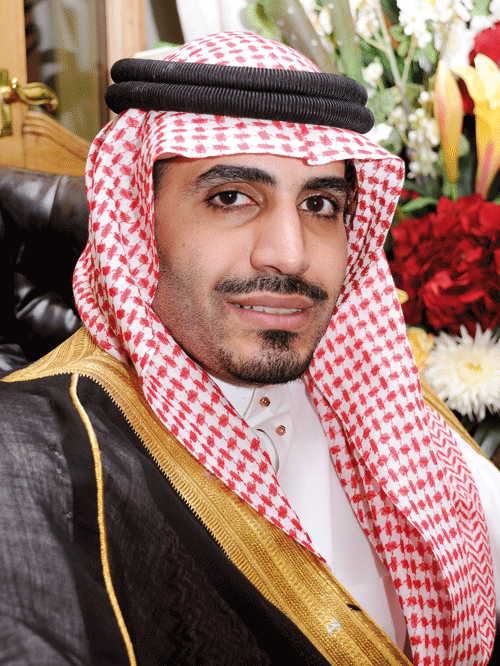
Q&A – Issam Hitti

by Thomas Schellen September 1, 2012
written by Thomas Schellen

Insurance broking is a business of consulting and risk advisory that historically bears the onus of being the “middle man”, with all the common questions of what value this function brings with it. Executive sat down with Issam Hitti, the president of the Lebanese Insurance Brokers Syndicate (LIBS) to find out how the brokers are contributing to the nation’s insuredness.

What can you tell us about the performance of Lebanese insurance intermediaries?

We just finished this study regarding the sector’s performance in 2011 and thus for the first time have a clear view on the sector, about how many people are working in it and how written premiums are divided by line and also by distribution channel. We have divided the channels of distribution according to three categories: the direct and exclusive agents, the bancassurance and the independent brokers.

How many people make their living as insurance intermediaries today?

We have found that we have 258 brokerage companies and 121 individual brokers, which gives us a total of 379 independent legal and licensed brokers. Besides the shareholders, we have about 1,790 active employees [at independent brokers]. There are also 1,023 exclusive agents in the market, including 812 agents working with insurance companies and 167 agents working in bancassurance. All in all, the total number of active persons in this field is 3,708. Counting four members per family we think that the number of people benefiting from the insurance intermediary industry is about 15,000 persons.

How big is the pie that these insurance intermediaries and their families live on?

From the reports of the Association des Compagnies d’Assurances au Liban (ACAL), we know that the insurance companies have about $1.22 billion written premiums in 2011. Regarding the channels of distribution, we have analyzed the reports by the Insurance Control Commission (ICC) at the Ministry of Economy and by ACAL and we have also issued our own study on the portfolio profiles of LIBS member companies. We found that bancassurance accounts for about 24 percent of overall production of written premiums, 33 percent for direct and exclusive agents and 43 percent for independent brokers. This means we are sure that independent brokers were producing about $528 million in written premiums in 2011.

So when compared with direct agents and the bancassurance channel, independent brokers are supplying the largest chunk of insurance premiums that are written each year?

Yes.

But do we know how this breakdown of insurance business by distribution channel has evolved over recent years?

No, this is the first year that this study was done.

And how do their shares in the underwriting of total premiums translate into revenues for the intermediaries?

We expect that the total remuneration paid to insurance intermediaries in 2011 is about $200 million, with 23 percent for the bancassurance distribution channel, 31 percent for exclusive agents and 46 percent for independent brokers.

So total cost of sales for insurance premiums across all distribution channels is approaching $200 million, and independent brokers take 46 percent, meaning your industry turnover of independent brokers and your employees came to about $92 million in 2011?

Yes.

Do you have projections how these numbers look for 2012?

No. We have only the first quarter and second quarter figures so we have to monitor and hope to get the real figures at the end of the year.

But from the perspective of brokerage business, do you see trends or significant points of strength or weakness in 2012 when compared with last year?

I think we are at the same level as 2011. There is no boom in the business; the main issue now is to maintain your business and do a good renewal business. Unfortunately, there is no big volume in new business, there are no projects. Nevertheless, because of premium increases related to inflation and higher loss ratios, etc., we think there will be an increase of about 12 to 15 percent in the market.

Before inflation?

Exactly.

September 1, 2012 0 comments
0 FacebookTwitterPinterestEmail
InsuranceSpecial Report

Orange scheme crashes

by Thomas Schellen September 1, 2012
written by Thomas Schellen

It ain’t broken, but the economy underlying one of the Lebanese motor insurance industry’s specialities has vanished. While the Orange Card system for cross-border liability insurance protection of Arab motorists is functionally fine, commercially speaking, Lebanese administrators tell Executive that business has fallen precipitously – premiums have roughly halved and sales are almost non-existent.

Data from the Association des Compagnies d’Assurances (ACAL), which administers the Orange Card system on the Lebanese end, reveal a massive drop in premiums between the first and second half of last year. Between July and December 2011, premiums slowed to $889,000, down from $1.53 million in the first half of 2011. In the first half of 2012, insurance premiums issued in Lebanon under the Orange Card system amounted to merely $947,000, down almost half when compared with $1.85 million in the first six months in 2010.

In a way this is not surprising but more a clarification of reality. The Orange Card is a short-term liability policy that all Lebanese private and commercial vehicles need to have in order to travel from here to Syria, Jordan, Iraq, and other Arab countries. The slowdown in premiums reflects in frightening crispness how travel between Lebanon and other Arab countries has been impacted by the situation in Syria. 

“If you want to travel through two or three Arab countries, you buy a small booklet where the pages are stamped in accordance with which countries you pass through. If you go from Lebanon, you buy from Lebanon a stamp for Syria and Jordan. If you travel from Qatar, you buy it there,” explains Fateh Bekdache, the head of Lebanon’s National Bureau for Compulsory Motor Insurance (and general manager of insurance company Arope).

If an insured vehicle is involved in a claims case in an Arab country, either the country’s national insurance association or a designated insurance company handles the settlement. The involved parties then balance the claims accounts between each other, Bekdache adds.

Stalled sales

In 2012, sales of Orange Card booklets to Lebanese insurance companies amounted to a paltry 2,151 cards in the first six months of the year; in April and May not a single card was sold. Given that 40 to 60 percent of cards sold to insurance companies lead to issuance of a cross-border policy, the number of issued policies hardly exceeded 1,000 in the first half of this year, according to Jamil Harb, secretary general of ACAL.

Before the unrest in Syria started unfolding last year, sales of Orange Cards were in the tens of thousands. In 2010, sales reached 60,750 cards in the full year and insurers reported issuance of some 30,000 policies.

The much larger drop in the number of cards sold, relative to the contraction in premiums from the issued policies, suggests that cross-border travel of passenger cars and private motorists has dwindled to the absolute essential.

Under the Orange Card fee structure, private motorists can purchase cards with durations from one month to one year, while commercial vehicles – taxis, buses, and trucks — can purchase cards lasting from three months to one year. Commercial vehicles not only pay two to three times higher premium rates than private vehicles, they will also tend to be active year-round and avail themselves of the discounts for longer lasting policies. The discounts offered for the longer-duration cards are significant, a taxi operator will have to pay $40 per month on a three-month validity but only $23.30 per month when buying for the full year. Similar discounts apply to buses and trucks.

The Orange Card scheme, which is under the authority of the Cairo-based General Arab Insurance Federation, doesn’t publish system-wide performance figures but the Lebanese data shows that people here have stopped relying on road travel for their summer vacations or shopping trips across the border.

For ACAL it means that the revenues from card sales, which are its main source of income, are so low that the association is for the first time in a situation where it is not breaking even. “We have to come up with new ways to finance the work of ACAL,” says Harb.

For the national economy, the numbers scream of the suffering tourism and trade activities between Lebanon and Arab countries.

September 1, 2012 0 comments
0 FacebookTwitterPinterestEmail
InsuranceSpecial Report

Weathering the rainy days

by Thomas Schellen September 1, 2012
written by Thomas Schellen

It has been said with some justification that the global economy could be saved from recession if enough people collectively started believing that the end of the world was upon us. Pre-apocalyptic consumer spending would skyrocket and blow the lid off all current growth restraints. But it is questionable if people would think to spend any money on insurance at the end of times.

Coming out of 2012 summer vacation, Lebanese insurance sure could use a boost, though. Collapse of economic confidence, shrinking payment morale, untrustworthy policy making and regional upheaval — all the things that are bad for business in Lebanon this year are especially bad for insurance.

Insurance premiums achieved fair growth of 9 percent year-on-year to $681 million by June 30. The growth rate after the second quarter is up from 4 percent in the first quarter, according to the Statistical Quarterly published by the Association des Compagnies d’Assurances au Liban (ACAL). However, the growth figure, which is not fully audited, does not account for inflation and also may still see a bit of correction — in 2011, the nine-month nominal growth was reported at 14 percent while full-year rates came out lower, at 12 percent. Furthermore, the indicators for the total number of insurance contracts (down 5 percent year-to-date) and motor insurance premiums, which have contracted for the first time in years and are down by one percent year-on-year, spell a worrisome slowdown in activity and could imply real trouble for some insurers.

A more collective, transparent industry

Probably the best things that can be said regarding the advancement of insurance in Lebanon to date in 2012 are that insurance stakeholders have started to sit more often at the same table and that transparency of the industry is making further advancements. Divergent positions of interest and mutual misunderstandings between regulators, insurers and intermediaries seemed to smolder unremittingly in earlier years behind a thin façade of cordiality; the last few years have seen a positive climate change to more genuine communication. Recent interaction between representatives of all sides in the National Insurance Board offers hope that, through greater collaboration between these and other participants in the collective insurance game, Lebanon’s insurance needs on a socioeconomic level will be better safeguarded.

On account of transparency, the availability of real insurance sector performance data has made great strides from being virtually inaccessible five years ago. The  first annual report by the Insurance Control Commission at the Ministry of Economy and Trade, which covered 2007, was issued after a several year lag. This delay has shrunk dramatically, with reports providing audited information now issued much more promptly. The Quarterly Reports by ACAL, issued since beginning of 2011, are augmenting this and starting from this year will be expanded further by an annual report of the association.

The picture is further sharpened by the Lebanese Insurance Brokers Syndicate (LIBS), which in July presented its first-ever study on the contribution of intermediaries in the insurance economy.

On the negative side, it appears that insurers in Lebanon this year can do little more than put a good face to a period that has been both tough and uneventful.

“For me personally, the time since the beginning of this year was the slowest and most boring period since I first became manager in an insurance company 16 years ago,” sighed an insurance leader in conversation with Executive, asking that he not be quoted by name.

2011 performance in the global context

The stage for insurance in 2012 was set by Lebanese insurers’ performance numbers in 2011, which were mellow, but proved better than many in the industry had anticipated. At the end of 2011, Lebanese insurance premiums stood at $1.2 billion, up from $1.1 billion in 2010.

Small as the gain was, it looked pretty good against the backdrop of worldwide insurance premiums contracting in 2011, by 1.1 percent in advanced markets and by 0.8 globally (inflation adjusted). The comfort of this “outperformance” is, of course, not exactly gargantuan when one notes that Lebanon has a 0.03 percent share of world insurance premiums of $4.597 trillion (nominal) according to the Sigma research unit of reinsurance giant Swiss Re.

Taking the dialectic to the next step, the national insurance performance again deserves respect when considering that insurers here faced not only the local impacts of European economic problems, and global financial jitters but also harder financial conditions in the insurance market because of humongous natural catastrophes of 2011 — the disaster tally came financially to $380 billion in total economic damage and $105 billion in insured economic losses, according to reinsurer Munich Re.

On top of being exposed to all that global trouble, local insurers also had to deal with severe regional political developments that drove the discipline of Lebanese risk management into the wall of Syria’s realities.

Costs rise, excitement lags

In regional comparison, Lebanon today is still ranked at the top for the percentage of gross domestic product spent annually on insurance. This ratio, known as insurance penetration, is seen to indicate if a country has sufficient strength of protection or if it is underinsured.

With 2.9 percent insurance penetration, Lebanon ranks ahead of the emerging markets average of 2.7 percent and more than a full percentage point ahead of most other Arab markets.

However, while the robust GDP growth of Arab oil exporting countries explains why insurance growth in those markets has not been reflected as higher insurance penetration, stagnant insurance penetration rates in the slower growing Lebanese market over the past five years give reason to ask if the country and its relatively well-developed insurance industry need to do more to keep protection adequate.

Life insurance is a segment that, because of its facilitation of clients’ long-term savings and contribution to financial preparedness in old age, should be a growth market. Some years ago, when the country was starting to come back from the depressed economic mood that had ruled between 1998 and 2002, insurance industry optimists would speculate that collective life premiums should be worth a billion dollars, or more, today.

In reality, life premiums came to about $350 million in 2011 and have seen growth rates varying from 10 percent last year to 23 percent in the first half of 2012, according to ACAL.

Fluctuating between 25 and 30 percent of the national premiums volume, life insurance is by regional standards healthy, but long-term growth rates and levels of life premiums are substantially below where they would need to be if private savings, by way of insurance, are to help relieve Lebanon’s stressed social networks.

Life insurance volumes also don’t look all that promising when the business of coerced life policies in consumer borrowing is taken into account. The requirement by all banks that loan customers have to buy life insurance with coverage for the loan amount — to indemnify the lender if the borrower cannot fulfil her or his obligations due to death or permanent disability — is a staple source of premiums income for bank-owned or affiliated insurance providers.

However, while the practice offers insurers good risks and fine premiums at very little work, and is a factor in making life insurance by far the most profitable line in Lebanon (according to data by the ICC), there are no indications supporting an assumption, frequently voiced by managers of bank-owned insurers, that the forceful practice helps in increasing awareness of the benefits of life insurance among Lebanese consumers.

According to the new LIBS study, the total number of life insurance contracts sold in 2011 via ‘bancassurance’, the distribution channel where people buy insurance from an agent situated in a bank, was equivalent to 46 percent of all life contracts.

“People don’t go to the bank to buy insurance. They go to the bank to get a loan,” commented LIBS President Issam Hitti.

If term-life, protection-only contracts sold via bancassurance are overwhelmingly tied to lending agreements, it ought to be a much more significant concern for the entire Lebanese insurance industry how to improve genuine demand for both savings and protection-only life insurance contracts.

In the property and liability insurance business, the best perspective is for growth in property premiums from corporate clients, led by industrial companies which are newly required to contract a basic fire insurance package.

Medical insurance — which alongside motor-related business constitutes the bread and butter of Lebanese and regional non-life insurance — has seen profitability resurge in 2009 and 2010 when compared with previous years, according to the ICC. However, members of the industry attributed growth of medical premiums in the past two years largely to premium hikes imposed to balance rising hospitalization costs. Recent trends in medical insurance showed negative developments in the number of issued contracts and growth of premiums by only 4 percent in the first half of 2012, 11 percentage points below the full-year growth shown in the ACAL Quarterly Report for Q4 2011.

The outlook for medical is further shaded by insider observations that corporate group clients are going down the road of cost cutting, reducing the scope of employee health insurance purchases or making employees pay for their dependents.

Retail clients of medical insurance have limited recourses when faced with rising policy costs, except for complaining to the provider — and insurance managers are hearing a lot of complaints this year.

Motor insurance quagmire

Motor insurance has a questionable outlook this year. Not only did premiums contract by one percent in the first half of the year and speciality coverage for cross-border travel slump because of the Syrian situation, but the combination of rising claims costs and shrinking premiums makes it likely that 2012 will see the bottom-line of motor insurance further in the red, after already incurring losses in previous years.

Given that falling demand for comprehensive or no-fault insurance of motor vehicles was behind the contraction of motor premiums, compulsory third-party liability (TPL) motor insurance is where the market can grow in months and perhaps years going forward.

For almost a decade Lebanon has had mandatory motor insurance. But the coverage, which represents 17.1 percent of all motor premiums, so far only indemnifies injury or death of accident victims. Now, clauses in a new traffic law propose that mandatory insurance will soon apply to both bodily injury and material damages, while the National Insurance Board is deliberating on how to best implement the new coverage.

The expansion of mandatory insurance protection to material damages caused by motorists will bring relief to society, as it will moderate the risks of suffering financial losses just from driving in Lebanese traffic. For insurance providers, the introduction of the wider mandatory cover is a mixed bag. An impending problem of mandatory motor liability insurance against material damage is abuse. Different to accidents with personal injury, deliberately staging an accident with some material damage to another car is an easy ploy in Lebanon’s environment of lousy roads and inconsistent enforcement of traffic discipline.

The combination of having a large number of competing car insurance companies and no system for identifying high-risk drivers means that Lebanon has the potential to become an Eldorado for automotive accident scams as soon as a compulsory, inexpensive TPL coverage for material damages is in the market.

A central issue for providing society with the advantages of full TPL motor insurance will therefore be the empowerment of a motor risk database with full participation by the industry. A motor risk center (MRC) has been under development where insurance companies supply accident and claims data on voluntary basis; it has undergone test runs but scepticism that the MRC will function as needed has been prevailing from the ranks of insurance managers right to the top people-in-the-know in motor insurance.

As noted by the head of the National Bureau for Mandatory Motor Insurance, Fateh Bekdache: “If it is not compulsory, I personally don’t believe it will work.”

September 1, 2012 0 comments
0 FacebookTwitterPinterestEmail
InsuranceSpecial Report

Tied up in risk

by Thomas Schellen September 1, 2012
written by Thomas Schellen

Lebanese entrepreneurs traditionally have approached risks with the attitude that they prefer to carry them themselves rather than pay for risk transfer, unless there is a compelling reason to buy insurance. Companies insure their vehicle fleets and some contract medical coverage for staff as add-on benefits beyond the obligatory payments to the social security system. Larger companies are usually more insurance-aware and acquire basic asset protection, such as property, fire, and cargo insurance. But the vast majority of commercial enterprises are small ventures and their insurance blankets reveal more risks than they cover — small and medium-sized Lebanese companies are underinsured on several and perhaps even most fronts.

The only insurance that has been compulsory for Lebanese companies until now, with some level of enforcement, has been workmen’s compensation, a basic accident policy for employees. This year, the Ministry of Industry introduced a new requirement for industrial establishments, which from this summer on have to obtain a fire insurance policy in order to renew their industrial licenses.

Interestingly though, demand for fire insurance has already been on the rise before the Ministry of Industry introduced its decree. According to the quarterly statistical report of the Lebanese insurance association, ACAL, premiums in the fire business increased 14 percent to $81.7 million in 2011 and represented a 9.3 percent market share of non-life insurance.

The corresponding numbers for the first and second quarters in 2012 show continued growth at 14 percent for January to March, and 16 percent for April to June. According to the report for the second quarter, the share of fire premiums in total non-life premiums has expanded to 10.3 percent of non-life premiums in Lebanon.

One factor that insurance leaders say influenced the demand — and also the consideration to create a mandatory fire package for industrial establishments — was a $12 million industrial fire that was settled by the insurer, Arabia Insurance, with quite some public fanfare in November 2011.

An unsure fire-sale

The latest statistics on insurance sales in the first half of 2012 do not necessarily enable growth estimations for fire insurance in the coming years. On one hand, implementation of the decree requiring coverage in industrial establishments still has to be shown in practice; companies in Lebanon are noted for their inventiveness when it comes to cost avoidance. On the other hand, the insurance providers do not have market data that would reveal how many industrial establishments and of what sizes are currently lacking fire coverage.

The new requirement, which insurance companies — no surprise — are supporting enthusiastically, has already generated applications from industrial companies that never before felt the need to buy fire insurance. The application surveys of these companies have shown that many do not conform to important standards, said Fateh Bekdache, general manager of Arope Insurance.

“Every insurance company has its own strategy on this but the companies that look for fire insurance have some risks that they need to work on, a lot, in order to be insurable,” he said.

It is a different case with managerial and professional liability insurance coverage in Lebanon, where growth is not led by any new regulatory initiatives. A discussion at the Ministry of Tourism regarding the introduction of mandatory liability coverage for restaurants and hospitality enterprises, to protect patrons if they suffer an accident or a food-related illness, was recently aborted.

But some factors have sparked interest in liability covers. When judicial authorities in Mount Lebanon ordered a doctor arrested in a dispute over medical treatment in June, it was the first case where alleged negligence and malpractice by a physician resulted in such action by the public prosecutor. According to Bekdache, the doctor’s arrest triggered inquiries by medical practitioners asking for quotations on malpractice insurance.

In parallel to newly malpractice-risk aware physicians, lawyers are also asking for professional liability coverage, but do so mainly for reasons of wanting to enter international partnerships. “A month ago I got a call from a prominent law firm which asked about the price indication for this kind of professional indemnity cover,” Bekdache said.

Demand for professional liability insurance by a law firm is attractive for the insurer, but these inquiries cannot be answered with a ready-made policy, he added. “It is a big proposal,” said Bekdache. “I have to know the track record of the law firm, how many cases were lost and won, what kind of litigation they do and what their turnover is.”

D&O’s and Don’ts

Another complex need is management liability insurance. Directors and officers, or D&O in insurance-speak, are today held responsible for a growing range of risks that range from unintentional errors and omissions in delivering projects, as well as products for financial and managerial liabilities. Regulators, shareholders and stakeholders such as employees and competitors represent a pool of litigation threats for both companies and directors as individuals.

Cases, which can be both civil and criminal, are brought for issues as diverse as a violation of anti-money laundering rules, failure to fulfill duties, keep adequate records or apply regulations, harassment, wrongful termination, or abuse of power. The range is so broad that insurance covering corporate errors and wider management liabilities, subsumed under the term D&O insurance, is “a must for any large company in Lebanon,” according to Bekdache.

Against the severity and frequency of this risk, however, the number of D&O policies issued in Lebanon is falling seriously short and the market is underpowered. Chartis, a prominent name in global D&O insurance that has presence in each of the six Gulf Cooperation Council countries and Lebanon, has seen demand for D&O coverage grow in some Arab markets. The United Arab Emirates and Saudi Arabia are leading demand developments for D&O insurance, said Muhannad Abdul-Majeed, an expert on financial insurance lines with Chartis Middle East.  “Unfortunately, Lebanon is a challenging market for management liability covers.”

Roger Zaccar, business development manager of Commercial Insurance, an independent Lebanese insurer, was blunter. “There is no demand [in the Lebanese market]; you have only two or three clients who are buying [D&O]. People don’t know why they need it and insurers don’t have the volumes to create specialized departments for it” he said.

Local providers are not equipped to assess and underwrite corporate liability policies, said also Arope’s Bekdache. “Nobody has a facility on those policies so we go via international brokers. It doesn’t make sense to have facility for such a product.” Among the reasons why D&O insurance in Lebanon is a tougher sell than in the GCC is so few companies are publicly traded on the Beirut Stock Exchange and very few international investors are looking to acquire stakes in Lebanese companies, according to Abdul-Majeed.

Regional D&O growth

At Chartis Middle East, 61 percent of premiums underwritten on management liability coverage in 2011 came from first-time buyers, evidencing demand growth, he said. “The majority of buyers were companies that were publicly listed, and/or had exposure to international jurisdictions via their customers, shareholders, suppliers, and so forth.”

However, the insurer also found that regional D&O insurance demand is still mostly reactive, as companies respond to demand from international investors and business partners, or to high-profile incidents where executives and corporate officers are scrutinized.

In the UAE and other GCC countries, regulators are popularizing D&O as they are stepping up investigations of corporate managerial liabilities. Chartis observed 20 percent more notifications of claims brought against D&O in 2011 when compared with 2009 and 2010.

Corporate and managerial liability insurances are just some of the protections that companies in Lebanon and the region will need more of in future if global markets are the guidepost. While no concise data on the presence of D&O insurance is available, Chartis estimates that current premium volumes invested in D&O liability protections is no more than 5 percent of non-life premiums across the GCC and Levant.

The level of coverage in the region is definitely lower than in more mature economies, Abdul-Majeed noted, even though corporate liability protection is anything but a than needless luxury.  “In terms of [a] corporation’s budget, a D&O policy is usually much cheaper than other more traditional insurances, such as property insurance or group medical, but whereas companies are prepared to pay the higher premiums for these covers, they unfortunately do not give much thought to management liability insurance.”

Circumstances could however boost adoption of some insurance policies for corporate decision makers and key persons. Besides seeing more corporate demand for insurance against terrorism, political violence and war risk, insurers in Beirut and the Middle East have been starting this year to get more calls asking about kidnap and ransom policies.

September 1, 2012 0 comments
0 FacebookTwitterPinterestEmail
Economics & PolicyElectoral Reform

Blank the ballot

by Rabih El-Chaer September 1, 2012
written by Rabih El-Chaer

Parliamentary elections in June 2013 will define both the ruling majority for the next four years and the identity of the future Lebanese president, and the Lebanese electoral law will play a crucial role in this process. But the country’s opposing political camps — the March 8 and March 14 coalitions — are not willing to risk any change in the balance between them. For this reason they are not likely to accept the proportional electoral system as it will open the door for independent candidates to take part in the elections, and this new blood would pose a serious threat to the established oligopoly in the Lebanese political system.

Prime Minister Najib Mikati’s government promised in a ministerial declaration shortly after taking office that the electoral law, which includes all the related reforms, would be effective one year before the elections. However, it was only sent to the parliament last month — 10 months before voting begins — meaning government is already in violation of this commitment. Furthermore, it is widely expected that Parliament will procrastinate in its review of the electoral law to use up time and make implementation of any reforms impossible before the election. For this reason we should not get our hopes up regarding electoral reform. Rather than presenting an opportunity for change, voting citizens will most likely be left with little choice but to reinforce the status quo.

Those of us campaigning within civil society understand the cynical game that is being played out before us and have therefore changed our strategies and priorities. There are other crucial reforms to the elections that should be implemented, whether they are instead of or in addition to the proportional electoral system.

For starters, an independent and permanent committee (IPC) that organizes and supervises elections needs to be established. It is disconcerting, but not surprising, that the draft law submitted by the Minister of Interior and Municipalities to the Council of Ministers, Lebanon’s cabinet, did not suggest the creation of an IPC. Without such a body, however, we should not accept the interior minister’s authority to conduct the elections, especially since he is a member of a monochromic government. The Civil Campaign for Electoral Reform (CCER) conducted a feasibility study that proved that there is still enough time to create the IPC if an honest will is expressed by the Council of Ministers and the Parliament.

We are also insisting on the adoption of pre-printed ballots and vote counting procedures in polling centers, instead of polling offices, in order to increase transparency and to limit bribery and vote buying, among the other various aspects of election corruption. What is more, logic dictates that the electoral law is also supposed to ensure candidates state publicly their electoral expenses in order to increase transparency and to limit electoral excesses. In reality it increases the limit candidates and parties can spend on electoral campaigning, further eroding the credibility of the political class.

We denounce this shameful behavior practiced by politicians and are increasing our lobbying efforts. However, the task at hand is not an easy one and a number of tough questions need to be addressed: How is it possible to apply pressure on a corrupted political class that regularly and successfully distracts public attention by creating alarming situations? How can we raise enough awareness to force our politicians to change when it is they who control the major media outlets? How can we persuade the silent majority of the Lebanese people to express their opinions without burning tires and blocking roads? The answers to these questions seemed far from reach before the Arab uprisings, but if our brethren in the region can overthrow their fierce dictatorships, then there is hope that we can change the Lebanese political system as well.

If civil society is to have any kind of success then it must find a common voice. If the active organizations and the potential army of thousands of volunteers can agree to submit one single list composed of 128 candidates for the parliamentary elections in 2013, or by default, one candidate for each electoral district respectively, then they will be heard by both the street and the establishment. However, if civil society as a whole is not able to unanimously reach a compromise, we will invite all those citizens who are fed up with the political class in Lebanon to cast blank votes. A blank vote, which is usually used to demonstrate dissatisfaction with the choice of candidates, would in this case be used to pressure the whole of the political class to take heed of the disenchanted masses.


RABIH EL-CHAER is managing director of the Lebanese Transparency Assosication

September 1, 2012 0 comments
0 FacebookTwitterPinterestEmail
Economics & PolicyElectoral Reform

Linking electoral and economic reform

by Sami Atallah September 1, 2012
written by Sami Atallah

The approval of the new electoral law based on proportional representation by the Council of Ministers, Lebanon’s cabinet, has the potential to be a historical moment but will most likely be cursed to an early grave. When it comes to a show of hands in Parliament, the Future Movement, the Progressive Socialist Party and the smaller Christian parties are likely to succeed in voting it down. This is because under such a system they would likely lose seats in the upcoming elections and see their power wane in the next Parliament.

Putting aside the zero-sum game between the two main rival political camps, voting down the proportional representation electoral law is a blow not only to better political representation, but will allow the existing majoritarian system to continue stifling Lebanon’s economic and social development, particularly in the regions. Quite simply, under the current system politicians do not need to deliver any concrete policy platform to run on, or even deliver successful reform while in office, to win seats. Under a majoritarian system, politicians with the most votes win the seat even if they don’t secure a majority. Districts where politicians are ahead of all the other candidates are considered “safe” and little effort is exerted to win them. Instead, the focus shifts to districts that are competitive or where there is a swing-voting constituency. Campaigning for votes in these areas thus becomes an essential strategy for the party. Add to this electoral system three other features — bloc voting, sectarian polarization and clientelism — and parliamentary seats are won based on a small coalition of voters within these tightly fought districts. Most political parties in Lebanon have benefited from the majoritarian electoral system, explaining why it has been in place for so many years.

The three cruxes

Bloc voting, which is common in rural Lebanon, reduces voting power to a few members of the community, that is tribal or family elders, who decide on behalf of the tribe or family members who to vote for and everyone else follows suit. Sectarian rhetoric is the cheapest political strategy to mobilize citizens to vote, but this works only in districts with an ethnically homogenous population (otherwise it can backfire). Finally, electoral clientelism is, effectively, buying votes by giving cash or services to targeted individuals, particularly in swing districts.

By expedient exploitation of these tactics in a majoritarian system elected politicians end up in parliament with the support of a relatively small but active coalition of voters. By keeping this coalition relatively content, politicians have no incentive to push for any socioeconomic development programs in the less contested regions, since they will get elected in any case and are rarely held accountable by their own constituents. 

The proportional representation system radically changes the relationship between voters and parliamentary candidates. Under this system every vote counts and seats are allocated based on the proportion of the votes won. This encourages people to vote even in districts that are dominated by a political party not of their choosing. Having more people voting will make clientelistic strategies vastly more expensive. Parties may eventually find themselves unable to buy all the votes they need directly. It could also encourage family members to break away from bloc voting since their votes would count even when they vote for the smaller and less powerful parties.

Rather than falling back on safe seats while coopting small but active groups of voters in swing districts, the political parties would have to address the electorate as a whole. This means they would have to actually devise and deliver concrete policy programs that will provide public goods and services to the larger community. Politicians would be held to account on their ability to deliver on critical issues such as infrastructure, education, health or electricity. As such it would be an impetus for socioeconomic development, particularly in the regions.

The bigger game

Proportional representation has ramifications beyond political representation, with most of the debate surrounding reform failing to recognize the link between electoral representation and economic development. The political and economic angles are intrinsically intertwined but too often discussed and debated by stakeholders, including civil society organizations, as two separate problems.

Proponents of proportional representation seem to appreciate its political end only, while those who advocate regional development seem nostalgic for the era of President Fouad Chehab, when regional development plans were drawn but never implemented. Sadly, little thinking goes into why the Chehab program did not stick: electoral reform is key to regional development.


SAMI ATALLAH is executive director of the Lebanese Center for Policy Studies

September 1, 2012 0 comments
0 FacebookTwitterPinterestEmail
Economics & PolicyElectoral Reform

The vice of vested interest

by Rony Al-Assaad September 1, 2012
written by Rony Al-Assaad

If there is one thing that has become clear since the debate over electoral reform resurfaced in Lebanon, as it does every four years, it is that the main political forces in the country consider elections to be a form of leverage over the people rather than an opportunity to ensure fair and democratic representation. While the Council of Ministers, Lebanon’s cabinet, passed an electoral reform law in August, whether this passes Parliament — and if it does, how it will have been altered — is still yet to be seen. Unfortunately, the election law that governs next year’s ballot will likely resemble the previous one: Distorted legislation that comes out of an 11th hour negotiation and falls short of basic democratic standards. In short, it is unlikely that the ruling elite will allow any significant rocking of the boat.

In any case, the public should know why our so-called leaders will let us down once again, specifically with regards to adopting a system of proportional representation. An analysis of politicians’ motives and their public statements, which are constantly adapted to fit changing political and electoral interests,  reveals much.

Behind the bluff

Let’s start with the opposition, specifically the Future Movement. They consider proportional representation as an electoral “weapon” which aims to undermine their dominance and position as the main representative of the Sunni sect, given the number of independent Sunni candidates. At the same time, Future is convinced that proportional representation will not break the monopoly their main political opponents — the Amal Movement and Hezbollah — have over the Shia sect, as these parties enjoy overwhelming representative power in their districts of popular support, such as South Lebanon, the Bekaa and Hermel. Future also rejects the proportional representation system as long as Hezbollah maintains its arsenal of weapons, as it firmly believes that arms undermine democracy, freedom to run for elections and even the security of candidates if they win; an example they often cite is Hezbollah’s direct interference in the municipal elections to deter candidates from running or pressuring them to withdraw. Do, however, keep in mind that this practice is prevalent in any area in Lebanon where one political party enjoys overwhelming hegemony. Future also fails to explain how the excuse of Hezbollah’s arms does not apply in a ‘winner take all’         electoral system.

At the same time, the Future Movement is waiting for a clear position to be declared by its Christian allies, who are generally more supportive of smaller districts since they fear that larger districts may erode the share of parliamentary power allocated to them under the 1989 Taif Accord, which is 64 deputies. It is worth noting that both demographic changes and the 2008 electoral law detracted greatly from the ability of Christian voters to choose their representatives — in six out of the 12 districts where there is a Christian majority, Muslim votes determine the election results. Future Movement deputies have stated that their party might support Fouad Boutros’ draft law if it was proposed as a serious alternative; this law proposes a mixed electoral system where 70 percent of parliamentary seats are elected according to the majoritarian electoral system at the qaza (or district) level, and 30 percent of seats are filled according to the proportional representation system at the mohafaza (or governorate) level.

The Christian parties in the opposition (the Lebanese Forces, the Kataeb and independent politicians) support small districts, and through the Bkerke committee — which brought together the four main opposition and governing Christian parties — they have put forth two proposals: either a modified version of the electoral law 25/2008 where Lebanon is divided into some 50 districts of four seats each at most, or a proportional representation system in 14 to 15 districts. Many see the position of the Christian opposition parties stemming from their wish not to go against their Sunni ally, as well as the fact that proportional representation is not viewed favorably among most Christians or in Christian political circles. This latter point is somewhat odd for opposition Christian parties, however, as proportional representation could help weaken the monopoly on parliamentary representation the Free Patriotic Movement (FPM) currently enjoys in some areas in Mount Lebanon (the district with the largest concentration of Christians), as a first-past-the-post ballot renders opposition votes in these areas inert.

The government’s side

As for the parliamentary majority, they have an interest in adopting the proportional representation system based on statistics from the 2009 parliamentary elections. According to repeated public statements by some of its leading members and its own polls, Hezbollah believes its popular base is large enough to ensure positive results within any system. However, it is also possible that the proportional representation system would go against Hezbollah’s interests, for it would certainly contribute to breaking (even if initially to a small extent) the bilateral monopoly of Hezbollah and the Amal Movement over Shia representation as independent Shia candidates gain more confidence to run, given that they have a chance of winning a seat. Hezbollah’s position is also linked to the position of its main Christian ally, the FPM, as Hezbollah needs their support in the districts with a Christian majority.

The most recent FPM position called for adopting proportional representation with Lebanon as a single district. This is mainly an attempt to gather the Christian votes that are scattered across the country outside of Mount Lebanon, which the FPM believes would go to its candidates. The FPM believes that its political power could be maintained by proportional representation since it should guarantee it a number of seats despite a perceived, but unproven, decline in popularity.

Deputy Walid Joumblatt (the main representative of the Druze sect) has outright rejected the proportional representation system. This stems from his belief that it will reduce his representation in Parliament, which is “exaggerated” in the present system where he is able to ensure the election of loyal Christian and Sunni deputies through Druze votes. Hence, even though the cabinet has voted in favor of the law it is unlikely to garner sufficient support in Parliament (at least in the form passed by the cabinet), given that Joumblatt has the ability to sway the final outcome. That is unless a new political tradeoff is struck among the different political blocks, which is not uncommon for Lebanon’s opportunistic political parties.

Lebanon may have a long history of elections, but this has rarely translated into the creation of functioning national institutions. If we are to transform our “culture” of holding elections into a state with accountable institutions and a participatory body politic, then we need an electoral law that ensures fair representation and the secrecy of the ballot within an independent and transparent organizational structure. Sadly this looks like it will not be the case, and now we know why.


RONY AL-ASSAAD is director of the Civil Campaign for Electoral Reform (CCER). This article expresses the personal views of the author and does not represent the official policy of the CCER.

September 1, 2012 0 comments
0 FacebookTwitterPinterestEmail
Finance

A view from the Alps

by Maya Sioufi September 1, 2012
written by Maya Sioufi

Swiss private banks seem to be losing their mojo. Gone are the days where one could open a bank account in Zurich or Geneva and sit back, relax and enjoy the returns. Now you worry your home country will bite into your yields.

Switzerland’s oldest private bank, Wegelin, fell prey to the United States’ tax-evasion squeeze in February; it was charged with helping wealthy Americans hide a whopping $1.2 billion in offshore bank accounts.

“Wegelin was a very special case,” says Jacques de Saussure, senior partner at Pictet & Cie, the third largest private bank in Switzerland with more than $360 billion of assets, in an interview with Executive. “As a consequence of the recent regulatory changes, undeclared US assets in Swiss banks must be very small, and probably much more limited than in other countries. As a result, Swiss banks are probably much better prepared to deal with FATCA (Foreign Account Tax Compliance Act)”, the US law requiring non-US financial institutions to provide details of their customers with American citizenship.

Washington is not the only cash-strapped capital eyeing Switzerland to raise revenues; other European states are targeting accounts of their high net-worth nationals in Swiss banks too. A tax treaty between Germany and Switzerland aimed at German tax dodgers is scheduled for 2013, with up to €10 billion ($12 billion) at stake for Germany’s coffers according to Der Spiegel. More recently, debt-ridden Greece is looking to sign an agreement with Switzerland to tax Greek citizens’ deposits held in Swiss accounts.

“Holders of foreign bank accounts are easy scapegoats for the troubles of governments with unbalanced public finances,” says Saussure. “Governments certainly grossly overestimate the amounts involved, and should start focusing on other types of assets, in particular real estate; also, and above all, they should review fundamentally their spending and tax systems.”

Looking east

While internationally there is a trend toward greater compliance and transparency, Saussure notes that “unfortunately… we have a lot of hypocrisy from other countries. A paradox to me is that we know of many dictators and politically exposed persons who own real estate in Paris and London, and who checks that? This is rather disturbing.”

As Swiss private banks feel the pinch, they are turning to emerging markets, and the Middle East is on their agenda. “The Middle East is still growing faster than the industrial countries in Europe and America, with the wealth creation this growth implies,” says Saussure. With turmoil shaking several countries in the region, Middle Eastern clients are reducing their exposure to local real estate and diversifying to other markets, “with a specific focus on the United Kingdom and the US as well as Asia, notably Malaysia”.

Investors from the region are more attracted to “the culture of discretion and the respect of private sphere inherent to Swiss private banking” than to the tax component of Swiss banking secrecy, particularly in the Gulf Cooperation Council, which enjoys low level of taxation, says Saussure.

Saussure believes that Swiss banks benefit from their country’s strong fundamentals. As Europe struggles with ballooning public debt issues and as its banks suffocate in sluggish domestic economies, he sees Pictet’s base in balanced-budget Switzerland as a new asset. “Don’t forget that our equity in the bank is essentially kept in Swiss francs. The Swiss franc has appreciated — too much for some and also for us — but one of the benefits is that our equity base, relative to other banks, has increased.”

He expects the private banking business to have to deal with more risk going forward as emerging markets take on a bigger share. “When we deal with investors in emerging countries, they are very frequently entrepreneurs in an early phase of the development. That is the case here in the Middle East and also in Asia.” For the Middle East, he sees additional political risk but he believes that “this is improving quite rapidly.”

As for Lebanon, he advises private bankers in the country, “to do the same as a Swiss banker, which is to make sure that they provide more added value to their clients through safety, security, expertise and quality of service; they have the potential to do that.” Lebanese private bankers, like Swiss bankers, are facing pressure to comply with new transparency and disclosure requirements such as FATCA but, says Saussure, “what is of course more difficult is that they are in a country that does not have the same rating as Switzerland.”

September 1, 2012 0 comments
0 FacebookTwitterPinterestEmail
Society

The limits of speed and sanity

by Nadim Mehanna September 1, 2012
written by Nadim Mehanna

The illuminated diodes blink up at me from their carbon-fiber dashboard encasement. Mileage. Speed. Performance. To one side sits the power gauge, its range like a prophecy carved in fiery letters: an impossible but unwavering 1,200 horsepower. As I take in the sleekness of the interior, the leather so supple it seems almost alive, the words “fastest production roadster in the world” flit through my head. I’m encased in a $2 million torpedo, and the top is down.  Following the success of the 16.4 Super Sport, it didn’t take long for Bugatti to up its ante with a new addition to the Veyron line: an open-top version of the Super that could nevertheless deliver the Grand Sport’s power and speeds.  The novelty alone was enough to set the fan forums buzzing — an open-top car capable of 410 kilometers an hour? The idea was like a gauntlet thrown in the face of physics. Tornadoes produce slower wind speeds. Strap a rocket to just about any other vehicle and set it off at 410 clicks and the air drag alone will, quite literally, rip it to pieces.

So why do it? Why tempt fate?

Why put a man on the moon, or a mechanical rover on the surface of Mars, for that matter? Any enterprise that pushes the bounds of the impossible contains its own implicit motivation, framed in the simple but central counter-question: why not?

Why not indeed, I think, and throw the car into first gear. The gas seems to drop to the floor of its own accord and the car is off, the world melting into indistinguishable streaks around it.

You can try to describe the Vitesse’s performance by such things as its horsepower or revolutions per minute, but personally, I find these stale calculations fall short of the car’s gut-wrenching reality. Going from zero to 100 in the space of a few heartbeats is best described, I think, as a kind of out-of-body experience. It’s as if the pure force of the vehicle’s takeoff has ripped the soul from your body and deposited it, confused and blinking, on the track behind you. It takes several seconds for your brain to catch up with the car, and when it does, it may still fail to comprehend the reality into which it’s been thrown. The world is a blur; the asphalt contracts beneath you like a snapped elastic band.

With this much power thrumming under your right foot, it’d be easy to panic — after all, unless you’re a professional Formula One driver, chances are this is the fastest you’ve ever moved at an elevation of four feet from the ground. But perhaps the most incredible and commendable thing about the Vitesse, once you’ve recovered from the initial G-Force of takeoff, is how straightforward the actual driving is. The gears slip smoothly upward, almost as an afterthought. Take your hands off the wheel and the car maintains a perfect, pencil-straight course forward. Turn it, and the vehicle prescribes neat, unflinching arks, its four-wheel traction solid as a rock. At every stage, the Vitesse seems to be working alongside you.

A device of both power and beauty

As with its performance, the Vitesse’s aesthetic does not overwhelm. Beautiful, to be sure: a number of aerodynamic measures carried over from the Super Sport, such as larger front-end air intakes and bottom air vents stretching sideways into the wheel house, transmit Bugatti’s characteristic mastery. Inside, the two-tone leather seats, carbon fiber console and quilted armrests, enhanced by contrasting stitching, do manage to convey a degree of luxury.

Every aspect of the vehicle is gorgeously worked, from its fine carbon weave to the buffed casements of its xenon headlights. But this is no high-shouldered Rolls Royce, no luxury sedan. There is nothing ostentatious in the design of this car, nothing to announce, to the untrained eye at least, its seven-figure price tag.

To see the car for what it truly is, you have to look below the hood (if there was one). The Vitesse’s Veyron W16 cylinder engine is a work of power and art, transferring nearly all the advantages of the Grand Sport in one neat package. With a maximum torque of 1,500 newton-meters, it boasts a maximum output of a staggering 1,200 horsepower (hp), achieved at 6,400 rotations per minute. Translate these figures into raw power and you’re looking at acceleration of zero to 100 kilometers an hour in just 2.6 seconds.

In the inner workings of the Vitesse, Bugatti seems to be hewing to the old Hot Rodder maxim: “More power, more better.”

Ettore Bugatti’s legacy

The car is purring away beneath me now, the world slipping by to reverberations of carbon fiber and steel. At speeds that would leave other roadsters spinning in the dust, the Vitesse seems only to be hitting its stride, rising smoothly through the instant shifts to well above 300 kilometers an hour. She’s topless and telling me, “Do what you want, I can take it!” The noise of the air rushing overhead is a torrential roar.

When you hear the Vitesse coming at you from a distance, the sound is like a stampede of mechanical bulls, reaching you long before the car actually swerves into view. It’s a darker, moodier sound than that of the original 1,000 hp Veyron engine. The 1,200 hp Vitesse engine employs bigger turbos, meaning less torque at low speeds and an extra jolt of power once it really starts to fly. I’m inside that sound now, and the roar pouring down from the corners of the windscreen is at once exhilarating and comforting. 

I’ve just begun to relax into the car’s velocity when the radio beside me crackles — the signal to turn back. Regretfully, I release the gas pedal and press the brake. The car responds beautifully, relinquishing its speed with a steady, even pull. 

The Vitesse is both beauty and the beast, a machine of aesthetic refinement with a dark side, capable of pushing the boundaries of both speed and sanity. 

It could be months or years before Mercedes or Renault rolls out a car that can top the Vitesse in terms of speed. Until they do, Vitesse will remain the undisputed king of the roadsters — and by all indicators, it measures up to that lofty distinction.


NADIM MEHANNA is an automotive engineer and the pioneer of motoring on Middle Eastern television

September 1, 2012 0 comments
0 FacebookTwitterPinterestEmail
Finance

Your social insecurity

by Maya Sioufi September 1, 2012
written by Maya Sioufi

For paying nearly a quarter of each employee’s monthly salary into the National Social Security Fund (NSSF), one would think that private sector businessmen would be ensuring a nice retirement package and healthcare coverage for those working for them. Why then is it so common for retiree savings to run out at 68, and for hospitals to threaten to deny them services? This Executive investigation dives into the inner workings of Lebanon’s social insecurity.

The money pit

The NSSF, Lebanon’s largest insurance provider, more commonly known as the daman, manages $4.7 billion in private sector contributions and offers coverage for approximately 30 percent of the Lebanese population. Other than end-of-service indemnities, the daman also offers healthcare coverage and family allowance payments.

To deliver these services — or attempt to deliver these services — the law stipulates that the NSSF should receive an amount equal to 23.5 percent of every employee’s monthly salary. This cash is then allocated to the NSSF’s three dedicated funds and entirely invested in Lebanese currency through treasury bills and deposits with local commercial banks. Employers carry the lion’s share of the burden, paying 21.5 percent and employees contribute the remaining 2 percent.

Under the umbrella of the Ministry of Labor, the NSSF is a “black hole” says Nassib Ghobril, chief economist of Byblos bank. Of the three funds run by the NSSF, two have been racking up deficits for the last 10 years. The family allowance fund reported an accumulated deficit of $252 million as of the end of last year.

Employers pay cash equal to 6 percent of each employee’s monthly salary into this fund, up to a salary cap of LL1.5 million ($995), meaning for higher salaries the fund payment is fixed at $60. This stash of money pays $40 to each married employee if the spouse is unemployed and $22 for each child until the age of 18, up to a maximum of five children. This means that if an employee is married with an unemployed spouse and just one child, he receives more from the family allowance fund than his employer pays into it.

“This allows for corruption,” says Ibrahim Muhanna, founder of the actuarial firm i.e. Muhanna. “Let’s say you are my sister and you have three children. I can put you down as an employee; tax and contributions to the funds are paid and you get the benefits for the children.”

The healthcare fund, also known as the ‘sickness and maternity fund’, also runs a deficit that stood at $239 million at the end of last year. The employer contributes to this fund an amount equal to 7 percent of each employee’s monthly salary, with contributions also capped at a salary level of LL1.5 million. Unlike the other two funds, the employee also contributes by paying 2 percent of his monthly salary, up to a cap of LL30,000 ($20).

What the fund does is reimburse employees for 90 percent of their hospitalization costs and 80 percent of medication and examination expenses, though payment delays often exceed several months and involve navigating long queues and a quagmire of bureaucracy.

The catch for healthcare providers is that NSSF also sets the rate private hospitals can charge patients using their coverage for certain services — rates that can remain unchanged for decades. This year private hospitals in Lebanon began threatening to stop taking NSSF patients unless the rate for an overnight hospital stay was raised from $20 to $60, citing the burden of mounting medical costs. In response, the NSSF administration has asked the government to raise the salary cap on contributions to the healthcare fund to LL2.5 million ($1660) — or a maximum payment of LL175,000 ($116). Economic associations in Lebanon, however, have publicly opposed raising the cap, based on fears that this would pass the burden onto the employers in a time when the country’s economic growth is contracting.

Daman deficits!

Given that the contributions to the healthcare and family allowance funds are capped to a fixed salary, they fail to take into account the rising cost of living, the increase in medical costs and the rise in wages. With the cost of healthcare equipment and pharmaceuticals on the rise — the 2012 Towers Watson Global Medical Trends Survey estimated global medical costs would jump 10 percent this year after increasing 10 percent in the past three years — and contributions into the healthcare fund stable, the deficit continues to plunge ever deeper into the red.

“The contributions do not have an automatic adjustment mechanism like in the West — for instance, having the ceiling at three times the average salary so the ceiling grows along with the increase in the average salary,” says Muhanna. “In Lebanon, if you want to change the figures, you need the Parliament to change the law.”

The deficits on these two funds started piling up after the contributions rates were slashed in 2001 under the leadership of former Prime Minister Rafik Hariri, with the aim of reducing labor costs. While the contribution rate to the EOSI remained unchanged, the family allowance fund rate was cut from 15 percent of an employee’s salary to 6 percent, and the sickness and maternity fund rate was cut from 15 percent to 9 percent, amounting to a 40 percent cut in contributions to social security. Mohamad Karaki, director general of the NSSF, blames these rate cuts on the deficits incurred by the two funds and wants to see them increased by at least a few percentage points.

Ghobril disagrees, saying that evasion from NSSF registration is very common. “Just like there are people who evade taxes and you don’t fight tax evasion by raising rates — it will scare away more companies from registering,” he says.

Jihad Rizkallah, lawyer at El Meouchi law firm, says it is “a frequent problem” and common practice in Lebanon for employers to declare lower salaries for their employees in order to decrease their NSSF contributions. “But the employee has the right to claim all amount due; this is of public order,” he says.  “Even if the employer and the employee agree on not registering with the NSSF, the employee can change his mind and his rights are preserved. The employer needs to pay up.”

While Karaki states that more controllers have been hired in the past year — from some 40 to now 100 staff — to stop evasion from contributions to the NSSF, the impact on the figures are yet to be seen.

Abundant insecurity

The only fund that is running a surplus is the end-of-service-indemnity (EOSI) fund catering to retirees [see story page 50]. With an accumulated surplus standing at $5.2 billion as of the end of 2011, the other two funds borrow from the EOSI to stop their bleeding. The lucrative nature of this fund might well be the reason some politicians have said they want to spin it off from the NSSF and have it privatized, which is delaying the discussions in Parliament on implementing reforms to social security, according to Karaki.

The daman’s mission is to provide private sector workers with society’s basic needs from healthcare to family assistance to catering for retirement. With private hospitals threatening to stop coverage, petty family allowances and with savings left depleted within a few years of retirement, it would seem that the nation’s social security fund actually contributes to a feeling of insecurity more than anything else.

September 1, 2012 0 comments
0 FacebookTwitterPinterestEmail
  • 1
  • …
  • 316
  • 317
  • 318
  • 319
  • 320
  • …
  • 686

Latest Cover

About us

Since its first edition emerged on the newsstands in 1999, Executive Magazine has been dedicated to providing its readers with the most up-to-date local and regional business news. Executive is a monthly business magazine that offers readers in-depth analyses on the Lebanese world of commerce, covering all the major sectors – from banking, finance, and insurance to technology, tourism, hospitality, media, and retail.

  • Donate
  • Our Purpose
  • Contact Us

Sign up for our newsletter

    • Facebook
    • Twitter
    • Instagram
    • Linkedin
    • Youtube
    Executive Magazine
    • ISSUES
      • Current Issue
      • Past issues
    • BUSINESS
    • ECONOMICS & POLICY
    • OPINION
    • SPECIAL REPORTS
    • EXECUTIVE TALKS
    • MOVEMENTS
      • Change the image
      • Cannes lions
      • Transparency & accountability
      • ECONOMIC ROADMAP
      • Say No to Corruption
      • The Lebanon media development initiative
      • LPSN Policy Asks
      • Advocating the preservation of deposits
    • JOIN US
      • Join our movement
      • Attend our events
      • Receive updates
      • Connect with us
    • DONATE