• Donate
  • Our Purpose
  • Contact Us
Executive Magazine
  • ISSUES
    • Current Issue
    • Past issues
  • BUSINESS
  • ECONOMICS & POLICY
  • OPINION
  • SPECIAL REPORTS
  • EXECUTIVE TALKS
  • MOVEMENTS
    • Change the image
    • Cannes lions
    • Transparency & accountability
    • ECONOMIC ROADMAP
    • Say No to Corruption
    • The Lebanon media development initiative
    • LPSN Policy Asks
    • Advocating the preservation of deposits
  • JOIN US
    • Join our movement
    • Attend our events
    • Receive updates
    • Connect with us
  • DONATE
Economics & Policy

Q&A – Ghazi Aridi

by Zak Brophy September 1, 2012
written by Zak Brophy

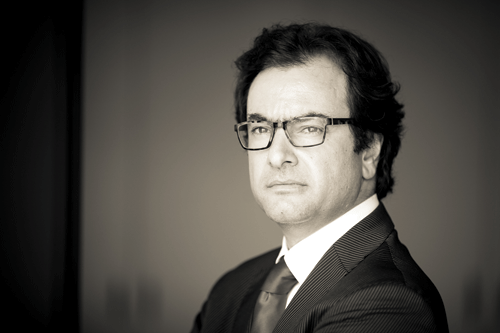
The Minister of Public Works and Transportation Ghazi Aridi is in charge of everything from the road networks to the aviation sector. What is more, he is one of three ministers representing the man who is tentatively holding the ruling coalition together: Walid Joumblatt. Executive met with the minister on August 13 for a sit down to talk beaches, busses, planes and politics. 

E  You recently submitted a draft law regulating the fees for private use of the public coastal lands, but the law was rejected. Why? 

No, everything is okay. Only today I met some people and we discussed the levels of the taxes and they have some comments, which I have taken on board and will present to the ministry. There are some legal and illegal projects on the coast and these fees will apply to all of them.

E  If they are illegal then why will you allow them to stay?

They are a fact.

E  But why will they remain?

They will pay but they don’t have any right [sic].

E  If they don’t have the right why won’t the law be enforced?

Unfortunately until now I have not been able to enforce the law due to resistance on the ground. In all the regions these projects have behind them parties or certain powerful people.

I tried to implement the law but this has been a question for more than 35 years. What can I do personally? I discussed it at the cabinet but I did not succeed in bringing about a final decision, but I cannot leave the situation as it is now, not receiving money from them. So I proposed this new project, which is not a change in the law but a change in the fees charged, or taxes if you like, and it will be implemented.

E  Can you give me details of the fees that will be applied? 

I can’t remember the levels.

E  Back in May you announced you had launched a tender for 250 public buses. Where are we with that project now?

Two days ago we finished with the tender and we have a meeting planned with the prime minister to decide on it in the coming days and we will invite the companies to participate in the tender. We have a master plan, which is finished, and when the tender is finished and we have chosen the companies we will be able to distribute [the busses] to all of the areas of Lebanon.

E  Do you have an idea of when we can expect to see them on the ground?

No, I cannot say anything now but I know there are so many companies that are interested. There will be many offers from China, Poland, Romania, Germany and elsewhere but I cannot say what will happen in the end.   

E  Lebanon is a signatory to the Open Skies agreement, which is intended to liberalize Lebanon’s aviation sector and increase competition. Is this a policy you support?

We don’t have any problems. Everything is organized. Middle East Airlines [MEA] is the priority for me and I am doing my best to protect them and I think they are doing very well.

E  MEA has been accused of resisting competition and you personally of supporting them in this pursuit, which stymies the sector and tourism within Lebanon. What is your response?

We are not resisting competition. I am protecting MEA and I am proud of this.

E  But by protecting them are you not decreasing competition?

This is not true, there are so many companies that are coming to Beirut and we don’t have any problem, but the priority is for MEA. If MEA requests slots here and there, they are always refused. ‘We don’t have places or slots’, they say. I discuss with the ministers abroad and explain we have our rights also. After discussing they accept, so in this way I protect them. 

E  The 2002 law for the aviation sector stipulates the creation of a Lebanese Civil Aviation Authority to regulate the sector.  This has not happened. Why?

We are preparing the nominations now.  

E  The law was passed more than 10 years ago…. 

I was not the minister all of this time. By the time you go to print we will have nominated the board and created this structure.  [The board had not been nominated by the time Executive went to print.]

E  Will it have independence from your ministry?

They will have their prerogatives that they can work within and they will be funded from the government’s general budget.

E  Tourism Minister Fadi Abboud has been calling for opening up the airport to more budget airlines and says there is resistance from MEA and your ministry. What is your response?

No, we resolved this 10 days ago with Fadi Abboud and Mohammad Hout, chairman of MEA, and the chairman of the Directorate General of Civil Aviation (DGCA); we drew up a master plan that everybody is happy with.

E  Who has the authority to decide who gets which routes at which times?

The Civil Aviation Authority and MEA.

E  So MEA helps decide who flies which routes to and from Lebanon?

Yes and we do feasibility studies as well.

E  Imperial Jet is an executive jet carrier that is based in Lebanon and was bringing good business to the country, but has had its Air Operation Certificate (AOC) revoked and been refused to fly even on its German AOC. The Shura Council (Lebanon’s highest court) has overruled this decision. Why have you ignored the Shura Council on this issue? 

There is nothing to say on this issue. They have had so many problems with the DGCA so two or three years ago I took this decision and I insist I will stick to it.

E  On what basis? At least twice the Shura Council ruled that they have the right to fly from Lebanon.

I don’t think it did.

E  I have the documents. It did.

I have the right to reject their decisions as I know very well what happened with [the company’s case]. 

E  Were they not punished because thy refused to “make friends” and help important people make money from their business here?

Who? Me?

E  Not you necessarily, but…

[Interjects] This is not true. I know the file very well, and I have taken the decision and I am insisting on keeping on the same way. This is my decision. [Slams table].

E  The Council for Development and Reconstruction is currently implementing an urban transport development project for the greater development area. What purview does your ministry have over this?

This is under our authority and if there is something to discuss with them then we are ready to discuss it. There is a cooperation between us. This is under our responsibility including the issuing of contracts and tenders and so on.

E  During your time in office what tangible results can you point to?

I can’t answer all of them now but we have done so many projects concerning the roads and the rights of the drivers and the master plan. But I am not alone and our ministry is not the only one responsible for these projects. 

E  Will the electoral reform law pass?

I don’t think it will pass. This is a game, from the other parties that is, but not the President [Michel Sleiman]. The President said “I told the people we would finish the law and send it to the Parliament.” What will happen in the Parliament he cannot know so we respect this decision. As for the other people, they have this project and they know we won’t accept it and they are preparing a law to protect their interests. We cannot accept this, but they insisted. 

E  Is Walid Joumblatt considering a break from the governing coalition?

Concerning the election we are awaiting the law. We can’t say anything before the law.  But electorally speaking everything is possible.

September 1, 2012 0 comments
0 FacebookTwitterPinterestEmail
Economics & Policy

Executive Insight – Who owns the sea?

by Malek Takieddine September 1, 2012
written by Malek Takieddine

In January 2007, Cyprus and Lebanon, both signatories to the United Nations Convention on the Law of the Sea (UNCLOS 1982), signed an agreement on the delimitation of their exclusive economic zones (EEZ) based on the internationally accepted method of equidistance, which consists of determining a median line between two opposite or adjacent coastlines.

Two years later, major offshore natural gas reserves were discovered off the Israeli coast with the potential to satisfy Israel’s domestic energy needs and make the country a substantial exporter. In January 2009 the Tamar Field was discovered near the port city of Haifa containing 240 billion cubic metres (BCM) of natural gas, while the 14 BCM Dalit Field near the northern city of Hadera was tapped in April that year and in June 2010 the world’s largest gas discovery of the decade was made at the Leviathan off the coast of Haifa, with approximately 460 BCM of natural gas. In 2010, the United States Geological Survey estimated that the entire Levant Basin, encompassing parts of Israel, Lebanon, Syria and Cyprus, could contain as much as 1.7 billion barrels of recoverable oil and 3.45 trillion cubic meters of recoverable natural gas. For comparison: Iraq, ranked as the 11th country worldwide in proven gas reserves, has 3.1 trillion cubic meters of gas.

In July 2010 and October 2010, Lebanon submitted to the United Nations the charts and lists of geographical coordinates of points marking the Southern Median Line and the Southern Part of the Western Median Line, to delimit its EEZ.

In December 2010, Israel and Cyprus concluded and ratified their own agreement on the delimitation of the EEZ. Israel deposited its own unilateral claim to the northern limit of its maritime space with the United Nations on July 12, 2011. Furthermore, in August 2011, Lebanon’s Parliament enacted a maritime boundary law (Law number 163). The relevant coordinates were subsequently determined by governmental decree in September 2011 (Decree number 6433) and were made subject to possible amendments in the future based on negotiations with neighboring states.

Wherein the problem lies

The delimitation of maritime areas between two or more states is governed by international law as mainly reflected in UNCLOS, precedence of the International Court of Justice (ICJ) and customary practice of coastal states. International law provides that coastal states are invited to seek the delimitation of their maritime boundaries by agreement and must show evidence of having exhausted all routes through negotiations (although not necessarily direct negotiations) before resorting to any other settlement procedures. The existence of overlapping claims over maritime zones is not an unusual occurrence, and has in fact become more frequent in recent decades, with a tremendous increase in maritime space coming under the jurisdiction of coastal states.

The maritime area of overlap between Israel and Lebanon covers an estimated 873,722 square kilometers, running from the coast to the median line between Cyprus and Israel and Cyprus and Lebanon. Both states claim that this area falls within their jurisdiction based on differing calculations of the outermost limits of their respective EEZs. Lebanon considers Point 23 on the list of geographical coordinates, which is claimed by Lebanon to be tri-equidistant between the three countries, as the endpoint of its southern maritime border with Israel, and the southwestern limit of its EEZ. On the other hand, Israel considers Point 1, which falls around 17 kilometers north of Point 23, as the endpoint of its northern maritime border with Lebanon.

Does Lebanon have a stronger case?

Lebanon claims its coordinates are based on the internationally recognized equidistance method, which remains the most frequently adopted method for delimiting maritime boundaries between states. This meets the criteria of geographical factors and customary international law that govern the delimitation of maritime areas between states. It is also consistent with Lebanon’s desire to uphold international law and its commitments as a signatory to UNCLOS, to which Israel is not a party.

Lebanon claims that Point 23 was determined using objective unambiguous mathematical principles and results in the equitable distribution of maritime space. Unless successfully contested, this should in principle correspond to the ‘equitable/relevant circumstances principle’ governing the delineation of EEZs.

It is not clear what reasonable factors, technical or otherwise, led Israel to determine Point 1 as the northwestern endpoint to its maritime border. Israel’s position reflects a lack of consideration for both equitability and relevant circumstances, relying solely on the coordinates of a provisional end point in the agreement between Cyprus and Lebanon.

Moreover, the Cyprus-Lebanon agreement confirms the provisional nature of Point 1 in accordance with customary international maritime law. The agreement states that “the geographical coordinates of Points 1 and 6 could be reviewed and/or extended and duly revised as necessary in light of further delimitation of the EEZ with other concerned neighboring states and in accordance with an agreement to be reached in this matter by the neighboring states concerned”. Thus, it can be argued that such a provisional point cannot be taken as a basis for the final (let alone unilateral) delimitation of the maritime boundaries by Israel and would not meet the requirements of the ‘equitable solution’ principle set by Article 74 of UNCLOS.

Lebanon may argue that although Israel is not party to UNCLOS, previous practice confirms that Israel accepts the equidistance principle. In the delimitation of the maritime boundaries between Israel and Jordan in the Gulf of Aqaba, Israel drew its maritime boundary between the coastal point and a tri-equidistance point, that is to say of equal distance from the three coasts at the head of the Gulf.

Lebanon may also argue that Israel’s claim is undermined by its previous acceptance of the median line with Lebanon as a de facto boundary between the two countries, as demonstrated in its delineation of hydrocarbon licensing blocks along its northern maritime border — notably the Alon D and F Blocks. This analysis is supported by ICJ precedence in the case of Tunisia-Libya 1982 where a line drawn by the Italian colonial administration in 1919 was recognized by the ICJ as a de facto working boundary that had been observed over a considerable period of time and respected by both parties in issuing their oil exploration concessions.

Finally, it could be noted that there are strong indications that Israel’s claims over the overlapping area are of a political nature and are not based on any declared solid legal or technical foundations beyond the adoption of Point 1 in the agreement between Lebanon and Cyprus.

In summary, the Lebanese legal position is relatively strong as it is based on the principle of equidistance, which is a commonly applied method in such disputes. However, a lasting settlement may also have to take into consideration any other relevant circumstances “in order to achieve an equitable solution” as per Article 74 of UNCLOS.

September 1, 2012 1 comment
0 FacebookTwitterPinterestEmail
Real Estate

Developing debauchery in downtown

by Nabila Rahhal September 1, 2012
written by Nabila Rahhal

In the olden days, Uruguay Street, behind what today is the Samir Kassir Square, was better known as the Souk El Kmash, or the “Clothes Market”, and was famous for high-end tailors and shops full of trendy attire. Today, and a year into its revival, it is becoming known for its bars and restaurants and is considered by many to be one of the most popular nightlife streets in Beirut. 

Just before sunset, the tables on bar terraces start filling up. By 10 p.m. the street is in full swing, with music filling the night and fashionable people parading up and down the walkway. A year after its conception the street already has a loyal fan base.

“I love coming here because the age group is perfect: I don’t see any teens around, and I also don’t see people who are my parents’ age,” says Sumaya Khoury, a Uruguay Street frequenter.  Another fan speaks of the diversity in the street saying: “Each place has its own character, from Spanish tapas to American cuisine and from Irish beer to Uruguayan signature drinks, so I can pick and choose whatever suits my mood that night.”

Detractors speak of it being not for their age group, and also of it feeling a bit false — a common contention among the dissenters of Beirut’s rebuilt downtown area.

Solidere and Venture DT

Uruguay Street is basically a development project, the first time in Lebanon this concept is applied to bars, and since it is still relatively new, the street still has a lot of room to grow.

It all began with Solidere’s vision to “create a dedicated area for bar hopping away from the residential areas in Downtown,” says George Nour, assistant general manager for Business Operations and Relations with Public Authorities in Solidere. To this end, they found Uruguay Street, and more specifically the municipality building that Solidere co-owns with the Municipality of Beirut, to be the ideal location.

To actualize their plans, recounts Nour, Solidere first approached established bar managers independently, but many were hesitant to risk being first on the street. Solidere then turned to Venture DT, a development and consulting company owned by Rabih Saba and Marwan Ayoub.

“When we signed with Venture DT, we got a company with the right contacts and momentum to attract the bar managers who would be in line with our vision of the street,” says Nour. As a “one shot deal” for a period of six years, Solidere leased its share of 10 ground-floor outlets in the municipality building to Venture DT, who in turn sublet them to the current bar owners. The remaining three venues in the building are owned by the Beirut municipality, and are currently vacant with no apparent plans to develop them.

Venture DT, according to Ayoub, followed two rent formulas with their tenants: either a fixed annual fee of approximately $1,000 per square meter (sqm) per year, or a percentage on sales in the venues where they are partners or have shares, such as Cassis, Julep’s and Tinto. With areas varying between 26 and 120 sqm, average rent is between $26,000 to $120,000 annually.

Ayoub says Venture DT approached the street as they would any development project: “We had a master plan to create a European style bar street which would be coherent with its community.” By European, Ayoub means pedestrian-only streets one sees in Barcelona or St. Torino with outdoor bars open all day. “To implement our plan, we handpicked the tenants according to their past successes and to the type of cuisine or concept they had to offer, as we were going for complementary venues to create a coherent whole,” he says. 

Ayoub and Saba did not have to twist any arms to sublet their venues, as the benefits of having a bar in such a location are many. “I could see the potential in the street straight away,” says Toni Rizk, owner of TRI, which owns Uruguay Cocktail Bar and Collins, among other locales in Beirut. “Its easily accessible location in the heart of the city and proximity to all areas was a tempting aspect for me. Another attractive feature of the street is since it is a business district, it does not have the problems caused by disturbances to residents in terms of music or traffic flow,” continues Rizk. He adds that based on the success and the positive experience of his first venture in Uruguay Street, Uruguay Cocktail Bar, he decided to open Collins Urban Bar, the last vacant venue owned by Solidere that opened its doors at the beginning of the summer.  Karim Jaber, general manager of Add Mind, which owns Cassis on Uruguay Street, adds that an advantage of the street is that it is pedestrian, meaning less traffic flow problems, and an added entertainment value for customers. Rabih Mockbel, owner of Bronx Restaurant and Bar, says he believes that the urban business feel of the street makes it ideal for people to come enjoy after-work drinks. 


Return on investment

Ayoub estimates pub owners invested between $250,000 to $500,000 in their bars and make between  $1,000 to $4,000 per night, depending on the number of seats and whether it’s a weekend or not. Pub owners Executive spoke to expect to make back their investment in one to three years, depending on the political situation and whether the place is a restaurant or a bar, with bars having a faster return on investment.

Operating within a planned project, and under the many rules and procedures of Solidere, is new to bar owners on the street who are more used to the idea of “each man for himself.” Nour sees the rules and procedures as necessary to establish fair play among the bars and not have one venue overpower another in terms of music or eccentric décor. Bar owners interviewed mainly appreciate aspects of Solidere’s presence, such as security guards and the added market value Solidere’s name brings to some clients. However, they complain about the rules sometimes being so rigid they end up hindering their work or incurring unnecessary extra expenses.

“Add Mind already has experience with Solidere through Iris,” says Jaber. According to him, “Solidere puts down rules and makes you spend a lot when you know you could do it in a different or cheaper way, and then they might change their mind, which is frustrating and costly.” However, Jaber believes that it is Solidere’s planning which will stop the street from growing chaotically, as what happened with other bar streets such as Makdessi Street in Hamra or Gemmayze in Ashrafieh.

Looking ahead

The street’s future is still in the process of being built. According to Nour, Solidere does not own any other outlets on the street but is still involved in the development of the street as it is part of Downtown. “We have had a success story so far with Uruguay Street and believe this is encouraging other bar and restaurant operators to rent the remaining vacant outlets in the street,” says Nour. “We are also encouraging retail shops that cater to young adults to consider the street as well.” Bronx’s Mockbel, for example, is already looking down the street and opening an oriental restaurant called Bhar, which will mainly cater to businesses on the street.

Pub owners generally seem optimistic about the future of Uruguay Street. Jaber says the street is not a trend like others. Rizk sums it up by saying, “Bar streets in Lebanon generally have six-year life spans before things start to go downhill either because the residents complain or because it becomes overcrowded, such as Monot and Gemmayze.” He adds that, “Uruguay Street has avoided those circumstances, but still, keeping good relationships with the surrounding community and maintaining the momentum we have achieved in the street is key to its continuing success.”

September 1, 2012 0 comments
0 FacebookTwitterPinterestEmail
Comment

Clan diplomacy

by Nicholas Blanford September 1, 2012
written by Nicholas Blanford

The mainly Shia tribes of the Bekaa Valley are fiercely independent, live by strict traditions of honor and clan solidarity and scorn the dictates of the Lebanese state. In the past month, the Bekaa tribes have hit the headlines in Lebanon with brazen displays of defiance toward the state, leaving the government looking impotent and providing another headache for Hezbollah, which is already reeling from a succession of crises.

The abduction of more than 20 Syrians in Lebanon by the Meqdad clan came in retaliation to the kidnapping of Hassan Meqdad in Damascus. The rebel Free Syrian Army (FSA) accused Hassan Meqdad of being a member of Hezbollah. Hezbollah and the Meqdad family have denied the claims, with the latter saying that he was an employee of a Lebanese bank.

The tit-for-tat kidnappings were not the first since the uprising against Syrian President Bashar al-Assad began in March last year. In May, the FSA kidnapped three Lebanese Shias, one of whom was from the powerful Jaafar clan. In response, the Jaafars kidnapped more than 30 Syrians and fought running battles with the FSA for a week. A subsequent prisoner swap settled the matter.

The kidnappings by the Meqdads in August gained greater prominence than the earlier Jaafar abductions because of the clan’s decision to hold a series of well-attended press conferences in southern Beirut. The Meqdads refused to meet with Interior Minister Marwan Charbel, scrapped with Ali Meqdad, a Hezbollah Member of Parliament, and left the tourism ministry wringing its hands as the few Gulf visitors to Beirut saw their respective governments issue emergency warnings to leave.

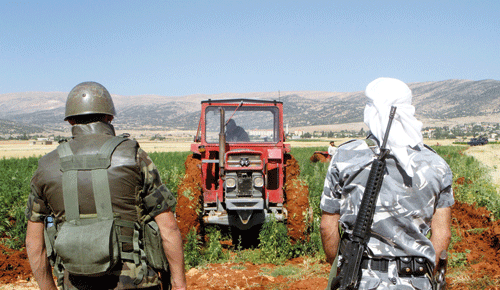
This was the second humiliation for the Lebanese government at the hands of the Bekaa clans inside a month. In early August, the annual hashish eradication program was cancelled in the face of unusually stiff resistance by a coalition of three Bekaa tribes, who had earlier formed a mutual defense pact to protect their lucrative but illicit crops. The Sharif, Jaafar and Shammas families agreed that they would come to each other’s assistance the moment the army and police arrive at a hashish field with their tractors. In the village of Deir Al Wassah, a Jaafar stronghold, a column of army and police vehicles was ambushed by rocket-propelled grenades and machine guns, leaving several soldiers wounded. The residents of Yammouneh, the Sharif family, blocked the road leading to the village with burning tires and denied access to the army. Minister Charbel was obliged to visit Yammouneh to appease the villagers and forge a deal to end the crisis.

Hashish cultivation in the Bekaa has long been a source of controversy in Lebanon. In the early 1990s, the farmers agreed to stop growing hashish as part of an internationally funded donor program that would encourage the cultivation of alternative crops. But the promised funds never came — successive governments blamed foreign donors for reneging on their promises, while the foreign donors claimed Lebanon never drew up realistic proposals. Either way, by the late 1990s, the impoverished farmers began growing hashish again.

The tribal alliance between the Jaafar, Shammas and Sharif families is an interesting development and could see the Bekaa clans becoming a potent force. The Zeaiters apparently declined to join the alliance and lost much of their hashish. The Christian hashish farmers of Deir Al Ahmar allowed the army to eradicate their crops, following assurances from a political figure who has strong support in the town that they would be compensated by the state.

Only the tribal alliance seems to have successfully seen off the government and protected their crops. The alliance has apparently encouraged some clans in the northern Bekaa to consider forming their own alliance to protect their hashish crops.

Such displays of cross-clan unity would be a serious headache for Hezbollah, which has traditionally sought to appease and mollify the tribes to maintain its political influence in the area. Significantly, Hezbollah apparently green-lighted the hashish eradication program this year and even permitted the army into one of its “security pockets” near Yammouneh in an attempt to outflank Jaafar gunmen, according to members of the Jaafar clan. The move angered the Jaafars: according to one prominent member of the family, some 200 Jaafars serving with Hezbollah quit the party in protest.

Given the looming parliamentary elections, Hezbollah may have to do some serious fence mending with the tribes in the months ahead.


NICHOLAS BLANFORD is the Beirut-based correspondent for The Times of London and The Christian Science Monitor


September 1, 2012 0 comments
0 FacebookTwitterPinterestEmail
Business

Talent rising

by Maya Sioufi September 1, 2012
written by Maya Sioufi

Three Lebanese entrepreneurial companies, Mosaic Marble, At7addak and ElementN, have been added to the network of New York-based Endeavor, the nonprofit organization supporting established entrepreneurs in emerging markets. The selection, which took place in London in June, saw a total of 17 high-impact entrepreneurs from Brazil, Columbia, Jordan, Lebanon, Mexico and Uruguay added to the network, bringing the total number of entrepreneurs supported by Endeavor to 443 in 13 emerging markets. Lebanon, which along with Mexico saw the highest number of companies selected, now has seven entrepreneurs on Endeavor’s network after four companies were selected last year, the organization’s first year of operation in the country. To understand what each company has to offer and their strategy going forward, Executive sat with the founders, Taline Assi of Mosaic Marble, Brahms Chouity of At7addak and Rabih Nassar of ElementN.

Challenging the gamers

If Mark Zuckerberg [chief executive of Facebook] could do it, why couldn’t I? This little kid is younger than me,” says Brahms Chouity, founder of At7addak.com (which means “I challenge you” in Arabic).

Chouity says he was inspired to start the dot-com company in February 2011. At that time he was bumming around playing video games, on sabbatical with his pregnant wife, away from their hectic lifestyle managing several companies. But Chouity’s new hobby became too much for his wife to handle: “This can’t continue; either you stop playing or you make a business out of it,” she said, and that’s when he got the idea to set up At7addak.com, a social platform for gamers in the Arab world where they can challenge each other to earn points and cash through online tournaments.  Chouity’s prior expertise was in the hospitality industry, so with no experience setting up a dot-com company, he went about hiring the smartest kids on the block, selecting top graduates from Lebanon’s universities, or “the lifeblood of the company” he says. The 11 employees of At7addak own 10 percent of the stock options, a percentage Chouity intends to eventually raise as “these guys own the concept; I support them to grow.”

Once the smart kids got on board, the dot-com startup spent several months building a unique gaming software, which links all consoles and computers to the At7addak system. Here’s how it works: you open an account on At7addak’s website free of charge, link your PlayStation or Xbox by inputting the ID of your console and bam! You are linked. You can challenge players across the Arab world —  the At7addak platform covers 15 games now, including big hits such as FIFA and Call of Duty — and your score is automatically updated to the website.

The online startup had 50,000 registered users as of July, 10 million viewers on their website per month and 200,000 fans on their Facebook page, the second highest number of fans of any website in the Middle East. At7addak also publishes articles in English and in Arabic covering new releases of games, previews of upcoming games and testing of electronics; think of it as the CNET.com of the gaming industry.

Playing for revenue
With no subscription fees, the company makes money through sponsorships of its tournaments. Its clients are made up of high profile names: American video game developer Electronic Arts, Swiss provider of PC accessories Logitech, American semiconductor company Advanced Micro Devices (AMD) and video console provider PlayStation ME. For this year, At7addak is expected to rack in some $700,000 in revenues from these sponsorship deals. “[It’s] a subtle way of pushing a brand,” says Chouity. “While these gamers are doing the thing they are most passionate about, in the middle of game, they get a video of a new tournament with the brand of a [sponsor].”

Going forward, however, Chouity aims to diversify the company’s  revenue sources. He plans an increase in advertisement on their website and product placements by their staff who, through the broadcasting of video news covering games, should eventually become “icons” for gamers in the region. A store selling At7addak branded products, as well as promoted games and gaming accessories, is also on the agenda. Eventually a premium membership, giving additional benefits, should become an added source of income, but that’s for later. “I don’t want to charge any of the users until the free service is absolutely spotless,” says Chouity.

A good headstart
With a potentially lucrative business model, which is “light to manage”, other hungry entrepreneurs could start to imitate. “We need to grow as quickly as possible before anyone else does the same thing, as anyone with time and resources can replicate our automated software,” says Chouity. His big dream is to create the ‘Arab Gaming League’, a ‘Star Academy’ for gamers who would represent their countries and play against each other. Eventually, he sees the online company building a social platform catered to different countries — a local At7addak for Turkey, Asia, North America, etcetera — and linking the different platforms to each other. “That’s huge, that’s world domination,” says Chouity.

With the new sources of revenues slated to start pouring in next year, Chouity expects the company to generate a “realistic” $3 million in 2013, and then grow by an annual 25 percent. Entirely self-funded for now, he does not intend on raising capital at least for the next year or two. Eventually, Chouity says he would consider the sale of a stake or even the entire company to a strategic partner who would “come in and explode it.” He will not be considering venture capitalists — Chouity has already had several offers especially after being selected by Endeavor, a non-profit nongovernmental organization that supports high impact entrepreneurs in emerging markets — but he would be interested in selling to a larger regional company in the same industry. “If the offer is good and they want to take us over completely, I wouldn’t oppose. I’ve already got my next venture prepared,” says Chouity.

September 1, 2012 0 comments
0 FacebookTwitterPinterestEmail
Last Word

Cairo’s new deal

by Ahmed Moor September 1, 2012
written by Ahmed Moor

The Egyptian-Palestinian relationship has been strained recently, but this trial by fire may forge stronger ties in the medium term.

On August 6 gunmen attacked an Egyptian army checkpoint on the Sinai Peninsula border with Israel, just south of Gaza. Sixteen soldiers and an unknown number of assailants died in the initial clash. The surviving assailants dashed across the border where they were promptly killed by the Israeli army. The brutality of the strike — the soldiers were preparing to break their day-long Ramadan fast when they were attacked — shocked both Egyptians and Palestinians.

Swift condemnations came from all sides as the search for additional assailants and their enablers began in the Sinai and among the Palestinians in Gaza. The Egyptians also sealed the Rafah border crossing with the Gaza Strip, casting a pall on previous optimistic signs from the new Egyptian leadership regarding their intention to ease the Gaza siege — yet that may still be in the cards. The Egyptian revolution resulted in the election of the country’s first overtly Islamic leader, Mohammed Morsi, a member of the Muslim Brotherhood. Before he was elected, the Supreme Council of the Armed Forces (SCAF), which had ruled since President Hosni Mubarak was deposed, stripped the role of the presidency of much of its power. The new president faced the choice of either accepting this truncated rule or pivoting to confront the country’s military.  Another precarious relationship the new president had to maneuver was with the Palestinians in Gaza — long on the Muslim Brotherhood’s agenda. Under Mubarak, Egypt had actively maintained the siege of the distressed Strip, but Morsi signaled early on that he was prepared to work with the Hamas-led government — further straining his relationship with SCAF, the principal executors of the Mubarak-era policy.

Among Morsi’s motivating factors may have been the popularity of the Palestinian issue in Egypt. Average Egyptians may not have prescriptions for how to resolve the Palestinian-Israeli conflict, but the moral force of the Palestinians’ claim resonates with the overwhelming majority of Egyptians. While popular opinion was a negligible feature of Cairo’s political landscape pre-January 25, 2011, today it carries much more weight.

The Muslim Brotherhood also has deep institutional ties to Hamas, as Brotherhood members, including Sheikh Ahmad Yassin, founded Hamas. While operationally independent, the two organizations’ foundational affinity has remained. Morsi’s election was loudly celebrated in Gaza — not only because of the expectation that he would ease the siege, but his election was also taken as an affirmation of Hamas’ political legitimacy.

Egypt’s new president met with both Mahmoud Abbas — the head of Fatah and the Palestinian Authority — and Ismail Haniyeh, his Hamas rival. The meetings came after Morsi eased restrictions on travel to the Gaza Strip that have long been in place. 

While it is unclear who perpetrated the attack in the Sinai, Palestinian concern was that the killings would end the relatively friendly treatment they had been receiving from the new government. The president would have to distance himself from any group or policy perceived to have been lenient on security in the enormous and largely vacant Sinai, and at least one figure in the Egyptian government claimed publicly that the assailants had received support from Gaza.

Initially it seemed that the Palestinians’ concerns were justified — the Egyptians closed the Rafah crossing despite comprehensive Hamas cooperation with the Egyptian security forces in the hunt for the groups behind the attacks. But developments quickly gained a new trajectory.

The president used the Sinai attack as a pretext for wresting control of the country from SCAF. He first sacked the chief of intelligence and head of police in Cairo; several days later the president retired both Field Marshall Tantawi, the head of SCAF, and one of his main subordinates from public life. This ouster coincided with the conditional reopening of the border with Gaza. It appears Morsi used the attacks to double down on his first policy instinct vis-à-vis the Palestinians: more cooperation and aid.

The election of a new president in Egypt meant a reconfiguration of the relationship with the Palestinians in Gaza. And when it appeared that Morsi’s agenda would be threatened by an Islamist attack, he recast the episode to yield an unambiguous victory for himself, his party, his agenda and ultimately the Palestinians.


AHMED MOOR is co-editor of “After Zionism: One State for Israel and Palestine” and a Masters in Public Policy candidate at Harvard University’s Kennedy School of Government

September 1, 2012 0 comments
0 FacebookTwitterPinterestEmail
Companies & Strategies

Behind the silver screen

by Nabila Rahhal September 1, 2012
written by Nabila Rahhal

“The movie business is a gambling business,” says Salim Ramia, chief executive of Grand Cinemas. “When you buy a movie for a million dollars before it is even filmed, isn’t that a gamble?”

Indeed, Ramia himself placed big bets by selling his successful company in the United Arab Emirates to start up the same business in Lebanon and the Levant. Yet, he has faith his lucky star will shine through.

Beirut to Dubai and back

Ramia is no stranger to the film business in Lebanon, he had a film distribution office called Phoenix Film Distribution in Hamra during the civil war back in the 1980s. “In 1986, the office was occupied by one of the warring political factions, and it was then that I took the decision to move back to Dubai, as Lebanon was in a state of war and there was no room for professional growth, ” says Ramia.

In 1989, Ramia and an Iranian partner established “Gulf Film” for film distribution. Three years later, they entered the theater operation business and established their first cinema in Dubai. He recalls “Unforgiven” was the first movie he brought to Dubai. “In Dubai back then, the film industry was dominated by Bollywood movies and my partner kept telling me that I was dreaming because I believed American movies could be a success in the UAE, but I wasn’t dreaming and they did succeed,” says Ramia.

Gulf Film’s venture into movie theaters kept expanding and they set up two cinemas in the Hyatt Regency in Dubai in 1994, as well as theaters in Sharjah. “The big boom was in 2000 when we established the first multiplex cinema Al Maria in Abu Dhabi,” says Ramia. “The year 2000 was also when we launched the brand name Grand Cinemas, inspired by the Grand Hyatt Hotel, which faced the Dubai Cineplex.”

“In 2005 we saw the most rapid growth for Grand Cinemas, as we expanded from having 38 screens to having 94 screens” he says. They acquired these screens by buying Century Cinemas in Dubai, an African-owned company that was closing down, and also buying Al Massa cinemas. “It is relatively easy to take over cinemas, as the theaters and employees are already there. You just have to trim the excess and reshape where needed,” explains Ramia. Finally, in 2007, Grand Cinemas opened their last multiplex in Dubai, called the Grand Festival Cineplex, to have a total of 106 screens in the UAE.

After having ventured into the Levant market in 2007, Ramia and his partner took the decision last year to sell the Grand Cinemas operations in the UAE and Qatar. “While the Grand Cinemas name is 100 percent the property of Salim Ramia and Sons, I sold Gulf Films Distribution and all the Grand Cinemas theaters already in operation in the UAE [which were owned by Gulf Films]. I also sold the rights of operation in Qatar, so as not to create any competition with the new owners for whom we are still consultants,” says Ramia. In explaining his decision, Ramia says he has reached his peak in the business, a good time to bank in on his success and relax. “It was easy to sell because of our successful name and also because the cinema business is a lucrative business where you can begin cashing in the next day after operation,” explains Ramia. 

Building the family business

“My business in Lebanon is different because it is a family one. My wife and my children work with me here and I will never sell it.” Ramia’s wife is the general manager during his absence on travels, and his daughter Carly is the marketing manager.

Relaxing, however, does not seem to be in Ramia’s cards: “I have built a successful business in the UAE, and I will do it again here,” he says.

Grand Cinemas’ expansion to Lebanon began in 2007 with a phone call from mall operator ABC Ashrafieh’s management team. They wanted Grand Cinemas to manage their cineplex, which at that time was run by Circuit Empire, so Ramia came to Beirut and “closed the deal”. That year, Ramia and a Lebanese partner of his also bought Concorde Cinema in Verdun and Las Salinas Cinema in Anfeh, North Lebanon. In 2007 Ramia also expanded into Jordan with cinemas in Amman’s City Mall.

Speaking about his start in Lebanon, Ramia says they had to improvise and deal with things as they are since they acquired theaters which were already in operation — albeit theaters that were not doing so well, thus he had to turn them around, revamp them physically and introduce more efficiencies, such as electronic ticketing booths and online services.

Grand Cinemas in ABC Dbayeh Mall was their first “from scratch” cineplex in Lebanon and Ramia says the reviews have been great. Of the Grand Class cinema, Lebanon’s first luxury cinema which includes champagne and caviar canapés as part of the viewing pleasure, Ramia says the 20 seater theater is full for at least two shows per day. “The Lebanese love to show off and so will encourage each other to try out our theater,” says Ramia, adding that while the champagne and caviar are not cheap, they are a marketing gimmick which is working in attracting viewers. 

With its latest cineplex in ABC Dbayeh, and the Grand Cinemas in Saida Mall, Grand Cinemas now has 32 screens in operation in Lebanon — including the country’s first 3D theaters — and plans to open a cineplex in the Landmark on Riad El Solh. The company’s headcount totals 136 employees in Lebanon between management and theater staff.

The movie market

Today Grand Cinemas has 41 percent of the movie market share in Lebanon, Circuit Empire has 46 percent and the rest is distributed among Planete Cinemas and others. Ramia explains that since Circuit Empire owns the largest cineplex in Lebanon in City Mall, which has 2,200 seats, it dominates by sheer numbers — by comparison, ABC Ashrafieh has 1,039 seats. He believes this will change with the introduction of ABC Dbayeh’s theaters, which opened in July (a notoriously slow movie season as would-be customers flock to beaches instead).

After Empire’s Cinema City, the next three theaters topping market share belong to Grand Cinemas (ABC Ashrafieh, Concorde and Saida Mall). While Ramia declined to go into revenue details he did say that three of his theaters were losing money, but added that this is something he can afford, and one has to be a good loser to be a successful businessman. 

In the rest of the Middle East, Grand Cinemas has nine screens in operation in Kuwait and 10 in Jordan with a new partnership for 16 theaters. The company also has a deal for 14 screens in Erbil, which will make for a total of 100 screens for including their Lebanese operations. Comparing his other businesses to Lebanon, Ramia says people in the Gulf go to the movies more. “In Lebanon, they have bars, rooftops and theater as entertainment options. In Kuwait, what else is there to do besides watch a movie and eat out?” says Ramia. He also speaks of censorship, which is much harsher in the Gulf and vetoes nudity, religion and politics. In Lebanon, according to Ramia, censorship is limited to issues of religion.  Besides being a movie theater operator, Ramia still deals with film distribution and says the Lebanese market is now open, where any theater can run any movie, though with a certain percentage paid to the distributor. “Distribution rights to a movie could cost between $100,000 and up to $1.5 million depending on what you are getting. It is a gamble because you are buying a movie based on the script, and on the name of the actors,” he says, adding that to be a successful distributor, you need to have the right contacts.

“In short, the movie business is an entertaining and glamorous one where you get to meet people,” concludes Ramia. “But it is also one with a lot of risks.”

September 1, 2012 0 comments
0 FacebookTwitterPinterestEmail
Comment

An illogical conspiracy

by Moe Ali Nayel September 1, 2012
written by Moe Ali Nayel

It was an apparent fall from grace for Lebanon’s former Minister of Information Michel Samaha, still in his pajamas as he was hauled from bed on August 9 during an early morning raid by heavily armed Internal Security Forces (ISF) personnel. His wife reported that it seemed as if the officers from the ISF’s Information Branch had “come to liberate something.”

Samaha, a close friend and ally of Syrian President Bashar al-Assad, was widely acknowledged to be Assad’s man in Lebanon, and his arrest shook his Lebanese allies in the March 8 coalition as much as it garnered fanfare from his opponents in the March 14 political alliance. Information leaked from the Information Branch indicates Samaha — whose house was reportedly found filled with explosive devices — was plotting to plant bombs in Sunni and Christian areas in Akkar, North Lebanon, under orders from Syrian intelligence chief Ali Mamlouk. The attacks were planned for the following week, during Maronite Patriarch Beshara al-Rahi’s scheduled visit to Christian villages in the area.

Samaha started his political life as a member in the students’ branch of the Kataeb political party, later defecting to the Lebanese Forces under the leadership of Elie Hobeika. Known to have close ties with the French intelligence and a Canadian passport, Samaha was also a renowned intellectual with in-depth knowledge of political theories, and had spent the past five years as a Syrian regime spin doctor, while also advising President Assad on foreign policy.  Shortly after his arrest, Samaha confessed to taking orders from Mamlouk and transporting bombs himself, in his own car, and handing them over to a “secret witness”, who filmed the whole exchange through the lens of a pen-like camera. Lebanese media later exposed this “secret witness” as Milad Kfouri, the head of a security company that provides security services for politicians and businessmen; among his clients is Finance Minister Mohamad Safadi. Kfouri has since disappeared without a trace.

Notably, the Information Branch, which carried out Samaha’s arrest, is headed by Wissam al-Hassan, previously a bodyguard for the late former Prime Minister Rafiq Hariri, with Hassan under the authority of ISF Director General Ashraf Rifi, himself known to have close ties to the Hariri family. As with every public department in Lebanon, the Information Branch operates under the unofficial sectarian quota system, and favors Sunnis from the Hariri camp. Thus, Samaha’s arrest is seen by some to be a blow in the internal war currently under way between the variously aligned security apparatuses in Lebanon now divided over the Syrian situation. Samaha, however, confessed to taking orders from the Syrian regime to plant bombs inside Lebanon and implode the country by pitting Christians against Sunnis: the regional instability Assad has warned about since the beginning of the Syrian uprising seems to be itself crafted in Damascus. Given the evidence and Samaha’s confessions, Hezbollah, Syria’s major ally in Lebanon, has kept quiet on the affair. When Member of Parliament Mohamad Raad, part of Hezbollah’s ‘Loyalty to the Resistance’ parliamentary block, condemned Samaha’s arrest, Hezbollah announced that Raad’s comments reflected his own opinion and not that of the party.

Could the surrender of Samaha — a man of often shifting political allegiances — be seen as another defection high in the ranks of the Syrian regime? The simplicity of the plot and Samaha’s personal involvement in the minutiae of the operation make one wonder what happened to the massive human resources and agents operating on behalf of the Syrian regime in Lebanon. Remember, Samaha’s role with the Syrian regime was always in an advisory and scholarly capacity, but never as mercenary. This whole operation does not fit with Samaha’s historical precedent, expertise or style. The criminal aspects and viciousness assigned to the operation simply seem outside of Samaha’s purview, and his CV would show none of the necessary prerequisites for the job. Why was this intellectual suddenly operating as an undercover bomber?

Government deputy Commissioner to the Military Court Judge Sami Sader has charged Samaha and Mamlouk with conspiracy to commit crimes in Lebanon. The Samaha case is another episode of Lebanese upheaval stemming from political and security developments in Syria. Whether Samaha defected, or was caught red-handed, his arrest diffused a plot that could have had similar results to the 1975 bus shooting in Ain Al Roumani — that sparked the 15-year-long sectarian civil war that we have yet to recover from.


MOE ALI NAYEL is a freelance journalist based in Beirut

September 1, 2012 0 comments
0 FacebookTwitterPinterestEmail
Society

Making them like they used to

by Nabila Rahhal September 1, 2012
written by Nabila Rahhal

What was once a relatively quiet bohemian street parallel to the Mar Mikhael main road has begun bustling in recent months. While artistic types have long visited the art and architectural book shop Paper Cup and the Spanish library here, the increased footfall seems due to a little diner called Frosty Palace, which boasts the best burgers in town. The diner has been a well-kept secret since it opened its doors in February 2012 , but as word of the quality of food spread, customers came to taste what the fuss is all about.

Tell me more, tell me more!

Frosty Palace is originally the name of the diner from the movie “Grease” where Sandy, Danny and the rest of the gang used to enjoy their burgers and shakes. Today, Zalfa Naufal has brought Frosty Palace to Beirut, with three booths and a bar running the length of the place. Frosty Palace is not for those who want “to see and be seen” while enjoying their meal, nor does it pretend to be: its small size sends the message that the focus is on the food itself, and not on catering to extroversion.

To step into the restaurant is to walk back into the American 1950s. No detail is spared to invoke the essence of a classic American diner; even the sugar and straw dispensers are reminiscent of those in the old time eateries. A checkered black and white floor, monochrome photos on stark white walls and icy blue booths all set the mood. The atmosphere is completed by the music, which features old time classics as “It’s Raining on Prom Night” and “Heartbreak Hotel”.

The crystal chandeliers dangling from the ceiling may seem out of theme, but can be considered a quirky charm, and one can tell a woman’s taste is behind the retro yet elegant setting.

Like the original Frosty Palace, burgers, shakes and fries comprise the menu’s signature items. Other offerings, (including vegetarian options) include sandwiches and salads. The chicken salad, a Thai style conception, is well done and the portion is generous. The brunch menu, offered from 11:00 am, sports tantalizing sounding items such as poached eggs and buckwheat pancakes with strawberries.

However, Frosty Palace’s reputation is built between the buns, and one must stay focused. The Frosty Palace Burger arrives alone on a plate, topped with salad leaves, tomatoes and pickles. Additional toppings, such as caramelized onions, cheeses or bacon, come at prices which vary from $0.75 to $2.60. The burger itself does not come cheap, priced at $13.50 without the side orders which usually come with burgers (fries cost $3 extra). It is, however, a delicious gourmet burger, with premium quality Australian meat cooked just right, with that barbecue taste in every bite. The bun is soft, and goes well with the burger, not overwhelming the taste of meat. The thick fries are served with dipping portions of homemade mayonnaise and tomato relish, a fresh alternative from ketchup.

In the tradition of 1950s diners, Executive ordered a shake to wash down the burgers, and again found it to be on the expensive side at $8. While the taste of the homemade strawberry ice cream in the shake was amazingly fresh, the drink could have used extra milk to make it more of a milkshake, and less of a fruit smoothie.

Frosty Palace isn’t easy on the pocket, but for those with the cash to burn it’s worth a visit, serving up a burger the 1950s would be proud of.

September 1, 2012 0 comments
0 FacebookTwitterPinterestEmail
Comment

Vroom a la Libanais

by Thomas Schellen September 1, 2012
written by Thomas Schellen

The concept of fantasy cars is well established on the wide avenues of automotive fiction. Think Transformers. And it has been exceedingly difficult to get these and other octane fairy tales out of my mind this summer because of a prospective car maker called W Motors, author of a new and absolutely presumptuous automotive project, the Lycan hyper car.

Although this $3.4 million car won’t have capacities to shape-shift into a super-robot (it won’t even be able to fly or swim), images of impossible dream cars became inescapable the more I was being told of the vehicle by its inventor and eventual manufacturer, Lebanese entrepreneur Ralph Debbas.

It is perfectly healthy for an entrepreneur to have a strong sense of self-worth and dreaming up a new supercar seems to have come naturally to Debbas, who graduated a couple of years ago from Coventry University in the United Kingdom with a masters degree in automotive design, and whose ambitions loom larger than his entrepreneurial credits. This perhaps excessive confidence plays out in high gear as Debbas claims that what he is creating is a whole line of Arab supercars, emphasis on ‘Arab’.   

However, the Lycan (like most things in W Motors, the name is wolf-themed) will come with German engineering, Austro-Canadian workmanship and Italy-based assemblage plus a hologram derived from a Californian inventor’s work. All very respectable as far as partnerships and the expertise involved, but it sounds more like a mongrel of multi-nationality than a pure breed racer of Arab pedigree.

What makes the car Arab, Debbas counters, is that he did the design and that the company is registered in Lebanon; plus, W Motors will open shop in downtown Dubai later this year. “The showroom and the design center and the virtual assembly line, everything is being done in Dubai.”

The virtual assembly line, however, is not to be confused with the car’s real assembly at a plant in Torino, Italy. The Dubai virtual reality will happen in an office tower where car buyers can peep, high-tech of course, while their vehicles are put together. Such reasoning still seems thin. There is a more important issue, however, than whether this hyper car’s links to Beirut and Dubai are enough to earn the brand the status of first Arab supercar.  

All successful car brands have identities. These identities of manufacturers and whole national automotive industries are tied to their accomplishments in engineering, efficiency, safety, convenience, affordability and so forth. The question then is if this car will make a contribution to the region’s automotive future, and technically will prove to be more than a marketing label and anachronism in a time of global manufacturing cultures. As Debbas admits, the Lycan’s highly-touted hologram, for example, won’t provide positive tech impulses for the mass market.

Debbas put the car’s price point at stratospheric $3.4 million (in Lebanon it would be $5.6 million, after taxes) in a calculated move to attract attention and avoid having to compete with established names in the ultra-high-luxury niche. No other maker asks that much, on top of which W Motors has copied a page from the playbook of off-plan real estate developers and requests buyers put 30 percent down before the assembly crew even starts on the car.

Despite all this playing with pricing to create a market for the car, Debbas naturally says that the exorbitant cost will be fully justified by the car’s engineering and extras, not found in the average Aston Martin One-77 or Bugatti Veyron, such as a door mechanism that costs a million dollars to develop and not one but two holograms (a “W” on the hood pops up before the car is put in motion).

While Debbas downplays some of the conspicuous things about the car — he says the gold armatures are only a very small cost factor and the 1.5 millimeter diamonds in the LED lights will create but a “beautiful glow” and practically no bling at all — it remains the designer’s secret if the car is going to provide value for money even by the insular standards of invidious consumption. 

Aside from leaving questions unanswered that regard his own capital — and how he got up to $15 million in capital financed from family and friends without submitting to the pesky scrutiny of a bank or private equity capitalist — Debbas simply projects promise in response to whatever queries arise. But while waiting for W Motors to deliver its product to market, there is a distinct chance that the characteristics of this “Arab supercar” will be captured by the question: “What goes bling, vroom, vroom, bling, bling, bling?” Answer: A supercar à la Libanaise.


THOMAS SCHELLEN is Executive’s MENA editor

September 1, 2012 0 comments
0 FacebookTwitterPinterestEmail
  • 1
  • …
  • 317
  • 318
  • 319
  • 320
  • 321
  • …
  • 686

Latest Cover

About us

Since its first edition emerged on the newsstands in 1999, Executive Magazine has been dedicated to providing its readers with the most up-to-date local and regional business news. Executive is a monthly business magazine that offers readers in-depth analyses on the Lebanese world of commerce, covering all the major sectors – from banking, finance, and insurance to technology, tourism, hospitality, media, and retail.

  • Donate
  • Our Purpose
  • Contact Us

Sign up for our newsletter

    • Facebook
    • Twitter
    • Instagram
    • Linkedin
    • Youtube
    Executive Magazine
    • ISSUES
      • Current Issue
      • Past issues
    • BUSINESS
    • ECONOMICS & POLICY
    • OPINION
    • SPECIAL REPORTS
    • EXECUTIVE TALKS
    • MOVEMENTS
      • Change the image
      • Cannes lions
      • Transparency & accountability
      • ECONOMIC ROADMAP
      • Say No to Corruption
      • The Lebanon media development initiative
      • LPSN Policy Asks
      • Advocating the preservation of deposits
    • JOIN US
      • Join our movement
      • Attend our events
      • Receive updates
      • Connect with us
    • DONATE