• Donate
  • Our Purpose
  • Contact Us
Executive Magazine
  • ISSUES
    • Current Issue
    • Past issues
  • BUSINESS
  • ECONOMICS & POLICY
  • OPINION
  • SPECIAL REPORTS
  • EXECUTIVE TALKS
  • MOVEMENTS
    • Change the image
    • Cannes lions
    • Transparency & accountability
    • ECONOMIC ROADMAP
    • Say No to Corruption
    • The Lebanon media development initiative
    • LPSN Policy Asks
    • Advocating the preservation of deposits
  • JOIN US
    • Join our movement
    • Attend our events
    • Receive updates
    • Connect with us
  • DONATE
Comment

Rebuilding Syria after revolution

by Jihad Yazigi August 3, 2012
written by Jihad Yazigi

Although now is apparently the time for destruction in Syria, hopefully, the time for reconstruction is not far off.

While it is difficult to estimate the actual cost of the damage inflicted to the country’s physical infrastructure by more than 16 months of a popular uprising — most of the destruction having actually occurred after the summer of 2011 — the Syrian National Council (SNC), which is considered by Western nations as their main interlocutor in the opposition, recently estimated that Syria would need some $12 billion in immediate financial support in the first six months after a potential fall of the regime.

While little of Syria’s large industrial concerns — such as power plants and refineries — have been hit, the urban landscape of many of the country’s cities is littered with flattened buildings, destroyed water, electricity and phone networks and crumbled roads and bridges. The cities of Homs — the country’s third-largest city — and Deir-ez-Zor have been particularly devastated, but so too have been dozens of smaller cities and towns across the country, in additional to the suburbs of Damascus and Aleppo. All-in-all, large parts of Syria will need to be entirely rebuilt.

It’s difficult to estimate what the $12 billion figure encompasses but if it were to cover only the first six months, this amount would exclude the cost of rebuilding most of the hard infrastructure, as this would obviously take much more than six months to carry out — in other words the total budget for rebuilding the country is likely to run much higher. In all cases, the question of how to source the money remains open.

Spokespersons from the SNC have said that they will seek support from “friends.” Knowing the financial turmoil the European Union and the United States are going through, they probably have in mind the deep-pocketed Gulf states, in particular Saudi Arabia and Qatar, which have been very active in supporting the opposition. Another issue to have in mind is the handling of any large disbursement of money. Indeed, contrary, for instance, to Libya or Iraq, which have vast reserves of oil and gas and therefore the means to reimburse almost any amount of debt they incur, Syrians will need to be very careful to efficiently use the money they will receive. Indeed, no one will lend money to Syria for free, and aside from the political cost that will come with such help there is also a financial cost, i.e. a debt burden that will be supported by the population for years if not decades to come.

Will any transitional government in Syria have the means to manage and spend $12 billion in financial support, let alone that it will have to be spent in only six months? From a political perspective, can a non-elected body — because any transitional authority is unlikely to be elected — legitimately spend such a large amount of money, an amount that will burden Syrians for years to come? How about the longer term and the larger amounts of money that will be associated with any reconstruction program that a future Syrian government will be in charge of? Can Syrians avoid the missteps and massive corruption that have come to be associated with the Iraqi reconstruction program?

The current and previous Syrian governments have shown a remarkable inability to handle large projects and to manage efficiently investments that carry significant costs. Indeed, very few of the large infrastructure projects announced by the Syrian authorities in the last two decades have taken off because of numerous bureaucratic and political constraints; and those that have been carried out have faced endless delays, cost overruns and suspicions of corruption.  It would be naïve to think that these obstacles will be bypassed easily. From what the opposition has shown in terms of (lack of) knowhow and capacity, and from what we know from the Iraqi experience, there is serious ground to worry.

Because of its political implications and future costs, any reconstruction program for Syria will have to make clear how it will be funded and repaid and what measures will be taken to limit corruption as much as possible; more importantly, however, it must be sanctioned by legitimate representatives of the people if it is to embody a meaningful new beginning for the country.


JIHAD YAZIGI is editor-in-chief of The Syrian Report
August 3, 2012 0 comments
0 FacebookTwitterPinterestEmail
Economics & Policy

Oil and gas as a catalog for peace

by Roudi Baroudi August 3, 2012
written by Roudi Baroudi

The science is still in progress, but it now seems clear that the Eastern Mediterranean Basin holds oil and gas deposits that are truly mammoth. While the precise amount and locations of the resources in question are far from assured, the current estimates suggest there is likely to be some $170 billion worth of oil and almost $2 trillion worth of gas.

For Lebanon, simply achieving energy self-sufficiency would be an unprecedented game-changer, slashing costs for households and businesses, freeing up the funds for improved social welfare and enabling the government to service its gargantuan debts. Now consider that even under the most conservative estimates of the deposits and of Lebanon’s share thereof, developing the resources in question would enable the country to garner billions in annual export revenues for the next century or so.

Odds are that each of the principal entrants in this bonanza — Cyprus, Israel, Lebanon, Palestine, Syria, and the Turkish Republic of Northern Cyprus (TRNC) — also stand to reap dramatic fiscal benefits. For some, at least, it would be no exaggeration to describe the income from oil and/or gas exports as a form of national salvation.

Yes, there is that much at stake. The gas alone may be worth more than the annual gross domestic product of Canada, Russia, or India.

The problem, however, is the relations within and between these players present severe obstacles to the successful extraction, sale and delivery of whatever deposits there are down there. Turkey and Cyprus do not have diplomatic relations; Lebanon and Syria are still at war with Israel; Israel at least partially occupies parts of Palestine, Lebanon and Syria; Turkey has not officially defined their Exclusive Economic Zone (EEZ), and although Israel has made a claim to this effect, it does not have legal legitimacy because Israel is not signatory to the United Nations Convention on the Law of the Sea. Syria is also preoccupied with what is for all intents and purposes a civil war that threatens to bring down the government; Lebanon is so badly divided internally that civil war is a perennial threat; and for good measure Palestine and the TRNC are not even fully fledged nation-states.

Who gets the rights?

The combined implications of these ‘inconvenient’ facts are that getting three or more of the various claimants to discuss — let alone agree on — anything is bound to be exceedingly difficult. If the result of this were simply a stalemate, it would be relatively easy to roll one’s eyes, express regret at the time being lost, and wait for the proverbial air to clear. But a stalemate is not how the situation is shaping up. Israel and Cyprus have already reached a bilateral agreement that could prejudice the rights of both Lebanon — which has vowed to defend its interests — and the TRNC, which is strongly backed by Turkey. The Turks and the Israelis have repeatedly traded harsh words over this issue, and their air forces have reportedly played cat-and-mouse off the coast of the TRNC, even if only a few years ago they were holding joint military operations. Now Israel’s navy has officially sought almost $1 billion to acquire new warships and sophisticated missile-defense systems.

No winner in war

There may be times when going to war seems necessary, but the gathering crisis described above is clearly not one of them. In fact, for each of the countries involved, the surest way to protect the national interest is to seek a compromise, however imperfect and/or temporary, that allows them to start collecting revenues in the shortest time possible. Even for Israel, the most powerful of the direct actors in military terms, defending the sensitive equipment required to exploit a disputed field might prove impossible, or too costly to be justified.

The potential for conflict here is clear, and if war does break out no one can claim they did not see it coming. The policies being followed by some of the major players may make the outcome all too predictable and even those not engaged in provocative actions or incendiary rhetoric will share some of the blame for not having done enough to stave off the impending — though not yet inevitable — clash(es). For both weak and strong alike, a peaceful solution is the optimal solution. The absence of a viable deal will be a deterrent to investment and hinder the potential economic benefits for all parties. Prospective companies will impose higher costs for drilling and seek more favorable contract terms when operating in potential conflict zones.

There can be no real victors in such a conflict, only various degrees of losers. If cooler heads prevail with dialogue and diplomacy, however, there can be winners all around the Eastern Mediterranean. A negotiated solution will require yeoman efforts and (almost certainly) outside mediation, but the rewards will be more than worth it.

Provided all sides refrain from gestures or acts that might inflame the situation, there is plenty of scope to design and implement an agreement. The first priority, though, has to be a moratorium on unilateral acts that threaten to scuttle negotiations before they begin. Lebanon and Israel, for instance, share the obvious option of initially restricting exploration and extraction to areas that are in no way under dispute. Cyprus and the TRNC would have a harder time on this score, but the same goal — conflict prevention — could be accomplished by mutually agreed observers, escrow accounts, and/or other mechanisms to ensure equal rights, all with the understanding that economic agreements would not prejudice the terms of any eventual political reconciliation between the two sides, especially during the Cypriot six-months presidency of the European Union, which started in July.

Likewise, the logistical hurdles of conducting negotiations between countries that have no ties with one another are imposing but not impossible. Proximity talks or other forms of indirect discussions would allow the claimants to protect their interests without sacrificing principle or breaking ranks. Third parties like the EU or the UN could act as guarantors to inspire confidence, and the International Court of Justice could adjudicate disputes that were not resolved by arbitration.

For a part of the world so accustomed to wars both hot and cold, there is a chance just now to move away from — if not entirely outside of — the cycle of enmity. Although needs are greater for some than for others, all those in question stand to reap huge economic, social and political benefits by exchanging crippling energy costs for lucrative energy revenues. First, though, their respective governments have to get their priorities in order by asking one simple question: is it more important to provide for one’s own or to deprive one’s neighbors? The answer being obvious — it is time to rein in the rabble rousers and send out the diplomats.

August 3, 2012 0 comments
0 FacebookTwitterPinterestEmail
Economics & Policy

Women and the Arab world’s glass ceiling

by Karim Sabbagh August 3, 2012
written by Karim Sabbagh

Based on figures from the International Labor Organization (ILO), at least 90 million women in the Middle East and North Africa are today part of what has been called the “Third Billion”, which is the approximate number of women worldwide who will be claiming their place as employees, producers and entrepreneurs in the global economy by 2030.

Until now, these women have been excluded from economic empowerment by either lack of opportunities or insufficient preparedness. Projected to number around 865 million by 2020, most of these women live in emerging and developing nations. The impact of this geographically dispersed group will be so large — equivalent to that of the billion-plus populations of China and India — that they have been dubbed the Third Billion.

The Third Billion was calculated by combining the forecast for “not prepared” and/or “not enabled” women globally between the ages of 20 and 65 in 2020. “Prepared” refers to having received a sufficient education, usually secondary school. Opportunities for basic education and literacy are prerequisites to women’s economic empowerment. “Enabled” refers to having sufficient social and political support to engage with the labor market. This support spans family, logistical, legal, and financial parameters.

The MENA's missing share

It is not surprising that more than 10 percent, or about double of the region’s share in world population, of the Third Billion live in the Middle East and North Africa (MENA) region. The World Bank places the female labor force participation rate in the MENA at just 26 percent, the lowest of any region globally. Although women have achieved equal, or better, education levels compared to men in most MENA countries, they are not making similar gains at work.

In entrepreneurship, too, women have not caught up. The World Bank estimates that women own just 20 percent of MENA companies, compared to 32 percent in countries from the Organization for Economic Cooperation and Development (OECD), and 39 percent percent in Latin America and the Caribbean.

Women must have the freedom to participate in the workforce and ultimately advance to senior positions to reach their economic potential. They should have the same opportunities as men to start their own companies. As long as women have limited economic opportunities, Middle Eastern countries will be unable to join the modern global economy.

The World Bank argues if rates of female participation in the labor force increased to levels predicted by women’s education, age, and fertility, average household earnings would increase by as much as 25 percent. For many families, that is the ticket to the middle class. If female participation rates had been at these predicted levels, per capita gross domestic product growth rates might have been up to 35 percent higher, according to the World Bank.

Entrenched gender roles

The environment in Egypt, the Middle East’s most populous country, is fluid. Women organized in a remarkable way during and after the 2011 revolution. They have since been vocal in demanding new reforms and have sought to defend previous social and economic gains. While the near-term in Egypt is hard to predict, what is clear is that Egyptian women are underrepresented in the workforce. The female participation rate was just 24 percent in 2010. Egyptian women cluster in a few sectors: agriculture, education, public administration, health and social work.

Some governments are attempting to redress the economic and workplace balance to assist female participation. Saudi Arabia is trying to integrate women into the workforce at a pace that balances economic needs with social norms. Legislation on workplace requirements is evolving to allow women and men in the same facility. Oftentimes, however, the legacies of old laws and traditions prevent female participation. There is a strong feeling within the private sector that it can be simpler for companies to retain all-male workforces than to pay for buildings that accommodate mixed gender staffs or to tackle potential resistance to female workers.

As a result, although women constitute 57 percent of Saudi Arabia’s university graduates, the participation rate of female nationals was just 12 percent in 2009. Women in the workforce often congregate in the public sector, despite government encouragement of a more vibrant, inclusive private sector. Women tend to focus on education and health because of gender perceptions and the lack of career guidance.

While each country has unique challenges, several approaches can apply regionally. To this end, Booz & Company has created the Third Billion Index, which ranks 128 developing and developing countries. The index highlights how countries have fostered economic opportunities for women, and where they can improve. To make the index relevant for ranked countries, we offer concrete recommendations. For MENA countries in particular, we see great potential in following these recommendations.

How to advance women

The first recommendation is for government-private sector partnerships to draw women into the workforce. Experience demonstrates that government mandates alone will not be effective. Forcing women into work without the necessary skills and workplace policies will damage productivity and could create an employer backlash.

At the same time, a clear official signal that female workforce integration is a priority can catalyze corporate commitment and investment. Together, government and enterprises can reinforce each other’s desire to promote female inclusion.

Second, governments and companies that employ women should establish mentoring programs. Men already benefit from informal ties, the “old boys’ network.” Mentoring programs can connect young women entering the workforce with successful women who have already broken in. We should not underestimate the power that role models, along with advice and encouragement from career women, can give to younger women entering the male-dominated workplace.

An example of such mentoring comes from the Prince Sultan Bin Abdul Aziz Fund for Women's Development. Over 1,300 women have gone through the fund’s various training programs. Similarly, the fund has provided finance to 40 female entrepreneurs. The result of these initiatives is that women have gone on to start businesses and create more than 200 jobs. Women’s business networks can also fill an important information gap on the economic status, education needs, and social roles of women. Governments, the private sector, and not-for-profits should collect this evidence-based data collaboratively. They can pool feedback to design high-impact programs.

In the United Arab Emirates, the Khalifa Fund in Abu Dhabi, Mohammed Bin Rashid Establishment for Young Business Leaders in Dubai, and Sharjah Tatweer Forum are providing such information — although their focus is not solely on women. Such organizations need to be better staffed and funded, have wider geographic coverage, and should network to share knowledge.

Third, governments and companies should examine success stories and innovative methods of bringing women into the workforce.

One example is Bupa Arabia. The company, a provider of health insurance products and services in Saudi Arabia, has a 40 percent female staff after a decade’s effort. The health insurance provider broke with stereotypes and partnered with the government to train women in job skills. By employing women in all departments — finance, human resources, information technology, operations, regulatory affairs and sales — the firm dispensed with the notion of “women’s work” that elsewhere confines them to supporting roles. Indeed, the company now has an all-female telesales team. This is good business — female customers in the healthcare market prefer female sales agents.

In Kuwait, Lebanon, Morocco, and the UAE, there is now a corporate funded program called the Arab Women’s Entrepreneurship Project. The project is run by AMIDEAST, a US educational institute. Funded by the Citi Foundation and leveraging the Cisco Entrepreneur Institute’s training program, the Arab Women’s Entrepreneurship Project will provide education and mentoring to 80 women entrepreneurs from disadvantaged backgrounds.

Fourth, companies and governments should turn social restrictions into opportunities for commerce and innovation. For example, Ataalam in Saudi Arabia has created a women’s virtual learning environment to allow women to study from home. The company is a female-owned private venture that arose from a Saudi government-sponsored innovation incubator named “BADIR.”

Combining these approaches can have an immediate impact on employment and skills building. Today, hard-working, high-profile women are chipping away at the “cement ceiling” and making it possible for others to do the same. Similarly, multi-sector cooperation will result in further success stories and role models that can alter mindsets and inspire young women. With more women at work, the Middle East can achieve its economic potential.

August 3, 2012 0 comments
0 FacebookTwitterPinterestEmail
Comment

Lebanon’s terrible first impression

by Zak Brophy August 3, 2012
written by Zak Brophy

The odds are now stacked in favor of there being a treasure trove of hydrocarbons locked under Lebanon’s seabed. Nobody can be certain until the first field has successfully been tapped but it is certainly looking promising. So when the government held the Lebanon International Petroleum Exploration Forum & Exhibition in early July it is no surprise that industry players from far and wide were swarming like bees around the proverbial honey pot.

Representatives from the big guns to the small fry came to Beirut to sniff out what the government had on offer and they had two reasons to be interested. The first is the fact that Lebanon is sitting on the same geographical structures that have already come up trumps for Israel and Cyprus.

Houston-based Nobel Energy has been operating in Israeli waters since 1998 but in recent years has had two massive finds. In 2009 they successfully drilled a natural gas field of 237 billion cubic meters (BCM) and then in 2010 a 453 BCM field was tapped. With the subsequent discovery of a 226 BCM field in Cypriot waters the international oil companies (IOCs) must be salivating at the prospect of what else could be down there. 

This needs to be considered in light of the fact that the 2010 United States Geological Survey predicted that the Levant Basin Province — a geological formation in the Eastern Mediterranean extending from Syria to the Sinai — contains 1.7 billion barrels of recoverable oil and 3.5 trillion cubic meters of recoverable gas.

The second carrot dangling in the face of the IOCs is the detailed and comprehensive library of seismic data within the 20,000 square kilometers of deep water in Lebanon’s Exclusive Economic Zone (EEZ), which has been collected by the companies Geco-Prakla, Spectrum Geo and Petroleum Geo-Services (PGS).

The prospective companies’ geological experts use this data to assess if there is actually anything down there and how accessible they anticipate it would be to drill and extract. The findings are promising and suggest a number of unexplored potential hydrocarbon hotspots including the Syrian Arc, the Levant Basin Province and the Levant Margin.

So with an attentive audience of bigwigs in town it was upon the government, and more specifically, the Ministry of Energy and Water (MoEW), to show that it finally has some impetus and momentum to push the sector forward.

“Triggered by the success in Israel and Cyprus we cannot afford to idly sit by,” remarked Fadi Nader, advisor to the energy minister.

The MoEW, however, tripped at the first step. The man at the head of the ministry, Gebran Bassil, had announced triumphantly in the first week of January that the Petroleum Administration (PA) would be named within a month, as the decree approving the bylaws for body had been passed. Come late July and there is still no PA and without a PA the whole progress of the sector is stuck in stasis, as none of the other areas of the Offshore Petroleum Resources Law from August 2010 can be enacted.

The hundreds of delegates were told, of course, that the naming of the PA was just weeks away. However, many of the attendees I spoke to were not exactly filled with confidence, as Lebanon’s reputation for inter-party and inter-sectarian squabbling over who sits where at which table precedes the country.

What was more, the Ministry of Finance did a rather good job of revealing pretty much nothing about the kind of tax regime prospective companies could expect to be subject to — discussions regarding income tax, value added tax, built property tax, stamp and customs duties were at best vague, while the entire presentation had that distinct vacuousness many associate with “a waste of time.”

The ministry representative who had the unenviable job of filling the airtime told the expectant crowd, “in any case the taxation system in the whole of Lebanon is very soon going to be reviewed.” Which is funny because the new budget — the first since 2005 — passed by the cabinet just weeks later, was devoid of anything that resembled a review of the tax system.

Alas, the government regrettably missed a trick; the forum intended to convince industry players to partake in Lebanon’s embryotic energy sector but instead it gave them every reason they needed to question the wisdom of doing just that.


ZAK BROPHY is Executive’s economics and policy editor

August 3, 2012 0 comments
0 FacebookTwitterPinterestEmail
Comment

Simple measures to end Lebanon’s energy crisis

by Paul Cochrane August 3, 2012
written by Paul Cochrane

Lebanon is going through one of its worst energy shortages in years. Even the most electrified part of the country, central Beirut, is experiencing more than the usually standard three-hour outages. Tires have been burnt in protest and people’s tempers are rising along with the mercury.

While wrangling at Électricité du Liban (EDL) over contract workers has caused interruptions of late and the state electricity provider has undoubted culpability in the chronic shortages, the rise in energy demand is also to blame. Last year, EDL produced the same amount of electricity as now — some 1,600 megawatts (MW) — while demand rose to over 2,300 MW. And what has caused more frequent and longer blackouts this summer is not the tourism season, weak as it is, but a surge in the use of high energy usage appliances.

One of the biggest energy guzzlers are widescreen LCD televisions, which have become so affordable to be almost ubiquitous, glaring away in so many homes, offices, restaurants and stores. For instance, a 40-inch LCD TV uses 240 watts per hour, and a 50-inch screen 400 watts, compared to 42 watts for a 28-inch LCD, and 87 watts for a conventional TV of the same size. While such wall-dominating screens are a drain on energy, watt usage rises again when coupled with air conditioning (A/C) units, which have risen in popularity in Lebanon as in much of the world, with global sales up 13 percent in 2011 on 2010. There are no accurate local figures, but in neighboring Gulf countries A/C accounts for a whopping 70 percent of annual peak electricity consumption and is expected to triple by 2030 to require the equivalent of 1.5 million barrels of oil per day to power.

In Beirut demand for A/C is driven in large part by what is called the “urban heat island effect,” where buildings retain heat and warm up the surroundings, which then increases humidity. On average, A/C units use 900 watts per hour, although more energy efficient ones use around 800 watts when initially turned on, then consumption drops to 600 watts and can drop to less than 80 watts if set at a high temperature. By comparison, a ceiling fan, at full power, uses just 75 watts per hour.

So what to do about this surge in energy demand? Widescreen TVs can of course be turned off or watched selectively, but turning off A/C in the height of summer is not an option for most, especially if there actually is electricity. Pleas for people to turn off A/Cs and use fans instead will no doubt fall on deaf ears — even though fans can make the temperature feel four to eight degrees cooler — as once people have made the switch to A/C it is hard to go back. But more efficient usage of A/C is possible, as was demonstrated in Japan a few years ago when the prime minister, expecting energy demand to spike in the summer months as A/C usage rose, suggested workers don more practical summer outfits, of short sleeved shirts over suits and ties, and set A/C units at 26 to 28 degrees instead of the temperature of a warmish spring day of 16 to 18 degrees. Although it is hard to judge the success of the initiative, according to one government survey, 43 percent of employees did lighten up on the office A/C. Another technique called district cooling, using available sea water, could also offer a cheap and affordable option to knock off as much as 30 percent of consumption during peak hours.

Lebanon, however, is not renowned for successful collective efforts ‘for the good of all’. Even if the president, prime minister and speaker of the house all gave a joint press conference uniformly dressed in short sleeved shirts, shorts and sandals with a message to encourage people to turn off the widescreen and set their A/Cs at 28 degrees, it would be unlikely that people would follow suit.

But the private sector could be encouraged to adopt a summer uniform and lower the A/Cs. One, it would reduce overheads through lower electricity bills; two, companies could tout such a move as part of a “going green” policy of corporate social responsibility; and three, staff will be more relaxed in the office. Even a partial reduction in energy use would help to keep the lights, fans and yes, even A/Cs on for just a bit longer in what is going to be a hot and humid few months ahead.

PAUL COCHRANE is the Middle East correspondent for International News Services

August 3, 2012 0 comments
0 FacebookTwitterPinterestEmail
Comment

Banks caught in Iranian propaganda war

by Maya Sioufi August 3, 2012
written by Maya Sioufi

"What else can go wrong?,” Lebanese bankers might ask these days as they flip through the news channels and jot down new additions to their “critical issues” list. When newscasts aren’t covering the civil war in neighboring Syria, commentators are wailing about volatile international markets and the European sovereign mess. What is more, record-low interest rates globally are limiting the range of investment options for Lebanon’s deposit-rich banks who are under intense international scrutiny, mainly spurred from Washington. Its all enough to keep a Lebanese bank manager up at night.

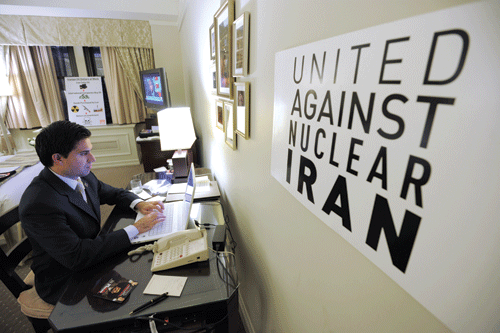
Tormenting their insomnia last month was the United States-based anti-Iranian lobby group, United Against Nuclear Iran (UANI), which publicly accused Banque du Liban (BDL), Lebanon’s central bank, and the country’s private banking sector of laundering massive amounts of cash for Hezbollah, Iran and Syria. “The LBS [Lebanese Banking System] is a fraud” and “the focal point of the fraudulent Lebanese banking centers on BDL,” were among UANI’s quotes in major international news outlets. As part of this campaign, UANI is pressuring Wall Street and European financial firms to divest of their holdings in Lebanese sovereign debt, requesting that credit rating agencies re-rate Lebanese debt to “no-rating,” and calling for Lebanon to be cut off from the US financial system, which would cripple the country’s highly dollarized economy. UANI is not inept either, having successfully lobbied the European Union to oblige Belgium’s Society of Worldwide Interbank Financial Telecommunication (Swift) to remove blacklisted Iranian banks from its network and thus restrain their worldwide financial transfers.

UANI’s board just so happens to feature Zionist luminaries such as Meir Dagan, former director of Mossad until 2011, as well as James Woosley, former director of the US Central Intelligence Agency, August Hanning, former head of the German intelligence service, and Richard Dearlove, former head of the British MI6 intelligence service. Fancy that.

The evidence supporting UANI’s claim that “vast inflows of deposits” are being washed in Lebanese banks is scant, with the group’s conclusions extrapolated from tenuous correlations that would amount to libel in any American court. The actual deposit figures — calculated by BDL, Lebanon’s Ministry of Finance and concurrent with those of international institutions such as the World Bank and International Monetary Fund — paint a different picture. In 2011, deposits grew by just 8 percent, down from a 12 percent growth in 2010 and 23 percent in 2009, and for the first four months of this year, deposits grew by just 3 percent. In response to UANI’s allegation, BDL Governor Riad Salameh pointed out that Syrian deposits held by Lebanese banks operating in Syria or in Lebanon have actually decreased since the start of the uprising in 2011.

UANI also claims that, for Lebanon, “the obvious risk of default is great” unless Hezbollah, Iran and Syria are supporting the “economic house of cards.” Had these ‘intelligence’ chiefs bothered to pick up a copy of Executive from time-to-time, they would have known better. For starters, default is less likely now then it has been in a while, as Lebanon’s debt-to-gross domestic product ratio, while still staggeringly high at well over 130 percent, has actually dropped more than 30 percent in the last five years. More importantly, the vast majority of Lebanese sovereign debt is held by local banks and not international institutions, and thus UANI’s call for foreign divestment of Lebanese debt has more bark than bite. Lebanese banks have admittedly voiced concerns about continuing to fund the highly indebted nation but, lacking better investment opportunities in international markets, sovereign paper still looks attractive, as does keeping the government from default. And, whenever there has been any uncomfortable up-ticks in yields demanded by the market to purchase Lebanese debt, the central bank has stepped in instead and bought the debt at lower rates  — not Iran, Syria, nor any other state or non-state actor.

UANI’s indictments against Lebanon are baseless and its assessment of the country’s vulnerabilities flawed. It is unfortunate that these well-placed propagandists will likely never have to account for their deception, while Lebanon’s bankers are forced to defend their industry from yet another assault on its reputation. Given everything else they are dealing with these days, however, UANI is a speed bump rather than a roadblock, an annoyance amongst matters of actual substance.

MAYA SIOUFI is Executive's banking and finance editor

August 3, 2012 0 comments
0 FacebookTwitterPinterestEmail
Finance

Information Minister Walid Daouk on the LIRA Law

by Executive Staff July 26, 2012
written by Executive Staff

Information Minister Walid Daouk discusses the thinking behind his controversial draft law regarding the regulation and control of websites based in Lebanon — the Lebanese Internet Regulation Act — and why his plans for a quick fix failed.

July 26, 2012 0 comments
0 FacebookTwitterPinterestEmail
Economics & Policy

Lebanon – Cannabis Farming

by Zak Brophy July 26, 2012
written by Zak Brophy

An inside look at the cannabis farming of the Bekaa Valley


July 26, 2012 0 comments
0 FacebookTwitterPinterestEmail
Finance

Banks in the crosshairs

by Joslyn Massad July 12, 2012
written by Joslyn Massad

Lebanon’s banks see soaring profits slow as trouble brews both at home and next door in Syria, while American muscle-flexing makes for costly compliance measures

July 12, 2012 0 comments
0 FacebookTwitterPinterestEmail
Economics & Policy

Q&A – Walid Daouk

by Zak Brophy July 11, 2012
written by Zak Brophy

Walid Daouk, Lebanon’s minister of Information, was given a baptism of fire upon taking his post in June 2011 when his pet piece of draft legislation, The Lebanese Internet Regulation Act (LIRA), caused a storm of opposition and vitriolic denunciations, leading it to being put on the back burner. Executive met with the minister to discuss life after the LIRA and the promise and perils within Lebanon’s media sector.   

What was your incentive to develop the LIRA legislation?
I have not seen any legislation related to electronic media. What I had in mind was to protect the [news] websites. There are so many of them and they are of great importance. In the coming couple of years they will become more important than the newspapers. I said let’s not try to regulate, but fix it in some way. I had two ideas. The first was to put a label that will let us know where the website is domiciled. This would make it more credible.

The second part of the law was to help the websites get better services. What can you do if another website is able to steal your content as soon as you post it? So to protect the intellectual property rights of a website, I would say the registered website would benefit from the legal intellectual property rights in Lebanon.

Were you surprised by the backlash to your proposed law?
Unfortunately I didn’t lobby with the community because it didn’t occur to [me]. I saw there was a loophole in the law and I wanted a law that would benefit the owners of the websites. In my mind it was great, but unfortunately some people were against it and said that I am against freedom of speech. This is not true, in the second article of the draft law I said freedom of speech was fully respected.

Do you still think new websites, news or otherwise, should have to register with the government?
No, they don’t have to. The law is for those that want to. It is not obligatory.

Would Lebanese libel law also apply to the registered websites?
Yes, if a website is registered I would know where it is domiciled and therefore if people are illegally harmed by these sites they could take them to a Lebanese court.

Would content on social media websites be subject to these regulations?
No, absolutely not. This has nothing to do with it and you cannot control this.

Is LIRA dead in the water now?
It is put aside for now as there is a draft law that concerns all of the media and it is being studied within a media commission at the parliament. Definitely it is better to have everything within a greater code, but my idea was to address this loophole quickly. In any case it is optional. A media code in parliament in my opinion will take many years to pass, during which time we will still have the loophole.

With so many media barons represented in parliament, will this law pass?
It will but the questions are ‘if’ and ‘how’. It is so political. This is why I prepared my draft law to be quick.

On Twitter recently, you said you believed in “absolute freedom of speech in any blog or any media” but later tweeted “bloggers in some circumstances should refrain from telling the whole truth for the sake of the public and the community.” There seems to be an inherent contradiction here.
It is not a contradiction. I believe fully in freedom of speech. However, in some professions, such as lawyers or doctors, there is a ‘code of ontology’.

But doctors and lawyers are responsible to their patient and client. Who are journalists responsible to protect?
You can say whatever you want as long as what you say does not harm the public interest.

Who determines that?
There must be a code of conduct for journalists and the media sector but in Lebanon this does not exist. I am pushing for such a code.

Enforceable by law?
Definitely not. It should be by the media’s own adherence.

Most journalists don’t have access to the editor’s syndicate and there is no union or syndicate for broadcast journalists. What are you doing to formalize this profession and to ensure journalists can enjoy proper professional support and protection?
The syndicate was presided over by the same chairman for the past 50 years [Melhem Karam]. To join the syndicate was something pending his will. These days, however, we should not only leave the syndicate open for the ones who benefited from the time of Melhem Karam. Now we should open the syndicate for all journalists.

Does the ministry have a role to play in that process?
The ministry has a moral role and I am trying to push it.  I am going further, to have the syndicate become a federation, because now it does not include the broadcast journalists. We want everyone in the media profession included, such as the photographers and the sound engineers… I want to have a federation that is one body that is united and therefore stronger.

This is what you would like to see but have you seen any movement in that direction?
It is too early to say but the new syndicate was voted three weeks ago and I am pushing very hard in this direction.

Chapter 10 of the Audio Visual Law aims to limit political and corporate control of the media but is patently not enforced. Can the ministry do anything to curb the increasingly partisan and sectarian tone of the Lebanese media?
Unfortunately not, for political reasons I can’t even impose penalties against any defaulting media — that is to say media that is not in line with their conditions of contract, and unfortunately they are all breaching the law. However, I can re-equilibrate by improving the public media.

Previous cabinets wanted to protect their own [political] and religious media. No cabinet dared to strengthen the public media. They neglected it. I am saying it is now time to reinforce Tele and Radio Liban to give them their federative role.

This takes money. Where is this going to come from?
The government could get the money even if it will take a lot. I don’t have today the intention to be in competition with the private media, especially in television. But Tele Liban could have a niche where it could succeed, for example in education or local output. Commercial stations would not go there because it would not generate much advertising. Tele Liban’s news gets good audiences. We are around 4 percent, which  in my opinion is good. We also have the national news agency, which has correspondents all over Lebanon. We are the first to broadcast the news but the majority of the media takes the news from the NNA and then do not credit it.

Lebanon’s predominance in Arab media has dwindled in the face of huge budgets and assertive media coming from the Gulf and other areas of the region. On a policy level can anything be done to ensure Lebanon maintains a prime position within the regional media?
Yes. I hope to have a Beirut media center. At the Dubai media center the majority of the workers there are Lebanese.  The idea is to have a media city, or cities, in Lebanon where you can incorporate the studios and the newspaper buildings. I am confident we can attract these Lebanese ex-pats back to Lebanon.

Many of the TV licenses expire this year.  Can we expect new terms of contract or will the status quo continue?
Unfortunately the status quo will remain.

Why unfortunately?
Because everyone knows there is a breach in the conditions of contract, and unfortunately for political reasons nobody is being penalized for these breaches.


July 11, 2012 0 comments
0 FacebookTwitterPinterestEmail
  • 1
  • …
  • 321
  • 322
  • 323
  • 324
  • 325
  • …
  • 687

Latest Cover

About us

Since its first edition emerged on the newsstands in 1999, Executive Magazine has been dedicated to providing its readers with the most up-to-date local and regional business news. Executive is a monthly business magazine that offers readers in-depth analyses on the Lebanese world of commerce, covering all the major sectors – from banking, finance, and insurance to technology, tourism, hospitality, media, and retail.

  • Donate
  • Our Purpose
  • Contact Us

Sign up for our newsletter

    • Facebook
    • Twitter
    • Instagram
    • Linkedin
    • Youtube
    Executive Magazine
    • ISSUES
      • Current Issue
      • Past issues
    • BUSINESS
    • ECONOMICS & POLICY
    • OPINION
    • SPECIAL REPORTS
    • EXECUTIVE TALKS
    • MOVEMENTS
      • Change the image
      • Cannes lions
      • Transparency & accountability
      • ECONOMIC ROADMAP
      • Say No to Corruption
      • The Lebanon media development initiative
      • LPSN Policy Asks
      • Advocating the preservation of deposits
    • JOIN US
      • Join our movement
      • Attend our events
      • Receive updates
      • Connect with us
    • DONATE