• Donate
  • Our Purpose
  • Contact Us
Executive Magazine
  • ISSUES
    • Current Issue
    • Past issues
  • BUSINESS
  • ECONOMICS & POLICY
  • OPINION
  • SPECIAL REPORTS
  • EXECUTIVE TALKS
  • MOVEMENTS
    • Change the image
    • Cannes lions
    • Transparency & accountability
    • ECONOMIC ROADMAP
    • Say No to Corruption
    • The Lebanon media development initiative
    • LPSN Policy Asks
    • Advocating the preservation of deposits
  • JOIN US
    • Join our movement
    • Attend our events
    • Receive updates
    • Connect with us
  • DONATE
Economics & Policy

Women and the Arab world’s glass ceiling

by Karim Sabbagh August 3, 2012
written by Karim Sabbagh

Based on figures from the International Labor Organization (ILO), at least 90 million women in the Middle East and North Africa are today part of what has been called the “Third Billion”, which is the approximate number of women worldwide who will be claiming their place as employees, producers and entrepreneurs in the global economy by 2030.

Until now, these women have been excluded from economic empowerment by either lack of opportunities or insufficient preparedness. Projected to number around 865 million by 2020, most of these women live in emerging and developing nations. The impact of this geographically dispersed group will be so large — equivalent to that of the billion-plus populations of China and India — that they have been dubbed the Third Billion.

The Third Billion was calculated by combining the forecast for “not prepared” and/or “not enabled” women globally between the ages of 20 and 65 in 2020. “Prepared” refers to having received a sufficient education, usually secondary school. Opportunities for basic education and literacy are prerequisites to women’s economic empowerment. “Enabled” refers to having sufficient social and political support to engage with the labor market. This support spans family, logistical, legal, and financial parameters.

The MENA's missing share

It is not surprising that more than 10 percent, or about double of the region’s share in world population, of the Third Billion live in the Middle East and North Africa (MENA) region. The World Bank places the female labor force participation rate in the MENA at just 26 percent, the lowest of any region globally. Although women have achieved equal, or better, education levels compared to men in most MENA countries, they are not making similar gains at work.

In entrepreneurship, too, women have not caught up. The World Bank estimates that women own just 20 percent of MENA companies, compared to 32 percent in countries from the Organization for Economic Cooperation and Development (OECD), and 39 percent percent in Latin America and the Caribbean.

Women must have the freedom to participate in the workforce and ultimately advance to senior positions to reach their economic potential. They should have the same opportunities as men to start their own companies. As long as women have limited economic opportunities, Middle Eastern countries will be unable to join the modern global economy.

The World Bank argues if rates of female participation in the labor force increased to levels predicted by women’s education, age, and fertility, average household earnings would increase by as much as 25 percent. For many families, that is the ticket to the middle class. If female participation rates had been at these predicted levels, per capita gross domestic product growth rates might have been up to 35 percent higher, according to the World Bank.

Entrenched gender roles

The environment in Egypt, the Middle East’s most populous country, is fluid. Women organized in a remarkable way during and after the 2011 revolution. They have since been vocal in demanding new reforms and have sought to defend previous social and economic gains. While the near-term in Egypt is hard to predict, what is clear is that Egyptian women are underrepresented in the workforce. The female participation rate was just 24 percent in 2010. Egyptian women cluster in a few sectors: agriculture, education, public administration, health and social work.

Some governments are attempting to redress the economic and workplace balance to assist female participation. Saudi Arabia is trying to integrate women into the workforce at a pace that balances economic needs with social norms. Legislation on workplace requirements is evolving to allow women and men in the same facility. Oftentimes, however, the legacies of old laws and traditions prevent female participation. There is a strong feeling within the private sector that it can be simpler for companies to retain all-male workforces than to pay for buildings that accommodate mixed gender staffs or to tackle potential resistance to female workers.

As a result, although women constitute 57 percent of Saudi Arabia’s university graduates, the participation rate of female nationals was just 12 percent in 2009. Women in the workforce often congregate in the public sector, despite government encouragement of a more vibrant, inclusive private sector. Women tend to focus on education and health because of gender perceptions and the lack of career guidance.

While each country has unique challenges, several approaches can apply regionally. To this end, Booz & Company has created the Third Billion Index, which ranks 128 developing and developing countries. The index highlights how countries have fostered economic opportunities for women, and where they can improve. To make the index relevant for ranked countries, we offer concrete recommendations. For MENA countries in particular, we see great potential in following these recommendations.

How to advance women

The first recommendation is for government-private sector partnerships to draw women into the workforce. Experience demonstrates that government mandates alone will not be effective. Forcing women into work without the necessary skills and workplace policies will damage productivity and could create an employer backlash.

At the same time, a clear official signal that female workforce integration is a priority can catalyze corporate commitment and investment. Together, government and enterprises can reinforce each other’s desire to promote female inclusion.

Second, governments and companies that employ women should establish mentoring programs. Men already benefit from informal ties, the “old boys’ network.” Mentoring programs can connect young women entering the workforce with successful women who have already broken in. We should not underestimate the power that role models, along with advice and encouragement from career women, can give to younger women entering the male-dominated workplace.

An example of such mentoring comes from the Prince Sultan Bin Abdul Aziz Fund for Women's Development. Over 1,300 women have gone through the fund’s various training programs. Similarly, the fund has provided finance to 40 female entrepreneurs. The result of these initiatives is that women have gone on to start businesses and create more than 200 jobs. Women’s business networks can also fill an important information gap on the economic status, education needs, and social roles of women. Governments, the private sector, and not-for-profits should collect this evidence-based data collaboratively. They can pool feedback to design high-impact programs.

In the United Arab Emirates, the Khalifa Fund in Abu Dhabi, Mohammed Bin Rashid Establishment for Young Business Leaders in Dubai, and Sharjah Tatweer Forum are providing such information — although their focus is not solely on women. Such organizations need to be better staffed and funded, have wider geographic coverage, and should network to share knowledge.

Third, governments and companies should examine success stories and innovative methods of bringing women into the workforce.

One example is Bupa Arabia. The company, a provider of health insurance products and services in Saudi Arabia, has a 40 percent female staff after a decade’s effort. The health insurance provider broke with stereotypes and partnered with the government to train women in job skills. By employing women in all departments — finance, human resources, information technology, operations, regulatory affairs and sales — the firm dispensed with the notion of “women’s work” that elsewhere confines them to supporting roles. Indeed, the company now has an all-female telesales team. This is good business — female customers in the healthcare market prefer female sales agents.

In Kuwait, Lebanon, Morocco, and the UAE, there is now a corporate funded program called the Arab Women’s Entrepreneurship Project. The project is run by AMIDEAST, a US educational institute. Funded by the Citi Foundation and leveraging the Cisco Entrepreneur Institute’s training program, the Arab Women’s Entrepreneurship Project will provide education and mentoring to 80 women entrepreneurs from disadvantaged backgrounds.

Fourth, companies and governments should turn social restrictions into opportunities for commerce and innovation. For example, Ataalam in Saudi Arabia has created a women’s virtual learning environment to allow women to study from home. The company is a female-owned private venture that arose from a Saudi government-sponsored innovation incubator named “BADIR.”

Combining these approaches can have an immediate impact on employment and skills building. Today, hard-working, high-profile women are chipping away at the “cement ceiling” and making it possible for others to do the same. Similarly, multi-sector cooperation will result in further success stories and role models that can alter mindsets and inspire young women. With more women at work, the Middle East can achieve its economic potential.

August 3, 2012 0 comments
0 FacebookTwitterPinterestEmail
Comment

Lebanon’s terrible first impression

by Zak Brophy August 3, 2012
written by Zak Brophy

The odds are now stacked in favor of there being a treasure trove of hydrocarbons locked under Lebanon’s seabed. Nobody can be certain until the first field has successfully been tapped but it is certainly looking promising. So when the government held the Lebanon International Petroleum Exploration Forum & Exhibition in early July it is no surprise that industry players from far and wide were swarming like bees around the proverbial honey pot.

Representatives from the big guns to the small fry came to Beirut to sniff out what the government had on offer and they had two reasons to be interested. The first is the fact that Lebanon is sitting on the same geographical structures that have already come up trumps for Israel and Cyprus.

Houston-based Nobel Energy has been operating in Israeli waters since 1998 but in recent years has had two massive finds. In 2009 they successfully drilled a natural gas field of 237 billion cubic meters (BCM) and then in 2010 a 453 BCM field was tapped. With the subsequent discovery of a 226 BCM field in Cypriot waters the international oil companies (IOCs) must be salivating at the prospect of what else could be down there. 

This needs to be considered in light of the fact that the 2010 United States Geological Survey predicted that the Levant Basin Province — a geological formation in the Eastern Mediterranean extending from Syria to the Sinai — contains 1.7 billion barrels of recoverable oil and 3.5 trillion cubic meters of recoverable gas.

The second carrot dangling in the face of the IOCs is the detailed and comprehensive library of seismic data within the 20,000 square kilometers of deep water in Lebanon’s Exclusive Economic Zone (EEZ), which has been collected by the companies Geco-Prakla, Spectrum Geo and Petroleum Geo-Services (PGS).

The prospective companies’ geological experts use this data to assess if there is actually anything down there and how accessible they anticipate it would be to drill and extract. The findings are promising and suggest a number of unexplored potential hydrocarbon hotspots including the Syrian Arc, the Levant Basin Province and the Levant Margin.

So with an attentive audience of bigwigs in town it was upon the government, and more specifically, the Ministry of Energy and Water (MoEW), to show that it finally has some impetus and momentum to push the sector forward.

“Triggered by the success in Israel and Cyprus we cannot afford to idly sit by,” remarked Fadi Nader, advisor to the energy minister.

The MoEW, however, tripped at the first step. The man at the head of the ministry, Gebran Bassil, had announced triumphantly in the first week of January that the Petroleum Administration (PA) would be named within a month, as the decree approving the bylaws for body had been passed. Come late July and there is still no PA and without a PA the whole progress of the sector is stuck in stasis, as none of the other areas of the Offshore Petroleum Resources Law from August 2010 can be enacted.

The hundreds of delegates were told, of course, that the naming of the PA was just weeks away. However, many of the attendees I spoke to were not exactly filled with confidence, as Lebanon’s reputation for inter-party and inter-sectarian squabbling over who sits where at which table precedes the country.

What was more, the Ministry of Finance did a rather good job of revealing pretty much nothing about the kind of tax regime prospective companies could expect to be subject to — discussions regarding income tax, value added tax, built property tax, stamp and customs duties were at best vague, while the entire presentation had that distinct vacuousness many associate with “a waste of time.”

The ministry representative who had the unenviable job of filling the airtime told the expectant crowd, “in any case the taxation system in the whole of Lebanon is very soon going to be reviewed.” Which is funny because the new budget — the first since 2005 — passed by the cabinet just weeks later, was devoid of anything that resembled a review of the tax system.

Alas, the government regrettably missed a trick; the forum intended to convince industry players to partake in Lebanon’s embryotic energy sector but instead it gave them every reason they needed to question the wisdom of doing just that.


ZAK BROPHY is Executive’s economics and policy editor

August 3, 2012 0 comments
0 FacebookTwitterPinterestEmail
Comment

Simple measures to end Lebanon’s energy crisis

by Paul Cochrane August 3, 2012
written by Paul Cochrane

Lebanon is going through one of its worst energy shortages in years. Even the most electrified part of the country, central Beirut, is experiencing more than the usually standard three-hour outages. Tires have been burnt in protest and people’s tempers are rising along with the mercury.

While wrangling at Électricité du Liban (EDL) over contract workers has caused interruptions of late and the state electricity provider has undoubted culpability in the chronic shortages, the rise in energy demand is also to blame. Last year, EDL produced the same amount of electricity as now — some 1,600 megawatts (MW) — while demand rose to over 2,300 MW. And what has caused more frequent and longer blackouts this summer is not the tourism season, weak as it is, but a surge in the use of high energy usage appliances.

One of the biggest energy guzzlers are widescreen LCD televisions, which have become so affordable to be almost ubiquitous, glaring away in so many homes, offices, restaurants and stores. For instance, a 40-inch LCD TV uses 240 watts per hour, and a 50-inch screen 400 watts, compared to 42 watts for a 28-inch LCD, and 87 watts for a conventional TV of the same size. While such wall-dominating screens are a drain on energy, watt usage rises again when coupled with air conditioning (A/C) units, which have risen in popularity in Lebanon as in much of the world, with global sales up 13 percent in 2011 on 2010. There are no accurate local figures, but in neighboring Gulf countries A/C accounts for a whopping 70 percent of annual peak electricity consumption and is expected to triple by 2030 to require the equivalent of 1.5 million barrels of oil per day to power.

In Beirut demand for A/C is driven in large part by what is called the “urban heat island effect,” where buildings retain heat and warm up the surroundings, which then increases humidity. On average, A/C units use 900 watts per hour, although more energy efficient ones use around 800 watts when initially turned on, then consumption drops to 600 watts and can drop to less than 80 watts if set at a high temperature. By comparison, a ceiling fan, at full power, uses just 75 watts per hour.

So what to do about this surge in energy demand? Widescreen TVs can of course be turned off or watched selectively, but turning off A/C in the height of summer is not an option for most, especially if there actually is electricity. Pleas for people to turn off A/Cs and use fans instead will no doubt fall on deaf ears — even though fans can make the temperature feel four to eight degrees cooler — as once people have made the switch to A/C it is hard to go back. But more efficient usage of A/C is possible, as was demonstrated in Japan a few years ago when the prime minister, expecting energy demand to spike in the summer months as A/C usage rose, suggested workers don more practical summer outfits, of short sleeved shirts over suits and ties, and set A/C units at 26 to 28 degrees instead of the temperature of a warmish spring day of 16 to 18 degrees. Although it is hard to judge the success of the initiative, according to one government survey, 43 percent of employees did lighten up on the office A/C. Another technique called district cooling, using available sea water, could also offer a cheap and affordable option to knock off as much as 30 percent of consumption during peak hours.

Lebanon, however, is not renowned for successful collective efforts ‘for the good of all’. Even if the president, prime minister and speaker of the house all gave a joint press conference uniformly dressed in short sleeved shirts, shorts and sandals with a message to encourage people to turn off the widescreen and set their A/Cs at 28 degrees, it would be unlikely that people would follow suit.

But the private sector could be encouraged to adopt a summer uniform and lower the A/Cs. One, it would reduce overheads through lower electricity bills; two, companies could tout such a move as part of a “going green” policy of corporate social responsibility; and three, staff will be more relaxed in the office. Even a partial reduction in energy use would help to keep the lights, fans and yes, even A/Cs on for just a bit longer in what is going to be a hot and humid few months ahead.

PAUL COCHRANE is the Middle East correspondent for International News Services

August 3, 2012 0 comments
0 FacebookTwitterPinterestEmail
Comment

Banks caught in Iranian propaganda war

by Maya Sioufi August 3, 2012
written by Maya Sioufi

"What else can go wrong?,” Lebanese bankers might ask these days as they flip through the news channels and jot down new additions to their “critical issues” list. When newscasts aren’t covering the civil war in neighboring Syria, commentators are wailing about volatile international markets and the European sovereign mess. What is more, record-low interest rates globally are limiting the range of investment options for Lebanon’s deposit-rich banks who are under intense international scrutiny, mainly spurred from Washington. Its all enough to keep a Lebanese bank manager up at night.

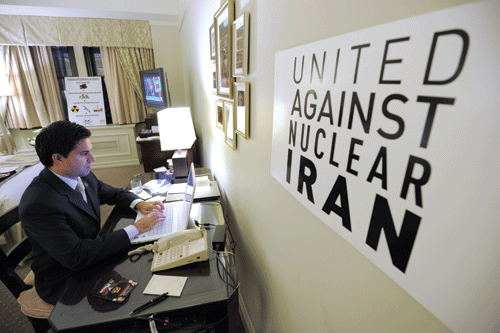
Tormenting their insomnia last month was the United States-based anti-Iranian lobby group, United Against Nuclear Iran (UANI), which publicly accused Banque du Liban (BDL), Lebanon’s central bank, and the country’s private banking sector of laundering massive amounts of cash for Hezbollah, Iran and Syria. “The LBS [Lebanese Banking System] is a fraud” and “the focal point of the fraudulent Lebanese banking centers on BDL,” were among UANI’s quotes in major international news outlets. As part of this campaign, UANI is pressuring Wall Street and European financial firms to divest of their holdings in Lebanese sovereign debt, requesting that credit rating agencies re-rate Lebanese debt to “no-rating,” and calling for Lebanon to be cut off from the US financial system, which would cripple the country’s highly dollarized economy. UANI is not inept either, having successfully lobbied the European Union to oblige Belgium’s Society of Worldwide Interbank Financial Telecommunication (Swift) to remove blacklisted Iranian banks from its network and thus restrain their worldwide financial transfers.

UANI’s board just so happens to feature Zionist luminaries such as Meir Dagan, former director of Mossad until 2011, as well as James Woosley, former director of the US Central Intelligence Agency, August Hanning, former head of the German intelligence service, and Richard Dearlove, former head of the British MI6 intelligence service. Fancy that.

The evidence supporting UANI’s claim that “vast inflows of deposits” are being washed in Lebanese banks is scant, with the group’s conclusions extrapolated from tenuous correlations that would amount to libel in any American court. The actual deposit figures — calculated by BDL, Lebanon’s Ministry of Finance and concurrent with those of international institutions such as the World Bank and International Monetary Fund — paint a different picture. In 2011, deposits grew by just 8 percent, down from a 12 percent growth in 2010 and 23 percent in 2009, and for the first four months of this year, deposits grew by just 3 percent. In response to UANI’s allegation, BDL Governor Riad Salameh pointed out that Syrian deposits held by Lebanese banks operating in Syria or in Lebanon have actually decreased since the start of the uprising in 2011.

UANI also claims that, for Lebanon, “the obvious risk of default is great” unless Hezbollah, Iran and Syria are supporting the “economic house of cards.” Had these ‘intelligence’ chiefs bothered to pick up a copy of Executive from time-to-time, they would have known better. For starters, default is less likely now then it has been in a while, as Lebanon’s debt-to-gross domestic product ratio, while still staggeringly high at well over 130 percent, has actually dropped more than 30 percent in the last five years. More importantly, the vast majority of Lebanese sovereign debt is held by local banks and not international institutions, and thus UANI’s call for foreign divestment of Lebanese debt has more bark than bite. Lebanese banks have admittedly voiced concerns about continuing to fund the highly indebted nation but, lacking better investment opportunities in international markets, sovereign paper still looks attractive, as does keeping the government from default. And, whenever there has been any uncomfortable up-ticks in yields demanded by the market to purchase Lebanese debt, the central bank has stepped in instead and bought the debt at lower rates  — not Iran, Syria, nor any other state or non-state actor.

UANI’s indictments against Lebanon are baseless and its assessment of the country’s vulnerabilities flawed. It is unfortunate that these well-placed propagandists will likely never have to account for their deception, while Lebanon’s bankers are forced to defend their industry from yet another assault on its reputation. Given everything else they are dealing with these days, however, UANI is a speed bump rather than a roadblock, an annoyance amongst matters of actual substance.

MAYA SIOUFI is Executive's banking and finance editor

August 3, 2012 0 comments
0 FacebookTwitterPinterestEmail
Comment

Syrian refugees leave schools struggling

by Nizar Ghanem August 3, 2012
written by Nizar Ghanem

Minister of Education Hassan Diab is probably not having easy days at the office. On top of the already decrepit state of public education, coupled with ongoing protests by teachers demanding higher wages and benefits, this year saw the student population grow by around 15,000 children, the majority of which lack proper shelter or families that can support them. We are of course not talking about the effects of a sudden baby boom, but rather the influx of Syrian students fleeing their alma maters for ours at a rate similar to the increase in violence.

Following various pressures by civil society organizations, Diab, presiding over thousands of employees, finally gave in. He issued a decree late last year instructing all schools operating within Lebanon to receive the incoming Syrian students regardless of their legal status and relieved the Syrian students of entrance fees. Problem solved?

If it were only about decrees, the Syrian students would have long been integrated in the Lebanese schools. With an enrollment rate estimated at 20 percent and a dropout rate approaching 30 percent (double the national average), the Syrian children are rare to be found in the Lebanese school system. Coming from a Baathist education, where Arabic is the main language of instruction, Syrian students in Lebanon face serious problems transitioning to curricula taught largely in French and English, not to mention the different teaching methods. The majority of students, nine years old and above, drop out of school because they cannot understand what is being spoken in class, and there has been no arrangement made between the Lebanese and Syrian governments to see that, if and when students return to Syria, they will be granted accreditation of equivalences.

While the minister’s decree requires schools to receive all Syrian students, many principals choose not to. For many in the border regions, the decree seems like a removed bureaucratic procedure that does not tackle the real problem. The Syrian students generally require intensive remedial classes, and/or a change in the curriculum that would account for their linguistic level in foreign languages — something public schools are not prepared to provide. Syrian students who attend higher classes are supposed to form complex phrase structures and read dense scientific passages in a language they can often only barely spell their name in. What’s more, in school Syrian students have been subjected to social isolation, discrimination and corporal punishment. With a teaching staff that was neither trained nor prepared to deal with this influx, the inevitable happens: Syrians drop out of school, or even worse, many do not even bother to enroll.

According to the decree, the principals should not charge Syrian students school fees as the ministry will reimburse them later. Knowing the state of affairs in the quasi-dysfunctional Lebanese government, the principals are unsurprisingly skeptical. Having to run their schools with tight budgets, they cannot afford delays in payment and so they do what any sane manager would: they cut their future losses by receiving a minimum number of Syrian students.

Other factors exacerbate the problem. With the majority of families suffering financially after leaving everything they had in Syria, many can barely afford a decent shelter, let alone education. Paying for transportation, stationery and other schooling requirements can exert a tremendous financial burden. The increasing insecurity in the North and Bekaa also adds to the feelings of uncertainty as families try to keep quiet and not take risks by sending their children to schools. It doesn’t help that Lebanon still refuses to classify incoming Syrians as refugees, or sign the United Nations Convention on the Status of Refugees that would protect them (and all the other refugees in the country).

Why should the Lebanese citizenry care? The overflowing problems of electricity and water cuts, inter-sectarian bickering, continuous political deadlocks and fear of a looming civil war seem to be sufficient reasons for them not to take notice of the implacable situation of Syrian refugees. However, as the Syrian influx to the country increases, the number of children between the ages of 12 and 18 is expected to grow. This age group is highly vulnerable to various social ailments such as child labor and militancy. Leaving thousands of desperate, poor and socially secluded teenagers on the streets does not seem a wise course of action.


NIZAR GHANEM is a policy consultant and researcher working with Syrian refugees in Lebanon and Turkey

August 3, 2012 0 comments
0 FacebookTwitterPinterestEmail
Comment

When resistance was simple

by Nicholas Blanford August 3, 2012
written by Nicholas Blanford

A few months ago, in a conversation with a Hezbollah official I said I could imagine Sayyed Hassan Nasrallah, the party’s leader, reminiscing about the good old days in the 1990s. Back then Hezbollah was engaged in resistance on a daily basis against the Israeli occupation, achieving ever greater feats on the battlefield, earning a consensus among Lebanese for its martial activities, and protected by Syria’s dominance of Lebanon. Other than a small but potent parliamentary presence, Hezbollah did not have to bother with the tangled and treacherous complexities of Lebanese politics but could concentrate on what it does best: resisting Israel.

But look at Hezbollah today, I continued. To defend its “resistance priority” it has had to build complicated alliances with potentially untrustworthy and difficult allies, and has become the dominant influence in an unpopular and near stagnant government; it faces growing Sunni resentment; it is in the crosshairs of the Special Tribunal for Lebanon in The Netherlands; its key ally Syria is mired in civil war with the durability of the pan-regional “axis of resistance” hanging by a thread.

“You’re right,” replied the Hezbollah official. “This is not where we want to be. Our cause flies with the angels above, but we find ourselves stuck in the political arena.”

Hezbollah has never been more powerful politically and militarily, but with the power of governance comes accountability. And in the Shia villages of the south and in the southern suburbs of Beirut it is easy to hear voices of discontent and frustration from those people who traditionally support and vote for Hezbollah. The reason for their anger is the chronic shortage of electricity. Parts of Dahiyah and the south barely receive three hours of electricity per day.

Not only do they have to deal with the sweltering heat of summer without air conditioning, more importantly they cannot store food and dairy products in fridges. One night in July, residents of Dahiyah were sleeping in chairs on the streets to try to cool themselves and were mouthing curses at Hezbollah, declaring it had been a mistake to vote for them in the 2009 elections and vowing not to do so next year. Many hoped that Nasrallah would tackle the electricity crisis in his July 18 speech and were dismayed when the Hezbollah chief made no mention of it.

Of course, the electricity crisis did not begin with the present government. But the perception is that the “Hezbollah  government” has failed to deliver and it is the party’s support base that is suffering the most.

Such is the paradox facing Hezbollah three decades after it emerged in the wake of Israel’s 1982 invasion. It is a mistake to assume that Hezbollah has always sought power in Lebanon for the sake of power. The party is essentially a jihadist Islamist organization dedicated to the struggle against Israel. In its earliest manifestation it railed against Lebanon’s sectarian political system and refused to participate in it. During the 1990s, it was content to limit its participation in the political system to parliament, neither asking nor being offered seats in the Rafik Hariri and Salim Hoss governments of that decade.

The first time Hezbollah took the step of joining government was in 2005 and it did so to better protect its resistance priority, after the loss of Syrian protection following the disengagement of Damascus in the wake of the assassination of Rafik Hariri.

The goal of defending its arms also compelled it to organize a parliamentary no-confidence motion against Saad Hariri’s government, chiefly because of its refusal to renounce the Special Tribunal for Lebanon. Bringing down the Hariri government was relatively easy, but it was also a case of “you break it, you own it”. When the March 14 (now) opposition coalition refused to join a government of national unity under Prime Minister Najib Mikati, it meant that the cabinet was going to be dominated by Hezbollah and its allies, ergo the “Hezbollah government”.

Now Hezbollah finds itself diverting much of its energy to mollify and appease its numerous allies, especially the truculent Michel Aoun and the crafty Nabih Berri, neither of whom it particularly trusts but both of whom it needs in order to preserve the integrity of the government. But when the government fails to perform, regardless of the reason, Hezbollah is the one that will be blamed.

How Nasrallah must fondly reminisce of the golden years in the 1990s when life — and resistance — was so much simpler.


NICHOLAS BLANFORD is the Beirut-based correspondent for The Christian Science Monitor and the Times of London

August 3, 2012 0 comments
0 FacebookTwitterPinterestEmail
Finance

Information Minister Walid Daouk on the LIRA Law

by Executive Staff July 26, 2012
written by Executive Staff

Information Minister Walid Daouk discusses the thinking behind his controversial draft law regarding the regulation and control of websites based in Lebanon — the Lebanese Internet Regulation Act — and why his plans for a quick fix failed.

July 26, 2012 0 comments
0 FacebookTwitterPinterestEmail
Economics & Policy

Lebanon – Cannabis Farming

by Zak Brophy July 26, 2012
written by Zak Brophy

An inside look at the cannabis farming of the Bekaa Valley


July 26, 2012 0 comments
0 FacebookTwitterPinterestEmail
Finance

Banks in the crosshairs

by Joslyn Massad July 12, 2012
written by Joslyn Massad

Lebanon’s banks see soaring profits slow as trouble brews both at home and next door in Syria, while American muscle-flexing makes for costly compliance measures

July 12, 2012 0 comments
0 FacebookTwitterPinterestEmail
Comment

Syria’s arms economy

by Nicholas Blanford July 11, 2012
written by Nicholas Blanford

The prices of some popular weapons on Lebanon's black market have dropped for the first time since the uprising against the regime of Syrian President Bashar al-Assad began in March 2011.

Bearing in mind that the demand that drove prices to record highs was almost all from Syria, the recent dip appears to strengthen reports that Syria's armed opposition is gaining ever-greater access to weapons and ammunition.

The two weapon types that recorded the largest drop are AK-47 rifles and rocket-propelled grenades. In March 2011, a good-quality Russian AK-47 or the Polish-manufactured version, known in Lebanon as a “Circle 11” from the stamp on the metalwork, cost around $1,100. By April this year, however, the rifle had doubled in price to around $2,200. The price climb for RPGs was even higher. A single grenade in March 2011 was worth $100 (itself a significant rise given that five years earlier it was selling for about $10). By April, however, it was nudging close to $1,000. Arms dealers were grumbling that they could not even find RPG rounds on the market.

However, since the beginning of May, both AK-47 and RPG prices have dropped to around $1,800 and $700 respectively. The cost of 7.62mm ammunition for the AK-47 also has declined from around $100 for a box of 50 rounds in April to $83 in June. Both AK-47 rifles and RPGs were the most commonly used, and sought after, weapons for the Free Syrian Army (FSA) and other armed opposition groups. The drop in prices suggests that the FSA is receiving a regular supply of armaments today, which has lessened demand in Lebanon.

It is widely believed that Saudi Arabia and Qatar have begun funding the FSA and that fresh arms supplies are reaching the fighters, mainly from Turkey. The New York Times reported in mid-June that CIA officers were in Turkey monitoring the flow of weapons to ensure that the recipients were not groups that shared Al-Qaeda's ideology.

The FSA also has had increasing success in raiding Syrian army depots and stealing weapons and ammunition, or co-opting Syrian army officers with access to arsenals. Indeed, the profits to be made from selling weapons have spurred Syrian soldiers to steal weapons and sell them on the black market, according to Lebanese arms dealers. That has led to some Syrian army weapons, including RPG rounds, to enter the Lebanese market.

The enormous profits to be made from selling arms has blurred political loyalties. There is a story presently circulating in the Bekaa about a member of a Syrian-backed political party who was in charge of the group's arsenal in his village. He struck a deal with a man from an influential family to sell the weapons to the Syrian opposition and they would split the proceeds. The weapons were duly sold across the border, but the second man then refused to share the profit with the party member. In revenge, the party member told the police where they could find the second man, who had a string of arrest warrants. The police laid an ambush and the second man died in a gunfight. The relatives of the second man then kidnapped the party member and he has not been seen since.

While AK-47 and RPG prices have declined, the cost of prestige weapons continues to climb. They include arms such as the AKS-74U, popularly known in Lebanon as the “Bin Laden gun” as it apparently was favored by the former Al-Qaeda leader. A Bin Laden gun costs $5,000 today, compared to about $2,800 a year ago. A Russian “Dushka” 12.7mm heavy machine gun is worth a staggering $9,000 compared to $3,000 in March 2011. Even that pales to the price of an American M4 assault rifle fitted with a M203 grenade launcher. Worth $5,000 in March 2011, today it will set you back at least $15,000.


NICHOLAS BLANFORD is the Beirut-based correspondent for The Christian Science Monitor and The Times of London

July 11, 2012 0 comments
0 FacebookTwitterPinterestEmail
  • 1
  • …
  • 321
  • 322
  • 323
  • 324
  • 325
  • …
  • 686

Latest Cover

About us

Since its first edition emerged on the newsstands in 1999, Executive Magazine has been dedicated to providing its readers with the most up-to-date local and regional business news. Executive is a monthly business magazine that offers readers in-depth analyses on the Lebanese world of commerce, covering all the major sectors – from banking, finance, and insurance to technology, tourism, hospitality, media, and retail.

  • Donate
  • Our Purpose
  • Contact Us

Sign up for our newsletter

    • Facebook
    • Twitter
    • Instagram
    • Linkedin
    • Youtube
    Executive Magazine
    • ISSUES
      • Current Issue
      • Past issues
    • BUSINESS
    • ECONOMICS & POLICY
    • OPINION
    • SPECIAL REPORTS
    • EXECUTIVE TALKS
    • MOVEMENTS
      • Change the image
      • Cannes lions
      • Transparency & accountability
      • ECONOMIC ROADMAP
      • Say No to Corruption
      • The Lebanon media development initiative
      • LPSN Policy Asks
      • Advocating the preservation of deposits
    • JOIN US
      • Join our movement
      • Attend our events
      • Receive updates
      • Connect with us
    • DONATE