• Donate
  • Our Purpose
  • Contact Us
Executive Magazine
  • ISSUES
    • Current Issue
    • Past issues
  • BUSINESS
  • ECONOMICS & POLICY
  • OPINION
  • SPECIAL REPORTS
  • EXECUTIVE TALKS
  • MOVEMENTS
    • Change the image
    • Cannes lions
    • Transparency & accountability
    • ECONOMIC ROADMAP
    • Say No to Corruption
    • The Lebanon media development initiative
    • LPSN Policy Asks
    • Advocating the preservation of deposits
  • JOIN US
    • Join our movement
    • Attend our events
    • Receive updates
    • Connect with us
  • DONATE
Economics & Policy

For your information

by Executive Editors August 7, 2012
written by Executive Editors

Left in the dark

Technical problems, industrial disputes and political brinkmanship have left most of Lebanon without electricity for abnormally extended periods of time on a daily basis. Around 2,500 contract workers and bill collectors at the nation’s sole power provider, Électricité du Liban (EDL), entered into their third month of strikes as they demand permanent employment with the company.  Minister of Energy and Water Gebran Bassil has staunchly refused their demands and opposes the bill passed last month granting the workers permanent employment. The bill was awaiting approval of the parliament’s secretariat at the time of Executive going to print. Meanwhile, the ministry signed a $360 million three-year contract to lease two power-generating ships from the Turkish company Karkey Karadeniz Elektrik Uretim. The first ship is expected to arrive in four months and the second within six months and combined they should provide Lebanon with 270 megawatts of electricity. Lebanon’s current electricity production stands at around 1,500 megawatts while peek demand exceeds 2,400 megawatts. However, the ships would not increase power generation in Lebanon as they are intended to offset the drop in production as vital maintenance works are done on existing power plants. Treasury transfers to EDL totaled $360.9 million in the first two months of 2012, constituting an increase of 56 percent from $231.5 million in the same period last year. [see comment page 14]

Not-so-happy holidays

The number of tourists visiting Lebanon in the first five months of 2012 was down almost 7 percent on the same period last year. Despite warnings from several Gulf Cooperation Council governments against travel to Lebanon, Arabs still accounted for 39.9 percent of total visitors and their numbers were actually up 15.2 percent on the same period last year. After Arab visitors, Europeans accounted for 29.7 percent of arrivals, 12.8 percent came from the Americas , 10.1 percent from Asia  and Africa 4.4 percent. Tourists from Iraq accounted for 8.3 percent of total visitors in May 2012, followed by visitors from the United States (8.1 percent), France (7.3 percent), Jordan (7 percent) and Saudi Arabia (6 percent). Incoming tourists totaled 1.66 million in 2011, down 24 percent year-on-year.

A banal budget, but a budget nonetheless

The Lebanese cabinet approved the 2012 draft budget, albeit without any of the tax changes mentioned in the budget that the Ministry of Finance proposed in May. The new version calculates $13.9 billion in expenditures and about $10.2 billion in revenues, which constitutes a fiscal deficit of $3.7 billion. Among the new taxes, or tax increases, dropped from the May version were a new 4 percent capital gains tax on real estate transactions on property owned prior to Jan 1, 2009 and 15 percent on transactions on property owned thereafter, an increase in value added tax from 10 percent to 12 percent, an increase in taxes on interest from banking sector deposits from 5 to 7 percent and an income tax rise in the banking sector from 15 percent to 20 percent. The budget still has to be passed in Parliament where it is likely to face criticism from the opposition block. Lebanon has been without a budget since 2005 and the state’s institutions have been kept afloat through extra budgetary spending bills. Lebanon’s contribution of approximately $33 million to the Special Tribunal for Lebanon (STL) was removed from the budget at the last minute as the funds were provided by the Higher Relief Committee, which falls under the prime minister’s office. The new budget will not cover the contentious issue of public sector wage increases as new sources of funding will be sought towards that end.

S&P: Growth on course, but also at risk 

Standard & Poor’s (S&P) credit rating agency has maintained its projection of Lebanon’s real gross domestic product growth at 3 percent in 2012 compared to an estimated 1.7 percent in 2011, but acknowledges that the prospects of higher and sustainable medium-term growth, which would increase competitiveness, enable private sector development and improve fiscal stability, depend on the implementation of key structural reforms by the government. The agency stated that the government’s proposed public infrastructure investments would support growth but are unlikely to materialize in the current political environment. S&P further observed that the continued factionalism in the cabinet is hindering macroeconomic and fiscal policy. The nation’s economic activity is supported by regional growth, especially in the GCC, but the turmoil in Syria since March 2011 has hobbled Lebanon’s economic growth. In the rating agency’s assessment Lebanon had not capitalized on potential benefits from the regional unrest, as it was not able to capture outflows from unstable neighbors due to its own instability in the first half of 2011 and the ongoing perceived risk emanating from the crisis in Syria.

A board to brand the nation

A Lebanese Promotion Board is slated to be established to support and promote the tourism sector and improve Lebanon’s brand perception. The council of ministers agreed to the creation of the new body that will be headed by the Minister of Tourism Fadi Abboud. On it will also sit the first vice governor of the central bank, the chairman of the nation’s flag carrier Middle East Airlines and the chairman of Casino du Liban, the president of the Association of Banks in Lebanon, the head of the Federation of Tourism Syndicates, the president of the Economic Associations, and the head of the Syndicate of Advertising Firms, in addition to five persons from the tourism sector to be selected by the tourism minister. The board will also help raise funds for the ministry, which is currently only able to make very minor contributions to the branding of Lebanon with its annual budget of just $18.4 million. The body will have an advisory role to the ministry proffering suggestions and advice regarding the development of the tourism sector, which is estimated to make up some third of the Lebanese economy. The Nation Brand Perception Index, compiled by the international consulting company East West Communications, ranked Lebanon in 189th place among 200 countries and territories in terms of how a country is projected in major media around the world and in 13th place among 19 countries in the Middle East & North Africa region in 2011.

Feeding the MEA fleet

Lebanon’s flag carrier Middle East Airlines no longer intends to buy a share in Cyprus Airways, having stated a previous interest in doing so. The Cypriot government, a 70 percent share holder in the carrier, revealed its intention in February to sell a portion of the airline, which posted losses of 29.3 million euros in the first half of 2011 and received 20 million euros in compensation from the government for extra costs incurred after Turkey banned Cypriot traffic. Meanwhile, MEA signed a memorandum of understanding for the purchase of 10 new Airbus aircraft at an estimated cost of $1 billion. The five A320neo and five A321neo planes will join the company’s existing fleet of 16 Airbus planes. MEA claims the new aircraft will offer the company 15 percent gains in fuel efficiency and cost effectiveness.

August 7, 2012 0 comments
0 FacebookTwitterPinterestEmail
Business

Q&A – Jacques Sarraf

by Executive Staff August 6, 2012
written by Executive Staff

Growing a Lebanese enterprise in the Middle East is fraught with risk and uncertainty but can sometimes reap huge profits. The company which embodies both the latter and the former is Malia Group, which has expanded from an industrial company into a regional holding active in six sectors. Executive chatted with chairman Jacques Sarraf about business wins and challenges in Iraq, Syria, and North Africa.


As a Lebanese business leader, what is your perspective on investing in Iraq today?

We are going to talk about Iraq? I am happy. I like that you think about Iraq. This is the way we make money.


How long have you been active in Iraq with Malia Group?

We have been in Iraq since 1997, after the agreement between Iraq and the United Nations was signed to exchange food and [medical] drugs for oil. We succeeded to get contracts through the UN system but it was very limited by products. It was food and drugs. Today, there is a big difference. You can trade all the goods you want and the Lebanese are very well accepted in Iraq. 

How competitive is the environment today when compared with 1997?
In ‘97, the competition was a political decision. Today, the competition is in the private sector and within the risk system. There is a high risk in Iraq and if you are afraid, you have to delete Iraq from your concept. This is the name of the game: it is high-risk, yes, but at the same time, high profit. 

High risk-high profit seems to have been your motto throughout your career as a business leader and industrialist. What is the risk premium in Iraq today?

It is a calculated risk. In the north of Iraq, there is a very low risk. The security is very high and the investment is also highly secure. Things are a little bit different in Baghdad or in Basra, where today we have a lot of support from decision makers in those regions. Our group is present in all of Iraq, but that is in distribution of [fast moving consumer goods] FMCG. In Kurdistan, we are in distribution but we are also in resort hotels and in controlling, in a partnership with [Bureau] Veritas; we are in construction and we are, with MIS Services, in information technology. 


Can you give us an estimate on the value of your assets in Kurdistan?

It is about $400 million. 


You have also been in the distribution business in Syria. Is this business currently under duress?

Since the beginning of 2012 we have been downsizing our business. We still have a team working there but we are on hold for any expansion or import activities. Our fashion business in Aleppo is completely closed whereas in Damascus we still have a team working on distribution and collection and doing business. But the risk is there. 


For exporting to the region, how critical is the ability to ship through Syria for you?

Until today, we are not facing this issue but our contingency plan is to go via Turkey. If we want to go to the Gulf, it is by vessel from Beirut harbor. For our pharmaceutical business, we always ship by air freight, which gives us a lot of cost but we are always present in those markets. 


What do you think of the risk of the euro?

We are exporting to Europe and we are in a positive situation until the euro is equal to about $1.20, not less. If the scenario goes to [one euro] at $1.15, we have to review our price strategy. [As Executive went to print the euro stood at 1.21 to the dollar.]


When viewing markets in the region and in Africa, which markets are overall the most important?

North Africa is one of the most important markets today where the Lebanese can expand their business. This is not only in Algeria, but Morocco, Tunisia, Libya and including Mauritania. That is why we have our liaison office in Algiers and have established Malia Group Algerie and from there we can serve those markets. I believe that the Lebanese have to look at these markets more deeply, because Lebanese businessmen and Lebanese products are very well accepted in those countries.


Between your manufacturing and your distribution activities in Malia Group, how have the profit contributions shifted over the years? 

We view this by sector and also by year. For example, in 2010-11, construction contributed a big part to our business turnover and profit. Within the industrial sector, our manufacture of pharmaceuticals and cosmetics is representing a good return on investment but FMCG, due to the high turnover in this region, is also giving us the same percentage. If I have to divide it, industry is representing one third of our business and return on investments.


Your vision also seems to have shifted toward becoming a publicly traded company… 

We began planning for our IPO in 2005 but going public [that time and again in 2008] was a risky decision. We postponed the IPO. We are a Lebanese group and if we want to go public, we have to offer something safe to our new investors. This is why we said let’s wait until 2016 and this is what we have been advised to by our lead manager of the IPO. 


How many companies are today in the Malia Group portfolio?

Twenty, and I just returned from the North [of Lebanon] where we will launch our biggest development with Natour {Resort] Developments in September. 


And the IPO will be for the whole group?

 In our strategy and IPO it was decided to sell 35 percent of the group, 10 percent for our employees, 10 percent for our partners and 15 percent on the markets. 


In 2004, you had 400 employees. How many employees does the group have today?

Today, we have 1,382 employees, and a big part of that is in Iraq. However, from this number we are excluding the construction teams that are hired on project base. 


What more can you tell us about the Natour Project in North Lebanon? Will this be a partnership?

We are two groups today [on this project] and we are now looking for a management company. We are on the edge of negotiating this.


With a European management company?

 No. On that, it is always good to have a Lebanese with high experience in managing such a resort business.  


If you are looking forward, what size are you aiming at for 2016, depending on the investments you are working on today?

A lot will depend on the Natour project. Natour alone is an investment where we are talking between $900 million and $1 billion. We are talking about 80 acres with 450 meters on the seashore and this needs a lot of investment. We are also going to create not less than 3,000 permanent jobs. 


So as far as benefit to the North…

…it is going to be the total reverse of the North Region.


And you are not worried of fighting in Tripoli?

Let me remind you, this is our culture — we have profits because we embrace risk.

August 6, 2012 0 comments
0 FacebookTwitterPinterestEmail
Business

Spirit of success

by Maya Sioufi August 6, 2012
written by Maya Sioufi

Sitting in his office in Sursock tower with a jersey of Barcelona club footballer Lionel Messi hanging on the wall, Hani Haddad, founder and Chief Executive Officer of Spirit, does not seem too concerned about the impact of Lebanon’s political instability on the advertising industry, but “by the time you go to print, things could change.” Established in Beirut in 2004, Spirit is a boutique advertising company providing custom made services to its clients in the Middle East and North Africa region in ways that “supermarket agencies”, as Haddad calls the large multinational advertising agencies, cannot. Unlike these agencies, “we do not copy and paste templates from abroad that can’t be applicable in our region,” adds Haddad. 

Structured for success
With more than 20 years of experience in the advertising industry in the Middle East — during which he founded advertising agency Triple H that was later sold off to Beirut-based Intermarkets, a subsidiary of global advertising agency WPP — Haddad felt there was a gap in the market for tailored services and he founded Spirit to fill that gap. For instance, Haddad highlights the recent TV ad campaign done for Skinnet, and the corporate event done for the launching of BMW’s six series in Zaitunay Bay, as examples of tailored services. Haddad refused to divulge his price structures to Executive but claims he charges “a little bit less” than multinational agencies. Spirit’s portfolio of clients now includes accounts such as Rotana Hotels and Al Ahli Bank as well as BMW and Renault in Lebanon.

With a total of 36 employees, after having made layoffs in its second office in Dubai two years ago, Spirit is made up of four entities: Spirit ME (the ‘ideas provider’), Spirit media (media planning and buying arm), Spirit PR (public relations) and Spirit digital (online advertising).

Total revenues for the group stood at $22 million last year, up from $18.5 million in 2010 and $16.5 million in 2009. “This year is still promising despite what is happening politically and economically [in Lebanon],” adds Haddad. Whereas real advertising expenditure in Lebanon dropped by just more than three percent last year to stand at $174 million according to research firm IPSOS-STAT, Spirit’s revenues from Lebanon, its largest market, grew by 20 percent, up from 18 percent in 2010 and 15 percent in 2009. The second largest market, the United Arab Emirates, did not witness such solid figures as Spirit recorded five percent growth rate last year, up from 3 percent in 2010 and zero in 2009 due to the financial crisis that shook the emirates. Haddad expects that this year growth in their UAE market will be in line with other Middle East markets.

Ads of the future

In Lebanon, the vast majority of expenditures go to television, as this media avenue netted $38 million of the $174 million total expenditures last year, but Haddad believes television is losing its importance. He jokes that “unless Barcelona or Liverpool football clubs are playing a match, people won’t watch TV.” In fact, television advertising spend, while still receiving the bulk of total advertising spend, grew by just three percent globally in the first quarter of the year according to Nielsen figures, the slowest growth after magazines among the seven media categories. In the Middle East though, as in Lebanon, television remains the avenue most widely used for advertisement purposes with TV ad spend growing by 34 percent in the Middle East and North Africa.

For the advertising space in Lebanon, his main concern is the lack of transparency. “In Dubai, there are monitored figures for prices, reaches, etc. In Lebanon, we don’t have such figures. You cannot trust anybody.”

He sees two key trends shaping up the industry in the near future. The first is for direct contact such as sending personal emails to consumers, calling them to discuss a promotion and planning events to launch a product.

The second trend, and the one where Haddad sees the most significant growth in advertising, is the shift from traditional to digital. In the UAE, Spirit’s clients are allocating a larger percentage of their advertising budgets to digital. “30 percent of their traditional budgets is digital, up from 5 to 10 percent [a few years ago] and the shift is coming to Lebanon too,” says Haddad. Online advertising witnessed the strongest growth worldwide among the seven different media categories in the first quarter of the year, up 12 percent according to Nielsen figures. Haddad is keen to direct interaction online through social media tools such as Facebook and Twitter. “Everybody now has a fan page on Facebook. You have to interact, activate and bring fans,” adds Haddad.  “No brand can ignore this.”

August 6, 2012 0 comments
0 FacebookTwitterPinterestEmail
Business

Winners at growing their business

by Maya Sioufi August 6, 2012
written by Maya Sioufi

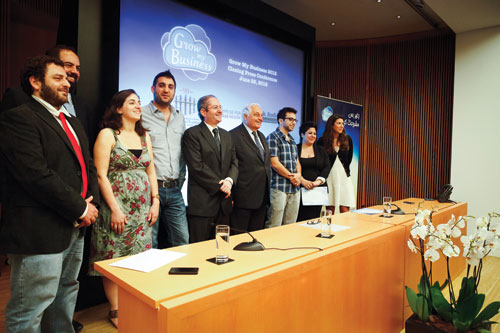
What do recycled electronics, olive oil and an online game have in common? They are the products behind the three companies that won the “Grow My Business” competition, a joint initiative between the Beirut Traders Association, the MIT Enterprise Forum for the Pan Arab Region and Bank Audi. The competition’s aim is to encourage entrepreneurship in Lebanon and support the development of the private sector. After 30 teams presented detailed business plans in front of a high-profile jury, three teams were granted awards. The first prize of LL50 million ($33,200) went to AD Tech, the second prize of LL20 million ($13,300) went to Olive Trade and the third prize of LL10 million ($6,600) went to Wixel Studios. Executive sat with the owners of each company to discuss their business model and expansion plans.

AD Tech – Recycling electronics 

When you renew your laptop or your smartphone, you have three options in Lebanon for disposing your used electronic device: toss it, sell it or give it away. AD Tech aimed to change that when it launched last year. The company started out importing high quality used electronics from the United States and selling them to several resellers in Lebanon. AD Tech sold more than 2,000 units in Lebanon last year and generated revenues of $200,000. “After one year of experience, we saw a huge market for used IT electronics,” says AD Tech founder Joseph Massih.

This observation led the team of four to develop an expansion plan into a new line of business: a waste management program. The plan, for which they won the competition, involves acquiring used electronics from end users in Lebanon, both corporations and individuals, and then either dismantling these products if they are obsolete or selling them to specific resellers in Lebanon and abroad. “We are going to encourage electronic recycling,” adds Massih. He expects that this expansion plan will cost between $200,000 and $300,000 in a first phase, as they will need to upgrade their current warehouse based in Amchit. Massih expects the plan to launch in six months and increase revenues by 40 percent within the first five years. While the prize money from the competition will be used towards this purpose, it covers only a minimal share of the total cost and AD Tech is currently looking to complete the financing of the project.

The long-term target of AD Tech is to raise awareness about the benefits of recycling and eventually develop a recycling plant in Lebanon, which could become a hub for the Arab world. “Awareness of recycling does not exist in Arab countries,” says Massih. “We hope to start it here and go with it abroad.”

Zejd – the Olive trade

Under the brand “Zejd”, meaning olive oil in the language of the Phoenicians, who are said to have been the first people to grow olive trees, Youssef Fares started selling products derived from Lebanese olives in 2004 through his company Olive Trade. It now sells products such as soaps, flavored oils, green and black olives and stuffed olives (with around 15 different types on offer) and brought in $300,000 in revenues last year. The olive trees used for the products come from land Fares owns in his native village in the Akkar region, as well as from lands managed for farmers in villages surrounding Akkar. The products are sold in high-end specialized stores in Lebanon such as Aziz, to high-end hotels and restaurants such as Le Grey, while also being exported to the US, France, Switzerland and Japan. Olive Trade, made up of four team members, entered the MIT competition to expand and open a retail shop in Ashrafieh called “House of Zejd” within the next month, according to Fares.

The retail store is expected to raise sales by $100,000 in the first year. The LL20 million won at the competition will only cover 15 percent of the cost of the shop. The remaining will be secured from self-financing and from a bank loan “which I have already received approval for,” says Fares. “There will be also be an olive bar for people to come and taste the olive oil before buying it as well as events explaining olive oil. It’s a shop but it is also an awareness about the oil product.”

Wixel Studios – Online Arabic applications

Do you want to choose between Hassan Nasrallah, Saad Hariri, Samir Geagea, Michel Aoun and other prominent Lebanese political figures and pitch them against each other in a street fight? That’s what the online game “Duma” at Wixel Studios allows players to do. Initiated in 2008 by Karim Abi Saleh, Rein Abbas and Ziad Feghali, all three former employees of Redmond- based Digipen, a leader in game development education, the company has so far been focused on “advergames” (games for advertising purposes) such as the ones done for Kit Kat and Almaza and “edugames” (games for education purposes), such as “The Civil Guardians”, a game initiated by the Lebanese Civil Defense Department and the European Union with 125,000 copies distributed to Lebanese schools. Covering the Middle East and North Africa region, Wixel Studios generated $120,000 in revenues last year.

The model of Wixel is now shifting as the team of four — with plans to grow to seven by the end of the year — will no longer provide games for advertising and educational purposes, and will start developing mobile games for the Arab consumer available through the iTunes store and Android market. “There is only a little amount of applications in Arabic,” says Ziad Feghali, one of the founders. “Our plan is to create valuable Arabic mobile content.”

With funds raised this year — an amount the company refused to disclose — from venture capitalists Berytech and Middle East Venture Partners, Wixel Studios will launch its first game, Abou Ahmad el Arabi, at the end of October. The description of the game would not be discussed at this point as “there is fierce competition,” says Feghali. He expects the launch of the first consumer mobile game to allow Wixel to generate $300,000 in revenues this year. “We intend to be the company leading mobile games in region," adds Feghali.

August 6, 2012 0 comments
0 FacebookTwitterPinterestEmail
Economics & PolicyTourism

No rockin’ around the clock

by Nabila Rahhal August 3, 2012
written by Nabila Rahhal

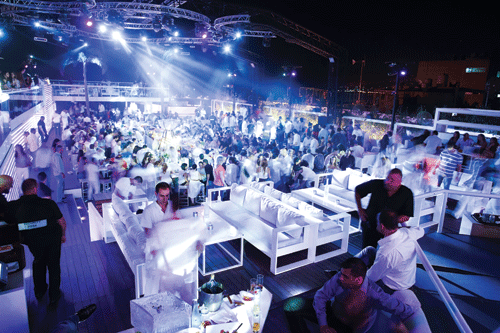
White Beirut’s website features a video which begins with news reporters announcing the various negative political events of this summer and Gulf country travel warnings for Lebanon. It then rolls on to the song “War, What is it Good For?” and shows photos of people clubbing at White and ends with the statement “This is Beirut. We Are Waiting For You.” Indeed, in his last stint in Beirut on June 2012, the comedian Maz Jobrani once again poked fun at the Lebanese’s love of partying despite any circumstances. Will this be enough to make up for the geopolitical situation of the summer?

Rooftop venues have become a staple of Beirut nightlife, despite the heat and humidity, and there are several several high-end rooftop clubs and bars to choose from. “One of the causes for the decrease in our business in summers is the wide choice of rooftop venues that Lebanese opt for,” says Olivier Du Parc, partner in Behind the Green Door club in Mar Mkhayel. Yet, it seems that rooftop venues were also planning for a dismal season.

This summer, Skybar is only operating four days a week (Thursday and the weekend) when last year it was open all week long. According to Abraham Helal, Media Manager at Sky Management, they adopted this strategy in anticipation of an imperfect season, but are actually “fuller than last year” and are doing well compared to the local market. He attributes this increase to less operating nights, which created a situation of scarcity and condensed their clients into four days, instead of having them spread over the week.

Skybar fans have noted, to their delight, that it is much easier to book a table this year and say calling around two weeks in advance is enough, as compared to last year when it seemed like tables were booked months in advance.

White Beirut is also closed Mondays and Tuesdays, a plan they adopted from the start of the season this year. “We usually adopt this strategy of closing on two weekdays when Ramadan begins,” says Reem Beydoun, spokesperson for Add Mind, which owns White. “But since Ramadan now comes in the middle of the month, and we usually have less people on weekdays, we decided to start off the season by closing those two days.”

“We are relying mainly on the expats and the local market, and are fully booked on Thursdays and the weekend with a considerable waiting list,” she adds. Beydoun also speaks of Iris Cocktail Bar and Restaurant, owned by Add Mind as well, saying since their clientele are mainly Lebanese, the tourist warnings have not affected them.  A bartender at White says the decrease in Arab tourists this season has affected them as staff. “Arab tourists are our biggest tippers, and last year I used to make more than half my salary through their tips,” he says. This year, their absence is translated in a decrease in tips and less people than last year, especially on Wednesdays and Sundays, he adds.

Effects on the bar scene

A stroll in Hamra on a late Friday night can lead you to believe that all is normal on the street, yet reality is different. “We have a 40 percent decrease in sales and clientele compared to last summer,” says Danny Khoury, owner of Danny’s Bar in Hamra. “We are directly affected by the Arab tourist bans,” he explains, noting that while his establishment is not a large draw for Gulf Arabs, it attracts those who want to escape the venues that are. Khoury also cites the increased number of bars in Hamra as another reason for the decrease in percentages: “People have many bars to choose from but there are not enough people to go around, as the tourists and expats avoided Lebanon this summer.”

“The events in Syria and the internal political situation are also causing people to be scared to go out as much,” he says, attributing only 20 percent of the decrease in business to Ramadan, noting this was the percentage decrease during the holy month last year.

This situation is repeated in Mar Mkhayel area, where bar-culture has been fast developing. “In anticipation of a bad season, we took the strategic management decision to operate only on weekends this summer,” says Green Door’s Du Parc. “We open the bar one night, and on the other, we are organizing outdoor festivals in Sporting Club.” He attributes this situation to several factors, such as the local clientele frequenting rooftops in the summer and there being fewer tourists this season. “The festivals in Sporting are compensating for the losses we might have had this season,” says Du Parc.

Summer is the season for going out, and the Lebanese have developed the reputation of being die-hard party lovers, but this does not seem to be enough to save the nightlife industry this season. Still, the summer is not over yet, and with the Eid festivities coming up next month, there might still be time to salvage the situation.

August 3, 2012 0 comments
0 FacebookTwitterPinterestEmail
Economics & PolicyTourism

Fewer people to play for

by Nabila Rahhal August 3, 2012
written by Nabila Rahhal

Every summer, people flock to the towns and remote areas of Lebanon for the festivals. Local residents anticipate those events for the publicity they bring to the area and for the obvious economic benefits to the restaurants and hotels there. This year, however, was not like the last. Ehdeniyat International Festival, Ehden’s annual summer festival, for example, was cancelled.

“We were forced to take this decision a month ago,” says the festival’s media representative Joelle Hage, “when our international artists cancelled their contracts due to their worries about the unstable situation in North Lebanon.”

Fortunately, since the festival was set for August no tickets were sold yet, but months of preparation went to waste. While some of the planned events like the Free Children’s Village will still take place, says Hage, the budget is now much lower and only local residents are expected to attend. Hage explains that Ehdeniyat is organized by the nongovernmental organization Al Midan — which focuses on health, rural development and environmental conservation — as a fundraiser, with all profits going to the NGO, while the event has also brought spinoff economic benefits to the hotels and restaurants of the area.

Lebanon’s unpredictable political situation might have also caused a decrease in attendance at festivals in South Lebanon. “I know of many who were reluctant to attend concerts in Beiteddine as they were worried the roads would be blocked on the way to, or back,” says Bernard Farah, onwer of Diwan Al Farah Restaurant, who annually operates a snack stand on the grounds of Beiteddine as he remarks on the more somber mood of this year compared to 2011’s high spirits and full houses.

Vacation hotspots cool down

The decrease in tourists this year also affected the festivals, with Abdo Hussein of Virgin’s ticketing office estimating that only 10 percent of the tickets they sold went to non-Lebanese. Hala Chahine, organizer of Beiteddine Art Festival, says it is the norm to have more Lebanese than foreigners attending the festival. “Annually, we usually have 20 percent Arab attendees,” said Chahine in early July, “but we have not felt their presence yet this year.”

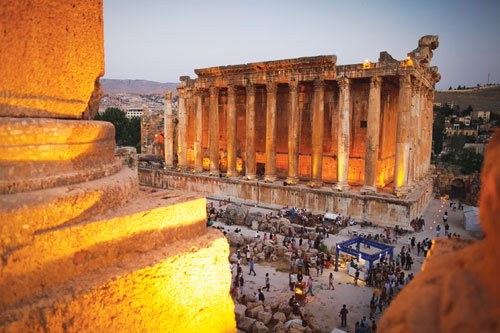
While Elga Trad, a Baalbek International Festival Executive Committee member, admitted that Baalbek Festivals are not selling as well as last year, she refrained from attributing this to one specific reason.

“We are understandably affected by the political unrest of the region, but we are doing better than we expected considering the situation,” says Latifa Lakis, organizer of the Byblos International Festival. She reported in mid-July that they had sold more than half of the available tickets, with BB King, Kadem al-Sahir and Snow Patrol, all since selling out.

Surprisingly, according to Hussein, the Virgin ticket office — which handles most festivals and large events in Lebanon — has seen a 30 percent increase in ticket sales this year from last year. But, he adds, there were about twice as many performances last year.

“When you consider how many events people had to choose from compared to last year and how many tickets were brought, you see this is actually a bad year for festivals,” he points out. “Due to the wide range of choices and the economic and political situation, we noticed people were selective in their purchasing.” Some shows have sold out, says Hussein, while others were barely attended. That may not be surprising given that this year only 57,000 tickets were sold at the three largest festivals (Byblos, Baalbeck and Beitedine) compared to last year’s 104,000.

Trad points out that festivals were overlapping this summer, as most organizers wanted to finish before Ramadan, which forced people to pick between concerts.

Paying for playing

All organizers interviewed said that their budget comes from three sources: sponsors, ticket sales and the Ministry of Tourism’s aid. According to Chahine, 70 percent of the Beiteddine Festival’s budget comes from ticket sales, 29 percent from sponsors and 1 percent from the tourism ministry. Baalbek Festival’s main support comes from sponsors and partners, says Trad, adding that the cost of sponsorship spots start at $10,000 and can vary depending on whether the sponsor wants to be a partner, or sponsor only one performance. Lakis believes festivals have limited profitability and are done for more cultural value than monetary gain. She adds that after paying the numerous expenses, whatever festival profits exist are largely reinvested into planning the next year’s event.

To be eligible for ministry support, festival directors must apply to the Ministry of Tourism, which then decides the amount, explains Michel Habis, advisor to the Minister of Tourism. He adds that depending on the location, how well established the festival is and the caliber of performers, support can range between $2,333 for smaller events to $332,000 for highly reputable showcases. Habis says the ministry aims to support all festivals due to their touristic value, but that it would not be fair to give all festivals the same amount.

The tourism ministry’s aid is consistent but late, agree Lakis and Chahine. Chahine explains that each year, they take loans from banks to cover for the delay in the government’s support, and that banks are used to this and know the support will eventually arrive, albeit some two years post-dated. Habis says he is aware of the delay and the loans the festival directors take, but says the issue lies with the Ministry of Finance, as the tourism ministry signs their support of approval at the right time and hands it over to them, after which delays are beyond their control.

The festival season is almost over, and as festival goers contemplate their favorite performers of the season, fair directors are busy balancing their books and wondering what talent they might be able to bring in next year. The available roster for 2013 may, however, have more to do with the geo-political situation swirling around Lebanon than the prestige of the event or the amount they can offer for artists to come, as the performers’ need, before anything else, a crowd to play for.

August 3, 2012 0 comments
0 FacebookTwitterPinterestEmail
Economics & PolicyTourism

Pandering to the penny pinchers

by Zak Brophy August 3, 2012
written by Zak Brophy

The vitality of Lebanon’s economy is intrinsically linked to the annual influx of tourists laden with their foreign coin. It is little surprise then that the vagaries of this temperamental sector play a large role in determining the national mood. And yet while income from the tourism trade roughly constitutes a fifth to a third of the whole economy, depending on how you calculate it, the finance ministry’s 2012 budget proposal allocates the Ministry of Tourism’s $18.5 million in funding, one of the lowest within the government.

“Our budget is a catastrophe,” remarked Michel Habis, advisor to the Minister of Tourism Fadi Abboud.

There is also no coherent strategy for the sector in Lebanon. There are ideas, proposals and plans, but most have been swamped in the miasma of cabinet and parliamentary debates, and thus never see the light of day.

“The Ministry of Tourism is trying to apply a strategy but first you need political stability before any strategy can be implemented and there is no stability in Lebanon,” complains Paul Ariss, president of the Syndicate of Owners of Restaurants, Cafes, Nightclubs and Pastries. Indeed for years the ministry has been touting Lebanon as a high-end tourism destination. Yet when Arab Gulf countries issued travel warnings for Lebanon over concerns related to the ongoing crisis in Syria, Abboud began talking about having Egyptians come to Lebanon for $500, flight and hotel included.

Opening the skies

The unpredictability of Lebanese stability is but one hurdle towards getting a comprehensive tourism plan through Lebanon’s notoriously turgid political process. It may well be beyond the scope of the ministry but one policy Abboud is pursuing with vigor is to attract the low-cost budget airlines to Lebanon; a strategy that has him on a collision course with the government-owned national carrier, Middle East Airlines (MEA), and its allies in the cabinet.

“If we significantly reduce the cost of travel we can boost the numbers by 50 percent.  The country will profit so much more,” says Habis. Last month the Emirati-based Arabian Business published an interview with Abboud stating that the ministry was in talks with European low cost carriers Monarch Airlines, easyJet and Ryanair, and the minister accused the Lebanese Civil Aviation Authority of not allowing the airlines to land without first being given extra access to their markets.

“I have a complete plan that I want to introduce low-cost flights and chartered flights,” said Abboud to the news outlet. “The hotels are ready to give special prices. I don’t want to reinvent the wheel. I want to do what Dubai did a few years ago when they had a problem, or what Egypt or Tunisia is doing now. You know you can spend a whole week in Tunisia now for $400 in a hotel plus the ticket.”

Lebanon signed up to the open skies policy in 2000 and fully implemented it in 2002, which opened up the market to unrestricted competition from other airlines. However, MEA never fully accepted the agreement and now with Ghazi Aridi, the minister of transportation and public works, firmly ensconced in their corner the country is retreating from this liberalization policy. “Airlines that are already servicing Beirut are requesting flights but Minister Aridi and MEA are rejecting these and this is what is killing the market,” says Hamdi Chaouk, former director general of Civil Aviation complains. “This comes specifically from the Ministry of Transport and Public Works which is trying to protect MEA.”

Other tourist hotspots in the region such as Israel and Turkey already have frequent flights from around Europe on budget airlines and as such are, in general, much more affordable tourist destinations.

“Today if you want to buy a ticket from London to Beirut it could cost close to a $1000 whereas the same ticket to Tel Aviv could be closer to $500,” says Habis.

Prices warding off newcomers

However, attracting budget tourists to Lebanon may seem counter intuitive considering the fact that a beer in Beirut costs as much as it does in London, and it is a struggle to get a good meal for under $20 a head. However, while acknowledging that Lebanon is an expensive destination for backpackers, Habis argues that if the flights are affordable, backpackers could be a big boost for the outlying areas such as Tripoli, Sour and the Bekaa where the cost of accommodation, food and entertainment is considerably less than in the capital.

The inexorable rise in prices is having a large affect on another potential tourism market and that is the community of Lebanese expatriates living abroad. In early July at a conference in Beirut held specifically for this community, the Minister of Tourism failed to turn up to a discussion on the policy of the Lebanese government to improve and increase tourism of Lebanese immigrants, eliciting more than a little bit of ire from the attendees.

“The Lebanese living abroad should be the permanent and continuous tourist to Lebanon,” said Nassib Fawaz, president of the Lebanese International Business Council speaking on the sidelines of the conference. “We want to be the tourists in Lebanon but the cost is so high. The middle classes are getting priced out of their homeland.”

Ripe new traveler markets

Habis says there are expanding markets that Lebanon is failing to tap into. Russia and Turkey are two countries within a four-hours flight where the traveler market is expanding considerably. “The Russians are becoming big, big travelers and we are not attracting enough of them because we only have two flights a week. They are all going to Cyprus but we need more flights,” say Habis.

In order to brand and promote Lebanon, Pierre Achkar, president of the Lebanese Hotel Association, argues it is necessary to target specific market segments and to communicate with captive markets in their own language. “We need to have close cooperation and a coherent strategy with foreign travel agents, for example in Turkey,” he says. The problem is that the Ministry of Tourism has virtually no budget to do this. The Council of Ministers recently agreed, however, to create a ‘promotion board’ headed by Minister Abboud, who will be joined by a number of concerned actors including the head of the central bank, the chairman of MEA and the head of the Federation of Tourism Syndicates. While the board will “brainstorm ideas,” according to Habis, on how to develop tourism in Lebanon, he claims it will primarily focus on raising funds for the promotion and branding of Lebanon abroad. In developing this brand Habis says the ministry is keen to engage with niche profiles of tourists, such as those interested in environmental and heritage tourism. However, Joseph Haddad, founding member and secretary of the Association for the Protection of Lebanese Heritage, argues that Lebanon is failing miserably to protect both its heritage and its environment. “The government right now views tourism only from the point of restaurants and hotels and nightlife but they are too short sighted to look at long term solutions such as preserving architecture or archeological sights,” he says. “This builds long-term tourism markets. They are just trying to pursue fast revenue. It is a typical Lebanese mentality.”

Lebanon’s Minister of Tourism does not pack the punch in the cabinet commensurate to the value of his sector, but Fadi Abboud is no shrinking violet. It is fair to say nobody is holding his breath for a comprehensive tourism strategy getting passed anytime soon. However, Abboud’s success or failure of opening the gates to budget airlines servicing more routes more frequently to Beirut will be a big determining factor in his ability to inject a fresh lease of life into the tourism sector in Lebanon.

August 3, 2012 0 comments
0 FacebookTwitterPinterestEmail
Economics & PolicyTourism

Where did everyone go?

by Peter Speetjens August 3, 2012
written by Peter Speetjens

With the electricity more off than on, it has been a hot, yet so far quiet summer. No waves of swaying black abayas in ABC and while Beirut’s hotels would normally be fully booked, a room these days is easy to find, often against bargain prices. A quick Internet search shows that a five-star Saturday night in mid-August costs $495 per room at the Movenpick Hotel and Resort, $240 at the Phoenicia Intercontinental, $135 at the Hilton Beirut Metropolitan Palace (down from $328!) and only $99 at the Commodore Hotel.

Now, Ramadan traditionally is a quiet time in terms of travel, yet a similar search for a Saturday in September again shows ample availability and only slightly higher prices. Surprisingly, the tourism sector’s main indicators at first sight do not seem all that bad. During the first five months of this year, 557,188 foreigners flocked to Lebanon, which represents only 6.5 percent decline compared to the same period last year. According to Ernst & Young’s survey of the Middle East hotel sector, the average occupancy rate at Beirut’s four and five-star hotels was 66 percent in the first five months of 2012, a 14 percent increase from the same period last year.

But these figures do not tell the full story. First, one should not forget that 2011 was already a precarious year. Only 1.65 million tourists visited Lebanon, a 23.7 percent decrease compared to 2010.

Secondly, the make-up of foreign visitors has changed. Most Arabs visiting Lebanon until June were Iraqis (48,125), Saudis (44,907) and Jordanians (39,744). Asian tourists recorded the sharpest decline, mainly due to the only 16,525 Iranians, an 80 percent drop compared to last year.

It illustrates the main issue at stake for Lebanon: Syria. Most Iranians normally visit Lebanon as part of a pilgrimage along the main Shiite sites in Syria. Yet, as Lebanon’s eastern neighbor has grown more and more dangerous, less and less Iranians go on holiday. The same is true for those Gulf Arabs and Jordanians — in 2010 the biggest group of foreign visitors — who tend to visit Lebanon by car.

In addition, following violent clashes in the streets of Tripoli and Beirut, the governments of Qatar, Kuwait, Bahrain and the United Arab Emirates in May urged their citizens not to travel to Lebanon. In early June, Saudi Arabia issued a similar warning. Many Lebanese believe the warning is partly politically motivated, as the Gulf Cooperation Council supports the Syrian opposition, while Lebanon’s government remains on somewhat good terms with the Assad regime.

“Until May 21, we had a relatively good year, but after the warnings we immediately felt the impact,” said Roger Saad, Director of Sales at the Four Seasons Beirut. “In July, we had an occupancy rate of only 55 to 58 percent, which is still not too bad seeing the circumstances. August will be much quieter, although we expect a strong pick-up to up to 85 percent for Eid at the end of August. Of course, we will have to wait and see. One major incident and all reservations are cancelled again.”

Following the travel warnings, Lebanon’s Tourism Minister Fadi Abboud headed to the Gulf claiming the reports about unrest in Lebanon were “exaggerated.” In July, Lebanon’s President Michel Sleiman followed in his footsteps. The efforts should not come as a surprise, knowing that tourists from these countries represented only 13 percent of foreign arrivals in 2011, yet were by far the biggest spenders.

Even this year, despite the decline in numbers, Global Blue, which maps shopping trends by analyzing VAT Returns, concluded that the biggest spenders were still Saudis, Emiratis and Kuwaitis, with a combined 41 percent of the total. Some 85 percent of their purchases concerned clothing and jewelry. According to Lebanon’s Ministry of Tourism the sector in 2010 contributed some $8 billion to the economy, or 20 percent of Lebanon’s gross domestic product. This decreased to some $7 billion in 2011, and this year it is feared it may drop below $6 billion.

The tourism toll

One of the main sectors affected is the hospitality market. “On July 2, Beirut high-end hotels reported an average occupancy rate of 74.5 percent, while over the first 6 months of 2012 the average occupancy income went up by 35 percent,” said Pierre Achkar, president of the Lebanese Hotel Association (LHA), as well as chief executive of the Monroe Hotel in Beirut and the Printania Palace Hotel in Broumana.

“However, that is only in Beirut, not in the rest of the country,” he continued. “Beirut’s high-end hotels will always attract corporate clients. Outside Beirut, that is hardly the case. The situation is extremely bad. At the Printania, we often have occupancy rates of 10 percent, which may go up to 40 percent on a very good day.” Achkar cited the negative travel advice or “embargo” as one reason for the malaise. Another, especially for places such as Broumana, is the situation in Syria, as most tourists who travel to Lebanon by car tend to stay in homes and hotels outside the capital. “Since the uprising began, we may have lost some 350,000 to 400,000 visitors coming through Syria,” he said.

The LHA figures for last year confirm the trend. By the end of 2011, over a third of Lebanon’s 18,593 hotel rooms belonged to 58 high-end hotels. While Beirut’s 5-star hotels in 2011 posted an average room occupancy rate of 53.56 percent, occupancy rates in 5-star hotels outside Beirut varied from 21 percent to 34 percent. The same was true for the country’s 4-star hotels.

The knock-on effect

The absence of tourists is not the hotels’ only problem. “In Broumana we do not have electricity for 16 to 18 hours a day,” said Achkar. “Still, people want AC and as we have a central cooling system that costs us about $1,000 a day. Also, we normally employ some 52 seasonal workers in summer, mostly students. This year only 11, as we have to bring our costs down.” While business has not been as bad for Beirut’s high-end hotels, they too have taken measures. “Nothing dramatic, but we must limit our overhead,” said Saad of The Four Seasons Hotel. “We are keeping our expenses down and spend less on ads and business trips. No one has been laid off yet, but we are pushing employees to take their (paid) holiday now.”

Paul Ariss, president of the Syndicate of Owners of Restaurants, Cafes, Nightclubs and Pastries in Lebanon, emphasized the problem did not start this summer. According to him, the sector’s combined turnover since early 2011 has taken an estimated 40 percent hit. However, he also stressed that not all venues have been affected in similar fashion, as some in particular target tourists, while others mainly depend on a local clientele.

He estimated the number of tourists normally traveling by car through Syria at some 40,000 a month. “There have so far not been more closures than normal, but we have seen some take-overs,” he said. He did not know how many Lebanesee lost their jobs, but signaled that, for more than a year, bars and restaurants have employed more and more foreign laborers.

Both Ariss and Achkar remained positive, however. “We don’t care and just keep up,” said Ariss, while according to Achkar recovery in Lebanon is always rapid. “Arab nationals own some 35,000 to 40,000 homes in Lebanon, so they will come back sooner or later,” he said. “And look at 2006. As soon as the war was over, tourists were back. The same was true in 2008. Following the Doha Accord, we had a 100 percent occupancy rate within a week.”

August 3, 2012 0 comments
0 FacebookTwitterPinterestEmail
Comment

When resistance was simple

by Nicholas Blanford August 3, 2012
written by Nicholas Blanford

A few months ago, in a conversation with a Hezbollah official I said I could imagine Sayyed Hassan Nasrallah, the party’s leader, reminiscing about the good old days in the 1990s. Back then Hezbollah was engaged in resistance on a daily basis against the Israeli occupation, achieving ever greater feats on the battlefield, earning a consensus among Lebanese for its martial activities, and protected by Syria’s dominance of Lebanon. Other than a small but potent parliamentary presence, Hezbollah did not have to bother with the tangled and treacherous complexities of Lebanese politics but could concentrate on what it does best: resisting Israel.

But look at Hezbollah today, I continued. To defend its “resistance priority” it has had to build complicated alliances with potentially untrustworthy and difficult allies, and has become the dominant influence in an unpopular and near stagnant government; it faces growing Sunni resentment; it is in the crosshairs of the Special Tribunal for Lebanon in The Netherlands; its key ally Syria is mired in civil war with the durability of the pan-regional “axis of resistance” hanging by a thread.

“You’re right,” replied the Hezbollah official. “This is not where we want to be. Our cause flies with the angels above, but we find ourselves stuck in the political arena.”

Hezbollah has never been more powerful politically and militarily, but with the power of governance comes accountability. And in the Shia villages of the south and in the southern suburbs of Beirut it is easy to hear voices of discontent and frustration from those people who traditionally support and vote for Hezbollah. The reason for their anger is the chronic shortage of electricity. Parts of Dahiyah and the south barely receive three hours of electricity per day.

Not only do they have to deal with the sweltering heat of summer without air conditioning, more importantly they cannot store food and dairy products in fridges. One night in July, residents of Dahiyah were sleeping in chairs on the streets to try to cool themselves and were mouthing curses at Hezbollah, declaring it had been a mistake to vote for them in the 2009 elections and vowing not to do so next year. Many hoped that Nasrallah would tackle the electricity crisis in his July 18 speech and were dismayed when the Hezbollah chief made no mention of it.

Of course, the electricity crisis did not begin with the present government. But the perception is that the “Hezbollah  government” has failed to deliver and it is the party’s support base that is suffering the most.

Such is the paradox facing Hezbollah three decades after it emerged in the wake of Israel’s 1982 invasion. It is a mistake to assume that Hezbollah has always sought power in Lebanon for the sake of power. The party is essentially a jihadist Islamist organization dedicated to the struggle against Israel. In its earliest manifestation it railed against Lebanon’s sectarian political system and refused to participate in it. During the 1990s, it was content to limit its participation in the political system to parliament, neither asking nor being offered seats in the Rafik Hariri and Salim Hoss governments of that decade.

The first time Hezbollah took the step of joining government was in 2005 and it did so to better protect its resistance priority, after the loss of Syrian protection following the disengagement of Damascus in the wake of the assassination of Rafik Hariri.

The goal of defending its arms also compelled it to organize a parliamentary no-confidence motion against Saad Hariri’s government, chiefly because of its refusal to renounce the Special Tribunal for Lebanon. Bringing down the Hariri government was relatively easy, but it was also a case of “you break it, you own it”. When the March 14 (now) opposition coalition refused to join a government of national unity under Prime Minister Najib Mikati, it meant that the cabinet was going to be dominated by Hezbollah and its allies, ergo the “Hezbollah government”.

Now Hezbollah finds itself diverting much of its energy to mollify and appease its numerous allies, especially the truculent Michel Aoun and the crafty Nabih Berri, neither of whom it particularly trusts but both of whom it needs in order to preserve the integrity of the government. But when the government fails to perform, regardless of the reason, Hezbollah is the one that will be blamed.

How Nasrallah must fondly reminisce of the golden years in the 1990s when life — and resistance — was so much simpler.


NICHOLAS BLANFORD is the Beirut-based correspondent for The Christian Science Monitor and the Times of London

August 3, 2012 0 comments
0 FacebookTwitterPinterestEmail
Economics & Policy

Vice: regulating Lebanon’s darker side

by Zak Brophy August 3, 2012
written by Zak Brophy

It is time to have a serious debate about the thriving industries of prostitution, gambling, weapons and drugs in Lebanon — that is the opinion of Lebanon’s straight talking Minister of Tourism, Fadi Abboud. In an interview with Executive in April the minister assailed the poor regulation, outdated laws and hypocritical divergence between policy and practice relating to these economies of vice. What is more, Abboud has his eye on the bottom line, smells a fast buck and wants the government to have a piece, or at least a bigger piece, of the action.

In this report Executive investigates the murkier corners of Lebanon’s economy from the hashish fields of the northern Bekaa valley to the strip clubs on the Jounieh highway to find out who is cashing in, who is covering whose back and who would be the winners and the losers in a shake up of the status quo.

Guns for all

It may be widely accepted that Lebanon is awash with arms but in reality nobody has a clue about who has what. This is hardly surprising considering the country’s protracted years of warfare, weak government and plethora of sectarian militia leaders-cum-politicians now running the show. The regulation and monitoring of the industry are laughable, and Abboud wants to shake up the system, both to bring clarity to the situation and to rake in some dollars for the state’s coffers.

“Nowadays we expect there are no less than 3 million light arms and small weapons in the country — everyone has arms here,” estimates Fadi Abi Allam, president of the Permanent Peace Movement, a non-governmental organization that works on disarmament. “This is a huge problem and there is the problem of arms trading through Lebanon.”

There is a native stock of weaponry in the country, much of which is a remnant from the civil war as the militias’ agreement to disarm in 1989 resulted in most of the small and medium sized weapons disappearing into the homes and under the beds.

What is more, Lebanon’s porous borders and fragile security have facilitated the country becoming a conduit for smuggling and trade in combat weapons to and from neighboring Syria. And yet while a discussion on the weaponry within Lebanon could not be complete without acknowledging the huge yet clandestine arsenal of Hezbollah, Abi Allam says, “We can see different districts of security made by different political leaders. The issue is not just that Hezbollah has arms. Of course Hezbollah has kinds of arms that the others don’t, but all Lebanese groups have arms to some extent.” 

What’s on the books?

The law is quite clear on the issue of arms in Lebanon, but its application and the processes of regulation are not. The decree that deals with arms and ammunition from June 12, 1959, amended in 1999, classifies arms into different categories and makes it illegal for anyone to deal in arms unless they have permission from the Ministry of Defense and the Ministry of Interior. Law 220 from May 1993 further stipulates the need to have a license to carry a hunting rifle, and under Article 3 of the law; if you have any kind of gun without a license you can be sentenced from six months to three years in prison and subject to a fine.

Arms are categorized into five categories in Lebanon and those permitted for hunting are all in the fifth bracket. “We can sell hunting guns to everybody but once they are bought from us they need to get a license or the police might catch them, confiscate the weapon and arrest them,” says Joseph Abi Saab, importer and exporter of arms and owner of Brescia Middle East hunting store in Jounieh.

Licenses range in price, with a single barrel costing some LL50,000 ($33), a double barrel LL100,000 ($66) and a semi automatic LL200,000 ($132). The state further benefits in this trade with each importer having to pay a license fee worth 1.5 percent of the import value, 5 percent customs duties on all imports and then importers and traders pay the same income and corporation taxes as any other business. Imports in arms and ammunition amounted to $28 million in 2011, which once import licenses, customs duties, VAT and corporation tax have been factored in amounts to a tidy little earner for the government.

The real money maker

However, it is the trade of weapons in categories one to four, meaning combat weapons, which is on Abboud’s radar. In theory, only the government, more precisely the Ministry of Defense, can import such weapons and even the trader who organizes the shipments never gets to see the weapons — he just works as the middleman and takes his commission while the army collects the goods.

There is, however, an inherent contradiction in the regulation of combat weapons, where people can be officially sanctioned to own firearms that could only have come from the black market. Basically, the Ministry of Defense offers licenses to owners of combat weapons — which must have been bought or imported illegally — without wanting to know how they were obtained or where they came from.

What is more, the licenses are often issued as mukhtalif, Arabic for ‘varied’, meaning that there is no specific gun type or number attached to the license, so the holder is permitted to handle any personal combat weapon from a handgun to an M16. A money exchanger, who has a license and spoke on condition of anonymity, said, “If you are an individual who is part of a political party or movement then you can easily get a license that says mukhtalif so you can own any kind of weapon… It completely depends on your connections. If you don’t have connections you don’t get a license.”

Despite numerous requests from Executive, the Ministry of Defense did not respond to requests for comment on the number of licenses issued, the registration process, the amount of money it makes from it, or the customs it pays on the weapons it imports.

Yet clearly, the supply of combat weapons is fed by a thriving black market that is much larger than the legitimate one.

“Lebanon is like a supermarket for weapons, I can get anything, anytime,” says Rifaat Ali Eid, leader of the Arab Democratic Party in the Jabal Mohsen neighborhood of Tripoli, whose militia regularly makes headlines on account of its armed clashes with the residents of Bab el Tabbeneh.

It is this supermarket of arms that Abboud wants to regulate and skim off the top of.

“We could put a license fee of 500,000LL ($330) every year for each gun and we could tax the purchase 200 percent. Today a Kalashnikov whose real price is $450 is selling for $2,500; why don’t we take this money, regulate the market and then we will know that every gun that is not registered is illegal.”

Just as the system of licensing combat weapons is maintained through a series of patronage networks linked to the political and military establishments, so too is the black market trade in arms. “Of course these traders are protected. No one can do this dangerous work without cover from people in power,” says legal importer Abi Saab. “If you are trading in combat weapons and the secret police catch you, and you are not backed up, then no one knows what could happen to you. They are all supported by politicians.”

For Abboud’s vision of Lebanon becoming a regulated and taxed trade hub for combat weapons to become a reality, he would have to find a way around those people in power who are profiteering from the status quo. Perhaps that explains why there is so much inertia against change.

“The government is not cooperative on this issue and they don’t have the intention to control this issue,” says Abi Allam. “The parliament has a lot of work in order to do something practical, but they are not doing anything at all.”   

Thank you Ma’am

Prostitution is illegal in Lebanon — well, on paper at least. The reality, however, is muddled by legal ambiguities and somewhat conflicting policies. The bottom line is that prostitution is rife and from the ghetto street corner to the 5-star penthouse suite women are selling their bodies. The price tag varies anywhere between $10 to $5,000, as surely, sex knows no class distinction.

Abboud harks back to the ‘heydays’ when prostitution was legal in Lebanon and the bordello was an acknowledged and legalized institution. He advocates a return to a similar system by bringing prostitution out of the dark and back into the open. The rationale he proffers is based on both concerns for the women involved and stone-cold profiteering. He argues that legalizing and regulating the ‘world’s oldest profession’ would offer increased protection and rights to the women, and at the same time, “could make $10 million a year or more for Lebanon.”

On February 6, 1931, while Lebanon was still being conceived, prostitution was legally acknowledged as a profession. This was only allowed in registered bordellos, which were regulated by the state and had to follow strict guidelines. The system persisted into the civil war by which time the majority of the bordellos were in downtown Beirut, where fighters would converge to forgo their internecine bloodletting and satisfy their sexual desires.

However, while this law has never been cancelled, prostitution within bordellos has become a thing of the past. “In Lebanon if you want to delete a law you need to issue another one but in this case that did not happen. They just stopped applying it,” explains Hiba Abou Chacra, social worker in the rehabilitation and reintegration center at the non-governmental organization Dar Al Amal. “Now prostitution is illegal in the eyes of the law, there is nothing known as legitimate prostitution.”

The end of the bordello certainly did not mean the end of prostitution, but rather what has come to exist is essentially the continuation of the trade within two sectors: The regulated and unregulated. Super nightclubs, certain licensed bars and massage parlors are not for prostitution per se, but in the vast majority of cases are involved in the sex trade in one way or another and are regulated and monitored by the state. On the other hand, to some extent, there are women working in street prostitution, illegal brothels, or those who are on call from certain phone numbers for ‘home delivery’, and this is all unregulated and unlicensed.

Quantifying the number of people involved in illicit industries is never an exact science, but, “It has been estimated that there are tens of thousands women in prostitution,” says Ghada Jabbour, head of the exploitation and trafficking in women unit at the women’s rights NGO Kafa. “There are around 6,000 to 7,000 ‘artists’ working in the country in the super nightclubs. It is incredibly difficult to know how many women are involved in street prostitution, apartment brothels, internet prostitution, massage parlors and so on.” Lebanon’s super nightclubs employ foreign women who enter the country on an ‘Artist’ visa system that permits them entry to the country for three months at a time.

Lt Colonel Elie Al Asmar leads a department of around 25 men within the Internal Security Forces (ISF) that deals with prostitution in Lebanon, and he takes exception to the suggestion that prostitution is in any way regulated in Lebanon: “Prostitution is not regulated. There is no regulated prostitution in Lebanon,” he says. “All prostitution is clandestine. There is no prostitution allowed.”

Yet while this may be true to the letter of the law it is not really true to the spirit of the law.  Ostensibly the super nightclubs are not in any way involved in prostitution but there is a ritual that everyone from the customer to the girls to the law enforcement officer knows all too well.

As the manager at a super night club in Jounieh told Executive, “It’s very simple, you come and choose a girl to sit with, you buy a bottle of champagne from us for $70, and the next day you take her and have sex with her. Of course you will pay her for that around $100 to $150. What more is there to say?”

The women are tightly controlled and regulated by rules, strictly enforced by the General Security, which confines them to the super nightclub or their hotel for the majority of the time. However, from 1pm to 8pm every day they are given ‘free time’ and it is in these few hours that the women can leave and go meet the customer to complete the deal that was sealed the night before with the bottle of champagne.

While the super nightclubs and authorities may wipe their hands of any responsibility once the women are out of the premises, the ceremony is well known and in practice amounts to a kind of regulated prostitution. “There is a two-faceted policy adopted by the authorities,” says Kafa’s Jabbour. “On one hand, the authorities say prostitution is banned in this country but then they are involved in regulating it. Everything goes through them. In practice it is kind of legalized without any legal text.”

Furthermore, the most recent United States State Department’s Trafficking in Persons Report from last year stated that, “In 2010 5,595 women entered Lebanon on the Artiste three-month visa system, which serves to sustain a significant sex trade and enables forced prostitution through such acts as withholding passports and restriction on movement.”

The security forces keep close tabs on these activities but it is much harder to monitor the unregulated sector, in which nearly all Lebanese prostitutes work. A concierge at one of Beirut’s most prestigious hotels, speaking on condition of anonymity, tells of parties where groups of men would bring 30 to 40 prostitutes, all of whom would receive hundreds of dollars each. Serving the big spenders within the hotel affords the worker an inside track on their more illicit activities. He claims there are a number of pimps who service the super rich enjoying the seedier side of Lebanon’s reputation as the party capital of the Middle East. “People pay up to $5,000 a night for a prostitute,” he says.

While this kind of prostitution is prevalent in Lebanon it is not easy to police. General Michel Shakkour, ex-head of the ISF General Crime Directory, reasons, “Can you imagine me sending my people to the lobby of the Phoenicia or the Metropolitan and checking all the girls entering and leaving? It would not be possible. We are a touristic country.”

Legalizing love-for-sale

And here in lies the crux of the Abboud’s argument. Lebanon is highly dependent on the tourists’ dollar, which is estimated to constitute anywhere from a fifth to a third of the economy, and the prevalence and ease of access to prostitution is undoubtedly a draw for many cash-flashing men seeking illicit thrills. The minister argues in true profiteering style, “We are being pushed out of the market by other countries in the region already like the UAE [United Arab Emirates].”

Adding a humane veneer to his business logic Abboud reasons that proper regulation would end the “slave-like” conditions of the ‘artists’, while offering greater protection and ensuring healthier environments for all women in the sex industry. Abou Chacra from Dar al Amal may take exception to Abboud framing his reasoning in terms of financial gain, but acknowledges, “We imagine that the organization of this work within a legal framework may bring positive results. The current system is chaotic and unclear so it exposes the women to a number of dangers such as violence, exploitation and health problems.”

However Kafa’s Jabbour is unconvinced by the argument that legalizing prostitution offers greater protection and safety to women, and posits that legalizing the prostitution industry will provide a safe haven to pimps, human traffickers and others who profit from buying and selling women. She backs up her argument by pointing to evidence, which shows that legalizing prostitution in the Netherlands did not eradicate trafficking and exploitation of women, or eliminate underground prostitution. She espouses decriminalizing the women but criminalizing the industry, which would mean targeting the pimps, traffickers and clients, a policy that has shown some success in Sweden.

While Jabbour and Abou Chacra may differ regarding decriminalizing prostitution, they are both ardently against using it to promote tourism.

“What do we want to say? That we are a country where women can be bought and sold just to make some quick money,” asks Jabbour rhetorically. The temptation does seem to exist, however, to turn the state into the biggest pimp of them all.

Hashing it out

It was during the 1980s, with Lebanon verging on a failed state rife with war, kidnappings and chaos, that “Lebanese Blond” and “Red Leb” earned international notoriety. No, these were not references to the country’s beautiful fair haired ladies, but to varieties of hashish produced in the fertile Bekaa Valley and exported to international markets.

As the civil war drew to a close with the signing of the Taif accords in 1989, American authorities pressured both the Lebanese and Syrians to clamp down on the Bekaa’s hashish and heroin industries. Production subsequently plummeted, but in the not so hidden corners of the northern Bekaa farmers have continued to grow the marijuana plants (botanically referred to as ‘cannabis’) from which the resin is extracted to produce hashish. According to the United Nations Office on Drugs and Crime’s 2011 World Drug Report, Lebanon is “increasingly reported as a source of cannabis resin [hashish],” and is identified within the top five producers in global markets.

A combination of officials being paid to look away, politicians trying to secure their voting base and farmers willing to run the risk of having their crop eradicated to secure up to 10 times more revenue than they could from growing vegetables, means the state has failed to stamp out this illegal trade. Again, Minister Abboud suggests that perhaps it is time to face up to reality, accept this economy of vice and look into growing the crop for alternative uses such as medicinal byproducts.

Every year farmers in the impoverished northern Bekaa grow plots of marijuana plants with the knowledge that their crop may be uprooted and burnt. They continue to do so quite simply because if they manage to give the authorities the slip then the returns are so handsome then it will have been worth the gamble. Indeed, as Executive went to print clashes were erupting in the Bekaa between ISF soldiers and hashish farmers as the annual show down of crop eradication began.

“You are comparing gold and lead here,” says Dominique Choueiter, industrial hemp project coordinator at the United Nations Development Program (UNDP), when comparing hashish and normal produce.

Fields of green

As the wide flat plain of the northern Bekaa lifts up to hug the lower eastern slopes of the Mount Lebanon range, a farmer nicknamed Abou Elie runs his fingers through the potent smelling leaves of his cannabis bushes that are only a couple of months away from budding. The hot dry days and cold crisp nights are perfect for maximizing the content of the mind altering chemical in the plants, Tetrahydrocannabinol (THC).

“I hedge my bets with what I grow,” he says. “If the market fails for my fruits and vegetables then I can compensate with hash or tobacco. On the flip side if the government comes and destroys my crop of hashish then I would sink if I don’t continue growing the potatoes, onions, carrots, garlic and so on.” Abou Elie is growing 10 dunums (10,000 square meters) of marijuana plants and if all goes well he should bring in about $12,000 gross, or $10,000 net, in profits this year. That is without irrigation, whereas farmers who irrigate can expect around $30,000 to $50,000 for the same sized plot, according to the ISF sources. Abou Elie calculates that if his crop survives, in a worst case scenario, his profits will be three times better than from alternative produce, but will most likely be “much, much more.”  The divergence in returns varies greatly year-to-year as fruit and vegetable markets are notoriously volatile in the face of global fluctuations. Furthermore, this year the Syrian crisis has put an extra squeeze on the markets of agricultural farmers, who are thus pinning even greater hopes on their hashish crops. A crude calculation of the value of the Lebanese hashish industry can be worked out from the eradication of 35,000 dunums last year. The UNDP’s Choueiter says few farmers escaped the cull, and if we assume half was irrigated and half was non-irrigated then that amounts to $87.5 million at the wholesale price between trader and farmer. This would increaseat least 10-fold in value by the time it gets to the street, amounting to $875 million. That’s no small fry.

In mid-July, Colonel Adel Mashmoushi, the man at the ISF charged with policing drugs in Lebanon, told Executive he believed the families and tribes controlling the hashish trade in the Northern Bekaa were preparing to ambush them. He was not mistaken. Within the week his men were under attack from gun and mortar fire. The eradication program is no easy pickings and takes about 1,000 ISF men, with the support of the army, two months to complete and Choueiter calculates that the cost to the ISF in 2011 was about LL500 million ($331,674).

Colonel Mashmoushi’s job is not only hindered by the lawlessness in the areas he has to work in, but also the complicity of elements from within the security forces and political establishment.

“There are officials and officers who profit handsomely from this,” explains Abou Elie. “Everyone involved has a partner among the authorities. They all take their cut at every step of the game. We will have to pay half of what we earn. If you pay you are fine, and if you don’t then they will simply arrest you.”

Colonel Mashmoushi is dependent on the intelligence from forces in the field, and sent around a memo in the weeks leading up to the eradication requesting tip-offs about where the cannabis crops were. Asked whether corruption and bribery could be squandering his efforts he replies, “In the ISF we are from the population, with relations to the people, and of course sometimes people take bribes, but this is not common. We have our morality and punish severely anyone caught doing this.” Statistics on investigations into corruption and bribery within the ISF are deemed “too sensitive” to be made public, according to Mashmoushi.

Society in the northern Bekaa is woven with tribal affiliations, and securing the loyalty of the families producing hashish can be a determining factor for the political parties in keeping large extended kin networks of voters on board. For the ISF teams being sent to uproot the marijuana plantations, a lack of political support on the ground makes the job a hell of a lot harder to execute. “I need support from all of the population and political cover but sometimes they need the votes, which means they won’t take the same position as me,” gripes Colonel Mashmoushi. Abou Elie goes a step further and claims that many of the local political parties are getting fat off the hashish trade by direct involvement. “Of course the parties make a lot of money off this — it is all about politics and the parties,” he says. “Everyone here belongs to parties. You don’t take your own decisions. If the party says yes, then it’s a yes, if the party says no then it’s a no.”

Few alternative crops

In such an environment it is little wonder the farmers continue to produce hashish. A 2007 report by the UNDP concluded that, “farmers will likely continue to cultivate illicit cannabis, and there is a danger of a return to illicit opium cultivation, unless appropriate measures and/or meaningful development alternatives are made available.”

Despite the fact several studies have illustrated therapeutic affects related to THC consumption, there is not a sufficient market in manufactured medicines that could substantiate legitimate exportation of cannabis grown in Lebanon, according to the UNDP. Another alternative is growing industrial hemp plants, which are varieties of the cannabis plant that contain less that 1 percent THC — compared to the normal 20 percent or higher found in marijuana plants — and thus are useless as narcotics. Once processed, hemp is among the strongest natural fibers in the world, while the plants also produce an oil whose many uses vary from fuel to medicine, and most importantly hemp has a growing international market. However, Choueiter’s study found that while hemp could provide an alternative for the hashish farmers, such a program would need strong government support in terms of implementation, policing and, at least initially, subsidies.

The reality is that there simply is not the will among the politicians or the strength and support within the security apparatus to bring this to fruition. The annual game of cat and mouse between the ISF and the hashish merchants will continue as politicians and policemen continue to fatten their wallets from the sidelines.

Raising the stakes

The Casino Du Liban (CDL) has for many a year been synonymous with the Lebanese high life, as dignitaries, VIPs and stars of the silver screen have graced its gaming tables. Ensconced on the near vertical slopes overlooking the Jounieh Bay, Lebanon’s betting hub is partly owned by the state and enjoys a legal monopoly on nearly all kinds of gambling within Lebanon. However, corruption and patronage maintain an illicit gambling economy outside the confines of the CDL from which the government is not getting its cut. In the eyes of Minister Abboud, it is time to open up the playing field and bring some diversity to the table.

Every night, officials from the Ministry of Finance (MoF) survey the floor of the casino and as the final chips are cashed they take a flat rate of 40 percent of all earnings. Last year alone the state profited LL168 billion ($112 million) from the dashed hopes of gamblers at the CDL. The government owns its stake in the casino through an investment body called Intra Investment in which the Banque du Liban (BDL), Lebanon’s central bank, owns 38 percent of the shares. Intra Investment is the majority stakeholder in the CDL with 52.32 percent, while the Abela Tourism Development Company owns 14 percent and the remainder is held by unlisted ‘private investors’.

The legal hegemony afforded to the casino dates back to decree 6919 from June 29, 1995, which granted the CDL a monopoly for 30 years. This law essentially annulled the gambling law from 1959 that had previously applied to the sector. The annexes of the 1995 decree strictly outline the vast majority of gaming activities that are confined to the CDL while other gaming activities may be permitted elsewhere, but only with the appropriate permission.

“You even need permission for pin ball machines,” says lawyer Wassim Mansouri. “Poker machines? You need permission for that. You even need a license for playing cards without money.”

Despite this there are a plethora of gaming centers in Lebanon, whose bright lights and promise of a “gambling paradise” are more often than not filled with rows of slot machines and despondent characters tapping away in silence in the vain hope that their chips will come in. Glamorous this is not.

The licensing and monitoring of these machines is littered with ambiguities and contradictions. According to a spokesperson at the Ministry of Finance, an annual license fee of LL1 million ($666.67) is collected for each poker machine, but this flies in the face of a 2008 agreement between the CDL and the MoF that all poker machines in Lebanon must be on the premises of the CDL. In its July 11 meeting the cabinet called on the Ministry of the Interior and the municipalities to clamp down on all gambling establishments operating outside of their licenses, and yet the MoF continues to collect the license fees.

With such inconsistencies between the authorities it is perhaps not surprising that the rules are bent and bastardized as standard practice. Khalil, a young man who manages the front house for one of the gaming centers on the Jounieh highway, claims illegal machines are imported, illicit poker nights are held, licensing hours are routinely flouted and machines are tampered with to charge higher playing fees. This is all possible because, “The police know the story, if you pay you can do whatever you want, but not in public.”

Colonel Ali Sheri is in charge of the department in the ISF responsible for policing gambling, and he denies corruption is a major problem but concedes that gambling violations are not a priority in the eyes of many of those applying the law. “You are happy if you catch people breaking the law but then the judge will say ‘what is this?’ and then let him go,” says Sheri. “The punishment needs to be stronger in terms of arrests and fines and closing places down.”

In addition to the abundance of small gaming centers routinely flouting their licenses, there are poker clubs that sprout up for a month of two, in which time they harvest their profits before shutting down and relocating. “Of course they have cover from political people and if they can stay open for several months then it is worth their while,” complains Lara Hafez, marketing manager at the CDL. As for the more well-heeled and well-connected high rollers that want to escape the regulations of the CDL and the taxes of the MoF, poker parties are organized in private homes, which almost always stay aloft from the meddling ways of the ISF.

Colonel Ali Sheri retells a recent bust, on a tip off from the CDL, in which he raided a large private villa in the mountains that was surrounded by top-of-the-range cars and filled with a banquet hall and a series of poker tables. “Of course there are important figures at such events and this makes things very difficult for us,” he says. “If they have lots of money and power what can we do?”

Abboud would like to open the market, regulate these clandestine gambling activities and allow Lebanon to become a gambling destination to rival its regional competitor; Turkish Controlled Northern Cyprus. However, the CDL’s monopoly has 12 years left to run and considering the fact it is part owned by the BDL and heavily taxed by the MoF, it is a long shot to imagine that a new law will be passed to overrule the 1995 decree.

The CDL’s Hafez was at best elusive when asked if there may be a conflict of interest with the government holding a major stake in the casino. “The management may have political connections, but they are not answerable to politicians and act independently,” she says. Back in 2006 Riad Salameh raised the idea of selling the bank’s shares in the CDL but that suggestion quickly slipped off the table and according to Hafez, “It does not seem to be an option for the time being.” 

What’s more, Abboud lambastes the CDL for not expanding its activities, opening new branches or reaching out to wider segments of the market. However, at the casino Hafez counters that they are confined by the law to their current location, but have plans for expansion on site, although details were patchy as “plans are still under review.”

The cozy set up between the casino, the bank and the politicians looks set to stay regardless of Abboud’s gripes. For the coming 12 years at least the challenge, including for Abboud’s tourism police, is simply to implement the law as is.

The profits of vice

Lebanon’s economies of vice are thriving. Weak security, rampant corruption and rackets within the corridors of power are making sure of that. It would appear protecting mini-fiefdoms is much easier than actually formulating, implementing and enforcing coherent national strategies or legislation that addresses reality.

When assessing how to tackle these problems the answers are rarely black and white. But that is exactly why the country is in such dire need of a straight-up debate about these issues that are so flippantly swept under the carpet. Minister Abboud is certainly right about that much at least.

August 3, 2012 0 comments
0 FacebookTwitterPinterestEmail
  • 1
  • …
  • 320
  • 321
  • 322
  • 323
  • 324
  • …
  • 696

Latest Cover

About us

Since its first edition emerged on the newsstands in 1999, Executive Magazine has been dedicated to providing its readers with the most up-to-date local and regional business news. Executive is a monthly business magazine that offers readers in-depth analyses on the Lebanese world of commerce, covering all the major sectors – from banking, finance, and insurance to technology, tourism, hospitality, media, and retail.

  • Donate
  • Our Purpose
  • Contact Us

Sign up for our newsletter

    • Facebook
    • Twitter
    • Instagram
    • Linkedin
    • Youtube
    Executive Magazine
    • ISSUES
      • Current Issue
      • Past issues
    • BUSINESS
    • ECONOMICS & POLICY
    • OPINION
    • SPECIAL REPORTS
    • EXECUTIVE TALKS
    • MOVEMENTS
      • Change the image
      • Cannes lions
      • Transparency & accountability
      • ECONOMIC ROADMAP
      • Say No to Corruption
      • The Lebanon media development initiative
      • LPSN Policy Asks
      • Advocating the preservation of deposits
    • JOIN US
      • Join our movement
      • Attend our events
      • Receive updates
      • Connect with us
    • DONATE