• Donate
  • Our Purpose
  • Contact Us
Executive Magazine
  • ISSUES
    • Current Issue
    • Past issues
  • BUSINESS
  • ECONOMICS & POLICY
  • OPINION
  • SPECIAL REPORTS
  • EXECUTIVE TALKS
  • MOVEMENTS
    • Change the image
    • Cannes lions
    • Transparency & accountability
    • ECONOMIC ROADMAP
    • Say No to Corruption
    • The Lebanon media development initiative
    • LPSN Policy Asks
    • Advocating the preservation of deposits
  • JOIN US
    • Join our movement
    • Attend our events
    • Receive updates
    • Connect with us
  • DONATE
Comment

No right to laugh

by Sami Halabi May 3, 2012
written by Sami Halabi

It is the proper application of law that separates anarchy from order, suppression from representation, people from slaves and fosters a society with a respect for the structures of governance. The opposite is just as true, where it is the selective application of law — for example when charges are conjured up to suppress freedom of expression in the name of preserving ‘public morality’ — that leads to the destruction of faith in the institution of law itself. As citizens’ distrust of their government mounts, the social contract between the two becomes less tenable and society breaks down. This is where Lebanon is today.

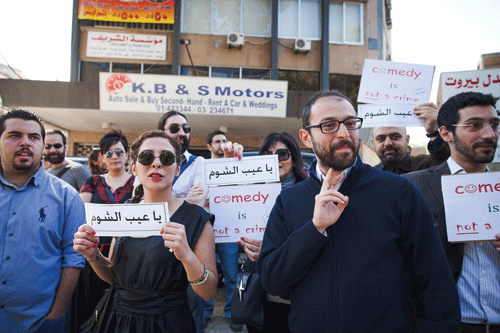
Following a recent string of arrests related to freedom of expression, last month actress Rawya el-Chab and comedian Edmund Hedded were in court to appeal a one-month sentence of imprisonment and a fine for committing “acts of offense against public morality”. Their crime: hosting a mock-auction of men at a pub in 2009 in order to raise money for the Brave Heart Foundation, which helps children with heart diseases. 

The General Prosecutor’s office dug deep through the Penal Code to find a way to invoke paragraphs two and three of Article 532 which cover, respectively, “words or screams that have been manifested by a person and heard by a party that has nothing to do with the act,” and “visuals presented in a public context or for a public or in exhibition or broadcasted or sold or distributed to one or more persons.” 

While Parliament’s library (yes, it does exist) is stacked with unapplied laws relating to the most basic functions of the state and serving the public — such as passing a budget, providing public services (electricity, water, telecoms) and ensuring human rights (among them the law against child abuse) — our justice system found the time to apply its energies and resources to exercise obscure laws to subdue free speech. 

But to think that the judiciary all of a sudden has the intent to weed out villainous threats to virtue and goodness would be a laughable assertion. Aside from the absurdity of a subjective concept such as ‘morality’ existing in a piece of law, an hour of local television will provide one with more than a dose of ‘immoral’ words and screams and the visuals to go with it, especially if one watched Parliament last month. Fortunately for them, our MPs can hide behind their legal immunity; we cannot.  And, as if there were not more pressing issues in the country, those who claim to defend freedom of expression — journalists from El Nashra and Annahar —provoked the judiciary by writing articles critical of the mock-auction. Indeed, the judge who sentenced the comic duo did so largely on the basis of these media articles. At the Appeals Court last month it was clear that the judge had no clue what the case was about and, worse still, after expelling the public from the courtroom, cross-examined the accused and the prosecutor, without allowing the defending lawyer to be heard; that will only happen on May 30. 

This is no laughing matter. If the General Prosecutor can convict someone for violating some backwards piece of legislation on the basis of an article, and without an investigation, then a harrowing precedent has already been set.  

Furthermore, what faith should the public have that the judiciary has any sense of ‘justice’ about it? Or that the laws passed by our government have as their intent any sort of proper governance?

What are meant to be the sacred words of our social covenant, also known as the constitution, have been defiled by the very people who are supposed to uphold them. We, the people, are not “sovereign, free, and independent,” the people are not “the source of authority and sovereignty,” the political system is not “established on the principle of separation, balance, and cooperation amongst the various branches of government.” Instead, imbeciles and their whims are given authority over our freedom of speech. 

If they wish to begin winning back the faith of the people they have so often betrayed rather than served, it is incumbent on our judiciary to see to it that these sentences are repealed, the charges dropped, and spare us their selective morality.         

May 3, 2012 0 comments
0 FacebookTwitterPinterestEmail
Comment

Hope of compromise in Iran

by Gareth Smith May 3, 2012
written by Gareth Smith

Talks between Iran and the leading world powers, including the United States, in mid-April have revived hopes of compromise on Tehran’s nuclear program. Essentially the two sides agreed that the basis for agreement would be the Nuclear Non-Proliferation treaty (NPT) and so respect Iran’s right to peaceful use of nuclear energy, with specialists preparing in advance for a second round of talks in Baghdad on May 23.

As I have written here before, the outlines of a potential agreement with Iran have knocked around for some years.  But an article by Dennis Ross, the pro-Israeli former Obama adviser, in the New York Times in February was telling in suggesting Washington would accept Iran enriching uranium, a “concession” that could enable Iran to claim victory with its “rights” acknowledged.

In a second article, Hossein Mousavian, the former Iranian security official at Princeton University, argued Tehran’s bottom line was “the ability to produce reliable civilian nuclear energy” as “entitled” under the NPT, while the US and European bottom line was “never having Iran develop nuclear weapons or a short-notice breakout capability.” 

Discussion in Washington over how to achieve its bottom line reflects the nature of nuclear technology. In broad terms, enriching uranium to low-level for civil use — to 3.5 to 20 percent — implies the ability to enrich to the higher level — 90 percent — required for a bomb. Broadly, you just keep the centrifuges spinning.

This is “break out”. A country can enrich uranium for civil purposes while developing missile delivery systems and so maneuver itself into a position where it can move relatively quickly towards making an atomic bomb.

Hence Mohammed ElBaradei, then head of the International Atomic Agency (IAEA), the UN body that monitors the NPT, said in 2004 that 35 to 40 states had the technology to make a bomb.

So why have the NPT? The first five states to possess nuclear weapons — the US, Russia, France, Great Britain and France — are among the 189 NPT signatories, but the only other states who subsequently developed weapons either left the NPT — North Korea — or were not signatories — Israel, Pakistan and India.

This suggests developing nuclear weapons within the NPT is far from easy, which is because signatories face IAEA monitoring, under article 3 of the NPT, to prevent “diversion of nuclear energy from peaceful uses.” 

The limits of basic monitoring under the NPT led to additional protocols (APs) with over 100 countries giving the IAEA more intrusive powers of inspection of declared and “possible undeclared” nuclear facilities. Iran agreed an AP in 2003, when it also suspended uranium enrichment as a goodwill gesture during talks with the European Union, but in 2006 announced it would resume enrichment and no longer apply the AP.

The US and allies are now demanding that Iran re-apply the AP, so building confidence it could not undetected divert enriched uranium into a weapons program. This could happen in one of three ways: by operating clandestine plants, by diverting nuclear material from declared facilities, or by leaving the NPT.

An enhanced AP — known as a ‘Model AP’ — could widen monitoring from enrichment facilities to mines and waste disposal, and so reduce both the danger of diversion from declared sites and the feeding of undeclared sites. It could even involve 24-hour access to sites not under inspection.

Clandestine activity is considered the most likely and most dangerous option by the Americans, given IAEA inspections are currently limited to declared facilities. Hence Washington’s interest in an extensive Model AP.

One option is WAES (wide-area environmental sampling) under which monitoring stations would be built through Iran to check air, water and sediments for unusual readings. This would amount to what one US report calls “expansion from monitoring individual facilities to monitoring the state as a whole”. 

The US considers the third danger — of Iran leaving the NPT, which any state may do under the treaty’s Article X on grounds of “supreme national interest” — the least likely. But even so, negotiators may want an Iranian commitment it would never do so.

There are certainly devils in the technical details. And there are also questions of political acceptability. Crucially, even if sanctions are lifted ‘step by step’ and Iran can unlock the real potential of its energy reserves, it remains to be seen how far the leadership in Tehran may go in accepting an inspection regime far beyond that agreed by any other country in the past.

May 3, 2012 0 comments
0 FacebookTwitterPinterestEmail
Society

Interview: Saad al-Barrak

by Thomas Schellen May 3, 2012
written by Thomas Schellen

The story of Arab telecommunications is rife with great achievements, rapid changes, sudden setbacks, and yet-to-be-realized potential. New technology, infrastructure and mass uptake have allowed the region’s information communications technology (ICT) sector to provide more exciting corporate tales than most other industries between Casablanca and Kuwait City could offer. The Arab ICT sector has also attracted some of the most enterprising and daring minds in corporate Arabia — among them is Saad al-Barrak. As the head of Kuwait’s MTC/Zain, Barrak led the telecom company from a purview over one small nation to a customer base of some 70 million customers and an intercontinental footprint. His narrative of how Zain became a marker in the history of Arab enterprise success is the subject of his first book, “A Passion for Adventure”. Barrak sat down with Executive for an exclusive interview to discuss his newly published work.   

The PR announcement of your book trumpets that Saad al-Barrak “transformed a moribund ex-state-owned Kuwaiti operator into the telecom giant Zain”. Do you see the story this way, as one person’s singlehanded triumph – yours?  

Nothing could be further [from the truth]. There is no one-man show. No, I think the issue was building a coalition and extending it to a whole organization composed of people who are believers and achievers at the same time, because believing is achieving. And that is how it happened; it was the Zain cult that achieved this transformation.

You wrote about your mother as being the ruler of the bayt (house), the interior life in the family and that she was very important for your evolution. How does this reverence for your mother as a person who manages the home correlate with the ability to manage a global company?

It correlates very well. It [describes] dedication, belief, and determination. For example my mother’s dedication to her family and to her children was insurmountable. Family is a unit and managing it is managing a group of people trying to achieve objectives. This is very much in line with managing [a company] where you are responsible for managing a certain group of people and achieve objectives. The sense of dedication and commitment and sacrifice and tenacity in pursuing your objectives are extremely interrelated.

You highlight the importance of achieving objectives, but in your book you took a jab at Peter Drucker’s management by objectives and said your way is management by love. Why?

That’s right. I think objectives are stationary or static and limited in that regard. We therefore should look at objectives as the floor and not as the ceiling. We also should look at them in an evolutionary way because objectives evolve. For example when we started our 3x3x3 [Zain growth strategy] we were talking about 30 million customers, which soon moved to 100 million as our objective. The issue is the direction and the way forward, thriving, growth, and so on. To thrive you need objectives as stepping-stones and not as the architecture itself.

You said that 90 percent of managers are stuck in a structural approach to management of the type introduced by 19th century economist Frederick Taylor. Do you see this high prevalence of focusing on management by task as opposed to relationship as something specific to the Middle East region?

No, I think it was an outcome of the industrial age. Mechanization was a historical stage. People were too loose and you needed quantification to measure and streamline advancement. That is needed and Taylor was definitely one of the greatest contributors to management who tried to take a step forward by bringing quantification and mechanization in a way that is conducive to better managing and progressing in your objectives. It is great as long as we look at it as a stage, but we must not forget the essence of management, which is the human side and the humanization of business. I say the emotional, spiritual side is the essence of management and leadership, not quantification.

The story of Zain as you were involved has a beginning and an end. In your book, did you conceal any regrets about how it ended?

Not at all. I am a warrior, not a worrier. If I finish one battle, I go to another battle. If I finish one war — and by that I mean peaceful war — I go to another one. I have no regrets in that regard. Of course, I look at regrets as learning episodes and not mourning episodes. I will have to employ this in the next episode of my life, but it is a journey and the achievements have already happened. We have achieved a great dream of taking a very small company from a very small country to be nearly a global company, highly international with massive achievements and 16,000 people working on it. The moments of happiness were 99 percent. I hope we will all enter our new stage in life, wherever we are and whatever direction we are taking, in a very positive and enticed way that should make us happier and make us better achievers and better global citizens.

In the sense that Zain’s role did not continue on the world stage and that the project regressed to a smaller level, is this not a point of regret?

It is not a matter of regret. It is a matter of being objective and pragmatic. We always strive to change it but we are not surprised or shocked to see that this limitation is there. It is sad if you go back to a smaller level, definitely. We wanted to be an example to the whole world and set an example for our region at the same time.

Seeing yourself as you say as cultural revolutionary, can you change the mindset of the Arab corporations?

That is the reason why I wrote this book. We wanted to document the great experience of the Zain story and reflect in it the new business and economic ideology that we are preaching and which is compliant and part and parcel of our universal, open philosophy — an all-encompassing philosophy considering the universe as our homeland and humanity as our tribe.

In your opinion, why are there not more globally known Kuwaiti entrepreneurs?

Kuwait is a very rich country and many Kuwaitis can make a lot by staying in Kuwait and around it. This did not really push them to be on the bigger platform. No incentive.

Do you want to play a role in Kuwaiti politics?

That is a very dangerous question. I also have a passion for politics as I have a passion for leadership. So far I am really enjoying the private sector and the space that the private sector gives you. Politics is very limiting to the space. I still can give and be very active and so [being in politics] could be extremely inhibiting to my soul. But later on, at the right moment and with the right combination of the leading change coalition, if the circumstances are conducive and if the country is ready to accept such a coalition to change it to a better country, I will not hesitate to be part of this.

Looking forward, you are talking about a company and other ventures. Where do we stand?

I have started a company called Ila, meaning forward or toward in Arabic. In this company we focus on two things. One is that we provide management expertise and strategic advisory for ventures in telecom and telecom-related IT. The other side of the business is investing in very small startups that are extremely promising.

So you take a financial stake in those companies?

We invest in each startup between $1 million and $5 million. Later on, we want to set up a fund of $300 million to invest in telecom-related IT, according to our philosophy of creating small startups that are very promising in value creation.

One of your statements is do not set out to make money, set out to make history and the money will follow. What is your net worth as result of practicing this maxim?

We made money for our company, for Zain. But it was on our expense, because it took all our efforts and the remuneration was not as commensurate as it should have been. We have no regrets in that regard. We are trying now to make good wealth out of this new venture, Ila. 

May 3, 2012 0 comments
0 FacebookTwitterPinterestEmail
Comment

Simmering discontent in Nahr el-Bared

by Josh Wood May 3, 2012
written by Josh Wood

It is five years to the month that the siege of Nahr El Bared began near Tripoli, and while the guns have gone silent, the potential for renewed conflict involving Lebanon’s Palestinian refugee camps looms ever as large. 

In conversations and interviews since with representatives from the different Palestinian factions in the camps — often in places where Kalashnikovs are stacked indiscreetly in the corner — the topic of Nahr El Bared has inevitably come up. The 2007 battle destroyed the camp, displaced tens of thousands and killed hundreds of Lebanese soldiers and mostly foreign Fatah Al Islam militants; it also represents for many Palestinians both their precarious position in Lebanon and the country’s careless disregard for their suffering.

To the south, in Lebanon’s largest refugee camp, Ain Al Helweh, the precarious security conditions that resulted in the Nahr El Bared fighting are mirrored in many ways. In Ain Al Helweh, the absence of proper governance, or even a single dominant armed faction or alliance, has allowed space for militant Jihadist organizations such as Usbat Al Ansar, Jund Al Sham and the Abdullah Azzam Brigades to establish themselves. Like Fatah Al Islam, such organizations operate with little regard for camp residents, the stability of the country or the few observed “rules of the game” that exist in relations between the Lebanese and mainstream Palestinian factions. 

The potential security threat these groups pose came up again in March when an Abdullah Azzam Brigades cell was discovered within the Lebanese army.  For the Lebanese government, trying to move security forces into the camp and arrest wanted extremists like Abdullah Azzam Brigades leader Tawfik Taha could risk another Nahr El Bared-type conflict. And yet, if nothing is done, the government facilitates the perpetuation of such groups and risks the increased likelihood of future confrontation. For mainstream Palestinian factions, who may not see eye-to-eye with the Lebanese government in general but also reject these fringe groups, moving against an organization such as the Abdullah Azzam Brigades risks sparking intra-Palestinian fighting within the camp. There are no easy solutions.

The Lebanese government has not, however, made any effective attempt to repair relations with mainstream Palestinians groups since the Nahr El Bared conflict. With the reconstruction still incomplete, mired in the contentions of politics and security and assailed by accusations of corruption, many Palestinians, already skeptical of the Lebanese state, have become even more suspicious of its intentions towards them. Relying primarily on donor funding for the rebuilding of the camp, the United Nations Relief and Works Agency, tasked with managing the reconstruction, seems hobbled by mismanagement, ineffectiveness and underfunding: it is still more than $180 million short of the funds it says it needs for the project, but with little headway made on the reconstruction, donors have been hesitant to pump more money in.

Declared a closed military zone, there is also a fear that Lebanese security forces will also attempt to maintain a presence in Nahr El Bared if the camp is ever rebuilt — a move that would be an unwelcomed precedent in Lebanon’s other camps. 

If the intent of the heavy-handed destruction at Nahr El Bared was meant to teach a lesson to the more mainstream Palestinian factions that hold sway in most of the camps and encourage them to disarm, it largely failed. Having lost another of their camps, many Palestinians see arms as the only way to guarantee their safety from the government or militant groups, and today the camps remain one of the few places in the country where weapons are openly flaunted and military positions are occupied during times of peace.

With the eyes of Lebanon following potential crises that seem to present a more immediate danger — such as the specter of a return to political assassinations and the possibility of the Syrian conflict spilling across the border — the problems brewing in the camps are allowed to fester unseen on the other side of Army checkpoints. To ignore and leave unaddressed the plight of Palestinians in Lebanon’s refugee camps, however, is to leave burning a fire which could easily flare out of control, yet again.

May 3, 2012 0 comments
0 FacebookTwitterPinterestEmail
Society

Firing up the frozen desert

by Nadim Mehanna May 3, 2012
written by Nadim Mehanna

As the last snow melts on Lebanon's mountain tops and with the ski season firmly over, ice racing is probably not the kind of driving experience you are gearing up for. But Lebanon's coldest winter in more than a decade certainly proved advantageous when our team went to the Arctic Circle for some extreme driving on ice, with Lebanon's mountain roads and abundant snowfall having provided a degree of preparation for extreme driving in minus twenty degrees Celsius. 

The ice circuit in Sweden's Lapland came about by chance some fifteen years ago, when a research team from Bosch accidentally arrived at a dot on the map called Arjeplog and found the perfect environment for testing equipment in sub-zero conditions. Bosch was soon joined by German car manufacturers for the same reason, creating replica racing tracks like Formula 1's Hockenheim, Indianapolis, the Euro Speedway and the Spa Francorchamps.

No brakes, all engine

So when Mercedes’ AMG asked us to stay at their Arjeplog lodge we leapt at the chance. After the plane touched down on the ice, the first stop was the garage: three lines of 15 E63 AMGs, C63 AMGs and the new SLK AMGs. Our group jumped into the E63 monsters with 525 horsepower and 700 Newton meters (Nm) of torque, to take us to an iced-over lake that, once out of the car, was so slippery we nearly ended up on our backsides.

The first firm order from instructor Bernd Schneider, five-time winner of the DTM (German touring car championship) and an ex-Formula 1 driver, was to “DSC OFF” — all electronic aids deactivated, so no guardian angels and just spiked tires to help stay on the “track.”

The first push on the accelerator delivered such a rush of torque that the spikes were unable to cope with it and the car went on a 80 degree drift. Running through bends at a 100 kilometers per hour there is some serious G-force at work that can only be countered by steering, throttling and never breaking. But despite the E63 AMG weighing in at two tons, the chassis was incredibly stable while the surgically precise throttle, the torque and the power made the AMG a cinch to drive in that icy wasteland. 

The next morning was spent roaring around the simulation race tracks, and in the afternoon the AMGs were fitted with on-board cameras with telemetry equipment for the competition to really begin. With a benchmark set by Schneider of 1.22.30, the AMGs set off one by one, with the teams keeping a watch out for cars that slid off into the snow banks on either side of the tracks. Any car requiring a tow from the G Class Mercedes cost the team a point, so there was a lot of snow spraying around as drivers tried to get back on the ice and team members puffed and panted to push the car out as best they could.

Drifting to win

After the race was over, telemetry analysis started with most recorded times 5 to 10 seconds slower than Schneider’s time. Then it was announced that the Lebanese team had collectively scored the fastest times, even slightly faster than Schneider's, although it must be said that he did not set his best time ever. Given the competition out on the ice, Schneider was surprised by the Lebanese effort, quipping: “You guys are really quick, where did you learn how to drive on snow in the desert?” Obviously, the remark was met with more than a few raised eyebrows. 

The last day was spent on faster tracks where drivers could really let the cars go full out, drifting at speeds of up 130 km per hour. It soon reached a point where drifting became almost second nature. While the AMGs were incredible out on the “rink,” we also drove the SLK 55 and C-Class 63 Coupe. The C63 Coupe was over powered for such conditions, and the SLK was the by far best on ice, being smaller and feeling like your were almost go-carting as the car drifted around the track.

Overall, a highly recommended trip, a total disconnection from everything and the ability to drive in a way you would never normally experience, even if you managed to get your car to the top of one of Faraya’s ski slopes.


May 3, 2012 0 comments
0 FacebookTwitterPinterestEmail
AdvertisingSpecial Report

Ad-vice from the top

by Executive Editors April 14, 2012
written by Executive Editors

“The problem is this [‘Arab Spring’] came in the wake of the remnants of financial struggle. The environment is not conducive to a high level of investments. Clients are maintaining their strategies rather than implementing aggressive ones.”

Roy Haddad, chairman of JWT MENA

“At times like the ones we are in today, tactical or immediate-result advertising becomes the main requirement. The pressure is definitely on creatives today to deliver immediate or short-term results. I can see that 2012 will be similar to 2011 and 2013 will also be similar in the way that everybody is looking for immediate results. The big ideas and big deliveries will not disappear but they will be less and less.”

Joseph Ghossoub, chairman and chief executive officer, Menacom Group

“We have come a long way in developing planning and doing campaigns that no longer address a single media but are integrated. Our creative people are now thinking in a broad spectrum way of thinking, rather than in the silos of the media disciplines.”

Ramzi Raad, group chairman and chief executive officer, TBWA Raad

“The agencies are being put under pressure and our margins are suffering because of the pressure, but at the end of the day you have to stand for something and if you stand for quality and a certain standard, you have to find a way or quit this business.”

Raja Trad, chief executive officer, Leo Burnett Group MENA

“Mobile, specifically in our markets, will take up more and more share of the digital spending. The opportunity to connect with people on a 24/7 platform will generate exponential growth, especially [since] we’re starting from such a low base.”

Tarek Miknas, chief executive officer, Promoseven Group

“With the apps model we finally have a way where people can pay one dollar for something. With a paid website you obviously want people to pay but more importantly you want some people to think it is so valuable that they are willing to pay for it.”

Jimmy Wales, Internet entrepreneur, founder, Wikipedia

“I would say 2011 was the year when companies significantly improved their online investments. Better infrastructure means more users in the GCC. North Africa and the Levant also show significant improvements in [online] usage, so ads [will] follow.” 

Ari Kesisoglu, Google regional director for MENA

Hussein Friejeh, commercial director, Yahoo Middle East:“The industry is dominated by 30 clients. Out of those 30, you have 10 who spend up to 10 percent of their ad budgets online. Once other clients get onboard, market will jump.”

Ajay Shrikhande, chief executive officer, DDB Gulf:“Perhaps one can compare the advertising industry awards with the air cargo industry awards, and how is the public excited with the air cargo industry awards?”

“We still have high hopes for Syria. It is a big market, a manufacturing market, and we believe that a lot of Syrian manufacturers and services providers will eventually grow into the region, including Iraq and Lebanon.”

Mark Daou, chief operating officer overseas, Rizkgroup Communications
April 14, 2012 0 comments
0 FacebookTwitterPinterestEmail
Feature

Syria rendez-vous with the rebellion

by Executive Editors April 14, 2012
written by Executive Editors

The deep, single boom announces a symphony of staccato gunfire, and the calm spring morning in Syria’s eastern mountains descends into chaos.

Two rag-tag groups of Syrian Army defectors, part of a loose umbrella group commonly known as the Free Syrian Army (FSA) have just detonated a gas canister full of explosives beneath a Syrian army tank which was patrolling outside their village. Having left their hilltop hideouts late the night before, the 11 rebel soldiers are now executing their hastily planned attack. Their payload delivered, the rebels fight their way home beneath airburst anti-personnel artillery and withering fire from the Syrian Army; of the three wounded that day one would later die.

Holed up in a small farm building on a cliff-top near the village of Janoudiyeh, this small group of defectors operating autonomously but in loose collaboration with similar groups in the area, is one of many such units striving to write the next page in the Syrian uprising. Saying they have learned from the mistakes of Homs, where the FSA was forced to make a “tactical withdrawal” after a month-long artillery bombardment, these fighters have taken to the hills, preferring quick surprise attacks over a protracted urban struggle.

But while they may maintain the element of surprise, supplies are scarce. This group relies on FSA comrades in a nearby village to keep them stocked up with food, but on a bad day lunch is foraged from the ground outside: cabbages, greens and spring onions.

A string of government assaults have recently driven the FSA from many of its strongholds, but the group’s fortunes may be on the rise. On Saturday, March 24, FSA chief Colonel Riad al-Asaad joined forces with a unit led by the most senior army deserter, General Mustafa al-Sheikh, to form a united military council.

The FSA needs to move beyond its fractious nature if it is to prove a substantive oppositional force. Foreign states with an interest in seeing the FSA succeed would then find it far easier to supply the weapons and support it with what it desperately needs.

“Given the weapons we have and what they have, we can’t do anything. Of course we don’t want outside interference but if things keep going the way they are then of course I hope that NATO would interfere,” said Lieutenant Mohammed el-Hajj. “Any kind of alliance…let Israel come into the country and it would be better than Bashar al-Assad… At least if they are bombing our children we would know it is not our brothers, cousins, our [own] army bombing us.”

April 14, 2012 0 comments
0 FacebookTwitterPinterestEmail
Consumer Society

For your information

by Executive Editors April 6, 2012
written by Executive Editors

Hello again, Mr. Moto

After 2011’s less robust showing in terms of new car sales — a major economic indicator of consumer confidence — automobiles are again flying off the lots. According to figures from the Association of Automobile Importers in Lebanon, which are compiled from car registration statistics, the sector has seen a 17.7 percent rise in the first two months of 2012, with 3,796 cars sold in the first two months of 2011 and 4,469 new passenger cars sold in the first two months of 2012. Again, Korean brand Kia was the big winner in these new statistics, selling 1,252 new cars,  against 938 in the same period last year. Korean models also took second place, with Hyundai selling 702 cars versus 538 in 2011. Third, fourth and fifth in the rankings were Japan’s Nissan, Japan’s Toyota, and rounding out the pack was the US brand Chevrolet.

The power of women

Of the CEO Middle East’s 2012 list of the 100 most powerful Arab women, 12 were Lebanese. The majority of Lebanese entries came from the entertainment sector, with Fairuz, Elissa, Nancy Ajram and Haifa Wehbe all making an appearance, at rankings 13, 41, 65 and 69 respectively. This trend to celebrate women’s roles in the ‘culture and society’ category was apparent across the list, with 43 out of the 100 overall listed being from this background. Other notable Lebanese entries include filmmaker and face of Johnnie Walker’s ‘Keep On Walking’ campaign in Lebanon 2012, Nadine Labaki (14), CEO of Treats Holding (Dunkin Donuts, Semsom) Christine Sfeir (15), and journalist and political analyst Maria Maalouf. The most powerful Arab woman was listed as the United Arab Emirates’ Minister of Foreign Trade, Sheikha Lubna al-Qasimi, for the second year in a row, ahead of Yemeni Nobel peace prize winner Tawakkul Karman in second place.

Organic food takes off

The well-established global trend toward organic foods will soon be reaching new heights, as Abu Dhabi-based carrier Etihad airways announces the introduction of organic produce to its in-flight menu, in exclusive partnership with Abu Dhabi Organics Farms. First class diners will find fresh organic food products on their plates, from eggs to vegetables to honey. Organic products are produced by sustainable farming practices and internationally certified, making them popular with discerning eaters. Etihad has plans to extend the provision of organic ingredients across all cabin classes in the future. The initiative comes after Etihad launched an on-board five-star restaurant service for First class last October, recruiting international chefs.

Superhero Con

The Middle East region’s first consumer convention devoted exclusively to pop culture, comic books and cult entertainment is being held this month, from April 20 to 21 in Dubai. Tickets for the Middle East Film and Comic Con (MEFCC) range from AED 55 ($14) for a day pass to AED 500 ($136) for a VIP festival pass.  The festival will feature blockbuster movie previews, gaming and competitions, workshops, panels and Q&As. To promote local talent, artists from all over the region are invited to set up stalls in ‘Artist Alley’ to promote or sell their collections. Areas covered by the MEFCC include science fiction, fantasy, manga, anime, animation, illustration and collectables.

The call of the camel

Demand is growing worldwide for camel milk products, according to Emirati chocolatiers Al Nassma. They launched their camel milk chocolate in August 2011, and it has just been announced that Al Ain Dairy, one of the biggest producers of dairy products in the UAE, will shortly be introducing camel milk ice cream flavored with dates, caramel, saffron and chocolate. The company plans to renovate its facilities at a cost of AED 10 million (nearly $2.7 million) in order to produce the range commercially, according to CEO Abdullah Saif al-Darmaki in UAE daily Gulf News. Camel milk is an essential part of the traditional Arab diet.  Research has shown  that the milk offers plenty of health benefits as well.Al Nasmaa chocolatiers — which also sells drinks like Camelcinos and Camelattes at its coffee shop in Mall of Emirates — is available in 60 outlets in Switzerland, as well as in Japan, Europe and the Gulf, where the product has proved extremely successful. Global expansion, however, is currently stalled by the EU, which is unlikely to give permission for the export of fresh camel milk until 2013. 

April 6, 2012 0 comments
0 FacebookTwitterPinterestEmail
Real estate

For your information

by Executive Editors April 6, 2012
written by Executive Editors

Hyperactivity around the Hippodrome

Solidere, the largest real estate developer in the country, and Minister of Culture Gaby Layoun are getting an earful of objection regarding a decision to dismantle ancient ruins once part of the Roman Hippodrome — to build a luxury residential development on a construction site in downtown Beirut. Layoun dismissed the decisions of three of his predecessors when he gave permission on March 15 for the destruction of the ancient ruins on the site to make way for development. For his part, he said the process would be respectful to archeological interests since it would involve dismantling and then recombining certain walls of the hippodrome to integrate them into the new structure. In response, the Association for the Protection of Lebanese Heritage called for a rally on March 24 near the site to voice their opposition to the destruction of the ancient ruins. The group’s Facebook page says the protest is “to protect the Phoenician port of Beirut, on plot 1398… and work for the reversal of the Ministry of Culture’s decision to allow the ‘integration’ of the Beirut Roman Hippodrome in Wadi Abou Jmil, into a development project, especially because the Hippodrome is on the list of culturally relevant monuments in Beirut.” Other politicians are taking a stance as well. A March 20 statement from the media office of Progressive Socialist Party leader Walid Joumblatt clarified his earlier published statements about the ordeal in Al Anbaa newspaper, placing full blame on Solidere rather than the Beirut Municipality, which is tasked with preserving archeological sites in collaboration with the General Directorate of Antiquities.  Former Culture Minister Tammam Salam urged Parliament on March 15 to reject the decision, calling it an “unacceptable crime” against the Lebanese, according to The Daily Star.

Fashionable arrival

While there are currently two “So by Sofitel” boutique hotels globally, the French hotel group, Sofitel, plans to expand that brand to 18 properties worldwide in the next five years, Sofitel CEO Robert Gaymer-Jones told Hotelier Middle East in a March 14 article. “Eventually we’ll have somewhere between 15 and 18 Sos operating around the world in the next five to seven years,” he said. “I’d love to bring it to Dubai, Cairo and other parts of the Middle East. We’re looking at an opportunity in Beirut.” The two existing properties are the original in Mauritius and a property in Bangkok, which featured the design collaboration of Kenzo Takada and Christian Lacroix, respectively. The Lifestyle-hotels heavily depend on a fashion-centered brand identity, where employee uniforms, bath robes and even toiletries like soap are designer products. Sofitel opened 9 more hotels in 2011 and its Bahrain property, Sofitel Bahrain Zallaq Thalassa Sea & Spa, contains the first thalassotherapy (therapy that uses seawater) in the Middle East. After three years of construction work, the company’s Egyptian property, the Sofitel Legend Old Cataract Aswan, reopened its doors in 2011.

Luxury incentives

Adding to the bevy of luxury hotels in downtown Beirut, a new five star hotel has been announced by the Investment Development Authority of Lebanon (IDAL), which gave the project owner, Sabah Barakat, a handy incentive package on March 16, according to Byblos Bank. Barakat, the general manager of Al Bashoura Company, will build a hotel that will hold 153 rooms, 62 suites and 35 apartments, costing $208 million to include retail area, a pool, and a conference room. Since the project will reportedly create 250 jobs and contribute to tourism, the 10-year incentive package will allow the owners to skip paying income tax for a decade while reducing construction fees by half. IDAL expects that close to $1 billion worth of projects will receive similar incentives in 2012.

Shop ‘til you drop

While the external work is already complete on what will be Lebanon’s largest shopping mall, Beirut City Center in Hazmieh, its Dubai-based developer, Majid Al Futtaim, announced that the $300 million development would be complete by early 2013. Originally, the mall, which will contain 200 stores within 60,000 square meters of retail space, was to be completed by this summer. MAF has developed 10 malls in the Arab region, including the United Arab Emirates, Egypt, Oman and Bahrain, and has two more under development in Fujairah, UAE and Cairo, in addition to its first mall development in Lebanon. In the fourth quarter 2011 report by Ramco Real Estate Advisors on the Lebanese real estate sector, it noted that Lebanon has a total of 240,000 square meters of gross leasable area (GLA) within six existing shopping malls and five shopping galleries, but that there is need for more malls outside the capital. There are four malls under construction, which will add another 130,000 square meters of GLA. These are Le Mall Dbayeh, the Landmark in downtown, Beirut City Center and the expansion of Beirut Souks on the North Side.

Investor–friendly rooms

While Saudi Arabia’s Mecca and Medina came in first and second place in a poll of hospitality performance among Arab cities, Beirut came in 16th place. A February 29 report in Arabian Business, based on data from Ernst & Young, showcased the best Arab cities for hotel investment, ranking them by hospitality performance based on occupancy and room rates from the year 2011. Beirut had an average hotel occupancy rate of 57 percent and an average room rate of $220, while the average room yield (the average revenue per room per night) was $126. The report indicated that less Arab visitors came to Lebanon because of political upheavals in the surrounding area. Mecca had an average occupancy rate of 73 percent in 2011, partly due to an increase in religious tourism.

Dubai, which saw an increase in tourists (and 78 percent occupancy rate) in 2011, came in 3rd, while Abu Dhabi ranked 9th place. By  January, however, Lebanon’s local hospitality industry had picked up. Hotel occupancy rose by 16 percent compared to January 2011, reaching 60 percent, and the average room rate increased 4 percent to $229 by the first month of this year, compared to January 2011, according to Ernst & Young. The room yield, which shot up 40.4 percent in comparison to January 2011, was the second highest rise in the region after Medina, where it was 114 percent.

Sales slow but values rise

According to figures from the General Directorate of Real Estate and Cadaster, the number of property transactions fell 1.2 percent in January compared to January last year, hitting 5,387 total transactions. It is important to note that this represents a fall of 44.9 percent compared to December 2011 figures. Ninety-seven  of the sales in January 2012 were to foreigners, showing a 12.8 percent rise in sales to foreigners compared to January 2011. The value of property sales, however, was up 17.4 percent in January 2012 compared to January 2011, reaching $562.1 million. Newly issued construction permits covered an area of 793,988 square meters in January 2012, up 5.81 percent compared to January 2011, while 61.63 percent of the area which received a construction permit is in Mount Lebanon, according to the Order of Engineers.

April 6, 2012 0 comments
0 FacebookTwitterPinterestEmail
Banking & Finance

Financial quotes of the month

by Executive Editors April 6, 2012
written by Executive Editors

“The idea that ‘drill, baby, drill’ can cure our jobs deficit is basically a joke.”

Paul Krugman, American economist, regarding former US vice presidential candidate Sarah Palin’s statement

“We call on banks to continue stimulating growth in their deposits, even at the expense of slowing growth in profits.”

Riad Salameh, Governor, Banque du Liban

“The Turkish lira now has a symbol, just like the US dollar, the euro and the yen.”

Recep Tayyip Erdogan, Turkish Prime Minister

“They [the Bahrainis] will pay if there is no race. The money is in the bank already. So we’re not going because we’re going to get paid. That has nothing to do with it.”

Bernie Ecclestone, the Formula One tycoon, defending his decision to go ahead with the Grand Prix in Bahrain in April

“We used to be the people of the Book. Now we became the people of the Facebook. Much better.”

Shimon Peres, Israeli President who recently opened a Facebook page

“The risks of turning away from Greece now are incalculable. No one can assess what consequences would arise for the German economy, on Italy, Spain, the Eurozone as a whole and finally for the whole world.”

Angela Merkel, German Chancellor

“I hope US companies would come. Even the US oil companies haven’t started coming back.”

Abdurrahim al-Keib, Libyan Prime Minister

“Britain seeks to protect Lebanon’s lucrative banking sector from sanctions against Syria, and we will do our utmost to safeguard its credibility.”

Tom Fletcher, British ambassador to Lebanon

“Over the last 12 months I have seen five different managing directors refer to their own clients as ‘muppets’.”

Greg Smith, ex-Goldman Sachs banker, in his resignation letter published in The New York Times

“We do realize that a 25 percent increase on the third salary bracket would not be realistic, but this is our legal right.”

Assad Khoury, head of Lebanon’s Association of Bank Employees

“We received a letter from Exxon on March 5 saying they are freezing the contract with the Kurds.”

Abdul Kareem Luaibi, Iraq’s oil minister after US oil company Exxon infuriated Baghdad by signing a contract with Kurdistan
April 6, 2012 0 comments
0 FacebookTwitterPinterestEmail
  • 1
  • …
  • 333
  • 334
  • 335
  • 336
  • 337
  • …
  • 686

Latest Cover

About us

Since its first edition emerged on the newsstands in 1999, Executive Magazine has been dedicated to providing its readers with the most up-to-date local and regional business news. Executive is a monthly business magazine that offers readers in-depth analyses on the Lebanese world of commerce, covering all the major sectors – from banking, finance, and insurance to technology, tourism, hospitality, media, and retail.

  • Donate
  • Our Purpose
  • Contact Us

Sign up for our newsletter

    • Facebook
    • Twitter
    • Instagram
    • Linkedin
    • Youtube
    Executive Magazine
    • ISSUES
      • Current Issue
      • Past issues
    • BUSINESS
    • ECONOMICS & POLICY
    • OPINION
    • SPECIAL REPORTS
    • EXECUTIVE TALKS
    • MOVEMENTS
      • Change the image
      • Cannes lions
      • Transparency & accountability
      • ECONOMIC ROADMAP
      • Say No to Corruption
      • The Lebanon media development initiative
      • LPSN Policy Asks
      • Advocating the preservation of deposits
    • JOIN US
      • Join our movement
      • Attend our events
      • Receive updates
      • Connect with us
    • DONATE