• Donate
  • Our Purpose
  • Contact Us
Executive Magazine
  • ISSUES
    • Current Issue
    • Past issues
  • BUSINESS
  • ECONOMICS & POLICY
  • OPINION
  • SPECIAL REPORTS
  • EXECUTIVE TALKS
  • MOVEMENTS
    • Change the image
    • Cannes lions
    • Transparency & accountability
    • ECONOMIC ROADMAP
    • Say No to Corruption
    • The Lebanon media development initiative
    • LPSN Policy Asks
    • Advocating the preservation of deposits
  • JOIN US
    • Join our movement
    • Attend our events
    • Receive updates
    • Connect with us
  • DONATE
Comment

Stored value in troubled times

by Jihad Yazigi March 3, 2012
written by Jihad Yazigi

The unrest gripping Syria may have created havoc on the economy, but there is one industry that has benefitted from the turmoil — the real estate sector.

Within days of the beginning of the protests last March, frantic construction activity began across most of the country’s informal areas. Syrians seized on a relaxation of strict construction rules and a general weakening of state control to rush and build in areas and lands normally out of their reach. The government, facing countrywide protests and with no appetite for causing further discontent by clamping down on small scale developers, kept its eyes closed.

One year later, there are up to half a million new housing units that are believed to have been built, leading to a temporary surge in the price of building materials and labor, and a change in the landscape of many suburban and rural areas. Although in the last few weeks construction activity has largely returned to normal, this temporary boom has shed light on the importance of the real estate sector in the Syrian economy and society.

In a region that, historically, has rarely been stable, that has seen countless invasions and that sits on the crossroads of several trading routes, the attractiveness of investments that can act as stores of value is great — and this obviously applies to real estate as it does with gold. Few Syrian men, for instance, can be considered to have succeeded in life — and for that matter can dream to marry — unless they own at the very least a residence. Thus, beyond its purely economic logic, investment in real estate has a social weight of its own. In recent years, several factors encouraged investment in the sector. They include excess liquidity held by Syrian expatriates and Gulf investors on the back of booming oil prices; limited other investment opportunities — because the Syrian business environment, comparatively to other countries in the region, remains very poor — and negative real interest rates; finally, supply bottlenecks in several segments of the market, including quality commercial properties and upscale housing properties, played a role. Thus, in the mid-2000s, several of the major regional developers, such as Majid Al Futtaim, Emaar and Qatari Diar, announced the launch of a variety of projects across the country, while local investors focused on smaller scale ventures.

In practice, however, only a handful of these landmark projects took off. Emaar’s Eighth Gate commercial development — which will host the Damascus Securities Exchange — located in the upscale Damascus suburb of Yaafour is the only one of significance that has moved ahead. Almost all the others remain burdened by endless bureaucratic and regulatory obstacles as well as legal disputes over land ownership. Indeed, beyond the traditional problems faced by all investors wishing to do business in Syria, many other hurdles hamper a proper expansion of the real estate industry. The lack of sufficient land and of proper zoning in many parts of the country, in particular in the densely populated urban centers, have led to a rise in informal housing, which represents today a staggering 40 percent of all housing units in the country, and to a lack of investment opportunities. Similarly, state control and administration over huge portions of land in city centers, for instance in the Central Business District of Damascus, have rendered any major commercial development in these areas almost impossible. Another impediment is the very low average rental yield of most properties across the country. It is not uncommon, for instance, for a mid-size residential property located in the center of Damascus and worth around $400,000 to be rented out at less than $10,000 per annum, or an average yield of 2.5 percent, very low not only by international standards but also by regional ones.

In the near term, the best hope for the sector lies, ironically, in the unrest gripping Syria. Indeed, nearing two months into 2012, the Syrian Pound lost 14 percent of its value compared to the US dollar — coming on top of a 34 percent decline last year — while the inflation rate has reached double digit levels. Both these factors encourage the role of the sector as a store of value. In the longer-term, however, the broader political dynamics will weigh in much more on the development of the real estate industry, and unless the current stalemate comes to an end quickly, real estate can only resist significant disinvestment, as is happening in the rest of the economy, for so long.

March 3, 2012 0 comments
0 FacebookTwitterPinterestEmail
Business

Avoiding the double-hit

by Iyad Hourani March 3, 2012
written by Iyad Hourani

After months of back-and-forth in cabinet over various wage hike proposals, Lebanese employers will finally face the inevitable. Wage Hike Decree (WHD) no. 7424 will have most employers opting for the “survival of the fittest” course in containing rising costs that could, otherwise, heavily impact their books.

The WHD will impose itself on companies’ income statements in two principal ways. The first is in the form of higher cash flows costs, from which there is no real escape. Employers may opt for cost-cutting strategies (such as cutting jobs, enforcing part-time work, putting expansion plans on hold, etc.) but at the end of the day, most companies will feel the impact. The second will appear in the form of higher non-cash accounting provisions within the income statements, such as the end-of-service indemnity provisions. Employers are fully aware that few fair measures for bypassing the higher cash flows exist; the question is can the same be said about the non-cash components, and the answer is yes. 

The aftermath

The recent WHD, effective February 1, raised the minimum wage to LL675,000, rescinding the 2008 cost of living increase of LL200,000. Moreover it imposes salary increases ranging between LL175,000 and LL299,000. 

This overall increase in workers’ wages is expected to have a major impact on company cash flows in 2012 and on their income statements: cash out-flows will increase as payrolls rise and consequently so will employers’ contributions to the National Social Security Fund (NSSF). Entities that mainly employ low-wage, low-skill workers will be significantly affected as their percentage increase in labor costs will be among the highest. As for their income statements, the financial hit will be a by-product of the increased provisions taken for the NSSF’s end of service indemnity (EOSI).

The NSSF’s EOSI branch is a mandatory program under which an employer pays contributions to the NSSF on behalf of its registered employees (the contribution being 8.5 percent of declared earnings, of which 0.5 percent goes to covering NSSF’s administrative expenses). At the time a worker cashes out his EOSI benefit, the employer may be liable to pay a settlement to the NSSF in the event that net paid contributions (8.0 percent), along with the interest credited, are insufficient to cover the EOSI amount. 

Employers typically keep, what is generally called an ‘EOSI provision’ to cover any possible future settlements payable to the NSSF. Under normal circumstances, this provision witnesses an annual growth due to a myriad of factors: the number of years served by employees, the evolution of declared earnings, worker movements, and so on. 

In addition to affecting employers’ total payroll, the latest WHD is expected to result in significantly higher EOSI provisions, which will further aggravate the impact on income statements in 2012.

Containing the adverse increase of the EOSI provision

Full implementation of International Accounting Standard no. 19 (IAS 19) — one of the International Financial Reporting Standards (IFRS) — can be seen as a readily available solution for employers wishing to mitigate part of the adverse impacts that will inevitably result from the WHD. In fact, fully complying with IAS 19 will likely cancel out most of (if not all) o the expected increase to the EOSI provision. 

Corporations in Lebanon are required to prepare their financial statements in accordance with the IFRS, including IAS 19. However, the majority of employers overlook certain aspects of this standard, in particular those pertaining to long-term, post-employment benefits. Indeed, an alternative accounting practice is commonly used in Lebanon and in the region to determine these provisions (including the EOSI provision); however the inherent inaccuracies of this practice overstate the fair level of such provisions by 20, 30 and sometimes as much as 50 percent. 

The commonly used method effectively calculates the EOSI provision based on the assumptions that the entity will terminate its operation on the balance sheet date and that all its workers will cash out their EOSI rights at that date, which is contrary to what is known as “going-concern”.  

Over the last few years, an increasing number of corporations started determining their provisions, pertaining to post-employment benefits (EOSI provision in particular), in accordance with IAS 19. These are typically multinational or large local companies from different industries. Moreover, several organizations have carried out an assessment of the financial impacts resulting from the potential implementation of IAS 19, since it is likely to be requested by auditors in the coming few years, though many have yet to actually apply the standard. 

IAS 19 in a nutshell

IAS 19 specifies the accounting methods and disclosure requirements for determining the employee benefits costs (cash & non-cash). In particular, it prescribes an adequate and objective approach for estimating employers’ obligations related to post-employment benefits by allocating the cost of such benefits in an orderly manner over the period where employees are expected to acquire them. 

And as such, through the use of actuarial techniques, the EOSI provision would be determined as the present value of accrued rights (at the balance sheet date) expected to be paid sometime in the future.

Company XYZ with 400 Employees

In an effort to elaborate on, and give a tangible sense to, the above, let’s take the case of a mock company (XYZ) which employs 400 workers in Lebanon. 

The line graph on the following page shows the declared earnings distribution (before and after the WHD), as well as the distribution of Years of Contribution to EOSI, for XYZ’s employee population as at February 2012.

The line chart and bar graph represent an EOSI provision based on the accounting method that is commonly used in Lebanon, as does the table. It clearly shows a 26 percent increase to this provision caused by the WHD. It also reveals that by implementing IAS 19, the level of EOSI provision drops back to around its initial level, which tells us that the current accounting method used by most Lebanese entities significantly overstates what would otherwise be the fair level of EOSI provisions; by 32 percent in the case of Company XYZ.

This fictive example also shows that generally, the pace of EOSI provision’s evolution is relatively slower under IAS 19 than under the accounting method commonly used in Lebanon.

Not a crisis

The passing of crises, political turmoil and government regulations, has taught many corporations that long term strategizing in the face of mounting costs is key to sustenance and survival. Lebanese employers should consider the applicability of all available solutions to their situation. 

Although the recent wage hike decree will inevitably strain companies’ finances, avoiding the double hit on their income statements in 2012 is possible if they heed the words of the late American poet Robert Lee Frost that “the best way out of a difficulty, is through it.”

March 3, 2012 0 comments
0 FacebookTwitterPinterestEmail
Comment

Aided innuendos

by Jonathan Wright March 3, 2012
written by Jonathan Wright

Sooner or later it was bound to come to post-Mubarak Egypt: the disagreement between Egyptians and Americans over whether and on what terms the United States should continue to give the Egyptian government more than $1.5 billion a year in military and economic aid. But few could have predicted the aid debate would rise over a relatively petty dispute regarding American-backed nongovernmental organizations (NGOs) that have been operating in Egypt for years, without licenses perhaps but with the full knowledge and tacit acceptance of the Egyptian authorities. 

The Egyptian judicial authorities are pressing ahead with plans to prosecute more than 40 foreign NGO workers, including Americans who have taken refuge in the US embassy in Cairo. American politicians have threatened to withhold or cut the aid permanently if the charges are not dropped and the Americans allowed to leave the country. The US State Department, more cautiously, says that failure to reach a solution will affect the administration’s ability to help Egypt economically. Even the $3.2 billion in International Monetary Fund assistance Egypt is seeking to support its current account could be at stake. 

So how did it get to this stage, especially when the prime rationale for US aid to Egypt, the 1979 peace treaty with Israel, is not in any serious danger? None of the explanations are fully satisfactory. 

Some speculate that the Supreme Council of the Armed Forces (SCAF), the group of generals who have been running Egypt for the past year, whipped up a xenophobic frenzy to enhance their patriotic credentials and discredit the hardcore revolutionaries who continue to call for their immediate departure. The generals have pledged to hand power to an elected civilian president by the end of June but their commitment to similar promises leaves room for doubt). Besides, they have no obvious interest in jeopardizing the $1.3 billion a year in U.S. military aid, which enables them to free up defense budget money to support their comfortable lifestyles. 

Others blame Planning and International Cooperation Minister Fayza Aboul Naga, the only cabinet minister to have survived from the Mubarak era, who touts that the revolution last year was an American conspiracy to weaken Egypt. Bizarrely, Aboul Naga would in that case be acting alone against the interests and in defiance of the wishes of the generals, although she is reputed to have retained her cabinet position because she has one or more influential patrons on the military council. Another theory is that mysterious relics of the Mubarak regime, trying to provoke conflict of any kind, have promoted the investigation of NGOs from within the system. That begs the question of why SCAF and the government cannot counteract the influence of such forces.

The dispute over the NGOs, which include the foreign-assistance affiliates of the two big American political parties, has revealed the internal Egyptian debate over how a democratically elected government should deal with Israel, and whether it should accept aid from the US at all. The Muslim Brotherhood, holding almost 50 percent of the seats in the recently elected parliament and bound to dominate the next government, is keeping its options open. If the US cuts the aid, Egypt would have to reconsider the peace treaty with Israel, a Brotherhood spokesman said. But the corollary of that is that if the aid continues the peace treaty is safe — some comfort for the US and Israel, for whom the peace treaty is central to their regional policy. That’s also very much in line with SCAF's thinking; Wikileaks documents show that the generals see the aid money as the price Washington pays for peace with Israel. 

American army generals also want the aid to continue; they value the right to fly warplanes over Egypt at will, preferential treatment for US warships passing the Suez Canal and the cozy relationship with their Egyptian counterparts. 

The best-placed candidates in Egyptian presidential elections in May are also happy to take American money, if the terms are right. Islamist candidate Abdel Moneim Aboul Fotouh, for example, dismissed the NGO dispute as hot air and political theater. “There’s no patriotic body that rejects financial support and cooperation with others in the interests of the country,” he said in an interview. 

So everyone may get their way except the Egyptian people who overwhelmingly favor ending the special, and sometimes humiliating, relationship with Washington.

March 3, 2012 0 comments
0 FacebookTwitterPinterestEmail
Comment

Anthony Shadid

by Nadim Houry March 3, 2012
written by Nadim Houry

Anthony made reporting look so easy. His writing was always fluid, transforming even the scariest of situations into the perfect setting for a good anecdote. I first met him in Tyre during the hot days of the July 2006 war when the Israeli air force was pounding southern Lebanon. Most journalists and NGO-types had gathered in one hotel in the city. It was hot, humid, and frankly a bit miserable. I was new to the journalists’ scene and it felt intimidating. Each evening, war photographers would trade stories on the day’s horrors dropping passing references to Grozny, Bosnia and Iraq.  

Anthony was different. Despite winning the Pulitzer Prize for his work on Iraq (he would go on to win a second one in 2010), he was approachable, modest and available to help others. He worked hard — was often the first out the door during that 2006 summer — but somehow never bragged about it. 

What set him apart was not just his beautiful prose or his attention to detail. It was his ability to get people to open up, to share with him intimate parts of their world. Iraqis, Tahrir square activists, southern Lebanese, Benghazi residents, all told him their stories, and he did a superb job relaying their fears, hopes and dreams. Steve Fainaru, a reporter who worked with him in Iraq was right when he called Anthony’s dispatches “poetry on deadline.” 

In an age of “embedded” journalists acting as scribes to invading armies, Anthony embedded himself in the societies he wrote about. He often reminded me of those mid-century anthropologists who spent months and sometimes years observing a society and striving to understand its unspoken rules. At his commemoration last month in Beirut, his brother said that even as a child, Anthony’s favorite past time on family vacations was to go discover. We should deem ourselves lucky that he shared his discoveries with us in writing.  

A few months ago, I met Anthony for coffee after he had returned from a particularly difficult and dangerous trip to Homs. He said it was one of the scariest trips he had ever made — a tall order for someone who had been shot in Ramallah and kidnapped in Libya. I teased him saying that with two Pulitzer prizes under his belt, maybe it was time to leave the running around the frontlines to others and write punditry. He smiled. He wanted to spend more time with his family, he said, but he loved reporting and there was so much going on in the region. That urge to go discover was still tugging at him.  

He died last month from an apparent asthma attack while trying to cross back to Turkey after reporting from northern Syria. Like so many great explorers before him, it was just one trip too many.

Anthony, you will be missed.

March 3, 2012 0 comments
0 FacebookTwitterPinterestEmail
Comment

Where outsiders fight

by Farea al-Muslimi March 3, 2012
written by Farea al-Muslimi

Pessimists think of Yemen as the new Afghanistan or Somalia, while the optimists’ tend to see it as the new Egypt, or better yet, Tunisia. Situated somewhere between the two, there is also an opinion of growing prominence that recognizes in the new Yemen an awful lot of Lebanon. Most notably, Yemen, like Lebanon, is a proxy field for the region’s hottest “cold war”, between the Middle East’s two titans of theocracy: The Kingdom of Saudi Arabia (KSA) and the Islamic Republic of Iran. This in itself is not new, but the new political landscape shaping Yemen has upped its significance for both sides.

Shortly after the Iranian revolution in 1979 the competition between KSA and Iran began in earnest for influence in, and over, Yemen. The regional rivals set about inciting strife between Yemen’s two main sects, Shafai Sunnis and Zaidi Shias, who had previously enjoyed a largely moderate and tolerant coexistence with each other.  

In the 1980s, Saudi Arabia began funding what they called “The Scientific Institutions” which taught their Sunni students an extremist and intolerant brand of Salafi Islam, in an effort to marginalize Zaidi influence in Yemen. Recently ousted President Ali Abdullah Saleh was also very adept at manipulating Saudi fears of Iranian influence to extract bundles of cash from the KSA’s monarchs, even to the point of empowering Iran’s allies in Yemen whenever the Saudi cash would wane. 

Sectarian tension was inflamed in the last decade through six wars — between 2004 and 2009 — in the Saada governorate between the Yemeni army and the Al Houthi group, led by Abdulmalik al-Houthi, a prominent Zaidi figure. Thought the causes of the conflicts were largely political, the sixth war had a massively negative impact on Zaidi-Shafai relations. KSA forces entered the affray on the side of the Yemeni army after several incidents along the border between Saudi troops and Houthi fighters. The Houthis called the Saudis invaders and the Saudis claimed Iran had manipulated the Houthis to instigate the border classes.  What is more, local and regional media expounded vitriol according to their allegiance to either KSA or Iran.

The government in Sanaa has long accused the Houthis of being Iranian-funded and armed; it has never produced any evidence of this. While it is undeniable that the Houthis have been well supported in Iranian media coverage Houthi spokesman Houhsi Muhamemd al-Emad denied in a recent interview with a Yemeni newspaper that Iranian support extended to financial assistance. He added that Saudi interference in Yemen should also be condemned. KSA has been paying monthly salaries to hundreds of Yemeni tribal sheikhs and other prominent figures via a “The Special Committee”, which the KSA itself formed, and which many Yemenis regard as simply a vehicle to buy loyalty. 

With the beginning of the Yemeni uprisings early 2011, the Houthis surprised all sides and joined the protests in the streets, peacefully standing side-by-side with their historical enemies: the Salafis and Muslim Brotherhood in Yemen. Such a move by the Houthis was considered pragmatic and welcomed by many other Yemenis, especially given the Houthis’ cache of arms. Within months, however, violence broke out anew between minority Wahhabi Salafis and Houthis in Saada, which by then was fully Houthi controlled, and more recently at the Dar Al Hadith religious school in Saada (among those set up by KSA in the 1980s). The violence has also spread to the neighboring Haja governorate.

Now, with Iranian influence taking a battering in Syria, the Yemeni arena looks more promising for them. Saudi Arabia’s influence in Yemen is also in retreat for two reasons: Firstly, Saudi Arabia has stuck by the old, traditional elites and political actors whose power at home has been rocked by the uprisings. Secondly, the Houthis and Iran are establishing partnerships with leftist and liberals who are wary of the power the Sunni Islamists will have in the country post-Saleh. These relationships have been publicized during the many conferences and workshops Iran has held with Yemeni actors inside and outside the country. 

Thus, while the proxy war between Iran and KSA in the Levant may seem to have swung toward the advantage of the latter, on the KSA’s own southern doorstep the “cold war” pendulum seems to be swinging the other way.

March 3, 2012 0 comments
0 FacebookTwitterPinterestEmail
Economics & Policy

The bribes between the bricks

by Zak Brophy March 3, 2012
written by Zak Brophy

"Of course, there is no bribery in Lebanon, there is no bribery in this office,” quipped the official at the finance ministry’s Directorate of Cadaster and Real Estate (DCRE), where property owners in Beirut register their deeds. The wry smile and wink before adding, “no seriously, we have no comment,” belied the accusations of endemic corruption among the laws and bureaucracy that fashion the nation’s construction sector. 

As the villages, towns and cities metamorphose to fashion the future residential, commercial and industrial face of Lebanon, exorbitant amounts of money are being made. The construction sector has grown immensely over the years and today comprises some 15 percent of the Lebanese economy, double what it did in 2003, with yearly volumes peaking at $9.5 billion in 2010. Deciding what is built, for whom it is built and where it is built has a profound impact on the country’s social, environmental and physical fabric, and is also clearly near the center of its economic heart — precisely why Executive, in this following report, offers a closer inspection of the charges of institutional corruption, political patronage and irresponsible practices plaguing Lebanese real estate.  

The letter of the law

Construction in Lebanon is regulated by a plethora of laws, with the first Urban Planning Code passed in 1962 stating that “integrating the master plan and guidelines for cities and villages within the comprehensive plan for territory arrangement is mandatory.” Whilst this legal development endeavored, with very limited success, to realize a grand strategy for the nation’s territory, a decree passed in 1983 further outlined an urban planning code to map and implement designs and systems for urban areas. Within this plan construction is managed by a system of building permits, which are governed by the official Building Code.  

Article 25 of the urban planning code stipulates: “The construction, conversion, restoration and renewal of buildings of different types, are subject to the provisions of the Building Code. The building permit may only be granted if the works planned to take place are in conformity with the rules specified in the Building Code.” 

Obtaining such a permit from the local municipality is the first hurdle any developer must cross once they have purchased their property. Gripes of corruption and bribery at this stage are commonplace. “Everyone has to go through the ‘proper channels’,” said a developer we will call ‘Hani’, as he spoke on condition of anonymity to protect his business. “Nobody gets away without paying. It is big money. On big projects you are talking tens of thousands of dollars.” The accusations of widespread bribery within the real estate and construction sector are supported by a poll conducted in 2002 by Beirut-based research firm Information International which showed that 28.6 percent of respondents paid bribes within the sector, even when they had fully abided by the law, and 42.5 percent said they had not met the legal requirements but paid bribes to complete a transaction.

The system under the table

The rationale behind paying is two-fold. Firstly, developers know that if they don’t grease the right palms their application could get passed from pillar to post within the bureaucracy, leaving their project to stall. “A law was passed that limited the time they could take to return your file. Which is two months at the latest, but it is never enforced because even after that time they can always find something that needs to be changed and then you will resubmit again and then another two months and so on,” said Hani. Time is money, he reasoned, and as there is no escaping the inevitable requests for bribes, it is a price worth paying.

The second motive to pay bribes is to secure a lower price on the building permit itself, which is linked to the average value of land in the area. Hani explained: “There is no fixed amount of money for a square meter in a street. It is between X and Y, and the range is very big. They say they will give you the higher rate so you pay them a little under the table and they charge the lower fee. This is a very common practice.” 

An engineer, who also insisted on speaking anonymously, reinforced this assertion saying, “This board [that appraises average street value] is the head of the municipality, the head of the engineering department and a third person. You bribe these people and you will receive a discount on this assessment” — something he said happens with “every single permit”.

Bilal Hamad is the president of the municipal council of Beirut and presides over this committee. He resolutely denies that there is any scope for corruption in the process. “No way [is there bribing]. This is completely wrong. We put the price on the land based on our estimate of that sector in which the land is, depending on the zoning,” he said. “We try to play it as logically as possible.” 

Hamad admits that the prices within different sectors are not available to the public and any final valuation from the committee is based on “market prices” — however notoriously variable they might be from one block to the next. 

Once a developer has run the bureaucratic gauntlet within their municipality and purchased a building permit they can move on with their construction. However, as the diggers are put to work and the concrete set in its mold, complaints of further underhanded practices persist. 

“A $4 million project would cost around $100,000 in bribes from start to finish from building permits, occupancy permits and then electricity and so on,” said Mona Halak, an architect and a member of the Association for Protecting Natural Sites and Old Buildings in Lebanon (APSAD). “Every single issue in construction has a department and every one has its cost. It’s an industry within the municipality.”

One man’s burden is another man’s gain, and there are offices of people who make a healthy living navigating the inner machinations of the bureaucracy, making sure the right papers are signed and the money-packed envelopes placed in the right drawers. 

“I have someone who knows all the people and I pay them to go and do it for me,” said Hani. “This is very common. There are offices specifically for this purpose. I’ll be paying those offices around five to ten thousand dollars [per project] for this service.” 

When asked whether bribery and corruption with regards to construction were common practice within the Beirut municipality, Hamad said he would not comment on the specifics because, he claimed, the responsibility lay within the concerned departments of the municipality and he was not privy to the details. 

“I come from a world of ethics and I am trying to do as much as possible to raise the level of ethical awareness in the municipality,” said Hamad. “We are trying to review the structure to reduce the time between application for the permit and the issuance, and also any possible violation of laws and regulations.” 

When challenged on whether there were any specific policies or oversight mechanisms being employed, he declined to comment.

As the construction phase on a building nears completion and the cranes come to rest the developer has to reenter the bureaucratic melee, but this time at a department within the ministry of finance. To obtain the property deeds the final construction has to be appraised at the DCRE’s Afraaz inshaat, roughly translated as the ‘building registry’, upon which one percent will be paid on the total value. With the deeds in hand the developer can sell the building or apartments within it, but with a sale comes a transfer of title, which carries a cost of 5.25 percent. So once again there is an appraisal and once again the developers will pay bribes to get a favorable price.  

“The government is screwed here,” said Hani. “Lets say you buy an apartment for $1 million and pay 5.25 percent — you are paying $52,000; if you register it for $600,000 you are paying $31,500. So the government gets around half of what it should get. As for the person registering it, they take a healthy cut. How much? It depends, there really is no science in that calculation.” Officials at the registry refused to comment on the accusation.

The developers’ law

Assem Salam, former president of the Order of Architects and Engineers, lamented the failings of the state in managing urban development: “All of these permits are to the law but the problem is that the law and all the regulations are wrong, because these laws were outlined not in the interest of the community, not after a study of the socio-economic areas, not after a study of the welfare of the communities, but they are a result of the pressure from landowners and speculators for the maximum coefficient of land use irrespective of the damage it creates on the community.”  

On June 20, 2009, decree 2366 was passed in which the government adopted a comprehensive plan for development in Lebanon, albeit with a delayed implementation of four years. The fact that there is no ministry of planning, or any other body which coordinates between ministries, lends credence to Salam’s assertion that the laws and the governing institutions are kept purposefully weak so as to allow the property developers and speculators free rein. 

“The Building Code is constantly being changed in favor of the developers because it is really controlled by… the main developers who are the ones who determine what is in this law,” said Architect Mona Halak. “They have a committee where they come together and meet and decide what needs changing to accommodate what they need in the coming years. It is a secret club, but everybody knows about it.” 

She cited a recent amendment whereby areas such as lifts, stairwells and secondary walls were taken out of the calculations measuring the construction area, thereby increasing the potential exploitation factor (how much floor space can be built on any piece of land) on buildings by up to 30 percent. That is to say a building that would have previously been permitted to have 5,000 square meters (sqm) could be increased to 8,000 sqm.    

“There is no urban planning policy in this country,” said Muhammad Fawaz, the former director general of urban planning. “There is talk of urban planning but there is no actual implementation on the ground… The government has no role in the speculation that happens. There are no property policies. They have no desire to interfere in this sector.” 

The octogenarian still writes and campaigns on this issue and at his office in southern Beirut he brandished the most recent building law passed in December 2004. “This was made by the developers… this is their law,” he said.

Salam claimed the “devilish arrangement between the Council of Ministers [Lebanon’s Cabinet], the politicians and the speculators,” is enabled by the fact that the responsibility for the establishment of land use and urban plans does not lie with the municipalities, but ultimately with the Council of Ministers, which, “is a political body subject to political desiderates, and to influence by the speculators on a higher level.”

Architect Halak explained that even within these laws, corners can, and regularly are, cut due to both professional incompetence and legal loopholes. For example, every tower that is built requires a traffic impact assessment to see how the increased car load from the development will affect the local infrastructure and road network.

“People buy traffic impact studies, they are just photocopied because no one really reads them,” she said. “They don’t care what is in the report; they just want to see it is there.” 

This flagrant disregard for the sound development of Lebanon’s shared urban areas may be disconcerting, but when the same practice is done with the soil reports the implications have the potential to be far more serious, or even fatal in the event of building collapse. Halak maintains that these documents, which say whether the soil in a certain plot can support a particular structure, are similarly bought as slightly doctored copies of recent reports. Policing these and similarly shady building practices is the responsibility of the Internal Security Forces [ISF], tasked with monitoring the implementation of the building permits. Considering that the ISF regularly fails to even direct traffic properly, it can be of no surprise that they have little inclination or capability to monitor technical building practices. 

View from the street

Construction is about more than just steel and concrete — it is about creating the spaces where people live. Proper regulations and their implementation ought to ensure that this development leaves people with places they can afford to live in, is sustainable with the natural environment and contributes to the physical and social wellbeing within the communities we all share. What the corruption endemic in Lebanon’s real estate sector does is erode all of those things, lowering the quality of life for those who reside in this country.

Indeed, we would do well to take heed of a quote from a bygone era: “First we shape our buildings and then they shape us.”

This article is part of a ongoing series covering corruption in different sectors carried out with the support of the Lebanese Transparency Association.

March 3, 2012 0 comments
0 FacebookTwitterPinterestEmail
Finance

Prying open privacy

by Joe Dyke March 3, 2012
written by Joe Dyke

Financial wherewithal was not a quality Lebanese poet Khalil Gibran naturally inherited; his father was a gambling addict who was imprisoned for embezzlement. But given his penchant for priceless wisdom, perhaps the Lebanese banking system would be sage to heed of one of Gibran’s most famous sayings: “If you reveal your secrets to the wind you should not blame the wind for revealing them to the trees.” 

Lebanon’s financial sector has long relied on the country’s banking secrecy laws, some of the toughest in the Middle East, and the country has, for decades, encouraged the powerful and affluent from across the region to use it as a safe house for capital. Yet, despite Gibran’s warning, word has gotten out and awoken some altogether more powerful beasts, with Western countries claiming Lebanon’s secrecy laws help their citizens avoid tax. Recent events, both in Lebanon and internationally, suggest those countries will look the other way no more and Lebanon’s secretive system is under threat.

Near the beginning of 2011 it emerged that the United States Department of the Treasury had designated Lebanese Canadian Bank as a money laundering concern, claiming it was acting as a washing machine for Hezbollah cash. To prevent a catastrophic collapse in confidence in the sector, Bank du Liban (BDL), Lebanon’s central bank, intervened, eventually facilitating LCB — minus the suspect accounts — being bought out by Société Générale de Banque au Liban. The LCB crisis proved seminal for the industry, with a December article in The New York Times alleging pervasive cooperation between LCB and Hezbollah in laundering money, bringing the crisis back into the international consciousness.

While the banking sector tried hard to regain confidence some of the mud stuck, and it has struggled to regain its international reputation. A compliance officer of a major Lebanese bank, talking on condition of anonymity because he was not officially permitted to speak to the press, admitted it signalled change in the industry.

“After the LCB it has become much more important for banks to have the backing of the international community. It has made all the Lebanese banks more concerned,” he said.

Fighting the FATCA

The crisis in confidence comes amid increasingly tough attitudes towards banking secrecy globally. In particular, the US has indicated that it going to go tough on those countries that act as havens for tax avoidance through the new Foreign Account Tax Compliance Act (FATCA).

Under the law, which comes into force in July 2013, non-US banking institutions will have to provide transaction details of all customers with American citizenship and a balance of more than $50,000 in their accounts, to the US Internal Revenue Service (IRS) annually. If they fail to do so they will have to pay 30 percent of the interest, dividend and investment payments due to those clients to the IRS. More worryingly for the banks, they could be deemed ‘non-compliant,’ making it difficult for US institutions to continue working with them, or for them to continue to trade in dollars — the same issue that saw the closure of LCB. 

The compliance officer, however, admits that there may still be loopholes. If a client, for example, spreads his money between banks he can avoid hitting the limit. “If you have $45,000 in our bank and $45,000 in five others it is not reportable,” he said.

Camille Barkho, manager of money laundering advice firm Amerab Business Solutions, explains that the law transforms the role of banks, particularly in a secretive financial system like Lebanon. “Let’s say I am a Lebanese-American, at any time my account hits the threshold the banks I work with are obliged every January to report directly to the IRS every transaction I have made,” he says. “FATCA changes the rules so that foreign banks have to take part in identifying US citizens, assessing who is eligible to be investigated and reporting it to the IRS.”

This is clearly incompatible with the banking secrecy rules in the country, based around the 1956 law which was amended in 2001 in the form of Law 318. Within that legal framework banking secrecy can only be terminated in a small number of circumstances, including if a client files for bankruptcy, becomes subject to legal proceedings or dies.

For this reason the Lebanese central bank initially sought to preserve banking secrecy by urging banks to just pay the fees on their clients accounts to the IRS.  

“Our recommendation to the banks is going to be to go for the 30 percent option because the other option is legally difficult,” he said. “It would involve the IRS auditing their banks, which is not in line with Lebanese laws and would also create much litigation, which, reputation wise, is not recommendable.”

However it appears attitudes have softened in the past year, with banks coming to the conclusion that they can no longer fight the tide of pressure from the US Treasury. Asked if his bank would abide by the FATCA law, the compliance officer said: “We are forced to. We live in a world where the US is the dominant force and the dollar is the global currency, we can’t just ignore that.”

He admitted that this could mean an end to banking secrecy, for Americans at least.

Outside the law?

However, the current legal framework in Lebanon may prevent banks from complying with FATCA even if they want to. Lebanese anti-money laundering legislation revolves around Law 318, which explicitly does not mention tax avoidance. The most common way to lift banking secrecy currently is through raising suspicion under Law 318; therefore, for the banks to supply the IRS with the information without a waiver from the customer could be a breach of the law.

Barkhro says he believes that for any Lebanese institution to comply with FATCA it would require Law 318 to be amended to include tax avoidance. Paul Morcos, founder of the law firm, Justicia Beirut Consult, and an adviser who works closely with the BDL, is less certain but said that an amendment has been discussed by the central bank. The BDL did not respond to repeated requests for confirmation.

But if reforms are needed, perhaps somebody should tell the parliamentarians. The head of the parliamentary finance and budget committee, Member of Parliament Ibrahim Kanaan, admitted he was not familiar with the intricacies of the FATCA law and said he hoped the BDL could deal with the issue without needing to change the law.

“Money laundering is an issue that is of concern to us and the central bank and the government,” he said. “It should be dealt with by different measures but these measures could be decisions taken, initiatives to control the cash flow, to try to see any way regulations could be more effective. I don’t know if it needs an amendment to the law.”

The downside of any such change to the law would be the effect it could have on remittances. In February, the World Bank estimated that money sent from the Diaspora had remained constant at around $7.6 billion in 2011, despite overall financial inflows falling 18 percent. In an economy with a gross domestic product of around $40 billion, that equates to around 20 percent of the country’s economy.

Adding tax evasion in foreign countries to the items recognized under Law 318 would mean that all remittances would have to have been taxed before they entered the country. If, for example, a dual British-Lebanese citizen brings money into Lebanon without paying tax in the UK and puts it in a Lebanese bank, currently there is no legislation under which he can be prosecuted. If the amendment were passed then these accounts would be open to scrutiny under Law 318, not just for Americans but all remittances.

“You have diaspora who transfer their money to Lebanon and the source of money might be considered tax evasion in American law, especially in the US where they have to pay high taxation rates,” said Morcos. “It is not in the interests of the Lebanese economy to classify tax evasion as a money laundering crime. It could prevent Lebanon from benefiting from huge amounts of transfers coming from abroad; it would have a very negative effect.”

According to Byblos Bank, at least 45 percent of households in Lebanon have at least one family member abroad who sends home some form of remittance. Some send more than others, but Nassib Ghobril, head of research and analysis at the bank, estimated that on average Lebanese emigrants are worth about $1,400 per capita every year to their home country.

The compliance manager admits that the changes would “certainly” have negative consequence for trade: “It is going to affect the business but it’s is not easy to know the full impact yet.” 

These difficulties with estimating the effect are even more pronounced as the $7.6 billion does not include the remittances that are brought into the country in cash. According to Morcos, Barkho and the compliance officer, if Lebanon wanted to comply with FATCA and change its laws accordingly, effectively cash deposits would have to be justified by the depositor to see if they are taxable — thus ending the days of ‘no questions’ over where cash comes from, and the consequent attractiveness of the Lebanese banking sector.  

The government and the banking sector are caught in a bind. If they carry out the reforms, they risk undercutting the remittances that keep the economy alive, if they fail to do so, they risk irking the international community and undermining confidence in the sector.

The Secretary-General of the Association of Banks in Lebanon (ABL) Makram Sader admits they are concerned about the effect FATCA could have on the sector, but denies that Lebanon's secretive system is more susceptible than any other country’s. “We are as concerned as any other bank in Asia, Europe or emerging [economies],” he said. 

The third way?

Karlheinz Moll, founder of the German firm SPIROCO Consulting, which focuses on FATCA, equates Lebanon’s two potential paths to being a choice between the two tax-havens of Switzerland and Singapore. Switzerland has announced concessions to its banking secrecy laws in recent years in an attempt to tame the anger of the international community, while Singapore has remained hostile to any reform of its banking system.

“Switzerland is in very strong dialogue with the US Treasury and the IRS and I expect they will reach an agreement [on FATCA] at some point, whereas Singapore is not yet actively approaching them,” he says.

There may yet be a way to square the circle. The most recent draft of the FATCA law, released in early February, contained a surprise for many bankers. Previously the assumption had been that the only agreements that would be signed were between the IRS and individual banks. However, the new draft contained a direct agreement with five European countries: France, Germany, Italy, Spain and Britain. The deal commits both sides to helping each other target tax evasion, but requires the US to work with these states to find their tax-dodging nationals in the US as well. 

Given that Lebanon does not have any sort of global income tax, however, the country may not have equal bargaining power with the IRS, though Moll believes that if Lebanon approaches the IRS with other countries in the region, it could achieve a similar agreement. 

“They will have to go to the IRS to get a deal. This is what the European governments are doing: they are going government to government,” he said. “Everyone in the region should sit together and say ‘let’s write to the IRS and enter a bilateral agreement that banks don’t need a contract and full disclosure, but we will supply you with some information’.”

Moll also pointed out that the Organization for Economic Cooperation and Development-led initiative TRACE aims to make information exchange agreements the standard method of fighting tax evasion, and thinks Lebanon could benefit from this: “You can get a special agreement but you have to approach the IRS. You have to go to them as they are not going to come to you.” Executive queried BDL officials regarding whether they were considering such agreements, but they failed to comment.

If such a deal is not stuck, the omens are not good. Without the correct planning the Lebanese banking system faces an unenviable choice: between opening up and potentially scaring away remittances that fuel the economy, or staying secretive but risking American censure. Whatever changes the government makes, the decision will be weighty, and the financial sector and remittances are too important to the economy to get it wrong.

March 3, 2012 0 comments
0 FacebookTwitterPinterestEmail
Finance

Lebanese capital markets

by Marwan Mikhael March 3, 2012
written by Marwan Mikhael
The healthy financial results released by top Lebanese banks at the end of January 2012 offset investors’ worries over the regional security situation and its implications on Lebanon. Hence, the BLOM Stock index (BSI), Lebanon’s equity gauge, moved in whipsaws between a lower band of 1,163 and its highest band of 1,184 points before ending the five-week period in green. The BSI rose 1 percent to settle at 1,183 points, widening its year-to-date performance to 0.57 percent.

 Trading activity on the Beirut Stock Exchange (BSE) was subdued between January 16 and February 17, as the daily average volume of trades per month decreased to 196,470 shares worth $1.45 million, as opposed to 237,574 stocks valued $1.42 million recorded in the preceding four-week period. On a regional comparative scale, the Lebanese equity benchmark index underperformed the S&P Pan Arab Composite Large Mid Cap index that rose 5.7 percent from its previous close on January 13. Moreover, the BSI failed to outperform the MSCI Emerging market index that grew 5.8 percent to 1,049 points. 

With respect to stock activity, the financial sector grasped the lion’s share of trades on the BSE accounting for 71 percent of the total value traded while real estate stocks represented the remaining 29 percent. The BLOM Bank GDR stock rallied during the past five-week period, rising 5.2 percent to $7.68. On the other hand, Audi stocks witnessed a mixed performance as its GDR and listed stocks advanced by a respective 6.5 percent and 5.2 percent to $6.35 and $6.01, while its preferred stock class “E” slightly fell by 0.1 percent to $100.4. Byblos stocks closed all in green; its common stock advanced by 1.86 percent to a two-week high of $1.64 whereas its preferred stocks 2008 and 2009 rose by 0.49 percent each to align at $102. It is worth highlighting that the top three banks in Lebanon, Audi, BLOM and Byblos, reported a respective net profit of $364 million, $331 million and $179 million for the year 2011. 

On the other side, Bank of Beirut and BEMO common stocks retreated by 0.52 percent and 6.4 percent to settle at $19.3 and $2.2 respectively. BLC Bank listed during last week of January 400,000 new Class A preferred shares and 550,000 Class B preferred shares on the BSE.
 
Lebanese Eurobond prices remained high and stable with limited offers during the past five weeks as investors waited for the new possible swap for the bonds maturing in 2012. The BLOM Bond Index (BBI) remained almost flat, adding a slight 0.1% from its previous close on January 13 to hit a level of 111.1 points. This cut the portfolio’s weighted effective yield by 8 basis points (bps) to 4.70% and the spread against the US benchmark yield by 11bps to 396bps. Five-year issues of Lebanon’s credit default swaps (a proxy for a country’s default risk) stood at 480-500bps compared to 465-495bps on January 13. On a comparative scale, Saudi Arabia and Dubai credit default swaps reached 132-141bps and 398-411bps respectively.
March 3, 2012 0 comments
0 FacebookTwitterPinterestEmail
Real Estate

A skyline of skeleton towers

by Peter Speetjens March 3, 2012
written by Peter Speetjens

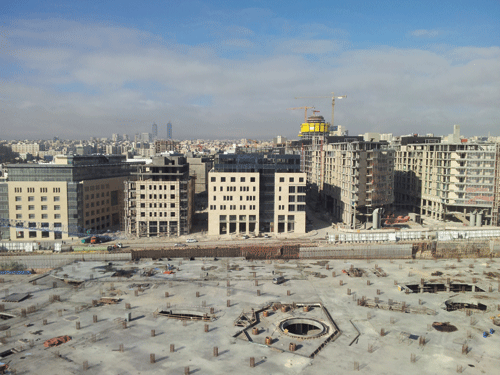
Reflecting the blue skies above, the Jordan Gate towers are the tallest — and arguably the emptiest — buildings on the Amman horizon. King Abdullah II in 2005 laid the foundation stone for the prestigious project, which was said to become the business address in the Hashemite Kingdom. Since 2009 however, the two giant cranes standing next to the towers have remained idle. The top floors have never been built and part of the glass exterior has come off. Today, the $300 million project remains a grim reminder of the days when the sky seemed the limit for Amman real estate.

The Jordan Gate was an initiative of the Gulf Finance House (GFH), a Bahrain-based investment firm badly hit by the 2008 financial crisis. GFH needed a $300 million loan to stay afloat and in 2010 escaped default only by agreeing to postpone the final repayment of $100 million. According to a prominent Jordanian contractor, who wished to remain anonymous due to fears public comments could jeopardize his business, GFH was not able to pay Al Hamad Contracting (AHC); instead, it offered the Sharjah-based firm the unfinished towers. Executive asked GFH and AHC to comment, but both declined.

“What happened is simple: the bubble burst,” said Wael Jaabari, owner of the large Jordanian real estate agency Abdoun Real Estate. “The developers had a business plan based on selling office space for some $4500 per square meter (sqm), which was, perhaps, feasible before the 2008 credit crunch. Yet they better get used to the new reality and swallow their losses. Maybe they can still rent out part of the building.”

“Compared to the peak prices of early 2008, prices in west Amman, depending on a property’s location and quality, have decreased by some 25 to 60 percent, while prices in the outskirts have decreased by some 80 percent,” said Jaabari. As an example, he refers to his office in Abdoun, a prime location, which he bought in 2010 for $1,200 per sqm, while a few years back people were paying up to $3,000. 

And yet the Jordan Department of Lands and Surveys (DLS) last January reported that the real estate market grew by 8 percent in 2011 to amount to nearly $9.8 billion, following a 25 percent increase in 2010. Hopeful signs of recovery, although the increase follows upon a decline of more than 30 percent in 2009 alone. When compared to 2007, the 2011 market is only 14 percent larger.

There are other reasons to treat the DLS statistics with care. “One government measure to boost trading was to abolish the real estate registration fee of some 10 percent,” said economist Yusuf Mansur, chief executive officer and owner of Jordanian consulting firm EnConsult. “Today, a government employee estimates the value of a property or land, which is generally higher than what the contract states. What’s more, the sales of a small number of commercially viable plots of land boost and obscure the overall picture.”

Boom & Burst

The reasons behind Jordan’s real estate boom prior to the crisis are well known. The 2003 United States-led invasion of Iraq forced many Iraqis to flee to Jordan. Some arrived, quite literally, with suitcases full of money, which they used to buy homes in Amman’s affluent western section. Price increases of up to 400 percent were recorded and real estate trading increased by a whopping 74 percent and 48 percent in 2004 and 2005, respectively.  The Amman market was awash with cash and seemingly everyone wanted a piece of the pie, including many foreign investors. An ABC Investments report states that 1,247 new construction companies were established between 2004 and 2008, of which 339 companies were established in 2008 alone. 

Today, the days of plenty seem long gone indeed, if only for the fact that loans are not as easy to come by. The Central Bank has imposed a strict ceiling of 20 percent of customer deposits on the amount of facilities granted by banks to the real estate and construction sector. “Banks are less lenient regarding real estate loans,” said Jaabari. “For a while, they permitted firms to postpone payments. Pay a bit now, a bit later. Now they just want their money. As a consequence, we no longer have pinball property development. No more building to speculate and sell; it’s a buyer’s market.”

The Jordan Gate project was not the bubble’s only victim. The GFH initially also intended to build the $800 million Royal Village — a project that never saw the light of day. The same is true for The Living Wall, a project that is anything but alive. An enormous billboard still reminds Amman of the six luxury towers and Buddha Bar that were set to arise. In 2006, the project was even named Best Future Commercial Project at Cityscape Dubai. Today it remains a huge hole in the ground. 

The Living Wall was the brain child of Mawared, a state-owned developer with close ties to the military, which has been tainted by a series of corruption scandals. Its former CEO, Akram Abu Hamdan, has been detained for allegedly pocketing millions of dollars.

Dubai World’s Limitless Towers did not even dig a hole. A massive marketing campaign prior to the crisis stressed the towers’ height: at 200 meters they would dwarf even the Jordan Gate, while the suspended swimming pool, at 125 meters, would be the world’s highest — would being the operative word, as the $300 million project was never even started.

Another failure concerns the $1 billion Saraya Aqaba resort. Construction started in 2006, yet has been stalled since 2008. Saraya Holdings, largely owned by former Lebanese Prime Minister Saad Hariri, also planned to build a $700 million Dead Sea resort. Announced with much fanfare at the 2007 World Economic Forum, construction never started. The same is true for the company’s regional projects. Small wonder therefore that the Saraya Holdings headquarter, which Hariri planned to build at his brother Bahaa’s Abdali Project, has been stalled as well [see box].

Abdali stays Afloat 

“The Abdali Project was not spared the effects of the global financial crisis like so many other large, mixed use developments,” said Salim Majzoub, deputy CEO of Abdali Investment and Development. “Since the start of the crisis, not a single investor has pulled out; however, construction work on some of the projects was halted for a period of time. Currently, some 15 percent of the developments in ‘phase one’ are on hold.”

With an estimated cost of $3 billion, the first phase of the Abdali Project foresees, among other elements, the construction of 12 mixed-use buildings and a shopping boulevard and mall, which are the heart of the 1.7 million sqm regeneration development in central Amman. The project is a joint venture between Jordan’s Mawared and Horizon, a Lebanese property developing firm established in 2002 by Bahaa Hariri. Both Mawared and Bahaa Hariri own 44 percent; the remainder is in the hands of Kuwait Projects Co.

If a tree falls in the forest…

As a forest of construction cranes continue to operate at Abdali, the project seems to have survived the onslaught that followed the 2008 crisis. “Approximately 75 percent of the mid-rise developments within the project will be ready for opening in 2012,” said Mazjoub. “They mainly consist of ‘Grade-A’ commercial and luxury residential space. The Abdali Boulevard has been over 80  percent completed and construction has started on the Abdali Mall, which is due to become operational by the end of 2013.” 

Since 2008, the project has received several loans from Arab Bank, BLOM Bank and Bank Audi, with work underway on a number of banks’ offices, as well as offices for Saudi Arabia’s Rajihi Cement and Lebanon’s MedGulf. Also, five towers are being built, among which are the Rotana Hotel Tower (“the highest in the Kingdom”) and a DAMAC residential tower. The Emirati developer reportedly faced some financial woes, yet found new partners to complete the 34-story building, though abandoned the initial idea of building a total of 7 luxury towers in the Jordanian capital.

The Abdali Project is arguably the most prestigious in the country. Modeled to a large extent on Solidere’s downtown Beirut project, it aims to become the new (commercial) heart of Amman. Its failure would be an absolute disaster for Jordan’s international standing. It remains to be seen however, if the project will finally be executed as planned on the drawing board. 

A planned university and medical city, reportedly, have already been cancelled. In the project’s $2 billion second phase are another nine high-rise towers and 25 mid-rise buildings. Seeing the fate of the twin coffins of the Royal Gate — and the many, many other plans to build Jordan’s biggest this and tallest that — perhaps a slightly humbler version is not entirely out of place.

Saraya dream turns sour

The Lebanese daily Al Akhbar reported on February 13 that King Abdullah of Saudi Arabia had saved Saad Hariri from bankruptcy by offering him a $2 billion interest-free loan. The latter firmly dismissed the report as Hezbollah propaganda. True or not, rumors over Hariri’s financial health have been persistent and if his real estate endeavors are anything to go by, then a major Saudi bailout would not come as a surprise.

Saad Hariri is the chairman and majority shareholder of Saraya Holdings, a Dubai-registered firm that aims to develop “luxurious mixed-use tourist destinations”. Its first and flagship project was announced in May 2005 at the World Economic Forum: Saraya Aqaba, a $1.2 billion mixed-use resort built around a man-made lagoon. In partnership with, among others, Arab Bank, the project had an initial capitalization of $242 million. It raised a further $120 million by issuing shares. 

Other project announcements followed in quick succession. In September 2005, Saraya Holdings, Arab Bank and the Emirate of Ras Al Khaimeh signed an agreement to launch the $500 million Saraya Islands. In February 2006, Saraya and Arab Bank launched a $250 million real estate investment fund. In June 2006, Saraya signed a deal with Oman to create a first-class beach resort south of Muscat. In 2007, it announced a deal to create a $700 million Dead Sea resort and a luxury resort on Russia’s Black Sea coast. Then came the ‘Big Bang’ of 2008, and suddenly things turned very silent indeed at Saraya Holdings. Work at Saraya Aqaba, by the construction arm of Hariri-owned Saudi Oger, had started in January 2006 but was stalled in 2008. Executive requests to Saraya Aqaba for further information on the matter were declined.

Last year, a former Saraya employee told Jordan’s Jo Magazine that Saraya Aqaba’s business model was based on one-third equity, one-third loans and one-third pre-sales. A model quickly undermined, he said, as the project’s estimated cost ballooned from $700 million to $1.2 billion. “The company grew incredibly quickly,” said a prominent Jordanian contractor and former employee of Saraya Aqaba, who wished to remain anonymous due to fears public comments could jeopardize his business. “It seemed they were trying to inflate the brand name in order to go public. Then the crash happened and we had to scale back dramatically. The marketing department in Amman alone went from thirty-five employees to just four or five. We thought it would get better, but the CEO, Ali Kolaghassi, eventually admitted that it wasn’t looking good — and that’s when many of us lost our jobs.”

While most Saraya projects are “on hold”, there is a chance that Saraya Aqaba will still rise from its coma. In October 2011, the company announced a new cash injection of $240 million by an unnamed Abu Dhabi investor, which follows a previous $350 million injection by Saraya Holdings’ Aqaba partners Arab Bank, the Aqaba Development Corporation and Jordan’s Social Security Corporation.

By February 2012, with work at Aqaba still yet to be resumed, the company issued a rare press release promising to begin discussions with clients who had bought homes in Saraya Aqaba. “We do appreciate the patience of our customers and look forward to addressing their needs within the coming weeks,” wrote Saraya Aqaba’s general manager, Saud Soror. Whether that means Saraya’s dream world of villas, townhouses and a lagoon will indeed manifest, one can only wait and see.

March 3, 2012 0 comments
0 FacebookTwitterPinterestEmail
Society

Snap, crackle and pop-ups

by Ellen Hardy March 3, 2012
written by Ellen Hardy

Life is tough for Lebanese designers. Despite unreliable spending and tourist numbers in a contracting economy, retail rents per square meter per year range from $400-$2,000 in malls, and are totally unregulated elsewhere. Multi-brand stores are reluctant to support local names, and even established retailers rely on holiday seasons to boost slack sales. This makes setting up shop a daunting prospect for small local businesses that need to boost their brand presence and client bases while running on minimal staff and overheads.

Some brands are therefore operating ‘limited edition’ or seasonal stores, which are as blink-and-you’ll-miss-them as Lebanese profit margins themselves. They are inspired by the trend in America and Europe for ‘pop-up shops’, which in some cities have become ubiquitous in their popularity. Opening sometimes for days or even hours, these stores offer unique products and experiences, from Hermès pitching its scarves and swimwear to summer crowds in the Hamptons, to ‘Alcoholic Architecture’ by Bombas & Parr, which filled a venue in London with vaporized gin and tonic. Brands love the marketing buzz and sales hike — qualities that are exceptionably valuable to Lebanese designers struggling for a foothold.

Temporal retail

“It’s not that sales increase twofold during the holiday period like Christmas and August, it’s that they increase seven to eight times,” says Nayla Assaf, whose casual contemporary clothing line En Ville has been selling wholesale to multi-brand stores in Beirut and Amman from a studio in Ain El Mreisseh since early 2010. She convinced Solidere to let her and six other brands take over a line of empty shops in the Souks for six weeks over Christmas and the New Year. 

“At this point in time it did not make sense for me to open a permanent shop,” says Assaf. “So I wanted to tap into that holiday buzz and holiday crowd… by choosing a really prime location with lots of tourists.” Unlike other locations that were overpriced and whose owners were reluctant to draft temporary contracts, Solidere listened to Assaf’s case that “we’re entrepreneurs, we’re Lebanese, those shops are empty… but equally we’re going to bring people. We have our own mailing lists, we have our own contacts.”

For a “symbolic” rent, these retailers could test the location and market, meet new clients and boost sales. Compared to her sales for the same period the previous year, Assaf scored an increase of around 150 percent, offset by incidental expenses like staff, décor, packaging and the DJs and catering that were an essential part of the “buzz”. Two of the pop-ups — jewellery designers Joanna Laura Constantine and Smartiz handbags and accessories — decided to extend their contracts on the site across Valentine’s Day and Mother’s Day. Joanna Laura Constantine, 90 percent of whose customers are in the United States, says that “the potential of the market in the Middle East had low expectations for me until I opened the pop-up store,” which exceeded her predictions “20 times over”. 

Elsewhere, Rouba Mortada’s paper products and homeware brand Choux à la Crème sells in a few local outlets, in Monocle stores worldwide and at Liberty in London, but she is not ready to commit to a Beirut boutique of her own. Instead, she opened her fourth-floor Clemenceau design studio to the public for two weeks in December, selling her standard and Christmas collections with special packaging and snacks on offer. A couple of posters and a Facebook group advertised “for two weeks only” and “limited edition pretty things”, generating 22 percent of her annual turnover. Simply, Mortada says, “it makes more sense and more money for me to sell on my own,” and the use-by date on a retail space can intensify this advantage. “It’s a whole experience,” says luxury brand consultant Marie-Noelle Azar from the agency Whyte Mulberry. “You’re selling them the product that they might not necessarily need but… because they know that in a week you won’t have it, they need to buy it now.” Mortada sees this potential as unexplored by established Lebanese brands: “One of the frustrations about Beirut is that it tends to run in the same circles… so I wouldn’t be surprised by any of the creatives doing a pop-up shop here.”

Seductive synergies 

For Nour Sabbagh and Nur Kaoukji, their ‘Beirut Loves’ pop-up experience is an end in itself rather than a test run or a boost to an existing brand, opening for 15 days a year and focusing on products from a different country each time, starting in 2011 with ‘Beirut Loves Jaipur’. 

“We both knew that we wanted something ephemeral, something that was a store and an event mixed into one,” says Kaoukji. “We imagine the store to be a kind of suitcase, something exciting we bring back from our travels.” They, too, scored a deal on a Downtown location. “People were initially surprised that we were only going to be present for 15 days, but that factor pulled them back. We received a lot of client’s details who were keen to be notified about our next pop-up.” For them, consumers are in a mood to be seduced by such projects. “One can sense their longing for this personal connection and we believe that this is going to affect businesses in the long run, the trend of the ‘one off’ or the handmade is growing stronger.”

Azar sees the pop-up trend in Beirut as an underdeveloped tool that, done properly, can bring together the best in online media, marketing and creative sales. “In terms of maturity… it’s still who you know that’s going to come and who you know that’s going to buy, it’s not commercial,” she says. “When pop-up stores started in Europe and the US they started in the main street where they know that they have traffic and they know that if they get the right product to this traffic they’re going to sell — you don’t have that here.” In an environment that lacks syndication, low-cost retail space or a healthy market for carefully crafted, locally branded goods, entrepreneurial artisans have always relied on exhibitions and exhibits to spread the word about their work; pop-up stores work on the same principle but with significantly more business benefits.

And when the store itself is the must-have limited-edition accessory, the possibilities are endless. Sara Darwiche at Chouchic.com, an invitation-only online boutique for the Middle East that deals in luxury labels, describes her marketing strategy as “a continuous virtual pop up store for a variety of high-end brands and trend setting styles [and] themes with a twist”.  

Daily sales at noon are driven by membership and email alerts that cause “a daily flood of transactional traffic,” she says, for a “business model based on scarcity, selection and urgency,” where “hundreds of thousands of shoppers compete online for the limited inventory… we expect the majority of the ‘hot’ items to be sold within the first 10 minutes, with the bulk of sales occurring within the first 90 minutes.” 

Attempting this sort of daily rush in the physical world, Hania Yaffawi from local multi-brand store Depeche Mode opened concept store 6:05 Downtown in January. Rather than spending money on traditional marketing, the store relies on the media and buzz generated by a daily cocktail hour with a DJ and weekly events with artists and musicians. If every day offers a unique or unusual experience, the theory goes, the clientele will be more diverse.

Big players in the industry are also waking up to the benefits of limited-edition, unusual events to hook customers. Retail rents at ABC Dbayeh might run at an estimated $1,000-$1,200 per square meter per year, but 205 square meters have been dedicated rent-free to temporary stalls for Lebanese designers for three months of 2012. The designers promote their wares in a new forum, and ABC benefits from corporate social responsibility brownie points, plus a percentage of the sales and publicity. As Azar says, it is a “win-win situation.”

March 3, 2012 0 comments
0 FacebookTwitterPinterestEmail
  • 1
  • …
  • 341
  • 342
  • 343
  • 344
  • 345
  • …
  • 686

Latest Cover

About us

Since its first edition emerged on the newsstands in 1999, Executive Magazine has been dedicated to providing its readers with the most up-to-date local and regional business news. Executive is a monthly business magazine that offers readers in-depth analyses on the Lebanese world of commerce, covering all the major sectors – from banking, finance, and insurance to technology, tourism, hospitality, media, and retail.

  • Donate
  • Our Purpose
  • Contact Us

Sign up for our newsletter

    • Facebook
    • Twitter
    • Instagram
    • Linkedin
    • Youtube
    Executive Magazine
    • ISSUES
      • Current Issue
      • Past issues
    • BUSINESS
    • ECONOMICS & POLICY
    • OPINION
    • SPECIAL REPORTS
    • EXECUTIVE TALKS
    • MOVEMENTS
      • Change the image
      • Cannes lions
      • Transparency & accountability
      • ECONOMIC ROADMAP
      • Say No to Corruption
      • The Lebanon media development initiative
      • LPSN Policy Asks
      • Advocating the preservation of deposits
    • JOIN US
      • Join our movement
      • Attend our events
      • Receive updates
      • Connect with us
    • DONATE