• Donate
  • Our Purpose
  • Contact Us
Executive Magazine
  • ISSUES
    • Current Issue
    • Past issues
  • BUSINESS
  • ECONOMICS & POLICY
  • OPINION
  • SPECIAL REPORTS
  • EXECUTIVE TALKS
  • MOVEMENTS
    • Change the image
    • Cannes lions
    • Transparency & accountability
    • ECONOMIC ROADMAP
    • Say No to Corruption
    • The Lebanon media development initiative
    • LPSN Policy Asks
    • Advocating the preservation of deposits
  • JOIN US
    • Join our movement
    • Attend our events
    • Receive updates
    • Connect with us
  • DONATE
Society

Tender teachings

by Ali Kazma March 3, 2012
written by Ali Kazma

At any given moment in a randomly selected Lebanese café, one will likely spot an eight-year-old girl amusing herself with the newest iPad or other high-tech device. It is difficult to imagine that said young girl realizes that what she holds in her hands is worth more than what thousands of Lebanese families make each month. These children are being raised to see expensive things — and money itself — as playthings, and what many are not learning as they grow into adults is that financial success requires them to see money as a tool, not a toy.  

In Beirut and other metropolitan areas, conspicuous consumption seems to be the order of the day. It is becoming all too easy to forget that almost 30 percent of the country lives in poverty, according to the United Nations. With all of this country’s outward displays of wealth, what’s slightly less apparent is how much of our nation’s youth is clueless about the true value of money, and the risks this financial illiteracy poses to the country at large.  

While Lebanon was lucky enough to be relatively insulated from recent global economic crises, all over the country one can see the effect that poor money management is having on the nation as a whole. We live in a culture of waste at every level in our society — from the government sector to the corporate realm, and we often see examples of poor financial decision-making at work within individual homes. Consumer debt levels are climbing, while our public debt is estimated at a jaw dropping $54.3 billion, roughly 133 percent of GDP, among the highest ratios in the world. Lebanon exports relatively little aside from much needed human capital, but our taste for extravagant things still sees us importing products and luxury items at considerable levels. The Lebanese economy is increasingly dependent on remittances from those living abroad, but given the recent economic crises around the globe, this dependency will only make us more susceptible to market fluctuations elsewhere.  All together, if this continues unchanged, it is a recipe for national disaster.  

Nipping the bud

We must combat these dangerous practices that place our entire economy at risk, and it is imperative we start the fight early. If we ever hope to witness the success borne from a financially responsible citizenry, we ought to begin by teaching Lebanese youth to respect and understand the value of a lira, by teaching them how any economy works: You work hard for financial rewards, and then you must make important decisions regarding how to best and most efficiently use those resources. 

Understanding how money is earned, and learning through vivid and detailed first-hand experience how to make informed and conscientious financial decisions, will give our children the best tools to succeed in the modern world. Some parents already do this by involving their little ones in the purchases they make everyday. Parents need to let their children see and understand that money is not something to be toyed around with. Giving children strict allowances and spending limits, as well as explaining our own financial decisions, will help train youth to cope with the kind of financial choices they will be forced to make later on. 

Outside the home, Lebanese parents and policy makers should begin to encourage activities for our children that will help us instill these important financial values early on. Fortunately for parents, teachers, and children alike, there are facilities popping up all over the globe that are developed with just this goal in mind, and one is set to open in Beirut in the summer of 2012. These facilities employ a concept called “edutainment,” and are rich, highly interactive mini-cities with functioning kid-sized economies that encourage children to learn the value of money by role-playing through numerous careers, earning “cash,” and offering choices on how to invest that money throughout the facility, with not all choices being equal. 

Though money might not be a toy, if we aim to take a playful approach in transmitting these important economic practices, learning how to be financially responsible can still be great fun. If we do not, the opportunity to address our current state of financial illiteracy will skip another generation.

March 3, 2012 0 comments
0 FacebookTwitterPinterestEmail
The Buzz

Promise and peril

by James Reddick March 3, 2012
written by James Reddick

Above the vast expanse of the East African plains, signs of human life finally come into view. Hardly the congested maelstrom of its neighboring capital cities of Kampala and Nairobi, Juba spreads outwards in moderation, a seemingly sedate outpost along the Nile. As the plane circles, the thatched, pointed roofs of tukuls, mud huts not usually befitting a nation’s capital, appear, dotted among the city’s more robust structures. 
    
After touching down, the weary arrivals pile into the stiflingly claustrophobic room that makes up this “international” airport’s baggage terminal and immigration hall. Some are returning home after years away, having left to escape the war and to seek out opportunity in neighboring Uganda and Kenya, or beyond, and anxiously await the reunion beyond these walls with their long-separated families. One man spots a woman outside — most likely his mother — and waves excitedly. She puts her hand to her face in exaggerated joy. Drawn back by the promises suggested by independence, and the prospect of lasting peace, what is actually to come for this man and other returnees, and for those who waited out the continent’s longest running civil war, is increasingly uncertain.
    
On the streets of Juba, and other semi-urban centers like Rumbek and Torit, the excitement in late 2011 remained palpable. The boyish face of John Garang, the founder of the Sudan People’s Liberation Army, which fought and won against Khartoum’s rule from the North, stares down approvingly from billboards throughout the capital, and t-shirts commemorating the July 9 day of independence are still very much the fashion du jour. But while nobody expected an easy transition to statehood for the world’s newest nation, just how calamitous an infancy it has proved to be has shocked those who for so long sponsored the idea of a sovereign South Sudan.
    
Nearly 40 years of civil war since united Sudan’s independence from British control in 1955  have naturally taken their toll — all the more so since one of the costs, and a principal motivation, of that guerilla war with the predominantly Arab North was a deprivation of development in the South. In terms of infrastructure, the country is virtually starting from scratch, with no homegrown electricity generation, 100 kilometers of paved roads in a country of approximately 660,000 square kilometers and no running water. In late fall of 2011, at the end of the rainy season, huge swaths of the country — nearly all of the northern half — were inaccessible by car, and even those routes with “safe passage” were a pock-marked mess, littered by the carcasses of trucks and vans left to rot after succumbing to one of many craters. For South Sudan, infrastructural development should be the number one priority of the new government, but the persistent threat of violent conflict both with Khartoum and among communities within the south is siphoning its resources and attention.
    
Cattle raiding — the practice of stealing another group’s livestock — is certainly not a new phenomenon among the country’s largely pastoral communities, but the scale of the raids and the collateral damage inflicted on civilians have escalated dramatically. At a certain point the term “cattle raiding” no longer does the violence justice; in December, a series of cyclical clashes between the Murle and Lou Nuer tribes in the largest and least developed state, Jonglei, prompted the release of an open letter by the Lou Nuer calling for the extermination of the rival group. In due course, “6,000 to 8,000” Lou Nuer youths brazenly attacked Murle villages over the span of several days and killed more than 3,000 people, according to a local commissioner (the figure has yet to be confirmed by the government). Despite tracking the column of fighters for weeks, neither United Nations peacekeepers, nor the SPLA (South Sudan’s army) soldiers deployed to prevent their approach were able to intervene, as the raiders’ forces dwarfed their own.
    
And particularly troubling in post-independence South Sudan are relations with the North, as the prospect for a return to war grows more imminent by the day. The two are linked by oil, a vital resource for both struggling economies, the majority of which lies in South Sudanese territory. Once extracted, however, it must pass through the North, up to Port Sudan. Since independence, the two sides have been unable to agree on a transit fee for the oil, leading Khartoum to seize shipments and Juba to halt its pumping altogether in January. And as the North suppresses an internal rebellion on its southern front, it has bombed the disputed town of Jau on multiple occasions, wounding several SPLA soldiers, as both sides mass forces along their respective borders.
    
This was not the narrative envisioned by John Garang, nor by those who danced in the streets on July 9 in cathartic jubilation. And it is certainly not the foundation of a new and better life envisioned by returnees — neither the more than 100,000 from the north, nor members of the diaspora who bring with them technical skills essential towards rebuilding a country. Blessed by largely untapped natural resources, South Sudan has the potential to be an economic powerhouse in East Africa, but the same conflict that has stunted its growth for decades continues to fester.
    
Back in the arrivals hall, the developmental depths out of which this nascent country will need to rise are on full display. The returnee jostles for position at the end of a conveyor belt, which unceremoniously dumps a suitcase to the floor while its owner scrambles to retrieve it, pushing people aside, before the next one falls on top. At the immigration desk, desperate hands wave passports at the two unfazed officials while a European NGO employee argues with another who has rebuffed her visa. It is not an easy thing to leave Juba Airport. Finally, passports stamped, bags collected and blood pressure high, the man steps out into the late morning sun of South Sudan, the world’s newest nation.

March 3, 2012 0 comments
0 FacebookTwitterPinterestEmail
Society

Porsches for courses

by Yasser Akkaoui March 3, 2012
written by Yasser Akkaoui

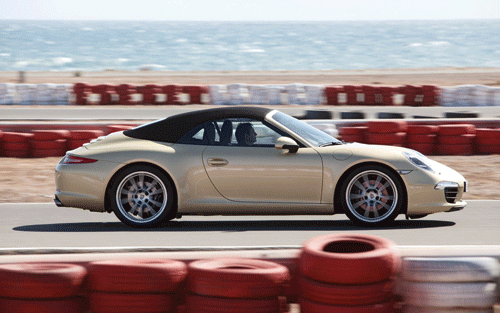
Las Palmas sprawls along the coast of the third largest of the Canary Islands archipelago, scattered in the warm seas just beyond the northwest coast of Africa. From a satellite’s eye view, the island is almost a perfect circle; Gran Canaria, with a surface area of 1,560 square kilometers, centers around its highest peak, the extinct volcano Pico de Las Nieves — the ‘peak of snows’ — at 1,949 meters. It’s a long way from Lebanon, and yet the charms are superficially similar: you can spend your days basking in balmy weather, draining the cocktail bars while admiring the snow-capped peaks above. It’s a superb destination for a Porsche press trip to test out their gleaming new 911 Carrera Cabriolet, but it also reminds you how pollution and traffic impede top-down driving in Beirut.

Until now, the choice between coupé and cabriolet might have been an agonizing one for someone considering dropping in the region of $100,000 (depending on customs fees) on the car of their dreams. Supreme performance from a coupé, or the style and freedom of a cabriolet with some compromises on the frame and engine? Now, a new intelligent lightweight design for the hood and all-aluminum frame for the body means that when the hood is up, the silhouettes of the coupé and the cabriolet are barely distinguishable. And, both of the 911 Careera Cabriolet and the sports version have the same engine as the 911 Carrera Coupé equivalent: 3.4 and 3.8 liter boxer engines, respectively, with 350 and 400 horse power. The driving power has been ratcheted up as well, with electro-mechanical power steering and, for the Carrera S, Porsche Torque Vectoring with differential lock featured as standard.

Foot to the floor

These features were amply put to the test spiraling up the sides of Pico de Las Nieves in a yellow Carrera S the morning after our arrival. The car, with its significantly reduced weight from previous models and torque of 390 Newton meters at 5,600 revolutions per minute, ate up the roads and cornered elegantly. 

The fantasy trip came to an end on the sands of the Las Palmas autodrome. In this environment you really test the car, and the fact that these are seriously high quality racing sports cars comes to the fore. Handling them requires reaching top speeds of around 286 kilometers per hour and taking curves brutally fast, and after putting the pedal to the floor for two to three laps you have to cool the car down for one slow driving lap, a process that really drives home its racing credentials.

After honing my embrace of the car and witling down my lap time through the day, needless to say, I left Las Palmas with a smile on my face.

March 3, 2012 0 comments
0 FacebookTwitterPinterestEmail
Comment

Driving us mad

by Sami Halabi March 3, 2012
written by Sami Halabi

Inching along amid a cacophony of horns in one of Lebanon’s estimated 1.6 million vehicles leaves a driver with ample time for reflection. As the clock on the dash ticks past another hour and the feet maneuver endlessly from gas to brake, how the country reached this point inevitably comes to mind. 

For the sixth year running the country is set to operate without a budget. The president has again broken his oath to uphold the constitution, which states a budget must be passed by the end of January. 

This is beyond unfortunate. With a budget comes some sort of policy framework that, in theory, commits the government to put its money where its mouth is. What we have currently is the politically calculated calamity of treasury advances, a crude process where cabinet has to agree on every spending measure outside of the 2005 budget. In any case, hardly any money that came from the people that year, or any subsequent year, comes back to them through the budget. That’s because after the debt servicing is paid to the banks, the deficit of Électricité du Liban is covered and the salaries of the patronage apparatus (also known as the public sector) are paid, the state is already in a deficit. 

Any further spending, with borrowed funds, lies solely in the hands of cabinet. In other words, the money borrowed on behalf of the public, that should be spent on the public good, becomes fodder for the overlords pulling the strings at the cabinet table in their petty battles and under-the-table deals. The fact that the funds of $1.2 billion agreed to by cabinet for new power plant construction is to be allocated from the next budget — regardless of how unlikely it is to manifest — and not done through a treasury advance, highlights how little intent exists in cabinet to actually implement reforms.

Thus no one should be surprised when they look out from the windows of their cars to find themselves locked tight in an inescapable labyrinth of metal, given the absence of government policy to reform public transportation. To say that we are approaching tipping point in terms of what our roads can handle would be tardy commentary — we are well past that point. Since our policy makers ceased producing budgetary policy, more than 500,000 cars have entered the country, with the current trend at around 100,000 cars every year. The traffic and the pollution can only get worse. 

But traffic aside all these cars are, quite literally, starting to drive the economy and an increasing proportion of the job market. Already the value of the car imports totals some 4 percent of gross domestic product, which doesn’t help much given that this is money leaving the country, not staying in it to create employment. Then consider all the customs and fees, which account for another 4 percent of GDP, which people must pay to a government that does little for them in return.  And since the years of economic growth were “jobless,” in the words of the last finance minister, many local private sector jobs are now being steered by those very same cars. 

Figures relating to how many people are directly and indirectly employed in the automotive sector are sketchy, not least because a national labor survey has never been conducted. But the sprawl of the ‘car economy’ can easily be seen with just a glance at the countless mechanics in Goberi, Sarafand or on the road to Halba, or the armies of valet parking attendants and cabs in the capital.  

With labor-intensive sectors such as agriculture in decline and the trade or services having a small labor component, the options left for gainful employment are hardly the professions that will produce a society that progresses beyond being passive consumers of imports, or one that has the political and economic infrastructure to build anything else. The longer we go without a shift in the financial dictates that rule the country, the more our job market and our economy will be skewed toward import-based sectors, rather than creating one that can compete productively on an international level. 

Unless our financial policy makes an abrupt U-turn, we will continue to be driven mad by our politicians and, perhaps deservedly, ourselves.

March 3, 2012 0 comments
0 FacebookTwitterPinterestEmail
Society

Journey to the opening bell

by Line Tabet, Ramsay G. Najjar & Zeina Loutfi March 3, 2012
written by Line Tabet, Ramsay G. Najjar & Zeina Loutfi

Facebook recently announced that it is going public, in a move which would constitute one of the biggest offerings and tech initial public offerings in history, estimated to reach $5 billion. While dwarfing the $1.67 billion raised by Google in 2004, this news can only remind us of the buzz that surrounded Google, turning it into one of the fastest growing companies and most attractive places to work at. 

All this ado about Facebook cannot but get us thinking about IPOs in our region, which have been relatively few and far between compared to most developed and emerging economies. Surely there are several challenges that stand in the way of regional companies wishing to go public, ranging from unfavorable regulatory and market conditions to lack of investor confidence in such times of political upheaval. However, there are several areas that a company can work on to prepare the grounds internally and thus improve its chances of carrying out a successful IPO. 

It is true that no one can predict the volatility of the stock market or the investors’ mood; however, it has become widely acknowledged that communication is key to any successful organizational change, especially when it involves going public. 

A well-established corporate culture is crucial to successful organizations. In fact, a corporate culture that all employees identify with is an enabler of their alignment around the company’s purpose, strategy and goals; it enhances productivity and increases their pride and sense of belonging to the organization. 

Part of the family

But having a solid and well-established corporate culture becomes much more critical when a company ventures into an IPO. This is because when a company goes public, it is moving from being privately managed to becoming publicly transparent and accountable, thus welcoming a new stakeholder to its family: the shareholders. The way business is managed changes and thus requires the company to adopt new management processes that reflect best leadership and management practices. This places employees under scrutiny and pressure; they feel vulnerable and are reluctant to change. Clearly, all these adjustments put a strain on the corporate culture, which would need to be solid and resilient to smoothly navigate the bumpy road of an IPO. As a very recent example of this, Zynga, the world’s largest social gaming company behind the popular Farmville Facebook game, decided to go public and succeeded in raising $1 Billion when it first traded on NASDAQ in December 2011. However, the company’s shares went down by 5 percent soon after the launch and upon announcing first quarter results that were more or less in line with expectations the stock fell nearly 18 percent. One of the reasons according to experts was the company’s corporate culture. Employees describe the corporate culture as intense and data-driven, where objectives and key results are the basis for employee and staff evaluation, and where performance data are used to calculate hard work, thus creating an atmosphere of competition and even all-out war between colleagues and departments. 

However, even having a strong corporate culture in place is not a sufficient guarantee that employees will remain on board during and after the IPO. Efforts should be put on internal communication to reassure employees that the change in the way business is conducted and the addition of new business partners does not imply that their performance will be questioned or that the company will no longer value them. Communication efforts should strive to make employees feel proud of being part of the IPO adventure; they should feel part of a family rather than pawns manipulated by top management. Google understood that the reason behind its success is in attracting top notch professionals and young minds, and as such, its IPO letter started by “Our employees, who have named themselves Googlers, are everything,” putting the emphasis on the idea that going public will not change their corporate culture but rather reinforce it.

Returning to the Arab region, we note the large number of companies that have yet to institutionalize their corporate cultures, let alone establish strong and solid ones which could withstand the strains of an IPO. With a vast majority of companies being family-owned businesses, family feuding, nepotism and emotions remain at the center of management practices. Non-family employees many times feel like outsiders and thus lose the motivation and desire to work, never mind getting into a long process of an IPO that will bring new stakeholders on board and make the family members richer. There is no secret ingredient in the recipe of a strong corporate culture. However, there are key drivers that any organization should have in order to build or reinforce a distinctive yet common corporate culture; this should start by gathering all employees around the same mission, vision and values of the company and establishing a two-way communication whereby leadership would make sure to listen to concerns, address doubts and acknowledge achievements. 

Weaving a tale

The second success factor that can go a long way in helping ensure a smooth IPO is elaborating a story or narrative around the company, one that would go beyond business and profit to emphasize its achievements, namely in terms of  how it touches the lives of its various stakeholders. Who can forget the story of Facebook that has been turned into an award-winning movie? It would be a generalization to say that behind every successful company that went public is the story of a young student with a genius idea who tried to make it happen from his bedroom. 

However, Steve Jobs, Larry Page, Sergey Brin and now Mark Zuckerberg are the first names that come to mind, when we think of successful companies that went public. In fact, the common ground between them is that all these high-listed companies were first start-ups whose founders wanted to make the lives of people easier through a certain service or product. Sometimes these stories might be far from reality, such as the story of e-bay founder Pierre Omidyar who started the e-shop concept following a discussion with his wife about how to acquire PEZ-dispensers. The anecdote might not be true; however, it succeeded in attracting potential investors, increasing familiarity with the company, allowing the public to relate to its founder, while downplaying the fact that he was already a multi-millionaire when he created the company. 

As such, it is important to create a story around the company, whether it is centered on its founding and evolution, its services and products, or the noble cause that it espouses, as it will help generate considerable brand awareness and often loyalty, allowing stakeholders to identify with it and providing it with significant communication mileage. But most importantly, a story helps establish an emotional bond and paint a human side to a company, particularly at a time when the schism between the corporate world and the rest of society is growing wider. A feel-good, inspiring story encourages people to often unconsciously root for the company over others, providing it with a competitive edge that can translate into a solid goodwill bank that might shield it in times of crises and positively impact its bottom line.

When we think about IPOs, the first thing that comes to mind is a number in billions, a ringing opening bell at Wall Street, and a success story of entrepreneurship. This entrenched image could very well be duplicated in the Middle East, especially since the region is now becoming an investment hub with many countries well on their way in carrying out capital market reforms and instituting regulations that are in line with international practices. With communication as a pivotal enabler behind the success of any IPO, regional companies should start by cementing their corporate cultures and creating an inspirational story behind their success. Who knows, the next Facebook or Google might just be around the corner.

March 3, 2012 0 comments
0 FacebookTwitterPinterestEmail
Comment

Salafi spillover

by Peter Speetjens March 3, 2012
written by Peter Speetjens

"We salute the Free Syrian Army,” reads a banner in Badawi, a poor suburb of Tripoli, where the Lebanese flag is about as common as the three-starred flag that adorned flagpoles in Syria prior to the 1963 Baath Revolution. Further down the road, a billboard heaps praise upon the “Islamic” revolutions in Tunisia, Egypt and Yemen.

Tripoli and the north of Lebanon are increasingly entangled in the Syrian quagmire, which could have dangerous implications for the future of Lebanon as a whole. As the Syrian conflict grows increasingly violent, Tripoli is no longer merely a safe haven for civilian refugees. It is also a base for the FSA to treat its wounded, as well as pick up arms and supplies. Syria is not at all popular in the predominantly Sunni city. Most inhabitants have not forgotten the heavy-handed presence of the Syrian army during and after the Lebanese Civil War. Many people were killed, or “disappeared”, and members of the Islamic movements bore the brunt of Damascus’ wrath. 

Today, seeing their Muslim brethren being killed in Syria, they smell revenge. Mohamed, a Badawi shopkeeper, armed with a walkie-talkie and a handgun under his shirt, explained how cross-border activities between Lebanon and Syria concerned people, medication and arms. He complained about inflation: three dollars for a bullet and up to $2,000 for an AK-47. “Thank God, we are supported by the Gulf,” he said. The financial and logistic support for the Syrian uprising by countries such as Qatar and Saudi Arabia is no longer a secret. British daily The Times on January 22, for example, reported that Qatar and Saudi Arabia were beginning to fund the Syrian National Council (SNC) and armed groups fighting the Assad regime. On paper, the SNC is an umbrella organization for Syrian opposition groups. In reality, it is dominated by the Muslim Brotherhood, while there appear to be sharp internal divisions. Such growing pains are of course only normal for an organization less than a year old. 

On January 26, the SNC published a one-page ad in Al Hayat thanking Saudi King Abdullah for his generous support; the 87-year-old monarch as a symbol of change in the age of Twitter and Facebook — who could ever have thought? Other reports are even more worrisome. On February 12, Al Qaeda leader Ayman al-Zawahiri urged Muslims in Lebanon, Turkey and Jordan to join the struggle in Syria. A day earlier the Iraqi vice-Minister of Interior, Adnan al-Assadi, claimed that Iraqi arms and Jihadists were crossing the western border.

While most mainstream media continue to broadcast a black and white picture of “the people vs. the power,” the mood of Syrian artists, students and intellectuals in west Beirut’s trendier bars is changing. They feel “their” revolution is slipping out of their hands. 

“The regime has committed too many crimes — we want it to fall,” a student from Homs summed things up. “Yet you cannot deny that the opposition is mainly Sunni. The religious minorities and Kurds are hardly part of the uprising. If the majority of the Syrian people vote for an Islamic government, I think we should give it a try. But seeing the way things are going, I fear a civil war.”  

If that were to be the future for Syria, then Lebanon would be foolish to think it can remain unaffected. The recent deadly clashes between pro and anti-Syrian factions in Tripoli were but a warning shot. The suggested solution, to turn the city into an arms-free zone, was well-meant yet laughable. No sane Lebanese person would dare uphold that as a feasible option. The problem with arming (radical) Sunni groups in Afghanistan, Iraq, and even Libya, has proven to be an unpredictable affair, as they often have their own agendas. Lebanon should know, following the pitched battles with Sunni fundamentalists at Diniyeh and Nahr Al Bared. Ask a shopkeeper, such as Mohamed, what he thinks should come next and the answer is truly frightening. According to him, the Shia simply are not Muslims and it is only thanks to Hezbollah that Assad is still in power. Therefore, following the fall of the latter, it should be the former’s turn. “If we had not had a civil war in Lebanon, Lebanon would today be Palestine,” he said. “That’s why we need another civil war to get rid of Hezbollah, so Lebanon is not an Iranian satellite state.”

March 3, 2012 0 comments
0 FacebookTwitterPinterestEmail
Society

Treasure Islands

by Paul Cochrane March 3, 2012
written by Paul Cochrane

There is only a passing mention of one of the Middle East’s tax havens, Dubai, and no mention of the other two contenders, Bahrain and Lebanon, in Nicholas Shaxson's book “Treasure Islands: Tax Havens and the Men Who Stole the World.” 

This is a shame as there are plenty of juicy tales to tell about shell companies, dodgy accounting and suitcases crammed with petrodollars, but there is a good reason for the lack of coverage. The Middle East three are small fry in this business, with more than half of world trade passing through tax havens, while in 2010 the balance sheets of small island financial centers alone were conservatively estimated by the International Monetary Fund to be worth a staggering $18 trillion — just less than a third of the world’s gross domestic product. 

Compare the Cayman Islands — population 56,000 — with Lebanon and Bahrain; in 2008, the Caymans had $2.2 trillion in equity liabilities (deposits and other obligations) and $750 billion in portfolio assets, while in 2010 Lebanese bank assets were $133 billion and Bahrain’s $210 billion. Likewise, the Dubai International Finance Center is a featherweight compared to the Dublin International Financial Services Center, which hosts 8,000 funds with $1.5 trillion in assets.  So, while the reader will find nothing about the 2008 law that enabled Lebanon to become an offshore center (there were 5,983 registered companies in 2010), “Treasure Islands” gives a full account of how tax havens developed worldwide, the back-room deals that prompted legislative change, and the problems that tax havens cause.

At this point, a definition of “tax haven” is worth making, for as Shaxson notes, there is little agreement. Shaxson’s definition is a broad but salient one, with a tax haven a “place that seeks to attract business by offering politically stable facilities to help people or entities get around the rules, laws and regulations of jurisdictions elsewhere.” This can refer to the obvious, evading tax, to more complex financial dealings such as repackaging capital and trade miss pricing, to usury specialties and lax corporate governance laws. What all havens, onshore and offshore, have in common is “secrecy in various forms,” while a giveaway is whether “the financial services industry is very large compared to the size of the local economy.” A further common marker is very low or zero taxation rates, which are typically offered to non-residents, whereas residents are taxed.

But these jurisdictions are not just obscure tropical islands, they are the renowned financial centers of the world: the United States, Luxembourg, Switzerland and Britain. Cumulatively, the biggest player is Britain, with its Crown Dependencies and overseas territories (Guernsey, Jersey, Cayman Islands, the British Virgin Islands etcetera), plus the former empire (Hong Kong, Singapore etcetera) accounting for 37 percent of all banking liabilities and 35 percent of all banking assets on the planet. If the City of London is added in, at 11 percent, the British group has almost half of the world’s banking assets.  Like the rest of the globe, the Middle East is linked to these tax haven networks, as a cursory glance through company registries will highlight a listing of places such as Panama, Cyprus, the Bahamas and so on. According to research published in 2011 by Global Financial Integrity (GFI), four Arab states were in the list of the top 10 countries worldwide with the highest illicit financial outflows between 2000 and 2009: Saudi Arabia with $380 billion, the United Arab Emirates with $296 billion, Kuwait with $271 billion and Qatar with $130 billion. The GFI notes that the prominent destinations of this capital flight were fiscal paradises and the interconnected global financial centers.

Curbing tax havens is a pressing concern, as they deprive countries of billions of dollars in tax revenues as well as the capital available for lending, and played a major role in triggering the financial crisis. Shaxson offers some solutions, but taking on tax havens and their clientele incurs serious opposition. Some two-thirds of global cross-border trade happens within multinational companies — the majority of which utilize tax havens — while 99 of Europe’s 100 largest companies use offshore subsidiaries, with the largest users being banks. 

While the reader is left with a degree of despondency given how intrinsically important tax havens are to the global financial system, Shaxson has done an invaluable service by making the public aware how rotten to the core it truly is.

March 3, 2012 0 comments
0 FacebookTwitterPinterestEmail
Comment

That moment unforeseen

by Nicholas Blanford March 3, 2012
written by Nicholas Blanford

The world of journalism lost two giants of the trade last month with the deaths of Anthony Shadid, the Middle East correspondent for The New York Times, and Marie Colvin, a veteran war correspondent for Britain’s Sunday Times.

Both died in Syria — Shadid from a fatal asthma attack while heading to the Turkish border after spending several days with the rebel Free Syrian Army, and Colvin from an exploding artillery shell in Homs from where she had been reporting for a week.

Their deaths have provoked once more, among journalists covering conflict zones, deep introspection on how to assess the critical balance between the need to report a story to the outside world and the risks involved in obtaining it. The demands to produce material combined with ever growing numbers of correspondents covering the same story — from newly arrived hopefuls looking for a big break to seasoned veterans — have increased the sense of competition among reporters.

Shadid’s moving memorial at the American University of Beirut attracted a large number of colleagues, many of whom had flown in for the occasion from points across the Middle East, Europe and even the United States. During the lengthy drinks that followed, a leading topic of conversation was the dangers involved in infiltrating Syria to report on conditions on the ground as both Shadid and Colvin had done. More and more journalists are undertaking the perilous trip to sneak across the border to spend a few days with the Free Syrian Army or besieged civilian populations, providing crucial eyewitness accounts to supplement the flow of often unverified cell phone footage or reports offered by so-called ‘citizen journalists’.

Few doubt the importance of the story. After all, the fate of Syria in the coming months has the potential to reshape the geo-political map of the Middle East, and not necessarily to the collective good.

The violence wracking the country and the tragic examples of Shadid and Colvin, among other foreign journalists who have died or been wounded in Syria, is causing many to err on the side of caution. One brave journalist I know who covered the conflicts in Afghanistan, Iraq and the Arab Spring uprisings in North Africa, and has been kidnapped twice, told me that he was stepping aside from the Syria story. Too many close calls and a recent marriage had changed his perspective.

Gathering as much information about the situation on the ground is critical, which is then weighed with the importance of the story and personal factors. A war reporter who is well established, middle-aged and married with children has much more to balance in his or her decisions than an ambitious single 25-year-old just embarking upon a career. But there is also the dreadful burden of peer pressure. When one reporter takes the plunge and survives with a scoop, his competitors feel compelled to do the same or better. Then there is the not-so-subtle pressure from newspaper editors — “I see Smith of the [rival] Daily Standard got into Homs, would you be interested in having a crack at it? No pressure of course, just wanted to check…” An outright refusal could jeopardize one’s career, but accepting the assignment could get you killed.

How does one calculate acceptable risk? There is risk in crossing a road (especially in Beirut), but we all do it. And the more often we cross the road, the more confident we feel and the sense of risk diminishes. That’s when we blithely march across a busy street while sending text messages on a cell phone with barely a sideways glance and end up squashed like a bug on a truck’s radiator. War reporting is similar. The fear factor is highest usually when taking the first step — whether it is following troops into battle, driving down a highway notorious for roadside bomb ambushes or passing through kidnapping territory. Once that Rubicon has been crossed safely, there is a temptation to push on to the next level of risk. But surviving a succession of dire situations can breed complacency, which in turn leads one to take ever greater risks.

Of course, the level of acceptable risk is different for everyone, but the heartbreaking examples of Shadid and Colvin are sobering reminders that the risks are deadly real. No one can plan for all possible contingencies, and even decades of experience offer no shield against that moment unforeseen.

March 3, 2012 0 comments
0 FacebookTwitterPinterestEmail
Business

Still shipping

by Joe Dyke March 3, 2012
written by Joe Dyke

In the list of Lebanese businesses, the name sticks out — Henry Heald and Co sounds incongruous. In many ways it is, yet it is believed to be the country’s oldest company.

Henry Heald and Company steamboat and shipping experts was registered in 1837, more than 100 years before the country gained independence. All of Mr Heald’s contemporaries have since closed down, meaning the shipping agents are believed to be the oldest continually registered company in Lebanon. 

Little is known about Heald, an Englishman from Yorkshire, apart from the fact that he had been living in the “Levant”, for several decades before setting up the company at a time when European trade was expanding rapidly. Philip Mansel, author of the book ‘Levant’ which tracks the history of Beirut and other port cities, explains how the Ottoman-led government of Muhammed Ali had opened up to foreigners.  “There was a complete change in attitude. The whole region was opening up because Muhammed Ali’s efficient modern administration arrived in 1831,” he says. “Customs receipts trebled in the 1830s and Heald’s were a part of that.”

In the late 1800s Heald’s nephew, Charles Smith, who had taken over the business, died, leaving it to his partner Earnest Joly, in whose family the business remains to this day and his great-granddaughter Harriet currently occupies the managing director chair. She explains it was the high-society connections of Earnest’s more affluent wife Catherine that enabled the takeover bid. 

“When Earnest and Catherine wanted to buy the rest of the company from Charles Smith, Smith’s sister was a bit of a snob,” Harriet explains. “This branch of our family had been living in Smyrna [now Izmir, Turkey] and Ms. Smith didn’t approve of the people from Smyrna and refused to sell her part of the company. Then Catherine produced a copy of Debrett’s [a magazine for Britain’s elites] showing her as the granddaughter of a Baron and immediately everything was alright and she was quite happy to sell.” Yet Earnest’s woes did not end there. With the company growing, both in Lebanon and other parts of the Middle East, he was taken prisoner by the Turks for a large part of the First World War. 

While many Europeans took the hostility to Westerners as their cue to abandon the Middle East, the Jolys returned to post-war Beirut to rebuild. And the family’s resilience was tested again 60 years later when they struggled to keep the business open throughout the Lebanese Civil War, despite the Beirut port closing for months and the company’s offices being blown up in 1975. Harriet’s dogged father kept operating, often risking personal harm to convince ships to dock.

“All the captains knew him but were frightened because there was a war going on, so they didn’t like coming in to port,” Harriet says. “Usually the condition for coming in was that they would give him a cabin and he would sleep on-board to prove it was safe.”

“Once he had a ship arrive and he took the captain and two visitors out for dinner over toward Jounieh. He sat them with their backs to the window and while they were eating a fire-fight broke out in the distance behind them,” she says. Once the fighting had abated he settled the bill and returned his guests, satiated and unawares to the affray, back to port.

Nowadays the company has around 15 staff in Lebanon, plus assets in other parts of the Middle East, and operates as a shipping agency, port services firm and recently even as an investigator of illicit insurance claims. Walking through the offices in Gemmayze there are few clues to the company’s unique heritage. Bar the odd ship’s wheel on the wall, you could be in any modern office in the country, with staff tapping away on computers, an impression Harriet admits is deliberate.

“When we are presenting to clients we always mention the history because we think that is kind of nice, but we like to also come across as very much up-to-date and in touch with the latest developments,” she says. “I think a lot of people have a downer on family businesses and think it’s not really the way it should be done.”

Much of the industry had a difficult 2011 as Hassan Qoreitem, head of Beirut port, admits. “It was a tough year not just because of Syria, but because of the situation in the region and in Lebanon as well. The local cargo decreased but we succeeded in increasing shipment cargo through the Port of Beirut.” 

Revenues for the port itself declined 4.79 percent in 2011, according to Blominvest Bank, but there was positive news as the port breached the landmark of handling one million containers for the first time.  Qoreitem describes Heald’s as “one of our most esteemed clients”, but the company has not been immune to the regional downturn. A crucial contract for the company is with NYK Roro to import cars to the Middle East but demand disappeared as uprisings swept the region, with just three shipments in the first six months of 2011. Yet it has slowly picked up in recent months, averaging one a month between August and January. 

Harriet sees room for expansion in the coming years, with freight forwarding and fraudulent claims on medical insurance among new potential areas of growth. She has two step daughters, a niece and a nephew, so the obvious question, therefore, is whether the business will stay in family hands for one more generation?

“It may or it may not,” she says. “No one is going to force someone to do something they don’t want to do, but it is obviously there for family to take over if anyone shows an interest.”

March 3, 2012 0 comments
0 FacebookTwitterPinterestEmail
Comment

Stored value in troubled times

by Jihad Yazigi March 3, 2012
written by Jihad Yazigi

The unrest gripping Syria may have created havoc on the economy, but there is one industry that has benefitted from the turmoil — the real estate sector.

Within days of the beginning of the protests last March, frantic construction activity began across most of the country’s informal areas. Syrians seized on a relaxation of strict construction rules and a general weakening of state control to rush and build in areas and lands normally out of their reach. The government, facing countrywide protests and with no appetite for causing further discontent by clamping down on small scale developers, kept its eyes closed.

One year later, there are up to half a million new housing units that are believed to have been built, leading to a temporary surge in the price of building materials and labor, and a change in the landscape of many suburban and rural areas. Although in the last few weeks construction activity has largely returned to normal, this temporary boom has shed light on the importance of the real estate sector in the Syrian economy and society.

In a region that, historically, has rarely been stable, that has seen countless invasions and that sits on the crossroads of several trading routes, the attractiveness of investments that can act as stores of value is great — and this obviously applies to real estate as it does with gold. Few Syrian men, for instance, can be considered to have succeeded in life — and for that matter can dream to marry — unless they own at the very least a residence. Thus, beyond its purely economic logic, investment in real estate has a social weight of its own. In recent years, several factors encouraged investment in the sector. They include excess liquidity held by Syrian expatriates and Gulf investors on the back of booming oil prices; limited other investment opportunities — because the Syrian business environment, comparatively to other countries in the region, remains very poor — and negative real interest rates; finally, supply bottlenecks in several segments of the market, including quality commercial properties and upscale housing properties, played a role. Thus, in the mid-2000s, several of the major regional developers, such as Majid Al Futtaim, Emaar and Qatari Diar, announced the launch of a variety of projects across the country, while local investors focused on smaller scale ventures.

In practice, however, only a handful of these landmark projects took off. Emaar’s Eighth Gate commercial development — which will host the Damascus Securities Exchange — located in the upscale Damascus suburb of Yaafour is the only one of significance that has moved ahead. Almost all the others remain burdened by endless bureaucratic and regulatory obstacles as well as legal disputes over land ownership. Indeed, beyond the traditional problems faced by all investors wishing to do business in Syria, many other hurdles hamper a proper expansion of the real estate industry. The lack of sufficient land and of proper zoning in many parts of the country, in particular in the densely populated urban centers, have led to a rise in informal housing, which represents today a staggering 40 percent of all housing units in the country, and to a lack of investment opportunities. Similarly, state control and administration over huge portions of land in city centers, for instance in the Central Business District of Damascus, have rendered any major commercial development in these areas almost impossible. Another impediment is the very low average rental yield of most properties across the country. It is not uncommon, for instance, for a mid-size residential property located in the center of Damascus and worth around $400,000 to be rented out at less than $10,000 per annum, or an average yield of 2.5 percent, very low not only by international standards but also by regional ones.

In the near term, the best hope for the sector lies, ironically, in the unrest gripping Syria. Indeed, nearing two months into 2012, the Syrian Pound lost 14 percent of its value compared to the US dollar — coming on top of a 34 percent decline last year — while the inflation rate has reached double digit levels. Both these factors encourage the role of the sector as a store of value. In the longer-term, however, the broader political dynamics will weigh in much more on the development of the real estate industry, and unless the current stalemate comes to an end quickly, real estate can only resist significant disinvestment, as is happening in the rest of the economy, for so long.

March 3, 2012 0 comments
0 FacebookTwitterPinterestEmail
  • 1
  • …
  • 341
  • 342
  • 343
  • 344
  • 345
  • …
  • 686

Latest Cover

About us

Since its first edition emerged on the newsstands in 1999, Executive Magazine has been dedicated to providing its readers with the most up-to-date local and regional business news. Executive is a monthly business magazine that offers readers in-depth analyses on the Lebanese world of commerce, covering all the major sectors – from banking, finance, and insurance to technology, tourism, hospitality, media, and retail.

  • Donate
  • Our Purpose
  • Contact Us

Sign up for our newsletter

    • Facebook
    • Twitter
    • Instagram
    • Linkedin
    • Youtube
    Executive Magazine
    • ISSUES
      • Current Issue
      • Past issues
    • BUSINESS
    • ECONOMICS & POLICY
    • OPINION
    • SPECIAL REPORTS
    • EXECUTIVE TALKS
    • MOVEMENTS
      • Change the image
      • Cannes lions
      • Transparency & accountability
      • ECONOMIC ROADMAP
      • Say No to Corruption
      • The Lebanon media development initiative
      • LPSN Policy Asks
      • Advocating the preservation of deposits
    • JOIN US
      • Join our movement
      • Attend our events
      • Receive updates
      • Connect with us
    • DONATE