• Donate
  • Our Purpose
  • Contact Us
Executive Magazine
  • ISSUES
    • Current Issue
    • Past issues
  • BUSINESS
  • ECONOMICS & POLICY
  • OPINION
  • SPECIAL REPORTS
  • EXECUTIVE TALKS
  • MOVEMENTS
    • Change the image
    • Cannes lions
    • Transparency & accountability
    • ECONOMIC ROADMAP
    • Say No to Corruption
    • The Lebanon media development initiative
    • LPSN Policy Asks
    • Advocating the preservation of deposits
  • JOIN US
    • Join our movement
    • Attend our events
    • Receive updates
    • Connect with us
  • DONATE
Comment

Prisoners to politics

by Ahmed Moor November 3, 2011
written by Ahmed Moor

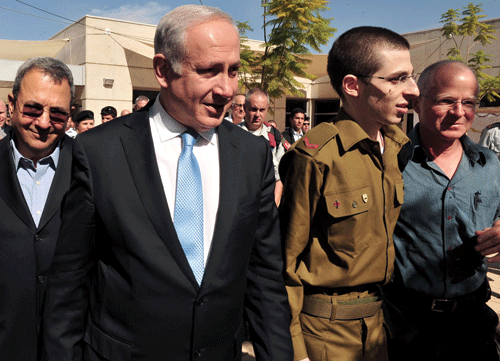
The prisoner exchange between Hamas and the Israeli government came at the only time it could; when the interests of both sides were aligned. In a sense, the actions of Mahmoud Abbas at the United Nations (UN) in September precipitated the deal. Both Hamas and the Netanyahu government sought to bolster their domestic popularity in its wake; something they managed with different degrees of success. The exchange — still unconcluded as October came to a close — has the potential to have an impact beyond its immediate implications, particularly for Palestinian reconciliation and the Gaza siege. 

In June 2006 Hamas conducted a raid in which they killed two Israeli soldiers and captured one. The party’s stated intent was to gain enough leverage to compel Israel into conducting a prisoner swap for some of the roughly 8,000 Palestinians held in Israeli jails, many of whom are political prisoners.

On October 18, Hamas and Israel completed the first stage of that swap. When the two-stage swap is concluded, 1027 Palestinians and one Israeli will have been liberated. It is significant that the exchange happened now and not years ago when the two sides appeared to be close to a deal. The gap between them was likely bridged by a mutual deterioration in their political situations.

Abbas — probably unknowingly — was the common denominator between the two adversaries. His appearance at the UN successfully undermined Benjamin Netanyahu and, to a lesser extent, Hamas. The call for an independent Palestinian state resonated so deeply and widely in the international community that both the Israeli government and the Islamic movement were forced onto the defensive. Hamas has also become increasingly sensitive as its patron Syria has been marginalized. Both parties sought to boost their support among their constituencies and the high-visibility, high-impact strategy of securing the release of prisoners was the best way to do that. Hamas gained more from the deal but Netanyahu also experienced a bump in the polls. Furthermore, whether  it was intended or not, the exchange had the added effect of undermining Abbas in two ways.

Firstly, Hamas demonstrated to the Palestinians that it could produce results: the release of Palestinian prisoners. Abbas by contrast seemed only capable of producing political theater. Further, Netanyahu made a massive concession to the extremists in his cabinet so as to gain their support for the deal.  He agreed to the establishment of a  new settlement which will consolidate the Israeli occupation of East Jerusalem, thus accelerating the erosion of Abbas’ credibility.

Aware of how weak the prisoner exchange with Hamas has made Abbas look, members of the Israeli government are now talking of attempting to bolster his public image by releasing more prisoners. However, hardliners led by Israeli Foreign Minister Avigdor Lieberman have protested loudly against any such move.

The political consequences of the prisoner exchange for the Palestinians are still unclear. It is likely that Hamas’ insistence upon the release of prisoners from all of the political factions earned the movement’s leadership goodwill among rank-and-file Fatah partisans. It may also work to thaw the hardened edges that have developed between the two factions in recent years, which would make a genuine reconciliation among the Palestinians possible.

Equally significant is the unprecedented degree of cooperation between Hamas and Israel. While not approaching anything like mutual recognition, the level of contact required for coordinating the exchange may provide the basis for future agreements on the scope of the Israeli siege on Gaza. Indeed, there have already been calls from both sides for the removal of the blockade — which was tightened punitively when Hamas captured the Israeli soldier.

The gains made by Hamas are also reflected on a regional level. According to recent media reports, Khaled Meshaal, Hamas’ political leader, may be meeting with Jordan’s King Abdullah soon. Observers believe that the organization is currently exploring the possibility of establishing political bureaus in Cairo and Amman.

Both Hamas and Israel have gained from the prisoner exchange. The Netanyahu government has improved its approval ratings while the Islamic party has reinvigorated its base and bolstered its reputation. What remains to be seen is whether the Hamas leadership is able to leverage the goodwill generated by the deal to weaken the siege on the Gaza Strip and achieve genuine reconciliation with Fatah.


AHMED MOOR is a contributor to Al Jazeera English and is a Master in Public Policy candidate at Harvard University’s Kennedy School of Government

November 3, 2011 0 comments
0 FacebookTwitterPinterestEmail
Economics & Policy

Executive Insight – Making smart investments in healthcare

by Jad Bitar & Ahmad Khalil November 3, 2011
written by Jad Bitar & Ahmad Khalil

The Middle East is in the midst of a social transformation, with people aspiring to better lives, including better health. Governments are trying to meet this need at a time when their populations are growing rapidly and developing new, lifestyle-related illnesses such as diabetes and heart disease. At the same time, new and expensive medicines and technologies are ratcheting up cost pressures on healthcare systems.

In the face of such disruptive change in the health sector governments need to fundamentally rethink their approach to providing care. Rather than curing people who are already sick, governments will have to develop healthcare systems that emphasize keeping people well. They will need to ensure healthcare systems are operating as effectively as possible, and they must find the right level of involvement for the private sector.

This level of overhaul is a daunting challenge. To understand what needs to change, it is important to have a solid overview of the industry’s current spending patterns and the way they are shifting. Currently, governments in the Middle East spend an average of 5 percent of gross domestic product on healthcare — well below the 2009 Organization for Economic Cooperation and Development (OECD) average of 9.5 percent — ranging from 2.5 percent in Qatar to 9.3 percent in Jordan. But these numbers are on the rise due to the introduction of mandatory health insurance and the growth of chronic diseases. In the Gulf Cooperation Council (GCC), for instance, healthcare spending per capita grew at more than 5 percent per year in the last decade, according to the World Health Organization, from $843 per person in 2000 to $1,224 in 2010. Increasing proportions of this money go to treating chronic diseases; in Abu Dhabi, 10.2 percent of spending went to cardiovascular disease and 8.6 percent to diabetes.

Falling short

As the region’s healthcare needs become more pressing, the lack of resources available becomes more glaring. Saudi Arabia, for example, has just 37,000 hospital beds; in order to reach OECD levels of 2.8 beds per 1,000 people, it will need 73,000 more in the next few years. Many governments are rushing to fill the gap by building hospitals and encouraging the private sector to do the same. In their haste, however, they run the risk of encountering high operating costs and low quality of care due to many factors, such as a lack of national-level planning and a scarcity of skilled talent.

The talent shortage is especially acute. GCC countries average 1.8 physicians and 4.3 nurses per 1,000 people, compared to OECD averages of 3.2 and 11.4 respectively. Abu Dhabi, for instance, will need an additional 3,000 physicians and 6,000 nurses by 2020. This recruitment challenge is compounded by the fact that the majority of the emirate’s existing doctors and nurses are expatriates, who are proving hard to retain for long periods of time. Healthcare systems will continue to struggle to build the capabilities they need if they lose their talent every few years.

With such scarce resources, it is especially important for healthcare systems to be efficient and effective. At present, the delivery of care (including hospitalization, physicians and drugs) consumes the greatest portion of spending — more than 80 percent of total budgets. Therefore, this is the area most critical for reform. Healthcare systems must control the cost for each episode of care, reduce average length of stay, lower overall hospitalization rates and make sure hospital beds are used in the way they were intended — for instance, by not putting chronic care patients into acute care wards.

Finally, to fully understand the dynamics of existing healthcare systems we must look at the split between public and private care. Currently, governments account for the majority of healthcare provision, contributing 65 percent of care on average but rising as high as 80 percent in some countries. Given the gaps in existing systems, governments are understandably reaching out to the private sector to increase its involvement. This is a welcome development in terms of the private sector’s ability to marshal resources and attract expertise. However, governments will need to be cautious: a two-tier system that includes public and private care presents much more complex challenges than a purely public care one. Governments will need to develop the capabilities to provide oversight and regulation in order to ensure accessibility, quality and cost control. For example, two-tier systems tend to lead to a segregation of services, with “profitable” services such as bariatric surgery and gastric banding delivered by the private sector, while the public sector maintains the heavier and costlier burden of cases such as vascular surgeries and transplants.

The healthcare systems of tomorrow

With so much for governments to do, they will need to make a concerted effort to build the required capabilities for managing the dynamics of a two-tier system.   There is no single recipe that will work for all healthcare systems, as each has its own idiosyncrasies in areas such as financing, care delivery, policies and regulations. But there are smart investments that would benefit most systems in the region. Although this list is not exhaustive, we believe the following provide the foundations for the healthcare systems of the future:

Refocus priorities on prevention and disease management. In the face of the rapid rise of chronic diseases, investments in health maintenance and prevention will help reduce hospitalization rates, mortality rates and cost per case in the long term while improving quality of care and patient satisfaction. Recent studies suggest a 10 percent  increase in public health spending reduces mortality by 3.2 percent for chronic diseases. This shift will require innovative approaches, with partnerships between the public and private sectors, as well as a shift in budget allotments from curing diseases to preventing them, which empowers citizens to better manage their own health. For example, projects such as national school health strategies that improve children’s health by emphasizing physical education and nutrition services have proven effective worldwide, and have begun to make headway in the Middle East. However, they require proper funding and solid partnerships between entities such as the Ministry of Health, the Ministry of Education and private schools. Other solutions include an emphasis on disease-management services, such as risk identification, awareness, education and adherence to treatment.

Empower providers with the right information. Offering the right information at the point of care — whether in hospitals, in the physician’s office or at home — should be a top priority. The infrastructure to capture, store, process and deliver the right information is essential for the transformation of healthcare systems. Governments should not be shy about establishing partnerships with the private sector to develop national electronic health records with the potential to reduce medical errors and avoid wasteful duplications.

Develop the private sector and build the right governance capabilities. Regional governments are currently playing the roles of regulator, provider, payer and licensor, and it is becoming evident that there should be some space for the private sector, especially as providers and payers. For their involvement to be a success, however, governments will need proper governance capabilities, including the capacity to govern providers’ quality of care and accessibility, payers’ fees and coverage and the interaction between providers and payers. Without such capabilities, systems can descend into a vicious cycle in which providers try to overcharge payers and payers try to squeeze providers, leaving the patients as the victims.

Although the challenges facing the region’s healthcare systems are numerous, the will to confront them is evident. With the right set of experts and the appropriate resources, this decade should witness the emergence of new healthcare systems in the region.

November 3, 2011 0 comments
0 FacebookTwitterPinterestEmail
Comment

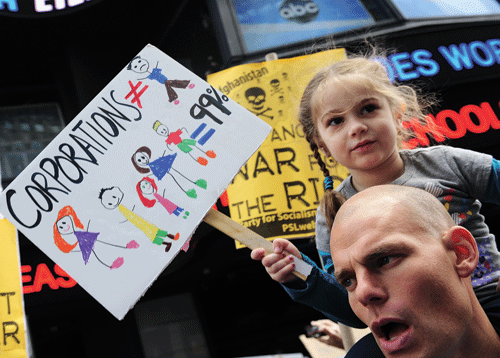
“We are the 99 percent”

by Peter Speetjens November 3, 2011
written by Peter Speetjens

Occupy Wall Street and the Egyptian uprising have more in common than it may seem, and surely much more than Washington wished for. Egypt seems a la mode in New York. For example, the protests were partly inspired by Adbusters magazine, which in July encouraged its readers to flood Manhattan with the battle cry: “Are you ready for a Tahrir moment?”

When American protesters, blocked by police from reaching Wall Street, decided to settle at nearby Zuccotti Park, little did they know it had only been renamed after a local property developer in 2006. Until then it had been known as Liberty (Tahrir) Plaza. These were not the first American signs of emulation of revolutionary Egypt. When the state of Wisconsin last February attempted to cut the salaries and benefits of government staff, tens of thousands of workers took to the streets under the slogan: “Fight like an Egyptian”.

Most Western observers, however, prefer to stress the differences between Occupy Wall Street and the Egyptian and other Arab uprisings. The former, they argue, aims for economic reform, while the latter called for political change. Hence, they speak of an  ‘Arab Spring,’ a reference to the 1968 Prague Spring when Czech citizens attempted to shake off the Soviet dictatorship. Implicitly, the term assumes that both Czechs and Arabs aspire for a Western notion of democratic freedom.

That is only partly true. Sure, most people prefer voting over dictatorships, yet the Arab uprisings, especially those in Egypt and Tunisia, were as much about economic justice as fair representation. Let us not forget that the so-called  ‘Arab Spring’ started over economic injustices: Following the confiscation of his vegetable cart, Tunisian street seller Mohamed Bouazizi set himself on fire at the main square shouting: “How do you expect me to make a living?”

At Tahrir Square, demonstrators not only called for the downfall of Mubarak, but also of people like Ahmed Ezz. Politically, Ezz was not particularly powerful, yet he controlled two-thirds of the steel market and was seen as one of the faces of Egypt’s corrupt and elitist economy. Interestingly, the ‘Arab Spring’ started in Tunisia and Egypt, both formerly state-led economies that — more than most countries in the region — bought into the West’s free market mantra over the last decade. State-owned assets and companies were privatized —generally ending up in the hands of the well-connected few — and then streamlined, resulting in massive layoffs. And while economists routinely pointed at gross domestic product growth as a token of success, the disparity between rich and poor accelerated year after year. Just as the Arab uprisings were not solely about political change, so the current manifestations in New York and elsewhere are not exclusively about economic reform. Yes, the Occupy Wall Street slogan, “We are the 99 percent”, refers to the pyramid-like structure of the American economy, as 1 percent of Americans earn 24 percent of national income and own 40 percent of national wealth.

Yet by referring to the majority, protesters also evoke the founding principle of democratic rule. “We are the 99 percent, and that is why we need a voice,” is the full slogan. The reality is fewer and fewer Americans feel represented by the two traditional parties, which both seem caught in a web of corporate interests and lobbying dollars; the situation is only slightly better in Europe. 

This sense of a political sell-out culminated in the 2008 financial crisis and the subsequent bailout. While several banks were soon awarding major bonuses again, unemployment rose and people everywhere were confronted with austerity programs. In the minds of many it is all rather blunt and simple; politicians bail out the banks, and the people end up paying.

It would be a severe miscalculation if President Barack Obama were to define Occupy Wall Street as merely a call to rein in the malpractices of the financial system. As one protester in New York put it, “we tried voting for change, today we shout for change.” And tomorrow, if need be, they may well fight for it.


PETER SPEETJENS is a Beirut-based journalist

November 3, 2011 0 comments
0 FacebookTwitterPinterestEmail
Society

Book Review – In the Lion’s Den

by Executive Staff November 3, 2011
written by Executive Staff

Andrew Tabler’s account of his time in Syria between 2001 and 2008 is refreshing — relative to the reams of Orientalist trite other Western authors have published about the Middle East and North Africa — in that he actually spent years in the region getting to know the place, first studying Arabic and working as a journalist in Cairo and later traversing the MENA for the Oxford Business Group writing country investment reports, before eventually basing himself in Damascus.  Thus his offering, “In the Lion’s Den”, is neither ‘parachute journalism’ nor the story of a doe-eyed apple-pie eater struggling to make sense of an alien Arab fantasyland — the two most common categories of expat writing on the region. Rather, Tabler — a former contributor to Executive — is candid and observant in relating the challenges of trying to comprehend the vast complexities of a country like Syria.

The author has been accused of being naïve, in asserting that after Bashar al-Assad’s succession to the presidency in 2000 the country would move from autocracy to democracy, but what Tabler says interested him more was getting an “unexpected front-row seat to a fight”, pitting the young reformist Assad against the entrenched status quo of the old guard. He later admits some of his shortcomings in framing the situation as such; while there were superficial changes, it was clear after the first few years of the new Assad’s leadership that regime survival would always be the paramount concern.

Tabler was in a unique position to assess the touted reforms in Syria after a private meeting with Assad’s wife, Asma, and then working for one of her government-organized non-governmental organizations (GONGOs), the Fund for Integrated Rural Development of Syria. This led him to start up, under the auspices of Asma Assad, the country’s first English-language magazine, Syria Today.  Tabler’s account of his meeting with the “first lady” is intriguing, as are the relations between Asma and her go-betweens at the GONGOs. Equally fascinating is Tabler’s account of being the only non-Arab and the first American to accompany a Syrian president on a state trip, to Beijing in 2004.

A criticism of “Lion’s Den” is it goes into no great depth about such encounters, or the running of Syria Today. Tabler also reveals little about his life in Damascus and travels around the country. A possible explanation for this may be that the book was intended both as a memoir and a dovetail into future career aspirations — Tabler’s current employer is the neoconservative Washington Institute for Near Eastern Policy think tank.

Much of the book consequently concerns Syria’s relations with Lebanon, Iraq and Israel, and America’s resultant foreign policy with Damascus. This ranges from Western hopes of engaging Assad to bring Syria ‘in from the cold’ — primarily through solving the Arab-Israeli conflict — to problematic relations after the Bush administration labeled Syria part of the ‘Axis of Evil’ and Damascus’ apparent reluctance to prevent fighters crossing its border into Iraq following the 2003 United States invasion. Relations soured further following the assassination of former Lebanese Prime Minister Rafiq Hariri in 2005, leading the US to withdraw its ambassador to Syria and Damascus entering into a strategic alliance with Tehran. The account of the ongoing tussle between Damascus and Washington is succinct and bipartisan, providing a useful primer on bilateral relations.

Tabler chose to write the book after he was not allowed back into Syria in 2008, due to his increasingly vocal criticism of the regime. Published in September, Tabler could not have asked for a more opportune moment for the release, given the international media attention on the Syrian uprising, and he has capitalized on this in the epilogue in arguing how Assad and the regime should be handled by Washington. While Tabler may have been taken in by Assad’s veneer of reform a decade ago, “In the Lion’s Den” resounds as an impeachment of the Syrian leadership and a call for even tighter international sanctions to bring the regime to account.

November 3, 2011 0 comments
0 FacebookTwitterPinterestEmail
Comment

Welcome to the waking nightmare

by Farea al-Muslimi November 3, 2011
written by Farea al-Muslimi

“Yemen is on the verge of a true, deep humanitarian disaster,” were the words late last month of Geert Cappelaere, representative of the United Nations Children’s Fund (UNICEF) in the country. Even in this country with a history struggling through strife and conflict, the current situation is accelerating into a catastrophe without precedent.

A third of Yemenis go to bed hungry — roughly 7.5 million people — while half of all children under five-years-old suffer from chronic malnutrition and half the population lives in deep poverty. The World Food Program (WFP) warned that it needs $56 million for its operations this year in Yemen — equal to around one third of American military assistance to the Yemeni government in 2010.

While millions of Yemenis are unable to sleep for hunger still more are kept awake by the increasingly bitter civil war. Heavy explosions and bombings continue in Sanaa and other major Yemeni cities as pro and anti-regime forces continue to battle for control. 

In the capital electricity is off for more than 23 hours per day, meaning those lucky enough to still have jobs are often unable to work; produce and perishables rot in grocery stores and the idle refrigerators in people’s homes. Sanaa becomes a ghost town once night falls, with regime forces opening fire on civil protesters with alarming regularity. A recent and unnerving trend has also emerged in the targeting of protesters: security forces have begun kidnapping young people — including the injured — from protests and holding them in hidden prisons, according to the National Organization for Defending Rights & Freedoms.

Outside of Sanaa the WFP has reported that more than half a million Yemenis have been displaced since the beginning of the uprising in January. In the Abyan Governorate in Southern Yemen alone, where many of the fiercest clashes between military forces and Islamic extremists have taken place, more than 100,000 people have fled their homes; most have taken refuge in some 50 school buildings in the neighboring governorate of Aden. Already by the beginning of the summer more than 2,400 people had been killed and more than 20,000 injured, according to a July report by Abaad Studies and Research Center, a Yemeni non-governmental organization and think tank.

All aspects of the humanitarian disaster and escalating violence are being exacerbated by the absence of any semblance of a functioning government and the grinding political deadlock. The continued refusal of President Ali Abdullah Saleh to step down after 33 years in power makes it hard to imagine how the situation can improve in the coming weeks.

Yet the world continues to look the other way. On October 21, The UN Security Council passed Resolution 2014 urging President Saleh to sign the Gulf Cooperation Council initiative calling for a transition of power as soon as possible. The vote, which was discussed for a little under two minutes, is a clear sign of how little import the international community is giving Yemen and its people — something the world will regret if, and more likely when, Yemen explodes into full blown conflict. The UN resolution gave Saleh another 30 days before the Security Council would meet again to discuss the situation. What the bureaucrats failed to grasp was that in 30 days there might be no Yemen left to discuss. 

Instead of becoming a new Tunisia or Egypt where — with international support — legitimate protests gave way to democratic elections, Yemen is increasingly likely to become the new Somalia, going the way of failed states. The continued support of much of the international community, including crucially Saudi Arabia, for President Saleh will only drive the country further down the road to ruin. The unbelievable will of the Yemeni people to persevere through the crises they have confronted this year is a rare and beautiful thing. However, if the world continues to ignore Yemen and refuses to step in to halt its complete dissolution, no one should be surprised by the waking nightmare that will ensue.


FAREA AL-MUSLIMI is a Yemeni activist and writer for Almasdar

November 3, 2011 0 comments
0 FacebookTwitterPinterestEmail
Society

Q&A – Omar Chaoui

by Executive Staff November 3, 2011
written by Executive Staff

Roger Dubuis (RD) is a Geneva-based horology manufacturer that specializes in luxury watches and was acquired in 2008 by the Richemont group. It sells its products through distributers in the Middle East but plans to open retail stores in the United Arab Emirates (UAE) soon, its first in the region. Executive sat with Omar Chaoui, regional brand manager of RD, for a chat about fine timepieces and regional prospects.

E  How did the 2008 financial crisis change the watch industry?
The crisis has taught us that today, as an industry, we need to provide something that has a genuine value, as we are no longer in the euphoric years between 2002 and 2008 when people were over-consuming. Consumers now want inner value and this has led brands to refocus their offering and for distributors to refocus on their portfolio of brands.

Over the past two to three years, brands within the industry have gone back to more discrete watches. Today, consumers don’t buy a watch because it is big and visible and has a cheap or dull mechanism. Today, when consumers buy a $50,000 watch they want $50,000 worth of watch, so they want the finest material, the best possible movement and they want a watch that they can wear today, 10 years and 20 years from now.

E  How does your brand fit in the portfolio of brands offered by Richemont?
We are the avant-garde traditional watchmaker. We are avant-garde in terms of design and 21st century brand but we are traditional in the sense that we are the only brand in the world that offers Poinçon de Genève (Seal of Geneva) 100 percent manufacturing in all of our watches. We are the fastest growing brand in the Richemont portfolio.

We feel that what we sell is not just a watch. If you want to know what time it is, you can look at your phone or the clock in your car. What we are selling is the demonstration that you, as an individual, appreciate the finest form of watch making. We are selling [the right to] belong to a closed club of connoisseurs and dandies. When you enter the RD boutique, you get the full experience. We call our employees watch advisers, not sales people, as they are genuinely passionate about watch making and in love with what the brand represents. They are here to share a passion with you, enjoy a drink with you and have a chat and if you want to buy a watch, they are happy to assist you.

E  What are your strongest areas of growth geographically? And have you seen any impact from the turmoil in parts of the Middle East? Are you going to open a store in Beirut?
The Asiatic region is the fastest growing market. The Middle East is also growing fast. We have faced a significant drop in sales in Egypt and Bahrain due to the unrest in these countries but the rest of the region is doing great. In Lebanon we are growing tremendously, as well as in the UAE, Kuwait, Qatar and Saudi Arabia. We might consider opening a boutique in Beirut in the future when the opportunity arises and we find a right location. Today, we are looking at opening a couple of boutiques in the UAE, our first stores in the Middle East.

E  What does your client drive?
He would drive a TVR or a Wiesmann because it is rare, it is automobile to its core and it is genuine car making.

E  Who are your competitors in the Middle East?
It is quite a tough question because we don’t compete just with watches. We compete with cars, apartments and art. When you reach a certain price point, consumers will not necessarily be choosing between two watches but between a watch, a piece of art or a two week holiday.

November 3, 2011 0 comments
0 FacebookTwitterPinterestEmail
Comment

Dithering in Damascus

by Jihad Yazigi November 3, 2011
written by Jihad Yazigi

The Syrian government’s September 22 decision to impose a ban on all imports carrying a tariff rate of 5 percent or more — and the reversal of that measure less than two weeks later — have created a crisis of confidence across the local business community and a sense that the authorities have little idea how to handle the country’s economic woes.

Seven months of popular protests across Syria have taken a significant toll on business activity, frightening off investors and tourists, enticing locals to stash their savings and leading to international sanctions on key sectors and actors in the economy. The confusion over the import restrictions has only reinforced a general feeling of malaise and darkened the prospects for the near future.  This partial ban, Syrians were initially told, would help save scarce foreign currency reserves and support local manufacturers who had been negatively affected by the free trade policies of the past decade. In press statements, Adib Mayaleh, governor of the central bank, claimed that the ban would generate $6 billion in annual foreign currency savings, $4.5 billion of which would come from car imports alone.

However, the government acted hurriedly and with little consultation, leading to a general outcry that forced it to reverse the measure on October 4. The strength of the opposition from the business community and the fact that it managed to deal a blow to the government and its credibility — already much affected by its dismal management of the economy in recent months — are a reflection of the changes that have taken place in the Syrian economy in the last decade.

While until the late 1990s Syria relied on local production and was largely closed to international trade, the need to attract foreign investors and to integrate more with the outside world saw a gradual easing of the country’s protectionist policies from the early 2000s.

The Greater Arab Free Trade Area agreement, which liberalized trade among the 18 member countries, came into force in 2005 and a free trade deal with Turkey was established in 2007. Tariff duties on imports from countries around the globe were also lowered, including for consumer items such as cars and garments.

This policy had a direct consequence on the structure of the economy: in 2000, imports represented the equivalent of 18 percent of GDP, rising to 26 percent by 2009; exclude inflation over the past decade and this number would be 46 percent. Meanwhile, bilateral trade with Turkey tripled in less than four years, from $800 million in 2006 to $2.5 billion in 2010. This boom in imports helped spur the development of broad sectors of the economy — including retail trade, banking, insurance, transport and logistics and commercial real estate — which were among the main contributors of economic growth in the last decade. A whole new category of businessmen, from wholesalers to local agents of international brands, saw their wealth jump and their influence increase.

Thus, it is not surprising that among the list of more than a dozen businessmen that have been put under sanctions by the European Union and the United States in the last few months one will find Emad Ghraiwati, the agent for Kia, Ford and Jaguar cars and for LG Electronics, Samir Hassan, partner of Lebanon’s Fattal Group in the consumer goods distribution company UniSyria and Tarif al-Akhras, one of the country’s largest importers of food commodities.

Still, the confusion over the import ban has raised all sorts of questions. Until now the government had claimed that its foreign currency position was stable and had not been affected by the political turmoil. If this is the case then why did it decide to impose a cap on imports in the first place? Now that import taxes have been liberalized again, where is the government going to find the $6 billion in savings? Also, if the measure was initially aimed at helping local manufacturers does its reversal mean that the priorities have changed?

The only certainty that has come out of this debacle is that the government has no strategic plan to rescue Syria’s floundering economy.


JIHAD YAZIGI is editor-in-chief of The Syria Report

November 3, 2011 0 comments
0 FacebookTwitterPinterestEmail
Economics & Policy

Where politics becomes personal

by Executive Staff November 3, 2011
written by Executive Staff

The government’s endorsement of a plan to increase the minimum wage from LL500,000 ($333) to LL700,000 ($467), accompanied by salary hikes for those earning up to LL1.8 million ($1200), gave rise to a fierce cacophony of debate. The claims and counterclaims pit different interest groups against one another, with arguments that the government has gone too far, not gone far enough or simply gone the wrong way.

The impassioned reactions are predictable for the simple reason that this policy will directly line and lighten the pockets of employees and their employers, respectively.

The worker

Iktimal Halawi, an English teacher in an intermediate level school in Nabatiyeh, earns a monthly salary of LL580,000 ($387).

“This is absolutely insufficient for us to live off,” she says. Iktimal argues the minimum wage does not amount to a living wage, adding that, “We can say now we are already living at the minimum level.”

Halawi stands in a more fortunate position than many other employees on similar earnings. Her husband is an employee in a bank and takes home some LL1 million ($667) every month. The family home — where they live with their three young children — was also built before they were married, sparing them the burden of rent. “If we had to pay rent I really don’t know how we would live,” adds Halawi. Nonetheless, she claims it is a constant struggle to balance the books without dipping into the red.

Food bills alone consume nearly half of their monthly income and then they pay LL100,000 ($67) for electricity, LL70,000 ($47) for phones, LL250,000 ($167) for gasoline, LL150,000 ($100) for school transport and LL150,000 ($100) in school fees. Consumer goods are almost always purchased on credit and they currently pay LL100,000 ($67) every month towards their TV and washing machine. This leaves them with little left over for unforeseen expenses such as household repairs or medical expenses.

“If something unexpected happens then we have to take a loan from friends or family in order to manage,” says Halawi. “We depend a lot on friends and family and the extended community.”

Whilst low-income employees understandably call for a rise in their pay packets, many business owners have been quick to argue that the stipulated rise in wages will increase unemployment, thwart growth and exacerbate Lebanon’s already high rate of inflation.

The employer

Hussein Sabaagh opened his restaurant, Istambuli, in Hamra, Beirut in 1970. He rode out the tumultuous years of the civil war and then enjoyed a relatively successful period, but he is now struggling to keep afloat. “I cannot afford to pay them anything extra,” argues Sabaagh about his team of staff. 

He says his monthly payroll expenses amount to LL30 million ($20,000), approximately 30 percent of his operating costs that also include LL2 million ($1,333) for electricity, LL1.25 million ($833) for rent and LL45 million  ($49,333) for food and drink.

“There are no profits, only losses,” sighs Sabaagh, but he would only elaborate as far as saying; “let’s just say times are hard.”

Amongst his staff he has five employees on minimum wage and the highest paid member of staff takes home LL1.5 million ($1000) every month. As such all of Sabaagh’s employees will be affected by the new wage legislation, which stipulates an increase of LL200,000 ($133) for those earning less than LL1 million and an increase of LL300,000 ($200) for those earning between LL1 million ($667) and LL1.8 million ($1,200). He argues that enforced wage increases would result in him having to close the business; his staff would not be earning more but rather they would be unemployed.

Sabaagh says he believes that it would be near impossible to recoup the extra costs incurred by charging his customers higher prices because they are already too high. 

“The food is already expensive, if I increase the prices then who is going to come and pay?” he asks.

The informal sector

Whilst the calculations regarding a rise in the minimum wage by low-income employees and their employers are relatively straightforward, the considerations for those working in the informal sector are no so clear-cut.

“This talk of increasing the minimum wage is a sin. You enter into a vicious circle; you take the increase but you have to pay for it because prices also rise, so in the end your standard of living doesn’t increase,” argues one low-paid worker who wanted to remain anonymous.

As an employee in a printing press that is not registered with social security his employment is off the record, and consequently his income of LL1.5 million ($1,000) per month is out of the purview of the state. His wife, who also asked not to be named, works as a house cleaner.

“I can take between $30 to $35 (LL45,000 to LL52,500) in a day but I won’t benefit [from an increase in the minimum wage] because I am self-employed,” she points out.

The couple claim their combined income is just enough to cover essential expenditures for their life in Beirut’s southern suburbs. Their primary concern is that an increase in the minimum wage will translate directly into a rise in prices. As they would not be protected by any stipulated wage increases, a hike in prices would in real terms amount to a fall in their standards of living. The inflationary pressures of a higher minimum wage are clearly a concern for policy maker and house cleaner alike. 

Her  husband agrees that it is important to increase the standard of living for low-income earners, but frets that a higher minimum wage would actually harm many of the most vulnerable members of society. As an alternative method to ease the financial burden felt among the poor and vulnerable he argues for a more progressive tax system: “Get rid of the indirect taxes such as the taxes on petrol or other fuels.  Someone who earns millions of dollars pays the same for a tank of petrol as me.  There should be more direct taxes on people’s incomes.”

The government

As with any new laws it is their enforcement that determines whether they will have any meaningful impact. This is not an issue with regards to the public sector in the case of the new minimum wage legislation, but the state’s ability and determination to enforce the new wage levels in the private sector is not so clear. 

“There are lots of companies now that are not paying the minimum wage,” says the printing press worker. “You can take or leave the wages because there are plenty of others who will take your place.”

Sabaagh, from Istambuli Restaurant, reasons that the problem is not just a case of ineffective government enforcement but also an unhealthy and distrusting relationship between the citizen and the government. 

“In other places the citizens are loyal to the state and the state is loyal to the people and therefore there is honesty,” he argues, before later adding, “sometimes when you are honest it is like grabbing hold of burning embers.”

In view of these conflicting interests it is little surprise that the government was berated from all quarters when it unveiled the new minimum wage legislation. With business leaders and various factions of the labor movement challenging the proposals, albeit for different reasons, the lawmakers seem to have made few friends with the new wage proposal.

November 3, 2011 0 comments
0 FacebookTwitterPinterestEmail
Comment

Uprising incomplete

by Jonathan Wright November 3, 2011
written by Jonathan Wright

If Arabs used acronyms and abbreviations, Egyptians would be drowning in alphabet soup. With dozens of political parties registered, uniting in a bewildering array of fronts and alliances and then splitting at the last minute as member parties fall out over how to share parliamentary seats, Egyptians will have to navigate their way through a labyrinth of confusing names when they start voting in parliamentary elections on November 28.  As the deadline for nominations loomed, many alliances had still not stabilized and more and more parties decided to stand alone, even at the risk of ending up with few seats. No good opinion polls have come out in recent weeks, but Muslim Brotherhood candidates did perform well in elections for the Doctors’ Syndicate in October, suggesting the movement is still strong in professional middle-class circles.

Political fragmentation is only to be expected after the January uprising opened the floodgates to pluralism; in the first elections in Spain after the death of Francisco Franco, more than 60 parties were on the ballot, though only six of them ended up with more than two percent of the popular vote. In the case of Egypt, other factors have contributed to a widespread sense of uncertainty and an atmosphere conducive to conspiracy theories, especially the indecisive and unimaginative performance by the Supreme Council of the Armed Forces, which has been running the country since President Hosni Mubarak stepped down on February 11.

The generals have alienated liberals and leftists by their law-and-order mentality and their reluctance to adopt the revolutionaries’ agenda, especially on human rights issues such as ending military trials for civilian protesters. The slogan: “The people want to overthrow the field marshal (interim head of state Mohamed Hussein Tantawi)” is common at the dwindling demonstrations. The generals’ refusal to allow an independent external inquiry into the killing of 25 people, mostly Coptic Christian protesters, outside the state television building on October 9, has added to the disenchantment among the politicized elite. Despite overwhelming evidence that armed thugs initiated the attacks on the Christian protesters, leading to deadly clashes between the Christians and the army, the military council has thrown no light on who the thugs might have been or who might have mobilized them. The generals have also done nothing so far to meet demands that members of Mubarak’s disbanded National Democratic Party be disqualified from standing in the elections, despite repeated reports that the military council is about to issue a decree addressing that demand. The NDP’s many opponents naturally suspect the generals have a secret agenda to preserve as much of the old regime as they can.

Even the Muslim Brotherhood and other Islamist groups, generally seen as more sympathetic to the generals, have put the military on notice that they must give way to an elected civilian government as soon as possible. The economy is stagnant as tourists and foreign investors stay away, worried by the political instability and the sporadic incidents of civil unrest, which the demoralized police force is unable or unwilling to prevent. Even if the parliamentary elections go smoothly and produce a new cabinet with a popular mandate, the generals plan to stay around until the parliament approves a new constitution and presidential elections take place, possibly in late 2012 or early 2013. Then another battle will loom — over how to subject the military to permanent oversight by civilian politicians who owe the army no special favors. For 60 years the Egyptian military has been immune from scrutiny. Parliament never saw or approved its budget and did not have the authority to investigate its extensive business dealings, which helped to make many generals very wealthy men. The head of state came from within the military establishment and had no incentive to change the system. That will have to change if Egyptians finally have an elected civilian leader who wants to govern the whole country and turn Egypt into a modern democracy.

But as the Turkish example has shown, taming a powerful military with a history of political influence behind the scenes can be the work of a generation. And as in Turkey, perhaps only a popular movement from an Islamist background will be capable of clipping the military’s wings without provoking the generals back into politics.


JONATHAN WRIGHT is managing editor of Arab Media and Society

November 3, 2011 0 comments
0 FacebookTwitterPinterestEmail
Economics & Policy

An arbitrary approach to minimum wage

by Executive Staff November 3, 2011
written by Executive Staff

Few would disagree that the minimum wage in Lebanon needs to increase to help the poorest socio-economic segment of the population better meet the rising cost of living. And while raising the minimum wage in any country would have hints of populist politics involved, the more well-functioning governments around the world would also base their decision, at least in part, on some sort of economic analysis and wider strategy for greater general prosperity and growth. Lebanon, unfortunately, is not one of these well-functioning places. 

As Executive went to print the minimum wage stood at LL500,000 ($330) per month, a level it reached after being hiked by LL200,000 ($132) in 2008; before that the last time the government addressed the minimum wage was in 1996. Last month the cabinet again decided to raise the minimum wage after a last minute deal was struck with the General Labor Confederation (GLC), the country’s largest collective union of workers, on the eve of an October 12 strike where they planned to demand that the minimum wage be raised 250 percent, to LL1,250,000 ($830).

“It’s normal that the unions and syndicates ask for more to get less,” said Jad Chaaban, acting president of the Lebanese Economics Association (LEA).

And less was what they got. In the end the parties agreed to raise the minimum wage by 40 percent, to LL700,000 ($464) per month, for every worker currently earning less than LL1,000,000 ($663) each month. For those making between LL1,000,000 and LL1,800,000 ($1,194) per month, salaries would increase by LL300,000 ($199), as well as raising the transportation allowance from LL8,000 ($5) per day to LL10,000 ($6) and raising the education allowance cap to LL1,500,000 ($995). The adjustments will not be retroactive and are slated to come into effect for the private sector when they are published in the Official Gazette, something that had yet to happen as Executive went to print. For the public sector, any adjustment will require a law to be passed by parliament.

While the decree averted a general strike that Finance Minister Mohamad Safadi claimed would have been used by a “fifth column” to spur riots in the country, everyone from the labor unions to private sector committees cried foul as soon as it was announced. The teachers union held a nation-wide strike on October 19, declaring the decree “humiliating”, stating it was not enough and deriding the upper-end limit of the wage increase. The Secretariat General of Catholic Schools also lashed out from the employers’ side, stating that tuition would be increased by LL1,000,000 ($663) per student if the measure came into effect. Private sector leaders condemned the decision, saying it was not based on economic analysis, declaring they would refuse to apply it. Instead they would wage an “economic protest”, according to Adnan Kassar, head of the Economic Committees, the largest umbrella association of private sector committees. He added, “The problem is not minimum wage… it’s economic policy.”

No growth, no salary

Put into the context of low growth, the proposed increase in minimum wage would spur a period of stagflation (high inflation and unemployment coupled with low growth), according to Neemat Frem, president of the Association of Lebanese Industrialists (ALI) and chief executive officer at Indevco Group, one of Lebanon’s largest industrial employers. While Frem admits the changes would impact only 5 percent of the workers at his company, he says the effects on industrial production, a naturally labor intensive sector, would be “a disaster”.

“In this low growth environment where we are staying for a while, businesses will have to lay off people,” said Nasib Ghobril, head of economic research and analysis at Byblos Bank group.

Charles Arbid, president of the Lebanese Franchise Association (LFA) and owner of the Rectangle Jaune brand, estimated that his costs would increase by 15 to 20 percent as a result of the plans. “The premier effect of this decision will be on the competitive ability of Lebanese production and competitive advantage and the internal market movement that affects the situation of organizations,” he said.

The effect on different sectors is not yet clear as the government still does not have the administrative capability to monitor wage levels, due mainly to a lack of comprehensive research.

“First of all there is no labor survey so there is no basis to request this kind of hike,” said Ghobril. “Then you need an employer survey, an expenditure survey, a new household survey, labor market conditions and wage distribution, none of which are available and from what is available, none have been updated. You cannot automatically ask for something like this when businesses have high operating costs and the economy is slowing down,” he said, stating that a minimum wage of $500 would be “reasonable” if operating costs on businesses, such as electricity and telecommunications, were reduced by the government.

The only indication of the cost of raising the minimum wage on businesses presently is a preliminary study released in September by the actuarial firm Muhanna & Co. The study is based on wage statistics from the National Social Security Fund and “many other databases” according to the company’s managing director, Ibrahim Muhanna. With these statistics its calculations are for a minimum wage increase to LL1,250,000 — what the GLC was initially requesting. That, the report states, would increase average salaries in Lebanon 52 percent, while in the educational and health sectors operating costs — of which labor accounts for about half of the total — would increase as much as 36 percent.

Given that the 250 percent rise in the minimum wage demanded by the GLC was slashed to 40 percent, these kinds of numbers will not become a reality for businesses any time soon. Indeed, Muhanna’s study advises wages be benchmarked to incomes of those who live around the poverty line ($4 per day) and thus reached a conclusion that minimum wage should be raised to around $500 per month, along with subsidies and reforms in water, electricity and public transport, somewhat in line with what was decided by the government.

While the proposed increase may, therefore, be in line with what several experts believe to be a fair wage level, the matter of timing seems to have been disregarded by policy-makers. “Raising the minimum wage reasonably and gradually is fine, and it should be planned ahead,” said Muhanna. “It’s these offshoot raises that create a problem. People don’t have budgets for a 40 percent rise. This is not acceptable.”

No growth, loads of bloat

Last month the finance minister announced that the first six months of the year saw zero economic growth, while his expectation for the end of the year was a figure of around 2 percent. Other organizations have been less optimistic, with growth estimates from the International Monetary Fund and the Economist Intelligence Unit of 1.5 percent and 1.3 percent, respectively. Next year many, including the finance minister, predict that growth will rebound to around 4 percent. Where that recovery will come from remains a mystery to many such as Nicolas Chammas, president of the Beirut Traders Association.

“On what basis do they predict growth in 2012? We have to accept that we are in a recession. When you are increasing salaries in a recession you are going to have stagflation, you are going to lose jobs and the non-salary wage earners are going to be cornered which will create political instability,” said Frem. “This is a classical formula to go to hell.”

Indeed, any pay raise will not affect those who are self-employed or work in the informal sector. According to a leaked World Bank labor study obtained by Executive, the informal sector, composed of  “self-employed low-skilled workers” and “informal wage employees” make up 35 percent of the workforce and are automatically ineligible for the wage rise. Another 20 percent of the labor force is categorized as “self-employed high skilled workers,” 11 percent unemployed (versus the 9.2 percent figure posited by the government) and 5 percent classified as employers; none of whom will see any benefit from increased minimum wage. That leaves 29 percent of the workforce — in both the public and private sectors — that would directly benefit.

In the private sector double bookkeeping is rampant because companies have an interest in under-reporting wages so as not to pay more in social security contributions, according to Chaaban. Muhanna believes that if the minimum wage hike is passed as it is, this dodgy bookkeeping will “definitely increase,” as employers refuse to implement the increase.

The main beneficiaries of the increase would thus be workers in Lebanon’s public sector, bloated from its abuse by political leaders as a tool for patronage. This will cost the government at least another $700 million, according to the finance minister last month.

“Today our deficit is around 10 percent of GDP… If all the taxes [in the new budget proposal] are voted for, which it doesn’t seem that they will be, with the salary increase we will go to 12 percent,” said ALI’s Frem, “This is completely crazy.”

The increase in wages in the public sector would raise the total deficit from 29 percent of expenditure to at least 33 percent, supposing that all the increased taxes contained in the 2012 budget proposal are passed by both the cabinet and the parliament, something that has no recent historical precedent. 

“There are dozens of empty posts in the government and instead of consolidating organizational structures, like the private sector does to recruit less, [politicians] are competing amongst each other to recruit their own people,” said Ghobril. “There is no political will to tackle things seriously, [the government] goes straight to taxation and minimum wage and populist approaches.”

Pricey plans

What must also be taken into account is that the latest budget proposal seeks to increase value added tax (VAT) from 10 percent to 12 percent.

“The major problem here is when you increase the indirect tax that is borne by everyone, most probably the effect of the wage increase is wiped out,” said Chaaban. “The solution is to increase taxes on the richest bracket but the current political class will not do it because they don’t have an interest in doing so. They are not going to make a law to tax themselves.”

Increases in wages and VAT automatically also have an inflationary effect, which would eat into growth prospects. The 2012 proposed budget predicts economic expansion of 4 percent with an inflation rate of 5 percent, but that does not factor in the inflationary impact of the wage increase.

“Things will become more expensive, people will consume less and government revenues from VAT will decrease with time,” said Ghobril.

Time to talk

The unscientific manner in which the minimum wage decision was made has prompted many to urge cooler heads to prevail. The Economic Committees stress that they want to open up a dialogue with the government while at the same time threatening to go to the Shura Council, Lebanon’s highest court, to recall the minimum wage decision.

Chammas argues the dialogue should focus on how to spur economic growth and how to increase government support to the private sector in the form of subsidies. The committees countered the government’s minimum wage decision by stating they are willing to raise the minimum wage by the 16 percent official inflation rate published by the Central Administration for Statistics, bringing the total wage level to LL580,000 ($385). That is not likely to appease the labor unions but Chammas also stated that he would be in favor of raising the minimum wage level every year based on inflation.  

For the government’s part, Finance Minister Safadi stated last month there are three conditions to raising the minimum wage: that it is not eaten up by inflation, subsidies must be given to “certain products for certain needy people” and a long-awaited competition law dealing with monopolistic behavior must be issued by parliament.

That, along with exclusive agencies, is something that many business owners who operate in such an environment will be loathe to accept. Chammas, who is the exclusive agent for the Chanel brand, does not believe that businesses should compete with each other over the same brand but rather between brands, as this allows for economies of scale.

Others are more willing to compromise given that they are asking the government to completely rethink their economic policy before raising wages.

“We can’t just think about wages, we need to think about the chronic problems of the Lebanese economy, our competitiveness; we want more than a complete economic policy; we want a new social contract,” said the LFA’s Arbid. “We need all the pending laws such as this to be issued and implemented. When we see that there is seriousness in the way we discuss and an intent to reform the laws, then industry will accommodate and we will start putting things back on the right track.”

If government does accept the private sector’s proposal in principle there will need to be a process by which those who speak on behalf of laborers and employers are selected, not to mention the input of economists. Such an initiative had yet to be announced as Executive went to print and the government itself was split over the issue of funding the Special Tribunal for Lebanon, much less discussing wages. The legal battle over the wage issue could take months and so could the political squabbling over the budget in both cabinet and parliament, meaning this issue is not likely to be resolved imminently.

“I want to see a day in Lebanon where politics is at the service of economics and not the other way around,” said Frem. “It just so happens that today the politicians are using very dangerous tools of economic fundamentals in their political games. And this is nothing less than collective suicide.”

November 3, 2011 0 comments
0 FacebookTwitterPinterestEmail
  • 1
  • …
  • 358
  • 359
  • 360
  • 361
  • 362
  • …
  • 686

Latest Cover

About us

Since its first edition emerged on the newsstands in 1999, Executive Magazine has been dedicated to providing its readers with the most up-to-date local and regional business news. Executive is a monthly business magazine that offers readers in-depth analyses on the Lebanese world of commerce, covering all the major sectors – from banking, finance, and insurance to technology, tourism, hospitality, media, and retail.

  • Donate
  • Our Purpose
  • Contact Us

Sign up for our newsletter

    • Facebook
    • Twitter
    • Instagram
    • Linkedin
    • Youtube
    Executive Magazine
    • ISSUES
      • Current Issue
      • Past issues
    • BUSINESS
    • ECONOMICS & POLICY
    • OPINION
    • SPECIAL REPORTS
    • EXECUTIVE TALKS
    • MOVEMENTS
      • Change the image
      • Cannes lions
      • Transparency & accountability
      • ECONOMIC ROADMAP
      • Say No to Corruption
      • The Lebanon media development initiative
      • LPSN Policy Asks
      • Advocating the preservation of deposits
    • JOIN US
      • Join our movement
      • Attend our events
      • Receive updates
      • Connect with us
    • DONATE