• Donate
  • Our Purpose
  • Contact Us
Executive Magazine
  • ISSUES
    • Current Issue
    • Past issues
  • BUSINESS
  • ECONOMICS & POLICY
  • OPINION
  • SPECIAL REPORTS
  • EXECUTIVE TALKS
  • MOVEMENTS
    • Change the image
    • Cannes lions
    • Transparency & accountability
    • ECONOMIC ROADMAP
    • Say No to Corruption
    • The Lebanon media development initiative
    • LPSN Policy Asks
    • Advocating the preservation of deposits
  • JOIN US
    • Join our movement
    • Attend our events
    • Receive updates
    • Connect with us
  • DONATE
Comment

Dithering in Damascus

by Jihad Yazigi November 3, 2011
written by Jihad Yazigi

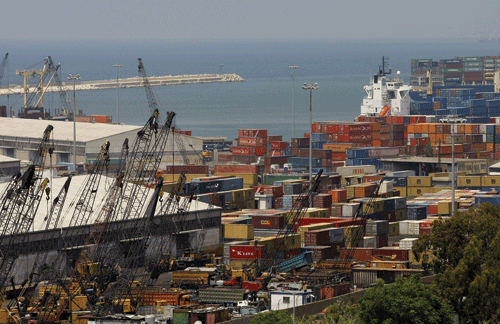
The Syrian government’s September 22 decision to impose a ban on all imports carrying a tariff rate of 5 percent or more — and the reversal of that measure less than two weeks later — have created a crisis of confidence across the local business community and a sense that the authorities have little idea how to handle the country’s economic woes.

Seven months of popular protests across Syria have taken a significant toll on business activity, frightening off investors and tourists, enticing locals to stash their savings and leading to international sanctions on key sectors and actors in the economy. The confusion over the import restrictions has only reinforced a general feeling of malaise and darkened the prospects for the near future.  This partial ban, Syrians were initially told, would help save scarce foreign currency reserves and support local manufacturers who had been negatively affected by the free trade policies of the past decade. In press statements, Adib Mayaleh, governor of the central bank, claimed that the ban would generate $6 billion in annual foreign currency savings, $4.5 billion of which would come from car imports alone.

However, the government acted hurriedly and with little consultation, leading to a general outcry that forced it to reverse the measure on October 4. The strength of the opposition from the business community and the fact that it managed to deal a blow to the government and its credibility — already much affected by its dismal management of the economy in recent months — are a reflection of the changes that have taken place in the Syrian economy in the last decade.

While until the late 1990s Syria relied on local production and was largely closed to international trade, the need to attract foreign investors and to integrate more with the outside world saw a gradual easing of the country’s protectionist policies from the early 2000s.

The Greater Arab Free Trade Area agreement, which liberalized trade among the 18 member countries, came into force in 2005 and a free trade deal with Turkey was established in 2007. Tariff duties on imports from countries around the globe were also lowered, including for consumer items such as cars and garments.

This policy had a direct consequence on the structure of the economy: in 2000, imports represented the equivalent of 18 percent of GDP, rising to 26 percent by 2009; exclude inflation over the past decade and this number would be 46 percent. Meanwhile, bilateral trade with Turkey tripled in less than four years, from $800 million in 2006 to $2.5 billion in 2010. This boom in imports helped spur the development of broad sectors of the economy — including retail trade, banking, insurance, transport and logistics and commercial real estate — which were among the main contributors of economic growth in the last decade. A whole new category of businessmen, from wholesalers to local agents of international brands, saw their wealth jump and their influence increase.

Thus, it is not surprising that among the list of more than a dozen businessmen that have been put under sanctions by the European Union and the United States in the last few months one will find Emad Ghraiwati, the agent for Kia, Ford and Jaguar cars and for LG Electronics, Samir Hassan, partner of Lebanon’s Fattal Group in the consumer goods distribution company UniSyria and Tarif al-Akhras, one of the country’s largest importers of food commodities.

Still, the confusion over the import ban has raised all sorts of questions. Until now the government had claimed that its foreign currency position was stable and had not been affected by the political turmoil. If this is the case then why did it decide to impose a cap on imports in the first place? Now that import taxes have been liberalized again, where is the government going to find the $6 billion in savings? Also, if the measure was initially aimed at helping local manufacturers does its reversal mean that the priorities have changed?

The only certainty that has come out of this debacle is that the government has no strategic plan to rescue Syria’s floundering economy.


JIHAD YAZIGI is editor-in-chief of The Syria Report

November 3, 2011 0 comments
0 FacebookTwitterPinterestEmail
Economics & Policy

Where politics becomes personal

by Executive Staff November 3, 2011
written by Executive Staff

The government’s endorsement of a plan to increase the minimum wage from LL500,000 ($333) to LL700,000 ($467), accompanied by salary hikes for those earning up to LL1.8 million ($1200), gave rise to a fierce cacophony of debate. The claims and counterclaims pit different interest groups against one another, with arguments that the government has gone too far, not gone far enough or simply gone the wrong way.

The impassioned reactions are predictable for the simple reason that this policy will directly line and lighten the pockets of employees and their employers, respectively.

The worker

Iktimal Halawi, an English teacher in an intermediate level school in Nabatiyeh, earns a monthly salary of LL580,000 ($387).

“This is absolutely insufficient for us to live off,” she says. Iktimal argues the minimum wage does not amount to a living wage, adding that, “We can say now we are already living at the minimum level.”

Halawi stands in a more fortunate position than many other employees on similar earnings. Her husband is an employee in a bank and takes home some LL1 million ($667) every month. The family home — where they live with their three young children — was also built before they were married, sparing them the burden of rent. “If we had to pay rent I really don’t know how we would live,” adds Halawi. Nonetheless, she claims it is a constant struggle to balance the books without dipping into the red.

Food bills alone consume nearly half of their monthly income and then they pay LL100,000 ($67) for electricity, LL70,000 ($47) for phones, LL250,000 ($167) for gasoline, LL150,000 ($100) for school transport and LL150,000 ($100) in school fees. Consumer goods are almost always purchased on credit and they currently pay LL100,000 ($67) every month towards their TV and washing machine. This leaves them with little left over for unforeseen expenses such as household repairs or medical expenses.

“If something unexpected happens then we have to take a loan from friends or family in order to manage,” says Halawi. “We depend a lot on friends and family and the extended community.”

Whilst low-income employees understandably call for a rise in their pay packets, many business owners have been quick to argue that the stipulated rise in wages will increase unemployment, thwart growth and exacerbate Lebanon’s already high rate of inflation.

The employer

Hussein Sabaagh opened his restaurant, Istambuli, in Hamra, Beirut in 1970. He rode out the tumultuous years of the civil war and then enjoyed a relatively successful period, but he is now struggling to keep afloat. “I cannot afford to pay them anything extra,” argues Sabaagh about his team of staff. 

He says his monthly payroll expenses amount to LL30 million ($20,000), approximately 30 percent of his operating costs that also include LL2 million ($1,333) for electricity, LL1.25 million ($833) for rent and LL45 million  ($49,333) for food and drink.

“There are no profits, only losses,” sighs Sabaagh, but he would only elaborate as far as saying; “let’s just say times are hard.”

Amongst his staff he has five employees on minimum wage and the highest paid member of staff takes home LL1.5 million ($1000) every month. As such all of Sabaagh’s employees will be affected by the new wage legislation, which stipulates an increase of LL200,000 ($133) for those earning less than LL1 million and an increase of LL300,000 ($200) for those earning between LL1 million ($667) and LL1.8 million ($1,200). He argues that enforced wage increases would result in him having to close the business; his staff would not be earning more but rather they would be unemployed.

Sabaagh says he believes that it would be near impossible to recoup the extra costs incurred by charging his customers higher prices because they are already too high. 

“The food is already expensive, if I increase the prices then who is going to come and pay?” he asks.

The informal sector

Whilst the calculations regarding a rise in the minimum wage by low-income employees and their employers are relatively straightforward, the considerations for those working in the informal sector are no so clear-cut.

“This talk of increasing the minimum wage is a sin. You enter into a vicious circle; you take the increase but you have to pay for it because prices also rise, so in the end your standard of living doesn’t increase,” argues one low-paid worker who wanted to remain anonymous.

As an employee in a printing press that is not registered with social security his employment is off the record, and consequently his income of LL1.5 million ($1,000) per month is out of the purview of the state. His wife, who also asked not to be named, works as a house cleaner.

“I can take between $30 to $35 (LL45,000 to LL52,500) in a day but I won’t benefit [from an increase in the minimum wage] because I am self-employed,” she points out.

The couple claim their combined income is just enough to cover essential expenditures for their life in Beirut’s southern suburbs. Their primary concern is that an increase in the minimum wage will translate directly into a rise in prices. As they would not be protected by any stipulated wage increases, a hike in prices would in real terms amount to a fall in their standards of living. The inflationary pressures of a higher minimum wage are clearly a concern for policy maker and house cleaner alike. 

Her  husband agrees that it is important to increase the standard of living for low-income earners, but frets that a higher minimum wage would actually harm many of the most vulnerable members of society. As an alternative method to ease the financial burden felt among the poor and vulnerable he argues for a more progressive tax system: “Get rid of the indirect taxes such as the taxes on petrol or other fuels.  Someone who earns millions of dollars pays the same for a tank of petrol as me.  There should be more direct taxes on people’s incomes.”

The government

As with any new laws it is their enforcement that determines whether they will have any meaningful impact. This is not an issue with regards to the public sector in the case of the new minimum wage legislation, but the state’s ability and determination to enforce the new wage levels in the private sector is not so clear. 

“There are lots of companies now that are not paying the minimum wage,” says the printing press worker. “You can take or leave the wages because there are plenty of others who will take your place.”

Sabaagh, from Istambuli Restaurant, reasons that the problem is not just a case of ineffective government enforcement but also an unhealthy and distrusting relationship between the citizen and the government. 

“In other places the citizens are loyal to the state and the state is loyal to the people and therefore there is honesty,” he argues, before later adding, “sometimes when you are honest it is like grabbing hold of burning embers.”

In view of these conflicting interests it is little surprise that the government was berated from all quarters when it unveiled the new minimum wage legislation. With business leaders and various factions of the labor movement challenging the proposals, albeit for different reasons, the lawmakers seem to have made few friends with the new wage proposal.

November 3, 2011 0 comments
0 FacebookTwitterPinterestEmail
Comment

Uprising incomplete

by Jonathan Wright November 3, 2011
written by Jonathan Wright

If Arabs used acronyms and abbreviations, Egyptians would be drowning in alphabet soup. With dozens of political parties registered, uniting in a bewildering array of fronts and alliances and then splitting at the last minute as member parties fall out over how to share parliamentary seats, Egyptians will have to navigate their way through a labyrinth of confusing names when they start voting in parliamentary elections on November 28.  As the deadline for nominations loomed, many alliances had still not stabilized and more and more parties decided to stand alone, even at the risk of ending up with few seats. No good opinion polls have come out in recent weeks, but Muslim Brotherhood candidates did perform well in elections for the Doctors’ Syndicate in October, suggesting the movement is still strong in professional middle-class circles.

Political fragmentation is only to be expected after the January uprising opened the floodgates to pluralism; in the first elections in Spain after the death of Francisco Franco, more than 60 parties were on the ballot, though only six of them ended up with more than two percent of the popular vote. In the case of Egypt, other factors have contributed to a widespread sense of uncertainty and an atmosphere conducive to conspiracy theories, especially the indecisive and unimaginative performance by the Supreme Council of the Armed Forces, which has been running the country since President Hosni Mubarak stepped down on February 11.

The generals have alienated liberals and leftists by their law-and-order mentality and their reluctance to adopt the revolutionaries’ agenda, especially on human rights issues such as ending military trials for civilian protesters. The slogan: “The people want to overthrow the field marshal (interim head of state Mohamed Hussein Tantawi)” is common at the dwindling demonstrations. The generals’ refusal to allow an independent external inquiry into the killing of 25 people, mostly Coptic Christian protesters, outside the state television building on October 9, has added to the disenchantment among the politicized elite. Despite overwhelming evidence that armed thugs initiated the attacks on the Christian protesters, leading to deadly clashes between the Christians and the army, the military council has thrown no light on who the thugs might have been or who might have mobilized them. The generals have also done nothing so far to meet demands that members of Mubarak’s disbanded National Democratic Party be disqualified from standing in the elections, despite repeated reports that the military council is about to issue a decree addressing that demand. The NDP’s many opponents naturally suspect the generals have a secret agenda to preserve as much of the old regime as they can.

Even the Muslim Brotherhood and other Islamist groups, generally seen as more sympathetic to the generals, have put the military on notice that they must give way to an elected civilian government as soon as possible. The economy is stagnant as tourists and foreign investors stay away, worried by the political instability and the sporadic incidents of civil unrest, which the demoralized police force is unable or unwilling to prevent. Even if the parliamentary elections go smoothly and produce a new cabinet with a popular mandate, the generals plan to stay around until the parliament approves a new constitution and presidential elections take place, possibly in late 2012 or early 2013. Then another battle will loom — over how to subject the military to permanent oversight by civilian politicians who owe the army no special favors. For 60 years the Egyptian military has been immune from scrutiny. Parliament never saw or approved its budget and did not have the authority to investigate its extensive business dealings, which helped to make many generals very wealthy men. The head of state came from within the military establishment and had no incentive to change the system. That will have to change if Egyptians finally have an elected civilian leader who wants to govern the whole country and turn Egypt into a modern democracy.

But as the Turkish example has shown, taming a powerful military with a history of political influence behind the scenes can be the work of a generation. And as in Turkey, perhaps only a popular movement from an Islamist background will be capable of clipping the military’s wings without provoking the generals back into politics.


JONATHAN WRIGHT is managing editor of Arab Media and Society

November 3, 2011 0 comments
0 FacebookTwitterPinterestEmail
Economics & Policy

An arbitrary approach to minimum wage

by Executive Staff November 3, 2011
written by Executive Staff

Few would disagree that the minimum wage in Lebanon needs to increase to help the poorest socio-economic segment of the population better meet the rising cost of living. And while raising the minimum wage in any country would have hints of populist politics involved, the more well-functioning governments around the world would also base their decision, at least in part, on some sort of economic analysis and wider strategy for greater general prosperity and growth. Lebanon, unfortunately, is not one of these well-functioning places. 

As Executive went to print the minimum wage stood at LL500,000 ($330) per month, a level it reached after being hiked by LL200,000 ($132) in 2008; before that the last time the government addressed the minimum wage was in 1996. Last month the cabinet again decided to raise the minimum wage after a last minute deal was struck with the General Labor Confederation (GLC), the country’s largest collective union of workers, on the eve of an October 12 strike where they planned to demand that the minimum wage be raised 250 percent, to LL1,250,000 ($830).

“It’s normal that the unions and syndicates ask for more to get less,” said Jad Chaaban, acting president of the Lebanese Economics Association (LEA).

And less was what they got. In the end the parties agreed to raise the minimum wage by 40 percent, to LL700,000 ($464) per month, for every worker currently earning less than LL1,000,000 ($663) each month. For those making between LL1,000,000 and LL1,800,000 ($1,194) per month, salaries would increase by LL300,000 ($199), as well as raising the transportation allowance from LL8,000 ($5) per day to LL10,000 ($6) and raising the education allowance cap to LL1,500,000 ($995). The adjustments will not be retroactive and are slated to come into effect for the private sector when they are published in the Official Gazette, something that had yet to happen as Executive went to print. For the public sector, any adjustment will require a law to be passed by parliament.

While the decree averted a general strike that Finance Minister Mohamad Safadi claimed would have been used by a “fifth column” to spur riots in the country, everyone from the labor unions to private sector committees cried foul as soon as it was announced. The teachers union held a nation-wide strike on October 19, declaring the decree “humiliating”, stating it was not enough and deriding the upper-end limit of the wage increase. The Secretariat General of Catholic Schools also lashed out from the employers’ side, stating that tuition would be increased by LL1,000,000 ($663) per student if the measure came into effect. Private sector leaders condemned the decision, saying it was not based on economic analysis, declaring they would refuse to apply it. Instead they would wage an “economic protest”, according to Adnan Kassar, head of the Economic Committees, the largest umbrella association of private sector committees. He added, “The problem is not minimum wage… it’s economic policy.”

No growth, no salary

Put into the context of low growth, the proposed increase in minimum wage would spur a period of stagflation (high inflation and unemployment coupled with low growth), according to Neemat Frem, president of the Association of Lebanese Industrialists (ALI) and chief executive officer at Indevco Group, one of Lebanon’s largest industrial employers. While Frem admits the changes would impact only 5 percent of the workers at his company, he says the effects on industrial production, a naturally labor intensive sector, would be “a disaster”.

“In this low growth environment where we are staying for a while, businesses will have to lay off people,” said Nasib Ghobril, head of economic research and analysis at Byblos Bank group.

Charles Arbid, president of the Lebanese Franchise Association (LFA) and owner of the Rectangle Jaune brand, estimated that his costs would increase by 15 to 20 percent as a result of the plans. “The premier effect of this decision will be on the competitive ability of Lebanese production and competitive advantage and the internal market movement that affects the situation of organizations,” he said.

The effect on different sectors is not yet clear as the government still does not have the administrative capability to monitor wage levels, due mainly to a lack of comprehensive research.

“First of all there is no labor survey so there is no basis to request this kind of hike,” said Ghobril. “Then you need an employer survey, an expenditure survey, a new household survey, labor market conditions and wage distribution, none of which are available and from what is available, none have been updated. You cannot automatically ask for something like this when businesses have high operating costs and the economy is slowing down,” he said, stating that a minimum wage of $500 would be “reasonable” if operating costs on businesses, such as electricity and telecommunications, were reduced by the government.

The only indication of the cost of raising the minimum wage on businesses presently is a preliminary study released in September by the actuarial firm Muhanna & Co. The study is based on wage statistics from the National Social Security Fund and “many other databases” according to the company’s managing director, Ibrahim Muhanna. With these statistics its calculations are for a minimum wage increase to LL1,250,000 — what the GLC was initially requesting. That, the report states, would increase average salaries in Lebanon 52 percent, while in the educational and health sectors operating costs — of which labor accounts for about half of the total — would increase as much as 36 percent.

Given that the 250 percent rise in the minimum wage demanded by the GLC was slashed to 40 percent, these kinds of numbers will not become a reality for businesses any time soon. Indeed, Muhanna’s study advises wages be benchmarked to incomes of those who live around the poverty line ($4 per day) and thus reached a conclusion that minimum wage should be raised to around $500 per month, along with subsidies and reforms in water, electricity and public transport, somewhat in line with what was decided by the government.

While the proposed increase may, therefore, be in line with what several experts believe to be a fair wage level, the matter of timing seems to have been disregarded by policy-makers. “Raising the minimum wage reasonably and gradually is fine, and it should be planned ahead,” said Muhanna. “It’s these offshoot raises that create a problem. People don’t have budgets for a 40 percent rise. This is not acceptable.”

No growth, loads of bloat

Last month the finance minister announced that the first six months of the year saw zero economic growth, while his expectation for the end of the year was a figure of around 2 percent. Other organizations have been less optimistic, with growth estimates from the International Monetary Fund and the Economist Intelligence Unit of 1.5 percent and 1.3 percent, respectively. Next year many, including the finance minister, predict that growth will rebound to around 4 percent. Where that recovery will come from remains a mystery to many such as Nicolas Chammas, president of the Beirut Traders Association.

“On what basis do they predict growth in 2012? We have to accept that we are in a recession. When you are increasing salaries in a recession you are going to have stagflation, you are going to lose jobs and the non-salary wage earners are going to be cornered which will create political instability,” said Frem. “This is a classical formula to go to hell.”

Indeed, any pay raise will not affect those who are self-employed or work in the informal sector. According to a leaked World Bank labor study obtained by Executive, the informal sector, composed of  “self-employed low-skilled workers” and “informal wage employees” make up 35 percent of the workforce and are automatically ineligible for the wage rise. Another 20 percent of the labor force is categorized as “self-employed high skilled workers,” 11 percent unemployed (versus the 9.2 percent figure posited by the government) and 5 percent classified as employers; none of whom will see any benefit from increased minimum wage. That leaves 29 percent of the workforce — in both the public and private sectors — that would directly benefit.

In the private sector double bookkeeping is rampant because companies have an interest in under-reporting wages so as not to pay more in social security contributions, according to Chaaban. Muhanna believes that if the minimum wage hike is passed as it is, this dodgy bookkeeping will “definitely increase,” as employers refuse to implement the increase.

The main beneficiaries of the increase would thus be workers in Lebanon’s public sector, bloated from its abuse by political leaders as a tool for patronage. This will cost the government at least another $700 million, according to the finance minister last month.

“Today our deficit is around 10 percent of GDP… If all the taxes [in the new budget proposal] are voted for, which it doesn’t seem that they will be, with the salary increase we will go to 12 percent,” said ALI’s Frem, “This is completely crazy.”

The increase in wages in the public sector would raise the total deficit from 29 percent of expenditure to at least 33 percent, supposing that all the increased taxes contained in the 2012 budget proposal are passed by both the cabinet and the parliament, something that has no recent historical precedent. 

“There are dozens of empty posts in the government and instead of consolidating organizational structures, like the private sector does to recruit less, [politicians] are competing amongst each other to recruit their own people,” said Ghobril. “There is no political will to tackle things seriously, [the government] goes straight to taxation and minimum wage and populist approaches.”

Pricey plans

What must also be taken into account is that the latest budget proposal seeks to increase value added tax (VAT) from 10 percent to 12 percent.

“The major problem here is when you increase the indirect tax that is borne by everyone, most probably the effect of the wage increase is wiped out,” said Chaaban. “The solution is to increase taxes on the richest bracket but the current political class will not do it because they don’t have an interest in doing so. They are not going to make a law to tax themselves.”

Increases in wages and VAT automatically also have an inflationary effect, which would eat into growth prospects. The 2012 proposed budget predicts economic expansion of 4 percent with an inflation rate of 5 percent, but that does not factor in the inflationary impact of the wage increase.

“Things will become more expensive, people will consume less and government revenues from VAT will decrease with time,” said Ghobril.

Time to talk

The unscientific manner in which the minimum wage decision was made has prompted many to urge cooler heads to prevail. The Economic Committees stress that they want to open up a dialogue with the government while at the same time threatening to go to the Shura Council, Lebanon’s highest court, to recall the minimum wage decision.

Chammas argues the dialogue should focus on how to spur economic growth and how to increase government support to the private sector in the form of subsidies. The committees countered the government’s minimum wage decision by stating they are willing to raise the minimum wage by the 16 percent official inflation rate published by the Central Administration for Statistics, bringing the total wage level to LL580,000 ($385). That is not likely to appease the labor unions but Chammas also stated that he would be in favor of raising the minimum wage level every year based on inflation.  

For the government’s part, Finance Minister Safadi stated last month there are three conditions to raising the minimum wage: that it is not eaten up by inflation, subsidies must be given to “certain products for certain needy people” and a long-awaited competition law dealing with monopolistic behavior must be issued by parliament.

That, along with exclusive agencies, is something that many business owners who operate in such an environment will be loathe to accept. Chammas, who is the exclusive agent for the Chanel brand, does not believe that businesses should compete with each other over the same brand but rather between brands, as this allows for economies of scale.

Others are more willing to compromise given that they are asking the government to completely rethink their economic policy before raising wages.

“We can’t just think about wages, we need to think about the chronic problems of the Lebanese economy, our competitiveness; we want more than a complete economic policy; we want a new social contract,” said the LFA’s Arbid. “We need all the pending laws such as this to be issued and implemented. When we see that there is seriousness in the way we discuss and an intent to reform the laws, then industry will accommodate and we will start putting things back on the right track.”

If government does accept the private sector’s proposal in principle there will need to be a process by which those who speak on behalf of laborers and employers are selected, not to mention the input of economists. Such an initiative had yet to be announced as Executive went to print and the government itself was split over the issue of funding the Special Tribunal for Lebanon, much less discussing wages. The legal battle over the wage issue could take months and so could the political squabbling over the budget in both cabinet and parliament, meaning this issue is not likely to be resolved imminently.

“I want to see a day in Lebanon where politics is at the service of economics and not the other way around,” said Frem. “It just so happens that today the politicians are using very dangerous tools of economic fundamentals in their political games. And this is nothing less than collective suicide.”

November 3, 2011 0 comments
0 FacebookTwitterPinterestEmail
Comment

Shooting blind, from the hip

by Yasser Akkaoui November 3, 2011
written by Yasser Akkaoui

The current Lebanese government is, in economic terms, as dangerous as a blind man with a loaded gun and an itchy trigger finger.

To date, it has shown little to no leadership in guiding Lebanon’s floundering economy back to prosperity, offering no comprehensive strategy to promote sustainable growth across the different job-creating industries — be they financial, service-related, manufacturing or agricultural. Instead what the government has offered is ill-considered, quick-fix patches. Cabinet’s commitment last month to raise wages for workers in lower income brackets by an arbitrary amount would be in the same category, if it were not also actually counter-productive to the ends it is purportedly trying to meet.   

Let’s be clear: With the rising prices it has become effectively impossible to achieve a decent standard of living earning the current minimum wage. However, the equation for setting the new optimal minimum wage requires knowing a few basic numbers ­— none of which the government has: It has developed no capacity to monitor wage rates or income distribution across the country, has no labor force or household surveys and no employer surveys. In other words the government has no idea what the optimal wage increase would be, and no clue as to the impact of its proposed minimum wage increase on either employees or employers.

Concurrently, since the beginning of this new government’s term, the country has experienced zero economic growth, meaning private sector businesses are already struggling. Forcing them to raise wages 40 percent overnight without offering the prospect of recouping these costs through new growth will result in employee layoffs and employer insolvencies.

This country should not have its major policy decisions taken by shoot-from-the-hip politicians who haven’t the faintest idea what they are aiming at.

November 3, 2011 0 comments
0 FacebookTwitterPinterestEmail
Finance

Rolling out the net of risk management

by Executive Staff November 3, 2011
written by Executive Staff

Lebanon’s insurance sector is approaching, ever so slowly, a time where global and regional macroeconomic enablers could provide the scale of economics that the industry has been chasing unsuccessfully for at least a decade. 

Driven by the tectonic shift from developed insurance markets into emerging ones, the most optimistic forecasters hope for an increase of about 150 percent in domestic insurance penetration in the coming years, a leap forward in the use of insurance as risk management in financial markets and a surge in Arab and Muslim interest in insurance through social media and networking.     

Scenarios for global insurance migration from saturated developed markets to those less well served are being discussed in the consulting houses trying to plot a future for the industry. A current study by PricewaterhouseCoopers (PwC) on the insurance industry predicts that in 2020 the big changes experienced by the sector in the early 21st century are likely to accelerate further in the next decade. It argues these will bring ‘STEEP’ changes, meaning “Social, Technical, Environmental, Economic and Political”.

In the Middle East and North Africa (MENA) one is inclined to add demographics to the list of agents of change that could boost the regional insurance industry from its current status as the least successful market in the world, in terms of average spending on insurance.

While the industrialized countries still accounted for 85 percent of global insurance premiums in 2010 — $3.69 trillion versus $650 billion in emerging markets — the double-digit growth outside the industrialized markets has finally made a noticeable dent in that disparity. According to the Sigma report by global reinsurance firm Swiss Re, the share of emerging markets in global premiums last year grew by two full percentage points to 15 percent of worldwide insurance spending.

Yet it is still clear that the entire non-industrialized world is under-insured when compared with the insurance penetration range of between six and 13 percent in individual industrialized countries.

Expressed in total share of gross domestic product, the gap between individual MENA countries and the world average of 6.9 percent spans from four to over six percentage points, depending on which MENA country is reviewed. Lebanon ranks among the leaders in insurance penetration in MENA.

Yet this gap has not drastically diminished in the past decade and other MENA countries have generally recorded only minute annual improvements in insurance penetration. For positive business thinkers, the long-term perspective on being the global insurance laggards cannot but translate into a possible space for growth. The search is on for new opportunities where regional insurers can branch out and balloon their business.

Credit lines and risk management

One very interesting range of activity in times of global turmoil and regionally peaking political risk is credit insurance, yet it must be examined with care. Although a simple sounding term, it can refer to two very different financial safeguards.

The first one, better called consumer or retail credit insurance, describes policies that consumers buy to protect themselves against the eventuality of defaulting on payments for their Bahaman vacation loan, or for the 144-piece Louis XIV-style Christofle silverware they bought on the eve of the latest financial crisis in 72 installments of $700 each.

The second one, which is specified as trade or business credit insurance, is a risk management cover that a trading, manufacturing or services company obtains to insure receivables from its business partners.

What both credit insurance variants have in common is that they are extremely hard to find in the MENA.

“We are most probably the only private entity in Lebanon and the Middle East that does the business we do,” says Karim Nasrallah, general manager of the Lebanese Credit Insurer (LCI), a Beirut-based trade credit insurance specialist whose policies are tailored to cover international and domestic receivables for mainly MENA-based, corporate clients with invoice periods extending up to six months.

According to other senior Lebanese insurance managers, the coverage of credit risk is an activity for very few specialists. “The market of credit insurance can show growth but the actors are very rare and they are very specialized people,” Elie Nasnas, general manager of AXA Middle East Insurance, tells Executive.

In his view, trade credit insurance growth would not lead to a wide increase in the commodity most sought-after by the local insurance community — insurance awareness among the customer base. For Nasnas, “The people targeted by credit insurance are already tuned in to insurance. It might generate some business but it won’t spread insurance awareness.”

Credit insurance is a field where established companies focusing on the provision of general insurance services will not easily find opportunities, agrees Max Zaccar, chairman and general manager of Commercial Insurance. Before advanced insurance and risk management products can be viable in the Lebanese market, Zaccar believes the companies must first obtain the standard covers that they are often dodging today, in areas such as liability or other employee-related insurance.

Such experience-based reservations reflect the fact that financial insurance and other sophisticated insurance products have long faced hurdles of viability in the small Lebanese market.

The reservations do not imply that ideas such as consumer credit insurance should be written off here. Yet before insurance for retail credit contracts and other financing agreements can be considered a serious tool for protection against individual or business bankruptcy, changes will have to be implemented in a number of areas.

Firstly on the legislative and regulatory side of banking, credit check and consumer protection will have to be brought up to international standards. Secondly, changes must occur in the mindsets and expectations of business people, consumers and consumer advocates, by way of embedding awareness that an insurance contract is mutually based on the insurer’s diligence in servicing his policy obligations and the insured’s prudent efforts to avoid careless or even reckless handling of risks.    

According to Nasrallah, the business of trade credit insurance, while admittedly a niche product, has yielded excellent performances in the past three to four years. He tells Executive that LCI has been growing annually at percentage rates in the high double digits over the past three years, including a doubling of results from 2009 to 2010.

Therefore LCI’s exposure to risk has been increasing but it is not a reason to worry the insurer whose business it is to accept and manage corporate risk. “Any day when I go to sleep at night I go to bed with about $350 million to $360 million at risk, which represents a turnover of almost $1 billion a year so far,” says Nasrallah. “We have risks in Syria, in Jordan, in Egypt and all what has been happening [in the region] has not really contributed to diminishing our risk appetite; however, we use a little more caution in the distribution of our insurance capacity.”

Buying trade credit insurance carries a relatively low cost but enables a manufacturer or trader to manage the risk of having to achieve new sales equal to a multiple of the profit that he foregoes when a buyer defaults. While corporations are more likely to use trade credit insurance than small firms or startups, Nasrallah thinks the service is neglected by corporations in the MENA.

“Credit insurance is a very interesting branch and the main obstacle to developing this branch is the lack of awareness,” he says, adding, “The awareness that we have to create is about the added value of credit insurance not only as a protection of receivables but also as a management and marketing tool.”

A handful of government-sponsored export credit agencies exist in the region and offer insurance backing for trade and investment deals that meet their usually narrow requirements. However, the risk management potential of this and other financial insurance specialty lines is hampered rather severely by the lack of focus on risk management in the region’s business community. According to surveys over the past five years, large numbers of corporate decision-makers regard insurance as a necessary evil more than as logical investment.    

An Arab insurance spring?

Looking further into the future for regional insurance companies, the shift from developed to emerging markets is highly probable. However, the shift of global insurance markets could happen in many ways, and those companies who want to benefit from new opportunities will have to be nimble and open to what could be some very specific concepts that turn their relations with customers upside-down.

In the PwC ‘Insurance 2020’ scenario paper, options for development in the next 10 years include the politico-economic consequences of a global downturn and a global recovery spearheaded by emerging markets. In other words, everything could happen, but in PwC’s view, today’s insurance companies will be strongly affected in at least three areas over the next few years and will need to adjust or wholly revamp their business models, their value chains and their talent management.

On the technical side, one PwC scenario postulates a shift of economic decision-making towards the customer, “with virtual social networks acting as trusted networks for insurance purchase or self-insurance.”

This suggests new realities in insurance marketing, realities that must benefit from the ideas and tools which the “Arab Spring” has come to be associated with. At a conference for Arab insurance brokers, held at the end of last month in Beirut, a youthful local insurance industry manager spoke about the idea.

According to Roger Zaccar, marketing manager of Lebanon’s Commercial Insurance, social media should have a marketing role for insurance in Arab countries and enable insurance providers, “…to understand what the consumer needs. Social media should act as a bridge between the insurance company and the consumers. It is a tool that gives consumers a voice and we are not listening. As insurance companies and banks we are not as active as we should be in social media,” he says.

As he presented the concept of social media as a crucial element in the interaction of insurance companies and clients, Taghreed Yehia, an equally youthful Egyptian insurance advisor, becomes enthused. “I have started to use interactive media because this makes the client open up and be more open-minded to communicate with the insurance company or broker freely and tell his opinions in a free way that can also make us reply in a free way that satisfies the client.”

In Yehia’s view, using social media will reduce fear barriers among the region’s insurance customers who have been turned off by pushy sellers. Yet she also warns that awareness of social networking “is not yet present in insurance companies. I started developing a personal interactive website and am going to publish this website shortly, aiming, inshallah, to have good responses from my clients. Most of my personal clients are waiting for such social media because it facilitates the communication between us.”

It is no surprise that the next generation of leaders in Arab insurance companies are excited about the potential for social networking in the industry. But it also begs the question on how much time will have to pass before an Arab insurance spring will see the light of day. For the moment at least, insurance companies in Lebanon — many of which 10 years ago said they embraced the idea of using online channels for insurance marketing — seem to have turned their online channels to low maintenance, as there is not a ‘tweet’ or Facebook link to be seen on many a provider’s website.

November 3, 2011 0 comments
0 FacebookTwitterPinterestEmail
Comment

Syria fires on a fickle border

by Nicholas Blanford November 3, 2011
written by Nicholas Blanford

Nasri Khoury, the long-serving head of the Lebanese-Syrian Higher Council, may have been a tad hasty in stating last month that the Syrian army “has not made any incursions onto Lebanese territory” and that the town of Arsal in the eastern Bekaa might in fact be in Syria rather than Lebanon.

First of all, despite the declared withdrawal of Syrian forces from Lebanon in April 2005, there remains a large number of Syrian troops in the hills south of Deir Al Ashayer and east of Kfar Qouk in the district of Western Bekaa. The locations of these Syrian military positions are clearly visible on Google Earth. The United Nations team charged with confirming the withdrawal of Syrian troops noted in its May 2005 report that there was a discrepancy over the delineation of the Lebanon-Syria border south of Deir Al Ashayer.

“As a result, the team was unable to verify whether the Syrian military unit in the Deir Al Ashayer area was in Syrian or Lebanese territory,” the report concluded.

Days before the UN issued its report, I was invited by a congenial Syrian officer onto the battalion-sized army base at Deir Al Ashayer to examine his military map to prove his contention that the location was inside Syria. According to his map we were indeed some 150 meters inside Syrian territory.

But Lebanese army maps, standard international maps of Lebanon and the claims of Deir Al Ashayer’s residents placed the officer and his men approximately one kilometer inside Lebanon. The issue has never been resolved between Beirut and Damascus, so the Syrian troops remain billeted in the hills between Deir Al Ashayer and Kfar Qouk and Lebanese army checkpoints prevent anyone going too close to the area.

Khoury’s other contention — that Arsal lies inside Syria — is manifestly incorrect. Arsal lies approximately 15 kilometers west of the border. The border in this remote tract of the frontier is supposed to follow the watershed of the Anti-Lebanon Mountains. However, the border east of Arsal has long been a zone of confrontation between Lebanese and Syrian farmers, the latter having encroached onto Lebanese territory to grow orchards of apricots and almonds on the barren western slopes of the mountains.

In early October, Syrian troops probed up to five kilometers into Lebanese territory east of Arsal, according to local residents. One Syrian was killed and a building attacked during the cross-border forays. On a recent trip to Arsal, I could go no further east than the isolated farmsteads five kilometers short of the border because local residents said it was too dangerous due to the Syrian soldiers in the area.

The residents believe that the incursions are due to Syrian concerns that arms are being smuggled from Lebanon through the rugged mountains into Syria. Certainly, the Sunni residents of Arsal do not disguise their hostility toward the regime of Bashar al-Assad and support for the opposition protest movement. Furthermore, smuggling is a way of life for Arsal, like many other villages along the eastern border. But smuggling goods — be it diesel, cement or weapons — across this section of the border is only really possible with the cooperation of both Lebanese and Syrian parties. The barren nature of the terrain east of Arsal and the long distances involved (unlike the northern border where a 10-second stroll through the ankle-deep water of the Kabir River takes you from one country to the other) would make smuggling hazardous if Syria chose to seal the border and deploy troops.

The crackdown by Syrian security forces in mid-October in the area south of Homs, 30 kilometers north of the border with Lebanon, gave rise to further reports of cross-border incursions, this time in the Qaa Projects near the Qaa-Jusiyah frontier crossing, a Sunni-populated area where sympathies for the Syrian opposition run deep.

Anecdotally at least, arms smuggling from Lebanon to Syria is increasing, although it still appears to be on an individual basis rather than a more organized transfer of arms. The bulk of the smuggling occurs in Sunni-populated areas along the border, the north in particular. The escalating arms smuggling and the porosity of an ill-defined border suggest that Syrian army incursions into Lebanon will continue as the uprising in Syria intensifies and grows more violent.


NICHOLAS BLANFORD is the Beirut-based correspondent for The Christian Science Monitor and The Times of London. His book “Warriors of God: Inside Hezbollah’s Thirty-Year Struggle Against Israel” was published by Random House in October

November 3, 2011 0 comments
0 FacebookTwitterPinterestEmail
Economics & Policy

For your information

by Executive Editors October 24, 2011
written by Executive Editors

Low growth, higher debt

The prospects of a second-half economic rebound appear dimmer than ever as Lebanon rounds out the third quarter, with predictions for gross domestic product (GDP) growth in 2011 from several economic institutions looking grim. According to the Economist Intelligence Unit (EIU), the country’s economy will expand by just 1.3 percent, representing a drastic drop in anticipated growth, from 4.6 percent in April. The EIU maintained its 3.6 percent GDP growth outlook for 2012. The agency cited several reasons for the revision, including the usual political instability in the country and elsewhere in the region. The report stated that while it believed reforms would occur due to relative accord within the cabinet, they would be slow to take effect as corruption, patronage and an over-bloated public sector prevent further economic growth. Barclays Capital also predicted economic growth in 2011 to come in at just 1.8 percent because of spillover effects from the Syrian uprising and a weakening services sector. Barclays said that the deficit this year should stay at around 7.6 percent of GDP, but a 15 percent expected increase in expenditures next year will have a harrowing effect on debt dynamics as the predicted deficit widens to 8.5 percent. The International Monetary Fund  (IMF) also weighed in with a projected growth figure of 1.5 percent, granting Lebanon the honor of the 16th slowest growth rate in the world. The IMF said that in the region Lebanon would come ahead of just Egypt and Tunisia in growth rates. Standard Chartered Bank also revised its previous 3 percent growth forecast downward to 1.5 percent.

Lebanon a little less risky

Lebanon has marginally improved its risk profile, if only in comparison to the rest of the Middle East. According to Euromoney magazine, Lebanon ranked 82nd out of 184 countries in terms of its risk profile and 11th out of 20 in the region. The rank is a 10-spot improvement on the June 2011 global rankings and represents the biggest leap in the region. The rankings were based on six weighted indicators: political risks (30 percent), economic performance (30 percent), access to bank finance and capital markets (10 percent), debt indicators (10 percent), credit ratings (10 percent) and a structural assessment (10 percent). Political risk declined by 1.3 percent since June, while Lebanon’s access to bank finance and capital markets rating increased by a whopping 288.7 percent.

Sharpening the stats

In an attempt to partially rectify the endemic lack of credible and timely data, the Central Administration for Statistics (CAS), Lebanon’s public bureau of statistics, is launching a new project that will form the basis of economic projections for some time to come. Last month the CAS announced that it will launch the National Household Budget Survey for 2011, the first such poll since 2004. The survey will cover a sampling of 4,000 households in cooperation with the World Bank and will quantify several elements related to the social, economic and demographic development in the country. The results will help assess poverty levels and provide a basis for updating the weights on different products used in the compilation of the consumer price index, the main indicator of inflation. Moreover, the survey will give a more accurate and timely reading on labor and unemployment levels.

Subsidy deal staves off strike

A nationwide strike by public transport sector workers was called off last month after a late-night deal to implement a subsidy for the drivers, which was agreed to during the previous cabinet’s term but never implemented. The subsidy will be doled out once a month and will cover the equivalent of 12.5 jerry cans (1 jerry can = 20 liters) of gas to around 40,000 licensed taxi drivers, as well as to an undisclosed number of truck drivers. The subsidy will provide taxi drivers with a total of LL470,000 ($311.77) per month, and truck drivers will receive LL350,000 ($232.17) over the next three months. The move comes after a reduction on the gasoline excise duty by LL5000 ($3.30) in February to a total of LL4,530 [$3.02] per jerry can.

EEZ finally rubber stamped

After a long wait, the Lebanese government is one step closer to future offshore oil and gas exploration. Last month the cabinet signed off on the borders of Lebanon’s exclusive economic zone in the Mediterranean Sea, which was ratified by Parliament in August. The declared border puts the country at odds with Israel after the latter declared a different border demarcation earlier this year. The cabinet decision follows an agreement between Tel Aviv and Nicosia that adopted “Point 1” as the ending point for Israel’s proposed border with Lebanon, which starts in Ras Naqoura and ends 133 kilometers off the coast at an angle of 291 degrees. Lebanon also signed an agreement with Cyprus adopting “Point 1” but never ratified it in Parliament. The new law proposes an end point around 17 kilometers southwest of “Point 1”, which corresponds to Israel’s existing northernmost contract blocs — areas where oil and gas companies can come to explore and extract hydrocarbon resources. The difference of opinion has resulted in a disputed area of some 854 square kilometers and has fueled fears of potential conflict.

Improving irrigation

The ongoing issues over a lack of irrigation in Lebanon’s rural areas will be addressed after an agreement between the ministries of agriculture, energy and water, the United Nations Food and Agriculture Organization and the Italian government was inked last month. The agreement will see $370 million provided by the Italian government go towards the rehabilitation of outdated water networks. The project seeks to deliver water to about 15,000 hectares (150 square kilometers) over the next five years. Irrigation accounts for around 60 percent of Lebanon’s water demand.

EDL hemorrhages ever more

Transfers from the treasury to Electricité du Liban during the first half of the year came in at $684 million, a 22 percent increase on the first half of 2010, according to the finance ministry. The increase in transfers, said the ministry, is due to higher prices for fuel and increased payments to the Egyptian Natural Gas Holding Company (EGAS) for natural gas delivered via pipeline. Payments to Lebanon’s two fuel providers, the Kuwait Petroleum Corporation (KPC) and Algerian energy conglomerate Sonatrach, totaled $620 million, constituting 90.6 percent of payments, while $36.4 million, or 5.3 percent of payment, went to EGAS, with debt servicing accounting for the rest. According to the Finance Ministry, average oil prices increased for the first half of 2011 by 14 percent, along with a 10 percent increase in the quantity of imports.

Striking for a higher lowest pay

As a general strike planned for October 12, called for by the General Labor Confederation (GLC), Lebanon’s largest union, looms on the horizon, a report released by the consulting and actuarial firm Muhanna and Co outlined the effects of increasing the minimum wage to the GLC’s proposed LL1,250,000 [$829.18] per month from its current level of LL500,000 [$333.3]. The report outlined the potential consequences the increase could have on different sectors of the economy and found that the increase would raise labor costs the most in agriculture, with a projected 99 percent increase, though operating expenditure in the sector would rise just 15 percent. Other sectors would also be hit by rising labor and operating costs, such as banking and insurance (24 percent and 12 percent, respectively), construction (72 percent and 15 percent), education and health (72 percent and 36 percent), energy and water (32 percent and 2 percent), industry (67 percent and 11 percent), market services (49 percent and 29 percent), trade (64 percent and 26 percent) and transport and communication (44 percent and 9 percent). The report proposed that the minimum wage should be raised to 150 percent of the poverty line, or LL750,000 ($497.51) per month. The labor ministry has formed a committee to study the effects of a minimum wage increase while, as Executive went to print, negotiations with the GLC to avert the strike were ongoing. 

October 24, 2011 0 comments
0 FacebookTwitterPinterestEmail
Real estate

For your information

by Executive Editors October 24, 2011
written by Executive Editors

In District//S, size does matter

The developer behind the 22-building residential and retail community District//S in Beirut’s Saifi area has launched a new initiative to satisfy those looking for pied-à-terres in the city in September. The launch, at Lebanon’s DREAM exhibition in the Beirut International Exhibition and Leisure Center, unveiled the plan for 20 one and two-bedroom studios. The studio apartments will be fully furnished and serviced (cleaning, laundry, concierge service, gym access), with the local interior design firm Nabil Dada and Associates offering four schemes. All of the studios, ranging from 65 to 160 square meters, will be offered within one five-story building of District//S, according to Estates co-founder Anthony el-Khoury.  Namir Cortas, chief executive officer of Saifi Modern, owner of District//S and co-founder of Estates, told Executive that there could be more than 20 studios if there is more demand in the future. The price differential of the studios is about $1,500 more per square meter than the $7,000 per sqm starting price of other apartments in the development. “The price differential is our estimated cost for furnishing them and equipping them,” said Cortas. Studio construction is expected to be complete within four years, in line with the rest of the project.

DREAM goes green

London-based green-building consultancy firm, G, has partnered with 45 buildings in Lebanon to lead them to Leadership in Energy and Environmental Design (LEED) certification. Nader Nakib, chief executive officer of G, told Executive at the DREAM exhibition in Beirut that for the first time investing in green technology in Lebanon is worth it for developers. “The cost of going green for a first level certification is around 2 percent extra of the construction cost,” he said, adding “but the central bank subsidy allows for up to 45 percent of the construction cost at almost zero percent interest fee.” G is the LEED consultant for a number of developments in Lebanon, including Audi Plaza, Beirut Terraces, Beirut Waterfront, Beirut Harbor, Saifi 178, Verdun Hights, the ESCWA Building and most recently Saifi Gardens. In the District//S residential community, G will ensure rainwater collection techniques, the use of recycled material where possible and the use of environmentally friendly gases for ventilation and air conditioning systems. 

Real Estate branches out

Jouzour Loubnan, an environmental non-governmental organization working towards the restoration of Lebanese woodland, is partnering with both private developers and government municipalities to continue planting trees in Lebanon on government land.  Raoul Nehme, president of the organization, told Executive at the DREAM exhibition that, in addition to 38,000 trees already planted since 2007, the group hopes its partnership with developers like Estates and HAR Properties will mean an additional 35,000 trees planted this year alone. The programs with real estate developers, launched two months ago, mean that “for every meter squared built and sold, one meter squared of new forest area will be planted,” Nehme said. The 2011 budget for the group is $400,000 based on an average cost of $10 per tree planted. Phillippe Tabet, chief executive officer of HAR Properties, the developer behind the AYA building in Mar Mikhael and UPark building in Ashrafieh, said at the exhibition that HAR’s contract with Jouzour does not directly help sales but is still part of the group’s “dedication” to green building.

Rejuvenating Iraq’s housing stock

Iraq has the biggest shortage of affordable housing in the Middle East and North Africa (MENA) region after Egypt, with about a million homes needed to bridge the gap, according to a September Jones Lang LaSalle report for the MENA region entitled “Why Affordable Housing Matters”. The National Investment Commission in Iraq is to construct 1 million affordable houses, and up to 430,000 of them are expected to be completed by the end of the first quarter of 2012, according to the report.  In related news, Faleh al-Ammiri, under secretary of the Iraqi Ministry of Housing and Construction, told Gulf News in a September 16 interview that the National Housing Plan currently includes 30 projects where units are to be sold to nationals at cost price or below. He added that financing for real estate is still in its infancy: “We look forward to a time when the private banking system takes part in financing investment projects and the limited housing projects with the cooperation of the state’s ministries,” he said.

Jordan’s unpaid builders

Local contractors are owed $282 million by developers and public sector institutions, President of the Jordan Construction Contractors’ Association Ahmad Tarawneh claimed in September. Tarawneh told The Jordan Times that the gap would force contractors to lay off staff if payment is not received in the short term. He highlighted major Turkish developer GAMA, which is carrying out the Disi Water Conveyance Project, but claimed that other projects like Andalucia and Abdali Urban Regeneration Project also failed to pay local firms. “For the past two years, developers have been promising to pay their financial obligations to contractors, but nothing happened,” he said. In a September 12 statement to Construction Week Online, Yahya Kisbi, Jordanian minister of public works and housing, disputed the figures claiming the government only owes local contractors $70.6 million, with the Ministry of Planning and Internal Cooperations owing $29.6 million. In related news, an official at the Central Bank of Jordan told The Jordan Times in a September 13 article that the loans extended to the property sector reached 2.2 billion Jordanian dinars ($3.09 billion) by the end of July, or 12 percent of the overall deposits at local banks. Commenting on the figures, President of the Housing Investors Society Zuhair Omari said that the availability of this cash at the banks, coupled with the improved lending policies in the local banking sector, should galvanize the property market in the final quarter.

Riding the wave in Oman

Consolidated Contractors Company Oman, a subsidiary of CCC group, headquartered in Athens, has won the contracting tender to build the Omagine mixed-use development of residences, educational buildings, hotels and theme park along Muscat’s waterfront near Seeb Al Hail in Oman. The total cost of the project is $2.59 billion, which will see the US-based Omagine Inc. developers create an integrated touristic and residential area on more than 1 million square meters that will complement the upcoming The Wave touristic marina and retail center in the capital. A total of 2000 homes will be built around a marina, which will have an array of hotels and resorts ranging from three-star to five-star. The centerpiece of the development includes a cultural theme park that will feature exhibition buildings and an open-air amphitheatre. According to the Oman Daily Observer in a September 17 article, Omagine’s equity holding in the project is 60 percent, while newly formalized shareholders include the Office of Royal Court Affairs (25 percent), Consolidated Contractors Company SA (10 percent) and Consolidated Contractors Co Oman LLC (5 percent). CCC boasts a 120,000-strong workforce in the region and is already commissioned to several other projects in Oman.

October 24, 2011 0 comments
0 FacebookTwitterPinterestEmail
Banking & Finance

Lebanese capital markets

by Executive Editors October 24, 2011
written by Executive Editors

BLOM Stock Index (BSI)

Weighted effective yield of Eurobonds

Equity update

Persistent political unrest in the region and volatility in the international markets continued to have a negative impact on the Beirut Stock Exchange (BSE). The BLOM Stock Index (BSI), Lebanon’s equity gauge, followed a downward path between August 16 and September 16, 2011, to hit a 27-month low of 1,244 points. The BSI was down 4.7 percent on the previous month, extending its year-to-date retreat to 15.7 percent. The BSE witnessed a daily average volume per month of 182,811 shares, worth $1.71 million, during the four-week period of August 16 to September 16, as compared to 153,424 shares, valued at $1.74 million, over the preceding four-week period.

When compared to regional equity markets, the BSI underperformed the S&P Pan Arab Composite LargeMidCap Index and the Morgan Stanley Emerging Markets Index. The former inched up 0.3 percent to 107.3 points and the latter slipped 2.6 percent to 963.7 points as investors remained wary. 

During the period, banking stocks dominated on the BSE, accounting for 64 percent of the total value traded. BLOM Bank’s stocks witnessed a mixed performance, with its Global Depository Receipts (GDR) falling 4.4 percent to settle at $8.17 while BLOM listed stock advanced 2 percent to $8.19. Audi Bank’s GDR and listed stocks fell, with the former declining 5.2 percent to $6.82 and the latter falling 9.9 percent to $6.2, hitting their lowest level since the 10 to 1 split became effective in May 2010. Byblos Bank’s common stock retreated as well, inching down 0.6 percent to $1.65, whereas Bank BEMO stocks slipped by 6.2 percent to an all-time low of $2.57. Bank of Beirut’s  common stock reached a peak of $20 on September 9 before ending at $19.26 on September 16, still 1.4 percent higher than its close on August 12. With regard to preferred stocks, Byblos preferred 2008 and 2009 lost 0.5 percent each to align at $100, while Bank of Beirut preferred D and E declined by 1.6 percent each to stand at $26. BLOM preferred 2011 rose 1.1 percent to close at $10.11.

Real estate leader Solidere saw its market dominance decline. Solidere A and B stocks tumbled an average of 9 percent to a 28-month low of $15.15 and $15.30, respectively.

In the industrial sector, cement manufacturer Holcim’s stock reached its highest level since October 2008, peaking at $17.88 on September 8 before settling at $16.70, 1.3 percent higher than its close the month before. Ciment Blanc Class B hit its highest level since March 1998, touching $3.25, before declining to $3.07, though still up 3.4 percent from August 12, whereas Ciment Blanc Class N rallied 11 percent to $1.72.

Rasamny Younis Motor Company stocks fell 7.4 percent to a one-year low of $2.50. 

Eurobond bulletin

The Lebanese Eurobond market has been volatile over the month. The market witnessed some selloffs on long-term maturities, especially on the 2021 issue between the middle and end of August before it rebounded, boosted by higher demand from local investors on the long end of the curve. Thus, the BLOM Bond Index rose 0.3 percent to reach 111.24 points. Consequently, the portfolio weighted yield fell by 14 basis points (bps) to 4.8 percent, while the spread against the United States benchmark yield widened 7 bps to 404 bps. Lebanon’s five-year credit default swaps (CDS) — which vary positively with the country’s default risk — reached 395-425 bps compared to 361-391 bps on August 12. Comparatively, in regional markets, Dubai and Saudi Arabia CDS were quoted at 415-430 bps and 111-113 bps, respectively.

October 24, 2011 0 comments
0 FacebookTwitterPinterestEmail
  • 1
  • …
  • 360
  • 361
  • 362
  • 363
  • 364
  • …
  • 707

Latest Cover

About us

Since its first edition emerged on the newsstands in 1999, Executive Magazine has been dedicated to providing its readers with the most up-to-date local and regional business news. Executive is a monthly business magazine that offers readers in-depth analyses on the Lebanese world of commerce, covering all the major sectors – from banking, finance, and insurance to technology, tourism, hospitality, media, and retail.

  • Donate
  • Our Purpose
  • Contact Us

Sign up for our newsletter

    • Facebook
    • Twitter
    • Instagram
    • Linkedin
    • Youtube
    Executive Magazine
    • ISSUES
      • Current Issue
      • Past issues
    • BUSINESS
    • ECONOMICS & POLICY
    • OPINION
    • SPECIAL REPORTS
    • EXECUTIVE TALKS
    • MOVEMENTS
      • Change the image
      • Cannes lions
      • Transparency & accountability
      • ECONOMIC ROADMAP
      • Say No to Corruption
      • The Lebanon media development initiative
      • LPSN Policy Asks
      • Advocating the preservation of deposits
    • JOIN US
      • Join our movement
      • Attend our events
      • Receive updates
      • Connect with us
    • DONATE