• Donate
  • Our Purpose
  • Contact Us
Executive Magazine
  • ISSUES
    • Current Issue
    • Past issues
  • BUSINESS
  • ECONOMICS & POLICY
  • OPINION
  • SPECIAL REPORTS
  • EXECUTIVE TALKS
  • MOVEMENTS
    • Change the image
    • Cannes lions
    • Transparency & accountability
    • ECONOMIC ROADMAP
    • Say No to Corruption
    • The Lebanon media development initiative
    • LPSN Policy Asks
    • Advocating the preservation of deposits
  • JOIN US
    • Join our movement
    • Attend our events
    • Receive updates
    • Connect with us
  • DONATE
Comment

Abbas’ UN tour de force

by Ahmed Moor October 3, 2011
written by Ahmed Moor

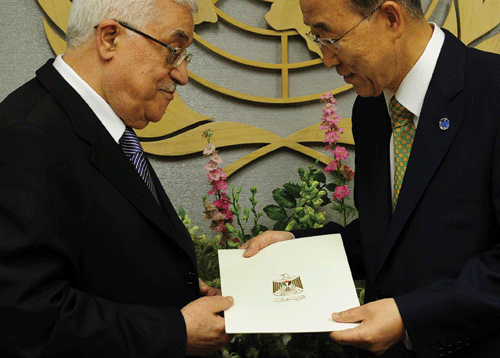
With one well-timed speech before the United Nations General Assembly, Palestinian Authority President Mahmoud Abbas focused global scorn on Israeli Prime Minister Benjamin Netanyahu while causing American President Barack Obama to undermine himself on the world stage. Equally importantly, Abbas partially resuscitated his reputation among Palestinians and regional powers, thus ratcheting up pressure on Hamas in Gaza.

The series of Arab uprisings changed Abbas’s relationships with the Americans, the Egyptians, the Israelis and others in different ways. But it also changed his relationship with his own people.

The waves of popular action against tyrannical regimes like the Palestinian Authority shocked Abbas into reaction. The PA’s heavy-handedness quickly stirred into action in much the same way as other security regimes throughout the region. Repressive, Mubarak-like tactics were quickly employed to quell small protests in the first part of the year, but these were only stopgap measures. Wilier than Mubarak, Abbas sought to win political approval for his leadership among disaffected Palestinians. It is still unclear whether he has succeeded, but his speech at the UN in September was met with approval by many, as the jubilant demonstrations on his return to Ramallah demonstrated.

In the zero-sum Palestinian political environment, his gains corresponded to Hamas’s loss. That loss has been compounded by Syria’s increased isolation (Syria is a patron of the Islamic movement). 

For the Israelis, too, the move could not have occurred at a worse time. Netanyahu’s abrasive personal style has combined with objectively poor decision-making to produce a nadir in the country’s relationship with European, Asian and Arab states. International opprobrium has jumped dramatically in recent years, catalyzed by events such as the 2009 assault on Gaza, which killed 1,400 Palestinians, 300 of whom were children, and the Israeli commando raid on the Mavi Marmara that left eight Turks and one American dead.

The marathon diplomatic battle that occurred in the run-up to Abbas’s UN submission saw the Israelis desperately lobby global capitals to follow the Netanyahu line. The unpalatability of the pro-occupation argument combined with residual ill will from the Gaza and flotilla assaults to produce a mammoth Israeli diplomatic failure at the UN. It is worth noting, however,that Netanyahu’s pugnacious speech at the international forum was positively received at home; barring some unforeseen event, he will likely remain in control in Israel. Obama was a bigger loser than his Israeli counterpart. While Netanyahu played up the threat of global isolation to corral domestic support, Obama found himself publicly vilified from both sides in his own country.

The presidential election season is in full swing in America, and Obama — whose approval rating is less than 50 percent — has been scrambling wildly to court the Israel lobby. It was with his own imminent electoral contest in mind that he entered the UN chambers. And it was with his own reelection in mind that he propounded the Israeli government’s talking points. But his placation strategy has not worked. Regardless of his pandering, Obama simply cannot convince the Israeli lobby that he is their man. His speech did little to change the common perception that he is weak on Israel.

On top of this, his speech worked to alienate important UN member states. France, for instance, was clearly alienated from the rightwing Zionist position. Without making a complete break from the American stance, Nicolas Sarkozy indicated that the status quo was untenable and that it was time to “change the method” of pursuing peace. Likewise, the Saudis have publicly pronounced their intent to break from US policies in the region if the Americans veto Palestinian attempts at official statehood status.

It is too early to assess the full impact of Palestine’s statehood bid, and many questions remain unanswered. Will the Israelis react meaningfully to increased global pressure and isolation? And could the Europeans edge America out to take a more forceful role in adjudicating the conflict?

What is clear is that the move is a catalyst for genuine change. For many Palestinians, this revision of the status quo will be welcome.

AHMED MOOR is a contributor to Al Jazeera English and is a Master in Public Policy
candidate at Harvard Universitys Kennedy School of Government

October 3, 2011 0 comments
0 FacebookTwitterPinterestEmail
Editorial

He who can bleed the most

by Yasser Akkaoui October 3, 2011
written by Yasser Akkaoui

In different ways, both the Syrian people who are rising up against the regime of President Bashar al-Assad, as well as the regime itself, are pushing the limits of their own mortality.

Protests that began in March have spread across the country, but still they have not gathered the critical force necessary to topple the regime. The regime’s brutal attempts to suppress the demonstrations have sent the death toll multiplying into the thousands, and the numbers of arrested into the tens of thousands. For every protester martyred, the regime has bullets for 10 more; if this trajectory is maintained, the protest movement will literally die.

On the other hand, the government is watching the economy evaporate. Expenses have soared, with billions of dollars spent on populist subsidy programs, keeping the Syrian pound afloat and funding the massive deployment of army and militiamen, while revenue has precipitously fallen, with multiple billions lost in capital flight, in vanishing trade and taxes, and in tightening sanctions. When the EU embargo against purchasing Syrian oil exports hits next month, it will wipe away at least a quarter more of the government’s remaining revenue. Assad is losing the ability to fund his grip on power; if this trajectory is maintained, his regime will collapse.

As with all pivotal moments in history, it is often the events that were impossible to foretell — the so-called “black swans” — that irretrievably alter the outcome in one direction or the other.   

Barring blind luck swooping in for either side, however, this will remain a war of attrition, and the winner will be he who can bleed the most.

October 3, 2011 0 comments
0 FacebookTwitterPinterestEmail
Comment

Yemen’s incipient civil war

by Farea al-Muslimi October 3, 2011
written by Farea al-Muslimi

The most horrifying week yet of the eight-month uprising in Yemen began on September 18. The terror and fear the people of Sanaa experienced was described by some as the worst since the civil war in 1994, with more than 80 civilians killed and hundreds more injured. In the areas surrounding Change Square — the heart of the protest movement against obstinate President Ali Abdullah Saleh — snipers fanned out on building tops, shooting randomly at sporadic intervals throughout the day and night. Those involved in the protests were shot, as were those who happened to live in the areas nearby. The sound of bombs exploding punctuated the muezzins’ call to prayers in Sanaa mosques, empty as never before. Those who failed to leave before the clashes intensified remained inside their homes for days, trying to survive with whatever supplies they had rather than risk venturing outside.

The clashes started when the protesters tried to enlarge the four-kilometer stretch they have occupied in Sanaa and expand to another nearby street. As protesters began to set up tents, security forces and Republican Guards opened fire. In less than an hour, more than 20 protesters had been killed. Later on, the First Armed Division, a powerful battalion of defected soldiers loyal to the uprising, returned fire. Fighting spread to the Al Hasba neighborhood, the stronghold of the powerful tribal leader Sadeq al-Ahmar. The neighborhood endured heavy clashes between Ahmar and Saleh’s forces only a few months ago; many homes remain abandoned after residents fled.

The tension in Sanaa ratcheted up a notch when Saleh made a sudden surprise return to the country on September 23, after three months in Saudi Arabia recovering from a bomb attack on the presidential palace mosque. Upon the announcement of Saleh’s arrival, celebratory gunfire from his supporters rang out around Sanaa, as demonstrators were being fired upon in Change Square.

Saleh still holds support from several different quarters.  He enjoys staunch military backing from the Republican Guards, which are led by his son, and similar support from the security forces led by his nephew, and neither lack firepower, in part due to American contributions intended to fight extremists like Al Qaeda. Then there are the corrupt network of stakeholders who will lose their patronage should Saleh go and the tribes who still support Saleh out of a historical enmity towards the Ahmars. But while pockets of support remain, Saleh’s majority lies in arms, not in popular sentiment. His return was a spark to the powder keg. His stubbornness amidst the chaos was a declaration of war. On September 26, while Yemen was celebrating its 49th anniversary of the 1962 revolution that overthrew the ruling Hamidaddin family, Saleh delivered a speech that for Yemenis contained nothing new. He reiterated his calls for dialogue and for an early presidential election, as he had disingenuously suggested on multiple occasions, while emphasizing that the vice president, not Saleh himself, sign the Gulf Cooperation Council initiative of a transfer of power.

The speech was seen by some as a stall tactic before all-out civil war, but it is not clear what the distinction between war and the current scenario is. It seems the line has already been crossed. Without an intensification of international pressure, particularly from within the GCC (Saudi Arabia’s hospitality and leeway in allowing Saleh to rally his supporters from the kingdom shows the tepid regional pressure on him), Saleh will lead Yemen to hell — indeed, it is already at the gates. But if so baited, the millions of Yemeni youth in the squares who have been demanding change peacefully could erupt like a volcano if their legitimate demands for the immediate departure of Saleh and his regime are not met.

Late last month, while Yemenis on the ground fought for the political future of their country, herds of NGO workers and embassy staff were lining up at Sanaa Airport with the very few Yemenis who can afford to leave the country. Yemen is among the most heavily armed countries on earth, with more than 68 million weapons — almost three arms for every man, woman and child. Yemenis have amazed the world over the last eight months with their peaceful protest. But their patience has run dry.

FAREA AL-MUSLIMI is a Yemeni activist
and writer for Almasdar


October 3, 2011 0 comments
0 FacebookTwitterPinterestEmail
Comment

The next pharaoh

by Josh Wood October 3, 2011
written by Josh Wood

In Cairo these days, asking random people on the street about the shortcomings of the ruling military-led transitional government often elicits the same reactions that asking about former President Hosni Mubarak andvhis cronies did not too long ago: people tense up and their eyes dart around before they quickly excuse themselves.

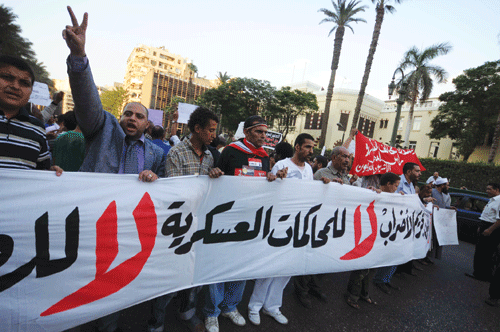
Such reactions and paranoia are not completely unwarranted. As the Supreme Council of the Armed Forces, headed by Field Marshal MohammedTantawi, faces increasing dissent, it has cracked down on freedom of speech and freedom of the press. For Egyptians, speaking out against those in power is again a dangerous venture.

“The problem is not freedom of speech, but freedom after the speech,” says Hafez al-Mirazi, the former Washington bureau chief for Al Jazeera and currently the head of the Kamal Adham Center for Journalism Training and Research at the American University of Cairo. “So you can say what you want, but the problem is going to be the consequences of what you say.”

This proved the case for Maikel Nabil Sanad, a young Egyptian blogger who was sentenced to three years in prison for posting criticism online about the way the military council was running the country. According to rights groups, he began a hunger strike in August and even refused liquids before his health deteriorated and he was hospitalized.

In August, 26-year-old Asmaa Mahfouz was arrested for criticizing the council of military officers on Twitter and was only released on a $3,300 bail following international pressure.

Criticism of the new government on social networking sites in Egypt is rampant. Though it would be hard to imagine the government pursuing everybody who voices dissent online, these cases were designed to intimidate, to make others think twice before voicing their opinions.

After protesters stormed Israel’s embassy in Cairo on September 9 and clashed with security forces through the night, the government added new provisions to the country’s feared Emergency Law. It had previously committed to repeal the law. Under Mubarak, the Emergency Law — which has been in place continuously since the 1981 assassination of Anwar Sadat — was one of the regime’s key tools of repression. One item on the amended Emergency Law now bans the spreading of “false news, statements or rumors”, of which the government has thus far had a fairly liberal — or conservative, depending on one’s outlook — definition. Amnesty International has labeled the revamped Emergency Law as the “biggest threat to rights” in post-revolution Egypt.

Days after the Israeli embassy raid, Al Jazeera’s offices around Cairo were raided. Al Jazeera Arabic and English were allowed to remain open, but their Egyptian affiliate Al Jazeera Mubasher was shut down for a discrepancy in its paperwork. The government, which allowed new television stations to open in Egypt relatively freely after Mubarak’s fall, is now looking to keep cameras out. They have put a freeze on new satellite stations opening and halted live broadcasts of the Mubarak trial.

As Egypt moves towards eight months without Mubarak, the freedoms that millions demonstrated and fought for in Tahrir Square are being rescinded, in many cases using the same tactics employed by the old regime. Many Egyptians are still quick to stress that the country continues to be in the early stages of the post-Mubarak era and there is an optimism that the hangover will subside with time, and immediately after the revolution, Egypt did look like a new place. But now, if you turn your head away from the burned-out skeleton of the Nile-side National Democratic Party headquarters and the occasional Friday protests, there are many signs that point to the Egypt of old reasserting itself. Perhaps one of the most visible is the country’s state-run media outlets, Mubarak’s private cheering section and propaganda outlet when he was in power.

“Any time you look at the newspaper it’s very similar [to before the revolution]” says Mirazi. “You just replace Mubarak’s name with Field Marshal Tantawi.”

JOSH WOOD is a contributor for
The International Herald Tribune
and Esquire Magazine


October 3, 2011 0 comments
0 FacebookTwitterPinterestEmail
Comment

Follow the money

by Peter Grimsditch October 3, 2011
written by Peter Grimsditch

It is a headline writer’s dream: “Ambassador expelled”; “Trade with Israel suspended”; “Prime Minister to visit Gaza”; “Turkish navy to patrol eastern Mediterranean”. The reality is much less Hollywood.

The Israeli ambassador to Turkey was not in the country anyway, conveniently and with “foresight” avoiding the embarrassment of television cameras capturing him skulking away. The trade suspension was rapidly qualified as government-to-government — a fraction of the $3 billion plus annual total. The Turkish navy is unlikely to provide the Israelis with another opportunity to demonstrate their military prowess with a 1967 Liberty-style attack. And Prime Minister Recep Tayyip Erdogan’s Gaza trip was always politically unrealistic, however much he personally may have wanted to go.

More significant than any of this is that private sector commercial relations between the two countries is growing, not declining. Never let rhetoric interfere with the sacred duty of making money. Even as Economy Minister Zafer Caglayan was solemnly declaring that trade ties with Israel were being downgraded to second secretary level, he was truthfully admitting that “there has not been much change in bilateral trade relations yet”. In short, if you want to know what is really going on in this world, follow the money. Verbal and political warfare between the two countries began with Erdogan’s walkout at the 2009 World Economic Forum in Davos and came to a head following the Israeli slaughter in May 2010 of eight Turks and an American of Turkish origin aboard an aid flotilla. Now check out the cash flow since then.

In the first half of this year, Israeli exports to Turkey shot up by 39 percent to $950 million. Trade in the opposite direction rose by 16 percent, to just more than $1 billion, and by the end of the year the two-way volume is expected to surpass $4 billion. Of course, there are sound reasons — on both sides — for wanting to maintain the exchanges.

Turkey has been suffering from the economic malaise in Europe, the main market for its exports, and suffered financial body blows from the uprisings in Libya and Syria. For its part, Israel was hurt by economic turmoil in the United States, its main customer.

Erdogan and Caglayan have both said Turkey’s quarrel is with the Israeli government, not individuals or businesses. Israeli Premier Benjamin Netanyahu was exporting his own complementary statement. The political crisis “is not our choice”, he said. “We respect the Turkish people and their heritage.” Not to mention their money. And their cheap holiday resorts.

The number of Israeli visitors to Turkey fell through the floor last year, dropping by around two thirds to 109,600. Tourists are not made of the same stern stuff as business people, and some Israelis took delight in flaunting figures to the northwest and pointing out how much they were hurting the Turkish tourist industry. That Turkey’s overall tourism numbers went up anyway, even given the missing Israelis, was not included in the gloating. Regardless, the Israelis are coming back. Perhaps encouraged by a favorable exchange rate as much as the facilities, the July and August figures rocketed from around 94,000 in 2010 to 166,000 this year, according to the Israeli Airports Authority. Tourism and trade operate on different dynamics of course. Tourist numbers can drop suddenly and build up again fairly quickly. Trade relations are established over a much longer period, and equally take a good while to wind down. Economic relations between Egypt and Israel had developed a rising momentum when Netanyahu became Israeli prime minister for the first time. It took just more than a year of his hardline policies before there were visible signs of decline.

In the longer term — and short of Middle East peace — Turkey is more important to Israel than the other way around. Erdogan’s relentless drive to enhance his country’s influence and strength took him to Egypt last month, where he forecast a rise in mutual trade to $10 billion over the next few years, as well as to Libya to restore the large and lucrative Turkish contracts that the revolution put in abeyance. Then there is always the US. Francisco Sanchez, the undersecretary of state for trade and commerce, said in Ankara last month the US aimed to triple trade with Turkey over the next five to six years. That would make it worth $45 billion, dwarfing the figure with Israel. And, after all, why deal with the monkey when you can trade with the organ grinder?

PETER GRIMSDITCH is Executive’s
Turkey correspondent


October 3, 2011 0 comments
0 FacebookTwitterPinterestEmail
Comment

Deference versus diversity in the Gulf

by Paul Cochrane October 3, 2011
written by Paul Cochrane

Gulf Cooperation Council (GCC) countries have long struggled with implementing nationalization employment policies (NEPs) to bring more GCC citizens into the workplace, offset reliance on expatriate labor and diversify their oil-dependent economies. The track record has been mixed — fairly good at getting citizens into the government sector but pretty hopeless at the private sector level.

In the United Arab Emirates and Saudi Arabia, nationals account for around 80 percent of the public sector workforce, in Kuwait around 90 percent and in Qatar 94 percent, although some of these statistics are questionable. In 2009 for instance, Sheikh Mohammed bin-Rashid, vice presidentof the UAE, admitted that Emiratization levels “did not exceed 54 percent in ministries and 25 percent in federal authorities.”

In the private sector, Emiratis account for less than 1 percent of the workforce of the UAE, in Kuwait and Qatar around 5 percent and in Saudi Arabia 13.3 percent, according to government statistics.

While NEPs have been in place for decades, most GCC governments appear to be working hard to ensure such policies do not succeed outside the public sector. The most effective way they have done so is by raising public sector salaries to ridiculous levels. Last year, the UAE gave federal government employees a 70 percent wage increase. In September, Qatar announced it would raise government employees’ wages by 60 percent and give military officers a 120 percent salary, pension and benefits hike. What incentive does this give to young Emiratis and Qataris to become, say, entrepreneurs or scientists when a cushy job for life can be had with the government?

Instead such moves create greater dependency on the state, a useful weapon to defuse political opposition and give the impression of greater distribution of oil wealth among nationals. Yet such ruler-subject dependency is not sustainable. It is creating divisiveness between nationals and expatriates, causing social malaise and stifling the potential of the Gulf people.

Such policies also throw into question the motivation behind spending billions of dollars on educational facilities and programs if citizens’ only incentive to study is to get into the public sector. Take Qatar’s Vision 2030 and the National Development Strategy 2011-2016, which mapped out the development of both a knowledge-based and free economy. One of the lofty aims of the multi-billion dollar, state-endowed Qatar Foundation is to make these plans a reality, but this is dependent on young Qataris entering the private sector and not opting to join the military and civil service instead. (Women, on the other hand, account for 77 percent of Qatar University’s student body, which bodes well for the future.)

So how is diversification going to occur and nationalization targets be met against such seemingly great odds? Is the answer to give passports to foreign professionals and experts, as has happened with 11 players on the Qatar national football team? (When I asked one Qatari if his countrymen were proud of their team after Qatar won the bid to host the 2022 World Cup, he replied: “What team?”)

While the UAE and Qatar are scoring own goals against their private sector NEPs, Saudi Arabia is taking its Saudi-ization policy more seriously, introducing this year the Nitaqat plan to find employment for 1.12 million Saudis by 2014. But through its complex quota categories — 205 of them in all — even the labor ministry has admitted that up to 40 percent of private companies will fail to employ enough Saudis and could “cease to exist.”

There appears to be no easy way of encouraging NEPs in the private sector, either beset by onerous requirements or countered by the government placating subjects through high-paying state jobs. A balance needs to be found. The hard truth, though, is that the GCC countries need to accept that introducing viable NEPs that put the private sector ahead or on par with the public sector as an attractive employment option for nationals will eventually bring about a different relationship between the state and the people. It would mean greater governmental accountability; a step that could be viewed by the rulers as one too far. But the status quo cannot continue forever, as major socio-political problems inevitably crash the party. Leaders of certain other Arab countries have recently learnt this the hard way.

PAUL COCHRANE is the Middle East
correspondent for International News Services


October 3, 2011 0 comments
0 FacebookTwitterPinterestEmail
Comment

Nuclear negotiations from fusion to fission

by Gareth Smith October 3, 2011
written by Gareth Smith

In the fall of 2004 I went twice to the Supreme Council for National Security in Tehran for long interviews with Hossein Mousavian, a senior negotiator in talks with Britain, France and Germany over Iran’s nuclear program. The transcripts make sharp reading seven years later, for two reasons. Firstly, leading Iranian diplomats or security officials no longer seem to give such access.

Secondly, the interviews recall a diplomatic process during which Iran suspended uranium enrichment as a “goodwill gesture” to help talks with Western powers. The Iranian negotiators were led by Hassan Rouhani, a pragmatic if dour cleric who, as a colleague told me, “understands we’ve suffered too long from ideologies, and that Iran should instead pursue its national interest.”

A whiff of compromise hung in the air. A European diplomat said the Mousavian interviews offered “real insight into the mind of the Iranian negotiators” and another insisted Europe would at some stage relax its demand for Iran to cease enrichment for good.

One point Mousavian made to me was that the Iranians felt domestic pressure from critics of the talks. Hossein Shariatmadari, editor of Kayhan newspaper, argued that Iran should leave the Nuclear Non-Proliferation Treaty (NPT). Ali Larijani, now parliamentary speaker, quipped Iran would be swapping “candy for a pearl” if it took economic aid in return for ending enrichment.

Some Europeans scoffed at the idea the Iranian negotiators were under pressure. One diplomat, who happened to be close to Washington, said this was a tactic cooked up by the Iranian team.

And yet, there were indications, going back to the 2003 offer of a “grand bargain”, that Iran’s leaders were ready for a deal in which they would accept, for a set period, limits on enrichment as well as intrusive inspections by the United Nation’s International Atomic Energy Agency (IAEA).

Such a compromise would give, Iran suggested, the “objective guarantees” the Europeans wanted of Iran’s peaceful intentions while recognizing its right to enrich as an NPT signatory.

Times have changed. Following his 2005 presidential election win, Mahmoud Ahmadinejad raised the nuclear program from state policy into a popular campaign. Enrichment was resumed and expanded, and sanctions have been strengthened. Barack Obama won the United States 2008 election promising “engagement” but, restrained by the US right and Israel, this has amounted to a few cursory meetings.

The latest IAEA report, out in September, finds Iran now has 4,534 kilograms of uranium enriched to around 5 percent (low-enriched uranium,or LEU) and 70.8 kg enriched to 20 percent.

That is far more than Iran had in 2004. It is also more than it had last year when it agreed with Turkey and Brazil to export the bulk of its LEU in return for 20 percent-enriched uranium, which is used for medical treatment, especially of cancer patients. Yet the US torpedoed theTurkey-Brazil deal, and Iran began enriching to 20 percent itself.

And so the show moves on. In August, Fereydun Abbasi-Davani, head of the Atomic Energy Organization, said Iran would no longer consider a fuel swap.

Iran is edging nearer to being able to enrich to 95 percent for a bomb, if it should choose to do so. Yet, the issue is political and not technical: any country that can enrich uranium can make a weapon. As Mousavian said in 2004, “Iran already has the capability… we have the minds.”

This summer Mousavian, now at Princeton University, published a wide-ranging piece, ‘Rules for Successful Engagement with Iran’, examining the state of diplomacy on the New Atlanticist blog. He suggested the Obama administration had continued the Bush policy of “ratcheting up pressure through new sanctions, hinting at a readiness to take military action and supporting covert sabotage of Iran’s nuclear program.” Threats and sanctions, he wrote, limited Iranian officials’ room for maneuver, just as Ahmadinejad’s rhetoric had “increased tremendously the political cost to American politicians of being seen as soft on Iran”.

Mousavian conceded engagement was “risky” for both camps and required “bravery and wisdom in Washington and Tehran”. But, the alternative he wrote was “the same escalation of the confrontation”. He seemed far from optimistic.

GARETH SMYTH has reported from around the Middle East for almost two decades and was formerly the Financial Times correspondent in Tehran

October 3, 2011 0 comments
0 FacebookTwitterPinterestEmail
Comment

Commemoration and conformity

by Peter Speetjens October 3, 2011
written by Peter Speetjens

Perhaps, if on another planet, one may have missed the 10-year anniversary of the day when September 11 became “9/11”. Virtually every self-respecting media outlet in the world dedicated time and space to the terrorist attack which, among other things, saw two planes torpedo New York’s Twin Towers. Television channels repeated the explosion again and again last month. Newspapers created special supplements and magazines filled entire issues with stories of the victims, their families, firemen, witnesses and just about anyone remotely connected to the dreadful event. For people not anywhere near the scene when it happened, no problem, there was always the “where were you when” question. The American media in particular went overboard, which is to some extent understandable, given the event took place on American soil. Worldwide, 9/11 also resonated, as it unfolded live on TV for a global audience of hundreds of millions — one reason the late German composer Karlheinz Stockhausen defined 9/11 as “the greatest work of art… ever”.

Still, while the West likes to pat itself on the back for its intrepid free press, the conformity of its coverage was striking. It was, by and large, an emotional affair with few critical questions asked. Only a heartless fool would not feel for the nearly 3,000 victims and their families, or take exception to a moment of silence. But do we need to watch and read the same thing in English, French, Arabic and God knows how many languages? What is more, is the wave of media attention justifiable, considering the millions of people who were killed over the course of history, yet for whom no tears are shed and no flags are waved? Why is there no global wave of compassion for the victims of “the other 9/11” in 1973? On that day, General Augusto Pinochet took power in Chile, with US blessing. Many more than 3,000 people were killed on that 9/11, while some 20,000 were to be shown their graves in the months following and a million forced into exile. Why does the rest of the world not commemorate the 800,000 Tutsis killed in Rwanda during the 100 days of horror, or the 2.5 million people killed by the Khmer Rouge in Cambodia? The book of mass atrocities has many chapters, with much of human history written in blood.

Commemoration, however, is not just about compassion. The ritual in memory of the martyr is also a means to close the ranks and stand as one. It is about reconfirming the collective identity, an act particularly welcome in the US, a country that seems to grow more divided by the day as it goes through one of the worst economic spells in its history.

On such a solemn moment of unity, it is not befitting to raise critical questions. Doing so is to step out of line and out of the group; one essentially declares oneself an outcast. That is what happened to New York Times (NYT) columnist Paul Krugman. In a welcome variation to the general mode of tear jerking, he wrote in a piece called “The Years of Shame” that “fake heroes like Bernie Kerik, Rudy Giuliani, and, yes, George W. Bush raced to cash in on the horror… [while] the attack was used to justify an unrelated war the neocons wanted to fight, for all the wrong reasons. How many of our professional pundits took the easy way out, turning a blind eye to the corruption and lending their support to the hijacking of the atrocity?”

Conservative America crucified Krugman. Former Defense Secretary Donald Rumsfeld, one of the Iraq War’s main architects, tweeted: “After reading Krugman’s repugnant piece on 9/11, I canceled my subscription to the NYT.” Waging a war on false grounds was not the only consequence of 9/11. What about Guantanamo Bay, the Patriot Act and the rendition of terrorism suspects to countries like Egypt, Jordan and Syria? In the name of the victims of 9/11, are these not the questions that should be asked? The media’s, and society’s, widespread abdication from its responsibility to address these controversial issues is no show of reverence for those who were killed, quite the opposite; it dehumanizes them, reducing them to objects fit only to be mourned, rather than remembered as living, feeling, thinking individuals — many of whom, had they survived, may well be asking these questions themselves. 

PETER SPEETJENS is a
Beirut-based journalist

October 3, 2011 0 comments
0 FacebookTwitterPinterestEmail
Finance

Beirut Stock Exchange: Ringing the changes

by Maya Sioufi October 3, 2011
written by Maya Sioufi

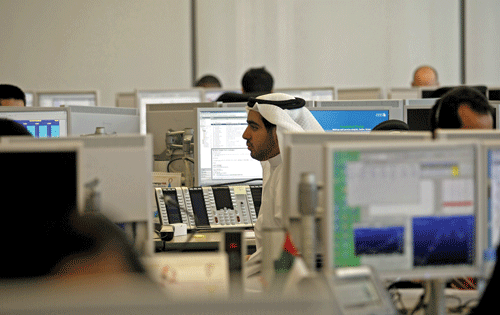
The Beirut Stock Exchange (BSE) could be considered among the sick children of Middle Eastern bourses. With a tiny market capitalization of $11 billion and an average daily volume of trades of $2 million, it is eclipsed in the shadows of the big boys in the Gulf such as Saudi Arabia, Qatar and Abu Dhabi, with market capitalizations of $324 billion, $122 billion and $67 billion respectively. Admittedly, the BSE, even in the best circumstances, is unlikely to rival the top regional markets, but few would disagree that its full potential has hardly been tapped.

For years, the BSE has been effectively orphaned by the Lebanese government. The Ministry of Finance has left the BSE chairman’s seat vacant for more than two years; the seats of three other board members — two resigned and one deceased — collect dust as well.

In an apparent effort to begin ameliorating the situation, on August 4 the Lebanese parliament approved the capital market and insider trading law, which will provide Lebanon with an independent authority to oversee the exchange and protect investors.

“This law is a quantum leap”, said Riad Salameh, governor of Banque du Liban (BDL), Lebanon’s central bank as it would attract “substantial” investment in Lebanese companies. “It will also allow companies to raise their capital and expand their business without borrowing money”, he added.

The new capital market law does lay out the blueprint for significant changes to the BSE, which, if implemented, could go a long way in helping inject new life into the bourse; however, the timeline and quality of implementation is as yet uncertain, and many feel that reforms need to go beyond the scope of what the law proposes.

What the law entails

Up until now the BSE has been both an exchange and its own regulator, simultaneously — meaning independent oversight has been utterly absent. 

“The role of an exchange should be to bring buyers and sellers together and not to be a regulator, and so the role of the BSE [has been] a failure,” said Jean Riachi, chairman of FFA Private Bank.

The long-awaited capital market law, which had idled on the shelf since it was first introduced in the Lebanese Parliament five years ago, calls for the establishment of an independent regulatory body called the “The National Council for Financial Markets in Lebanon” — headed by the governor of BDL and consisting of seven members, with five drawn from the private sector.  The law also requires theBSE to be privatized but it does not state how this should be done. The Arab Federation of Exchanges (AFE) has suggested privatizing the exchange by selling part of it to brokers with an equal distribution of shares amongst them, granting veto power to the government to protect investor interests and selling a specified amount to the public with a limit of 5 percent ownership per shareholder.

Ziad Abou Jamra, deputy general manager at Fidus, believes the law would “serve as a milestone in enhancing the overall performance of the BSE.”  The problem, however, is: “You never know when it will be implemented, as with any law in Lebanon,” said Fadi Khalaf, secretary general of the AFE and former head of the BSE.

The lack of liquidity

Investors had regularly complained that the BSE simply lacked the liquidity to make it attractive — even before popular uprisings swept through the Middle East and North Africa this year. Since the regional unrest began, the volumes have only become thinner, while the BSE also lost $2 billion in market cap between January and September.

According to a senior private banker the Lebanese equity market is cheap and offers attractive dividend yields but the illiquidity could leave the exchange dormant and unattractive. Georges Khoury, general manager of Libano-Française Finance and head of private banking at Banque Libano-Française, similarly argues that Lebanese equities are cheap but the thin volumes and Lebanon’s inherent political instability scare away investment in the BSE.

The scant listings on Lebanon’s exchange contribute to the lack of liquidity. There are currently 11 companies with securities listed on the BSE, of which three (Solidere, Bank Audi and BLOM Bank) account for almost 75 percent of the exchange’s market capitalization. There is little diversification among sectors either, as the exchange consists of six banks, two industrial companies, one real estate company, one automotive company and one fund. Though Lebanon has a relatively small economy, Khalaf says there are some 50 companies sizeable enough to raise equity on the exchange, but which avoid doing so.

Khalaf said, however, that the new law should be a catalyst for greater liquidity in the capital markets, given that the head for both the central bank and the capital market regulator is the same person; he explained that the central bank governor is the most influential person in Lebanon’s banking sector and can encourage the sector to inject liquidity into the capital markets and motivate companies to list.

Other challenges the BSE faces, however, go beyond the scope of the new law and may yet leave the exchange hobbled.

Entrepreneurs and family affairs

Several factors contribute to the limited options on the BSE menu, among them being that the majority of Lebanese companies are family-owned enterprises (FOEs) and prefer not to have foreign investors own a stake in their company. It is also a transparency issue. Listing implies corporate taxes and transparency; according to Khalaf, companies in Lebanon often keep “several books” and thus prefer not to list.

Khaled Zeidan, general manager at MedSecurities, a BankMed subsidiary, said the mentality of family businesses in Lebanon needs to change in order for the businesses to survive. As new generations rise up through a company, the distribution of its capital becomes more and more diffuse.

“You need to institutionalize or it is over for everyone,”said Zeidan.

According to Ammar Bakheet, head of asset management at Audi, FOEs need to be educated about the long-term benefits of listing; in order to expand, at some point they will need to access the equity markets and go beyond bank financing.

A viable BSE would also help venture capitalists, who on the one hand seek out entrepreneurial start-ups to invest in, and on the other hand need to exit these investments; in developed economies, listing on equity markets is a lucrative exit strategy. Take Berytech for example: this Lebanese business incubator created a fund in 2008 with $6 million of capital to invest in start-ups. With a lifespan of seven years, the fund has not yet exited any of its investments, and as Nicolas Rouhana, managing director at Berytech, explains, the exit strategies for investments is one of their main challenges. He says the fund’s current exit strategies include the company being acquired by the entrepreneurs themselves, by larger funds or by multinationals looking to buy the technology or the product. The BSE is not considered a viable option. 

The banks vs. the bourse?

Long seen as the backbone of the Lebanese economy, the country’s banking sector is 10 times the size of the capital market. This has lead to mixed opinions regarding the banks’ impact on the market’s development. AFE’s Khalaf believes that the banking sector and the capital markets are in competition, as it is in the banks’ interest to provide loans to companies: loans generate more income for banks than advising companies on listing on the exchange.

A study undertaken in May 2010 by the French consulting firm Arche and sponsored by the French Ministry of Finance noted that banks in Lebanon are acting more as credit issuers and less as market intermediaries, given that “their operating income is heavily geared toward interest income.” The study also stressed that “capital markets will never develop without strong and active intermediaries.” Arche experts recommended that the BDL push investment banks to act more as intermediaries with the use of incentives or penalties.

A financial expert disagreed, saying she believes that in the long run the whole financial system, including banks, would benefit from strong capital markets, as the extra liquidity would go through the system. A stronger capital market would also require more activity from the advising arm of the bank. BLF’s Khoury concurred, saying the strength of the banking sector is not the main issue affecting the development of the exchange. He stressed that the main roadblocks were the lack of liquidity and the lack of diversification of the bourse.

Beyond the law

It is clear that the new capital market law, in and of itself, will not make the BSE an exchange ripe for hungry investors; policymakers will need to do more.

Saeb el-Zein, managing partner at Spinnaker Middle East and board member of the BSE, recommended the privatization and listing on the exchange of the various telecommunication, electricity and water companies owned by the government, a suggestion that AFE’s Khalaf strongly adheres to aswell. Zein also suggested encouraging the development of private pension funds — supported via various tax incentives — that would commit to investing in local capital markets and obliging the social security fund to invest up to 20 percent of its assets in Lebanese stocks.

Khalaf said he suggested to Lebanon’s Ministry of Finance a tax exemption of a limited number of years for companies that list, but the ministry turned down his proposal as it reduces revenues. Zeidan suggested that incentives ought to be given to local banks that buy securities on the BSE in order to increase institutional participation in the exchange.

Jacques Sarraf, chairman of Malia Group conglomerate, recommended creating a system to encourage small companies to merge, which will create larger companies better suited for listing on the exchange.

Khalaf, however, warned against relying too heavily on incentives to boost the exchange. He points out that when Egypt introduced tax exemptions on the profits of listed companies, the number of listed companies increased significantly but there was little trading. Owners would list a stake to benefit from the tax exemption but they would not trade; listed companies on the Egyptian exchange went from 627 in 1991 to 1,070 by the end of June 2001, but the majority of the trading was concentrated in 30 companies.

Investors are also concerned about the lack of transparency, which is crucial in building confidence in an exchange. Stock exchanges usually encourage good corporate governance by issuing listing and disclosure standards and by monitoring compliance with these standards, but this is not applied in Lebanon.

According to Badri Meouchi, executive director at the Lebanese Transparency Association, the BSE does not have corporate governance guidelines; it only has requirements for listing.

In order for proper corporate governance to be implemented, several articles in the Lebanese code of commerce need to be amended, such as separating the role of general manager from chairman, protecting minority shareholders rights (such as allowing them to elect board members) and not requiring board members to have shares in the company.

The BSE’s ills have not gone unnoticed, and the government’s passage of the new capital market law could provide some useful medicine. However, much remains to be done before the bourse is given a clear bill of health and given the chance to reach its full potential.

October 3, 2011 0 comments
0 FacebookTwitterPinterestEmail
Finance

Fadi Khalaf – Arab Federation of Exchanges

by Maya Sioufi October 3, 2011
written by Maya Sioufi

Lebanon’s capital market is entering a new era, at least in legislative terms, with parliament’s approval of the long awaited capital market law in August 2011. In a next step, an independent regulatory authority with oversight of the Beirut Stock Exchange (BSE) is to be created and headed by the central bank governor, the indomitable Riad Salameh. Fadi Khalaf, secretary general of the Union of Arab Stock Exchanges and former BSE chairman, talks to Executive about the new law, imbalances in Lebanon’s financial markets and the BSE’s new prospects and challenges.

The BSE has not had a president since you left in August 2009. Do you know of any plans to have a new president?

I am not aware of any plans regarding the election of the next president. This is government politics. There are over 50 vacant positions in the Lebanese government and this is just one of them. It is the government’s decision to find a new president. When I left in August 2009, I never thought that we would be in September 2011 and still without a president, but some posts in Lebanon stay vacant for three to four years.

What are the most important issues that the BSE faces?

We don’t have enough companies listed. Most of the companies in Lebanon are family owned and they avoid listing because they don’t want foreign investors to own a stake in their company. Listing implies fiscal taxes and transparency, and in Lebanon, companies have several books. If companies list and don’t disclose their entire income, their stock price will be hit. If they disclose their income, then they have to pay taxes. So some companies will avoid listing.

There is also a lack of liquidity. The BSE is not a priority for the government. It has always been secondary. The government wants to encourage the BSE but it needs the liquidity to cover the government expenses and the government deficit. If there remains excess liquidity, then it will see if it will be directed to the exchange. If the banking sector needs liquidity, then the government needs to keep it there. Many exchanges in the world have enjoyed a strong boost due to the privatization of state owned enterprises, which also gives incentive for other companies to list. We have not had this in Lebanon. Take the privatization of the telecom sector for instance, if a strategic investor wants to pay a good price and not be listed, the government accepts. So the BSE was never a priority.

Do banks encourage companies to list?

Capital markets and the banking sector are usually complementary but [in Lebanon] they are in competition. Investors put their money either in a bank or in the capital markets. When companies need funds, they either take it as debt from banks or equity from capital markets. Since the banking sector is 10 times the size of the capital markets, it has a much stronger influence and it will not encourage companies to list since it is not in their interest.

For example, I had once convinced a very large Lebanese company to list on the exchange and sent them the necessary [documents]. Two to three months later, the CEO tells me that his banker, who is also a shareholder in the company, advised him against listing and provided him with a loan to cover his financing despite the fact that his bank has a brokerage firm and its duty is to convince companies to list.

How about the fees that banks would receive from advising companies to list on an exchange?

Banks earn more fees by providing companies with loans as it provides them with regular payments of interest, whereas listing on the exchange only generates a one off fee. When a company’s debt to capital ratio reaches a certain limit, then the banks might advise them on considering the capital markets. The exchange is just a tool. It is living on the crumbs of the banking sector.

Will there be more interest in the stock exchange following the capital markets law signed in August?

Yes there will be more interest. The governor of the central bank will head the capital markets authority and he has the most influence in the banking sector. This is a good step for the exchange. He can direct the banking sector to inject liquidity into the capital markets. He can also influence the banking sector into encouraging companies to list. In the exceptional case of Lebanon, the banking sector’s market capitalization is around $120 billion whereas the exchange is a mere $11 billion so if the banking sector is not convinced, the only other way to boost the exchange is through privatization of the telecom industry and it does not look like that will happen anytime soon.

When do you think the law will be implemented?

I am not sure if it will be implemented by the end of the year. No one knows how long it will take in Lebanon.

How about the initiative to privatize the stock exchange?

It gives the exchange independence from politics. The private sector is the driving force in Lebanon. Privatizing the exchange will give it a boost but it is not the key factor; if companies are not convinced of listing, privatizing… it is not going to change anything.

One issue that needs to be addressed regarding privatization is how to implement it. The law says the stock exchange should be privatized but it doesn’t say how. It says that after the formation of the capital markets authority, the exchange has one year to have the legislation in place to become a [registered] company as opposed to a public institution and one year after that to be become private.

What initiative could be put in place to increase liquidity? Would it help for example to provide incentives to local banks to buy stocks on the BSE?

What is the point of going to the supermarket with plenty of money in your pocket if there is not much on the shelf for you to buy?

How about incentivizing companies to list? Should the government encourage mergers?

When I was head of the BSE, we did a study on the Lebanese market and we found that there were 50 companies sizeable enough to list on the exchange and they were not listing. Mergers mean putting family businesses together. It is a problem on a whole different level. It could help but it is not enough. Besides, we shouldn’t want the exchange to live on incentives only.

What can the Beirut Stock Exchange do to improve?

It cannot do much… The evolution of the exchange has already taken place in the past ten years with the implementation of measures such as an increase in the type of instruments that can list (stocks, bonds, preferred shares, GDRs,  etcetera) ,a move from fixed pricing to continuous pricing, a reduction of the taxes on dividends and an update of the trading system. All these steps helped increase the volume of shares traded from $200,000 per day in 2000 to 8 to 10 million dollars per day today.

The exchange has done what it can do. The rest remains in the hands of the other players of the Lebanese economy. Unfortunately, the correct step they are taking with the capital markets law is happening during a time when the biggest Arab bourses are complaining of low volumes, so the timing is not great, but at least the exchange will be ready for the next wave of investment in the Middle East.


October 3, 2011 0 comments
0 FacebookTwitterPinterestEmail
  • 1
  • …
  • 361
  • 362
  • 363
  • 364
  • 365
  • …
  • 686

Latest Cover

About us

Since its first edition emerged on the newsstands in 1999, Executive Magazine has been dedicated to providing its readers with the most up-to-date local and regional business news. Executive is a monthly business magazine that offers readers in-depth analyses on the Lebanese world of commerce, covering all the major sectors – from banking, finance, and insurance to technology, tourism, hospitality, media, and retail.

  • Donate
  • Our Purpose
  • Contact Us

Sign up for our newsletter

    • Facebook
    • Twitter
    • Instagram
    • Linkedin
    • Youtube
    Executive Magazine
    • ISSUES
      • Current Issue
      • Past issues
    • BUSINESS
    • ECONOMICS & POLICY
    • OPINION
    • SPECIAL REPORTS
    • EXECUTIVE TALKS
    • MOVEMENTS
      • Change the image
      • Cannes lions
      • Transparency & accountability
      • ECONOMIC ROADMAP
      • Say No to Corruption
      • The Lebanon media development initiative
      • LPSN Policy Asks
      • Advocating the preservation of deposits
    • JOIN US
      • Join our movement
      • Attend our events
      • Receive updates
      • Connect with us
    • DONATE