• Donate
  • Our Purpose
  • Contact Us
Executive Magazine
  • ISSUES
    • Current Issue
    • Past issues
  • BUSINESS
  • ECONOMICS & POLICY
  • OPINION
  • SPECIAL REPORTS
  • EXECUTIVE TALKS
  • MOVEMENTS
    • Change the image
    • Cannes lions
    • Transparency & accountability
    • ECONOMIC ROADMAP
    • Say No to Corruption
    • The Lebanon media development initiative
    • LPSN Policy Asks
    • Advocating the preservation of deposits
  • JOIN US
    • Join our movement
    • Attend our events
    • Receive updates
    • Connect with us
  • DONATE
Comment

Charged with tragic comedy

by Sami Halabi October 3, 2011
written by Sami Halabi

Lebanon’s political theater played out another scene last month with a host of government actors trying to elbow their way to centerstage, propped up by a supporting cast of journalists and media figures. Entitled “Utterly Missing the Point”, the plot of this tragic comedy pitted these two groups in a mischievous conspiracy against the Lebanese in which they engineered dramatic distractions to obfuscate the true reason for the country’s failing public services. The scene opened with the infamous General Michel Aounand his son-in-law, Minister of Energy and Water Gebran Bassil, initiating a blistering quarrel in cabinet over how to divvy up $1.2 billion amongst different contractors and authorities in the installation of new power generation — a project that would, when finished in 2015, supply just barely enough electricity to meet what was needed in 2009. The argument was then duly taken up by a chorus of objecting cabinet blocs and members of parliament who, in the end, decided against implementing any effective checks and balances on the expense.

The obfuscation of the spectacle would not have been possible without the generous support of Lebanon’s newsrooms, which proceeded, with passion and dedication, to cover the controversy ad nauseam without ever elucidating the reasons behind the objections to the proposed legislation, or even the content of the initial proposal. In not focusing on the plan or the law, they scuttled any chance of a counter-narrative that may have pressured the government to actually implement the long-awaited basket of solutions to the country’s most basic needs.

Then there were the exhibitions in befuddlement (misleadingly labeled press conferences) of the principal architect, Minister Bassil, at the beginning of the month.

At the first exhibition, the media dutifully fulfilled their part of the bargain, focusing on why Bassil had not attended a meeting of other ministerial virtuosos aimed at putting the finishing touches on the plan earlier in the day, and not on the details themselves — a particularly canny contrivance. For sending their headliner journalists to the first exhibition and, after the bickering had subsided, their lower tier to the next — where the issues of how to actually realize the objectives of the newly finished piece were up for discussion — we should extend applause to Lebanon’s news agencies.

This propensity of the media to focus on the petty infighting and sound bites espoused by Lebanon’s sectarian leaders, as opposed to dissecting legislative deficiencies and potential solutions, arrives from the intersection of habit and our sectarian media landscape. Maintaining the irroutine throughout, the media furthers the narrative of “Utterly Missing the Point” by attributing utmost importance to Lebanese leaders’ intentionally insidious and vacuous polemics, entrenching in the mind of the public the insurmountability of the status quo.

The media and its partners in both the ruling majority and opposition have inspired journalists to usher in a new era of reporting and construct the closest thing we have to a national narrative. From here on out, we should endeavor to set the framework for a new philosophy, which all Lebanese, regardless of creed or social standing, can adhere to. As we have done recently, we must seek to adhere to the principle of the bare minimum: demanding only that reform allow us to continue our present state of existence, relative to the world at large, without aiming to actually effect any substantive structural reform.

After two post-war decades with the same headlines, and the same figures making headlines, it should be clear that no leader truly seeks structural reform. Then again, who among us really wants to be hamstrung by the laws and institutions propelling the rest of the civilized world? We would have to sacrifice our freedom to litter at will, to drive in the wrong direction, to smoke in public. We may even lose our entitlement to treat with disdain the foreign workers who build and clean our homes and streets because they work for salaries that we would never accept. This is what gives our country a unique charm that outsiders can only marvel at. Indeed, who needs real reform when you can have chaos and liberty that is only checked by the haphazard application of a law that you can get around with a little wasta?

Perhaps we should not express this notion too loudly lest we tip off those who will never understand how sublime our cycle of freewheeling really is under the surface of constant complaints and invective. So (in a lowered voice), if there is any lasting lesson in “Utterly Missing the Point”, let it be that we stop complaining, accept who we are and stick to the bare minimum. 

SAMI HALABI is EXECUTIVE’s
Economics & Policy editor

October 3, 2011 0 comments
0 FacebookTwitterPinterestEmail
Comment

Open to abuse

by David Segall October 3, 2011
written by David Segall

The stench of mold in the dormitory was overpowering. A dozen bunk beds hugged the perimeter, lest one centimeter of potential sleeping space be wasted. Wooden planks served as mattresses for some of the men who called that barrack home.

This was not a prison or a housing complex in one of the world’s poorer regions. It was a company-built dormitory for Bangladeshi workers in the state of Qatar, the world’s wealthiest nation in terms of gross domestic product per capita. And it took only 15 minutes to get there from Doha’s breathtaking downtown.

Qatar aspires to be a global player in politics, business, education and sports. From the ubiquitous billboards of the Qatar Foundation touting Doha’s “Education City” — where Western universities are building high-tech campuses — to Qatar’s designation as host country for the 2022 FIFA World Cup, the ambition of this small nation is undeniable.

But not far from modern, cosmopolitan Qatar lurk the people upon whose backs the enterprise continues to be built: 1.2 million migrant workers, most from Southeast Asia, who outnumber Qatari citizens at least four to one. With the equivalent of at least $55 billion to $60 billion committed to World Cup-related construction projects, the number of migrants in the construction sector will only grow.

I recently visited Qatar on behalf of Human Rights Watch to document the conditions of migrant construction workers. The vast majority of workers we spoke with reported that employers confiscated their passports, making it difficult for some to leave the country or return home freely. Many said that their working conditions or salaries differed significantly from what they had agreed to before leaving their home countries. Many also reported having borrowed heavily to pay fees charged by recruiters in their countries of origin — Qatar, unlike the United Arab Emirates, does not require sponsoring employers to pay all fees associated with imported labor — and needing to work for months or years in Qatar just to pay off these debts. And many slept in unclean, overcrowded barracks, sometimes with no mattresses or air-conditioning, in a country where summer temperatures routinely exceed 40 degrees Celsius.

The Qatari government representatives who received the Human Rights Watch delegation cited domestic legislation as prohibiting practices like passport confiscation, overcrowded dorms and non-payment or delayed payment of salaries by employers, but generally would not acknowledge the pervasiveness of the violations. Despite serious instances of abuse, high-level officials at Qatar’s Ministry of Labor informed us that none of the 150 employees at the ministry’s labor inspections unit speak languages commonly used by the migrant workers. When we asked how the ministry could accurately monitor working conditions without staff members who could communicate directly with the workers, the officials informed us that they are able to monitor everything from working hours to payment problems through information garnered from the employers. The obvious consequence of this surprising lack of interest in obtaining information from the workers themselves is a disconnect between the ministry’s information and the realities of life for many workers.

Qatar also continues to maintain the “sponsorship system,” which prohibits workers from changing jobs without their sponsoring employer’s consent and requires workers to procure exit visas from their sponsors before they can leave the country. Trying to navigate the legal system to break the bond if their rights are abused is a terrifying or even impossible prospect for many workers, who fear losing their only source of income and often do not possess the language skills or financial means to pursue a case.

The root of the problem is a system that allows officials, employers and ordinary citizens to evade responsibility for abuses at every turn. Government officials point to laws on the books without enforcing them diligently. Employers claim that they treat their workers better than other employers treat theirs. And Qatari citizens sleep easy believing that these workers, despite low wages and vulnerability to abuse, earn more in Qatar than they would as farmers, craftsmen or menial workers in their countries of origin.

The Qatar Foundation’s billboards constantly remind us to “Think” in the service of “Unlocking Human Potential.” Qatar is employing much human and material capital to become a major force in global affairs, media and sports. If it deployed similar resources to improving the conditions of its migrant workers and promoting fair labor standards, it would become a regional leader in this realm too. It would set a commendable  example for the many neighboring countries that employ hundreds of thousands of migrant workers.

DAVID SEGALL is an associate for the Middle East and North Africa division at Human Rights Watch


October 3, 2011 0 comments
0 FacebookTwitterPinterestEmail
Comment

Abbas’ UN tour de force

by Ahmed Moor October 3, 2011
written by Ahmed Moor

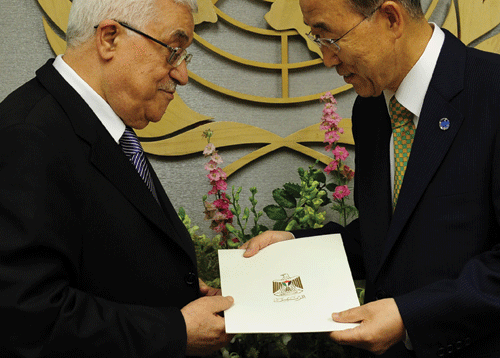
With one well-timed speech before the United Nations General Assembly, Palestinian Authority President Mahmoud Abbas focused global scorn on Israeli Prime Minister Benjamin Netanyahu while causing American President Barack Obama to undermine himself on the world stage. Equally importantly, Abbas partially resuscitated his reputation among Palestinians and regional powers, thus ratcheting up pressure on Hamas in Gaza.

The series of Arab uprisings changed Abbas’s relationships with the Americans, the Egyptians, the Israelis and others in different ways. But it also changed his relationship with his own people.

The waves of popular action against tyrannical regimes like the Palestinian Authority shocked Abbas into reaction. The PA’s heavy-handedness quickly stirred into action in much the same way as other security regimes throughout the region. Repressive, Mubarak-like tactics were quickly employed to quell small protests in the first part of the year, but these were only stopgap measures. Wilier than Mubarak, Abbas sought to win political approval for his leadership among disaffected Palestinians. It is still unclear whether he has succeeded, but his speech at the UN in September was met with approval by many, as the jubilant demonstrations on his return to Ramallah demonstrated.

In the zero-sum Palestinian political environment, his gains corresponded to Hamas’s loss. That loss has been compounded by Syria’s increased isolation (Syria is a patron of the Islamic movement). 

For the Israelis, too, the move could not have occurred at a worse time. Netanyahu’s abrasive personal style has combined with objectively poor decision-making to produce a nadir in the country’s relationship with European, Asian and Arab states. International opprobrium has jumped dramatically in recent years, catalyzed by events such as the 2009 assault on Gaza, which killed 1,400 Palestinians, 300 of whom were children, and the Israeli commando raid on the Mavi Marmara that left eight Turks and one American dead.

The marathon diplomatic battle that occurred in the run-up to Abbas’s UN submission saw the Israelis desperately lobby global capitals to follow the Netanyahu line. The unpalatability of the pro-occupation argument combined with residual ill will from the Gaza and flotilla assaults to produce a mammoth Israeli diplomatic failure at the UN. It is worth noting, however,that Netanyahu’s pugnacious speech at the international forum was positively received at home; barring some unforeseen event, he will likely remain in control in Israel. Obama was a bigger loser than his Israeli counterpart. While Netanyahu played up the threat of global isolation to corral domestic support, Obama found himself publicly vilified from both sides in his own country.

The presidential election season is in full swing in America, and Obama — whose approval rating is less than 50 percent — has been scrambling wildly to court the Israel lobby. It was with his own imminent electoral contest in mind that he entered the UN chambers. And it was with his own reelection in mind that he propounded the Israeli government’s talking points. But his placation strategy has not worked. Regardless of his pandering, Obama simply cannot convince the Israeli lobby that he is their man. His speech did little to change the common perception that he is weak on Israel.

On top of this, his speech worked to alienate important UN member states. France, for instance, was clearly alienated from the rightwing Zionist position. Without making a complete break from the American stance, Nicolas Sarkozy indicated that the status quo was untenable and that it was time to “change the method” of pursuing peace. Likewise, the Saudis have publicly pronounced their intent to break from US policies in the region if the Americans veto Palestinian attempts at official statehood status.

It is too early to assess the full impact of Palestine’s statehood bid, and many questions remain unanswered. Will the Israelis react meaningfully to increased global pressure and isolation? And could the Europeans edge America out to take a more forceful role in adjudicating the conflict?

What is clear is that the move is a catalyst for genuine change. For many Palestinians, this revision of the status quo will be welcome.

AHMED MOOR is a contributor to Al Jazeera English and is a Master in Public Policy
candidate at Harvard Universitys Kennedy School of Government

October 3, 2011 0 comments
0 FacebookTwitterPinterestEmail
Editorial

He who can bleed the most

by Yasser Akkaoui October 3, 2011
written by Yasser Akkaoui

In different ways, both the Syrian people who are rising up against the regime of President Bashar al-Assad, as well as the regime itself, are pushing the limits of their own mortality.

Protests that began in March have spread across the country, but still they have not gathered the critical force necessary to topple the regime. The regime’s brutal attempts to suppress the demonstrations have sent the death toll multiplying into the thousands, and the numbers of arrested into the tens of thousands. For every protester martyred, the regime has bullets for 10 more; if this trajectory is maintained, the protest movement will literally die.

On the other hand, the government is watching the economy evaporate. Expenses have soared, with billions of dollars spent on populist subsidy programs, keeping the Syrian pound afloat and funding the massive deployment of army and militiamen, while revenue has precipitously fallen, with multiple billions lost in capital flight, in vanishing trade and taxes, and in tightening sanctions. When the EU embargo against purchasing Syrian oil exports hits next month, it will wipe away at least a quarter more of the government’s remaining revenue. Assad is losing the ability to fund his grip on power; if this trajectory is maintained, his regime will collapse.

As with all pivotal moments in history, it is often the events that were impossible to foretell — the so-called “black swans” — that irretrievably alter the outcome in one direction or the other.   

Barring blind luck swooping in for either side, however, this will remain a war of attrition, and the winner will be he who can bleed the most.

October 3, 2011 0 comments
0 FacebookTwitterPinterestEmail
Comment

Yemen’s incipient civil war

by Farea al-Muslimi October 3, 2011
written by Farea al-Muslimi

The most horrifying week yet of the eight-month uprising in Yemen began on September 18. The terror and fear the people of Sanaa experienced was described by some as the worst since the civil war in 1994, with more than 80 civilians killed and hundreds more injured. In the areas surrounding Change Square — the heart of the protest movement against obstinate President Ali Abdullah Saleh — snipers fanned out on building tops, shooting randomly at sporadic intervals throughout the day and night. Those involved in the protests were shot, as were those who happened to live in the areas nearby. The sound of bombs exploding punctuated the muezzins’ call to prayers in Sanaa mosques, empty as never before. Those who failed to leave before the clashes intensified remained inside their homes for days, trying to survive with whatever supplies they had rather than risk venturing outside.

The clashes started when the protesters tried to enlarge the four-kilometer stretch they have occupied in Sanaa and expand to another nearby street. As protesters began to set up tents, security forces and Republican Guards opened fire. In less than an hour, more than 20 protesters had been killed. Later on, the First Armed Division, a powerful battalion of defected soldiers loyal to the uprising, returned fire. Fighting spread to the Al Hasba neighborhood, the stronghold of the powerful tribal leader Sadeq al-Ahmar. The neighborhood endured heavy clashes between Ahmar and Saleh’s forces only a few months ago; many homes remain abandoned after residents fled.

The tension in Sanaa ratcheted up a notch when Saleh made a sudden surprise return to the country on September 23, after three months in Saudi Arabia recovering from a bomb attack on the presidential palace mosque. Upon the announcement of Saleh’s arrival, celebratory gunfire from his supporters rang out around Sanaa, as demonstrators were being fired upon in Change Square.

Saleh still holds support from several different quarters.  He enjoys staunch military backing from the Republican Guards, which are led by his son, and similar support from the security forces led by his nephew, and neither lack firepower, in part due to American contributions intended to fight extremists like Al Qaeda. Then there are the corrupt network of stakeholders who will lose their patronage should Saleh go and the tribes who still support Saleh out of a historical enmity towards the Ahmars. But while pockets of support remain, Saleh’s majority lies in arms, not in popular sentiment. His return was a spark to the powder keg. His stubbornness amidst the chaos was a declaration of war. On September 26, while Yemen was celebrating its 49th anniversary of the 1962 revolution that overthrew the ruling Hamidaddin family, Saleh delivered a speech that for Yemenis contained nothing new. He reiterated his calls for dialogue and for an early presidential election, as he had disingenuously suggested on multiple occasions, while emphasizing that the vice president, not Saleh himself, sign the Gulf Cooperation Council initiative of a transfer of power.

The speech was seen by some as a stall tactic before all-out civil war, but it is not clear what the distinction between war and the current scenario is. It seems the line has already been crossed. Without an intensification of international pressure, particularly from within the GCC (Saudi Arabia’s hospitality and leeway in allowing Saleh to rally his supporters from the kingdom shows the tepid regional pressure on him), Saleh will lead Yemen to hell — indeed, it is already at the gates. But if so baited, the millions of Yemeni youth in the squares who have been demanding change peacefully could erupt like a volcano if their legitimate demands for the immediate departure of Saleh and his regime are not met.

Late last month, while Yemenis on the ground fought for the political future of their country, herds of NGO workers and embassy staff were lining up at Sanaa Airport with the very few Yemenis who can afford to leave the country. Yemen is among the most heavily armed countries on earth, with more than 68 million weapons — almost three arms for every man, woman and child. Yemenis have amazed the world over the last eight months with their peaceful protest. But their patience has run dry.

FAREA AL-MUSLIMI is a Yemeni activist
and writer for Almasdar


October 3, 2011 0 comments
0 FacebookTwitterPinterestEmail
Finance

Q&A with Jean Riachi, chairman at FFA Private Bank

by Executive Staff September 26, 2011
written by Executive Staff

FFA’s Jean Riachi gives high-net worth investors tips on how to get the best out of their private bank

September 26, 2011 0 comments
0 FacebookTwitterPinterestEmail
Consumer Society

Ian Gorsuch

by Executive Editors September 18, 2011
written by Executive Editors

It the Beirut launch of McLaren Automotive’s long awaited high performance car, the MP4-12C, Executive spoke with Ian Gorsuch, McLaren’s regional director for the Middle East and Africa.

A totally bespoke car, the 12C has a lightweight carbon fiber chassis structure and a 3.8-liter, V8 twin-turbo engine producing around 600 brake horse power (bhp), able to reach 0-100 kilometers per hour (km/hr) in just 3.3 seconds.

  • The MP4-12C has been a long time coming, with production of the iconic McLaren F1 ending in 1998 and the world’s best selling luxury supercar, the Mercedes-Benz SLR McLaren, in 2009. Why did it take so long?

We had a long gestation period. Over the last three years there’s been a lot of speculation about what we were doing, especially as we had no new car on the road. And because it is our first car (in such volume), there has been a lot of discussion. Perhaps we revealed too much information too early, and we should have been more circumspect in releasing information as it created such a seemingly long waiting time. But although it seems like a long time to launch, it is on time.

  • How much did McLaren invest in developing the MP4-12C?

More than $1.3 billion has been invested in the project since 2005. Around 30,000 hours were spent in simulation development, and 100,000 kilometers of prototype testing was carried out, from the Arctic to the Middle East. We could have done testing in Death Valley in the United States, where the temperatures are the highest on earth, but we thought it better to do the testing in the humidity and dust of the Gulf.

  • Will there be other MP4-12C models?

We will also be launching the MP4-12C GT3 racecar. It is not like the Porsche GT3, which can be driven on the roads; it is purely a racecar. There has been a lot of interest from race teams, and we will initially start in Europe.

  • A new trend appears to be for supercar manufacturers to downsize and improve carbon emissions. Is this the case for the MP4-12C?

The car has the lowest carbon emissions in its segment, better per horsepower than a Toyota Prius. We built in performance criteria, not just 0-100 kilometers, but also ergonomics and CO2 [carbon dioxide] levels. We are a technology-led company.

  • How else does the car differ from others in the same segment?

The problem for many people is that they have to choose a luxury vehicle for a certain job. [They need] good suspension to make driving in traffic comfortable, or a performance car for high speed, which needs rigidity and good engagement with the road. Rarely can you enjoy the two together. With the MP4-12C’s unique suspension you can feel everything on the road, high speed on bends and you are able to cruise around in town, much like the comfort of a BMW M-Series. It can be driven every day, not just for a burn out on the weekend.

  • The F1 famously had a gold covered engine. Does the MP4-12C?

No, we didn’t need it for the MP4, perhaps due to the engine size. It was only on the F1, and for heat insulation on the engine bay.

  • How many MP4s are to be produced?

About 1,000 a year. There are already around 20 on the roads in Britain. Once we get up to full production and offer different models, it will be 4,500 worldwide.

  • How many do you expect to sell in the Middle East?

We will sell around 100, so 10 percent of global sales. The order bank is more than that, but the constraint is the production capacity. The biggest market is the United States.

  • What’s the price tag?

In Dubai, AED900,000 to AED 1,000,000 [$245,000 to $272,271].

  • Are customers old clients?

There are only 106 F1s in the world at the moment, so if we sold to F1 customers it would not be a viable business. We don’t advertise, so the key is through the media and our reputation.

  • Could the financial crisis affect sales?

At our level there are a limited number of cars so we are reasonably secure. And this is indicative worldwide. Before the crisis, if someone was worth $100 million, they are now worth, say, $70 million. This has not affected their lifestyle but it has affected their purchasing psyche. It’s not value for money, but people don’t just want a badge, they want intrinsic qualities behind the badge. This is an advantage we have.

  • Can you tell us about the main investors in McLaren Automotive?

Peter Lim, a Singapore investor, has joined us along with our chairman Ron Dennis. Other investors are the TAG Group, headed by [Saudi businessman] Mansour Ojjeh, and Mumtalakat Holding Co., the Bahraini sovereign wealth fund (with 50 percent). So we now have European, Middle Eastern and Asian investors, bringing new money, equity and experience to the board. We are perhaps the best funded car company in the world.

  • What is your regional presence in the Middle East?

We have six new showrooms; a 400 square meter showroom in Dubai, which is to open in November, and in Abu Dhabi, Jeddah, Doha, Bahrain and Kuwait. And we have eight service points, including Beirut, as a lot of Gulf nationals bring their cars to Lebanon in the summer and need the confidence that their car can be looked after.

Asia is the next step, with Osaka, Singapore and Hong Kong. We will be opening 35 new showrooms in 19 countries. It has been very exciting but [there has been] a lot of pressure, as no luxury brand has done in such a short time span a global launch with showrooms for just one car. We have had to train technicians at our facility in Woking, England, create unique dealer ordering portals and sign dealership contracts.

  • Is McLaren facing problems with the gray market?

The gray market is a problem for every luxury manufacturer, and it is costing the second buyer a lot of money. I heard of one car sold on Ebay, worth $280,000, that was offered online for $411,000. It was sold to a trader for $445,000.

  • When it was launched in 1993, the McLaren F1 was the world’s fastest production road car with a top speed of 386 kilometers per hour. British actor Rowan Atkinson, known for his role as Mr. Bean, crashed his F1 in early August in England. Have you any news?

Atkinson is fine and his car is being repaired. The press undervalued the car at $3.2 million. It is actually worth $5.76 million as there are only a few in existence worldwide.

“People don’t just want a badge, they want intrinsic qualities behind the badge. This is an advantage we have”

September 18, 2011 0 comments
0 FacebookTwitterPinterestEmail
Economics & Policy

For your information

by Executive Editors September 18, 2011
written by Executive Editors

Huff, and puff, and blow ,your smoke out

Non-smokers will be breathing a breath of fresh air after a new anti-smoking law was passed by Lebanon’s parliament last month. The law, which has been in the pipeline since 2004, was slow to come to fruition but was spurred on recently by both civil society and the press. It prohibits smoking in certain indoor and outdoor locations including bars, restaurants, schools, hospitals, public and private offices and on public transportation. It also bans any form of tobacco advertising, including promotion and sponsorship. In addition, the law increases the size of the required health warnings on cigarette packages to 40 percent of the surface area of a pack. Hotels were granted some leeway by being permitted to allow smoking in 20 percent of their rooms. Penalties to be introduced range from a fine of $663 to $1,990 for establishments that are caught allowing smoking indoors, as well as a fine of $66.3 for individuals caught smoking in public spaces. Implementation is to take place gradually over the next year, allowing establishments and businesses to recalibrate their activities accordingly.  “A long road ahead to achieve effective implementation awaits us,” said a statement released last month by the health ministry’s National Tobacco Control Program unit. “The previous partial law passed in 1996 was very weakly implemented; it is necessary to prevent the tobacco industry and its allies from once again standing in the way of effective implementation.”

Enough energy to bring ,down a cabinet

Cracks in the cabinet began to emerge last month when a bill proposed by MP and Free Patriotic Movement leader Michel Aoun to borrow $1.18 billion to fund electricity projects from 2011 to 2014 was not passed from the cabinet to parliament. Aoun threatened to pull his ministers out of the cabinet if the bill was not passed, and as Executive went to print a deal had not yet been hammered out. The project proposes to produce 700 megawatts of electricity at a cost of $850.4 million using combined cycle gas turbines, as well as $247 million on transportation of power, $38.5 million on distribution and $40 million for consulting. According to the energy minister, the additional 700 megawatts could decrease average power rationing around the country by up to seven hours per day. If the power was only partially distributed to curb rationing by an average of 4 hours and repairs on the rest of the aging infrastructure were completed, estimated savings of $460 million per year for the treasury could be achieved and individual households could save $730 million to $1.3 billion on expenditures for private generator companies, said Energy Minister Gebran Bassil.

Assuming a deficit fall

The finance ministry seemed to shift the goal posts in the latest release of public finances last month, which stated that the total fiscal deficit had fallen 4.8 percent in the first half of the year. According to their figures, the 2011 deficit through June came in at $908.7 million. Government expenditure was put at $5.63 billion, a rise of 7.3 percent on the same period in 2010, while revenues were believed to have risen to $4.77 billion, a 9.8 percent rise. The smaller deficit figure, however, factors in revenues estimated by the telecom ministry totaling $704 million over the first six months of 2011, even though this sum has not yet been transferred to the treasury. The government’s largest expenditure item, debt servicing, shrank slightly during the first six months of this year to $1.9 billion, a fall of 0.5 percent year-on-year, constituting 33.8 percent of total expenditures. Interest payments on domestic debt made up $1.2 billion of that total in the first half of this year, with the primary surplus — the government’s income statement without debt servicing — at $1.13 billion, fractionally different than in 2010.

Welcome news on the web

The price of legal Internet in Lebanon looks set to fall after the adoption of a ministerial decree last month by the cabinet. The decree, which was proposed by the telecom ministry, details a new breakdown of prices and bandwidth caps for different categories of Internet speeds. The changes will take effect one month from the projected publication in the official gazette on August 29. The price list was not yet made public but was leaked to the pro-opposition Al Mustaqbal newspaper and confirmed as accurate by several telecom experts. The changes will see the slowest available residential Internet package rise in capacity — from 128 kilobits per second (kbps) with a bandwidth cap of 2 gigabits (GB) per month to 1 megabit (mbps) per second with a cap of 4 GB — while falling in price, from $23.21 to $15.90. The highest available residential package will rise from 2.3 mbps with an 8 GB cap to 8 mbps with a 30 GB cap, while decreasing in price from $199.00 to $114.09. The telecom ministry also announced that the 3G mobile Internet service will have a test-run on some 4,000 clients by mid-September, with the service available to the general public by the end of the year.

Business feeling blue

The feeling amongst the top hirers in the country is that business has been stagnant in 2011 but may well emerge from the doldrums come next year, according to a new survey conducted by the job site Bayt.com. Bayt’s latest Consumer Confidence Index (CCI) stated that 45 percent of Lebanese respondents believe that business has been stagnant this year while only 13 percent think things are going well, with the remaining 36 percent offering a neutral response. Nonetheless, 34 percent of respondents think that next year things will improve, while around half that percentage believes things are heading south in a year’s time. The June CCI index itself decreased year-on-year by 19.7 percent to 98.3 points. Asked whether salaries make up for the increasing cost of living in Lebanon, 71 percent said that they did not.

Buttressing the maritime border

The issue of the location of Lebanon’s maritime border has finally been resolved, at least as far as the Lebanese government is concerned. Last month, Lebanon’s parliament passed a law demarcating the country’s maritime border with Cyprus and “Occupied Palestine” for the first time. The law sets out Lebanon’s Exclusive Economic Zone from which it can extract what many expect to be hydrocarbon resources present under the seabed. The move comes after Israel submitted its own proposal regarding maritime borders, in which it drew its boundary according to a previous agreement between Tel Aviv and Nicosia that adopted “Point 1” as the boundary for Israel’s proposed border with Lebanon, which starts in Ras Naqoura and ends 133 kilometers off the coast at an angle of 291 degrees. Lebanon also signed an agreement with Cyprus adopting Point 1 but never ratified it in parliament. The new law proposes “Point 23” as the ending point, which is around 17 kilometers southwest of Point 1 and corresponds to Israel’s existing northernmost contract blocs, areas where oil and gas companies can come to explore and extract hydrocarbon resources. The differences have resulted in a disputed area of some 854 square kilometers and have fueled fears of potential conflict over the area. Israel has already found large deposits of gas in its northern fields and is in the process of extracting them, while Lebanon has not yet had its first bidding round or set out contract blocs. The agreements signed with Nicosia by both Israel and Lebanon (which never ratified the agreement in Parliament) each allow for an adjustment of Point 1. Last month, the foreign ministry requested to the United Nations Secretary General that the UN step in as arbitrator to resolve the issue.

September 18, 2011 0 comments
0 FacebookTwitterPinterestEmail
Real estate

For your information

by Executive Editors September 18, 2011
written by Executive Editors

Solidere’s ups and downs

Solidere, Lebanon’s largest firm by market capitalization, will be distributing $147 million in dividends to shareholders, as approved at the Ordinary General Assembly held by the real estate company on August 1. Of this, $61 million will be paid out in cash, while the majority, $86 million, will be distributed as shares. This comes after a 19 percent drop in sales through the first half of 2011, with share prices hitting a two-year low of $15.85 in the last week of August. At the same time, Citi Investment Research & Analysis, a division of Citigroup Global Markets, valued Solidere’s target price per share at $31 in August, though it said the company’s shares were “high risk”.  They also warned that they may not be able to reach the target price, due to concerns that those planning to build on plots already purchased from Solidere may have trouble securing financing and making payments, given the economic slowdown and tightening of credit in the region. The company currently owns a land bank of 1.9 million square meters, valued at about $7.5 billion based on current market prices.  In an August 18 press release, Solidere unveiled their plans for Zeitouneh Square, a public garden behind the Starco building in Beirut Central District, with the company’s master plan stipulating the allocation of 50 percent of the total land area to public spaces and gardens. It plans to complete four other public squares in the near future as part of this overall plan.

Increased construction of the humble abode

While the number of construction permits increased 21.8 percent year-on-year in the first half of 2011, to 9,728, according to figures from the Order of Engineers in Beirut and Tripoli, the actual construction area authorized by permits increased by just 5 percent to 8.77 million square meters (sqm). These numbers indicate that developers are increasingly interested in smaller plots, possibly to deliver buildings with small-sized apartments (less than 250 sqm) to accommodate demand, according to a recent report by real estate advisory RAMCO. Supply indicators in Lebanon have been low through the first half of 2011. Unlike during the first half of 2010 and 2009, when cement deliveries increased 9.2 and 19.8 percent, respectively, deliveries rose just 2.9 percent in the first half of this year, in parallel with the slow progression of construction activity. Tons of cement delivered reached 2,662,000, according to figures from Banque Du Liban, Lebanon’s central bank, and in June cement deliveries increased 18.3 percent year-on-year, putting an end to a downward trend seen earlier in 2011.

Rising up amid an uprising

In an August 2 company statement, Dubai-based mall developer Majid Al Futtaim (MAF) Properties said it had started foundation work the week before on its $1 billion mixed-use project in Syria, its first in the country, which will cover 1.5 million square meters in the Yaafour district west of Damascus. The news is surprising given the uprising against President Bashar al-Assad, which has engulfed Syria and hobbled its economy since March. The first phase of the Khams Shamat project, slated for completion by 2014, will include hotels, residences, offices and commercial space. Peter Walichnowski, chief executive officer of MAF, said that the foundation work is “in preparation for the buildings’ development and the completion of works related to roads, electricity, water, sanitation and public services.” MAF has three other major projects underway in Lebanon, Egypt and the UAE.

Israel’s cynical use of housing crisis

Israel’s Ministry of Interior gave final approval on August 11 to the construction of 1,600 new units in the East Jerusalem settlement of Ramat Shlomo in the occupied West Bank, with an impending approval of 2,700 additional units. Israeli officials claimed the move came in response to protests over soaring real estate prices in Jerusalem, a claim that anti-settlement group Peace Now called a “cynical use” of the housing crisis, according to The New York Times. The settlements were initially proposed in March 2010 during a visit by US Vice President Joe Biden, an apparently deliberate affront to the Obama administration’s calls for a permanent cessation to settlement building. On August 4, 900 new homes were approved in Har Homa, a settlement just north of Bethlehem, also in the West Bank.  European Union foreign policy chief Catherine Ashton condemned the settlement approvals, telling Agence France-Presse, “The European Union has repeatedly urged the government of Israel to immediately end all settlement activities in the West Bank, including in East Jerusalem. All settlement activities are illegal under international law.” The area is a point of contention between the Palestinian Authority, which views East Jerusalem as the capital of any future Palestinian state, and the Israeli government, which has insisted on a unified Jerusalem as its capital in the event of a two-state solution. It was originally annexed from Jordan after the 1967 war.

Getting real on land prices     

The last quarter was the worst in the past five years for the real estate industry in Lebanon, according to property advisory firm RAMCO’s second-quarter report, citing limited land sales and especially slow sales in the luxury segment of the residential market, where the price per square meter (sqm) is $5,000 or above. The report called the continually rising price of land “worrying”, and said that realistic selling prices would not justify the cost of the plots to land buyers, thus concluding that landowners will eventually re-align their expectations with market realities and lower their prices. Demand mostly exists for smaller apartments, under 250 sqm, at prices ranging between $500,000 and $800,000 each; two projects with a built-up area of nearly 10,000 sqm each “were almost entirely sold out in a very short period of time” because they offered small-sized apartments at a fair market price. In the commercial sector, the report said that Grade A, purpose-built offices are undersupplied in Beirut and are mostly concentrated in the Beirut Central District (BCD). Estimated Rental Values (ERV) in BCD are $325 to $375 per sqm per year in the Park Avenue area, and $275 to $325 per sqm per year in the Beirut Souks area. Other business areas like Tabaris offer some high-end office buildings with ERV between $250 and $275 per sqm per year. It also noted that Verdun and Clemenceau have ERVs of $250 to $275 and $225 to $250 per sqm per year, respectively.

Bringing life to the Dead Sea

On July 28, the Jordanian government, along with the Jordanian Development Zones Company (JDZ), announced a 25-year development plan to create a touristic and commercial area within 12 zones along the northern coast of the Dead Sea. The chief executive officer of JDZ, Taha Zboun, said that the project was openly looking for both local and foreign investors (small and medium sized) to undertake development on the 59 plots up for sale, while also claiming it would create jobs for thousands of locals. Though the vision for the corniche boulevard is to create a string of hotels, malls and restaurants within the touristic zone, the project will also focus on boosting infrastructure, including an investment of $250.5 million in a desalination station. American development firm, Sasaki Associates, has been appointed to lead the consortium for master planning purposes.

$4.08 billion backlog for UAE construction giant

The UAE’s biggest construction company by market value, Arabtec, has posted a 67 percent drop in first-half net profits — hitting just less than $27 million — following a 74 percent drop in second-quarter profit as multiple project delays took their toll on the balance sheet, reported the company in a statement on August 7. Chet Riley, an analyst at Dubai’s Nomura Bank, told Gulf News in an August 8 article that payment transfers from profits also took a toll; “around 35 per cent of Arabtec’s actual profit in the second quarter was actually paid out to minority interests… We are finding revenues are slightly lower across the board due to delays in starting up new projects.” Its current backlog of projects stands at $4.08 billion, of which a third comprises a 5,000-home project to be built in a joint venture with the Saudi Bin Laden Group in Saudi Arabia. On August 17, the builder announced it had won a $76.2 million construction contract from Nakheel to build 523 homes in Dubai’s Jumeirah Village Circle, to be completed by the end of 2012.

September 18, 2011 0 comments
0 FacebookTwitterPinterestEmail
Banking & Finance

Regional equity markets

by Executive Editors September 18, 2011
written by Executive Editors

Beirut SE  

Current year high: 886.37       Current year low: 882.02

>  Review period:  Closed August 26 at 886.37 points     Period Change: -3%

Investors found little time for Beirut stocks in a tumultuous month for international equity markets and amid escalating events in Syria. Trade volumes were unusually low even by Ramadan standards and proved as uninspiring as this summer’s tourist numbers. The affirmation of Lebanon’s credit rating by Moody’s with a stable outlook meant little to Solidere investors who were bitten by a 19 percent decline in property sales in the first half of 2011. Shares of the real estate developer plummeted 6.8 percent to a 2-year low of $15.85, while banks came in slightly ahead of the market.

Amman SE  

Current year high: 2,477.99                Current year low: 2,03.71

>  Review period:  Closed August 25 at 2,028.1 points     Period Change: -2.6%

Amman stocks watched from the sidelines as neighboring equity markets spiraled downwards in August. Although the index retreated during the first week, it has since been on strong footing, backed by renewed political stability as the government pushes forward its promised reforms. A troubling increase in the budget deficit during the first six months was partly mitigated by a new agreement with Iraq to increase oil imports. Meanwhile, Royal Jordanian reported heavy losses in the first half due to regional turmoil, sending the stock down 19.5 percent through August 25.

Abu Dhabi Exchange  

Current year high: 2,833.09                Current year low: 2,491.65

>  Review period:  Closed August 25 at 2,590.49 points     Period Change: -1.1%

The rebound of ADX stocks stumbled on the downgrade by S&P of the US credit rating in early August. The emirate’s banks had reported strong second-quarter earnings when energy and real estate stocks were struck by rising fears of a new global recession. Dana Gas and Aldar fell 11.3 percent and 4.8 percent, respectively, during our review period while National Bank of Abu Dhabi was slightly better off at -0.5 percent. Abu Dhabi plans to face fresh global economic uncertainty with new blood after a shake-up of leading company managers, including at Aldar.

Dubai FM  

Current year high: 1,781.92                Current year low: 1,352.24

>  Review period:  Closed August 25 at 1,465.01 points     Period Change: -3.5%

The region’s international hub was synching more with global equity malaise than listening to positive domestic indicators. Skepticism spread to major stocks, dragging Emaar Properties down 3.5 percent despite the group reporting a 20% increase in hospitality revenues in the second quarter. Similarly, Emirates NBD slipped 7 percent during our review period, although Fitch removed the ratings of the bank from negative watch, citing Dubai government support. Thin trading also showed how equities took second stage to gold trading, in addition to the typical Ramadan calm.

Kuwait SE  

Current year high: 7,129.30                Current year low: 5,764.30

>  Review period:  Closed August 25 at 5,785.6 points     Period Change: -4.1%

Kuwait’s exchange continued to nose dive in August, hitting a dangerous seven-year low in the benchmark index. Kuwait closed August trading almost 63 percent below the KSE’s June 2008 historic high tide mark. Latest corporate results were just as discouraging, with Agility reporting a 57 percent decline in net income in the second quarter with less government business, sending the stock down 10.2 percent during our review period.

Saudi Arabia SE  

Current year high: 6,788.42                Current year low: 5,323.27

>  Review period:  Closed August 24 at 5,979.3 points     Period Change: -6.5%

Domestic market sentiment took a direct hit from rising fears of a global recession. Stocks tumbled following the downgrade of US debt, which represents a major chunk of the kingdom’s portfolio. Petrochemical stocks slid 11% during the month as the Tadawul’s powerful stock SABIC dropped 10.5% among Ramadan trading volumes. A recent report by Global Finance Magazine said that Saudi Arabia hosts five of the 10 safest banks in the Middle East.

Muscat SM  

Current year high: 7,027.32                Current year low: 5,426.56

>  Review period:  Closed August 25 at 5,584.67 points     Period Change: -3.8%

Muscat securities investors were flooded by a flurry of corporate and regulatory announcements during a supposedly quiet month, with the Capital Market Authority introducing margin trading to boost the exchange’s activity. But the Renaissance Services conglomerate announced a disappointing 71 percent drop in first-half profits and revealed fraudulent activities at its Topaz unit, pushing the stock into a 24.3 percent fall during our review period. Other investors struck gold in Omantel’s 7.1 percent gain following the announcement of strong revenues in the second quarter.

Bahrain Bourse  

Current year high: 1,475.10                Current year low: 1,259.80

>  Review period:  Closed August 25 at 1,260.95 points     Period Change: -2.4%

Ever declining Bahraini stocks were dominated by negative sentiment echoing Europe and the US. A steady market decline since late February’s civil unrest has cost stocks nearly 12 percent so far in 2011 and the trend appears unwavering. The country heads for elections in September to replace resigned opposition politicians, adding another layer of uncertainty to already murky global and domestic waters. Banking stocks faced rising investor uncertainty, falling 3.15 percent during the month through August 25, with Ahli United Bank leading the decline by 4.2 percent.

Qatar SE  

Current year high: 9,242.63                Current year low: 7,195.88

>  Review period:  Closed August 25 at 8,171.48 points     Period Change: -2.8%

Industries Qatar, the country’s second largest stock, called back investors from their Ramadan escape, after adjusting its profit goals upwards for 2011 and putting on hold a steel expansion project. Traders rushed to book their profits, especially amid mounting global economic concerns, driving the stock down 12.2 percent through August 25. Outside the petrochemicals arena, sectors continued to show some strength, with banks adding 0.5% during the period, led by Qatar Islamic Bank, which rose 1.5% after its credit rating was affirmed by Fitch.

Tunis SE  

Current year high: 5,681.39                Current year low: 4,058.53

>  Review period:  Closed August 25 at 4,476.94 points     Period Change: +1.3%

While global investors were getting burnt in international equity markets, Tunisian investors have put on a nice summer tan. The Tunindex led Middle East exchanges under coverage for the third consecutive month, signaling a steady return of domestic and foreign investors to a reinvigorated market. The country introduced a new press code and launched a successful electoral role registration process, sending positive shockwaves to the country’s tourism industry. Several stocks registered strong gains, including market heavyweight, Poulina Group, which rose 4.7 percent through August 25.

Casablanca SE  

Current year high: 13,397.47              Current year low: 10,784.67

>  Review period:  Closed August 25 at 11,277.3 points     Period Change: +0.7%

Casablanca stocks were on the offensive in August as the country took delivery of the first batch of F-16 jets from the US. The market index performed near the top of MENA exchanges, buoyed by banking stocks which rose 1.6 percent during our review period. Despite minor dismay over several electoral law items, the announcement of parliamentary elections in November rejuvenated investor sentiment. Positive news

also included tourist numbers, rising 6 percent during the first half of the year.

Egypt SE  

Current year high: 7,210.00                Current year low: 4,478.00

>  Review period:  Closed August 25 at 4,676.05 points     Period Change: -7.1%

Fresh financial support from Saudi Arabia and the World Bank to post-Mubarak Egypt took the backseat to rising tensions between the country and Israel following a military incident in the Sinai desert. Stocks had originally tumbled along with global equities, but the rebound in the second half of the month was limited by fears of escalation on the northeastern border. Losses at market heavyweight Telecom Egypt were limited to 3.9 percent despite reporting an 11 percent drop in net profits in the second quarter.

September 18, 2011 0 comments
0 FacebookTwitterPinterestEmail
  • 1
  • …
  • 362
  • 363
  • 364
  • 365
  • 366
  • …
  • 686

Latest Cover

About us

Since its first edition emerged on the newsstands in 1999, Executive Magazine has been dedicated to providing its readers with the most up-to-date local and regional business news. Executive is a monthly business magazine that offers readers in-depth analyses on the Lebanese world of commerce, covering all the major sectors – from banking, finance, and insurance to technology, tourism, hospitality, media, and retail.

  • Donate
  • Our Purpose
  • Contact Us

Sign up for our newsletter

    • Facebook
    • Twitter
    • Instagram
    • Linkedin
    • Youtube
    Executive Magazine
    • ISSUES
      • Current Issue
      • Past issues
    • BUSINESS
    • ECONOMICS & POLICY
    • OPINION
    • SPECIAL REPORTS
    • EXECUTIVE TALKS
    • MOVEMENTS
      • Change the image
      • Cannes lions
      • Transparency & accountability
      • ECONOMIC ROADMAP
      • Say No to Corruption
      • The Lebanon media development initiative
      • LPSN Policy Asks
      • Advocating the preservation of deposits
    • JOIN US
      • Join our movement
      • Attend our events
      • Receive updates
      • Connect with us
    • DONATE