• Donate
  • Our Purpose
  • Contact Us
Executive Magazine
  • ISSUES
    • Current Issue
    • Past issues
  • BUSINESS
  • ECONOMICS & POLICY
  • OPINION
  • SPECIAL REPORTS
  • EXECUTIVE TALKS
  • MOVEMENTS
    • Change the image
    • Cannes lions
    • Transparency & accountability
    • ECONOMIC ROADMAP
    • Say No to Corruption
    • The Lebanon media development initiative
    • LPSN Policy Asks
    • Advocating the preservation of deposits
  • JOIN US
    • Join our movement
    • Attend our events
    • Receive updates
    • Connect with us
  • DONATE
Feature

Game over

by Sam Tarling September 18, 2011
written by Sam Tarling

In the days following the libyan rebels’ push into tripoli, stubborn resistance by loyalist fighters continued in various areas of the capital. With the final battles raging and the fall of the city imminent, Executive was at the front lines documenting the fierce firefights, the surrender of soldiers and the casualties of war

1) After rebels routed loyalist forces during a day of skirmishes in the neighborhood of Abu Salim, one resident celebrates by ripping up a picturenof the fallen Libyan dictator Muammar al-Qadhafi with his teeth

2) A rebel patrol hunts for loyalist forces on the streets of Abu Salim, a staunchly pro-Qadhafi area that saw heavy house-to-house fighting after rebels took the city

3) A rebel soldier aims and fires through an opening in a wall at a loyalist gunman who, from a position in a residential building overlooking the Qadhafi compound of Bab Al Aziziya, had the rebels pinned
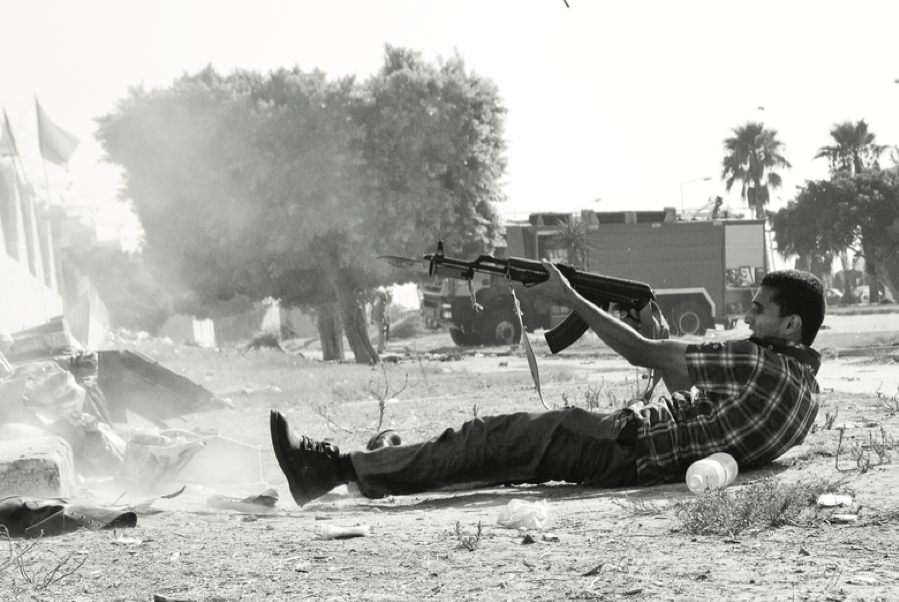
4) Rebel soldiers argue over the fate of a captured Qadhafi loyalist
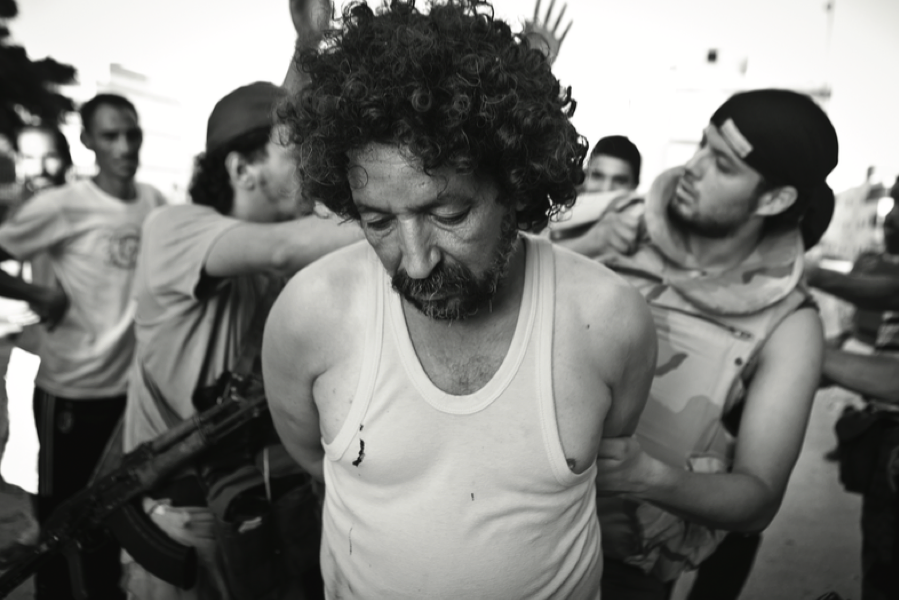
5&6) A Qadhafi fighter pleads with his rebel captors before being struck in the head with a rifle butt 
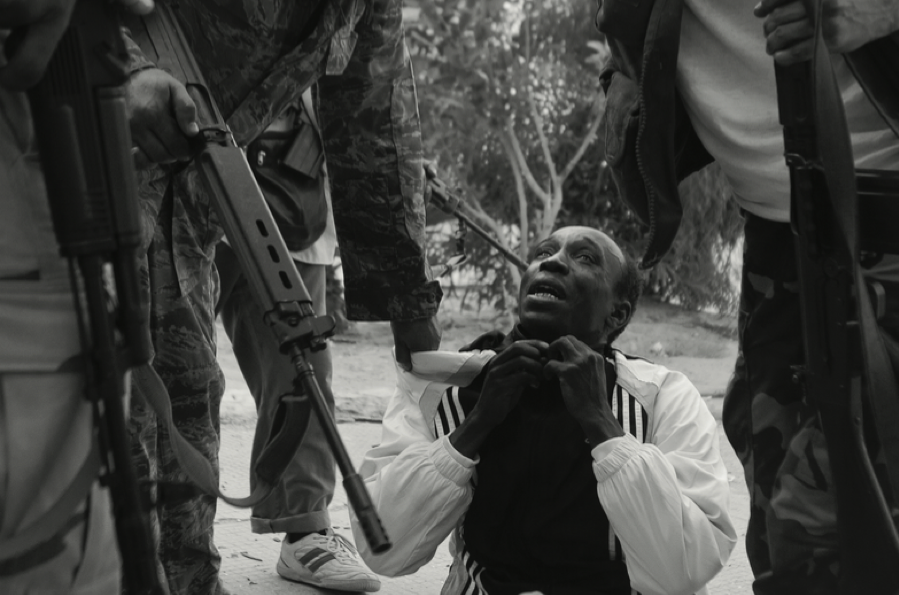
7) A terrified resident is reassured by rebels who, after a vicious assault, had just captured four loyalist troops from her building 

8) A loyalist soldier has his hands tied behind his back after surrendering to rebel forces. With the discovery of what appeared to be executed loyalist prisoners, the rebel leadership urged fighters not to abuse detainees. However, with little coordination between the various rebel groups, the fate of their captives was far from assured. Executive saw one captive being shot in the leg and others being beaten, though most of those seen captured by rebel forces appeared to be treated humanely

9) A loyalist soldier is interrogated by rebel troops minutes after he and several of his comrades surrendered amid heavy fighting in Abu Salim

10) Rebels take cover from sniper fire inside a guard post at the Qadhafi compound of Bab Al Aziziya 

11) Opposition soldiers fire at loyalist gunmen in a residential area of the Abu Salim neighborhood in Tripoli 

12) Some rebel divisions have taken to wearing uniforms and have developed formal structures of command, though for the most part remain loosely organized and use an informal assortment of arms and apparel 

13) The body of a soldier lies dead in a corner after heavy fighting in Abu Salim
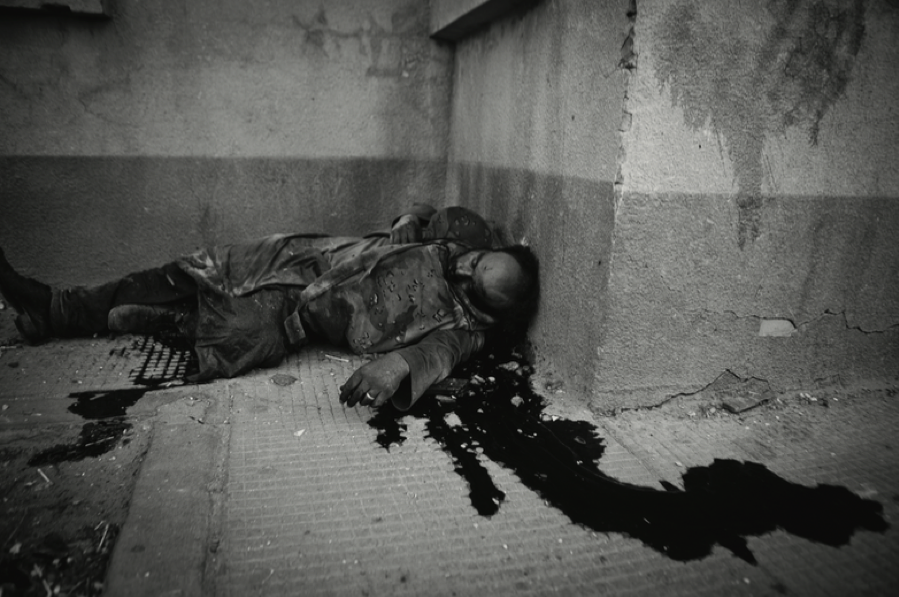
14) A rebel fighter escorts an Abu Salim resident from his home. Given the urban nature of the warfare and that fighters were often informally dressed, distinguishing civilians from soldiers was often difficult

15) A family flees after rebel troops surrounded their building in Abu Salim. As loyalist gunmen took up positions in residential housing blocks, civilians found themselves in the middle of heavy exchanges of fire from rifles, anti-aircraft weapons and rocket propelled grenades

16) Rebels dash toward the outer wall of the Bab Al Aziziya compound, keeping low to avoid Qadhafi gunmen who had been firing at them

17) Leaving no stone unturned, rebels search a giant stuffed bear found in the Bab Al Aziziya compound

18) Rebel soldiers patrol the streets of Abu Salim near sunset after a day of heavy house-to-house fighting 

19) Children collect bullet shell casings in what was formely called Green Square in Tripoli, now renamed Martyrs’ Square. The square saw little actual fighting but much celebratory gunfire 

20) As fighting ceased and quiet descended with the night, a resident walked through Tripoli’s old city, El Madina El Kadima

September 18, 2011 0 comments
0 FacebookTwitterPinterestEmail
Feature

Oil’s return from turmoil

by Executive Editors September 18, 2011
written by Executive Editors

As Libyan rebel fighters began routing government forces and advancing on the capital city of Tripoli in August, international oil and gas companies with interests in Libya (including five European and five North American hydrocarbon multinationals) began aggressively vying for the resumption or possible expansion of their roles in the country.

Italian oil firm, Eni, Libya’s most significant partner in hydrocarbons, said it expects a sub-Mediterranean gas pipeline between Libya and Italy to resume operations by mid-October. The company signed a memorandum with the National Transitional Council (NTC) — the rebels’ de facto government based in the eastern city of Benghazi — by which “Eni and NTC are committed to creating the conditions for a rapid and complete recovery of Eni’s activities in Libya and to doing all that is necessary to restart operations on the Greenstream pipeline, bringing gas from the Libyan coast to Italy”, the Italian company said in an August 29 press statement. The full restoration of oil output and exports, however, will be enormously complicated. Three factors will determine the speed of recovery of Libyan oil and gas production.

First, damages to the existing facilities will need to be examined and capacities restored. According to statements from NTC and Libyan oil officials at the end of August, direct conflict damages from the past six months to facilities have been limited and repairs have already begun. However, the restoration of facilities also includes dealing with the impacts of the shutdown process and inactivity of oil fields and pipelines.  

Second, oil sector workers will have to return to their jobs, which will require a rapprochement between the National Oil Company (NOC) and the NTC, as well as the return of foreign companies and their staff, which is heavily contingent upon an improvement in the security situation. The third and most crucial precondition for resumption of Libya’s oil economy, therefore, is a return to stability and internal security in the country. Reliable security structures have to be in place before the restoration of hydrocarbon facilities and the redeployment of the workforce can be meaningfully expected.

The nitty-gritty of Libyan oil

The oil and gas industry accounts for about 25 percent of Libyan gross domestic product, 80 percent of government revenues, and approximately 95 percent of export earnings. The 2011 BP Statistical Review of World Energy ranks the country as having the 11th largest oil reserves in the world, at 46.4 billion barrels, though it had been ranked at 19th in terms of production, at 1.6 million barrels per day, before the revolution. The equivalent figures for Libya’s natural gas reserves put it at 15th largest in the world at 1.5 trillion cubic meters, with its annual production at 32nd globally, with 15.9 billion cubic meters per year (cum/yr).

The sector is dominated by the NOC, which exploits and exports the country’s hydrocarbon reserves — both onshore and offshore — via a number of wholly-owned subsidiaries and international oil companies licensed by special agreements. The company owns the country’s refining and oil and gas-processing facilities, which include refineries at Mersa El Brega, Zawiya, Ras Lanuf, Tobruk and Sarir; the Ras Lanuf petrochemical complex and gas-processing plant is the country’s largest, also producing ammonia, urea, methanol, ethylene and low and high-density polyethylene.

Before the revolution, the NOC refined close to 380,000 barrels per day of the country’s crude oil in its refineries, with approximately 60 percent of the refined product output being exported. Libya’s oil and gas is sent to Europe, the country’s biggest export market, both by sea and a 540-kilometer, 11-billion cum/yr capacity subsea pipeline, dubbed ‘Greenstream’, across the  the Mediterranean to Gela in Sicily.

Within the country, Libya has a network of more than 8,700 km of onshore oil, gas and product pipelines.  Following the current unrest, most of the country’s oil and gas production and refinery capacity has been shut down. While refineries can be relatively easily restarted, damage notwithstanding, the crude oil pipeline network will have problems in starting up due to the waxy nature of the high-quality and relatively ‘light’ crude oil the Libyan oilfields produce. Once flow has halted for any appreciable time, the wax separates out and gradually blocks the pipeline. This material, similar to candle-wax, then becomes difficult to remove in order to restart the system, and it is foreseen that a considerable investment in technology and effort will be required to bring the system back to full operating capacity.

Looking ahead

UK-based energy and mining consultants Wood Mackenzie said in an August 25 statement that it expects resumption of full oil production capacities in Libya to require 36 months from “from whenever the current crisis reaches a resolution.” According to the analysts, the recovery of oil production capacities is likely to take longer for the mature Sirte basin in eastern Libya but will be faster in the newer Murzuk and Pelagian Shelf basins of western Libya.

For the longer term, “Libya has the potential to produce up to 3 million barrels per day of oil and become a major gas exporter through partnering with the international industry,” Wood Mackenzie noted, with the caveat that this future remains “on hold until military operations are concluded.”

September 18, 2011 0 comments
0 FacebookTwitterPinterestEmail
Feature

The fall of Tripoli

by Executive Editors September 18, 2011
written by Executive Editors

Tuesday, August 23 

Abdallah slides his finger across the map of Tripoli. “They’re still fighting here, in Abu Salim. And in Bab Al Aziziya, of course: that’s Qadhafi’s stronghold. And over there, around the airport. Oh, and I was just talking to a friend in Sidi Khalifa yesterday; she said there was heavy shooting in her neighborhood.”

It has been three days since rebels entered Tripoli but intense fighting persists in the capital, while outside of it Qadhafi soldiers continue to stalk Western Libya. At the Tunisian border, nearly every car is heading out of the war-torn country. Apart from a Red Cross truck and a few dozen journalists busy filming each other, only a few Libyans are heading the other way. One of these is Abdallah, who says that, after having been involved in the Egyptian revolution, he would not miss this one for the world: “It’s my country now. I want to be there when Tripoli falls.”

In Nalut, the first city on the road from Tunisia, the shelling ended more than a month ago but schools and businesses are still closed. The few open shops have half-empty shelves and petrol is in short supply — a liter now costs $2.50, whereas before the war it was cheaper than water. Like the capital, this city is still living the war and so are its people.

“There must be war,” affirms Khamis Birgig, a 35-year-old rebel who garnishes every other sentence with a “boom-boom!” and skillfully maneuvers the gearshift with what remains of his right arm. “Just a few more days and we’ll be rid of Qadhafi,” he says, as the car heads towards the capital.

Khamis clearly took some psychological hits when he lost his right arm, eye and part of his knee to a Qadhafi rocket early in the uprising, though he does not seem overly fazed about his physical disabilities: he can still shoot with his good arm and is confident that when the new government arrives his sacrifices will be rewarded. “They will respect human rights and take care of me. But first we have to catch Qadhafi, so that we can put him in front of the international court, where he has to tell the world what he has done.”

Khamis, like most of the rebels, speaks about freedom and democracy when asked why he rose up. But when pressed, out come the complaints about a lack of work, income and opportunities. “Under Qadhafi there was nothing,” he says. “Just poverty.”

With the sun setting over the Libyan desert, Khamis is asked how long the ride will be. “I have no idea,” he replies cheerfully to Executive. “It depends on whether or not we run into Qadhafi soldiers.” He looks to the side with his one eye, points to the Kalashnikov on the seat and smiles hopefully. “Boom-boom!”

Wednesday, August 24

The capital of a disintegrating state is a strange place to be. Since the rebels entered Tripoli a few days ago, the city has been alternating between sounds of celebration and the booms of Qadhafi soldiers’ last-ditch efforts to stave off their own impending demise. Car horns honk incessantly while bored rebels light up the night sky with tracer fire. The streets are strewn with the burnt-out wreckage of cars and dumpsters, improvised roadblocks set up by the new authorities, most of whom are younger than 20.

Some residents have a hard time getting used to the new status quo. In one incident in the neighborhood of Dahra, young fighters pounce on a taxi driver after he takes exception, with a swing, to their demands to open the trunk. As the struggling man is dragged away from his car, one rebel lands a punch squarely on his face before elderly residents intervene and the driver is allowed to leave. “Idiot. Should have opened the boot when I told him to,” the boxing rebel shrugs, before turning his attention to the next car.

Incidents like this one are rife within the city, but thus far the local councils secretly put in place to take over the day-to-day running of the city after Qadhafi’s departure have done well: looting has been kept to a minimum and, apart from the occasional resident happily jogging through Qadhafi’s former stronghold with a painting under his arm, very little plundering has been reported. No stores ransacked of flatscreen televisions, no looting of abandoned homes. But their control is slipping.

“No government, so no water,” says a smiling teenager to a foreign journalist scavenging the city for food and drink. A few days after the rebels all but took over the city, it has begun to break down. A lack of milk, vegetables and petrol may be manageable for the moment, but with drinking water increasingly scarce and tap water and electricity on the cusp of running out, one cannot help but wonder how long until the residents of Tripoli start pining for the good old days.

Thursday, August 25

“Watch out, sniper!” yells a rebel, before a deafening firefight explodes in the streets of Abu Salim. Through the black smoke tears a truck with thundering anti-aircraft guns on the back. From the besieged building, snipers open fire on the rebels. A wooden garden door is shredded on impact. Two rebels drop while their comrades in full sprint empty their Kalashnikovs at the flashes from the building down the road. The sharp smell of cordite and burning asbestos drifts over the streets. While the rest of the city has been enjoying relative calm, rebel fighters have been trying to clear this working-class neighborhood of the remaining Qadhafi loyalists for several days now. When a rumor that Qadhafi may be hiding in one of the buildings starts to buzz, Abu Salim turns into a full-fledged war zone.

After the dust settles, three bloodied corpses lie on the streets: two rebels, one loyalist. No Qadhafi. The deposed dictator’s location is still a mystery, and the search continues.

“When we finally get Qadhafi, the resistance will die out by itself,” says 25-year-old Abdallah Masoud, still shaking from narrowly escaping a sniper’s volley. “But as long as he’s free, the fighting will continue.”

In a few days, Abu Salim will be cleared of Qadhafi loyalists, while the fighting will go on in other neighborhoods. Some parts of Libya, notably the cities Sirte and Sabha, are still under Qadhafi control.

But a return of the dictator is now out of the question. It is “game over” for him, says Majid Fituri, a 47-year-old rebel leader from Misrata, while wandering around the rubble of Qadhafi’s former stronghold of Bab Al Aziziya.

He looks back at the ruins behind the famous statue of the clenched fist crushing an American fighter jet. Qadhafi left intact the concrete skeleton of the building, destroyed by American bombs in 1986, to serve as a reminder of the West’s wickedness. 

“Look at that,” Fituri says. “That used to be a museum in the form of a ruined building: a propaganda tool for Qadhafi.” He turns around and smiles. “Now, it’s just another ruined building.”

September 18, 2011 0 comments
0 FacebookTwitterPinterestEmail
Editorial

The fortunes of upheaval

by Yasser Akkaoui September 18, 2011
written by Yasser Akkaoui

The Libyan rebel forces’ rout of government troops from Tripoli last month heralded a pivotal moment in history, with the toppling of Muammar al-Qadhafi’s regime marking the third North African autocrat to fall to popular uprisings this year. Even while the security situation remains perilous, world powers and multinational companies are climbing over each other for a chance to reap their slice of the spoils of war: Libya’s fabulous resource wealth of oil and gas.

The Libyan revolution and its impact on global energy prices have been among the factors playing into the economic turmoil of late, where the sovereign debt crises in the United States and Eurozone have raised fears of a double-dip recession, sending markets into a flailing panic and rendering them near untradeable at times. In this environment, protecting one’s wealth becomes an anxious business. Executive has sought out the brightest minds in the business, locally, regionally and globally, for their take on how to navigate the storm.

Much of the world’s attention this month will also be focused on the 10-year anniversary of the September 11, 2001 terrorist attacks in New York and Washington. How much does this event, and the reactions it was used to justify, still impact the world we live in today? And is the so-called ‘clash of civilizations’ as clear-cut as its proponents would have us believe?

Despite all the turmoil, however, one must not forget to always look for opportunity. Perhaps that is a thought to ponder as one cruises what just recently became a long, open highway from the Gaza border to the doorstep of Algeria.

September 18, 2011 0 comments
0 FacebookTwitterPinterestEmail
Comment

Rivalries wrack Yemen’s opposition

by Farea al-Muslimi September 3, 2011
written by Farea al-Muslimi

Embattled Yemeni President Ali Abdullah Saleh, still in Saudi Arabia recovering from a June bomb attack in Sanaa, has been delivering speeches to his supporters back home promising a swift return to Yemen. His messages have raised fears that his return will lead the country to a civil war— a justifiable concern. In reality, whether Saleh comes back or not is not Yemen’s biggest question today. Even if he returns and refuses to relinquishpower, the post-Saleh period is imminent.

With this is in mind, the country’s opposition groups have been piecing together differing frameworks for a transfer of power. On July 16, coalitions of Yemeni youth in “change square” in Sanaa — groups created amid months of daily protests and sit-ins against the Saleh regime — established a Transition Council of 17 national figures from various groups to rule the country and “[put] an end to Saleh’s regime”.

The youths’ measure was followed by the formation of a“National Council” a few days later by the Joint Meeting Parties (or JMP, established in 2006 by the main opposition political parties in the country), which declared that discussions were taking place between the JMP and other opposition actors to establish a comprehensive transition council representative of the different actors in the opposition and political movements from around the country.

Thus, “The National Council for Peaceful Revolution Forces” was formed after some debate and was originally comprised of 143 members from different political groups: the JMP, opposition actors abroad, al-Houthis, the Southern movement, and religious, military, tribal and civil society leaders. As comprehensive as its intentions may have been, the council quickly ran into discord. The Houthi movement declined to participate, citing a lack of representation, while 23 high-profile members from the South withdrew, namely because they wanted seats on the national transitional council to be split 50-50 between the southern and the northern provinces — this, despite the overwhelming population majority in the north. They also griped at having been named to the council without first being consulted, a common refrain indicative of the larger criticism of the opposition: the lack of strategic planning and coordination. The councils have put the opposition’s boot to Saleh’s neck and begun the process of transitional dialogue, but they have failed to put forward a viable plan for a transfer of power or to reconcile differences between opposition groups.

Since the establishment of the councils by the “youth”, and the JMP and its alliances, nothing has really changed on the ground. The regime still holds power, the security forces continue to attack protesters and the political and economic crises worsen by the day. More importantly, the councils do not enjoy any international recognition; at least not yet.

Whether an interim government will be in power for months, a year or longer, at some point elections will have to be held and new actors will come to power in Yemen. Of principal concern on this matter is the real chance that it would be the Islamists who emerge on top, and, if this does happen, what their makeup might be.

The Yemeni branch of the Muslim Brotherhood, the Islah Party, would be most likely to attract popular support, as the strongest political party in the country. But it is a divided congregation, with three groups making up its core: the Salafists, a smattering of tribes, and the Ikhwan, with the latter known to be the most pragmatic and least ideologically driven. The main concerns are regarding Salafists, led by Abdul Majeedal-Zandani, an extremist religious leader once classified as a “specially designated global terrorist” by the US Treasury Department. Zandani announced more than a month ago that he is pro-Islamic Caliphate, while declaring a“government by the people and for the people is a concept for infidels”. And in 2007, he opposed the appointing of a woman to the Shura Council.

The Islah party has been increasingly realizing that Zandaniis costing the party more than he is helping it, and had already begun minimizing his role, albeit unofficially, even before the uprisings started. The fear of Zandani’s role and the Islamists in general is more an exaggerated phobia than reality; it is anathema for Yemenis to accept a new dictatorship under any justification, even a religious one.

Still, without a better organized, more unified effort from opposition parties to replace Saleh via political means, the question will remain: a transition council to what?

FAREA AL-MUSLIMI is a Yemeni activist and writer for Almasdar

September 3, 2011 0 comments
0 FacebookTwitterPinterestEmail
Comment

At war without knowing why

by Adam Pletts September 3, 2011
written by Adam Pletts

Images of the World Trade Center buildings billowing smoke, as their final minutes counted down a decade ago this month, gave a very different symbolism to the already iconoclastic twin towers — one representing the change of an era and a new geo-political order. Later that afternoon of September 11, 2001, according to the confidential notes of his aides, Donald Rumsfeld, then United States Secretary of Defense, was to instruct: “Go massive. Sweep it all up. Things related and not”.  And thus followed the two prolonged and bloody wars in Afghanistan and Iraq.

On top of its tangible tragedy, 9/11 was also devastatingly aesthetic, a mixture which helped to sear the event into our collective memory, so much so that it has become one of those rare occasions for which most can remember where they were when they first saw the smouldering towers.

But what do Afghans who live in some of the places most affected by the fallout of 9/11 recall about that day?

Helmand Province in Southern Afghanistan has borne the brunt of the fighting between Taliban and US-led coalition forces. It is also home to Das Mohammad, a farmer who scrapes a living from subsistence crops and opium cultivation. With an expression of some confusion, Mohammad recently took a quick glance at a photograph I handed him of the two metal towers spewing clouds of smoke against the blue sky of that day. When asked whether he knew what it was he shook his head. A small group of locals gathered around him, all of whom examined the picture with curiosity but no sign of recognition. When asked whether they thought the events depicted in the image had any bearing on their own lives the group was unanimous in dismissing them as irrelevant.

From his reactions to the picture it was clear that Mohammad had no idea what 9/11 was, or for that matter why America and its allies originally sent their military forces to Afghanistan. He is not alone; a survey carried out in October 2010 by the International Council on Security and Development found that 92 percent of a sample of 1,000 men in Helmand and Kandahar provinces were “unaware of the events of 9/11 or that they triggered the current international presence”.

Given the extremely poor infrastructure, lack of media and high levels of illiteracy, not to mention 30 years of war and the fact that the Taliban banned television and radio, it should perhaps not be surprising that most Afghans in Helmand and Kandahar have little idea about 9/11.

It should, however, beg the question as to how effective the coalition campaign to win hearts and minds can really be when those very minds, through no fault of their own, cannot place the international military presence within any context. It is one thing to tell Afghans that the Taliban are the “bad guys” — many would willingly agree — but quite another for them to understand why this is the business of foreign military forces.

After the assassination of Osama Bin Laden there is a case to be made that 9/11 itself is no longer a factor in the war in Afghanistan, which has moved on to attempting to create a safe environment where reconstruction and development can take place. These efforts, though, have been painfully slow, and it is likely that, just as the international military forces will leave without a great many Afghans ever having known why they were there in the first place, they will also do so without having adequately paved the way to real stability.

At the end of the day, the lack of knowledge about 9/11 is symptomatic of a far broader failure in communication between the allied forces and Afghanis, be they civilian, political or military. There are of course exceptions, but at every level, from the humble military translator misinterpreting his officer’s questions to an Afghan president who frequently decries the actions of his own international allies, war and reconstruction in Afghanistan is too often a story lost in translation.

ADAM PLETTS is a freelance journalist based in Beirut who recently completed the documentary film “Have You Heard of 9/11?”

September 3, 2011 0 comments
0 FacebookTwitterPinterestEmail
Comment

The end of engagement

by Gareth Smith September 3, 2011
written by Gareth Smith

During the 2008 United States presidential campaign, Barack Obama distanced himself from George Bush’s Middle East adventures and was given ample electoral space by his opponent, John McCain, who famously sung “bomb-bomb-bomb, bomb-bomb Iran” to a Beach Boys tune.

So Obama promised to engage Tehran. In truth, this hardly represented a departure in US foreign policy, as Washington has dealt diplomatically with many of its adversaries for decades. The Obama administration did join brief talks with Iran in October 2009 as part of the P5+1 (the permanent members of the UN Security Council plus Germany), and there was even a face-to-face meeting between William Burns, US under secretary of state, and Saaed Jalili, secretary of Iran’s Supreme National Security Council.

More substantive talks over Iraq, begun under the Bush presidency, helped foster tacit understandings allowing both Washington and Tehran to support Nouri al-Maliki’s government. But Obama has proved unable or unwilling to engage Iran more widely. Instead, sanctions against Tehran, and against companies or countries trading with Iran, have been tightened.

Historians will no doubt argue as to why. Engagement was opposed from the outset by the Israelis, who milked President Mahmoud Ahmadinejad’s theatrics on the Jewish holocaust as further justification for bolstering their arsenal, building more walls and attacking Palestinian “terrorists”.

And the protests after the disputed 2009 Iranian presidential election, and the authorities’ crackdown on dissent, exposed proponents of engagement in the US to charges of “appeasement” or worse.

Recent months have surely sounded the death-knell of Obama’s “engagement” policy. In August, the administration castigated Iran for backing the “brutal and unjust crackdown” in Syria, after earlier imposing sanctions on two senior Iranian policemen for allegedly advising Damascus on curbing protests.

In July, the US “designated” six alleged Al Qaeda operatives for running through Iran what a US treasury press release called the “core pipeline” for Al Qaeda’s “money, facilitators and operatives from across the Middle East to South Asia”. According to David Cohen, the under secretary for “terrorism and financial intelligence”, there had been “a secret deal” between Tehran and Al Qaeda.

The point of the exercise was likely more to up the ante on Iran than to sound alarms about Al Qaeda. Among the more fanciful claims about the relationship was a quote in the neo-conservative Weekly Standard from a “senior administration official” saying that “the most ready cadre” of Al Qaeda “operative types and senior-level managers” were in Tehran.

Of course sanctions targeting these men will have little effect, and only one of the six designated individuals was described as being “Iran-based”. Ezedin Abdel Aziz Khalil was said to have liaised with the Iranian government over the release of Al Qaeda operatives, presumably a reference back to the men detained by Iran soon after 9/11 as they fled American forces in Afghanistan. Since then, many of these detainees have been repatriated — to Saudi Arabia in many cases.

A leading politician in Tehran once told me that Iran’s basic strategy vis-à-vis Al Qaeda was to scheme and pray that the organization would be active elsewhere, and this continues to hold water. Even without violent Salafis who despise Shia as heretics, Iran is nervous over its Sunni minorities, principally the Kurds and the Baluchis.

Given all this, a more serious sign of growing US-Iran tension may be Washington’s allegations of Tehran orchestrating attacks in Iraq on American forces as their withdrawal looms in December. In seeking confirmation as chairman of the Joint Chiefs of Staff, General Martin Dempsey warned the Senate last month of a possible huge attack in Iraq similar to the 1983 bombing of the marine barracks in Beirut.

Of course, Iranian officials are well aware of the unpopularity within Iraq of the US presence and feel that time is on their side. Tehran has been more successful than Washington in developing relations with Iraq’s various groups and factions, and knows well that the broad brush of the US right, and the Israelis, hardly suits the terrain.

GARETH SMYTH has reported from around the Middle East for almost two decades and was formerly the Financial Times correspondent in Tehran

September 3, 2011 0 comments
0 FacebookTwitterPinterestEmail
Finance

Tallying the results

by Tamim Akiki September 3, 2011
written by Tamim Akiki

Although investable assets of the Middle East’s most wealthy in 2010 are back to their 2007 level of $1.7 trillion, according to the Capgemini and Merrill Lynch’s World Wealth Report (WWR), return expectations and attitudes have changed considerably. In particular, Ultra High Net Worth individuals (UHNWIs), a category comprising households with over $50 million in investable assets, have shifted their focus to capital preservation through less risky, simple investments.

“UHNW investors are starting to understand that probably in the near-and-medium-term, returns will be smaller than in the past… and also what they want to achieve is to protect the assets which they have and then tactically invest in distressed opportunities,” said Heiner Weber, who heads the Middle East desk at Falcon Private Bank. 

Largest global private banks in 2010

Largest global private banks in 2010

In fact, rising fears of another global recession in 2011 come at a time when the Middle East’s High Net Worth Individuals (HNWIs) — defined as having more than $1 million in investable assets — and UHNWIs are better positioned and prepared for a crisis than they were in 2007.

A 2011 survey of private bankers by Booz & Company showed the low-risk fixed income asset class topping the list of preferred investments by the region’s investors. Fifty percent of those surveyed selected fixed income as their clients’ most favored category after the 2008 crisis, while cash and time deposits ranked second, with 40 percent of responses. On the other hand, only 15 percent of private bankers said the risky funds business was favored by their clients, behind equities, with 35 percent of responses.

Middle East HNWI wealth ($trillions)

Middle East HNWI wealth

Percentage of HNWI population under 55 in 2010

Source: Capgemini and Merrill Lynch 2011 World Wealth Report.

In addition to more defensive portfolios and lower return expectations, investors have become more familiar with the products they hold and even more thorough in selecting their private bankers. According to Stephen Evans, the Middle East’s regional head at Standard Chartered Private Bank, “The way the wealthy think about their advisors now has changed. They are very much more particular, choosy, discerning, they ask more questions now about the quality of their bankers, their qualifications, and they are asking the right questions.”

Although private bankers and clients in the region have built valuable relationship experience since 2008, the wealthy in the region are still more difficult to cater to than in developed markets, given product preferences, demographic structure and geographic breadth.

Firstly, a third of GCC clients prefer Islamic products over conventional products, presenting the need for additional skills and product development. The Islamic preferences of the region’s clients have so far handed local private banks a key advantage over global banks operating in the Middle East, although the latter are still perceived to have “more stability, brand equity and institutional trust,” according to Daniel Diemers, principal with Booz & Company in Dubai.

The geographic fragmentation of GCC wealth also implies an added layer of cost to private banks. According to Booz & Company, Saudi Arabia has the largest pot of wealth in the region, with an estimated $530 billion in investable assets as of 2010, but others, such as the UAE and Kuwait, also hold considerable wealth, estimated at $270 billion and $145 billion, respectively, in investable assets.

As a result, private banks find themselves setting up multiple fully-staffed offices across various Middle Eastern cities. In particular, Switzerland-based banks, whose home country is viewed as a key source of geographic liquidity diversification, have offices in virtually every major city in the region. Credit Suisse and UBS offer private banking services in at least seven regional cities, with the latter employing more than 150 people in its Middle East operations.

Furthermore, the region’s wealthiest are far from the gray-haired clients typical of developed markets; The WWR showed that 56 percent of HNWIs in the Middle East are under 55 years of age, the second highest rate after Asia-Pacific, excluding Japan, with 69 percent and ahead of Europe’s 45 percent.

Despite the emerging global economic and financial challenges, the region’s wealthy and their advisers are better equipped than ever. However, upgrading Information Technology tools for investors and broadening the scope of services offered by private banks, especially in the corporate finance area to cater to the widespread family business model in the Middle East, will be critical to the industry’s resilience. 

September 3, 2011 0 comments
0 FacebookTwitterPinterestEmail
Finance

A perilous path

by Vanessa Khalil September 3, 2011
written by Vanessa Khalil

Executive caught Rudy Sayegh at a bad time. “There’s blood on the street,” joked HSBC Lebanon’s managing director as he walked into his office. Sayegh had just wrapped up a 40-minute conference call with one of the bank’s ultra high net worth clients, and the urgency of the conversation was not without reason. Following weeks of volatility, the United States financial markets had hit another low that day, August 18, with the Dow Jones index down 4 percent, the S&P 500 down 4.6 percent and NASDAQ down 6.6 percent. Sayegh’s client was, naturally, worried. 

For wealth managers and private and investment bankers, both globally and in the Middle East and North Africa (MENA), their client portfolios’ high levels of exposure to US and European equity and debt markets is, unanimously, a great deal of concern. And while Merrill Lynch and Capgemini’s 2011 World Wealth Report posted more than healthy growth rates for the worldwide High Net Worth (HNW) population and its overall wealth, which respectively rose 8.3 percent and 9.7 percent respectively in 2010 year-on-year and surpassed levels prior to the 2008 financial crisis, it also revealed early warning signs of an uneven economic recovery path, as the 3.9 percent global economic growth of 2010 was driven primarily by emerging markets in Asia-Pacific and Latin America.

A little introspection

Daniel Diemers, principal at Booz and Company, says the situation in both the US and Eurozone sets an all-too-familiar scene for the global wealth management industry. “Again, most relationship managers in the region are facing the same dilemma: Rapidly sliding markets where clients want to shift portfolios to lower margin assets under high time pressure, while product providers, chief investment officers and chief economists struggle to provide clear guidance and issue recommendations that leave the front office one step ahead of the client and the market,” he said. But what could soften the blow, he added, is that global private banks have pursued market share much less aggressively since 2008, have focused on revamping their business andrevenue models and have redefined the roles of their higher management andinvestment support teams.

And as many would assure, wealth managers’ conservative and cautious strategies throughout the last three years have trickled down to their private bankers and relationship managers, who seem to have learned lessons on the risk and reward perception of high margin products, the suitability of those products for investor needs and, most importantly, the value of a good client risk profile assessment.

“The last decades witnessed the development of new economic theories on investor behavior. The consequences of introducing behavioral aspects to how investors make investment decisions are far-reaching, but essentially we believe that they help our clients to become more disciplined investors,” said Reto Bartel, senior representative at UBS AG in Beirut. According to Bartel, UBS had introduced a risk monitor framework after the 2008 financial crisis, and as a result advised its clients to sell Greek sovereign bonds in early 2010 when their yields were still below 6 percent.

“The fundamental lesson of the financial crisis, as far as the private bankers are concerned, had to do with putting the client first. Unfortunately, a lot of people were either not qualified or not properly trained to determine what information was relevant, or they decided to look at products rather than people,” said Stephen Evans head of private banking in the western hemisphere at Standard Chartered bank. The 2011 World Wealth Report shows that private bankers have redeemed themselves in the past three years, as 98 percent of clients surveyed had regained their trust in their financial advisors by 2010, while a large percentage of them felt less confident about financial markets as a whole, as well as their regulatory bodies and institutions.

Stuck with ‘em

For Selim Chami, director of investment banking at BSEC, high net worth individuals (HNWIs) do not have much of a choice to let go of their private bankers. “At first you would basically get frustrated. You would hold a grudge against your private bankers [and] blame it on them. But again, who do you have [to] better run your money?” he said. UBS’s Bartel explained that clients are aware that wide swaths of the developed world are overly indebted and face rising healthcare costs, aging societies, as well as a scarcity of resources, which calls for a reallocation of investments — one that a do-it-yourself approach could not possibly achieve.

Whether the clients choose big banks or smaller investment boutiques to reallocate those investments, however, has been a matter of debate over the last three years. While some experts advocate the big and established names in the wealth management industry, others are promoting multi-family offices and small-to-medium sized financial institutions that have increasingly gained favor with Ultra High Net Worth Individuals (UHNWIs) and HNWIs since 2008. A recent report by Scorpio Partnership states that, although the global top-10 banks still controlled two thirds of the high net worth managed assets worldwide in 2010, “the wealth management industry still has the aura of a boutique service within the financial services community.” Their research shows that while the top-20 banks in the world managed 77 percent of the high net worth market in 2010, there are approximately $10 trillion of high net worth assets left over to potentially be managed by banks — an opportunity as much it is a challenge, as big banks face declines in efficiency, a rise incost-to-income ratios and a continuous struggle to maintain and increase profitability.

“Big names, big banks have big kitchens that tailor-make investment products and then dump them onto a sales team that has targets to meet. That’s why we’ve been able to snap [up] lots of clients from them since 2008,” said Nael Raad, managing director at Al-Ahli Investment Group, adding that for the last three or four years, clients have been migrating from big banks to small-and-medium-sized ones.

“Definitely, we’re going into family offices, and that’s been for five or six years where they will take care of the investments of UHNW families. When you have your own investment institution then you can be an unbiased investor,” said Mohammed al-Hamidi, managing director at AMFinancials, adding that UHNWIs, who usually deal with more than one bank and banker, benefit from having their investment portfolios under one umbrella of a family office that saves a great deal on the cost of investment.

MENA challenges

But Hamidi also realizes that local institutions in the MENA region, while a force to be reckoned with, face many challenges. “I think the biggest challenge for local and regional private banks is the distribution, expertise and depth of their capital,” he said, adding that the lack of talent in the MENA region, a problem that both local and global banks seem to suffer from, starts at the banks’ higher management level. “When we’re talking about the chief executive officers and the chief investment officers — all these big guys — usually if they’re really good, they’re not going to be in the region,” he said.

If the lack of technical expertise begins at the top of the hierarchy, BSEC’s Chami is sure that it does not get better at the bottom. “Private bankers in the Middle East — I don’t think they do much. They are more brokers than anything else. They take orders and execute for the clients,” he said. Georges Abboud, head of private banking at BlomInvest Bank, said that Lebanese investors in particular are mostly traders by nature, which does not allow much room for long-term wealth management. “But we are educating the bankers and the clients to move from a trading mentality to a more diversified, long-term strategy. This will take time. And at the same time you need to provide products and services to meet needs,” he said.

Structured products, which have been controversial for their complex payout terms and embedded risks that even bankers fail to understand at times, are largely off-limits to Lebanese private bankers because Banque du Liban (BDL), Lebanon’s central bank, has a tight rein on the development of banking products. “We need [central bank] approval for any product and that takes time, mainly because they want to control activities in this area, but also because  sometimes they needto build in-house expertise to understand and do the right due-diligence on[the products],” Abboud said, before adding that such measures are essential to promote a safe environment, as Lebanese private bankers generally still lack the sophistication to develop sound structured products.

Chami said bankers and brokers are one and the same thing in Lebanon because of limitations to both their job description and qualifications. “In Lebanon, you will hear private bankers say they can’t give their opinion on many things. You have those who put in a little more effort and give their recommendations. But I’m not sure that these people know enough about the markets,” he said, adding that modest trading volumes and a small client base in Lebanon push financial institutions toward economies of scale in hiring bankers who know a bit about all asset classes, but not enough about one in particular, which automatically results in a reduction in the quality of information and advisory services. “Normally speaking, if you look at developed economies you have specialization because they can afford it,” Chami added.

For Khaled Zeidan, general manager of securities and structured products at MedSecurities Investment, Lebanon’s small economies of scale do not allow for a legitimate private banking market in-country. “I think there is a future for asset management in Lebanon. In that aspect there is scale. For example, if I wanted to set up a Saudi Fund, or a MENA fixed income fund, then the cost of operating something like this is minimal. But for private banking, in the absence of scale, a few billion dollars of assets do not justify an operation,” he said, noting that global banks, on a standalone basis, often have assets under management equivalent to the whole Lebanese banking sector’s assets. “One should understand one’s limits,” said Zeidan, “I can’t do what Pictet [& Cie] can do.”

Weaning the clients

Another impediment to the development of the private banking industry in Lebanon is the mentality of clients themselves. “The majority of Lebanese, they like to trade. They are short-term speculators because in Lebanon we live in an environment of short-term vision because of the security situation,” said Hamidi. “So if you compare the activity of portfolio management, which is the main service of private bankers, and the activity of brokerage you see the [latter] in Lebanon is much bigger.” He added that Middle Eastern clients prefer not to concern themselves with industries outside of their core sphere of expertise, due either to a lack of time or blind faith in their bankers. “We present to clients for 15 minutes and they only hear the last two words: 10 percent or 5 percent or 12 percent [return],” said Hamidi.

This pushes bankers, said Chami, to only sell products that might appear to bear little risk and still yield high returns, a common yet unrealistic demand from clients in the region.

Regardless of these challenges, Raed Khoury, managing partner at Lebanon’s newest specialized private bank, Cedrus Invest, says there shuffling of wealth in the region, being driven by high oil prices, is a major opportunity for MENA private banking, even though building a platform for such an industry remains a challenge, especially in Lebanon. “Our approach is, we need to introduce more and more… to the Lebanese market the concept of wealth management, whereby we would look at the profile of the client, at their needs and at their family needs, [at] structuring [their] wealth — the whole spectrum.”

September 3, 2011 0 comments
0 FacebookTwitterPinterestEmail
Finance

Searching for security

by Zak Brophy September 3, 2011
written by Zak Brophy

The cataclysmic crash in global financial markets in 2008 was a smack in the face with a wet fish for both bankers and investors alike. A new reality emerged in its wake: gone were the days of carefree flurries into magnificently low-risk and high-return financial products fueled by seemingly boundless levels of borrowing. After a high-octane binge of hedonism and excess the hangover kicked in.

Many investors, left reeling from their losses, woke up to the sober realization that, in the words of Al Ahli Investment Group Managing Director Nael Raad, “nothing is safe”. Daniel Diemers, principal at Booz &Company, explained: “Clients shifted their assets towards simple, transparent, liquidity-oriented products with lower margins. Structured products in particular fell from favor, and clients largely retreated from risky and complex asset classes.” 

From Spring 2009 to late 2010, confidence returned to the markets and many investors were once again upping their risk threshold to try and recoup their losses. But the bonanza was short lived. Profound structural defects in the United States and Europe have been hounding their economies and fear has reentered the market.

Safety first

Many of the private bankers who spoke with Executive for this special report said the turmoil in the markets has instigated a shift in mentality amongst clients. “People only learn from their mistakes,” said Khaled Zeidan, general manager of securities and structured products at Med Securities Investment, “and people have been burnt a lot here.”

According to AM Financials Managing Director Mohammed al-Hamidi, “In general, the environment is very conservative. Not a lot of people are taking risks and that’s why we see that yields on bonds in the US are going down, the stock market is very volatile… [Clients] are not trusting anybody”. It is a classic case of once bitten, twice shy.

Whilst there are still gamblers and seasoned traders seeking the quick buck to be made in the storm, most clients have shifted their expectations. Preservation of capital has usurped quick-fire trading as the order of the day. Head of Private Banking at BlomInvest Bank Georges Abboud said: “We are educating the bankers and the clients to move from a trading mentality to a more diversified, long term strategy.”

Abboud claims, however, that investing in equities can still be considered a responsible option if played right. “If there is a high yield, say 8 percent, low debt, and you have reliable revenues over the coming five years, then buy! There is a risk it could go down with the market but I am comfortable with the risk.”

Private bankers consider a core aspect of their work to educate and inform the clients. But Jean Riachi, chief executive officer of FFA Private Bank, has found that convincing the Lebanese client to ignore the short-term vicissitudes of the market is not always an easy task. “We would like to convince people to forget about the volatility in the short term. But people are very difficult to convince, they have to look almost daily, in any case monthly, at their net worth, and they will panic anytime you have a fall in this valuation,” he said.

Paranoia’s parade

The rotten roots of today’s market instability are sunk in the very shores that have long been the bedrock of the global economic system.The 2008 banking crisis, the Eurozone sovereign debt crises and the US credit rating downgrade have upended many previously held assumptions about what is a‘safe investment’.

According to Al Ahli’s Raad, “what’s risky nowadays are definitely the international banks in the US and Europe and sovereign bonds in Europe.” 

BlomInvest’s Abboud considers the western banking system a toxic miasma as well. “I have been telling the team since 2008 not to invest in any Western European or American banks. When the rates are low they don’t make money, and there is all the junk around in terms of assets, and they are having to make provisions on all the problems that have happened with the governments. We cannot know what the banks hold in terms of assets so you have to get away,”he said.

The sovereign debt traumas continue to hector the Eurozone, and what’s beyond the horizon is far from certain. The very real prospect of a Greek default would pose a significant threat to the solvency of the banks in Europe’s core nations of France and Germany (who hold substantial amounts of Greece’s outstanding debts). And that’s before we dare to look at Europe’s other tottering members Ireland, Spain, Portugal and Italy. A recent indication of the markets’ unease with the Eurozone is the almost 130 billion euros [$187.75 billion] banks are parking overnight in the European Central Bank’s deposit facility rather than lending to other banks.

FFA’s Riachi explained that the Euro-crisis presents a new and hostile territory for economists and bankers due to the fact that such an array of national economies are tied into a single currency. There is no real precedent to base their analysis on. “I don’t know what kind of solutions they will find but it’s really a very deep crisis and it needs to be solved as soon as possible. Germany needs to show leadership on this issue; otherwise they have to renounce the Eurozone,” he said.

Across the Atlantic, the US is also proving an insufferable headache for private bankers as they strive to offer sage advice to their clients. Opinions on whether it is going to relapse into a double dip recession remain divided but few disagree with HSBC Private Bank Managing Director Rudy Sayegh’s assessment that “everyone [American and European governments and consumers is up to the hilt in debt, so their capacity to spend is limited and thus what will come is slow growth, if not recession, but in a best case scenario slow growth for several years.” 

Despite the recent debacle over America’s debt, some private bankers still view it as a safe investment. “They downgraded the debt and at the same time the bond yield went down. You should have expected the contrary. So people still believe it is a safe haven,” said Abboud.

For Jean Riachi, the political fiasco of the debt ceiling debates, replete with playground histrionics and stern-browed brinkmanship, was as damaging as the underlying economic ills. “In the US, I think it was more of a leadership issue, and it was clearly stated by Standard & Poor’s when they did the downgrade that they know there is no doubt about the ability of the US to repay its debt,” he said.  

In any case American markets remain in a somewhat battered and disheveled state. When US companies released their mid-year reports at the end of July, they had much lower guidance for future earnings, a warning sign for equity markets. According to Sayegh, “People are selling equities on the concept that if you don’t have growth now the market should not be valued at this level but at less in terms of private equity.” 

Counting the fundamentals

Despite the woes in western markets, several bankers warned against overstating the case. When asked if investors should disassociate from European and American markets, MedSecurities Investment’s Zeidan sought todownplay reasons for alarm. “Let’s not be ridiculous. Despite all the problems and issues we have today in the US and Europe, these are mature markets. There are sound laws and there is protection for the investor.”

Nada Safa, regional manager for Audi Saradar Private Bank added: “You have to choose growth stocks. Look at the US and all the blue chips and growth stocks. It is true that they went down but we know that at the end of the day they will go up.”

While there may still be promise in western markets, it is clear there has been a shift in perceptions and investors are increasingly looking elsewhere. “Is it the time to invest in emerging markets? It’s been the time for 10 years,” said Georges Abboud. 

The Institute of International Finance (IIF) is projecting increases in overall net private capital flows to emerging markets this year to more than $1 trillion, after a 54 percent rise to $990 billion in 2010. IIF Managing Director Charles Dallara said, “The high level of capital flows to emerging markets reflects the rising weight of these economies [globally] and their very strong performance relative to mature economies in recent years.”

Nonetheless, Raad warned that investment in emerging economies still poses potential risks, and only informed and specifically targeted investments should be made. “You need to be much more selective. It’s not regional anymore. Which sector, which companies, which currency, you have to be selective. It’s not a broad idea like it used to be.”

Although private bankers are increasingly searching out those fruitful opportunities in emerging markets, it is still the US that sets the tune for the world to dance to. It is just unfortunate that the record is stuck on a Waltz and not a Polka.

Audi Saradar Private Bank’s Safa, speaking about Brazil, Russia, India and China, said: “they are all linked to the US, and you know if the US sneezes the whole world gets the flu. I think they are solid but still no one allocates more than 10 percent to 15 percent to emerging markets.”

Abboud agreed the US was still a dominant force in the global economy but argued the shift east was ineluctable. “The US market is still a big driver for the rest of the world, and it will remain that way because of its consumption. In time, though, it will de-correlate, and I am a firm believer that you have to move your money away to Asian economies, and to move away from the US dollar,” he said. 

With over 60 percent dollarization of Lebanon’s banking assets, investors are increasingly mindful of minimizing their exposure to a potentially precipitous decline in the value of the dollar. Reto Bartel, senior representative at UBS AG in Beirut, said, “We expect major currencies to remain relatively unattractive in the quarters ahead. When diversifying their US dollar and Euro exposure, investors might think of the Scandinavian currencies, the Canadian dollar and several Asian currencies.”

Looking ahead

The disorienting upheavals of the past couple of years have been a wakeup call to many investors, and private bankers now talk of customers being both better informed and more demanding. “They want to know everything,” said Abboud.

What is more, private bankers in Lebanon say their clients now have somewhat more realistic expectations with regards to protecting their capital and expanding their wealth. While the Lebanese predisposition to take risks has not been completely snuffed out, a more conservative approach to asset management now prevails.

The problem is that there are no longer any true safe havens. In the words of Zeidan, “there is no longer one black swan; there are 100…so we should not take anything for granted.”

September 3, 2011 0 comments
0 FacebookTwitterPinterestEmail
  • 1
  • …
  • 364
  • 365
  • 366
  • 367
  • 368
  • …
  • 696

Latest Cover

About us

Since its first edition emerged on the newsstands in 1999, Executive Magazine has been dedicated to providing its readers with the most up-to-date local and regional business news. Executive is a monthly business magazine that offers readers in-depth analyses on the Lebanese world of commerce, covering all the major sectors – from banking, finance, and insurance to technology, tourism, hospitality, media, and retail.

  • Donate
  • Our Purpose
  • Contact Us

Sign up for our newsletter

    • Facebook
    • Twitter
    • Instagram
    • Linkedin
    • Youtube
    Executive Magazine
    • ISSUES
      • Current Issue
      • Past issues
    • BUSINESS
    • ECONOMICS & POLICY
    • OPINION
    • SPECIAL REPORTS
    • EXECUTIVE TALKS
    • MOVEMENTS
      • Change the image
      • Cannes lions
      • Transparency & accountability
      • ECONOMIC ROADMAP
      • Say No to Corruption
      • The Lebanon media development initiative
      • LPSN Policy Asks
      • Advocating the preservation of deposits
    • JOIN US
      • Join our movement
      • Attend our events
      • Receive updates
      • Connect with us
    • DONATE