• Donate
  • Our Purpose
  • Contact Us
Executive Magazine
  • ISSUES
    • Current Issue
    • Past issues
  • BUSINESS
  • ECONOMICS & POLICY
  • OPINION
  • SPECIAL REPORTS
  • EXECUTIVE TALKS
  • MOVEMENTS
    • Change the image
    • Cannes lions
    • Transparency & accountability
    • ECONOMIC ROADMAP
    • Say No to Corruption
    • The Lebanon media development initiative
    • LPSN Policy Asks
    • Advocating the preservation of deposits
  • JOIN US
    • Join our movement
    • Attend our events
    • Receive updates
    • Connect with us
  • DONATE
Real Estate

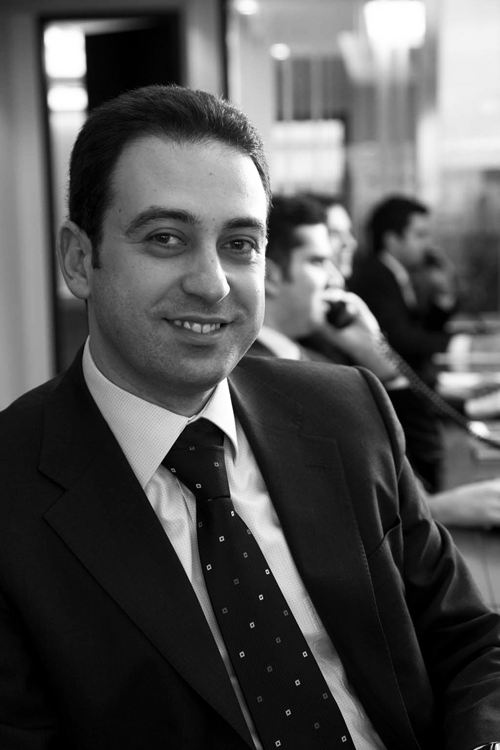
Q&A – Fadi Antonios

by Rayya Salem September 3, 2011
written by Rayya Salem

Fadi Antonios presides over a network of industrial enterprises in the United Arab Emirates and has growing interests in Lebanese real estate. Through his development company, Antonios Projects, he is the sole owner and developer behind what will be Lebanon’s tallest tower, the 50-story Sama Beirut, currently under construction in Ashrafieh, where it will offer luxury retail space, offices and residences. Executive recently got the scoop on the project and on Antonios’ future plans for his home city.

Since the construction contract alone is well over $100 million for Sama Beirut, is it not risky to self-finance the entire project?

My father used to say, ‘In real estate, never take a partner; it’s like [having a] wife, you don’t take a partner.” [laughs] If you can realize your project without banking facilities it is better and less risky… Now we have a bridge loan [a guarantee from the bank in case of a financial shortfall]… but we don’t have any problems with financing. I always work by myself [without partners].

Besides that, I am working on a much bigger project. It will be a gated community, which will have close to 60 buildings in a prime location in Beirut and will have all internal facilities, security at the gates and a club for the families.

I am also starting an office building in Beirut, near Université Saint Joseph, where there is a need for “clever offices”. I bought the plot, which is close to 2,000 square meters, and we are now working on the drawings and architecture. Again, it is all being financed by myself.

To date, what is your total investment in Lebanon?

Quite a lot. I think investing in Lebanon in real estate is still the safest and most interesting place. Especially that we are Lebanese and we know the mentality, the people. It is much easier to navigate the construction field [in Lebanon] than anywhere else in the world.

The construction contract awarded to MAN Enterprise was more than $100 million whenannounced in June. Was this the original budget?  

Yes, but the construction budget has increased more than 50percent.

We didn’t expand floors but it is due to the improvements,choice of material, high technology and the devaluation of the US dollar.

How does Sama Beirut use solar water heating techniques?

We tried to use solar energy to produce basic electrical needs. Unfortunately the photovoltaic technology is still very expensive and it did not pay to invest in it. For the hot water, that is a much simpler technology and it’s enough to provide hot water for 24 hours without burning fuel… Fuel for boilers and maintenance of systems is getting more expensive. With solar, it’s a free system and maintenance is cheap.

In the UAE,developers have traditionally applied a mix of British and US fire safety standards, but the rules are currently being standardized, as some new residential buildings reach over 100 stories. What about in Sama Beirut?

Here we can use the service floors [every 10 floors] and we also have fire-proof elevators in addition to fire safety plans and installations. We are applying fire safety [techniques] that are a mix of the French and American systems.

Lebanese engineers are really the best, I would say. I enjoy working with these engineers and architects. I always use Gregory Gatzerelia for all my private residences… For Sama Beirut, we considered international contractors before choosing MAN Enterprise. [The deciding factor] was not price, it was experience in mastering Lebanese construction, rules and regulations — its name and its realizations are the best buildings in Beirut.

September 3, 2011 0 comments
0 FacebookTwitterPinterestEmail
Comment

Nokia’s got your number

by Paul Cochrane September 3, 2011
written by Paul Cochrane

Nokia’s brand image is of two hands — one a child’s and one adult — reaching towards each other with the slogan: “Connecting People”; a nice image for a mobile phone manufacturer and service provider. But in a dozen countries in the Middle East and North Africa (MENA), the Finnish mobile phonegiant’s joint subsidiary with the German company Siemens, Nokia Siemens Network (NSN), has been connecting people in a way that consumers were not expecting: with the mukhabarat, or secret police.

Dozens of pro-democracy activists arrested in Bahrain by mukhabarat following the uprising that began in February were presented with transcripts of text messages and phone calls that they had made. Detainees were puzzled as to how their communications had been intercepted and were being used as evidence against them. They were not aware of the monitoring systems that 12 countries in the MENA, according to a report by Bloomberg published last month, had bought software from NSN and its subsidiary, Trovicor, that enables governments to intercept phone calls, emails and text messages. Such surveillance software also allows the powers that be to create disinformation by changing the contents of written communications and to scan phone networks through voice-recognition and keyword-search software, in addition to remotely activating laptop webcams and microphones on mobile phones, according to Wired magazine.

The Bloomberg exposé of the usage of such technologies in Bahrain is a first during the MENA uprisings of this year. That websites were being monitored was well known, and people in Syria, Libya, Egypt, Yemen and elsewhere have long been wary of what they said on the phone in case of a third, unwanted listener. But the level of interception and its usage by secret police is a concern not only for activists, protesters and the like but also for the very privacy of all people.

Furthermore, it is not an issue confined to Bahrain or the MENA. This follows the phone hacking scandal in Britain in July that reached the highest echelons of the police force, the offices of the prime minister as well as dozens of print publications, and add to this the news of Google’s cozy relations with not only Washington DC but also Beijing. This all comes on top of the revelations over the last decade about the joint American-British global surveillance system Echelon.

Such phone hacking and monitoring is a growing concern reminiscent of George Orwell’s dystopian novel 1984, which depicts a society under the hyper-surveillance of “Big Brother”. The arguments given for such surveillance software in the hands of the state are acceptable when it comes to tracking terrorists, organized criminals and other deemed baddies, but, as always, it is how such technology is used, for what purpose and how you classify a “bad guy”. Inflicting human rights abuses on Bahraini activists for what they wrote and said via their mobile phone is not a shining example of what Trovicor calls in its website: “Making the world a safer place.” Safer for the Bahraini ruling elite perhaps, but not for its citizens.

Telling in the unveiling of Bahrain’s usage of Trovicor’s systems is the fact that it will most likely not cause the same outcry as when NSN was hauled over the coals in 2009 in the United States for providing the same technology to the Iranian government to snoop on protesters in the wake of the disputed presidential elections. What has become very clear this year in the region is that there are halal and haram revolutions, depending on the country’s relations with the US. Bahrain is of course in the latter category.

Conversely, Tehran’s usage of Trovicor’s systems and a “Noto Nokia” international boycott for its indirect role in human rights abuses resulted in NSN selling Trovicor to Germany’s Perusa Partners Fund in 2009, although management, staff and equipment have remained largely the same. Meanwhile, NSN sales teams have been instrumental in the continued roll out of the service in the MENA.

By connecting and informing protestors and by distributing news and video updates from the streets, technology and social media have been key components in the successes of some of the uprisings throughout the region. Unfortunately, these same mediums are being used as a tool of autocracy. Just as governments should be held accountable for repressing their people, so too should corporations who facilitate such brutality.

PAUL COCHRANE is the Middle East correspondent for International News Services


September 3, 2011 0 comments
0 FacebookTwitterPinterestEmail
Comment

In search of deus ex machina

by Peter Grimsditch September 3, 2011
written by Peter Grimsditch

If events in Syria are a tragedy, its monumental regional and international cast combines to weave an intriguing plot rivaling incomplexity the tales of Greek playwright Euripides. Their public utterances areas striking as some lines in, say, Medea, and never was the need for a Euripidean deus ex machina — an unlikely intervention by a higher power to resolve a conflict — more urgent. Some 2,500 years ago, the mythical Medea shocked audiences by slaughtering her children off stage. She justified the infanticide as retribution for her philandering husband’s unfaithfulness. Nowadays, it is the mother country torturing and mowing down its children in a remorseless fight against subversive minors.

Meanwhile, political actors on the global stage gravely offer advice that to many in the audience must sound like — well, Greek. Syria’s western neighbor dispatched its courier (many times) to urge an immediate end to the violence. “Our initiatives had positive results,” said Turkey’s prime minister, Recep Tayyip Erdogan, in an aside to that portion of the auditorium containing his supporters; “The important thing is that Damascus took the first step less than 24 hours after I visited the country,” added Ahmet Davutoglu, his trusty sidekick and main emissary to foreign lands. Yet even as the oppressors were promising to mend their ways and introduce democratic family counseling, their tanks were racing from Hama to continue target practice in another town. Syrian leader Bashar al-Assad put those “positive results” in a different light. “In general, we meet with officials from other countries, take advice, and discuss their experiences, especially countries whose societies resemble ours, but when it comes to a decision, we don’t allow any country, near or far, to interfere.”

Cue the passionate public pleas from myriad actors, none of whom seem to be listening to the others.

Iranian President Mahmoud Ahmadinejad said he was grateful to Erdogan for opposing, as the Iranian news agency IRNA reported, “the US-led Western alliance of NATO’s military invasions,” saying that “foreign meddling in regional matters only exacerbates the state of affairs.” The audience may have scratched its collective head at this. NATO has led aerial strikes in Libya while military action against Syria is an idea few have taken seriously. Turkey supplied the Libyan rebels with several hundred million dollars, all the while simultaneously trying to convince Muammar al-Qadhafi, to be more accommodating.

That policy of pragmatism was also demonstrated by Davutoglu’s pleas to Assad in Damascus being accompanied by two separate conferences on Turkish soil of the so-called Syrian opposition. Meanwhile, further complicating the twisted plot, as Ahmadinejad was expressing gratitude to Erdogan, the Ankara-based Center for Middle Eastern Strategic Studies (ORSAM) claimed Iran had been spreading anti-Turkish propaganda, accusing it of supplying arms to Syrian opposition groups. And the Tehran Times wondered how Erdogan could wag his finger at Syria for “attacking armed terrorist groups” when his own military forces had launched a massive operation against “a few attacks” by Kurdish insurgents. Enter the United States and Russia. After some considered indecision, President Barack Obama announced that Assad had to go and said he and Erdogan had agreed to “consult closely” over the ongoing violence; Erdogan’s people say in public they do not support denying Assad his right to rule, while a few admit in private that it may come to that. Meanwhile, Russia said that it vehemently opposes military action against Syria, while declining comment on the possibility of Turkish support for armed intervention. Ankara has never said openly it was considering using its army on Syrian soil, although it has done little to squash analysts’ publicly aired speculation on the various forms in which this could happen.  So how will the drama end? Euripides would have stuck a character in a crude crane on the corner of the stage and raised him aloft to explain, in some of the more unremarkable passages of Greek verse, how everything would be resolved.

The deus ex machina to provide a solution for Syria, and a good few other countries in the region, could well be an international conference to seek a comprehensive Middle East settlement. And if curbing human rights abuses and extending freedoms make the agenda as well, so much the better — indeed, these ideas seems almost as old as Euripides. But the convenient final scene in which all problems were resolved was one reason the author of Medea won very few prizes; I’d hold the cigars for the conference’s prospects as well.

PETER GRIMSDITCH is EXECUTIVE’s Turkey correspondent

September 3, 2011 0 comments
0 FacebookTwitterPinterestEmail
Comment

Rivalries wrack Yemen’s opposition

by Farea al-Muslimi September 3, 2011
written by Farea al-Muslimi

Embattled Yemeni President Ali Abdullah Saleh, still in Saudi Arabia recovering from a June bomb attack in Sanaa, has been delivering speeches to his supporters back home promising a swift return to Yemen. His messages have raised fears that his return will lead the country to a civil war— a justifiable concern. In reality, whether Saleh comes back or not is not Yemen’s biggest question today. Even if he returns and refuses to relinquishpower, the post-Saleh period is imminent.

With this is in mind, the country’s opposition groups have been piecing together differing frameworks for a transfer of power. On July 16, coalitions of Yemeni youth in “change square” in Sanaa — groups created amid months of daily protests and sit-ins against the Saleh regime — established a Transition Council of 17 national figures from various groups to rule the country and “[put] an end to Saleh’s regime”.

The youths’ measure was followed by the formation of a“National Council” a few days later by the Joint Meeting Parties (or JMP, established in 2006 by the main opposition political parties in the country), which declared that discussions were taking place between the JMP and other opposition actors to establish a comprehensive transition council representative of the different actors in the opposition and political movements from around the country.

Thus, “The National Council for Peaceful Revolution Forces” was formed after some debate and was originally comprised of 143 members from different political groups: the JMP, opposition actors abroad, al-Houthis, the Southern movement, and religious, military, tribal and civil society leaders. As comprehensive as its intentions may have been, the council quickly ran into discord. The Houthi movement declined to participate, citing a lack of representation, while 23 high-profile members from the South withdrew, namely because they wanted seats on the national transitional council to be split 50-50 between the southern and the northern provinces — this, despite the overwhelming population majority in the north. They also griped at having been named to the council without first being consulted, a common refrain indicative of the larger criticism of the opposition: the lack of strategic planning and coordination. The councils have put the opposition’s boot to Saleh’s neck and begun the process of transitional dialogue, but they have failed to put forward a viable plan for a transfer of power or to reconcile differences between opposition groups.

Since the establishment of the councils by the “youth”, and the JMP and its alliances, nothing has really changed on the ground. The regime still holds power, the security forces continue to attack protesters and the political and economic crises worsen by the day. More importantly, the councils do not enjoy any international recognition; at least not yet.

Whether an interim government will be in power for months, a year or longer, at some point elections will have to be held and new actors will come to power in Yemen. Of principal concern on this matter is the real chance that it would be the Islamists who emerge on top, and, if this does happen, what their makeup might be.

The Yemeni branch of the Muslim Brotherhood, the Islah Party, would be most likely to attract popular support, as the strongest political party in the country. But it is a divided congregation, with three groups making up its core: the Salafists, a smattering of tribes, and the Ikhwan, with the latter known to be the most pragmatic and least ideologically driven. The main concerns are regarding Salafists, led by Abdul Majeedal-Zandani, an extremist religious leader once classified as a “specially designated global terrorist” by the US Treasury Department. Zandani announced more than a month ago that he is pro-Islamic Caliphate, while declaring a“government by the people and for the people is a concept for infidels”. And in 2007, he opposed the appointing of a woman to the Shura Council.

The Islah party has been increasingly realizing that Zandaniis costing the party more than he is helping it, and had already begun minimizing his role, albeit unofficially, even before the uprisings started. The fear of Zandani’s role and the Islamists in general is more an exaggerated phobia than reality; it is anathema for Yemenis to accept a new dictatorship under any justification, even a religious one.

Still, without a better organized, more unified effort from opposition parties to replace Saleh via political means, the question will remain: a transition council to what?

FAREA AL-MUSLIMI is a Yemeni activist and writer for Almasdar

September 3, 2011 0 comments
0 FacebookTwitterPinterestEmail
Comment

At war without knowing why

by Adam Pletts September 3, 2011
written by Adam Pletts

Images of the World Trade Center buildings billowing smoke, as their final minutes counted down a decade ago this month, gave a very different symbolism to the already iconoclastic twin towers — one representing the change of an era and a new geo-political order. Later that afternoon of September 11, 2001, according to the confidential notes of his aides, Donald Rumsfeld, then United States Secretary of Defense, was to instruct: “Go massive. Sweep it all up. Things related and not”.  And thus followed the two prolonged and bloody wars in Afghanistan and Iraq.

On top of its tangible tragedy, 9/11 was also devastatingly aesthetic, a mixture which helped to sear the event into our collective memory, so much so that it has become one of those rare occasions for which most can remember where they were when they first saw the smouldering towers.

But what do Afghans who live in some of the places most affected by the fallout of 9/11 recall about that day?

Helmand Province in Southern Afghanistan has borne the brunt of the fighting between Taliban and US-led coalition forces. It is also home to Das Mohammad, a farmer who scrapes a living from subsistence crops and opium cultivation. With an expression of some confusion, Mohammad recently took a quick glance at a photograph I handed him of the two metal towers spewing clouds of smoke against the blue sky of that day. When asked whether he knew what it was he shook his head. A small group of locals gathered around him, all of whom examined the picture with curiosity but no sign of recognition. When asked whether they thought the events depicted in the image had any bearing on their own lives the group was unanimous in dismissing them as irrelevant.

From his reactions to the picture it was clear that Mohammad had no idea what 9/11 was, or for that matter why America and its allies originally sent their military forces to Afghanistan. He is not alone; a survey carried out in October 2010 by the International Council on Security and Development found that 92 percent of a sample of 1,000 men in Helmand and Kandahar provinces were “unaware of the events of 9/11 or that they triggered the current international presence”.

Given the extremely poor infrastructure, lack of media and high levels of illiteracy, not to mention 30 years of war and the fact that the Taliban banned television and radio, it should perhaps not be surprising that most Afghans in Helmand and Kandahar have little idea about 9/11.

It should, however, beg the question as to how effective the coalition campaign to win hearts and minds can really be when those very minds, through no fault of their own, cannot place the international military presence within any context. It is one thing to tell Afghans that the Taliban are the “bad guys” — many would willingly agree — but quite another for them to understand why this is the business of foreign military forces.

After the assassination of Osama Bin Laden there is a case to be made that 9/11 itself is no longer a factor in the war in Afghanistan, which has moved on to attempting to create a safe environment where reconstruction and development can take place. These efforts, though, have been painfully slow, and it is likely that, just as the international military forces will leave without a great many Afghans ever having known why they were there in the first place, they will also do so without having adequately paved the way to real stability.

At the end of the day, the lack of knowledge about 9/11 is symptomatic of a far broader failure in communication between the allied forces and Afghanis, be they civilian, political or military. There are of course exceptions, but at every level, from the humble military translator misinterpreting his officer’s questions to an Afghan president who frequently decries the actions of his own international allies, war and reconstruction in Afghanistan is too often a story lost in translation.

ADAM PLETTS is a freelance journalist based in Beirut who recently completed the documentary film “Have You Heard of 9/11?”

September 3, 2011 0 comments
0 FacebookTwitterPinterestEmail
Finance

Q&A with Riad Salameh

by Executive Staff August 26, 2011
written by Executive Staff

Riad Salameh, the governor of Lebanon’s central bank discusses his strategies and successes as he enters his fourth term at the helm of the country’s banking sector

August 26, 2011 0 comments
0 FacebookTwitterPinterestEmail
Economics & Policy

A town on the frontlines

by Sam Tarling August 26, 2011
written by Sam Tarling
Members of the Free Syrian Army take positions near the town of al-Qusayr in Homs province, Syria, in anticipation of an attack by regime forces that won't come [Executive/Sam Tarling]
Members of the Free Syrian Army's Ah Al Rassi (freedom for the river Assi) brigade take part in an attack on regime forces in the village of Nizareer, near the Lebanese border in Homs province, Syria, on Saturday, May 12th. The FSA said the attack was a response to a regime incursion into the village during which they killed villagers and imprisoned others [Executive/Sam Tarling]
This fighter survived his injuries after comrades patched his wounds before sending him back to safety [Executive/Sam Tarling]
A fighter is treated for his wounds after being shot in the torso and the leg while attempting to fire a rocket propelled grenade at government troops [Executive/Sam Tarling]
Member of the Free Syrian Army prepare to attack regime forces in the village of Nizareer, near the Lebanese border in Homs province [Executive/Sam Tarling]
Dead civilians are loaded onto the back of a truck outside a hospital in al-Qusayr, Homs province, after heavy fighting broke out in the town after the Syrian Army entered the town [Executive/Sam Tarling]
FSA fighters take a moment of solitude in the town's martyrs' cemetery, where some 200 people are buried [Executive/Sam Tarling]
Members of the Free Syrian Army's Mughaweer (commandos) Ah Al Rassi (freedom for the river Assi) brigades celebrate after an attack on regime forces in the village of Nizareer, near the Lebanese border. The FSA said the attack was in response to a regime incursion into the village during which they killed villagers and imprisoned others [Executive/Sam Tarling]
FSA brigades return home after attacking regime forces that had raided a village near the Lebanese border [Executive/Sam Tarling]
With the town's mosques unusable due to shell damage, Friday prayers are held in the street under the watchful eye of FSA guards [Executive/Sam Tarling]
United Nations monitors talk to community leaders in an effort to broker a cease fire. While there is an uneasy peace of sorts in al-Qusayr, it's frequently shattered by sniper attacks and shellfire. The efficacy of the UN mission in Syria is yet to be measured but its presence seems to have been welcomed by people in al-Qusayr [Executive/Sam Tarling]
A fighter from the Free Syrian Army's 'commandos brigade' receives treatment for a previous shrapnel wound at a field hospital in al-Qusayr [Executive/Sam Tarling]
Although al-Qusayr is effectively blockaded by the government, the FSA controls the bountiful arable land to the south of the town. Here an FSA fighter cooks beans over an impromptu barbecue [Executive/Sam Tarling]
Members of the Free Syrian Army 'commandos brigade' take positions near the town in anticipation of an attack by regime forces [Executive/Sam Tarling]
A moment of relief as the Syrian Red Crescent delivers two truck-loads of much needed food. [Executive/Sam Tarling]
A family packs up and leaves for the safety of Lebanon. Some 80 percent of the town's 50,000 residents have now left [Executive/Sam Tarling]
Heavy shelling has almost completely destroyed some parts of this small, rural town [Executive/Sam Tarling]
Members of the Free Syrian Army 'commandos brigade' take part in a training exercise [Executive/Sam Tarling]
FSA fighters take part in a training exercise in the countryside outside al-Qusayr [Executive/Sam Tarling]
Petrol for sale in bottles such as these are a common sight; there's no working gas station so the town is fueled by a stream of smugglers. Prices are exorbitant [Executive/Sam Tarling]
A woman makes bread by hand on a traditional 'saj' oven because oven-baked break is in short supply in al-Qusayr [Executive/Sam Tarling]
Every day, residents of al-Qusayr celebrate their freedom and protest openly against the regime [Executive/Sam Tarling]
Surgeons use basic equipment to save the life of a man who was shot by a sniper positioned at the town's hospital [Executive/Sam Tarling]
A boy brandishes the sole of a shoe at a picture of Syrian President Bashar al-Assad which is draped inside a dumpster in which other demonstrators have been throwing rubbish [Executive/Sam Tarling]
A barber is seen cutting hair through the broken window of his salon on Monday, May 7th, as a parliamentary election took place elsewhere in the country [Executive/Sam Tarling]
Due to trigger-happy government snipers, streets with checkpoints such as this are deserted [Executive/Sam Tarling]

Al-Qusayr pays a heavy toll for a taste of freedom – photos by Sam Tarling for Executive

August 26, 2011 0 comments
0 FacebookTwitterPinterestEmail
Consumer Society

Preparing for the transcendent web

by Karim Sabbagh, Olaf ackerDanny Karam & Jad Rahbani August 17, 2011
written by Karim Sabbagh, Olaf ackerDanny Karam & Jad Rahbani

Imagine a world in which a movie search on your phone turns up only the kind of movies you like, and only those playing in your neighborhood; your behavior and interactions on social networks automatically produce lists of recommendations, potential friends, even job offers; searching and browsing the web becomes vastly more interesting and efficient, with results and link suggestions tailored specifically to your interests, and your “virtual representative,” a kind of online personal assistant, keeps working to find you the best information even when you are offline.

This is the world of web 3.0, or what we call the ‘transcendent web’, and it will bring profound changes to people and businesses alike. The benefits it will provide users include the creation of a much more personalized web experience and the automation of many of the services already in use. Businesses too, will benefit from vastly greater amounts of information about consumers and thus the opportunity to market and sell to them much more directly. They will also be able to take advantage of the greater operational efficiencies brought about by technologies that will keep people, processes and products much more tightly connected. The transcendent web will play a critical role in the digitization of industries as wide-ranging as telecommunications, financial services and healthcare.

The transcendent web is still on the horizon, but it is critical that companies understand what is coming, and how it will affect their businesses, if they hope to take full advantage of what it will offer.

Web 3.0 will build on the kinds of applications and services that have proved so popular in the past few years. Recommendation engines will produce much more complete and targeted information, based on a greater knowledge of the habits and preferences of users.

Search engines will become much more precise, taking context and wording into account in generating their results. And services will arise that enable users to create avatars to perform all these functions for them, automatically, depending on highly specific preferences.

These kinds of services will depend on new web technologies that are significantly more intelligent than current standards.

The Social Web: Social networking will continue to be a mainstay of the transcendent web. Indeed, much of the activity on web 3.0 will take place within the context of social media, as the connections among like-minded people become strengthened, reenforced and multiplied.

The Semantic Web: The semantic web will understand on a considerably deeper level the meaning of the search terms people use, and the context in which they are used. This in turn will enable far better results when searching and generating recommendations on the web.

The Internet of Things: More and more things are being made Internet-enabled — houses, cars, appliances, even clothing — allowing them not just to be located through technologies like radio frequency identification but to communicate richer amounts of information about themselves; all of this becomes not just possible but also visible to web users.

Artificial intelligence: Ultimately, the transcendent web will depend on a high level of artificial intelligence underlying many web processes. Using inputs from different sources, including browsing history, user-specified preferences and contextual information such as location, these systems will profile users to better understand both the content and the context of their requests.

The Impact of the Transcendent Web

As web 3.0 comes into being, its effect on both users and businesses will be profound. It will change how people work and play, and how companies use information to market and sell their products, and operate their businesses.

The huge increase in user data, behavior and preferences offers marketeers a great opportunity to attract more consumers to their websites, target their efforts to particular consumers, gather more information about those consumers and use that information more efficiently.

To do so, they must prepare to take advantage of the coming ‘semantic web’, optimizing their websites by embedding them with search engine–friendly, structured, semantic data to increase traffic. When Best Buy embedded semantics into the descriptions of its online products in 2009, describing not just the product, but also accessories, delivery and payment options, and warranty conditions, its site traffic increased by 30 percent.

Advertising too, will be transformed, as businesses come to understand and take advantage of behavioral advertising, in which the kinds of ads placed on websites will depend on highly specific information about who is visiting the site. The result will be a large boost in online sales, as companies learn how to target those consumers most likely to purchase their products.

The impact of the transcendent web will also allow companies to reexamine their entire organizational structures, business and governance processes, supply chains and product innovation efforts. What’s more, they will be able to further automate many processes, promote better communication among employees and enable far more efficient manufacturing, supply chain and inventory management practices, as parts, machines and finished products are linked together in the growing ‘internet of things’.

Enhanced customer feedback will allow companies to boost innovation and continuously improve product quality.

“The impact of the transcendent web will allow companies to reexamine their entire organizational structures, business and governance processes, supply chains and product innovation efforts”

Getting Ready for the Transcendent Web

Many critical elements of the transcendent web have yet to be put in place. We expect, however, that the effort to implement them will accelerate through the coming decade.

The evolution of the transcendent web will take time, but companies should not take that as an excuse to wait and see what it will look like once it is finished. Organizations need to begin now to build the capabilities that will be key to reaping those benefits.

Open up to the Internet world: Ensure that every critical business system is open and ready to interface in a secure way with external systems over Internet protocols.

Move to real time: Convert business systems from today’s often asynchronous data management operating models to real-time analytics and processing.

Structure your data: Move to structure all of your company’s data so that it can be used in different ways both internally and externally by your business partners. This will require the automation of tagging to provide for how data is managed and searched in context.

Develop your people: Create a plan to ensure that your company has the skills needed to take advantage of today’s needs and tomorrow’s opportunities. Keep in mind that the skills required will extend beyond the technology department to encompass the entire organization.

Involve your customers: If you have not done so already, start now to move your customers from a passive, “lean-back” approach to a more active, “lean-forward” attitude. Stimulate an active online dialogue about your products and services, then capture the information produced and use it to further refine your products and services, and to enhance your marketing activities.

Each stage of the journey will bring benefits, and the companies that begin planning now will reap those incremental benefits and be that much better prepared when all the pieces are in place.

KARIM SABBAGH is senior partner and the global leader for the Communications, Media and Technology Practice at Booz & Company; OLAF ACKER is a partner, DANNY KARAM a senior associate and JAD RAHBANI an associate with Booz & Company

August 17, 2011 0 comments
0 FacebookTwitterPinterestEmail
Consumer Society

Eric Vergnes

by Executive Editors August 17, 2011
written by Executive Editors

In an effort to move from a pure traditional watch brand to a full-on lifestyle brand, the 151-year-old Swiss manufacturer, TAG Heuer, is taking some bold risks. As the world’s fourth largest luxury watch brand and number one worldwide in chronograph pieces, it is also launching its second generation of luxury phones, called “Link”, the first luxury smart phone developed on an android platform. Its expansion plan in the Middle East is no less ambitious. In July the firm opened its 10th boutique in the Middle East, in the Beirut Souks, with the Atamian family as their exclusive agent. Beirut will be one of the first markets in the region to be exposed to the new “1887”, which is an update of the iconic Carrera watch, with a twist. Though originally launched in 1964, the firm is now a chronograph manufacturer, so movements are made for the first time via the firm’s 100 percent in-house department, instead of sourcing from Swiss suppliers of chronograph movements like Zenith and ETA. Executive got in on the details during a cozy bar room chat with General Manager of LVMH Watch & Jewelry, Middle East, Eric Vergnes. [TAG Heuer is one of the 60 brands under LVMH]

  • How much does it cost to produce the movement yourself?

It’s a huge investment… We are still at 25 percent of what we are aiming to produce in the future. But the difference in price would be only around 10 percent.

  • You don’t feel that the people would rather choose the Zenith or the ETA movement?

The Zenith is very limited in terms of supplies, quantities. We have a Zenith modified movement “Caliber 36”, it’s on the very high-end, around $12,000, compared to $4,000 for the other ones.

  • On a point-of-sale level, how are you going to adapt your boutiques to allow these new models to be represented?

Our targeted customer is the feminine one; we have this very strong image of being a masculine brand, but today, in the region, more than 50 percent of our sales, in value, are done with ladies.

  • Where does the strategy of diversifying away from watches come from?

We don’t have diversification in the main families of the watches, which are the Carrera, Monaco 1969 and Grand Carrera. Seven years ago we launched the eyewear, and now, for every two watches we sell one pair of eyewear, and 100,000 units of eyewear are sold every year. We are one of the very few luxury brands making mobile phones. Of course we are very small compared to Vertu. For every 10 Vertu mobile phones sold, we sell one [Link].

  • In the last four to five years the performance of luxury phone manufacturers was not very good. How would you justify the Link [priced at $6,750]?

There was a survey that [said] that the market of luxury phones will eventually be as big as the market of luxury watches. Nokia has had difficulties, but Vertu is extremely successful in China, the Middle East and Russia. Our main competitors are stuck with their in-house software, but Link has a late generation of androids and the catalog of android applications. 

  • How much does the Middle East represent out of your total sales?

Approximately 5 percent, but we have huge potential for growth in the Middle East. We’re not very big in Saudi yet… Iran and the United Arab Emirates look very promising. We will not double the sales but we can certainly grow by 30, 40, 50 percent.

  • How did TAG Heuer manage the relationship with the retail agents around the world after the financial crisis?

All partners in the region (in mid 2008) had all of a sudden nearly two years of stock. We didn’t push the selling, instead we did as much advertising as possible and by the end of 2009 they were back to one year of inventory. No partner has dumped product.

August 17, 2011 0 comments
0 FacebookTwitterPinterestEmail
Economics & Policy

For your information

by Executive Editors August 17, 2011
written by Executive Editors

Paying more for the same

Prices of consumer goods in Lebanon continue to rise, with last month’s consumer price index, the major indicator of inflation, showing that the trend of increasing prices since 2000 continues unabated. Even though real estate and communication prices remained steady, the first half of this year witnessed a 6 percent increase in inflation compared to June 2010 levels, according to the Central Administration of Statistics, though many economists fear that actual inflation may be much higher. The rise in prices was mostly attributed to an increase in the price of clothing and footwear (+21.1 percent), electricity, water, gas and other fuels (+13.1 percent), as well as more moderate rises in the price of education, restaurants and hotels. According to the International Monetary Fund the index hit 127.62 in 2009 and is expected to exceed the 150 mark in 2015. Most analysts agree that Lebanon imports around 70 percent of its inflation.

Keeping the country watered

Minister of Energy and Water Gibran Bassil inaugurated last month the Lebanese Center for Water Conservation and Management and announced a strategy aimed at conserving water in the country. According to the minister, unless new measures are taken soon Lebanon will face a water deficit by the year 2020. The project was put together to “promote sustainable water management through both technical and policy-level support”, according to the United Nations Development Program (UNDP) website. It will be conducted with the support of Italy and Spain, through their embassies in Lebanon. According to the UNDP, the strategy has three components: technical capacity building on sustainable water management, the promotion of public awareness on the issue and an assessment and collection of data on groundwater.

Trade deficit hits five-year high

According to Ministry of Finance figures, the period from January to May 2011 registered the highest trade deficit in five years in terms of value. Lebanon’s trade deficit was about $5.95 billion, or 10 percent higher than the trade deficit recorded the same period last year ($5.4 billion). In fact, the economy witnessed a 7 percent increase in imports, which reached $7.66 billion, while exports decreased by 1 percent to $1.71 billion. The main reason was the rise in oil prices. However, an increase in prices of Lebanon’s most important imports was also a key reason (such as a 49 percent rise in the value of unwrought and semi-manufactured gold, precious stones and metals, and a 19 percent rise in pharmaceutical products). Imports from major trading partners Italy and France increased, according to a Byblos Bank report last month, while key export destinations like Switzerland, the United Arab Emirates and Syria fell 17 percent. Lebanon’s main exports include jewelry (33 percent of total exports), base metal (15 percent), machinery and mechanical appliances (13 percent), prepared foodstuff (9 percent) and chemical products (8 percent).   

Debt roll over, and over, and…

The government’s strategy of rolling over short-term debt for longer maturity periods looks to continue as reports emerged in July that the finance ministry was seeking to issue Eurobonds this month. The issuance will be the first under the new government and is an indicator of the level of confidence in Lebanese paper. The ministry is looking to make a $950 million issuance that reportedly consists of a $750 million principal and $200 million in interest. According to various reports Citigroup and BLOM Bank will handle the book running for the issuance. The last issuance of Eurobonds occurred in May when $1 billion were issued in two tranches, the first at a rate of 6 percent with a maturity of eight years and a value of $650 million, and a second at a rate of 6.1 percent with an 11-year maturity and a value of $350 million. This month’s issuance will be part of the remaining $2.1 billion in Eurobonds that will mature this year. The public debt maintained its level of $52.7 billion at the end of May, unchanged since the beginning of the year.

Internet penetration on the rise in MENA

According to the International Telecommunications Union (ITU) the United Nations agency for information and communication technology, the rate of Internet penetration in Lebanon rose from 24.7 percent in 2009 to 31 percent in 2010. The figures ranked Lebanon 10th in the Middle East and North Africa in this category, and 100th among 233 countries worldwide — surpassing Egypt and Syria with 26.7 percent and 20.7 percent penetration, respectively. However, Lebanon still has a long way to go to catch up with the leaders in the region. The country is still far behind the United Arab Emirates and Qatar, with 78 percent and 69 percent penetration, respectively. As for fixed-line communications, Lebanon is ranked highest in the Middle East and North Africa region with a 21 percent rate of subscription for fixed lines, compared to a 9.19 percent average in the region; worldwide Lebanon ranks 97th.

Fewer tourists, spending more

An unstable political situation in Lebanon and the region has resulted in a 20 percent decline in tourist arrivals to the country during the first six months of the year, compared to the same period last year — from 964,067 down to 774,214. However, tourist spending grew by 6 percent in the first half of this year, according to duty free agency Global Blue. Arab tourists accounted for 31.9 percent of total arrivals and 54 percent of tourist spending in Lebanon. Among them, tourists from Saudi Arabia took the lead, at 20 percent, followed by the United Arab Emirates (11 percent), Kuwait (9 percent), Syria (8 percent) and Egypt (6 percent). Some analysts say the rise in tourist spending comes on the back of the financial crisis of recent years.

Another growth downgrade for Lebanon

The Institute of International Finance (IIF) has followed other institutional surveys and reduced Lebanon’s real gross domestic product (GDP) growth expectation for 2011 from 4 percent to a range of 1.1 to 3.0 percent. The global bank HSBC made a similar move a few weeks prior, cutting Lebanon’s growth forecast from 3.2 percent to 2.7 percent. Indeed, so far most economic proxy indicators have witnessed a decline, with observers saying that growth will depend on the development of the political situation in Lebanon and the region. In that vein, the IIF has predicted two separate scenarios. The first, with a 70 percent probability of occurrence, assumes that the situation in Lebanon and Syria will remain unchanged, in which case any recovery would be insignificant and GDP growth would not exceed 1.3 percent. With a stable political situation, in other words the return of political calm in Syria and a resolution to strife over the Special Tribunal for Lebanon, the organization would expect 5.1 percent growth in the second half of 2011.

Minimum wage still lagging

As prices rise, wages should follow suit. That was the sentiment last month of Lebanon’s largest labor union, the General Labor Confederation (GLC), when asking that the minimum wage be raised once again. The GLC demanded that the Lebanese government increase the minimum wage in the country by 150 percent, from $333 to $833. However, according to the Association of Lebanese Industrialists and the Federation of Chambers of Commerce, Industry and Agriculture, before being able to do so the government needs to create incentives for companies to increase their level of productivity. Otherwise such a move could lead to the bankruptcy and/or closure of many factories and private companies due to increased wage costs.

August 17, 2011 0 comments
0 FacebookTwitterPinterestEmail
  • 1
  • …
  • 365
  • 366
  • 367
  • 368
  • 369
  • …
  • 686

Latest Cover

About us

Since its first edition emerged on the newsstands in 1999, Executive Magazine has been dedicated to providing its readers with the most up-to-date local and regional business news. Executive is a monthly business magazine that offers readers in-depth analyses on the Lebanese world of commerce, covering all the major sectors – from banking, finance, and insurance to technology, tourism, hospitality, media, and retail.

  • Donate
  • Our Purpose
  • Contact Us

Sign up for our newsletter

    • Facebook
    • Twitter
    • Instagram
    • Linkedin
    • Youtube
    Executive Magazine
    • ISSUES
      • Current Issue
      • Past issues
    • BUSINESS
    • ECONOMICS & POLICY
    • OPINION
    • SPECIAL REPORTS
    • EXECUTIVE TALKS
    • MOVEMENTS
      • Change the image
      • Cannes lions
      • Transparency & accountability
      • ECONOMIC ROADMAP
      • Say No to Corruption
      • The Lebanon media development initiative
      • LPSN Policy Asks
      • Advocating the preservation of deposits
    • JOIN US
      • Join our movement
      • Attend our events
      • Receive updates
      • Connect with us
    • DONATE